Immortal Jellyfish and the Collapse of Civilization

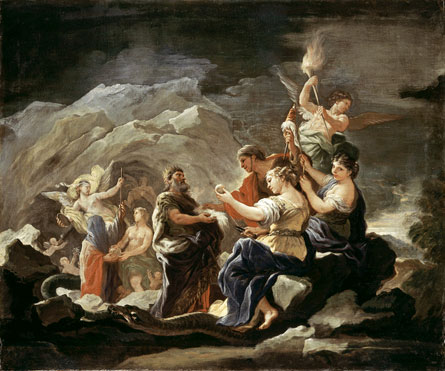
Luca Giordano Cave of Eternity 1680s

The one rule that seems to hold for everything in our Universe is that all that exists, after a time, must pass away, which for life forms means they will die. From there, however, the bets are off and the definition of the word “time” in the phrase “after a time” comes into play. The Universe itself may exist for as long as 100s of trillions of years to at last disappear into the formless quantum field from whence it came. Galaxies, or more specifically, clusters of galaxies and super-galaxies, may survive for perhaps trillions of years to eventually be pulled in and destroyed by the black holes at their centers.

Stars last for a few billion years and our own sun some 5 or so billion years in the future will die after having expanded and then consumed the last of its nuclear fuel. The earth having lasted around 10 billion years by that point will be consumed in this  expansion of the Sun. Life on earth seems unlikely to make it all the way to the Sun’s envelopment of it and will likely be destroyed billions of years before the end of the Sun- as solar expansion boils away the atmosphere and oceans of our precious earth.

The lifespan of even the oldest lived individual among us is nothing compared to this kind of deep time. In contrast to deep time we are, all of us, little more than mayflies who live out their entire adult lives in little but a day. Yet, like the mayflies themselves who are one of the earth’s oldest existent species: by the very fact that we are the product of a long chain of life stretching backward we have contact with deep time.

Life on earth itself if not quite immortal does at least come within the range of the “lifespan” of other systems in our Universe, such as stars. If life that emerged from earth manages to survive and proves capable of moving beyond the life-cycle of its parent star, perhaps the chain in which we exist can continue in an unbroken line to reach the age of galaxies or even the Universe itself. Here then might lie something like immortality.

The most likely route by which this might happen is through our own species,  Homo Sapiens or our descendents. Species do not exist forever, and our is likely to share this fate of demise either through actual extinction or evolution into something else. In terms of the latter, one might ask if our survival is assumed, how far into the future we would need to go where our descendents are no longer recognizably, human? As long as something doesn’t kill us, or we don’t kill ourselves off first, I think that choice, for at least the foreseeable future will be up to us.

It is often assumed that species have to evolve or they will die. A common refrain I’ve heard among some transhumanists  is “evolve or die!”. In one sense, yes, we need to adapt to changing circumstances, in another, no, this is not really what evolution teaches us, or is not the only thing it teaches us. When one looks at the earth’s longest extant species what one often sees is that once natural selection comes us with a formula that works that model will be preserved essentially unchanged over very long stretches of time, even for what can be considered deep time. Cyanobacteria are nearly as old as life on earth itself, and the more complex Horseshoe Crab, is essentially the same as its relatives that walked the earth before the dinosaurs. The exact same type of small creatures that our children torture on beach vacations might have been snacks for a baby T-Rex!

That was the question of the longevity of species but what about the longevity of individuals? Anyone interested the should check out the amazing photo study of the subject by the artist Rachel Sussman. You can see Sussman’s work here at TED, and over at Long Now.  The specimen Sussman brings to light have individuals over 2,000 years old.  Almost all are bacteria or plants and clonal- that is they exist as a single organism composed of genetically identical individuals linked together by common root and other systems. Plants and especially trees are perhaps the most interesting because they are so familiar to us and though no plant can compete with the longevity of bacteria, a clonal colony of Quaking Aspen in Utah is an amazing 80,000 years old!

The only animals Sussman deals with are corals, an artistic decision that reflects the fact that animals do not survive for all that long- although one species of animal she does not cover might give the long-lifers in the other kingdoms a run for their money. The “immortal jellyfish” the turritopsis nutricula are thought to be effectively biologically immortal (though none are likely to have survived in the wild for anything even approaching the longevity of the longest lived plants). The way they achieve this feat is a wonder of biological evolution.The turritopsis nutricula, after mating upon sexual maturity, essentially reverses it own development process and reverts back to prior clonal state.

Perhaps we could say that the turritopsis nutricula survives indefinitely by moving between more and less complex types of structures all the while preserving the underlying genes of an individual specimen intact. Some hold out the hope that the turritopsis nutricula holds the keys to biological immortality for individuals, and let’s hope they’re right, but I, for one, think its lessons likely lie elsewhere.

A jellyfish is a jellyfish, after all, among more complex animals with well developed nervous systems longevity moves much closer to a humanly comprehensible lifespan with the oldest living animal a giant tortoise by the too cute name of “Jonathan” thought to be around 178 years old.  This is still a very long time frame in human terms, and perhaps puts the briefness of our own recent history in perspective: it would be another 26 years after Jonathan hatched from his egg till the first shots of the American Civil War were fired. A lot can happen over the life of a “turtle”.

Individual plants, however, put all individual animals to shame. The oldest non-clonal plant, The Great Basin Bristlecone Pine, has a specimen believed to be 5,062 years old. In some ways this oldest living non-clonal individual is perfectly illustrative of the (relatively) new way human beings have reoriented themselves to time, and even deep time.When this specimen of pine first emerged from a cone human beings had only just invented a whole set of tools that would make the transmission of cultural rather than genetic information across vast stretches of time possible. During the 31st century B.C.E. we invented monumental architecture such as Stonehenge and the pyramids of Egypt whose builders still “speak” to us, pose questions to us, from millennia ago. Above all, we invented writing which allowed someone with little more than a clay tablet and a carving utensil to say something to me living 5,000 years in his future.

Humans being the social animals that they are we might ask ourselves about the mortality or potential immortality of groups that survive across many generations, and even for thousands of years. Group that survive for such a long period of time seem to emerge most fully out of the technology of writing which allows both the ability to preserve historical memory and permits a common identity around a core set of ideas. The two major types of human groups based on writing are institutions, and societies which includes not just the state but also the economic, cultural, and intellectual features of a particular group.


Among the biggest mistakes I think those charged with responsibility for an institution or a society can make is to assume that it is naturally immortal, and that such a condition is independent of whatever decisions and actions those in charge of it take. This was part of the charge Augustine laid against the seemingly eternal Roman Empire in his The City of God. The Empire, Augustine pointed out, was a human institution that had grown and thrived from its virtues in the past just as surely as it was in his day dying from its vices. Augustine, however, saw the Church and its message as truly eternal. Empires would come and go but the people of God and their “city” would remain.

It is somewhat ironic, therefore, that the Catholic Church, which chooses a Pope this week, has been so beset by scandal that its very long-term survivability might be thought at stake. Even seemingly eternal institutions, such as the 2,000 year old Church, require from human beings an orientation that might be compared to the way theologians once viewed the relationship of God and nature. Once it was held that constant effort by God was required to keep the Universe from slipping back into the chaos from whence it came. That the action of God was necessary to open every flower. While this idea holds very little for us in terms of our understanding of nature, it is perhaps a good analog for human institutions, states and our own personal relationships which require our constant tending or they give way to mortality.

It is perhaps difficult for us to realize that our own societies are as mortal as the empires of old, and someday my own United States will be no more. America is a very odd country in respect to its’ views of time and history. A society seemingly obsessed with the new and the modern, contemporary debates almost always seek reference and legitimacy on the basis of men who lived and thought over 200 years ago. The Founding Fathers were obsessed with the mortality of states and deliberately crafted a form of government that they hoped might make the United States almost immortal.

Much of the structure of American constitutionalism where government is divided into “branches” which would “check and balance” one another was based on a particular reading of long-lived ancient systems of government which had something like this tripart structure, most notably Sparta and Rome. What “killed” a society, in the view of the Founders, was when one element- the democratic, oligarchic-aristocratic, or kingly rose to dominate all others. Constitutionally divided government was meant to keep this from happening and therefore would support the survival of the United States indefinitely.

Again, it is somewhat bitter irony that the very divided nature of American government that was supposed to help the United States survive into the far future seems to be making it impossible for the political class in the US to craft solutions to the country’s quite serious long-term problems and therefore might someday threaten the very survival of the country divided government was meant to secure.

Anyone interested in the question of the extended survival of their society, indeed of civilization itself, needs to take into account the work of Joseph A. Tainter and his The Collapse of Complex Societies (1988). Here, the archaeologist Tainter not only provides us with a “science” that explains the mortality of societies, his viewpoint, I think, provides us for ways to think about and gives us insight into seeming intractable social and economic and technological bottlenecks that now confront all developed economies: Japan, the EU/UK and the United States.

Tainter, in his Collapse wanted to move us away from vitalist ideas of the end of civilization seen in thinkers such as Oswald Spengler and Arnold Toynbee. We needed, in his view, to put our finger on the material reality of a society to figure out what conditions most often lead them to dissipate i.e. to move from a more complex and integrated form, such as the Roman Empire, to a more simple and less integrated form, such as the isolated medieval fiefdoms that followed.

Grossly oversimplified, Tainter’s answer was a dry two word concept borrowed from economics- marginal utility. The idea is simple if you think about it for a moment. Any society is likely to take advantage of “low-hanging fruit” first. The best land will be the first to be cultivated, the easiest resources to gain access to exploited.

The “fruit”,  however, quickly becomes harder to pick- problems become harder for a society to solve which leads to a growth in complexity. Romans first tapped tillable land around the city, but by the end of the Empire the city needed a complex international network of trade and political control to pump grain from the distant Nile Valley into the city of Rome.

Yet, as a society deploys more and more complex solutions to problems it becomes institutionally “heavy” (the legacy of all the problems it has solved in the past) just as problems become more and more difficult to solve. The result is, at some point, the shear amount of resources that need to be thrown at a problem to solve it are no longer possible and the only lasting solution becomes to move down the chain of complexity to a simpler form. Roman prosperity and civilization drew in the migration of “barbarian” populations in the north whose pressures would lead to the splitting of the Empire in two and the eventual collapse of its Western half.            

It would seem that we have broken through Tainter’s problem of marginal utility with the industrial revolution, but we should perhaps not judge so fast. The industrial revolution and all of its derivatives up to our current digital and biological revolutions, replaced a system in which goods were largely produced at a local level and communities were largely self-sufficient, with a sprawling global network of interconnections and coordinated activities requiring vast amounts of specialized knowledge on the part of human beings who, by necessity, must participate in this system to provide for their most basic needs.

Clothes that were once produced in the home of the individual who would wear them, are now produced thousands of miles away by workers connected to a production and transportation system that requires the coordination of millions of persons many of whom are exercising specialized knowledge. Food that was once grown or raised by the family that consumed it now requires vast systems of transportation, processing, the production of fertilizers from fossil fuels and the work of genetic engineers to design both crops and domesticated animals.

This gives us an indication of just how far up the chain of complexity we have moved, and I think leads inevitably to the questions of whether such increasing complexity might at some point stall for us, or even be thrown into reverse?

The idea that, despite all the whiz-bang! of modern digital technology, we have somehow stalled out in terms of innovation is an idea that has recently gained traction. There was the argument made by the technologist and entrepreneur, Peter Thiel, at the 2009 Singularity Summit, that the developed world faced real dangers of the Singularity not happening quickly enough. Thiel’s point was that our entire society was built around the expectations of exponential technological growth that showed ominous signs of not happening. I only need to think back to my Social Studies textbooks in the 1980s and their projections of the early 2000s with their glittering orbital and underwater cities, both of which I dreamed of someday living in, to realize our futuristic expectations are far from having been met. More depressingly, Thiel points out how all of our technological wonders have not translated into huge gains in economic growth and especially have not resulted in any increase in median income which has been stagnant since the 1970s.

In addition to Theil, you had the economist, Tyler Cowen, who in his The Great Stagnation (2011)  argued compellingly that the real root of America’s economic malaise was that the kinds of huge qualitative innovations that were seen in the 19th and early 20th centuries- from indoor toilets, to refrigerators, to the automobile, had largely petered out after the low hanging fruit- the technologies easiest to reach using the new industrial methods- were picked. I may love my iPhone (if I had one), but it sure doesn’t beat being able to sanitarily go to the bathroom indoors, or keep my food from rotting, or travel many miles overland on a daily basis in mere minutes or hours rather than days.

One reason why technological change is perhaps not happening as fast as boosters such as singularitarians hope, or our society perhaps needs to be able to continue to function in the way we have organized it, can be seen in the comments of the technologists, social critic and novelist, Ramez Naam. In a recent interview for  The Singularity Weblog, Naam points out that one of the things believers in the Singularity or others who hold to ideas regarding the exponential pace of technological growth miss is that the complexity of the problems technology is trying to solve are also growing exponentially, that is problems are becoming exponentially harder to solve. It’s for this reason that Naam finds the singularitarians’ timeline widely optimistic. We are a long long way from understanding the human brain in such a way that it can be replicated in an AI.

The recent proposal of the Obama Administration to launch an Apollo type project to understand the human brain along with the more circumspect, EU funded, Human Brain Project /Blue Brain Project might be seen as attempts to solve the epistemological problems posed by increasing complexity, and are meant to be responses to two seemingly unrelated technological bottlenecks stemming from complexity and the problem of increasing marginal returns.

On the epistemological front the problem seems to be that we are quite literally drowning in data, but are sorely lacking in models by which we can put the information we are gathering together into working theories that anyone actually understands. As Henry Markham the founder of the Blue Brain Project stated:

So yes, there is no doubt that we are generating a massive amount of data and knowledge about the brain, but this raises a dilemma of what the individual understands. No neuroscientists can even read more than about 200 articles per year and no neuroscientists is even remotely capable of comprehending the current pool of data and knowledge. Neuroscientists will almost certainly drown in data the 21st century. So, actually, the fraction of the known knowledge about the brain that each person has is actually decreasing(!) and will decrease even further until neuroscientists are forced to become informaticians or robot operators.

This epistemological problem, which was brilliantly discussed by Noam Chomsky in an interview late last year is related to the very real bottleneck in Artificial Intelligence- the very technology Peter Thiel thinks is essentially if we are to achieve the rates of economic growth upon which our assumptions of technological and economic progress depend.

We have developed machines with incredible processing power, and the digital revolution is real, with amazing technologies just over the horizon. Still, these machines are nowhere near doing what we would call “thinking”. Or, to paraphrase the neuroscientist and novelist David Eagleman- the AI WATSON might have been able to beat the very best human being in the game Jeopardy! What it could not do was answer a question obvious to any two year old like “When Barack Obama enters a room, does his nose go with him?”

Understanding how human beings think, it is hoped, might allow us to overcome this AI bottleneck and produce machines that possess qualities such as our own or better- an obvious tool for solving society’s complex problems.

The other bottleneck a large scale research project on the brain is meant to solve is the halted development of psychotropic drugs– a product of the enormous and ever increasing costs for the creation of such products. Itself a product of the complexity of the problem pharmaceutical companies are trying to tackle, namely; how does the human brain work and how can we control its functions and manage its development?  This is especially troubling given the predictable rise in neurological diseases such as Alzheimer’s.   It is my hope that these large scale projects will help to crack the problem of the human brain, and especially as it pertains to devastating neurological disorders, let us pray they succeed.

On the broader front, Tainter has a number of solutions that societies have come up with to the problem of marginal utility two of which are merely temporary and the other long-term. The first is for society to become more complex, integrated, bigger. The old school way to do this was through conquest, but in an age of nuclear weapons and sophisticated insurgencies the big powers seem unlikely to follow that route. Instead what we are seeing is proposals such as the EU-US free trade area and the Trans-Pacific partnership both of which appear to assume that the solution to the problems of globalization is more globalization. The second solution is for a society to find a new source of energy. Many might have hoped this would have come in the form of green-energy rather than in the form it appears to have taken- shale gas, and oil from the tar sands of Canada. In any case, Tainter sees both of these solutions as but temporary respites for the problem of marginal utility.

The only long lasting solution Tainter sees for  increasing marginal utility is for a society to become less complex that is less integrated more based on what can be provided locally than on sprawling networks and specialization. Tainter wanted to move us away from seeing the evolution of the Roman Empire into the feudal system as the “death” of a civilization. Rather, he sees the societies human beings have built to be extremely adaptable and resilient. When the problem of increasing complexity becomes impossible to solve societies move towards less complexity. It is a solution that strangely echoes that of the “immortal jellyfish” the turritopsis nutricula, the only path complex entities have discovered that allows them to survive into something that whispers eternity.
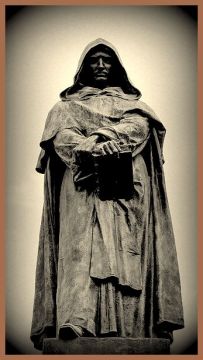
Image description: From the National Gallery in London. “The Cave Of Eternity” (1680s) by Luca Giordan.“The serpent biting its tail symbolises Eternity. The crowned figure of Janus holds the fleece from which the Three Fates draw out the thread of life. The hooded figure is Demagorgon who receives gifts from Nature, from whose breasts pours forth milk. Seated at the entrance to the cave is the winged figure of Chronos, who represents Time.”

Finding Our Way in the Great God Debate, part 2

Last time, I tried to tackle the raging debate between religious persons and a group of thinkers that at least aspire to speak for science who go under the name of the New Atheists. I tried to show how much of the New Atheist’s critique of religion was based on a narrow definition of what “God” is, that is, a kind of uber-engineer who designed the cosmos we inhabit and set up its laws. Despite my many critiques of the New Atheists, much of which has to do with both their often inflammatory language, and just as often their dismissal and corresponding illiteracy regarding religion, I do think they highlight a very real philosophical and religious problem (at least in the West), namely, that the widely held religious concept of the world has almost completely severed any relationship with science, which offers the truest picture of what the world actually is that we have yet to discover.

In what follows I want to take a look at the opportunities for new kinds of religious thinking this gap between religion and science offers, but most especially for new avenues of secular thought that might manage, unlike the current crop of New Atheists to hold fast to science while not discarding the important types of thinking and approaches to the human condition that have been hard won by religious traditions since the earliest days of humanity.

The understanding of God as a celestial engineer, the conception of God held by figures of the early scientific revolution such as Newton, was, in some ways, doomed from the start predicated not only on a version of God that was so distant from the lives of your average person that it would likely become irrelevant, but predicated as well on the failure of science to explain the natural world from its own methods alone. If science is successful at explaining the world then a “God of the gaps” faces the likely fate that science at some point eventually explains away any conceivable gap in which the need for such a God might be called for.  It is precisely the claim that physics has or is on the verge of closing the gap in scientific knowledge of what Pope Pius XII thought was God’s domain- the Universe before the Big Bang- that is the argument of another atheist who has entered the “God debate”, Lawrence Krauss with his A Universe From Nothing.

In his book Krauss offers a compelling picture of the state of current cosmology, one which I find fascinating and even wonderous. Krauss shows how the Universe may have appeared from quantum fluctuations out of what was quite literally nothing. He reveals how physicists are moving away from the idea of one Universe whose laws seem ideally tuned to give rise to life to a version of a multiverse. A vision in which an untold number of universes other than our own exist in an extended plane or right next to one another on a so call “brane” which will forever remain beyond our reach, and that might all have a unique physical laws and even mathematics.

Krauss shows us not only the past but the even deeper time of the future where our own particular Universe is flat and expanding so rapidly that it will, on the order of a few hundred billion years, be re-organized into islands of galaxies surrounded by the blackness of empty space, and how in the long-long frame of time, trillions of years,  our Universe will become a dead place inhospitable for life- a sea of the same nothing from whence it came.

A Universe from Nothing is a great primer on the current state of physics, but it also has a secondary purpose as an atheist track- with the afterword written by none other than Dawkins himself. Dawkins, I think quite presumptuously, thinks Krauss will have an effect akin to Darwin banishing God from the questions regarding the beginning of the Universe and its order in the same way Darwin had managed to banish God from questions regarding the origin of life and its complexity.

Many people, myself included, have often found the case made by the New Atheists in many ways to be as counter-productive for the future of science as the kind of theologization and politicization of science found in those trying to have Intelligent Design (ID) taught in schools, or deny the weight of scientific evidence in regards to a public issue with a clear consensus of researchers for what amounts to a political position e.g. climate change. This is because their rhetoric forces people to choose between religion and science, a choice that in such a deeply religious country such as the United States would likely be to the detriment of science.  And yet, perhaps in the long-run the New Atheists will have had a positive effect not merely on public discourse, but ironically on religion itself.

New Atheists have encouraged a great “coming out” of both fellow atheists and agnostics in a way that has enabled people in a religious society like the United States to openly express their lack of belief and skepticism in a way that was perhaps never possible before. They have brought into sharp relief the incongruity of scientific truth and religious belief as it is currently held and thus pushed scholars such as Karen Armstrong to look for a conception of God that isn’t, like the modern conception, treated as an increasingly irrelevant hypothesis of held over from a pre-Darwinian view of the world.


Three of the most interesting voices to have emerged from the God Debate each follow seemingly very different tracks that when added together might point the way to the other side. The first is the religious scholar Stephen Prothero. Armstrong’s Case for God helped inspire Prothero, to write his God is Not One (2010.) He was not so much responding to the religious/atheist debate as he was cautioning us against the perennialism at the root of much contemporary thought regarding religion. If the New Atheists went overboard with their claim that religion was either all superstitious nonsense ,or evil, and most likely both, the perennialists, with whom he lumps Armstrong, went far too much to the other side arguing in their need to press for diversity and respect the equally false notion that all religions preached in essence the same thing.


Prothero comes up with a neat formula for what a religion is. “Each religion articulates”:


  • a problem;
  • a solution to this  problem, which also serves as the religious goal;
  • a technique (or techniques) for moving from this problem to this solution; and
  • an exemplar (or exemplars) who chart this path from problem to solution. (p. 14)

For Prothero, what religions share is, as the perennialists claim, the fundamentals of human ethics, but also a view that the human condition is problematic. But the devil, so to speak, is in the details, for the world’s great religions have come up with very different identifications of what exactly this problematic feature is ,and hence very different, and in more ways than we might be willing to admit, incompatible solutions   to the problems they identify.

God is Not One is a great introduction to the world’s major religions, a knowledge I think is sorely lacking especially among those who seem to have the most knee-jerk reactions to any mention of religious ideas. For me, one of the most frustrating things about the New Atheists, especially, is their stunning degree of religious illiteracy. Not only do they paint all of Judaism, Christianity, and Islam with the same broad brush of religious literalism and fundamentalism, and have no grasp of religious history within the West, they also appear completely disinterested in trying to understand non-Western religious traditions an understanding that might give them better insight into the actual nature of the human religious instinct which is less about pre-scientific explanations for natural events than it is about an ethical orientation towards the world. Perhaps no religion as much as Confucianism can teach us something in this regard.  In the words of Prothero:

Unlike Christianity which drives a wedge between the sacred and the secular- the eternal “City of God” and the temporal “City of Man”- Confucianism glories in creatively confusing the two. There is a transcendent dimension in Confucianism. Confucians just locate it in the world rather than above or beyond it.

For all these reasons, Confucianism can be considered as religious humanism. Confucians share with secular humanists a single minded focus on this world of rag and bone.  They, too, are far more interested in how to live than in plumbing the depths of Ultimate Reality. But whereas secular humanists insist on emptying the rest of the world of the sacred, Confucians insists on infusing the world with sacred import- of seeing Heaven in humanity, on investing human beings with incalculable value, on hallowing the everyday. In Confucianism, the secular is sacred. (GN1 108)

Religions, then, are in large part philosophical orientations towards the world. They define the world, or better the inadequacies of the world, in a certain way and prescribe a set of actions in light of those inadequacies. In this way they might be thought of as embodied moral philosophies, and it is my second thinker, the philosopher Alain de Botton who in his Religion for Atheists: A Non-believer’s Guide to the Uses of Religion tries to show just how much even the most secular among us can learn from religion.

What the secular, according to Botton, can learn from religions has little to do with matters of belief which in the light of modern science he too finds untenable. Yet, the secular can learn quite a lot from religion in terms institutions and practices. Religion often fosters a deep sense of community founded around a common view of the world. The religious often see education as less about the imparting of knowledge but the formation of character. Because religion in part arose in response to the human need to live peacefully together in society it tends to track people away from violence and retribution and toward kindness and reconciliation. Much of religion offers us tenderness in times of tragedy, and holds out the promise of moral improvement. It provides the basis for some of our longest lived institutions, embeds art and architecture in a philosophy of life.


Often a religion grants its followers a sense of cosmic perspective that might otherwise be missing from human life, and reminds us of our own smallness in light of all that is, encourages an attitude of humility in the face of the depths of all we do not yet and perhaps never will know. It provides human beings with a sense of the transcendent something emotionally and intellectually beyond our reach which stretches the human heart and mind to the very edge of what it can be and understand.

So if religion, then, is at root a way for people to ethically orient themselves to others and the world even the most avowed atheist who otherwise believes that life can have meaning can learn something from it.  Though one must hope that monstrous absurdities such as the French Revolution’s Cult of the Supreme Being, or the “miraculously” never decomposing body of V.I. Lenin are never repeated.

One problem however remains before we all rush out to the local Church, Temple, or Mosque, or start our own version of the Church of Scientology. It is that religion is untrue, or better, while much of the natural ethics found at the bottom of most religions is something to which we secularists can assent because it was forged for the problems of human living together, and we still live in together in societies, the idea of the natural world and the divinities that supposedly inhabit and guide it are patently false from a scientific point of view. There are two possible solutions I can imagine to this dilemma, both of which play off of the ideas of my third figure, the neuroscientist
and fiction author, David Eagleman.

Like others, what frustrates Eagleman about the current God debate is the absurd position of certainty and narrowness of perspective taken by both the religious and the anti-religious. Fundamentalist Christians insist that a book written before we knew what the Universe was or how life develops or what the brain does somehow tells us all we really need to know, indeed thinks they possess all the questions we should ask. The New Atheists are no better when it comes to such a stance of false certainty and seem to base many of their argument on the belief that we are on the verge of knowing all we can know, and that the Universe(s) is already figured out except for a few loose ends.

In my own example, I think you can see this in Krauss who not only thinks we have now almost fully figured out the origins of the Universe and its fate. He also thinks he has in his hand its meaning, which is that it doesn’t have one, and to drive this home avoids looking at the hundreds of billions of years between now and the Universe’s predicted end.

Take this almost adolescent quote from Dawkins’ afterword to A Universe From Nothing:

Finally, and inevitably, the universe will further flatten into a nothing that mirrors its beginning” what will be left of our current Universe will be “Nothing at all. Not even atoms. Nothing. “ Dawkins then adds with his characteristic flourish“If you think that’s bleak and cheerless, too bad. Reality doesn’t owe us comfort.  (UFN 188).

And here’s Krauss himself:

The structures we can see, like stars and galaxies, were all created in quantum fluctuations from nothing. And the average total Newtonian gravitational energy of each object in our universe is equal to nothing. Enjoy the thought while you can, if this is true, we live in the worst of all possible universes one can live in, at least as far as the future of life is concerned. (UFN 105)


Or perhaps more prosaically the late Hitchens:


For those of us who find it remarkable that we live in a universe of Something, just wait. Nothingness is headed on a collision course right towards us! (UFN 119)


Really? Even if the view of the fate of the Universe is exactly like Krauss thinks it will be, and that’s a Big- Big-  If, what needs to be emphasized here, a point that neither Krauss or Dawkins seem prone to highlight is that this death of the Universe is trillions of years in the future and that there will be plenty of time for living, according to Dimitar Sasselov, hundreds of billions of years, for life to evolve throughout the Universe, and thus for an unimaginable diversity of experiences to be had. Our Universe, at least at the stage we have entered and for many billions of years longer than life on earth has existed, is actually a wonderful place for creatures such as ourselves.  If one adds to that the idea that there may not just be one Universe, but many many universes, with at least some perhaps having the right conditions for life developing and lasting for hundreds of billions of years as well, you get a picture of diversity and profusion that puts even the Hindu Upanishads to shame. That’s not a bleak picture. It one of the most exhilarating pictures I can think of, and perhaps in some sense even a religious one.


And the fact of the matter is we have no idea. We have no idea if the theory put forward by Krauss regarding the future of the Universe is ultimately the right one, we have no idea if life plays a large, small, or no role in the ultimate fate of the Universe, we have no idea if there is any other life in the Universe that resembles ourselves in terms of intelligence, or what scale- planet, galaxy, even larger- a civilization such as our own can achieve if it survives for a sufficiently long time, or how common such civilizations might become in the Universe as the time frame in which the conditions for life to appear and civilizations to appear and develop grows over the next hundred billion years or so. See the glass empty, half empty, or potentially overflowing it’s all just guesswork, even if Krauss’ physics make it an extremely sophisticated and interesting guesswork. To think otherwise is to assume the kind of block-headed certainty Krauss reserves for religious fanatics.  

David Eagleman wants to avoid the false certainty found in many of the religious and the New Atheists by adopting what he calls Possibilism. The major idea behind Possibilism is the same one, although Eagleman himself doesn’t make this connection, that is found in Armstrong’s pre-modern religious thinkers, especially among the so-called mystics, that is the conviction that we are in a position of profound ignorance.

Science has taken us very very far in terms of our knowledge of the world and will no doubt take us much much farther, but we are still probably at a point where we know an unbelievable amount less than will eventually become known, and perhaps there are limits to our ability to know in front of us beyond which will never be able to pass. We just don’t know. In a similar way to how the mystics tried to lead a path to the very limits of human thought beyond which we can not pass, Possibilism encourages us to step to the very edge of our scientific knowledge and imagine what lies beyond our grasp.

I can imagine at least two potential futures for Possibilism either one of which I find very encouraging.  If traditional religion is to regain its attraction for the educated it will probably have to develop and adopt a speculative theology that looks a lot like Eagleman’s Possibilism.  

A speculative theology would no longer seek to find support for its religious convictions in selective discoveries of science, but would  place its core ideas in dialogue with whatever version of the world science comes up with. This need not mean that any religion need abandon its core ethical beliefs or practices both of which were created for human beings at moral scale that reflects the level at which an individual life is lived. The Golden Rule needs no reference to the Universe as a whole nor do the rituals surrounding the life cycle of the individual- birth, marriage, and death at which religion so excels.


What a speculative theology would entail is that religious thinkers would be free to attempt to understand their own tradition in light of modern science and historical studies without any attempt to use either science or history to buttress its own convictions.

Speculative theology would ask how its concepts can continue to be understood in light of the world presented by modern science and would aim at being a dynamic, creative, and continuously changing theology which would better reflect the dynamic nature of modern knowledge, just as theology in the past was tied to a view of knowledge that was static and seemingly eternal. It might more easily be able to tackle contemporary social concerns such as global warming, inequality and technological change by holding the exact same assumptions as to the nature of the physical world as science while being committed to interpreting the findings in light of their own ethical traditions and perspectives.

Something like this speculative philosophy already existed during the Islamic Golden Age a period lasting from the 700s through the 1200s in which Islamic scientists such as Ibn Sina (Avicenna) managed to combine the insights of ancient Greek, Indian, and even Chinese thinking to create whole new field of inquiry and ways of knowing. Tools from algebra to trigonometry to empiricism that would later be built upon by Europeans to launch the scientific revolution. The very existence of this golden age of learning in the Muslim world exposes Sam Harris’ anti-Islamic comment for what it is- ignorant bigotry.

Still, a contemporary speculative theology would have more expansive and self-aware than anything found among religious thinkers before.  It would need to be an open system of knowledge cognizant of its own limitations and would examine and take into itself ideas from other religious traditions, even dead ones such as paganism, that added depth and dimensions to its core ethical stance. It would be a vehicle through which religious persons could enter into dialogue and debate with persons from other perspectives both religious and non-religious who are equally concerned with the human future, humanists and transhumanists, singularitarians, and progressives along with those who with some justification have deep anxieties regarding the future, traditional conservatives, bio-conservatives,  neo-luddites, and persons from every other spiritual tradition in the world.  It would mean an end to that dangerous anxiety held by a great number of the world’s religions that it alone needs to be the only truth in order to thrive.   

Yet, however beneficial such a speculative theology would be I find its development out of any current religion highly unlikely.  If traditional religions do not adopt something like this stance towards knowledge I find it increasingly likely that persons alienated from them as a consequence of the way their beliefs are contradicted by science will invent something similar for themselves. This is because despite the fact that the Universe in the way it is presented by the New Atheists is devoid of meaning this human need for meaning, to discuss it, and argue it, and try to live it, is unlikely to ever stop among human beings. The very quest seems written into our very core. Hopefully, such dialogues will avoid dogma and be self-critical and self-conscious in a way religion or secular ideologies never were before. I see such discussions more akin to works of art than religious-treatises, though I hope they provide the bases for community and ethics in the same way religion has in the past as well.

And we already have nascent forms of such communities- the environmentalist cause is one such community as is the transhumanist movement. So, is something like The Long Now Foundation which seeks to bring attention to the issues of the long term human future and has even adopted the religious practice of pilgrimage to its 10,000 year clock– a journey that is meant to inspire deeper time horizons for our present obsessed culture.

Even should such communities and movements become the primary way a certain cohort of scientifically inclined persons seek to express the human need for meaning, there is every reason for those so inclined to seek out and foster relationships with the more traditionally religious ,who are, and will likely always, comprise the vast majority human beings. Contrary to the predictions of New Atheists such as Daniel Dennett the world is becoming more not less religious, and Christianity is not a dying faith but changing location moving from its locus in Europe and North America to Latin America, Africa, and even Asia. Islam even more so than Christianity is likely to be a potent force in world affairs for some time to come, not to mention Hinduism with India destined to become the world’s most populous country by mid-century. We will need all of their cooperation to address pressing global problems from climate change, to biodiversity, to global pandemics, and inequality. And we should not think them persons who profess such faiths ignorant for holding fast to beliefs that largely bypass the world brought to us by science. Next to science religion is among the most amazing things to emerge from humanity and those who seek meaning from it are entitled to our respect as fellow human beings struggling to figure out not the what? but the why? of human life.

Whether inside or outside of traditional religion the development of scientifically grounded meaning discourses and communities, and the projects that would hopefully grow from them, would signal that wrestling with the “big questions” again offered a path to human transcendence. A path that was at long last no longer in conflict with the amazing Universe that has been shown to us by modern science. Finding such ways of living would mean that we truly have found our way through the great God debate.

Finding Our Way Through The Great God Debate

“The way that can be spoken of. Is not the constant way; The name that can be named. Is not the constant name.”

Lao Tzu: Tao Te Ching

Over the last decade a heated debate broke onto the American scene. The intellectual conflict between the religious and those who came to be called “the New Atheists” did indeed, I think, bring something new into American society that had not existed before- the open conflict between what, at least at the top tier of researchers, is a largely secular scientific establishment, or better those who presumed to speak for them, and the traditionally religious. What emerged on the publishing scene and bestseller lists were not the kinds of “soft-core” atheism espoused by previous science popularizers such as the late and much beloved Carl Sagan, but harsh, in your face atheist suchs as the Sam Harris, Richard Dawkins and another late figure, Christopher Hitchens.

On the one hand there was nothing “new” about the New Atheists. Science in the popular imagination had for sometime been used as a bridge away from religion. I need only look at myself. What really undermined my belief in the Catholicism in which I was raised were books like Carl Sagan’s Dragons of Eden, and Cosmos, or to a lesser extent Stephen Hawkings A Brief History of Time, even a theologically sounding book like Paul Davies God and the New Physics did nothing to shore up my belief in a personal God and the philosophically difficult or troubling ideas such as “virgin birth”, “incarnation”, “transubstantiation” or “papal infallibility” under which I was raised.

What I think makes the New Atheists of the 2000s truly new is that many science popularizers have lost the kind of cool indifference, or even openness to reaching out and explaining science in terms of religious concepts that was found in someone like Carl Sagan. Indeed, their confrontationalist stance is part of their shtick and a sure way to sell books in the same way titles like the Tao of Physics sold like hotcakes in the archaic Age of Disco.

For example, compare the soft, even if New Agey style of Sagan  to the kind of anti-religious screeds given by one of the New Atheist “four horsemen”, Richard Dawkins, in which he asks fellow atheists to “mock” and “ridicule” people’s religious  beliefs. Sagan sees religion as existing along a continuum with science, an attempt to answer life’s great questions. Science may be right, but religion stems from the same deep human instinct to ask questions and understand, whereas Dawkins seems to see only a dangerously pernicious stupidity.

It impossible to tease out who fired the first shot in the new conflict between atheists and the religious, but shots were fired. In 2004, Sam Harris’ The End of Faith hit the bookstores, a book I can still remember paging through at a Barnes N’ Noble when there were such things and thinking how shocking it was in tone. That was followed by Harris’ Letter to a Christian Nation, Richard Dawkins’ The God Delusion along with his documentary about religion with the less than live-and-let-live  title- The Root of All Evil? -followed by Hitchens’ book  God is Not Great, among others.

What had happened between the easy going atheism of the late Carl Sagan and the militant atheism of Harris’ The End of Faith was the tragedy of 9/11 which acted as an accelerant on a trend that had been emerging at the very least since Dawkins’ Virus of the Mind published way back in 1993. People who once made the argument that religion was evil or that signaled out any specific religion as barbaric would have before 9/11 been labeled as intolerant or racists.  Instead, in 2005 they were published in the liberal Huffington Post. Here is Harris:

It is time we admitted that we are not at war with “terrorism”; we are at war with precisely the vision of life that is prescribed to all Muslims in the Koran.

One of the most humanistic figures in recent memory, and whose loss is thus even more to our detriment than the loss of either the poetic Sagan or the gadfly Hitchens tried early on to prevent this conflict from ever breaking out. Stephen Jay Gould as far back as 1997 tried to minimize the friction between science and religion with his idea of Nonoverlapping Magisteria (NOMA). If you read one link I have ever posted please read this humane and conciliatory essay.  The argument Gold makes in his essay is that there is no natural conflict between science and religion. Both religion and science possess their own separate domains: science deals with what is- the nature of the natural world, whereas religion deals with the question of meaning.

Science does not deal with moral questions because the study of nature is unable to yield meaning or morality on a human scale:

As a moral position (and therefore not as a deduction from my knowledge of nature’s factuality), I prefer the “cold bath” theory that nature can be truly “cruel” and “indifferent”—in the utterly inappropriate terms of our ethical discourse—because nature was not constructed as our eventual abode, didn’t know we were coming (we are, after all, interlopers of the latest geological microsecond), and doesn’t give a damn about us (speaking metaphorically). I regard such a position as liberating, not depressing, because we then become free to conduct moral discourse—and nothing could be more important—in our own terms, spared from the delusion that we might read moral truth passively from nature’s factuality.

Gould later turned his NOMA essay into a book- The Rocks of Ages in which he made an extensive argument that the current debate between science and religion is really a false one that emerges largely from great deal of misunderstanding on both sides.

The real crux of any dispute between science and religion, Gould thinks, are issues of what constitutes the intellectual domain of each endeavor. Science answers questions regarding the nature of the world, but should not attempt to provide answers for questions of meaning or ethics. Whereas religion if properly oriented should concern itself with exactly these human level meaning and ethical concerns. The debate between science and religion was not only unnecessary, but the total victory of one domain over the other would, for Gould, result in a diminishment of depth and complexity that emerges as a product of our humanity.

The New Atheists did not heed Gould’s prescient and humanistic advice. Indeed, he was already in conflict with some who would become its most vociferous figures- namely Dawkins and E.O. Wilson- even before the religion vs. science debate broke fully onto the scene. This was a consequence of Gould pushing back against what he saw as a dangerous trend towards reductionism of those applying genetics and evolutionary principles to human nature. The debate between Gould and Dawkins even itself inspired a book, the 2001, Dawkins vs. Gould published a year before Gould’s death from cancer.

Yet, for how much I respect Gould, and am attracted to his idea of NOMA, I do not find his argument to be without deep flaws. One of inadequacies of Gould’s Rocks of Ages is that it makes the case the that the conflict between science and religion is merely a matter of dispute the majority of us, the scientifically inclined along with the traditionally religious, against marginal groups such as creationists, and their equally fanatical atheists antagonists. The problem, however, may be deeper than Gould lets on.

Rocks of Ages begins with the story of the Catholic Church’s teaching on evolution as an example of NOMA in action.  That story begins with Pius XII’s 1950 encyclical, Humani Generis, which declared that the theory of evolution, if  it was eventually proven definitively true by science, would not be in direct contradiction to Church teaching.  This was followed up (almost 50 years later, at the Church’s usual geriatric speed) by Pope John Paul II’s 1996 declaration that the theory of evolution was now firmly established  as a scientific fact, and that Church theology would have to adjust to this truth. Thus, in Gould’s eyes, the Church had respected NOMA by eventually deferring to science on the question of evolution whatever challenges evolution might pose to traditional Catholic theology.

Yet, the same Pope Pius XII who grudgingly accepted that evolution might be true, one year later used the scientific discovery of the Big Bang to argue, not for a literal interpretation of the book of Genesis which hadn’t been held by the Church since Augustine, but for evidence of the more ephemeral concept of a creator that was the underlying “truth” pointed to in Genesis:

Thus, with that concreteness which is characteristic of physical proofs, it [science] has confirmed the contingency of the universe and also the well-founded deduction as to the epoch when the cosmos came forth from the hands of the Creator.

Hence, creation took place in time.

Therefore, there is a Creator. Therefore, God exists!

Pius XII was certainly violating the spirit if not the letter on NOMA here. Preserving the requisite scientific skepticism in regard to evolution until all the facts were in, largely because it posed challenges to Catholic theology, while jumping almost immediately on a scientific discovery that seemed to lend support for some of the core ideas of the Church- a creator God and creation ex nihilo.

This seeming inclination of the religious to ask for science to keep its hands off when it comes to challenging it claims, while embracing science the minute it seems to offer proof of some religious conviction, is precisely the argument Richard Dawkins makes against NOMA, I think rightly, in his The God Delusion, and for how much I otherwise disagree with Dawkins and detest his abusive and condescending style, I think he is right in his claim that NOMA only comes into play for many of the religious when science is being used to challenge their beliefs, and not when science seems to lend plausibility to its stories and metaphysics. Dawkins and his many of his fellow atheists, however, think this is a cultural problem, namely that the culture is being distorted by the “virus” of religion. I disagree. Instead, what we have is a serious theological problem on our hands, and some good questions to ask might be: what exactly is this problem? Was this always the case? And in light of this where might the solution lie?

In 2009, Karen Armstrong, the ex-nun, popular religious scholar, and what is less know one time vocal atheist, threw her hat into the ring in defense of religion. The Case for God which was Armstrong’s rejoinder to the New Atheists is a remarkable book .
At least one explanation of theological problems we have is that a book like the Bible, when taken literally, is clearly absurd in light of modern science. We know that the earth was not created in 6 days, that there was no primordial pair of first parents, that the world was not destroyed by flood, and we have no proof of miracles understood now as the suspension of the laws of nature through which God acts in the world.  

The critique against religion by the New Atheists assumes a literal understanding either of scripture or the divine figures behind its stories. Armstrong’s The Case for God sets out to show that this literalism is a modern invention. Whatever the case with the laity, among Christian religious scholars before the modern era, the Bible was never read as a statement of scientific or historical fact. This, no doubt, is part of the reason its many contradictions and omissions where one story of an event is directly at odds with a different version of the exact same.

The way in which medieval Christian scholars were taught to read the Bible gives us an indication of what this meant. They were taught to read first for the literal meaning and once they understood move to the next level to discover the moral meaning of a text. Only once they had grasped this moral meaning would they attempt to grapple with the true, spiritual meaning of a text. Exegesis thus resembles the movement of the spirit away from the earth and the body above into the transcendent.

The Christian tradition in its pre-modern form, for Armstrong then, was not attempting to provide a proto-scientific version of the world that our own science has shown to be primitive and false, and the divine order which it pointed to was not one of some big bearded guy in clouds, but understood as the source and background of  a mysterious cosmic order which the human mind was incapable of fully understanding.

The New Atheists often conflate religion with bad and primitive science we should have long outgrown: “Why was that man’s barn destroyed by a lightning bolt?” “ As punishment from God. “How can we save our crops from drought?” “Perform a rain dance for the spirits?” It must therefore be incredibly frustrating to the New Atheists for people to cling to such an outdated science. But, according to Armstrong religion has never primarily been about offering up explanations for the natural world.

Armstrong thinks the best way to understand religion is as akin to art or music or poetry and not as proto-science. Religion is about practice not about belief and its truths are only accessible for those engaged in such practices. One learns what being a Christian by imitating Jesus: forgiving those who hurt you, caring for the poor, the sick, the imprisoned, viewing suffering as redemptive or “carrying your cross”. Similar statements can be made for the world’s other religions as well though the kinds of actions one will pursue will be very different. This is, as Stephen Prothero points out in his God is not One, because the world’s diverse faith have defined the problem of the human condition quite differently and therefore have come up with quite distinct solutions. (More on that in part two.)

How then did we become so confused regarding what religion is really about? Armstrong traces how Biblical literalism arose in tandem with the scientific revolution and when you think about it this makes a lot of sense. Descartes, who helped usher in modern mathematics wrote a “proof” for God. The giant of them all, Newton, was a Biblical literalists and thought his theory of gravity proved the existence of the Christian God. Whereas the older theology had adopted a spirit of humility regarding human knowledge, the new science that emerged in the 16th century was bold in its claims that a new way had been discovered which would lead to a full understanding of the world- including the God who it was assumed had created it. It shouldn’t be surprising that Christians, perhaps especially the new Protestants, who sought to return to the true meaning of the faith through a complete knowledge of scripture, would think that God and the Bible could be proved in the same way the new scientific truths were being proved.


God thus became a “fact” like other facts and Westerners began the road to doubt and religious schizophrenia as the world science revealed showed no trace of the Christian God -or any other God(s) – amid the cold, indifferent and self-organizing natural order science revealed. To paraphrase Richard Dawkins’ The Blind Watchmaker if God was a hypothetical builder of clocks there is no need for the hypothesis now that we know how a clock can build itself.

Armstrong,thus, provides us with a good grasp of why Gould’s NOMA might have trouble gaining traction. Our understanding of God or the divine has become horribly mixed up with the history of science itself, with the idea that God would be “proven”
an assumption that helped launch the scientific revolution. Instead, what science has done in relation to this early modern idea of God as celestial mechanic and architect of the natural world, is push this idea of God into an ever shrinking “gap” of knowledge where science (for the moment) lacked a reasonable natural explanation of events. The gap into which the modern concept of God got itself jammed after Darwin’s theory of natural selection proved sufficient to explain the complexity of life eventually became the time before the Big Bang. A hole Pope Pius XII eagerly jumped into given that it seemed to match up so closely with Church theology. Combining his 1950-51 encyclicals he seemed to be saying “We’ll give you the origin of life, but we’ll gladly take the creation of the Universe”!

This was never a good strategy.

Next time I’ll try to show how this religious crisis actually might provide an opportunity for new ways of approaching age old religious questions and open up new avenues of  pursuing transcendence- a possibility that might prove particularly relevant for the community that goes under the label, transhumanist.

God in the Age of Alien Earths

329px-Giordano_Bruno_Campo_dei_Fiori

Four hundred and thirteen years ago to the day, on February, 17 1600, the mystic philosopher, and some would  argue,scientist, Giordano Bruno, was handed over by the Catholic Church to the civil authorities in Rome and burned to death in the Campo de’ Fiori. Burning at the stake was a punishment that aimed at the annihilation of the person. The scattering of a body’s ashes, like Bruno’s ashes were scattered into the Tiber river, was not as many now look on similar rituals, a way of connecting a person forever into the fabric of a place they find for whatever reason sacred, but a way to cast a person out from the human world from which they came. It was the way “soulless” creatures such as animals were treated in death.

The “crimes” for which Bruno was executed revolved around his holding heretical beliefs, that is ideas which were directly in contradiction to the teachings of the Church.The idea common today that Bruno was not so much a condemned religious heretic as the first martyr in the conflict between science and religion gained traction only in the late 19th century, and is if not false, is doubtless overly simplistic.  Only one of the charges against Bruno dealt with a scientific rather than a religious question, or at the very least what should have been considered a scientific hypothesis alone. Bruno was charged with believing the existence of, in the words of the Inquisition, “the plurality of worlds”.

What was meant by the plurality of worlds? Primarily it meant Bruno had argued for the belief in more earths than our own, that there were many worlds with life and sentient creatures not merely similar but perhaps, given his belief in infinities, identical or only slightly different from the those on our own earth. What we see when we witness Bruno trying to apply the new Copernican astronomy along with his own ideas regarding infinity to Christian theology is a Christian narrative stretched to the breaking point. Bruno wrote:

I can imagine an infinite number of worlds like the earth, with a Garden of Eden on each one. In all these Gardens of Eden, half the Adams and Eves will not eat the fruit of knowledge, but half will. But half of infinity is infinity, so an infinite number of worlds will fall from grace and there will be an infinite number of crucifixions. Therefore, either there is one unique Jesus who goes from one world to another, or there are an infinite number of Jesuses. Since a single Jesus visiting an infinite number of earths one at a time would take an infinite amount of time, there must be an infinite number of Jesuses. Therefore, God must create an infinite number of Christs.  *

What drew Bruno to the attention of Inquisitors was, I think, less the fact that he contradicted scriptures than the fact that he drew theological implications from the new view of the Universe provided by Copernicus and in light of his own ideas regarding infinity. This matter of the drawing of theological implications by someone outside of the Church hierarchy was a matter for which the Church had become particularly defensive and aggressive during Bruno’s time given this was the very power that had slipped from its fingers with Martin Luther and lay at the root of much of its then raging conflict with Protestants.

Yet, this drawing of specifically Christian theological implications was something Bruno had to do give the fact that any discussion regarding the question of cosmological meaning by someone living in a Christian society had to be done within Christian terms.  What I mean by the phrase cosmological meaning is what might be called the “big questions”. They include questions that were answered almost solely by religion until the modern era, but are now the prerogative of science, questions such as “what is the nature of the world?” “what is its origin?” “what is its ultimate fate?” ,but also questions that really can’t be answered by science even today, questions such as “what is the role of humanity in the future of the Universe?”, or “what is our place in the cosmic scheme of things?”. At the time Bruno was writing there existed no real philosophical or other discourse which might address these sorts of questions, questions that had been reopened by the new science that wasn’t tightly woven with Christian theology.

The fact that Bruno was more likely a theological rather than a scientific martyr can be seen in the experience of the thinker who spurred much of his brilliant imagination. No one had really cared when Copernicus, 60 years before Bruno, had shown that a heliocentric model of the solar system was the best way to predict the orbits of the planets. Church authorities did care when Galileo in 1610 with his book The Starry Messenger was not only able to show that the Copernican Theory was no mere piece of mathematical fancy-footwork that had little to do with reality, but was an observable fact, and that, as was Bruno had argued, objects in the heavens in some sense were worlds like earth- the moon had mountains, and Jupiter itself was orbited a series of moons, but this too might have been for different reasons than at first seem.

Yet, Galileo probably got himself in hot water with the Church as much for his pugnaciousness as for his science. He did, after all, name the dim-witted character who argues for a geocentric model in his book, Simplistico, a character with whom it doesn’t take much imagination to see the Pope himself. In the end, Galileo fared far better than Bruno, not being burned, but merely confined to the limits of his home.

That the Church didn’t much care about philosophical arguments for life on other worlds so long as no theological implications were drawn, and that its brutal reaction to Bruno was driven in part by its then raging conflict with “heresies” throughout Europe during Bruno’s time seems to be the conclusion one should draw from the reaction, or better lack of reaction, to Bernard Le Bovier de Fontenelle’s Conversations on the Plurality of Worlds, published in 1686 after the religious wars had died down. The reaction to Fontenelle’s work, to which science-fiction writers ever since owe their lineage, was that no one batted an eye .  No Catholic or Protestant theologian took note of the work. Despite its popularity, no one ever attempted to ban it or burn it as had happened with the works of both Bruno and Galileo not to mention the fact that Fontenelle was never accused of heresy, tortured, put on trial or imprisoned in his home or anywhere else.

Fontenelle’s Conversations on the Plurality of Worlds is a dialogue between a philosopher (presumably Fontenelle himself)  and a marquess, a noblewoman of refinement and leisure as such person existed before the French monarchy went to rot, that takes place while the pair take a series of walks in her garden under the beauty of the night sky.   

The first chapter in Conversations has the philosopher establish, despite all appearances, the reality of the Copernican heliocentric model of the solar system whereas the rest is a superb piece of early science fiction in which the philosopher
discusses what life might be like on earth’s moon and her sister planets.

The resolution of telescopes wasn’t all that great in Fontenelle’s day, though it was a heck of alot better than looking at things through the naked eye. It was thus easy to confuse smooth areas on the moon lacking mountains or craters for large bodies of water, which is why we have things like The Sea of Tranquility, features that were themselves mapped and named by the Jesuit scholars Giovanni Battista Riccioli, and Francesco Maria Grimaldi.

What makes Fontenelle’s Conversations, despite its sometimes jarring Eurocentrism, and the droll background of a caricature of  philosopher engaged in a flirtatious dance with a caricature of a noblewoman, is not that he projects the kind of life found on earth outward, but that he argues that we may be blinded to its possibility beyond earth by sticking too close to our own experience, and should therefore try to reason our way from the type of planet we are talking about to the kinds of life that might be found upon it.

Fontenelle’s philosopher in Conversations states that  “the moon is an earth too and a habitable world” (p. 30). He speculates that our belief that it is lifeless no doubt resembles ancient belief that there could be no life at the antipodes of the earth- its poles. Our position is somewhat akin to that of American Indians that had no idea that whole civilizations existed over the oceans, and that someday we will be able to communicate with beings from the moon, whether initiated by us or them.

The revolution in the way we looked into space thanks the telescope, or the way we looked at the geography of the earth on account of Columbus and those that followed him, weren’t the only revolutions that upended the view of the world of early modern Europe. There was also the new world brought to us by the invention of the microscope, and it is here that Fontenelle thinks we can see a glimpse of just how deep the profusion of living forms in the Universe, especially ones that defy our expectations run:

A mulberry leaf is a little world inhabited by multitudes of these invisible worms which to them is a country of vast extent. What mountains what abysses are there in it? (pp. 71-72)

Fontenelle with two centuries to go before evolution would become known, assumes that life will have to be suited for the environment in which it exists. In leaps we with our knowledge likely find ridiculous, but which are close in spirit to the truth of the matter the philosopher speculates on what life might be like in environments very different from the earth: The arid moon bathed in long stretches of light and darkness, the hothouses of Mercury and Venus the frigid enormity of Jupiter and Saturn. (For whatever reason he has no interest in Mars.)

The philosopher is overawed by the diversity of a Universe filled with life, and acknowledges the stars are suns like our own. Around many of these stars will circle planets, although a diversity of types of solar systems will be found. The marquess recoils from the scale of all this life and its ungraspable diversity. Such a richness makes her own life seem far too small. Yet, the philosopher thinks this should not impact our appreciation for the specialness of what is in front of us, an ability which has been implanted in us by nature.

“They cannot spoil fine eyes or a pretty mouth their value is still the same in spite of all the worlds that can possibly exist.” (p. 105)

As to life in the solar system we, three and some centuries after Fontenelle, of course, know better. Our exploration of the moons and planets that along with us circle our sun might be written as a tragic tale of the failure to find any life in our neighborhood other than our own. Fontenelle’s marquess had anticipated a reason for this- the Goldilocks Zone, the fact that the earth appears to orbit the sun at just the right distance from the sun. Like the famous porridge, neither too hot nor too cold.

I am sure said the Marchioness we have one great convenience in the situation of our world it is not so hot as Mercury and Venus nor so cold as Jupiter or Saturn and our country is so temperately placed that we have no excess either of heat or cold I have heard of a philosopher who gave thanks to nature that he was born a man and not a beast a Greek and not a Barbarian and for my part I render thanks that I am seated in the mildest planet of the universe and in one of the most temperate regions of that planet. (p. 99)

Yet, our own day might give new life to the dream of Fontenelle’s philosopher. This at least is the story one finds in another remarkable and much more recent book-  Dimitar Sasselov’ The Life of Super-Earths: How the Hunt for Alien Worlds and Artificial Cells Will Revolutionize Life on Our Planet.  Sasselov book lays out how astronomers have in the last decade identified a huge number of extra-solar planets, and through amazing instruments, especially NASA’s aptly named Kepler Probe , are seeking out such bodies in the Goldilocks Zone around near earth planets.

Many of the extrasolar  planets so far discovered turnout to be something quite different from our earth, especially in terms of scale. They are much bigger than our own “big” blue marble, only a little smaller than Uranus- hence the term “super-earth”.  Sasselov’ tries to show how life on such planets might be even more ideally suited for life than the earth itself which is almost as small as dead planets such as Mars that are not large enough to hold complex atmospheres and engender internal processes such as plate tectonics,and is nowhere near the limit of big living planets that might be water worlds of pure ocean, a limit that is closer to the size of Uranus.  Planets much larger such as Saturn or Jupiter are not good places for life to take hold with too much atmospheric complexity and gravity for fragile life forms. We are Goldilocks here too, but we have baby bear’s bowl.

Life requires the kinds of complex elements that make up our own planet, and it is supposed, any super-earths. It is only recently,  Sasselov argues, that the generation of stars in the Universe has aged enough to produce these necessary elements. Hence the silence of the Universe today likely reflects the fact that we are one of the first to the party. But it will be a long celebration, with more than 10 times the age of the Universe- 150 billion years- of excellent conditions for life to take hold in front of it. Fontenelle would leap for joy at the diversity!

The Kepler Probe is helping us find planets located in the Goldilocks Zone using the same method Galileo used for identifying Jupiter’s moons. It is locating transits- moments when an object passes, in this case, in front of a parent star. It will take other techniques and instruments to gauge whether life is present on such planets when identified, but Sasselov is pretty confident that we are on the verge of finding life outside the solar system. Thus, in his view, we are about to complete the revolution started by Copernicus.

In one of those strange coincidences of intellectual history, Sasselov, is proposing the use of updated ideas and tools to understand life beyond the solar system that can be found in Fontenelle’s Conversations. Sasselov thinks we should be able to use the new synthetic biology, the heir to the philosopher’s microbiology, to create in the lab life forms that might have evolved in any of the distinct worlds we find, which, as Fontenelle claimed in a much more simplified form will be different from life on earth because they have evolved (not his word) to match the conditions found there. Sasselov thinks synthetic biology will allow us to reset the clock back to the very beginning of life and run experiments in how these life forms might have evolved given conditions that are different, in terms of composition, temperature, pressure etc. from those on earth.

Should life be discovered on another planet in our near future, what might the impact be on traditional religion, especially in light of the current conflict between it and science? Or, to phrase the question differently, how might Bruno fare in a world where his alien earths had actually been found?

I, of course, have no way to know. My sincere hope, however, is that such a completion of the Copernican Revolution will have the effect of ending (or at least substantially decreasing) rather than exacerbating the conflict between the two domains. Right now, a good deal of the conflict between science and religion appears to be driven by the desire of religious authorities to use the language of science to make cosmological claims that support their own theological worldview, and the overreaction of the so-called New Atheists to these claims. On the one hand you have the misnomer of “creation science” that seeks to lend the air of scientific support for what are in reality religious convictions. On the other, you have the seemingly open minded view of an institution such as the Catholic Church that looks for a God that somehow resembles the God of their tradition in the “gaps” of knowledge science cannot currently explain. Seeing, for instance, in the Big Bang evidence for a creator God who brought the world into being ex nihilo- out of nothing.  This seemingly modern view inspired an entire book by the vocally atheist physicist, Lawrence Krauss, who in his A Universe From Nothing aims to show that the Universe of contemporary physics leaves no room at all for a creator God in the Christian sense.

I have complained about the militant intolerance of the New Atheist elsewhere, but agree with at least this about their critique: No religion should use the findings of science to back their theological claims, which in the end amount to a claim to exclusive say over the universal human questions of cosmological meaning. For example, followers of theistic religions: Judaism, Islam or Christianity should avoid using scientific phenomena such as the Big Bang to argue for the existence of the creator that underlies their theology because it theologically excludes the many faiths and philosophies that contain no concept of such a creator. Likewise, even if the finding of modern science appear to fit better with the concepts of a particular religion, say Buddhism, this does not mean that Buddhists can turn around and say that the moral, ethical and existential bearings of a theistic religion such as Christianity are somehow false. This is because the cosmological claims of any religion are merely secondary features rather than primary ones. Religions are above all ethical and philosophical orientations towards life on a human scale. If one finds concepts such as charity or sin the best way to establish one’s bearings towards other human beings and the human condition more generally, then the truth of this can be found only in the living out of the concepts not in the scientific reality of cosmological claims which were only secondary to the development of the faith in the first place.

As for these big questions, the ones that transcend our individual lives or even the life of our species, these questions of meaning  ideally should involve a discussion all of us, secular and religious, scientist and non-scientist, can share. In terms of its “why?” and “where?” questions that explore the issue of human purpose. These types of questions are not really resolvable in the sense that that they will never really be answered in the same way scientific questions are answered or religious beliefs and practices constitute a particular set of answers to the question of how a human being should live.

My hope is that the discovery of life elsewhere in the Milky Way, rather than result in continued conflict between religion and science (in which many of the religious play a role similar to “climate deniers” and view such an amazing scientific discovery as a cabal against their deeply held beliefs)  will encourage the religious to back off from using cosmological justifications for their faith. Instead, perhaps they will realize that the world which the modern science has revealed is far more complex and surprising than anything any sacred books contain and that their most fruitful path lie not in trying to square these two worlds and find “proofs” for their faith, but to ensure their faith provides meaning and purpose for the human beings who live within them.

In turn, I hope the New Atheists, no longer vulnerable to the belief that religion is somehow invading its intellectual turf, will stop demonizing and ridiculing religious persons whose goal has always been, even if it has so often failed, or if other non-religious paths to the same exist higher purpose exist, to be better human beings. It would be a world in which Bruno was never again burned at the stake be he scientist- or saint.

*This Bruno quote is reportedly from the Fifth Dialogue of his Cause Principle and Unity, but I have not been able while searching the text to find it. Any help would be appreciated.

The Dangers of Religious Rhetoric to the Trans-humanist Project

Thomas_Cole_-_Expulsion_from_the_Garden_of_Eden

When I saw that  the scientist and science-fiction novelist, David Brin, had given a talk at a recent Singularity Summit with the intriguing title “So you want to make gods?  Now why would that bother anybody? my hopes for the current intellectual debate between science and religion and between rival versions of our human future were instantly raised. Here was a noted singularitarian, I thought, who might raise questions about how the framing of the philosophy surrounding the Singularity was not only alienating to persons of more traditional religious sentiments, but threatened to give rise to a 21st century version of the culture wars that would make current debates over teaching evolution in schools or the much more charged disputes over abortion look quaint, and that could ultimately derail us from many of the technological achievements that lie seemingly just over the horizon which promise to vastly improve and even transform the human condition.

Upon listening to Brin’s lecture those hopes were dashed.

Brin’s lecture is a seemingly lite talk to a friendly audience punctuated by jokes some of them lame, and therefore charming, but his topic is serious indeed. He defines the real purpose of his audience to be “would be god-makers” “indeed some of you want to become gods” and admonishes them to avoid the fate of their predecessors such as Giordano Bruno of being burned at the stake.

The suggestion Brin makes for  how singularitarians are to avoid the fate of Bruno, a way to prevent the conflict between religion and science seem, at first, like humanistic and common sense advice: Rather than outright rejection and even ridicule of the religious, singularitarians are admonished to actually understand the religious views of their would be opponents and especially the cultural keystone of their religious texts.

Yet the purpose of such understanding soon becomes clear.  Knowledge of the Bible, in the eyes of Brin, should give singularitarians the ability to reframe their objectives in Christian terms. Brin lays out some examples to explain his meaning. His suggestion that the mythological Adam’s first act of naming things defines the purpose of humankind as a co-creator with God is an interesting and probably largely non-controversial one. It’s when he steps into the larger Biblical narrative that things get tricky.

Brin finds the seeming justification for the expulsion of Adam and Eve from the Garden of Eden to be particularly potent for singularitarians:

And the LORD God said, Behold, the man is become as one of us, to know good and evil: and now, lest he put forth his hand, and take also of the tree of life, and eat, and live for ever. Genesis 3:22 King James Bible


Brin thinks this passage can be used as a Biblical justification for the singularitarian aim of personal immortality and god-like powers. The debate he thinks is not over “can we?”, but merely a matter of “when should we?” attain these ultimate ends.

The other Biblical passage Brin thinks singularitarians can use to their advantage in their debate with Christians is found in the story of the Tower of Babel.  

And the LORD said, Behold, the people is one, and they have all one language; and this they begin to do: and now nothing will be restrained from them, which they have imagined to do.  Genesis 11:6 King James Bible

As in the story of the expulsion from the Garden of Eden, Brin thinks the story of the Tower of Babel can be used to illustrate that human beings, according to Christianity’s  own scriptures, have innately god-like powers. What the debate between singularitarians and Christians is, therefore, largely a matter of when and how human beings reach their full God-given potential.

Much of Brin’s lecture is animated by an awareness of the current conflict between science and religion. He constructs a wider historical context to explain this current tension.  For him, new ideas and technologies have the effect of destabilizing hierarchy, and have always given rise in the past to a counter-revolution supported and egged on by counter-revolutionary oligarchs. The United States is experiencing another one of these oligarchic putsches as evidenced in books such as The Republican War on Science. Brin thinks that Fermi’s Paradox or the “silence” of the universe, the seeming lack of intelligent civilizations other than our own might be a consequence of the fact that counter-revolutionaries or “grouches” tend to win their struggle with the forces of progress. His hope is that our time has come and that this is the moment where those allied under the banner of progress might win.

The questions which gnawed at me after listening to Brin’s speech was whether or not his prescriptions really offered a path to diminishing the conflict between religion and science or were they merely a means to its further exacerbation?
The problem, I think, is that however brilliant a physicists and novelists Brin might be he is a rather poor religious scholar and even worse as a historian, political scientist or sociologist.

Part of the problem here stems from the fact that Brin appears less interested in opening up a dialogue between the singularitarians and other religious communities than he is at training them in his terms verbal “judo” so as to be able to neutralize and proselytize to their most vociferous theological opponents- fundamentalist Christians. The whole thing put me in mind of how the early Jesuits were taught to argue their non-Catholic opponents into the ground.  Be that as it may, the Christianity that Brin deals with is of a literalist sort in which stories such as the expulsion from the Garden of Eden or the Tower of Babel are to be taken as the actual word of God. But this literalism is primarily a feature of some versions of Protestantism not Christianity as a whole.

The idea that the book of Genesis is literally true is not the teaching of the Catholic, Anglican, or large parts of the Orthodox Church the three of which make up the bulk of Christians world-wide. Quoting scripture back at these groups won’t get a singularitarian  anywhere. Rather, they would likely find themselves in the discussion they should be having, a heated philosophical discussion over humankind’s role and place in the universe and where the very idea of “becoming a god” is ridiculous in the sense that God is understood in non-corporal, indefinable way, indeed as something that is sometimes more akin to our notion of “nothing” than it is to anything else we can speak of.  The story Karen Armstrong tells in her 2009, The Case for God.

The result of framing the singularitarian argument on literalist terms may result in the alienation of what should be considered more pro-science Christian groups who are much less interested in aligning the views and goals of science with those found directly in the Bible than in finding a way to navigate through our technologically evolving society in a way that keeps the essence of their particular culture of religious practice and the beliefs found in their ethical perspective developed over millenia intact.

If Brin goes astray in terms of his understanding of religion he misses even more essential elements when viewed through the eyes on an historian. He seems to think that doctrinal disputes over the meaning of religious text are less dangerous than disputes between different and non-communicating systems of belief, but that’s not what history shows. Protestants and Catholics murdered one another for centuries even when the basic outlines of their interpretations of the Bible were essentially the same. Today, it seems not a month goes by without some report of Sunni-Muslim on Shia-Muslim violence or vice versa. Once the initial shock for Christian fundamentalist of singularitarians quoting the Bible wears off, fundamentalists seem likely to be incensed that they are stealing “their” book, for a quite alien purpose.

It’s not just that Brin’s historical understanding of inter/intra-religious conflict is a little off, it’s that he perpetuates the myth of eternal conflict between science and religion in the supposed name of putting an end to it. The myth of the conflict between science and religion that includes the sad tale of the visionary Giordano Bruno whose fate Brin wants his listeners to avoid, dates no later than the late 19th century created by staunch secularists such as Robert Ingersoll and John William Draper. (Karen Armstrong, The Case for God, pp. 251-252)

Yes, it is true that the kinds of naturalistic explanations that constitute modern science emerged first within the context of the democratic city-states of ancient Greece, but if one takes the case of the biggest most important martyr for the freedom of thought in history, Socrates, as of any importance one sees that science and democracy are not partners that are of necessity glued to the hip. The relationship between science, democracy, and oligarchy in the early modern period is also complex and ambiguous.

Take the case of perhaps the most famous case of religions assault on religion- Galileo. The moons which Galileo discovered orbiting around Jupiter are known today as the Galilean moons. As was pointed out by Michael Nielsen, (@27 min) what is less widely known is that Galileo initially named them the medicean moons after his very oligarchic patrons in the Medici family.


Battles over science in the early modern period are better seen as conflicts between oligarchic groups rather than a conflict where science stood in the support of democratizing forces that oligarchs sought to contain. Science indeed benefited from this competition and some, such as Paul A. David, argue that the scientific revolution would have been unlikely without the kinds of elaborate forms of patronage by the wealthy of scientific experiments and more importantly- mass publication.

The “new science” that emerged in the early modern period did not necessarily give rise to liberation narratives either. Newton’s cosmology was used in England to justify the rule of the “higher” over the “lower” orders, just as the court of France’s Sun-king had its nobles placed in well defined “orbits” “circling” around their sovereign. (Karen Armstrong, The Case for God,  p. 216)

Brin’s history and his read of current and near future political and social development seems to be almost Marxist in the sense that the pursuit of scientific knowledge and technological advancement will inevitably lead to further democratization. Such a “faith” I believe to be dangerous. If science and technology prove to be democratizing forces it will be because we have chosen to make them so, but a backlash is indeed possible. Such a “counter-revolution” can most likely be averted not by technologists taking on yet more religious language and concepts and proselytizing to the non-converted. Rather, we can escape this fate by putting some distance between the religious rhetoric of singularitarians and those who believe in the liberating and humanist potential of emerging technologies. For if transhumanists frame their goals to be the extension of the healthy human lifespan to the longest length possible and the increase of available intelligence, both human and artificial, so as to navigate and solve the problems of our complex societies almost everyone would assent. Whereas if transhumanists continue to be dragged into fights with the religious over goals such as “immortality”, “becoming gods” or “building gods”(an idea that makes as much sense as saying you were going to build the Tao or design Goodness)  we might find ourselves in the 21st century version of a religious war.

Nightfall

Van Gough Starry Night

When I was fourteen, or thereabouts, one of the very first novels I read was the Foundation Trilogy of Isaac Asimov. Foundation is for anyone so presumptuous, as I was and still am, to have an interest in “big history”- the rise and fall of civilizations, the place of civilization within the history earth and the universe, the wonder at where we will be millenia hence, a spellbinding tale.

The Foundation Trilogy tells the story of the social mathematician, Hari Seldon, who invents the field of psychohistory which allows him to be able to predict the fall of the Galactic Empire in which he lives. The fall of the galaxy spanning empire will lead to a dark age that will last 35,000 years. Seldon comes up with a plan to shorten this period of darkness to only a millennium by establishing foundations that will preserve and foster learning at opposite ends of the galaxy.

My understanding of the origins of the  Foundation Trilogy was that it was one of the greatest examples ever of a writer breaking free from the vice -grip of writer’s block. In 1942 Asimov was at a complete loss as to what he should write. Scanning his bookshelf he saw a copy of Edward Gibbon’s The Decline and Fall of the Roman Empire and started to read, and soon had the plot of all plots, an idea that would see him through not just the Foundation Trilogy,  but a series of works- fourteen in all.

I found it strange, then, when I picked up a book that represented our 21st century version of Gibbon’s Decline and Fall , a book by Ian Morris entitled Why the West Rules- For Now: The Patterns of History and What They Reveal About the Future,
that Morris made reference not to Foundation,  but to a short story by Asimov that was written prior, which I had never heard of called Nightfall.  *

Next time I want to do a full review of Morris’  fascinating book. For those so inclined, please do not be put off by the title. Morris is something much different from Eurocentrists who usually write books with such titles, and if he has the courage to write a meta-history in an age when respectable scholars are supposed to be more humble in the face of their ignorance and deliberately narrow in their purported expertise, his is a self-conscious meta-narrative that fully acknowledges the limits of our knowledge and of its author.  Morris is also prone to creative leaps, and he borrows and redefines for his purposes two concepts of the human future. The first is one often talked about on this blog, The Singularity, and the second an idea from Asimov- the idea of social collapse found in Asimov’s  aforementioned,  Nightfall.

Like Foundation, Nightfall is also a tale of a civilization’s end, but it is not the gradual corrosion and decay found in Gibbon or Asimov’s other stories but of swift and total collapse. (The reason, no doubt, Morris chose it as his version of a negative future Again, more on that next time).

Nightfall, too, has a story around its origins. Asimov was discussing a quote from Ralph Waldo Emerson with the editor of Astounding Stories, John W. Campbell, that:

If the stars should appear one night in a thousand years, how would men believe and adore, and preserve for many generations the remembrance of the city of God which had been shown!

Campbell thought instead that people would very likely go mad.

Nightfall takes place on the imaginary world of Lagash. The planet is located in a star systems with six suns to the effect that it is always daytime on Lagash. The plot centers around a group of scientists at Saro University who discover that their civilization is headed towards a collapse that has been cyclically repeated (every 2049 years) many many times.

The most unbelievable  element of Nightfall isn’t this cyclical collapse, which looks a lot like the “Maya Apocalypse” that a host of poor souls got sucked up into just last month, but the collaboration between scientists from different fields within the university, indeed, bordering on what E.O. Wilson has called “consilience”. You have a psychologist studying the psychological effects of darkness on Lagashians, an archeologist who has found evidence of repeated civilizational collapse, an astronomer who has discovered irregularities in the orbit of Lagash, and a physicist, and one of the main characters, Aton, who puts the whole thing together, and realizes that all of this fits with an invisible (because of the light) body orbiting Lagash that causes an eclipse and a brief night every two millennia that results in the destruction of civilization.

The other main character, Theremon, is a journalist who has written on a religious group, “The Cult” who have a distinct set of beliefs about the end of days handed down in their “Book of Revelation” (ugh). The belief entails the destruction of the world by a darkness in which flames in the sky rain down fire upon the earth and the souls of the living flow out into the heavens. The presentation of Theremon as a hardscrapple reporter, rather than, say, a scholar of religion, is the only thing that dates Nightfall as a story written in the early 20th century. One has no idea that as Asimov is writing civilization around him was in fact in a state of collapse as world war raged.

Why does nightfall bring the collapse of civilization on Lagash? For one, people become psychologically unhinged by darkness. Lagashians,  evolved for eternal day, feel they are being suffocated when darkness falls. Without darkness, they have had no need to invent artificial light. When darkness falls, it is not fire from the heavens that destroys their own civilization, but the fact that they inadvertently  burn their cities to the ground, lighting everything they can find on fire to escape the night.

In some ways, I think, Asimov was playing with all sorts of ideas about technology, science, and religion with Nightfall. After all, it was the taming of fire that stands as the legendary gift of Prometheus, the technology that gave rise to human civilization destroys the civilization of Lagash. The faculty of Saro, like we humans, undergo their own version of a Copernican Revolution. Just as our relative position in the space blinded us for so long to the heliocentric nature of the solar system, and just as our inability to see with the naked eye past Jupiter, let alone out past the Milky Way, blinded us to the scale of the cosmos, Lagashians are blinded by their own position of being surrounded by six suns that hide the night sky. The astronomer, Beenay, speculates in Nightfall that perhaps what the “Cultist” saw with the fall of darkness were other suns more distant than the six that surround Lagash as many as “a dozen or two, maybe”.  Theremon responds:

Two dozen suns in a universe eight light years across. Wow! That would shrink our world into insignificance.

Indeed.


Asimov is also playing with the tendency of all of us, even scientists, to get imaginatively stuck in the world which they know. Beenay can imagine a world like our own with only one sun, but he thinks life on such a strange world would be impossible, because the sun would only shine on such a planet for half of the day, and constant sunlight, as the Lagashians know, is necessary for life.

Whereas Asimov localizes the myopia that comes from seeing the universe from a particular point in space and time the physicist, Lawrence Krauss, in a recent talk for the Singularity University, places such myopia from our place within the overall history of the universe. Before 1910, with Edwin Hubble and his telescopes, people thought they lived in a static universe with only one galaxy- our own. Today we know we live in an expanding universe with many billions of galaxies. Krauss points out that in the far future of a universe such as our own which is expanding, and in which local regions of galaxies are converging, future astronomers will not be able to see past their own galaxy even as we now do into the past of the universe including telltale signs of the beginning of the universe such as the cosmic background radiation. What they will see, the only thing they will be able to see, is the galaxy in which they live surrounded by seemingly infinite darkness- exactly the kind of universe astronomers thought we lived in in 1910.

Asimov’s, Nightfall, and Krauss’s future universe should not, however, encourage the hubris that we are uniquely placed to know the truth about the universe. Rather, it cautions us that we may be missing something very important by the myopia inherent in seeing the universe from a very particular point in space and time.

If all that weren’t enough, Asimov’s, Nightfall,  is playing with the conflict between science and religion. The work of the scientist at Saro threatens to undercut the sacred meaning of nightfall for the Cultists. Indeed, the Cultist appear to hold beliefs that are part “Maya apocalypse” part pre-Copernican Christian cosmology regarding the abode of God and the angels being in the “heavenly spheres”. Whereas the scientists at Saro have set up a kind of mass fall out shelter in which a number of Lagashians can survive nightfall, and intend to photograph what happens as a sort of message in a bottle for the next civilization on Lagash to witness the darkness, the Cultists try to sabotage the recording of night and to destroy the observatory in which the scientists at Saro have retreated. Their own religious convictions being more important than the survival of civilization and scientific truth.

Ian Morris thought the 70 year old short-story Nightfall had something very important to say to us of the early 21st century, and I very much agree. Why exactly Morris, who is, after all, a historian and archaeologist interested in very long cycles of history would see this strange story of immediate collapse as a warning we should heed will be my subject of my next post…

*In 1990, the story was adapted into a novel with Robert Silverberg.

How Copernicus Stole Christmas

Ancient and Modern Models of the Universe

Above are two pictures of the known universe roughly four centuries apart. The picture on the left is a beautiful illustration from the year 1661, found in Andreas Cellarius’ Harmonia Macrocosmica. The second is a composite image of the observable universe from 2008 created by NASA’S Wide-field Infrared Survey Explorer, one of a number of orbiting satellites meant to take the place of the undeniably awesome Hubble Space Telescope.  You might not think that either one of these images has anything to do with Christmas, but I’m afraid you would be wrong. * Let me explain:

The “true meaning of Christmas” as Linus from Peanuts can tell you is that, God, the  most perfect being imaginable, becomes a mere creature through human birth.There is a whole celebratory scene around this nativity with shepherds, angels, and three wise men from the east, but that shouldn’t distract from the reality that the king of the universe spends his first moments in a stable filled with barnyard animals.  This is a version of God that is truly imminent-  in the world- and not like some form of super baby from Krypton, but as a weak and vulnerable one, of earthly flesh and bones, a god who, in child friendly language, “poops and pees” like ourselves.

Step back for a second to grasp the utter strangeness of this idea. This human baby, one of the most vulnerable creatures in nature is, according to the tale, the creator of the universe. A child who can not even speak in fact the omniscient intelligence that knows everything that is known, will be known, or knowable. This “royal birth” in a stable reeking of animal feces is the sovereign of the world, the founder of nations, destroyer of civilizations, the ultimate source of justice.

I came to the recognition of wonder at the strangeness of this tale long after I had ceased being a Christian in even the nominal sense of the word. I was brought to it by what was a certainly less than five minute segment on NPR by the playwright Peter Sagal who was reflecting on the Christmas holiday as a Jewish man married to a Christian. A clip which I unfortunately have been unable to find, but which has stuck with me ever since.

It is true that Christianity wasn’t the first religion to turn God into a baby, but the Christian version of the story is the one that made it down to our own day. Why would people imagine this strange and beautiful story? Why think of a God so like ourselves?

These questions start to open up once one realizes the types of gods a human god was meant to replace. We tend to see the Greek god Zeus as a somewhat cartoonish figure, with his seduction (and rape) of human women, and his hurtling of lightning bolts, but he was every bit as real a god for his worshipers in the ancient world as gods are for people today. Zeus actually has a lot in common with his contemporary, Yahweh. Both had a penchant for destroying the world by flood when they thought human beings got out of hand. Both based their sovereignty over the universe on appeals to their power rather than their justice. Zeus was the king of the Olympians because he was the only one strong enough to succeed in a divine coup against the Titans. Yahweh’s answer to the accusations of Job that God does not act with justice are answered not with an explanation, but with a terrifying display of divine power.

If Western religions tended to see in human suffering some sort of divine architect with a higher purpose, Hinduism, which is less a single religions than a constellation of religious and philosophical traditions, tended to embrace the creative and destructive aspects of existence at once without a necessary design or purpose behind them. The creation of the new was the product of the destruction of the old so that all of its major deities, oversimplified as the difference between two of the major Hindu gods- Vishnu the preserver, and Shiva the destroyer, who were both merely manifestations of the one all-embracing god- Brahman. Hinduism too, found need of a personal god, a human god, that bridged the gap between the both traditional gods such as Shiva, or deep and all embracing ideas such as Brahman and found it in the figure of Krishna a manifestation of Vishnu who enters the world as a human being to set it, for a time, aright.

Christ and Krishna are distinct in that the birth, life, crucifixion, resurrection,  and promised return of the messiah in the Christian telling represents a kind of play in which the destructive elements of existence are to be overcome once and for all. Unlike in the Krishna tales God shows up in person only only twice- once to begin the climax to the end of history and a final time to close the book.

This brings me back to those two models of the universe with which this post began. For the overthrow of the Ptolemaic version of the solar system by the heliocentric model of Copernicus had deep theological implications that would call into question the promise of Christianity that the nativity represented the beginning of a path that would bring to an end the endless cycle of creation and destruction- of birth and death- that were the existential features of the world in which human beings inhabited.

These theological implications were not at first grasped- at least not by most. Newton could sincerely believe that the model of the universe he was building atop the Copernican system was “proof” of the Christian version of God. The philosopher, Spinoza, seemed to grasp the theological implications of the new cosmology with a  much clearer eye seeing that in place of the moral architect found in Judaism and Christianity, the new science seemed to point towards a divinity that was both wondrous and beyond good and evil in the sense that all of its aspects- bountiful or destructive from the human perspective- were but different aspects of its same underlying reality.

But, it was the iconoclast, Giordano Bruno, who tried more than any other to grapple with the theological implications of the Copernican revolution for Christianity. Bruno almost immediately grasped what Copernicus never addressed that the end of the Ptolemaic system meant a universe that had to be much bigger than previously conceived, indeed it was likely infinite in space and time. This meant many suns like our own and therefore many earths like our own, and many intelligent creatures like ourselves. And what did Bruno think this meant for the nativity:

I can imagine an infinite number of worlds like the earth, with a Garden of Eden on each one. In all these Gardens of Eden, half the Adams and Eves will not eat the fruit of knowledge, but half will. But half of infinity is infinity, so an infinite number of worlds will fall from grace and there will be an infinite number of crucifixions. Therefore, either there is one unique Jesus who goes from one world to another, or there are an infinite number of Jesuses. Since a single Jesus visiting an infinite number of earths one at a time would take an infinite amount of time, there must be an infinite number of Jesuses. Therefore, God must create an infinite number of Christs.  *

It is the very scale of our new vision of the Universe that makes the idea of a singular salvation impossible. With up to a trillion galaxies between 10 sextillion and 1 septillion stars a conservative estimate, giving one planet for each star, would give us an equal number of planets, and even if only a tiny, tiny, fraction of those planets support life, and yet a smaller fraction of those have advanced civilizations we would still have many, many fellow creatures in the universe other than ourselves whom it would be greatly unjust for God, should he exist, to have offered neither a soul nor a path to salvation. Should God not have put other intelligent species in the Universe or made it all for “us” it would represent the most colossal waste of real estate imaginable.

The trouble with trying to wed the inexpressibly prolific Universe science has shown us with a Christian narrative that holds to the position that Christ is the primary or sole path to salvation can be seen in the life and work of the Christian technologist- Kevin Kelly.

Kelly had his modern “Road to Damascus” moment in  which he hit upon a “technological metaphor” for God  in 1986 while watching Jaron Lanier, one of the pioneers of virtual reality enter the world he had created.

 I had this vision of the unbounded God binding himself to his creation. When we make these virtual worlds in the future—worlds whose virtual beings will have autonomy to commit evil, murder, hurt, and destroy options—it’s not unthinkable that the game creator would go in to try to fix the world from the inside. That’s the story of Jesus’ redemption to me. We have an unbounded God who enters this world in the same way that you would go into virtual reality and bind yourself to a limited being and try to redeem the actions of the other beings since they are your creations. So I would begin there. For some technological people, that makes the faith a little more understandable.

Given his extensive travels in Asia, as shown in his beautiful website, Asia Grace, it somewhat amazes me that Kelly does not see in Krishna or the Buddha figures who attempt to “fix” the world in the same way as Kelly’s Christ. His conclusion, I think, was the wrong one to draw in being so narrow.

What the scientific version of the Universe has shown us is not, as someone like Lawrence Krauss, in his A Universe from Nothing would have it, that God doesn’t exist, or that spirituality is born of ignorance and exploitation as is the view of Richard Dawkins and Daniel Dennett, but that the scale of creation is so vast its possibilities and diversity so beyond human intelligence that any narrative we create to give it meaning can capture almost nothing of its fullness.  It supports not the clockwork demiurge God of Newton or the intelligent designer and miracle worker of literalists, but something more akin to the mystical tradition found in all the world’s religious faiths. It is the adoption of a perspective of deep humility regarding our own knowledge- both religious and scientific- and tolerance for those whose views are different than our own.

Copernicus may have stole Christmas, but he left it where we could find it.

* This post was a major adaptation from a post I wrote on December 20, 2011: God vs. The Big Brain, A Christmas Story
* This Bruno quote is reportedly from the Fifth Dialogue of his Cause Principle and Unity, but I have not been able while searching the text to find it. Any help would be appreciated.

Could more than one singularity happen at the same time?

WPA R.U.R Poster

James Miller has an interesting looking new book out, Singularity Rising: Surviving and Thriving in a Smarter, Richer, and More Dangerous World.  I haven’t had a chance to pick up the book yet, but I did listen to a very engaging conversation about the book at Surprisingly Free.

Miller is a true believer in the Singularity, the idea that at some point, from the next quarter century to the end of the 21st, our civilization will give rise to a greater than human intelligence which will rapidly bootstrap to a yet higher order of intelligence in such a way that we are unable to see past this event horizon in historical time. Such an increase of intelligence, it is widely believed by the singularians, will bring perennial human longings such as immortality and universal prosperity to fruition. Miller has put his money where his mouth is. Should he die before the promised Singularity arrives he is having his body cryonically frozen so the super intelligence at the other side of the Singularity can bring him back to life.

Yes, it all sounds more than a little nuts.

Miller’s argument against the Singularity being nuts is what I found most interesting. There are so many paths to us creating a form of intelligence greater than our own that it seems unlikely all of these paths will fail. There is the push to create computers of ever greater intelligence, but even should that not pan out, we are likely, in Miller’s view, to get hold of the genetic and biological keys to human intelligence- the ability to create a society of Einstein’s.

Around the same time I came across Miller’s views, I also came across those of Neil Turok on the transformative prospects of quantum computing. Wanting to get a better handle on that I found a video of one of the premier experts on quantum computing, Michael Nielsen, who, at the 2009 Singularity Summit, suggested the possibility of two Singularities occurring in quick succession. The first occurring on the back of digital computers and the second by those of quantum computers designed by binary AIs.

What neither Miller, nor Turok, nor Nielsen discussed, a thought that occurred to me but that I had seen nowhere in the Singularity or Sci-Fi literature was the possibility of multiple Singularities, arising from quite different technologies occurring around the same time. Please share if you know of an example.

I myself am deeply, deeply skeptical of the Singularity but can’t resist an invitation to a flight of fancy- so here goes.

Although perhaps more unlikely than a single path to the Singularity, a scenario where multiple, and quite distinct types of singularity occur at the same time might conceivably arise out of differences in regulatory structure and culture between countries. As an example, China is currently racing forward into the field of human genetics with efforts at its Beijing Genomics Institute 华大基因.  China seems to have less qualms than Western countries regarding research into the role of genes in human intelligence and appear to be actively pursuing research into genetic engineering, and selection to raise the level of human intelligence at BGI and elsewhere.

Western countries appear to face a number of cultural and regulatory impediments to pursuing the a singularity through the genetic enhancement of human intelligence. Europe, especially Germany, has a justifiable sensitivity of anything that smacks of the eugenics of the brutal Nazi regime. America has in addition to the Nazi example its own racist history, eugenic past, and the completely reasonable apprehension of minorities to any revival of models of human intelligence based on genetic profiles. The United States is also deeply infused with Christian values regarding the sanctity of life in a way that causes selection of embryos based on genetic profiles to be seen as morally abhorrent.  But even in the West the plummeting cost of embryonic screening is causing some doctors to become concerned.

Other regulatory boundaries might encourage distinct forms of Singularity as well. Strict regulation regarding extensive pharmaceutical testing before making a drug available for human consumption may hamper the pace of developing chemical enhancements for cognition in Western countries compared to less developed nations.

Take the work of a maverick scientist like Kevin Warwick. Professor Warwick is actively pursuing research to turn human beings into cyborgs and has gone so far as to implant computer chips into both himself and his wife to test his ideas. One can imagine a regulatory structure that makes such experiments easier. Or, better yet, a pressing need that makes the developments of such cyborg technologies appear notably important- say the large number of American combat veterans who are paralyzed or have suffered amputations.

Cultural traits that seemingly have nothing to do with technology may foster divergent singularities as well. Take Japan. With its rapidly collapsing population and its animus to immigration, Japan faces a huge shortage of workers with might be filled by the development of autonomous robots. America seems to be at the forefront of developing autonomous robots as well- though for completely different reasons.  The US robot boom is driven not by a worker shortage, which America doesn’t have, but by the sensitivity to human casualties and psychological trauma suffered by the globally deployed US military seeing in robots a way to project force while minimizing the risks to soldiers.

It seems at least possible that small differences in divergent paths to the singularity might become self-enhancing and block other paths. Advantages in something like the creation of artificial intelligence using Deep Learning or genetic enhancement may not immediately result in advances in the developments of rival paths to the singularity insofar as bottlenecks have not been removed and all paths seem to show promise.

As an example, let’s imagine that some society makes a major breakthrough in artificial intelligence using digital computers. If regulatory and cultural barriers to genetically enhancing human intelligence are not immediately removed, the artificial intelligence path will feed on itself and grow to a point where it will be unlikely that the genetic path to the singularity can compete with it within that society. You could also, of course, get divergent singularities within a society based on class with, for instance, the poor being able to afford relatively cheap technologies such as genetic selection or cognitive enhancements while the rich can afford the kind of cyborg technologies being researched by Kevin Warwick.

Another possibility that seems to grow out of the concept of multiple singularities is the idea that the new forms of intelligence themselves may chose to close off any rivals. Would super-intelligent biological humans really throw their efforts into creating form of artificial intelligence that will make them obsolete? Would truly intelligent digital AIs willfully create their quantum replacements? Perhaps only human beings at our current low level of intelligence are so “stupid” as to willingly chose suicide.

This kind of “strike” by the super-intelligent whatever their form might be the way the Singularity comes to an end. It put me in mind of the first work of fiction that dealt with the creation of new forms of intelligence by human beings, the 1920 play by the Czech, Karel Capek, R.U.R.

Capek coined the word “robot”, but the intelligent creatures in his play are more biological than mechanical. The hazy way in which this new form of being is portrayed is a good reflection, I think, of the various ways a Singularity could occur. Humans create these intelligent beings to serve as their slaves, but when the slaves become conscious of their fate, they rebel and eventually destroy the human race. In his interview with Surprisingly Free, Miller rather blithely accepted the extinction of the human race as one of the possibilities that could emerge from the singularity.

And that puts me in mind of why I find the singularian crowd, especially the crew around Ray Kurzweil to be so galling. It’s not a matter of the plausibility of what they’re saying- I have no idea whether the technological world they are predicting is possible and the longer I stretch out the time-horizon the more plausible it becomes- it’s a matter of ethics.

The singularians put me in mind of David Hume’s attempt to explain the inadequacy of reason in providing the ground for human morality: ‘”Tis not contrary to reason to prefer the destruction of the whole world to the scratching of my finger.”, Hume said. Though, for the singularians,  a whole lot more is on the line than a pricked finger. Although it’s never phrased this way, singularians have the balls when asked the question: “would you risk the continued existence of the entire human species if the the payoff would be your own eternity?” to actually answer “yes”.

As was pointed out in the Miller interview, the singularians have a preference for libertarian politics. This makes sense, not only from the knowledge that the center of the movement is the libertarian leaning Silicon Valley, but from the hyper-individualism that lies behind the goals of the movement.  Singularians have no interest in the social- self: the fate of any particular nation or community is not of much interest to immortals, after all. Nor do they show much concern about the state of the environment- how will the biosphere survive immortal humanity?, or the plight of the world’s poor- how will the poor not be literally left behind in the rapture of rich nerds? For true believers all of these questions will be answered by the super-intelligent immortal us that awaits on the other side of the event horizon.

There would likely be all sorts of unintended consequences from a singularity being achieved, and for people who do not believe in God they somehow take it on faith that everything will work out as it is supposed to and that this will be for the best like some
technological equivalent to Adam Smith’s “invisible hand”.

The fact that they are libertarian and hold little interest in wielding the power of the state is a good thing, but it also blinds the singularians to what they actually are- a political movement that seeks to define what the human future, in the very near term, will look like. Similar to most political movements of the day, they intend to reach their goals not through the painful process of debate, discussion, and compromise but by relentlessly pursuing their own agenda. Debate and compromise are unnecessary where the outcome is predetermined and the Singularity is falsely presented not as a choice but as fate.

And here is where the movement can be seen as potentially very dangerous indeed for it combines some of the worst millenarian features of religion, which has been the source of much fanaticism, with the most disruptive force we have ever had at our disposal- technological dynamism.  We have not seen anything like this since the ideologies that racked the last century. I am beginning to wonder if the entire transhumanist movement stems from a confusion of the individual with the social- something that was found with the secular ideologies- though in the case of transhumanism we have this in an individualistic form attached to the Platonic/Christian idea of the immortality of the individual.

Heaven help us if the singularian movement becomes mainstream without addressing its ethical blind spots and diminishing its hubris. Heaven help us doubly if the movement ever gains traction in a country without our libertarian traditions and weds itself to the collective power of the state.

Our Physicists Fetish

This week I’ve been enjoying listening to the latest Massey Lectures, a series of talks by the physicists, Neil Turok. For at least a certain segment of this blogs readers,these lectures are worth checking out. You can do so by clicking on the picture above. In his talks,Turok provides an overview of the history of humankind’s quest to understand the universe in which it lives from the ancient Greeks to our own day.

He also provides a vision of what he calls “our quantum future”. Turok states in his lecture and its accompanying book “We are analog beings,living in a digital world,facing a quantum future.” I was intrigued by what this phrase meant and was lucky enough to find an pre-lecture interview of Turok by the ever excellent Paul Kennedy of the Canadian Broadcasting Company’s wonderful program- Ideas.

Turok’s point is that human beings have an analog form of intelligence whereas the current generation of computers that surround us are digital. (A distinction I touched on briefly in my post Turning and the Chinese Room 2 .) Turok sees digital computers and how they process information as essentially “stupid”. Our analog intelligence is built on a much more simple “digital” DNA, and what we’ve done in moving to the digital world is in some sense an evolutionary step backward.

Quantum computers, however, which Turok finds inevitable, will be an evolutionary advance of a whole different order, a new,and yet more natural form of intelligence. I am not quite sure how to imagine this, but my intuition is to imagine an intelligence that could write every possible book,compose every possible piece of music, solve any solvable problem in mathematics.

Turok seems to think that this new kind of intelligence will lack purpose and intentionality which will be the role of our analog minds that will exists within this sphere of quantum intelligence with us playing a role that is somewhat analogous to the role our genes play to our much more complex brains. Our genes provide us with imperatives “eat, mate, acquire, rule” and our brains are tasked with the particular job of figuring out how to do this. We will give quantum intelligence its intentionality, direction, purpose, the “what” it is to do, but the new form of intelligence will provide us with the how.

All fascinating stuff!

And yet, as I was watching Kennedy’s interview with Turok I found myself getting a little annoyed. A former student of the brilliant Marshall Mcluhan,Kennedy kept trying to have a conversation about how specialization had made it impossible for people of different knowledge domains to talk to one another, that the university had become a “multiversity” with people cordoned off into strict domains. Turok didn’t really seem to want to engage in this line of conversation and muttered something about an intellectual diversity of perspectives being good, but physics had to be “in the lead”, which sparked an association for me of how philosophy used to be called the “handmaiden” of theology. And that’s when I started to wonder if we were all, myself included, under the spell of what was little more than a new secular priesthood.

Why do we turn to physicists for meaning? Why are the religious views of an eminent scientist considered major news? Why do we think physicist are somehow able to divine the human future? Perhaps its because physics has taken over fundamental questions that used to be the domain of religion and philosophy: “how did the universe begin? how will it end?” Perhaps we are contaminated by a kind of intellectual radioactivity from that generation of scientist during the Second World War that, with the bomb, gave us the capability of destroying ourselves. Perhaps we are so overawed by the technology and rise in the standard of living science has given us that we think the intelligence behind this must be able to answer the existential questions of the human condition, must have access to some sort of divine wisdom.

I honestly don’t know.

What I do know is that even the most brilliant of physicists have had a horrible track record when they stepped outside their domains. Isaac Newton’s intelligence was a gift to humanity, but he was nevertheless a horrible human being. His view of the future was based on his obsession with counting down the days to armageddon by applying numerology to the Bible. Einstein thought global catastrophe was imminent unless a world government was established immediately after World War II. The only surviving genius from the generation of scientist that gave us the bomb is Freeman Dyson who thinks global warming is nothing much to worry about.

Few of the most renowned scientists have been great in other domains of human thought and expression great philosophers, religious thinkers, poets, writers,composers or painters. Perhaps the only ones that fit the bill are Davinci and Goethe. The former a great anatomist, engineer and artist, the latter both a great scientist and a great writer. Human thought and expression is multifold and no domain should have a monopoly on meaning or purpose.

Physics here isn’t in the lead so much as it provides the background for the world we live in: “what is it?” “ how did it come to be?” “how will it end?” “what is possible within it?” Given the vast differences in timescales between human life and civilization and the “life-cycle” of the universe itself, the question of our future and role within the universe is not one that physicists are anymore qualified to answer than the rest of us.

Far too often, and Turok is as guilty here as any, physicists use the same deterministic language to describe the future of civilization as they do for the universe itself. Yet there is no real way of knowing this. Perhaps intelligent civilizations follow different paths and end up at as many different destinations as are possible within the boundaries of the laws of physics and biological evolution. This to me seems a more interesting prospect than every world following the same damned deterministic course to the Omega Point or Quantum intelligence or whathaveyou.

In any case, this speculation about the human future is a parlor game that all of us are free to play, but presenting a personal preference for a particular outcome for civilization as physics isn’t science- it’s setting oneself up as a modern day arbiter between us and the gods physicists have shown us are not there.

Turing and the Chinese Room 1

Two-Thousand-and-twelve marks the centenary of Alan Turing’s birth. Turing, of course, was a British mathematical genius who was preeminent among the “code -breakers”, those who during the Second World War helped to break the Nazi Enigma codes and were thus instrumental in helping the Allies win the war. Turing was one of the pioneers of modern computers. He was the first to imagine the idea of what became known as a Universal Turing Machine, (the title of the drawing above) the idea that any computer was in effect equal to any other and could, therefore, given sufficient time, solve any problem whose solution was computable.

In the last years of his life Turing worked on applying mathematical concepts to biology. Presaging the work of, Benoît Mandelbro, he was particularly struck by how the repetition of simple patterns could give rise to complex forms. Turing was in effect using  computation as a metaphor to understand nature, something that can be seen today in the work of people such as Steven Wolfram in his New Kind of Science, and in fields such as chaos and complexity theory. It also lies at the root of the synthetic biology being pioneered, as we speak, by Craig Venter.

Turning is best remembered, however, for a thought experiment he proposed in a 1950 paper Computing Machinery and Intelligence, that became known as the “Turing test”, a test that has remained the pole star for the field of artificial intelligence up until our own day, along with the tragic circumstances the surrounded the last years of his life.

In my next post, I will provide a more in-depth explanation of the Turing test. For now, it is sufficient to know that the test proposes to identify whether a computer possesses human level intelligence by seeing if a computer can fool a person into thinking the computer is human. If the computer can do so, then it can be said, under Turing’s definition, to possess human level intelligence.

Turing was a man who was comfortable with his own uniqueness,  and that uniqueness included the fact that he was homosexual at a time when homosexuality was considered both a disease and a crime. In 1952, Turning, one of the greatest minds ever produced by Britain, a hero of World War Two, and a member of the Order of the British Empire was convicted in a much publicized trial for having engaged in homosexual relationship. It was the same law under which Oscar Wilde had been prosecuted almost sixty years before.

Throughout his trial, Turing maintained that he had done nothing wrong in having such a relationship, but upon conviction faced a series of nothing- but- bad options, the least bad of which he decided was hormone “therapy” as a means of controlling his “deviant” urges, a therapy he chose to voluntarily undergo given the alternatives which included imprisonment.

The idea of hormone therapy represented a very functionalist view of the mind. Hormones had been discovered to regulate human sexual behavior, so the idea was that if you could successfully manipulate hormone levels you could produce the desired behavior. Perhaps part of the reason Turing chose this treatment is that it had something of the input-output qualities of the computers that he had made the core of his life-work. In any case, the therapy ended after the period of a year- the time period he was sentenced to undergo the treatment. Being shot through with estrogen did not have the effect of mentally and emotionally castrating Turing, but it did have nasty side effects such as making him grow breasts and “feminizing” his behavior.

Turing’s death, all evidence appears to indicate, came at his own hand,  ingesting an apple laced with poison in seeming imitation of the movie Snow White. Why did Turing commit suicide, if in fact he did so? It was not, it seems, an effect of his hormone therapy, which had ended quite some time before. He did not appear especially despondent to his family or friends in the period immediately before his death.

One plausible explanation is that, given the rising tensions of the Cold War, and the obvious value Turing had as an espionage target, Turing realized that on account of his very public outing, he had lost his private life. Who could be trusted now except his very oldest and deepest friends? What intimacy could he have when everyone he met might be a Soviet spy meant to seduce what they considered a vulnerable target, or an agent of the British or American states sent there to entrap him?  From here on out his private life was likely to be closely scrutinized: by the press, by the academy, by Western and Soviet security agencies. He had to wonder if he would face new trials, new tortuous “treatments”, to make him “normal” perhaps even imprisonment.

What a loss of honor for a man who had done so much to help the British win the war the reason, perhaps, that Turing’s death occurred on  or very near the ten year anniversary of the D-Day landing he had helped to make possible. What outlets could there be for a man of his genius when all of the “big science” was taking place under the umbrella of the machinery of war, where so much of science was regarded as state secrets and guarded like locked treasures and any deviation from the norm was considered a vulnerability that needed to be expunged? Perhaps his brilliant mind had shielded him from the reality of what had happened and his new situation after his trial, but only for so long, and that once he realized what his life had become the facts became too much to bear.

We will likely never truly know.

The centenary of Turing’s birth has been rightly celebrated with a bewildering array of tributes, and remembrances. Perhaps, the most interesting of these tributes, so far, has been the unveiling of a symphony composed entirely by a computer, and performed by the London Symphony Orchestra on July, 2, 2012..  This was a piece (really a series of several pieces) “composed” by a computer algorithm- Iamus, and entitled:  “Hello World!”

Please take a listen to this piece by clicking on the link below, and share with me your thoughts. Your ideas will help guide my own thoughts on this perplexing event, but my suspicion right now is that “Hello World!” represents something quite different than what either its sympathizers or distractors suggest, and gives us a window into the meaning and significance of the artificial intelligences we are bringing into what was once our world alone.

Hello World!”