Shedding Light on The Dark Enlightenment

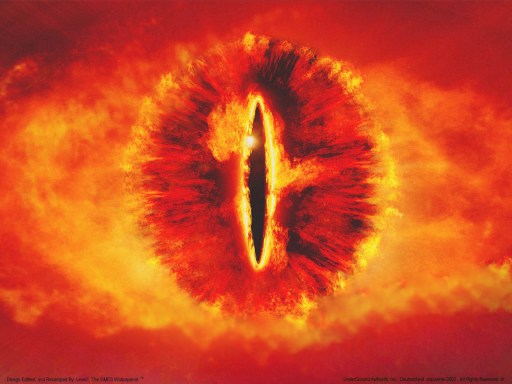
Eye of Sauron

There has been some ink spilt lately at the IEET over a new movement that goes by the Tolkienesque name, I kid you not, of the dark enlightenment also called neo-reactionaries.  Khannea Suntzu has looked at the movement from the standpoint of American collapse and David Brin within the context of a rising oligarchic neo-feudalism.  

I have my own take on the neo-reactionary movement somewhat distinct from that of either Suntzu or Brin, which I will get to below, but first a recap.  Neo-reactionaries are a relatively new group of thinkers on the right that in general want to abandon the modern state, built such as it is around the pursuit of the social welfare, for lean-and-mean governance by business types who know in their view how to make the trains run on time. They are sick of having to “go begging” to the political class in order to get what they want done. They hope to cut out the middle-man. It’s obvious that oligarchs run the country so why don’t we just be honest about it and give them the reins of power? We could even appoint a national CEO- if the country remains in existence- we could call him the king. Oh yeah, on top of that we should abandon all this racial and sexual equality nonsense. We need to get back to the good old days when the color of a man’s skin and having a penis really meant something- put the “super” back in superior.

At first blush the views of those hoping to turn the lights out on enlightenment (anyone else choking on an oxymoron) appear something like those of the kind of annoying cousin you try to avoid at family reunions. You know, the kind of well off white guy who thinks the Civil Rights Movement was a communist plot, calls your wife a “slut” (their words, not mine) and thinks the real problem with America is that we give too much to people who don’t have anything and don’t lock up or deport enough people with skin any darker than Dove Soap. Such people are the moral equivalent of flat-earthers with no real need to take them seriously, though they can make for some pretty uncomfortable table conversation and are best avoided like a potato salad that has been out too long in the sun.

What distinguishes neo-reactionaries from run of the mill ditto heads or military types with a taste for Dock Martins or short pants is that they tend to be latte drinking Silicon Valley nerds who have some connection to both the tech and trans-humanist communities.

That should get this audience’s attention.

To continue with the analogy from above:  it’s as if your cousin had a friend, let’s just call him totally at random here… Peter Thiel, who had a net worth of 1.5 billion and was into, among other things, working closely with organizations such as the NSA through a data mining firm he owned- we’ll call it Palantir (damned Frodo Baggins again!) and who serves as a deep pocket for groups like the Tea Party. Just to go all conspiracy on the thing let’s make your cousin’s “friend” a sitting member on something we’ll call The Bilderberg Group a secretive cabal of the world’s bigwigs who get together to talk about what they really would like done in the world. If that was the case the last thing you should do is leave your cousin ranting to himself while you made off for another plate of Mrs. T’s Pierogies.  You should take the maniac seriously because he might just be sitting on enough cash to make his atavistic dreams come true and put you at risk of sliding off a flattened earth.

All this might put me at risk of being accused of lobbing one too many ad hominem, so let me put some meat on the bones of the neo-reactionaries. The Super Friends or I guess it should be Legion of Doom of neo-reaction can be found on the website Radish where the heroes of the dark enlightenment are laid out in the format of Dungeons and Dragons or Pokémon cards (I can’t make this stuff up). Let’s just start out with the most unfunny and disturbing part of the movement- its open racism and obsession with the 19th century pseudo-science of dysgenics.

Here’s James Donald who from his card I take to be a dwarf, or perhaps an elf, I’m not sure what the difference is, who likes to fly on a winged tauntaun like that from The Empire Strikes Back.

To thrive, blacks need simpler, harsher laws, more vigorously enforced, than whites.  The average black cannot handle the freedom that the average white can handle. He is apt to destroy himself.  Most middle class blacks had fathers who were apt to frequently hit them hard with a fist or stick or a belt, because lesser discipline makes it hard for blacks to grow up middle class.  In the days of Jim Crow, it was a lot easier for blacks to grow up middle class.

Wow, and I thought a country where one quarter of African American children will have experienced at least one of their parents behind bars– thousands of whom will die in prison for nonviolent offenses– was already too harsh. I guess I’m a patsy.

Non-whites aren’t the only ones who come in for derision by the neo-reactionaries a fact that can be summed up by the post- title of one of their minions, Alfred W. Clark, who writes the blog Occam’s RazorAre Women Who Tan SlutsThere’s no need to say anything more to realize poor William of Occam is rolling in his grave.

Beyond this neo-Nazism for nerds quality neo-reactionaries can make one chuckle especially when it comes to “policy innovations” such as bringing back kings.

Here’s modern day Beowulf Mencius Moldbug:

What is England’s problem?  What is the West’s problem?  In my jaundiced, reactionary mind, the entire problem can be summed up in two words – chronic kinglessness.  The old machine is missing a part.  In fact, it’s a testament to the machine’s quality that it functioned so long, and so well, without that part.

Yeah, that’s the problem.

Speaking of atavists, one thing that has always confused me about the Tea Party is that I have never been sure which imaginary “golden age” they wanted us to return to. Is it before desegregation? Before FDR? Prior to the creation of the Federal Reserve (1913)? Or maybe it’s back to the antebellum south? Or maybe back to the Articles of Confederation? Well, at least the neo-reactionaries know where they want to go- back before the American Revolution. Obviously since this whole democracy thing hasn’t worked out we should bring back the kings, which makes me wonder if these guys have mourning parties on Bastille Day.

Okay, so the dark voices behind neo-reaction are a bunch of racist/sexist nerds who have a passion for kings and like to be presented as characters on D&D cards. They have some potentially deep pockets, but other than that troubling fact why should we give them more than a few seconds of serious thought?

Now I need to exchange my satirical cap for my serious one for the issues are indeed serious. I think understanding neo-reaction is important for two reasons: they are symptomatic of deeper challenges and changes occurring politically, and they have appeared as a response to and on the cusp of a change in our relationship to Silicon Valley a region that has been the fulcrum point for technological, economic and political transformation over the past generation.

Neo-reaction shouldn’t be viewed in a vacuum. It has appeared at a time when the political and economic order we have had since at least the end of the Second World War which combines representative democracy, capitalist economics and some form of state supported social welfare (social democracy) is showing signs of its age.

If this was just happening in the United States whose 224 year old political system emerged before almost everything we take to be modern such as this list at random: universal literacy, industrialization, railroads, telephones, human flight, the Theory of Evolution, Psychoanalysis, Quantum Mechanics, Genetics, “the Bomb”, television, computers, the Internet and mobile technology then we might be able, as some have, to blame our troubles on an antiquated political system, but the creaking is much more widespread.

We have the upsurge in popularity of the right in Europe such as that seen in France with its National Front. Secessionist movements are gaining traction in the UK. The right in the form of Hindu Nationalism under a particular obnoxious figure- Narendra Modi -is poised to win Indian elections. There is the implosion of states in the Middle East such as Syria and revolution and counter revolution in Egypt. There are rising nationalist tensions in East Asia.

All this is coming against the backdrop of rising inequality. The markets are soaring no doubt pushed up by the flood of money being provided by the Federal Reserve,  yet the economy is merely grinding along. Easy money is the de facto cure for our deflationary funk and pursued by all the world’s major central banks in the US, the European Union and now especially, Japan.

The far left has long abandoned the idea that 21st century capitalism is a workable system with the differences being over what the alternative to it should be- whether communism of the old school such as that of Slavoj Žižek  or the anarchism of someone like David Graeber. Leftists are one thing the Pope is another, and you know a system is in trouble when the most conservative institution in history wants to change the status quo as Pope Francis suggested when he recently railed against the inhumanity of capitalism and urged for its transformation.

What in the world is going on?

If your house starts leaning there’s something wrong with the foundation, so I think we need to look at the roots of our current problems by going back to the gestation of our system- that balance of representative democracy, capitalism and social democracy I mentioned earlier whose roots can be found not in the 20th century but in the century prior.

The historical period that is probably most relevant for getting a handle on today’s neo-reactionaries is the late 19th century when a rage for similar ideas infected Europe. There was Nietzsche in Germany and Dostoevsky in Russia (two reactionaries I still can’t get myself to dislike both being so brilliant and tragic). There was Maurras in France and Pareto in Italy. The left, of course, also got a shot of B-12 here as well with labor unions, socialist political parties and seriously left-wing intellectuals finally gaining traction. Marxism whose origins were earlier in the century was coming into its own as a political force.  You had writers of socialist fiction such as Edward Bellamy and Jack London surging in popularity. Anarchists were making their mark, though, unfortunately, largely through high profile assassinations and bomb throwing. A crisis was building even before the First World War whose centenary we will mark next year.

Here’s historian JM Roberts from his Europe 1880-1945 on the state of politics in on the eve, not after, the outbreak of the First World War.

Liberalism had institutionalized the pursuit of happiness, yet its own institutions seemed to stand in the way of achieving the goal; liberal’s ideas could, it seemed, lead liberalism to turn on itself.

…the practical shortcomings of democracy contributed to a wave of anti-parliamentarianism. Representative institutions had for nearly a century been the shibboleth of liberalism. An Italian sociologist now stigmatized them ‘as the greatest superstition of modern times.’ There was violent criticism of them, both practical and theoretical. Not surprisingly, this went furthest in constitutional states where parliamentary institutions were the formal framework of power but did not represent social realities. Even where parliaments (as in France or Great Britain) had already shown they possessed real power, they were blamed for representing the wrong people and for being hypocritical shams covering self-interest. Professional politicians- a creation of the nineteenth century- were inevitably, it was said, out of touch with real needs.

Sounds familiar, doesn’t it?

Liberalism, by which Roberts means a combination of representative government and laissez faire capitalism- including free trade- was struggling. Capitalism had obviously brought wealth and innovation but also enormous instability and tensions. The economy had a tendency to rocket towards the stars only to careen earthward and crash leaving armies of the unemployed. The small scale capitalism of earlier periods was replaced by continent straddling bureaucratic corporations. The representative system which had been based on fleeting mobilization during elections or crises had yet to adjust to a situation where mass mobilization through the press, unions, or political groups was permanent and unrelenting.

The First World War almost killed liberalism. The Russian Revolution, Great Depression, rise of fascism and World War Two were busy putting nails in its coffin when the adoption of social democracy and Allied Victory in the war revived the corpse. Almost the entirety of the 20th century was a fight over whether the West’s hybrid system, which kept capitalism and representative democracy, but tamed the former could outperform state communism- and it did.

In the latter half of the 20th century the left got down to the business of extending the rights revolution to marginalized groups while the right fought for the dismantling of many of the restrictions that had been put on the capitalist system during its time of crisis. This modus vivendi between left and right was all well and good while the economy was growing and while the extension of legal rights rather than social rights for marginalized groups was the primary issue, but by the early 21st century both of these thrusts were spent.

Not only was the right’s economic model challenged by the 2008 financial crisis, it had nowhere left to go in terms of realizing its dreams of minimal government and dismantling of the welfare state without facing almost impossible electoral hurdles. The major government costs in the US and Europe were pensions and medical care for the elderly- programs that were virtually untouchable. The left too was realizing that abstract legal rights were not enough.  Did it matter that the US had an African American president when one quarter of black children had experienced a parent in prison, or when a heavily African American city such as Philadelphia has a child poverty rate of 40%? Addressing such inequities was not an easy matter for the left let alone the extreme changes that would be necessary to offset rising inequality.

Thus, ironically, the problem for both the right and the left is the same one- that governments today are too weak. The right needs an at least temporarily strong government to effect the dismantling of the state, whereas the left needs a strong government not merely to respond to the grinding conditions of the economic “recovery”, but to overturn previous policies, put in new protections and find some alternative to the current political and economic order. Dark enlightenment types and progressives are confronting the same frustration while having diametrically opposed goals. It is not so much that Washington is too powerful as it is that the power it has is embedded in a system, which, as Mark Leibovich portrays brilliantly, is feckless and corrupt.  

Neo-reactionaries tend to see this as a product of too much democracy, whereas progressives will counter that there is not enough. Here’s one of the princes of darkness himself, Nick Land:

Where the progressive enlightenment sees political ideals, the dark enlightenment sees appetites. It accepts that governments are made out of people, and that they will eat well. Setting its expectations as low as reasonably possible, it seeks only to spare civilization from frenzied, ruinous, gluttonous debauch.

Yet, as the experience in authoritarian societies such as Libya, Egypt and Syria shows (and even the authoritarian wonderchild of China is feeling the heat) democratic societies are not the only ones undergoing acute stresses. The universal nature of the crisis of governance is brought home in a recent book by Moisés Naím. In his The End of Power  Naím lays out how every large structure in society: armies, corporations, churches and unions are seeing their power decline and are being challenged by small and nimble upstarts.

States are left hobbled by smallish political parties and groups that act as spoilers preventing governments from getting things done. Armies with budgets in the hundreds of billions of dollars are hobbled by insurgents with IEDs made from garage door openers and cell phones. Long-lived religious institutions, most notably the Catholic Church, are losing parishioners to grassroots preachers while massive corporations are challenged by Davids that come out of nowhere to upend their business models with a simple stone.

Naím has a theory for why this is happening. We are in the midst of what he calls The More, The Mobility and The Mentality Revolutions. Only the last of those is important for my purposes. Ruling elites are faced today with the unprecedented reality that most of their lessers can read. Not only that, the communications revolution which has fed the wealth of some of these elites has significantly lowered the barriers to political organization and speech. Any Tom, Dick and now Harriet can throw up a website and start organizing for or against some cause. What this has resulted in is a sort of Cambrian explosion of political organization, and just as in any acceleration of evolution you’re likely to get some pretty strange mutants- and so here we are.

Some on the left are urging us to adjust our progressive politics to the new distributed nature of power.  The writer Steven Johnson in his recent Future Perfect: The case for progress in a networked age calls collaborative efforts by small groups “peer-to-peer networks”, and in them he sees a glimpse of our political past (the participatory politics of the ancient Greek polis and late medieval trading states) becoming our political future. Is this too “reactionary”?

Peer-to-peer networks tend to bring local information back into view. The fact that traditional centralized loci of power such as the federal government and national and international media are often found lacking when it comes to local knowledge is a problem of scale. As Jane Jacobs has pointed out , government policies are often best when crafted and implemented at the local level where differences and details can be seen.

Wikipedia is a good example of Johnson’s peer-to-peer model as is Kickstarter. In government we are seeing the spread of participatory budgeting where the local public is allowed to make budgetary decisions. There is also a relatively new concept known as “liquid democracy” that not only enables the creation of legislation through open-sourced platforms but allows people to “trade” their votes in the hopes that citizens can avoid information overload by targeting their vote to areas they care most about, and presumably for this reason, have the greatest knowledge of.

So far, peer-to-peer networks have been successful at revolt- The Tea Party is peer-to-peer as was Occupy Wall Street. Peer-to-peer politics was seen in the Move-ON movement and has dealt defeat to recent legislation such as SOPA. Authoritarian regimes in the Middle East were toppled by crowd sourced gatherings on the street.

More recently than Johnson’s book there is New York’s new progressive mayor-  Bill de Blasio’s experiment with participatory politics with his Talking Transition Tent on Canal Street. There, according to NPR, New Yorkers can:

….talk about what they want the next mayor to do. They can make videos, post videos and enter their concerns on 48 iPad terminals. There are concerts, panels on everything from parks to education. And they can even buy coffee and beer.

Democracy, coffee and beer- three of my favorite things!

On the one hand I love this stuff, but me being me I can’t help but have some suspicions and this relates, I think, to the second issue about neo-reactionaries I raised above; namely, that they are reflecting something going on with our relationship to Silicon Valley a change in public perception of the tech culture and its tools from hero and wonderworker to villain and illusionist.

As I have pointed out elsewhere the idea that technology offered an alternative to the lumbering bureaucracy of state and corporations is something embedded deep in the foundation myth of Silicon Valley. The use of Moore’s Law as a bridge to personalized communication technology was supposed to liberate us from the apparatchiks of the state and the corporation- remember Apple’s “1984” commercial?

It hasn’t quite turned out that way. Yes, we are in a condition of hyper economic and political competition largely engendered by technology, but it’s not quite clear that we as citizens have gained rather than “power centers” that use these tools against one another and even sometimes us. Can anyone spell NSA?

We also went from innovation, and thus potential wealth, being driven by guys in their garages to, on the American scene, five giants that largely own and control all of virtual space: Google, Facebook, Amazon, Apple and Micro-Soft with upstarts such as Instagram being slurped up like Jonah was by the whale the minute they show potential growth.

Rather than result in a telecommuting utopia with all of us working five hours a day from the comfort of our digitally connected home, technology has led to a world where we are always “at work”, wages have not moved since the 1970’s and the spectre of technological unemployment is on the wall. Mainstream journalists such as John Micklethwait of The Economist are starting to see a growing backlash against Silicon Valley as the public becomes increasingly estranged from digerati who have not merely failed to deliver on their Utopian promises, but are starving the government for revenue as they hide their cash in tax havens all the while cosying up to the national security state.

Neo-reactionaries are among the first of Silicon Valleians to see this backlash building hence their only half joking efforts to retreat to artificial islands or into outer space. Here is Balaji Srinivasan whose speech was transcribed by one of the dark illuminati who goes by the moniker Nydwracu:

The backlash is beginning. More jobs predicted for machines, not people; job automation is a future unemployment crisis looming. Imprisoned by innovation as tech wealth explodes, Silicon Valley, poverty spikes… they are basically going to try to blame the economy on Silicon Valley, and say that it is iPhone and Google that done did it, not the bailouts and the bankruptcies and the bombings, and this is something which we need to identify as false and we need to actively repudiate it.

Srinivasan would have at least some things to use in defense of Silicon Valley: elites there have certainly been socially conscious about global issues. Where I differ is on their proposed solutions. As I have written elsewhere, Valley bigwigs such as Peter Diamandis think the world’s problems can be solved by letting the technology train keep on rolling and for winners such as himself to devote their money and genius to philanthropy.  This is unarguably a good thing, what I doubt, however, is that such techno-philanthropy can actually carry the load now held up by governments while at the same time those made super rich by capitalism’s creative destruction flee the tax man leaving what’s left of government to be funded on the backs of a shrinking middle class.

As I have also written elsewhere the original generation of Silicon Valley innovators is acutely aware of our government’s incapacity to do what states have always done- to preserve the past, protect the the present and invest in the future. This is the whole spirit behind the saint of the digerati Stewart Brand’s Long Now Foundation in which I find very much to admire. The neo-reactionaries too have latched upon this short term horizon of ours, only where Brand saw our time paralysis in a host of contemporary phenomenon, neo-reactionaries think there is one culprit- democracy. Here again is dark prince Nick Land:

Civilization, as a process, is indistinguishable from diminishing time-preference (or declining concern for the present in comparison to the future). Democracy, which both in theory and evident historical fact accentuates time-preference to the point of convulsive feeding-frenzy, is thus as close to a precise negation of civilization as anything could be, short of instantaneous social collapse into murderous barbarism or zombie apocalypse (which it eventually leads to). As the democratic virus burns through society, painstakingly accumulated habits and attitudes of forward-thinking, prudential, human and industrial investment, are replaced by a sterile, orgiastic consumerism, financial incontinence, and a ‘reality television’ political circus. Tomorrow might belong to the other team, so it’s best to eat it all now.

The problem here is not that Land has drug this interpretation of the effect of democracy straight out of Plato’s Republicwhich he has, or that it’s a kid who eats the marshmallow leads to zombie apocalypse reading of much more complex political relationships- which it is as well.  Rather, it’s that there is no real evidence that it is true, and indeed the reason it’s not true might give those truly on the radical left who would like to abandon the US Constitution for something more modern and see nothing special in its antiquity reason for pause.

The study,of course, needs to be replicated, but a paper just out by Hal Hershfield, Min Bang and Elke Weber at New York University seems to suggest that the way to get a country to pay serious attention to long term investments is not to give them a deep future but a deep past and not just any past- the continuity of their current political system.

As Hershfield states it:

Our thinking is that the countries who have a longer past are better able see further forward into the future and think about extending the time period that they’ve already been around into the distant future. And that might make them care a bit more about how environmental outcomes are going to play out down the line.

And from further commentary on that segment:

Hershfield is not using the historical age of the country, but when it got started in its present form, when its current form of government got started. So he’s saying the U.S. got started in the year 1776. He’s saying China started in the year 1949.

Now, China, of course, though, is thousands of years old in historical terms, but Hershfield is using the political birth of the country as the starting point for his analysis. Now, this is potentially problematic, because for some countries like China, there’s a very big disparity in the historical age and when the current form of government got started. But Hershfield finds even when you eliminate those countries from the equation, there’s still a strong connection between the age of the country and its willingness to invest in environmental issues.

The very existence of strong environmental movements and regulation in democracies should be enough to disprove Land’s thesis about popular government’s “compulsive feeding frenzy”.  Democracies should have stripped their environments bare like a dog with a Thanksgiving turkey bone. Instead the opposite has happened. Neo-reactionaries might respond with something about large hunting preserves supported by the kings, but the idea that kings were better stewards of the environment and human beings (I refuse to call them “capital”)  because they own them as personal property can be countered with two words and a number King Leopold II.

Yet, we progressives need to be aware of the benefits of political continuity. The right with their Tea Party and their powdered wigs has seized American history. They are selling a revolutionary dismantling of the state and the deconstruction of hard fought for legacies in the name of returning to “purity”, but this history is ours as much as theirs even if our version of it tends to be as honest about the villains as the heroes. Neo-reactionaries are people who have woken up to the reality that the conservative return to “foundations” has no future. All that is left for them is to sit around daydreaming that the American Revolution and all it helped spark never happened, and that the kings still sat on their bedeckled thrones.

We Are All Dorian Grey Now

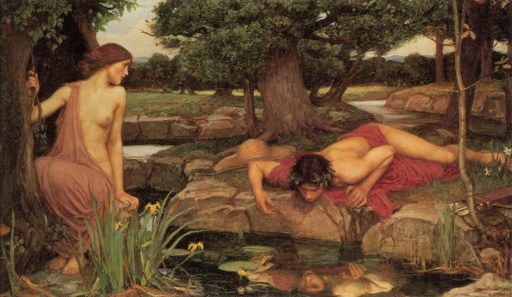
Echo_and_Narcissus

If someone on the street stopped and asked you what you thought was the meaning behind Oscar Wilde’s novel A Picture of Dorian Grey you’d probably blurt out ,like the rest of us, that it had something to do with a frightening portrait, the dangers of pursuing immortality, and, if one remembered vague details about Wilde’s life, you might bring up the fact that it must have gotten him into a lot of trouble on account of its homoeroticism.

This at least is what I thought before I sat down and actually read the novel. What I found there instead was a remarkable reflection on human consciousness all the more remarkable because in 1890 when the novel was published we really had no idea how the mind worked. Wilde would arrive at his viewpoint from introspection and observation alone. His reflections on thought and emotion are all the more important because many of the ways his protagonist becomes unhinged from the people around him, and thus cursed to a fateful demise, are a kind of amplified intimation of what social media is doing to us today. Let me explain.      

The science writer and poet, Diane Ackerman in her book An  Alchemy of the Mind list three ways evolution has “played tricks” on us: 1) We have brains that can imagine states of perfection they can’t achieve, 2) We have brains that compare our insides to other people’s outsides, 3) We have brains desperate to stay alive, yet we are finite beings that perish. (p. 6). Although the novel is not discussed by Ackerman,  A Picture of Dorian Grey explores all three of these “tricks”, though the third one, which is perhaps often thought to be the main subject of the novel is in fact the least important one in terms of the story and its meaning.

The whole tragedy of Dorian Grey begins, of course, when Dorian looking upon his portrait by Basil Hallward dreams he could exchange his own temporal youth for the youth frozen in time by the painter:

… if only it were the other way! If it were I who was to be always young, and the picture that was to grow old! For that-for that- I would give everything! Yes, there is nothing in the world I would not give! I would give my soul for that! (25-26)

What drives Dorian to make his “deal with the devil” is his ability to imagine something that cannot be- his own beauty frozen in time- like the dead portrait- while he himself remains living. Of course, the mark of maturity (or sanity) is being able to tell the difference between our dreams and reality and learn somehow to accept the gap. What this devil’s wager brings Dorian will be a failure to mature though this will not mean that he will not experience the other emotional manifestation of aging that emerges if one fails to grow with experience- that is degeneration and corruption.

If we do ever master the underlying mechanisms of aging, especially cognitive aging, this question of maturation and development seems sure to come up. We may all wish were as good looking as when we were 19 or as deft on the basketball court, but few of us would hope for the return of the emotional rollercoaster of adolescence or the lack of foresight we had as children. Many of these emotional changes from youth to middle age and older are based upon our accumulated experience, but they also follow what seems to be a natural maturing process in the brain. What we lose in reflex- time and rapid memory recall we more than makeup for in our ability to see the big picture and exercise emotional control. Aging in this sense, can indeed be said to be healthy.

These changes are certainly a factor when it comes to the relationship between aging and crime. Not only do the rates of crime track chronological age with the majority of crimes committed by young men in their late teens and early 2o’s, but rates of recidivism for those convicted and imprisoned plummets by more than half for those 59-69 years old versus 18- 24 year olds.

What does all of that have to do with Dorian Grey? More than you might think. In the novel it is not merely Dorian’s physical development that is arrested, but his emotional development as well. The eternal youth goes to parties, visits opium dens, visits brothels and does other things that remain unnamed. He does not work, does not marry, does not raise children. He has no real connection with other human beings besides perhaps Lord Henry Wotton who has introduced him to the philosophy of Hedonism, though even there the connection is tenuous. Dorian Grey gains knowledge but does not learn, neither from his own pain or the pain he inflicts on others.  Had he been arrested he would make the perfect recidivist.

Yet, it is in Ackerman’s second trick she thinks evolution has played on us: “having a brain that compares our insides to others outsides” that the real depth of The Picture of Dorian Grey can be found, and its most  important message in light of our own social media age. Indeed the whole novel might be thought of as a meditation on that simple, but universal, trap of our own nature. But first I must discuss the question of empathy.

Dorian manages to ruin almost every life he touches. His first romance with the poor actress Sibyl Vane ends in her suicide, his blackmail of Adrian Singleton leads to his suicide as well. He will murder Basil Hallward the person who perhaps loved him most in the world. There are countless other named and unnamed victims of Dorian’s influence.

What makes Dorian heartless is that everyone around him becomes a mere surface, a plaything of his own mind. It was his cruelty to Sibyl Vane that led to her suicide. Hallward who plays the Mephistopheles to Dorian’s Faust explains the actresses death to him this way:

No she will never come to life. She has played her final part. But you must think of that lonely death in the tawdry dressing- room simply as a strange fragment of some Jacobean tragedy, as a wonderful scene from Webster, or Ford or Cyril Tourneur. The girl never really lived so she never really died. To you at least she was always a dream a phantom… (103)

To which Dorian eventually responds regarding the girl’s death:

It has been a marvelous experience! That is all. I wonder if life has still in store for me anything as marvelous. (103)

We might reel in revulsion at Dorian’s response to the death of another human being, at his stone- heartedness in light of the pain the girl’s death has brought to her loved ones, a death he bears a great deal of responsibility for, but his lack of empathy holds up a mirror to ourselves and might be something we need to be more fully in tune with now that our digitally mediated lives allow us to so much more easily turn real people into the mere characters of our own life play.

There was the tragic case of Rebecca Sedwick a 12 year old girl who killed herself by jumping from an industrial platform after repeated bullying from her peers including multiple incitements by these young women for the girl to kill herself. The response of one of the bullies to the news of Rebecca Sedwick’s death was not horrified remorse, but this message which she posted on FaceBook:

Yes I know I bullied Rebecca and she killed herself, but I don’t give a f—k.

Two of the bullying girls had been arrested and charged with felony harassment, though the charges have now been dropped.

In addition to this kind of direct cruelty there is another form of digitally mediated cruelty where people are willing spectators and sometimes accomplices of heinous acts: snuff films, pornography with some participants unaware that they are being filmed, especially the epidemic of child pornography. Deliberate cruelty to animals is another form of a digitized house of horrors as well.

This cruel pixelization of human beings (and animals) can strike us in seemingly innocent forms as well, as the media critic Douglas Rushkoff wrote of our infatuation with reality TV in his Present Shock :

We readily accept the humiliation of a contestant at the American Idol audition- such as William Hung, a Chinese American boy who revived the song “She Bangs” – even when he doesn’t know we are laughing at him. The more of this media we enjoy the more spectacularly cruel it must be to excite our attention…. (pp. 36-37)

On top of this are all the kinds of daily cruelty we engage in with our simulations- violent video games, or hit shows like “The Walking Dead”.

Is all of this digital cruelty having an effect on our ability to feel empathy? It appears so. Researchers are starting to pick up on what they are calling the “empathy deficit” a decline in the level of self-reported empathetic concern over the last generation. As Keith O’Brien wrote in The Boston Globe:

Starting around a decade ago, scores in two key areas of empathy begin to tumble downward. According to the analysis, perspective-taking, often known as cognitive empathy — that is, the ability to think about how someone else might feel — is declining. But even more troubling, Konrath noted, is the drop-off the researchers have charted in empathic concern, often known as emotional empathy. This is the ability to exhibit an emotional response to someone’s else’s distress.”

Between 1979 and 2009, according to the new research, empathic concern dropped 48 percent.

The worst case scenario that I can think of is that we are witnessing an early stage of the shift away from the non-violent society, we, despite our wars, created over the 19th and 20th centuries. A decline that Steven Pinker so excellently laid out in his Better Angels of Our Nature.  

Pinker traced our development of a society incredibly less violent and less accepting of violence than any of its predecessor. We appear to have a much more developed sense of empathy than any society in the human past. One of the major players in this transition from a society where cruelty was ubiquitous to one where it invokes feelings of revulsion and horror Pinker believes was the rise of reading, of universal literacy and especially the reading of novels.

Reading is a technology for perspective-taking. When someone else’s thoughts are in your head, you are observing the the world from that person’s vantage point. Not only are you taking in sights and sounds that you could not experience firsthand, but you have stepped inside that person’s mind and are temporarily sharing his attitudes and reactions.

Stepping into someone else’s vantage point reminds you that the other fellow has a first-person present-tense, ongoing stream of consciousness that is very much like your own but not the same as your  own. It’s not a very big leap to suppose that the habit of reading other people’s words could put one in the habit of entering other people’s minds, including their pleasures and pains.

What visual/digital media fails to give us, what still allows even bad novels to give great films a run for their money, is any real grass of characters internal lives. The more cut off from other’s internal lives we become, the more they become mere surfaces with which we can play the “film” of our lives the only internal life we’ll ever know with certainty to be real.

This failure to recognize other’s internal lives is like the flip-side of “having brains that compare our insides to other people’s outsides” to which I will now after that long digression return. Perhaps all of the characters in The Picture of Dorian Grey mistake the surface for the truth of things. This is the philosophy of Lord Wotton, the origin of Dorian’s dark pact, and even infects the most emotionally attuned character in the novel, Basil.

In one scene, Basil comes to warn Dorian about his growing public infamy. It is a warning that will eventually lead to Bail’s murder at Dorian’s hands. The painter cannot believe the stories swirling around about the unaged man who once sat in his studio and was the muse of his art. Basil gives this explanation for his disbelief:

Mind you, I don’t believe these rumors at all. At least I can’t I can’t believe them when I see you. Sin is a thing that writes itself across a man’s face. It cannot be concealed. People talk sometimes about secret vices. There are no such things. If a wretched man has a vice, it shows itself in the lines of his mouth, the droop of his eyelids, the moulding of his hands even.  (149-150)

Basil believes Dorian is good because his outside is beautiful, or he confuses his own virtue with Dorian’s appearance. This mistaking of outside with inside is the curse of the FaceBook generation.  As Stephen Marche explained it in his article Is FaceBook Making Us Lonely? we have put ourselves in a situation where we are constantly confusing people’s lives with their social media profiles and updates where we often only see photos the beautiful kids making crafts- not the temper tantrums, the wonderful action packed vacation- not the three days in the bathroom with the runs, or the sexy new car or gorgeous home rather than the crippling car and home payments.

In other words, we assume people to be happy because their digital persona is happy, but we have no idea of the details. We should be able to guess that, just like us, the internal lives of everyone else are “messy”, but this takes the kinds of empathy we seem to be losing.  We are stuck with a surface of a surface and are apt to confuse it with the real. To top it all off we have to then smooth out our own messiness for public consumption, or worse fall into a pit where we try to dig out of our own complexity, so we like the personas of others we mistake for real people can be “happy”.

Here’s Marche:

Not only must we contend with the social bounty of others; we must foster the appearance of our own social bounty. Being happy all the time, pretending to be happy, actually attempting to be happy—it’s exhausting. “

So what of the last of Ackerman’s tricks of evolution that “we have brains desperate to stay alive, yet we are finite beings that perish.” Although it might seem surprising, the exploration of this desire to be immortal is the element least explored in A Picture of Dorian Grey.

The reason for this is that Dorian is not so much interested in immortal life as he is in eternal youth, or better the eternal beauty that is natural for some in their youth. A deal with the devil to live forever, but be homely, is not one vain Dorian would have made.

Dorian is certainly afraid of dying, he is terrified and sickened by the fear that Sibyl’s brother will kill him. But in the short space between the appearance of this fear and Dorian’s actual death there is no room to explore Wilde’s thoughts regarding death.Dorian does not live forever, he dies a middle aged man.

A new radio series The Confessions of Dorian Grey does explore this theme barely developed by Wilde, imaging a Dorian Grey who lives rather than dies and takes his corruption through different times periods after the fin-de siecle. I look forward to seeing where the writers and producers take the theme.

___________________________________________________________________

In the back of my version of A Picture of Dorian Grey is a wonderful essay The ‘Conclusion’ to Pater’s Renaissance  by Wilde that is really about what it means to be alive and to be conscious and the place of art in that. Wilde writes:

… the whole scope of observation is dwarfed to the narrow chamber of the individual mind. Experience already reduced to a swarm of impressions, is ringed round for each one of us by that thick wall of personality through which no real voice has ever pierced on its way to us, or from us to that which we can only conjecture to be without. Every one of those impressions is the impression of the individual in his isolation, each mind keeping as a solitary prisoner its own dream of a world.  (226)

Wilde wanted to grab hold of the fleeting impressions of life for but a moment and locate the now. Art, and in that sense “art for art’s’” sake was his means of doing this a spiritual recognition of the beauty of the now.

What ruined Dorian Grey was not the or sentiment or truth of that, though Wilde was exploring the dangers implicit in such a view. The black box nature of our consciousness, the fact that we create our own very unique internal worlds, is among the truths of modern neuroscience. Rather, Dorian’s failure lie in his unwillingness to recognize the “dream of a world” of others was as real and precious as his own.

Caves, Creationism and the Divine Wonder of Deep Time

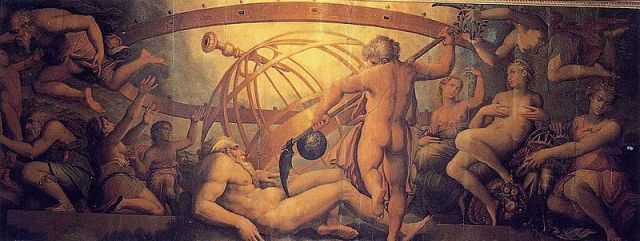
The Mutiliation of Uranus by Saturn

Last week was my oldest daughter’s 5th birthday in my mind the next “big” birthday after the always special year one. I decided on a geology themed day one of whose components were her, me and my younger daughter who’s 3 taking a trip to a local limestone cave that holds walk through tours.

Given that we were visiting the cave on a weekday we had the privilege of getting a private tour: just me, the girls and our very friendly and helpful tour guide. I was really hoping the girls would get to see some bats, which I figured would be hibernating by now. Sadly, the bats were gone. In some places upwards of 90% of them had been killed by an epidemic with the understated name of “White Nose Syndrome” a biological catastrophe I hadn’t even been aware of and a crisis both for bats and farmers who depend on them for insect control and pollination.

For a local show-cave this was pretty amazing- lots of intricate stalactites and stalagmites, thin rock in the form of billowing ribbons a “living” growth moving so slowly it appears to be frozen in time. I found myself constantly wondering how long it took for these formations to take shape. “We tell people thousands of years” our guide told us. “We have no idea how old the earth is”. I thought to myself that I was almost certain that we had a pretty good idea of the age of the earth – 4.5 billion, but did not press- too interested in the caves features and exploring with the girls. I later realized I should have, it would have likely made our guide feel more at ease.

Towards the end of our tour we spotted a sea shell embedded in the low ceiling above us, and I picked up the girls one at a time so they could inspect it with their magnifying glass. I felt the kind of vertigo you feel when you come up against deep time. Here was the echo of a living thing from eons ago viewed by the living far far in its future.

Later I found myself thinking about our distance in time from the sea shell and the cave that surrounded it. How much time separated us and the shell? How old was the cave? How long had the things we had seen taken to form? Like any person who doesn’t know much about something does I went to our modern version of Delphi’s Oracle- Google.

When I Googled the very simple question: “how old are limestone caves?” a very curious thing happened. The very first link that popped up wasn’t Wikipedia or a geology site but The Institute for Creation Research.  That wasn’t the only link to creationist websites. Many, perhaps the majority, of articles written on the age of caves were by creationists, the ones that I read in seemingly scientific language, difficult for a non-scientist/non-geologist to parse. Creationists seem to be as interested in the age of caves as speleologist, and I couldn’t help but wonder, why?

Unless one goes looking or tries to remain conscious of it, there are very few places where human beings confront deep time- that is time far behind (or in front) of thousands of years by which we reckon human historical time.  The night sky is one of these places, though we have so turned the whole world into a sprawling Las Vegas that few of us can even see into the depths of night any more. Another place is natural history museums where prehistoric animals are preserved and put on display. Creationists have attempted to tackle the latter by designing their very own museums such as The Creation Museum replete with an alternative history of the universe where, among other things, dinosaurs once lived side-by-side with human beings like in The Flintstones.

Another place where a family such as my own might confront deep time is in canyons and caves. The Grand Canyon has a wonderful tour called The Trail of Time that gives some idea of the scale of geological time where tourists start at the top of the canyon in present time and move step by step and epoch by epoch to the point where the force of the Colorado River has revealed a surface 2 billion years old.

Caves are merely canyons under the ground and in both their structure and their slow growing features- stalactites and the like- give us a glimpse into the depths of geologic time. Creationists feel compelled to steel believers in a 5,000 year old earth against the kinds of doubts and questions that would be raised after a family walks through a cave. Hence all of the ink spilt arguing over how long it takes a stalagmite to grow five feet tall and look like a melting Santa Claus. What a shame.

It was no doubt the potential prickliness of his tourists that led our poor guide to present the age of the earth or the passage of time within the cave as open questions he could not address. After all, he didn’t know me from Adam and one slip of the word “million” from his mouth might have resulted in what should have been an exciting outing turning into a theological debate. As he said he was not, after all, a geologist and had merely found himself working in the cave after his father had passed away.

As regular readers of my posts well known, I am far from being an anti-religious person. Religion to me is one of the more wondrous inventions and discoveries we human beings have come up with, but religion, understood in this creationist sense seems to me a very real diminishment not merely of the human intellect but of the idea of the divine itself.

I do not mean to diminish the lives of people who believe in such pseudo-science. One of the most hardworking and courageous persons I can think of was a man blinded by a mine in Vietnam. Once we were discussing what he would most like to see were his sight restored and he said without hesitation “The Creation Museum!”. I think this man’s religious faith was a well spring for his motivation and courage, and this, I believe is what religions are for- to provide strength for us to deal with the trials and tribulations of human life. Yet, I cannot help but think that the effort to black- hole- like suck in and crush our ideas of creation so that it fits within the scope of our personal lives isn’t just an assault on scientific truth but a suffocation of our idea of the divine itself.

The Genesis story certainly offers believers and non-believers alike deep reflection on what it means to be a moral creature, but much of this opportunity for reflection is lost when the story is turned into a science text book. Not only that, both creation and creator become smaller. How limited is the God of creationists whose work they constrict from billions into mere thousand of years and whose overwhelming complexity and wonder they reduce to a mere 788,280 human words!  With bitter irony creationists diminish the depth of the work God has supposedly made so that man can exalt himself to the center of the universe and become the primary character of the story of creation. In trying to diminish the scale and depth of the universe in space and time they are committing the sin of Milton’s Satan- that is pride.

The more we learn of the universe the deeper it becomes. Perhaps the most amazing projects in NASA’s history were two very recent one- Kepler and Hubble. Their effects on our understanding of our place in the universe are far more profound than the moon landings or anything else the agency has done.

Hubble’s first Deep Field image was taken over ten consecutive days in December of 1995. What it discovered in the words of Lance Wallace over at The Atlantic:

What researchers found when they focused the Hubble over those 10 days on that tiny speck of darkness, Mather said, shook their worlds. When the images were compiled, they showed not just thousands of stars, but thousands of galaxies. If a tiny speck of darkness in the night sky held that many galaxies, stars and—as scientists were beginning to realize—associated planets … the number of galaxies, stars, and planets the universe contained had to be breathtakingly larger than they’d previously imagined.

The sheer increased scale of the universe has led scientist to believe that it is near impossible that we are “alone” in the cosmos. The Kepler Mission has filled in the details with recent studies suggesting that there may be billions of earth like planets in the universe.   If we combine these two discoveries with the understanding of planet hunter Dimitar Sasselov, who thinks that not only are we at the very beginning of the prime period for life in the universe because it has taken this long for stars to produce the heavy elements that are life’s prerequisites, but that we also have a very long time perhaps as much as 100 billion years for this golden age of life to play out, we get an idea of just how prolific creation is and will be beside which a God who creates only one living planet and one intelligent species seems tragically sterile.

To return underground, caves were our first cathedrals- witness Lascaux. It is even possible that our idea of the Underworld as the land of the dead grew out of the bronze age temple complex of Alepotrypa inspiring the Greek idea of Hades that served as the seed through which the similar ideas of Sheol held by the Jews and revved up by Christians to the pinnacle of horror shows with the idea of Hell.

I like to think that this early understanding of the Underworld as the land of the dead and the use of caves as temples reflects an intuitive understanding of deep time. Walking into a cave is indeed, in a sense, entering the realm of the dead because it is like walking into the earth’s past. What is seen there is the movement of time across vast scales. The shell my daughter’s peered at with their magnifying glass, for instance, was the exoskeleton of a creature that lived perhaps some 400 million years ago in the Silurian Period when what is now Pennsylvania was located at the equator and the limestone that was the product of decay the shells inhabitant’s relatives began to form.

Recognition of this deep time diminishes nothing of the human scale and spiritual meaning of this moment taken to stop and stare at something exquisite peeking at us from the ceiling- quite the opposite. Though I might be guilty of overwinding,  it was a second or two 400 million years or perhaps one might say 13 billion years in the making- who couldn’t help thanking God for that?

The Longevity Crisis

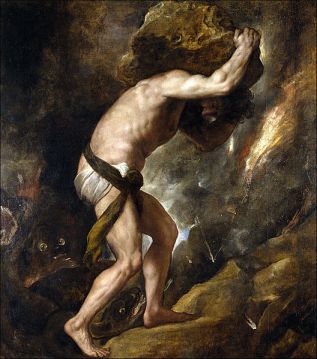
Sisyphus

When our most precious and hard fought for successes give rise to yet more challenges life is revealing its Sisyphean character. We work as hard as we can to roll a rock up a hill only to have it crush us on the way down. The stones that threatens us this time are two of our global civilization’s greatest successes- the fact that children born are now very likely to live into old age and the fact that we have stretched out this old age itself so that many, many more people are living into ages where in the past the vast majority of their peers would be dead. These two demographic revolutions when combined form the basis of what I am calling the Longevity Crisis. Let’s take infant mortality first.

The changes in the pattern of infant mortality rates from 1900 until today is quite simply astounding. In the US a child born at the beginning of the 20th century had a 10% chance of dying before the age of 1. In some cities the rate of infant deaths was as high as 30%. By the end of the 20th century this rate of infant deaths had declined by over 90%. For all of human history up until very recently families that wanted children needed to shoot for high numbers. Many of their children would likely die before they had even learned to speak. More would likely die before reaching age 5.

As late as 1920, 30% of Americans still worked on farms which gave additional impetus to have large families. This combined with the lack of effective birth control (“the pill” wasn’t widely available until 1960) meant that average household size was large- around 4 children- though this was down from the average of seven children per household in the 1800s.

Everything about this story leads to the outcome that the number of children born per woman eventually shrinks. The compression has already happened almost everywhere and in some places such as East Asia including China, Japan and South Korea and in Europe it is happening much faster than in others.

Ultimately in terms of the sustainability of our species this decline in the birth rate is a very good thing. Demographics, however, is like a cruise ship- it is hard to turn. In the lag time the world’s population is exploding as societies are able to save the lives of children but continue to have nearly as many of them. We are living through the turning. As this incredibly cool video graphic from the Economist shows it took humanity roughly 250,000 years to reach 1 billion of us in 1900, but thereafter the rate of growth skyrocketed. There was only a little over a century between our first billion and second billion. 40 years later in 1960 we numbered 3 billion. Only 14 years after that we reached the 4 billion mark and the time between adding another billion would shorten to about a mere dozen years with 5 billion reached in 1987, 6 billion following 12 years later in 1999, and 7 billion a dozen after that in 2011.

Thankfully, the rate of population growth is slowing. It will take us 14 years to pass the 8 billion mark and 20-25 years to reach what will perhaps be the peak of human population during this era-  9 billion in 2050. Though comforting we shouldn’t necessarily be sanguine in light of this fact-  we are still on track to add to the world the equivalent of another China and Europe by the middle of the century. Certainly, these people will, with justice, hanker after a middle class lifestyle putting enormous pressures on the global environment. Add to that the effects of climate change and it seems we are entering a very dangerous and narrow chute through which humanity must pass.

Making the chute even narrower will be the fact that the transition from a high birth rate to a low one is occurring under equally unprecedented conditions regarding human longevity. As pointed out by Ted C. Fishman in his Shock of Grey a person born in 1900 had an average life expectancy of 49 years. By 2000 we had turned that into almost 77 years diligently increasing the average human lifespan by between 1.5 and 2.7 years per decade. (p.14)

It needs to be stressed here, however, that the vast majority of these gains in life expectancy are the result not of keeping the old alive, though we have gotten much better at that, then making sure children survive. The fact that many less children die today skews the average life expectancy upward. These were relatively “easy” gains technically speaking and involved public investments as much as anything else: better sanitation, clean drinking water, routine vaccinations, diet and antibiotics.

Fishman has a neat way of giving us perspective on what the achievement of 80 year longevity means for our species by putting it in terms of life years. At merely the same rate of longevity increase as we have today the world’s population in 2050 will have lived around 500 billion years more than had they be born in 1900! (p.14) That number, 500 billion, not only reveals the extent of the environmental challenges we face, but gives us an idea of the depth of human experience and creativity we might gain. Our longevity and numbers seem to add time to the universe itself.

If you want a jaw-dropping visualization of humanity’s demographic rollercoaster, not to mention a humbling perspective of your own existence within the warp and woof of being and not being, you can get little better than World Births and Deaths in Real-Timea real time simulation of reported human births and deaths created by software developer Brad Lyon.

Aside from the sheer environmental impact of what in the near future will be our increasing human numbers there is the question of how we deal with the transition to what are in essence old societies. Take a rapidly aging country such as Japan. By 2050 Fishman sees the percentage of the Japanese population over age 65 to be a jaw dropping 40%. (p. 145) The dependency ratio, that is the ratio that measures the number of workers per dependent children and elderly is expected to reach 1:1.  We have never seen a dependency ratio like that, and Japan isn’t even the worst. Cities such as Shanghai are projected to have a percentage people of over 65 as high as 60%. As a result of its draconian 1 child policy China faces the real danger of growing old before it gets rich.  

In Europe too we are seeing the emergence of elderly societies. Fishman again captures the problem quite well writing of Europe where no country is getting proportionally younger and in the worst of the lot, Spain, especially:

Translate the numbers into an estimate of how many people need help with their basic needs, and Spain begins to look like a country that is literally handicapped. Unless medical advances deliver millions of people from infirmities they are now destined for, one out of every six to eight Spaniards will need help with walking, going to the toilet, or doing some other activity that we take for granted until it becomes too difficult. (114)

When transhumanists and their opponents debate the former’s wish lists of medical and technological breakthroughs: radically increased healthy longevity, regenerative medicine, cognitive enhancements, cyborg technologies, advanced AI and robotics the dispute is normally centered around the question of human enhancement and the empowerment of healthy individuals.  My guess is that in the long run, however, the development and deployment of these technologies will have occurred not in the interests of the minority of healthy individuals that want them, but because without the use of such technologies societies will simply cease to be functional.

For our survival not as individuals, but as a society, we desperately need technologies and medical breakthroughs that keep the elderly functional and contributing for as long as possible. We need a major investment in regenerative technology, and major research into arresting especially neurological decline. We need cheap and effective exoskeletons that will allow the elderly to retain mobility well past their 65th year, and robots to do much of the work we may no longer be fit to do. The deployment of such technologies will need to be global because the Longevity Crisis is global and will hit especially hard those societies which remain poor.

We also need to avoid losing the gains in longevity we have made in the past century.

If you’re in the mood to be freaked out there’s nothing better than this recent Frontline documentary Hunting the Nightmare Bacteria. To bring up my oft quoted Orgel’s Second Rule “Evolution is cleverer than you are” as shown in this documentary bacteria who are the true lords of the earth are busy outsmarting us. Our overuse of antibiotics and our obsessive compulsive craziness for things like antibacterial dish soap is threatening us with a surge of resistant bacteria that could reveal our seeming defeat of communicable diseases in the last century- which has added to our numbers of both young and old- tragically temporary.

It was this defeat over communicable diseases that transformed death into primarily an experience of the old whereas in all ages prior it was terrifying precisely because of its randomness and especially its impact on the young- a thief in the night- the Grim Reaper and his scathe.

We might also eat our way into shorter longevity. Quoted by Fishman, one of the top thinkers on longevity outthere-  S. Jay Olshansky- thinks that today’s generation of diabetic children have a good chance of living shorter lives than their parents. (205)In the West we haven’t seen that since the late Middle Ages when longevity declined by a decade from 48 to 38 years.

As Olshansky points out in his The Quest for Immortality: Science at the Frontiers of Aging simply continuing the trend of increasing longevity we have now is likely to prove difficult.

… adding 80 years to the life of an 80- year- old person is far more difficult than adding 80 years to the life of an infant. The implications for life expectancy are obvious. As life expectancy climbs beyond its current level (80 and older) death rates must fall at a progressively faster pace to achieve even small gains in life expectancy.

This is the stark reality of entropy in the life table. Increasing life expectancy in a population already long-lived is like walking up a hill of increasing slope while carrying a stone of increasing mass.

Gains in life expectancy are already slowing and entropy in the life table ensures that gains in the future will be even slower.  (p. 87)

Olshansky is especially well known for popularizing the idea of the “longevity dividend”. He wants us to focus our medical research on finding ways to slow biological aging. Olshansky does not see this refocusing as a means to transhumanist ends- neither radical longevity let alone biological immortality strike him as realistic goals, and one might add as did Kevin LeGradure launching off the recent Pew survey on the subject that the goal of radical longevity is not one the public is hankering for in any case.

Rather, what Olshansky wants us to do is find ways to slow aging so that we can compress the time frame in which human beings suffer terminal illnesses. Longevity isn’t the goal here, but the delay of chronic and debilitating diseases many of the elderly are under current conditions doomed to suffer. Increased average lifespan is a secondary effect. For those interested primarily in increased longevity the promise of shortening the length of frightening and devastating illnesses such as Alzheimer’s is a potentially politically broadening selling point for increased public funding for longevity related research. Indeed, our very success in holding off death in the middle aged and those in their 60s and 70s demands, on grounds of compassion, that we attempt to compress the timeframe in which people suffer the new types of very emotionally and physically painful diseases of aging that our success has inadvertently created.

As noted, we have been extremely effective at rolling back the death of children from threats such as infectious diseases. We are also extremely effective at saving the middle-aged, say a 59 year old who suffers a heart attack. Yet, the sisyphean nature of reality always manages to strike back. A person saved while a child by antibiotics or as an adult through heart surgery- threats to life that would have killed the person quickly- has the chance now of dying from Alzheimer’s diseases an extremely crippling and expensive condition that might take a decade or more to result in death.

Alzheimer’s is especially frightening- not merely for the way it robs the individual of their identity and is therefore one of the most tragic of diseases both for the sufferer and her loved ones, but because of the scale of the disease. Olshansky predicts that on current trends the US will have 16 million Alzheimer’s sufferers by 2050. That’s over 3 million more people than live in my beloved Pennsylvania or as many people as there are in the country of Australia.

The longevity gains we had in the past were largely the result of investments in public health. It was our devotion to one another as fellow citizens and human beings that gave us the miracle of hundreds of billions of more human life years. When as they should be these are years of love and wonder, insight and creativity, and, we can hope -wisdom.

Ensuring that the majority of us can remain healthy and productive with our increased years will require perhaps even greater public investments, many of them in technologies transhumanists have long held dear. Above all, continuing the gains we have had in longevity by both avoiding going backward and increasing longevity will take both shoring up our public health capacities so that we can avoid the return of pandemic killers. (The most galling effect of the recent blockheaded government shutdown was that it compromised the essential work of the CDC in preparing for a potentially devastating flu outbreak.) As the Frontline documentary points out public sector investment is necessary to deal with issues such as bacteriological infection because the market does not find research into necessities such as new antibiotics profitable.

The very complexity of the problem of figuring out how to slow the process of aging going forward will likewise demand massive public investments into areas little touched by today’s medical researchers refocusing our efforts on understanding the underlying mechanisms of aging rather than just trying to come up with cures for specific diseases. At the same time we will have to ensure we fully support the development of the young or society will have poisoned itself at the root, along with ensuring that the benefits of medical and technological advances are shared both within our societies and globally. We can make it through the Longevity Crisis and beyond but only if we do so in the spirit of a supportive family- young, old and in the space between.

Finding Frankenstein a Home

Frankenstein Cover

Percy’s epic poem, Prometheus Unbound is seldom read today while his wife’s novel,  Frankenstein; or the Modern Prometheus has become so well known that her monster graces the boxes of children’s cereal, and became the fodder from one of the funniest movies of the 20th century.

The question that always strikes me when I have the pleasure of re-reading Frankenstein is how could someone so young have written this amazing book? Mary Shelley was a mere twenty-one when the novel was published and the story she penned largely to entertain her husband and friends has managed to seep deeply into our collective assumptions especially those regarding science and technology. Just think of the kinds of associations the word “frankenfood” brings to mind and one gets a sense of how potent as a form of resistance against new forms of technology her gothic horror story is.

What is lost in this hiving off of the idea of the dangers of “unnatural” science for use as a cautionary tale against using a particular form of technology or exploring a certain line of research is the depth and complexity of the other elements present in the novel. I blame Hollywood.

The Frankenstein’s monster of our collective imagination isn’t the one given us by Mary Shelley, but that imagined by the director James Whale in his 1931 classic Frankenstein.

It was Whale who gave us the monster in a diner jacket, bolts protruding from his neck, and head like a block. Above all, Whale’s monster is without speech whereas the monster Mary Shelley imagined is extraordinarily articulate.

Whale’s monster is a sort of natural born killer his brain having come from a violent criminal. It is like the murderous chimpanzee written about in the weekend’s New York Times a creature that because we can not control or tame its murderous instincts must be killed before it can harm another person. Mary Shelley’s monster has a reason behind its violence. He can learn and love like we do, and isn’t really non-human at all. It is his treatment by human beings as something other than one of us- his abandonment by Victor Frankenstein after he was created, the horror which he induces in every human being that encounters him, that transforms the “creature” into something not so much non-human as inhumane.

There is a lesson here regarding our future potential to create beings that our sentient like ourselves – the technological hopes of the hour being uplifting and AI – that we need to think about the problem of homelessness when creating such beings. All highly intelligent creatures that we know of with the remarkable exception of the cephalopods are social creatures therefore any intelligent creature we create will likely need to have some version of home a world where it can be social as well.

The dangers of monstrousness emerging from intelligence lacking a social world was brilliantly illustrated by another 19th century science-fiction horror story- H.G. Wells’ The Island of Dr Moreau. In Mary Shelley’s novel she gives us insight into the origins of evil in the absence of such a world. Because it cannot be loved, Victor’s Frankenstein’s creation will destroy in the same way his every attempt to reach out to other sentient creature is ultimately destroyed with the creature telling his creator who has left him existentially shipwrecked:

“I too can cause desolation.”

Mary’s Shelley’s creature isn’t just articulate, he can read, and not only everyday reading, he has a taste for deep literature, especially Milton’s Paradise Lost which seems to offer him understanding of his own fate:

Like Adam, I was apparently united by no link to any other being in existence; but his state was far different from mine in every respect.  He had come forth from the hands of God a perfect creature, happy and prosperous, guarded by the especial care of his creator, he was allowed to converse with, and acquire knowledge from, beings of a superior nature: but I was helpless and alone. Many times I considered Satan as the fitter emblem of my condition: for often, like him, when I viewed the bliss of my protectors, the bitter gall of envy rose within me. “ (Chapter 15, p.2)

In some sense Mary Shelley’s horror story can be seen as less of a warning to 19th century scientist engaged in strange experiments with galvanization than a cautionary tale for those whose dehumanizing exploitation of industrial workers, miners, serfs and chattel slaves might lead to a potentially inhuman form of revolutionary blow back.  The creature cries to his creator:

Yet mine shall not be the submission of abject slavery: if I cannot inspire love, I will cause fear; and chiefly towards you my archenemy, because my creator, do I swear inextinguisable hatred. “(Chpapter 17 p. 1)

Yet, these revelations of the need for compassion towards sentient beings were largely lost in the anti-scientific thrust of the novel by which Frankenstein; or the Modern Prometheus and its progeny has become one of our most potent cautionary tales against hubris.  A scene in Whale’s Frankenstein where the doctor is speaking to a fellow scientist who lacks his ambition for great discovery sums it up nicely:

Where should we be if nobody tried to find out what lies beyond. Have you never wanted to look beyond the clouds and the stars, or what causes the trees to mount, or what changes the darkness to light? When you talk like that people call you crazy. But if I could discover just one of these things- what eternity is for example, I wouldn’t care if they did think I was crazy.

This bias against trying to answer the big questions isn’t merely an invention of the film maker but a deep part of Mary Shelley’s novel itself. Victor Frankenstein is first inspired not by science but by medieval occultists such as Cornelius Agrippa. Exchanging these power and knowledge aspirations of the magicians for run of the mill science meant for Victor:

“I was required to exchange chimeras of boundless grandeur for realities of little worth.” (Chapter 3, p. 3)

Victor would not let this diminishment of his horizons happen:

So much has been done, exclaimed the soul of Frankenstein, – more, far more will I achieve: treading the steps already marked, I will pioneer a new way, explore unknown powers, and unfold to the world the deepest mysteries of creation. (Chapter 3)

His ultimate goal being to create-life anew, a road not only to biological immortality but his worship:

A new species would bless me as creator and source; many happy and excellent natures would owe their being to me. No father could claim the gratitude of his child so completely as should deserve theirs. “ (Chapter 4, p. 4)

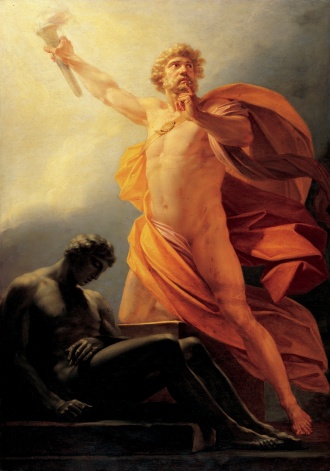
It is here, I think where we see that Mary Shelley has turned the tables on her husband’s Prometheus giving him the will to power seen in Milton’s Satan whom Percy Shelley in his tale of the Titan had tried to find an alternative for. Scientists would oblige Mary’s warnings by coming up with such horrors as the machine gun, chemical warfare, aerial bombing, nuclear weapons, napalm and inhumane medical experiments such as those performed not just by the NAZIs, but by ourselves.

At the same time scientists gave us anesthesia, and electric lighting, penicillin and anti- biotics along with a host of other humane inventions. It is here where the emotional pull of Mary Shelley’s divine imagination loses me and the anti-scientific nature of her novel becomes something I am not inclined to accept.

The idea of hubris is a useful concept some variant of which we must adopt the exploration of which I will leave for another time. In crafting an updated version of the tale of the dangers of human hubris Mary Shelley has dimmed under Gothic shadows some of the illumination of the Enlightenment in which she played a large part. Warnings against following our desire to know is, after all, the primary moral of her novel. As Victor tells the polar explorer Robert Walton who has saved him:

Learn from me, if not by my precepts, at least by my example, how dangerous is the acquirement of knowledge, and how much happier the man is who thinks his native town to be the world, than he who aspires to become more than his nature will allow (Chapter 4, page 2)

Walton on the basis of Victor’s story does prematurely end his polar exploration, perhaps saving his crew from mortal danger, but also stopping short an adventure and as a consequence contracting the horizon of what we as human beings can know. Many of the lessons of Frankenstein; or the Modern Prometheus we need to grapple with and take to heart, yet this refusal to ask or take upon ourselves the danger of attempting to answer the deepest of questions would constitute another very different, though very real, way of losing a elemental component of our humanity.       

Pernicious Prometheus

Prometheus brings fire to mankind Heinrich fueger 1817

It should probably seem strange to us that one of the memes we often use when trying to grapple with the question of how to understand the powers brought to us by modern science and technology is one inspired by an ancient Greek god chained to a rock. Well, actually not quite a god but a Titan, that is Prometheus.

Do a search on Amazon for Prometheus and you’ll find that he has more titles devoted to him than even the lightning bolt throwing king of the gods himself, Zeus, who was the source of the poor Titan’s torment. Many, perhaps the majority of these titles containing Prometheus- whether fiction or nonfiction- have to do not so much with the Titan himself as our relationship to science, technology and knowledge.

Here’s just an odd assortment of titles you find: American Prometheus: The Triumph and Tragedy of J. Robert Oppenheimer, Forbidden Knowledge: From Prometheus to Pornography, Prometheus Reimagined: Technology, Environment, and Law in the Twenty-first Century, Prometheus Redux: A New Energy Age With the IGR, Prometheus Bound: Science in a Dynamic ‘Steady State’ . It seems even the Japanese use the Western Prometheus myth as in: Truth of the Fukushima nuclear accident has now been revealed: Trap of Prometheus. These are just some of the more recent non-fiction titles. It would take up too much space to list the works of science-fiction where the name Prometheus graces the cover.   

Film is in the Prometheus game as well with the most recent being Ridley Scott’s movie named for the tragic figure where, again, scientific knowledge and our quest for truth, along with its dangers, are the main themes of the plot.

It should be obvious that the myth of Prometheus is a kind of mental tool we use, and have used for quite some time, to understand our relationship to knowledge in general and science and technology specifically. Why this is the case is an interesting question, but above all we should want to know whether or not the Promethean myth for all the ink and celluloid devoted to is actually a good tool for thinking about human knowing and doing, or whether have we ourselves become chained to it and unable to move like the hero, or villain- depending upon your perspective, whose story still holds us in his spell.

It is perhaps especially strange that we turn to the myth of Prometheus to think through potential and problems brought about by our advanced science and technology because the myth is so damn old. The story of Prometheus is first found in the works of the Greek poetic genius, Hesiod who lived somewhere between 750 and 650 B.C.E. Hesiod portrays the Titan as the foil of Zeus and the friend of humankind. Here’s me describing how Hesiod portrayed Zeus’ treatment of our unfortunate species.

If one thought Yahweh was cruel for cursing humankind to live “by the sweat of his brow” he has nothing on Zeus, who along with his court of Olympian gods:

“…keep hidden from men the means of life. Else you would easily do work enough in a day to supply you for a full year even without working.”

In Hesiod, it is Prometheus who tries to break these limitations set on humankind by Zeus.

Prometheus, the only one of the Titans that had taken Zeus’s side in coup d’état against Cronos had a special place in his heart for human beings having, according to some legends, created them. Not only had Prometheus created humans who the Greeks with their sharp wisdom called  mortals, he was also the one who when all the useful gifts of nature had seemingly been handed out to the other animals before humans had got to the front of the line, decided to give mortals an upright posture, just like the gods, and that most special gift of all- fire.

We shouldn’t be under the impression, however, that Hesiod thought Prometheus was the good guy in this story. Rather, Hesiod sees him as a breaker of boundaries and therefore guilty of a sort of sacrilege. It is Prometheus’ tricking Zeus into accepting a subpar version of sacrifice that gets him chained to his rock more than his penchant for handing out erect posture, knowledge and technology to his beloved humans.

The next major writer to take up the myth of Prometheus was the playwright of Greek tragedy, Aeschylus, or at least we once believed it to have been him, who put meat on the bones of Hesiod’s story. In Aeschylus’ play, Prometheus Bound, and the fragments of the play’s sequels which have survived we find the full story of Prometheus’ confrontation with Zeus, which Hesiod had only brushed upon.

Before I had read the play I had always imagined the Titan chained to his rock like some prisoner in the Tower of London.  In Prometheus Bound the rebel against Zeus is not so much chained as nailed to Mount Kazbek like Jesus to his cross. A spike driven through his torso doesn’t kill him, he’s immortal after all, but pains him as much as it would a man made of flesh and bones. And just like Jesus to the good thief crucified next to him, Prometheus in his dire condition is more animated by compassion that rage.

“For think not that because I suffer therefore I would behold all others suffer too.”

To the chorus who inquires as to the origin of his suffering Prometheus list the many gifts besides his famous fire which he has given humankind. Before him humans had moved “as in a dream”, and did not yet have houses like those of the proverbial three little pigs made of straw or wood or brick. Instead they lived in holes in the ground- like ants. Before Prometheus human beings did not know when the seasons were coming or how to read the sky. From him we received numbers and letters, learned how to domesticate animals and make wheels. It was him who gave us sails for plying the seas, life in cities, the art of making metals. What the ancient myth of Prometheus shows us at the very least is that the ancient Greeks were conscious of the historical nature of technological development- a consciousness that would be revived in the modern era and includes our own.

In Aeschylus’  play Prometheus holds a trump card. He knows not only that Zeus will be overthrown, but who is destined to do the deed. Definant before Zeus’ messenger, Hermes and his winged shoes, Prometheus Bound ends with the Titan hurtled down a chasm.

Like all good, and more not so good, stories Prometheus Bound had sequels. Only fragments remain of the two plays that followed Prometheus Bound, and again like most sequels they are disappointments. In the first sequel Zeus frees the Titans he has imprisoned in anticipation of his reconciliation with Prometheus in the final play. That is, Prometheus eventually reconciles with his tormentor, centuries later many would find themselves unable to stomach this.

Indeed, it would be a little over a millennium after Hesiod had brought Prometheus to life with his poetry that yet another genius poet and playwright- Percy Bysshe Shelley would transform the ancient Greek myth into a symbol of the Enlightenment and a newly emergent relationship with both knowledge and power.

Europeans in the 18th the early 19th century were a people in search of an alternative history something other than their Christian inheritance, though it should be said that by the middle of the 19th century they had turned their prior hatred of the “dark ages” into a new obsession. In the mid to late 1800s they would go all gothic including a new obsession with the macabre. A host of 19th century thinker including Shelly’s brilliant wife would help bring this transition from brightsky neo-classicism and its worship of reason which gave us our Greco-Roman national capital among other things, to a darker and more pessimistic sense of the gothic and a romanticism tied to our emotions and the unconscious including their dangers.

Percy Shelley’s Prometheus as presented in his play Prometheus Unbound was an Enlightenment rebel. As the child resembles the parent so the generation of Enlightenment and revolution could see in themselves their own promethean origins. Not only had they shattered nearly every sacred shibboleth and not just asked but answered hitherto unasked questions of the natural world their motto being in Kant’s famous words “dare to know”, they had thrown out (America) and over (France) the world’s most powerful kings- earthbound versions of Zeus- and gained in the process new found freedoms and dignity.

Shelly says as much in his preface:

“But in truth I was averse from a catastrophe so feeble as that of reconciling the  Champion with the Oppressor of mankind.”

There is no way Shelley is going to present Prometheus coming to terms with with a would be omnipotent divine tyrant like Zeus. Our Titan is going to remain defiant to the end, and Zeus’s days as the king of the gods are numbered. Yet, it won’t be our hero that eventually knocks Zeus off of his throne it will be a god- the Demogorgon- not a Titan who overthrows Zeus and frees Prometheus. There are many theories about who or what Shelley’s Demogorgon is- it is a demon in Milton, a rather un-omnipotent architect  a bumbling version of Plato’s demiurge- in a play by Voltaire, but the theory I like best is that Shelley was playing with the word demos or people. The Demogorgon in this view isn’t a god- it’s us– that is if we are as brave as Prometheus in standing up to tyrants.  Indeed, it is this lesson in standing up for justice that the play ends:

To defy Power which seems omnipotent

To love and bear to hope till

Hope creates

From its own wreck the thing it contemplates

Neither to change nor falter nor repent his like thy glory

Titan is to be

Good great and joyous beautiful and free

     This is alone Life Joy Empire and Victory

Now, Shelley’s Prometheus just like the character in Hesiod and Aeschylus is also a bringer of knowledge and even more so. Yet, what makes Shelley’s Titan different is that he has a very different idea of what this knowledge is actually for.

Shelley was well aware that given the brilliant story of the rebellion in heaven and the Fall of Adam and Eve that had been imagined by Milton Christians and anti-Christians might easily confuse Prometheus with another rebellious character- Lucifer or Satan. If Milton had unwittingly turned Satan into a hero in his Paradise Lost the contrast with Shelley’s Prometheus would reveal important differences. In his preface to Prometheus Unbound he wrote:

The only imaginary being resembling in any degree Prometheus is Satan and Prometheus is in my judgment a more poetical character than Satan because in addition to courage and majesty and firm and patient opposition to omnipotent force he is susceptible of being described as exempt from the taints of ambition envy, revenge and a desire for personal aggrandizement which in the Hero of Paradise Lost interfere with the interest. The character of Satan engenders in the mind a pernicious casuistry which leads us to weigh his faults with his wrongs and to excuse the former because the latter exceed all measure.

That is, Prometheus is good in a way Satan is not because his rebellion which includes the granting of knowledge is a matter of justice not of a quest for power. This was the moral lesson Shelley thought the Prometheus story could teach us about our quest for knowledge. And yet somehow we managed to get this all mixed up.

The Prometheus myth has cross fertilized and merged with Judeo-Christian myths about the risks of knowledge and our lust for god-like power. Prometheus the fire bringer is placed in the same company as Satan and his rebellious angels, Eve and her eating from the “Tree of Knowledge”, the  story of the construction of the Tower of Babel. The Promethean myth is most often used today as either an invitation to the belief that “knowledge is power” or a cautionary tale of our own hubris and the need to accept limits to our quest for knowledge lest we bring down upon ourselves the wrath of God. Seldom is Shelley’s distinction between knowledge used in the service of justice and freedom which is good- his Prometheus- and knowledge used in the service of power- his understanding of Milton’s Satan acknowledged.

The idea that the Prometheus myth wasn’t only or even primarily a story about hidden knowledge- either its empowerment or its dangers- but a tale about justice is not something Shelley invented whole cloth but a latent meaning that could be found in both Hesiod and Aeschylus. In both, Prometheus gives his technological gifts not because he is trying to uplift the human race, but because he is trying to undo what he thinks was a rigged lottery of creation in which human beings in contrast to the other animals were given the short end of the stick. If the idea of hidden knowledge comes into play it is that the veiled workings of nature have been used by power- that is Zeus- to secure dutiful worship- a ripoff and injustice Prometheus is willing to risk eternal torment to amend.

Out of the three varieties of the Promethean myth- that of encouraging the breaking of boundaries in the name of empowerment (a pro-science and transhumanist interpretation), that of cautioning us against the breaking of these boundaries (a Christian, environmentalist and bioconservative interpretation), or knowledge as a primary means and secondary end in our quest for justice (a techno-progressive interpretation?) it is the last that has largely faded from our view. Oddly enough it would be Shelly’s utterly brilliant and intellectually synesthetic young wife who would bear a large part of the responsibility for shifting the Prometheus myth from a complex and therefore more comprehensive trichotomy to a much more simplistic and narrowing dichotomy.

Mary Shelley’s Frankenstein; or, The Modern Prometheus would turn the quest for knowledge itself into a potential breaking of boundaries that might even be considered a sort of evil. Scientists in the public mind would play the role of Milton’s Satan – hero or villain. Unfortunately in drawing this distinction with such artistic genius Mary Shelley helped ensure that the paramount promethean concern with justice would become lost.  I’ll turn to that tale next time…

I’m going to London! (sort of)

For interested readers of Utopia or Dystopia this Sunday, October 20th there will be a live discussion on The Transhumanist Wager held by the London Futurists. I’ve been invited.

Here’s the announcement:

This “London Futurists Hangout on Air” will feature a live discussion between Zoltan Istvan and a panel of leading futurists and transhumanists: Giulio Prisco, Rick Searle, and Chris T. Armstrong. Questions covered will include:

• Which aspects of the near future depicted in the book are attractive, and which are abhorrent?

• What do panellists think of the basic concept of the transhumanist wager, and of “the three laws of transhumanism” stated in the book?

• What are the best ways for transhumanists and radical futurists to use fiction to engage the wider public in awareness of the positive potential of transhumanist technologies?

Live questions

Futurists who want to join the discussion about the book and the issues raised are welcome to view the discussion live on Google+ or YouTube.

Viewers of the live broadcast on Google+ will be able to vote in real time on questions and suggestions to be discussed by the panellists as the Hangout proceeds.

Here’s how to view or participate:

This event will take place between 7pm and 8.30pm UK time on Sunday 20th October.

You can view the event:

• On Google+, via the page https://plus.google.com/104281987519632639471/posts – where you’ll also be able to vote on questions to be submitted to the panellists

• Via YouTube (the URL will be published here 15 minutes prior to the start of the event).

There is no charge to participate in this discussion.

Note: there is no physical location for this meetup (despite the postcode given above – in compliance with something that the Meetup software seems to insist upon).

No Spoilers please – until the Hangout starts

Wish me luck...


Science, a religious or utopian project?

New Atlantis Island

It is interesting at least to wonder what the scientific revolution would have looked like had it occurred somewhere other than in the West. What latent goals and assumptions might the systematic and empirical study of nature have had if it had arisen somewhere in what were at the time more technologically and scientifically advanced civilizations: in the lands of Islam, in Confucian-Daoist-Buddhist China, in the Hindu lands of southern India?

We will never know, for what we think of as modern science emerged only once and in the context of a Christian civilization, although also one shaped by classical mythology, though more on that another time. Modern science’s latent goals and assumptions, for good an ill, are likely, then, to have been refracted through Christian religious ideas, ideas which are in many ways, I believe, again for good and ill, still with us.

Modern science emerged in a period of increasing rather than declining religious enthusiasm and its earliest proponents such as Descartes, Newton and Francis Bacon were religious and Christian men. The spread of religious literacy to the masses that grew out of the Reformation provided a wealth of ideas around which the project of understanding nature empirically,which was the essence of the new science, could be conceptualized.

One passage of the book of Genesis would prove especially important in the way the scientific project would be understood and granted theological justification.

And God said, Let us make man in our image, after our likeness: and let them have dominion over the fish of the sea, and over the fowl of the air, and over the cattle, and over all the earth, and over every creeping thing that creepeth upon the earth. Genesis 1:26

As Carolyn Merchant has written:

The problem of domination becomes the problem of the Scientific Revolution. Does humanity remain the victim of nature, fatalistically accepting the hand that nature deals in the form of failed harvests and deaths from unknown diseases, droughts, and fires? Or can humanity, by understanding those causes through science and manipulating them through technology, gain the upper hand? As William Leiss pointed out in The Domination of Nature, “the consequence of this view is to set the relationship of man and the world inescapably in the context of domination: man must either meekly submit to these natural laws (physical and economic) or attempt to master them.”

And yet, surely it matters what exactly this idea of dominion actually means, and it is our confusion over what this strange status of being a “lord” over nature is actually for and what its limits are that I believe are at the root of many of our contemporary debates about the proper relationship of science and technology to society and the natural world.

One of the key figures in the shift from pre-scientific to scientific thinking and its move to control nature was Francis Bacon. His utopia, The New Atlantis, reads today like a description of a research university. The members of the scientific institution which governs the island- Solomon’s House- focus their energies on observation and experimentation. They set up weather stations, work on understanding the properties of metals, research remedies on improving human health and longevity. They send out missions that are essentially involved in scientific and technological espionage seeking to bring back to their island of Bensalem useful knowledge discovered by other peoples all the while trying to keep their own knowledge and even their very existence hidden.

Bacon’s works, and not just The New Atlantis are surrounded by Christian themes and motifs. The inhabitants of Bensalem are given special revelation of the Christian gospels, their governing institution traces its roots to the Old Testament’s King Solomon. Many scholars such as the political theorist Howard B. White in his Peace Among the Willows have argued that this religious talk was all a clever ruse by Bacon, and that what he was really after was a reconceptualized idea of power that would strengthen the nascent modern state.

Yet White’s is not the only view. Stephen A. McKnight in his The Religious Foundations of Francis Bacon’s Thought makes a compelling case that we should take Bacon’s religious rhetoric seriously. Indeed, if McKnight is correct the idea of dominion found in Bacon leans science much more in the direction of being a humanist and compassionate utopian project than being a road to human power.

As was the case with many of his fellow travelers in the early days of the scientific revolution, McKnight argues that Bacon was deeply influenced by religious ideas and their tumult swirling around him. He too spring boarded off of Genesis 1:26 to come up with new ideas about humanity’s relationship to nature and the development of knowledge over time.

More precisely, Bacon had the idea that in the “prelapsarian” state before Adam and Eve’s Fall human beings understood the work handiwork of God- nature- perfectly and without effort. Just as Protestants had revived millennial expectations that at last human beings were bringing into being the true nature of the Christian message,and therefore the possibility even in a postlapsarian world of living a Christian life,  Bacon believed that his “new science” would restore in some measure the dominion over nature promised to Adam and the knowledge of the natural world that the first parents possessed in their prelapsarian state.

Yet what was such dominion actually for, and why would God, in Bacon’s eyes allow such a restoration of human powers? There is a one word answer to this question- charity.

Here is McKnight:

It is well known that Bacon repeatedly links the knowledge of nature with the ability to bring relief to man’s estate. Most often this linking is associated with knowledge as power. What is often overlooked is Bacon’s emphasis on charity as the motive for using the knowledge of nature for the benefit of humankind. It is wrong, therefore, to link Bacon to a Faustian exercise of egomaniacal power. The understanding of nature enables humanity to enjoy the blessings that God provides.” (43)

If you don’t believe him, here is McKnight quoting Bacon himself speaking of the three types of reasons for which the dominion over nature that came from unveiling its secrets might be exercised:

The first is of those who desire to extend their own power in their own native country; which kind is vulgar and degenerate. The second is of those who labor to extend the power of their country and its dominion among men. This certainly has more dignity if not less covetousness.  But if a man endeavor to establish and extend the power dominion of the human race itself over the universe, his ambition (if ambition it can be called) is without doubt a more wholesome thing and more noble than the other two.  (97)

In other words, science is a project that can be directed by individuals against other individuals, by human groups (and we should include corporations) over and against other groups or is a project that is aimed at the benefit of humankind as a whole,which is how Bacon understood charity as in the improvement of “man’s estate.” We’ve essentially been faced with these three choices ever since.

McKnight is at pains to show that even the restoration of humanity’s prelapsarian control of nature did not mean, for Bacon, that human beings had assumed “God-like” powers. Man was an imitator not a creator. Bacon would have considered our confusion of our own powers with the powers of God a form of idolatry- turning our ideas and capabilities into idols to be worshiped. It was this question of the idolatry latent in the new science that would be the launch point of another great thinker of this period- John Milton.

I have written on Milton’s Paradise Lost before, so I will quote myself.

[Paradise Lost] is the tale of Lucifer and his angelic allies’ rebellion against God, the Son of God, and the angels that remain loyal to their Creator. Lucifer’s rebellion is sparked by his claim that angels are “self-begot”, and therefore owe no worship to God and his Son. The rebels are single-handedly casts out of Heaven by the Son of God, and into the depths of Hell, where they become monstrous, shift-shaping demons. Under the encouragement of the demon, Mammon, (literally “money”), they build Hell’s capital of glittering gold, Pandemonium. This city is supposed to replicate the glorious visages of Heaven, but, though more splendid than any earthly city, remains but Heaven’s pale shadow.

Satan plots his revenge against God, and finds his opportunity in the weak link of God’s new creation- Adam and Eve. After a courageous and epic journey through the depths of Hell, Satan makes his way to the earthly Garden of Eden, where in the form of a serpent, he convinces Eve that the Tree of  Knowledge of Good and Evil God had commanded her and Adam not to eat of on pain of death, is instead the means to upgrade to a god herself.

Ye eat thereof, your eyes that seem so clear,
Yet are but dim, shall perfectly be then
Open’d and clear’d, and ye shall be as gods. (PL 286)

Eve takes the bait, and Adam the ever dutiful husband follows her lead. Rather than leading to godhood, eating from the Tree of Knowledge results in the couple’s expulsion from the Garden and the beginning of the sad fate of human beings until the arrival, promised to Adam by the archangel, Michael, of the Messiah.

If Bacon was trying to recover a prelapsarian knowledge of nature with his new science, Milton might be thought of as trying to unveil this prelapsarian world itself through his enormous powers of intuition, imagination and poetry. Yet, in Milton we also find a kind of moral critique that warns us not to confuse our new found material powers with the ability to self-generate, to actually be gods which is the driving force behind his version of Satan’s rebellion, and the Fall itself.

And this is what people today who talk of us “becoming gods” or “omnipotenders” or any such thing are engaged in- a category error thinkers and poets such as Bacon and Milton warned us against. Or, in secular terms they have taken but one piece of religious mythology, inverted it, and have confused themselves into thinking it is real. God in Christian mythology can be the architect, designer and controller of nature because he is thought to be somehow “outside” or “above” nature like a player of Simcity.

I often wonder whether the type of science we have would have emerged absent this Christian originating confusion that we are somehow “outside” of nature, or if science could have emerged at all without such confusion? There are no real answers to those questions. What we do know is that we are actually inside of nature and therefore incapable of exercising god-like sovereignty over it because affecting one thing means changing another which then affects us and so on and so on ad infinitum. There is no return to a prelapsarian state as either fully empowered human beings or as gods because no such state ever existed- it was a myth which allowed us to launch and exercise a new form of still very limited control over our surroundings. And still, we can not forget that such limited control is real and its results are astounding, but the powers themselves are morally neutral. The question is what should we use them for?

As Bacon pointed out, such control over nature can be used for a host of different ends. On the more disturbing side science and technology have increased our ability to exercise power over other individuals, and groups to lord over rival groups (including our fellow animals) though the most horrific and truly apocalyptic of these powers are those of states aimed against states, at least to date.

Even so it is undeniably the case that, at the same time, absolutely nothing has improved “man’s estate” more than science and technology. Because of the revolution Bacon helped spark we live better and longer and there are more of us than ever before. This science used for the benefit of others should be understood in broadest terms as Bacon’s charity. Freed from its Christian derived prejudice that only the well-being of human beings count because they are considered the only creature made in the “image of God” such charity is easily extendable outward to the animal world or perhaps someday sentient machines.

Though its exact boundaries and priorities are likely to be forever contentious, charity, unlike the similarly Christian derived desire to become “godlike”, is sensible and translates across a wide range of human value systems both secular and religious. Buddhists understand it, as do Muslims. As mentioned the urge to charity can be found at the heart of the secular left. And yet science is not often understood in this Baconian sense of charity ,or perhaps worse the best path to charity is too little seen in science.  Imagine, for instance, a world where a good portion of the Muslim obligation to charity, the zakat, estimated to be fifteen times global humanitarian aid went to science and technology to improve the lot of people in the poorer parts of the Islamic world.

In our diverse modern world Baconian charity is perhaps the only almost universally acceptable utopian project possible and our best road to survive as a species. Bacon’s question of whether or not we use science and technology primarily as our greatest tools for improving “man’s estate” as in charity, or instead use the as a means of power and control that serves our individual ambitions and group rivalries will inevitably decide whether or not newfound form of knowledge that we call science was ultimately a blessing- or a curse.

The Falling Sky: A Different Sort of Science Fiction

“…bodies are actually quite pointless substitutes for people.”

Pippa Goldschmidt, The Falling Sky

Rebecca Rosen over at  Atlantic has a fascinating recent article about how the MIT Media Lab is using science-fiction to help technologists think through the process of design. Not merely to think up new gadgets, but to think iteratively and consciously about the technologies they are creating to try and prevent negative implications from occurring before a technology is up and running. A fascinating idea that get us beyond the endless dichotomy of those who call for relinquishment and those urging, risks be damned, full-steam ahead.

For how little respect it gets in literary circles, science-fiction, is a genre that takes the big questions seriously and remains the best tool we have for thinking through the social and ethical questions brought about by technology and for reflecting upon what it means to be human given the decline, at least among many educated persons, of the kinds intellectual and emotional buttresses once provided by religion and the adoption of a materialist worldview that has been built largely out of the discoveries of modern science.

It was in the sense of reflecting upon what it means to be human and what all those experiences that surround every human life such as time, birth and death, love and loss, from a standpoint that is essentially agnostic or atheistic that I found the recent first novel called The Falling Sky  by the one time astronomer, Pippa Goldschmidt, such an amazing work of art. It is as if Goldschmitt has invented a brand new form of science-fiction though perhaps she doesn’t think of her work as any sort of science-fiction at all.

I first learned of Goldschmidt from a piece she had written for the New York Times. She wrote of her experience as an astronomer, working, as astronomers needing to escape the constant glare of our city lights need to do, in one of the remotest of places, in this case the Atacama Desert, in Chile. North of the observatory at which she worked lay a place with a horrible history, Chacabuco, a former concentration camp from the 1970’s set up by the regime of Augusto Pinochet. Goldschmidt wrote of the disjunction between the astronomical work she was engaged in and the horrors of Chacabuco:

Our telescopes had the power to detect candle flames many miles away, not to mention galaxies billions of light years away. And yet they never turned toward the camp. They weren’t built to do that sort of observation.

And I thought; how pregnant with reflection on the nature and role of science, with the need to confront historical memory, with the demand that we keep our eyes open to the truths of the human and not just the natural world , is that! When I saw that Goldschmitt had just published The Falling Sky I felt compelled to buy it, and although the specific juxtaposition of astronomers working in the Atacama with the harsh world of Chacabuco played only a small part in the novel, it did not disappoint. What I found instead in The Falling Sky was a deep reflection on science and consilience, memory and truth, certainty and uncertainty, life and death.

The Falling Sky tells the story of the Smith family and their struggle to recover from the death of the oldest daughter, Kate, in a mysterious drowning accident. The three remaining Smiths, Jenette (the protagonist), her mother and her father each respond to Kate’s death in radically different ways all of which share the feature of being ways to reorient themselves in time. What each of the Smiths attempt to recover is the world of the past- the world where Kate was still vibrant and alive though the ways in which these attempts at recovery are made are radically different.

It is in part Kate’s death and even more her parent’s reaction to it, that draws Jeanette to the stars. The vast interstellar distances mean that looking at the night sky is also looking into the past and becomes a sort of comfort for Jeanette. It is partially in the search for a framework of meaning that would make sense of Kate’s death that Jeanette will turn her passion for astronomy into a successful career. The novel is also, then, a book about the internal politics of science, its very human vanity and careerism, the role of women in science and how psychological need and inclinations influence the process of scientific discovery itself.

Jeannette’s astronomical explorations in Chile result in what might amount to a monumental discovery: two galaxies linked together in such a way that the Big Bang theory of the origin of the Universe seems challenged. Precisely the idea that had drawn Jeannette to astronomy while a child as a way to understand Kate’s death. Up until the time of this discovery science has offered Jeanette a clear line of causation that serves as an alternative to the contingency not just of Kate’s death but her birth.

Kate was born 13.7 billion years ago in the Big Bang…

Indeed, for Jeannette astronomy itself is almost a religious practice:

Those journeys up the mountain into air stretched out thin feel as if they take place in another life. Perhaps they’re the scientific equivalent of going to a monastery. Perhaps the only way to understand the universe is to retreat from normal life.

The light now seen from those stars has been emitted by them before Kate died. She has the power to see into the past into a world that is innocent of Kate’s death.

The only way to escape is to travel into atoms and stars….. To uncover the ages of the Universe, like geologic layers, and see how the constant expansion of the Universe makes time happen.”

Jeanette can contrast the solidity of cosmic evolution from Big Bang to the formation of galaxies and stars to the emergence of life which gave rise to her lost sister Kate to “the other version” of her sister being born, the human version, with Kate and Jeannette’s parents meeting on a train platform by sharing a handkerchief. The human story is too contingent, accidental, “ too uncertain, there are too many unknowns”. It also a version subject to the inconstancy of human memory- each parent with a slightly different version of how they met the other- who gave the handkerchief to whom?

If Jeannette’s answer to the death of her sister is to turn her gaze away from the present and peer into deep time, her parent’s engage in their own attempts to keep to reach into the past and hold onto the time before their daughter’s death no matter how much such efforts end up distorting the present and robbing them of the future.

For Jeanette’s mother the goal becomes to freeze time to kept the stream of entropy damned at the time of Kate’s death. The mother does this by creating a kind of museum room for Kate in the family’s new house, a house Kate herself never lived in. The room

… is like an event horizon showing the last bit of ordinary life clinging to Kate.

Jeanette’s mother also takes on a new career and becomes a de-clutterer helping people to purge themselves of their accumulated things.

Jeanette can’t stop thinking of all the things taken away, like some surgical procedure performed by her mother. People amputated from their favorite belongings.

In a way you might see the actions of Jeanette’s mother as a sort of stand against the forces of entropy, the source of the universe’s arrow of time, the fact that things pile up transform, grow chaotic, inevitably change. Jeanette’s mother wants a world frozen in amber at the time of her daughter’s death and has in the process turned her family’s home into “a desert devoid of time.”

The response of Jeannette father to Kate’s death is also one of trying to anchor himself to the past though at first he is confronted by the garden grown with his own hands and its display of the ability of nature to seemingly escape death through it’s capacity to begin again.

But as her dad tended to the garden and watched it grow, he must have realized how blind all this activity is. There’s no intent, no purpose to this new grass. It simply is. And Kate simply isn’t. It must have taunted him with its ability to revive and renew.

The initial response of Jeannette father, however, is to set his garden ablaze and in the process burn himself. His response, thereafter, is not to tend to his vegetable garden and flowers, the only type of resurrection he can control, but to try to anchor himself to the past in a way that is similar to that of his wife and Jeannette. Shortly before Kate’s death he had been flirting with a woman, and he now throws himself into extramarital affairs which also serve as an escape from the suffocation of his home.

Yet, if The Falling Sky gives us a whole world of reflection on the subject of time and death, it is a novel of much else besides, such as giving us a new and what I found to be a deeper version of what E.O Wilson called “consilience”- the coming together of science and the humanities.

In contrast to the way the digitization of the tools of astronomy have cut astronomers off from the sky they see with their eyes, which is what Jeannette experiences during her research in Chile, her early love of astronomy grew not only from an urge to escape but from the desire to partake of a kind of unveiling where the true nature of the universe could be seen. In developing an exposure of Rigel one of the many double stars of Orion:

This is what she can do. Make the unseen, seen. Find things and know them. These things are real to her, even though she can’t reach them.

Later in her life, Jeannette’s lover Paula who is an artist engages in a similar sort of unveiling. Her portrait of Jeannette dealing not with her surface but uncovering what might only be called her essence. In the same way that Jeannette photographs of her first, and unrequited love while she was a teenager, Alice, were an attempt to unveil the girl’s “soul”. In a way the failure of this love when Alice flees at the confession of Jeannette’s feelings sets the stage for her obsessive focus on astronomy. Viewed from a sufficient distance the universe will not crush you and yet still offers itself up to be unveiled.

Sex too is presented as the same sort of unveiling, the discovery of a body and the depth of the person behind it. Jeannette understands this in the language of science:

Since they became lovers, Paula exists in several dimensions in a way no one else does…. they don’t overwhelm her with information and memories in the way that Paula does. She can’t look at Paula’s arms without being reminded of the first time she stroked them, and felt the texture of the skin. Only Paula fully inhabits space and time.”

Goldschmitt is offering here a version of consilience that is much different than the kinds of hierarchy of knowledge seen in the works of E.O. Wilson. Rather than science being the perspective from which all fields of knowledge derive their ultimate sanction, science is just one among many different not so much types but practices of seeing and unveiling to see. Astronomy reveals one type of truth about the universe, but so does painting and even love. Yet, this kind of unveiling demands a kind of openness to what one will find once one attempts to really know something or someone, and such openness can best be understood as a willingness to accept uncertainty. Perhaps, The Falling Sky might best be understood as a primer on accepting uncertainty as the price of deep knowledge and this is as much the case for science as it is for art and even more so when it comes to romantic love.

In the scenes where Jeannette is interviewed by the BBC, Goldschmitt not merely manages to display the way in which science is distorted by modern media and those vested in some particular outcome when it comes to scientific discovery but the centrality of uncertainty for the practice of science itself.

Jeannette’s discovery undermining the support for the Big Bang becomes fodder for religiously inspired intelligent- design “loons” who see in her touching galaxies a cosmic scale version of Michelangelo’s “God and Man”. But traditional religion appears much less pernicious than the peddlers of pseudo-science who run far ahead of Jeannette potentially paradigm shifting discovery.

Here is how Goldschmitt describes one such peddler, David Grant, being interviewed with Jennette on the BBC about the implications of her discovery:

Grant: “Oh, there are all sorts of possibilities. The plasma universe is one. In this model everything is connected by twisted magnetic fields…’  He’s off. Not even the interviewer can stop him spouting an incontinent stream of alternative theories… It’s all words. He’s not making any attempt to explain these madcap ideas they’re just spilling out all over the studio, most likely confirming the interviewer’s prejudice that science is long words and jargon, designed to exclude ordinary people.”

Jeannette directly confronts the interviewers notion that science exists to give us clear and unambiguous answers:

That’s exactly what science isn’t about…. it’s about quantifying uncertainty.

Yet, the extent to which Jeannette has been dependent on the control over uncertainty she has gained through astronomy is shown when the Orion probe, which is the only means by which her touching galaxies and their implications for the Big Bang can be definitively established, blows up at launch. At that she suffers mental breakdown unable to reconcile a long lasting uncertainty, which she herself has caused, regarding the very theory upon which she has centered her personality.

‘What else would be normal if we didn’t have a Big Bang?’ ‘It would just be- chaos. No structure at all.’  And she realizes, maybe for the first time, that most people don’t have this structure to their lives. This cosmic scaffolding to cling onto. Perhaps that’s why they go for religion.

By choosing a course that seemed to grant her financial certainty, as in tenure and grants through the notoriety of her findings, Jeannette has put at risk and ultimately lost the kind of cosmic solidity that she has embraced in light of her sister’s death.

What Goldschmitt is exploring here is a relationship between the accepting uncertainty and our orientation towards both the world around us and the people we place our trust in within it. Any open exploration in science, in art, in love means we may discover something we do not like or might not want to know. It is a form of risk taking where risk consists of losing the very identity, and our affection for and connection to the very object, that pulled us towards it in the first place.

Many human endeavors exist in this space besides art, science, and love. Plato in his Symposium describes philosophy as a form of love that works in this way. Religion, not when it is the source of “answers”, but in its mystical manifestations which are born of the search for God and end in an acceptance of the ineffable nature of the divine is like this as well.

Goldschmitt is also exploring the relationship of uncertainty and our orientation towards the future. Jeannette’s family is restored only when the uncertain nature of Kate’s drowning death is laid out for all to see and confront. In accepting this other risks and their uncertain outcomes can now be embraced- Jennette can be open with her family about her sexuality as can her father with his infidelities. Jeannette can walk away from renewing her relationship with Paula in a spirit of openness to what the future might bring.

Jeannette ultimately comes to see Kate’s death in a way similar to how her father experienced his garden but was initially unable to accept:

But even in nothing there is always something. Nothingness never actually exists. Nothing plus the uncertainty principle will always make something, particles of energy that pop into being and out again. The higher their energies the shorter their lives. That’ll do for her. She can play with that.

In writing The Falling Sky Goldschmitt has provided an alternative to the common literary tropes that are so often found when scientists are found in a work of fiction. There is the Promethean trope of the scientist struggling against the odds and against the forces of ignorance to arrive at the truth whose mirror image is the equally as common myth of Dr Frankenstein, the mad scientist whose hubris leads to destruction. The Falling Sky might be thought of as a version of realist science-fiction. The scientists in Goldschmidt’s novel, including Jeanette herself, are driven as much if not more by petty careerist aspirations and their own unmet psychological needs as by any heroic desire for the truth. At the same time, the scientist in The Falling Sky are no Dr Frankensteins either. Perhaps Jeannette’s ultimate goal is to understand the world as it really is and as best as she can and manifest a deep kind of inner courage in being willing to submit beliefs that for her have such deep psychological meaning to the challenge of scientific verification.

Goldschmidt’s leap over these two tropes of science-fiction is a perfect compliment to the much different use of science-fiction as a guide to ethical pre-design being experimented with at the MIT Media Lab whose premise is that both blind faith in science and technology and outright rejection is too simplistic. Let’s take warnings about the potential ill effects of a technology seriously and see if we can design around them before the technology is actually deployed.

Although we should not expect to always to have easy answers. Indeed, sometimes we see something more clearly even if no definitive answers have been provided at all. Above all, for me, that was what I gained by reading this wonderful little novel. In a way few works have done for me, after putting the book down I felt I knew more about time, and memory, and death, about what it means to live itself, and yet I was no nearer to any answers and felt even these revelations were beyond my power to articulate.

On the Space Between the Human and the Post- Human

Utopia sign

What especially distinguishes human beings from other animals has been the degree to which they seek out and invent ways to leverage the basics of their biology to reach ever more complex levels of thought and action. Early human beings leveraged their fragile and limited bodies with tools including fire, leveraged their own natural psychology using naturally occurring drugs and religious rituals and used music to obtain a more emotional connection with one another and the world. They most especially leveraged the range of their own knowledge through language, which gave them both a more broad and comprehensive picture of the present, and allowed them to convey lessons learned across generations so that repeat mistakes could be avoided.

The movement into cities and the creation of written language and number systems was another such leveraging. The development of broad ethical systems in the form of world religions was so as well, and many of these religions ramped up human capabilities that were present in the prehistorical phase- the capacity for artistic and musical expression exploded, new forms of internal-emotional or mystical exploration were developed.  These religions were also the first to imagine “perfect worlds” as in world’s free from the ills that seemed to eternally plague individuals and societies- disease, famine, poverty, violence, war, pain, suffering, and death.

Until the modern era there was a tendency on the part of religion to bear down on the only elements of this miserable equation where their efforts could be shown to have a real effect- the moral and internal aspects. And then came science.

In the 16th century modern science emerged as a way to address these perennial human problems.  Science along with political and social reorganization proved extremely effective at coming up with practical solutions to many of these problems. Not complete elimination of them to be sure, but substantial amelioration. Science was a new and extremely powerful form of leverage allowing human beings to form intricate understandings of how nature worked and then ride or tweak these understandings to achieve goals they wanted to obtain.

Transhumanism as the philosophy of the post-human focuses itself on the speculation and imagining of future extensions and leveraging. Yet, the line of demarcation between a continuation of what we have always done in the past and the reaching of some state where we are recognizably no longer human beings has never been absolutely clear. When will we experience changes which are qualitatively greater than the development of written language, empirical science, adoption of universal education, industrialization and its multifold machines, or any of the other huge phase changes humanity has undergone since it emerged in Africa anywhere from 200,000 to 50,000 years ago?

The farther out one goes, of course, the more likely such qualitative shifts appear, but I think that the shift to something that is so far from humanity that it is no longer recognizable as human in terms of morphology, lifespan, intelligence and the like seems unlikely until at the very earliest sometime in the 22nd century, much less the holy grail of 2045 which so many transhumanists and singularitarians hold as an end point.

How much morphologically distinct, long-lived, intelligent etc a human descendant would have to be to be considered post-human is anybody’s guess, but before that the problem of how to better distribute the positive aspects found in the range of differences human beings already have would likely been solved first. The reason for this is quite simple: evolution has already figured out how to achieve outliers in characteristics we wish were more widely distributed. Even if we stick with just human beings, some, today, are active into their 90’s and live to be as old as 120. Some human beings, today, show prodigious talents in sport, mathematics, creativity etc.

The problem of even combining these already present outlier characteristics in one person is likely to be a formidable one. Einstein was a genius when it came to physics, but was not also a great composer, novelist, painter, athlete etc. We should also remember Orgel’s Second Rule “Evolution is cleverer than you are” in gauging the complexity of technical challenges in front of us. It must not be easy to get human beings to live out beyond 120 years of age because otherwise it would be found somewhere among human beings. It must not be easy to create human beings who are simultaneously prodigious across all forms of human endeavor. Unacknowledged too is the fact that mastering the environment is just as important to the question of how to raise human potential as any firmer grasp of underlying neurological and biological mechanisms.

We are likely to spend a prolonged period merely learning what evolution- both natural and cultural- already knows and trying to more widely distribute these still human capabilities. This potential flowering of full human capabilities is the space between the human and the post-human. While it is definite that should our species survive for a long enough period of time it will give rise to descendants who are in some very large ways qualitatively different from us we will probably find ourselves in this interim stage first. Such a stage may last a very long time, indeed, we may choose as a species to have it last a very long time.

All this by a circuitous route brings me to a new way of looking at human rights known as the “Capability  Approach” or “Capabilities Approach”. Pioneered by thinkers such Amartya Sen and Martha Nussbaum the Capabilities Approach is not much older than contemporary transhumanism itself dating from the late 1970’s. CA manages to combine two very different utopian projects- the human rights and development projects.

Rather than focus on abstract rights CA looks closely at the individual person within their specific political, social and economic context by asking the question: “What are people able to do and to be?” CA is particularly interested in the situation of disabled persons and aims to draw attention to the question of whether or not society is so structured as to allow persons with disabilities to have access to the full-range of human potential. In terms of social justice CA seeks not so much social leveling as it calls for living standards that have become the norm in advanced countries to be extended to all human beings, something that given current circumstances requires redistribution to achieve.

Nussbaum herself has come down solidly in favor of many techno-progressive concerns from stem cells, to the liberalization of neurological drugs, to animal rights and the push to expand the range of human longevity. And in the case of longevity, unlike what I take to be the position of transhumanists more generally, but similar to techno-progressives more specifically, Nussbaum is concerned with the question of equity when comes to such gains.

 Here is Nussbaum on longevity:

And what about the question of death? Is it somehow contrary to human dignity to seek to prolong life? Once again, the use of the term “natural” seems to me to do great harm, as when people talk about extending life “beyond the natural lifespan,” or, as I heard on NPR yesterday, “beyond our allotted threescore years and ten”-as if that figure were given by the stars or fate, rather than by conventional human experience.

People used to have a life expectancy at birth of around 35 years. (That seems to have been the situation in ancient Greece, where the effects of a healthy climate were greatly undercut by persistent warfare.) In the developing world today, average life expectancy at birth is still under 40 in many nations. Many people in those nations, especially those with no literacy, probably believe, then, that it is “natural” to die early, just as they may believe that it is “natural” that a majority of one’s children will die before age five. We know, however, that the low life expectancy in many nations is an artifact of poverty and the unequal distribution of medical care and sanitation. On a recent visit to West Bengal, for example, I attended a workshop on the high rate of maternal mortality in one populous rural district. The primary causes of death mentioned were anemia, unsafe drinking water, and the sheer distance a woman would have to travel to find medical facilities. None of these is “natural” in the sense of “given, inevitable, unable to be changed.”

We should say that what is wrong with this situation is not the fact that life expectancy in the richer nations is now around 80 years. What is wrong is the fact that food, medical care, and lifesaving technologies are so unequally distributed around the globe. Seeking to prolong life for a privileged few while ignoring the low life-capabilities of the many is morally wrong, a violation of the dignity of those who are treated as if they were of unequal human dignity. That is why my capability approach urges ample redistribution from richer to poorer nations, as well as from rich to poor within each nation.

It is morally bad to focus on how one’s own life can be extended while totally ignoring these global inequalities. (That doesn’t mean waiting to do research about extending life until all global inequalities are corrected, since we learn a great deal from basic research, and it often has unexpected dividends in other areas.) The sheer fact of prolonging life is a very good thing, and should be encouraged, up to the point where life becomes nothing like a human life at all, such as when someone enters a persistent vegetative state-or, up until the point when the person, mentally fit and free from undue pressure, chooses not to live.

The reason I find CA instructive for techno-progressives is in its openness to technological change. The concept of rights is too often static and de-contextualized. The “right to life” means different things in a world where people die on average at 45 and where people live into their 80’s. What CA suggests is that once technological and social advancement makes a human good obtainable our efforts should be focused on making sure that good is widely distributed.

Unlike bio-conservatism which looks backward to “nature” and attaches itself to the “natural” and unlike transhumanism that looks forward to post-human possibilities almost exclusively to be realized through technology, CA looks around us asking what is possible in the present, where are these possibilities not found right now, what do we need to do to make sure they are widely available as quickly as possible?    

CA also offers an alternative to the technological fetishism that all types of transhumanism, including techno-progressives, often suffer. Very often the solution to an unreached human capability is technological, but environmental factors are just as important as well and absolutely necessary in the intermediate stages when a technological solution has yet to be fully formulated. It is CA’s interest in disabilities which has allowed it to better articulate such a position than other utopian projects including the traditional human rights and transhumanist discourses.

We should work hard in working out medical and technological interventions that will allow blind people to see, and the deaf to hear and everything in between, but until then the widespread adoption of low-tech wrap-arounds, schools that teach braille and sign language, accessibility requirements for public places and the like need to be as widespread as possible. Once effective medical and technological interventions, including genetic interventions, come online and are proven to be safe they need to be extended to the human population as a whole, again, as quickly impossible.

In a similar vein, we may at some point figure out the neurological mechanisms behind differences in human intelligence or even morality, but that shouldn’t preclude our investment in low-tech methods of achieving those same ends such as good and universal education, good nutrition, the promotion of loving family environments. Indeed, even as we discover the neurological mechanisms behind such things as musical ability we will want to double down on low-tech means of making these capabilities realizable- such as the support for music education in schools.

This space between the human and the post-human is what lies in front of us as far as we are able to confidently predict for we are likely to be able to reach the full limits of humanity for some time before we are able to move beyond them. In this light, the project for techno-progressives would be to bring attention to and support low-tech methods of enabling human capabilities where they continue to be needed even while pushing those capabilities ever outward through medicine and technology. At the same time techno-progressives need to ensure both that these low-tech and high-tech enabled capabilities are widely shared and that attention continues to be paid to the creation and sustaining of environments in which they can be considered meaningful.