Erasmus reads Kahneman, or why perfect rationality is less than it’s cracked up to be

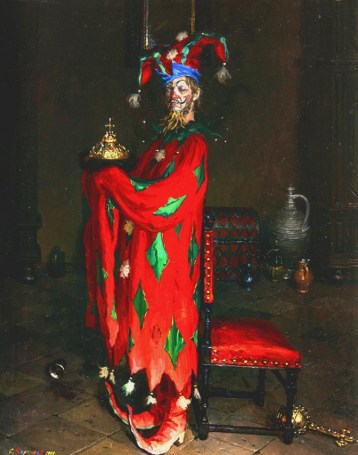
sergei-kirillov-a-jester-with-the-crown-of-monomakh-1999

The last decade or so has seen a renaissance is the idea that human beings are something far short of rational creatures. Here are just a few prominent examples: there was Nassim Taleb with his The Black Swan, published before the onset of the financial crisis, which presented Wall Street traders caught in the grip of their optimistic narrative fallacies, that led them to “dance” their way right over a cliff. There was the work of Philip Tetlock which proved that the advice of most so-called experts was about as accurate as chimps throwing darts. There were explorations into how hard-wired our ideological biases are with work such as that of Jonathan Haidt in his The Righteous Mind.

There was a sustained retreat from the utilitarian calculator of homo economicus, seen in the rise of behavioral economics, popularized in the book, Nudge which took human irrational quirks at face value and tried to find wrap arounds, subtle ways to trick the irrational mind into doing things in its own long term interest. Among all of these none of the uncoverings of the less than fully rational actors most of us, no all of us, are have been more influential than the work of Daniel Kahneman, a psychologist with a Nobel Laureate in Economics and author of the bestseller Thinking Fast and Slow.

The surprising thing, to me at least, is that we forgot we were less than fully rational in the first place. We have known this since before we had even understood what rationality, meaning holding to the principle of non-self contradiction, was. How else do you explain Ulysses’ pact, where the hero had himself chained to his ship’s mast so he could both hear the sweet song of the sirens and not plunge to his own death? If the Enlightenment had made us forget the weakness of our rational souls Nietzsche and Freud eventually reminded us.

The 20th century and its horrors should have laid to rest the Enlightenment idea that with increasing education would come a golden age of human rationality, as Germany, perhaps Europe’s most enlightened state became the home of its most heinous regime. Though perhaps one might say that what the mid-20th century faced was not so much a crisis of irrationality as the experience of the moral dangers and absurdities into which closed rational systems that held to their premises as axiomatic articles of faith could lead. Nazi and Soviet totalitarianism had something of this crazed hyper-rational quality as did the Cold War nuclear suicide pact of mutually assured destruction. (MAD)

As far as domestic politics and society were concerned, however, the US largely avoided the breakdown in the Enlightenment ideal of human rationality as the basis for modern society. It was a while before we got the news. It took a series of institutional failures- 9/11, the financial crisis, the botched, unnecessary wars in Afghanistan and Iraq to wake us up to our own thick headedness.

Human folly has now come in for a pretty severe beating, but something in me has always hated a weakling being picked on, and finds it much more compelling to root for the underdog. What if we’ve been too tough on our less than perfect rationality? What if our inability to be efficient probability calculators or computers isn’t always a design flaw but sometimes one of our strengths?

I am not the first person to propose such a heresy of irrationalism. Way back in 1509 the humanist Desiderius Erasmus wrote his riotous, The Praise of Folly with something like this in mind. The book has what amounts to three parts all in the form of a speech by the goddess of Folly. The first part attempts to show how, in the world of everyday people, Folly makes the world go round and guides most of what human beings do. The second part is a critique of the society that surrounded Erasmus, a world of inept and corrupt kings, princes and popes and philosophers. The third part attempts to show how all good Christians, including Christ himself, are fools, and here Erasmus means fool as a compliment. As we all should know, good hearted people, who are for that very reason nieve, often end up being crushed by the calculating and rapacious.

It’s the lessons of the first part of The Praise of Folly that I am mostly interested in here. Many of Erasmus’ intuitions not only can be backed up by the empirical psychological studies of  Daniel Kahneman, they allow us to flip the import of Kahneman’s findings on their head. Foolish, no?

Here are some examples: take the very simple act of a person opening their own business. The fact that anyone engages in such a risk while believing in their likely success  is an example of what Kahneman calls an optimism bias. Overconfident entrepreneurs are blind to the fact, as Kahneman puts it:

The chances that a small business will survive in the United States are about 35%. But the individuals who open such businesses do not believe statistics apply to them. (256)

Optimism bias may result in the majority of entrepreneurs going under, but what would we do without it? Their sheer creative-destructive churn surely has some positive net effect on our economy and the employment picture, and those 35% of successful businesses are most likely adding long lasting and beneficial tweaks to modern life,  and even sometimes revolutions born in garages.

Yet, optimism bias doesn’t only result in entrepreneurial risk. Erasmus describes such foolishness this way:

To these (fools) are to be added those plodding virtuosos that plunder the most inward recesses of nature for the pillage of a new invention and rake over sea and land for the turning up some hitherto latent mystery and are so continually tickled with the hopes of success that they spare for no cost nor pains but trudge on and upon a defeat in one attempt courageously tack about to another and fall upon new experiments never giving over till they have calcined their whole estate to ashes and have not money enough left unmelted to purchase one crucible or limbeck…

That is, optimism bias isn’t just something to be found in business risks. Musicians and actors dreaming of becoming stars, struggling fiction authors and explorers and scientists all can be said to be biased towards the prospect of their own success. Were human beings accurate probability calculators where would we get our artists? Where would our explorers have come from? Instead of culture we would all (if it weren’t already too much the case) be trapped permanently in cubicles of practicality.

Optimism bias is just one of the many human cognitive flaws Kahneman identifies. Take this one, error of affective forecasting and its role in those oh, so important of human institutions, marriage and children. For Kahneman, many people base their decision to get married on how they feel when in the swirl of romance thinking that marriage will somehow secure this happiness indefinitely. Yet the fact is, married persons, according to Kahneman:

Unless they think happy thoughts about their marriage for much of the day, it will not directly influence their happiness. Even newlyweds who are lucky enough to enjoy a state of happy preoccupation with their love will eventually return to earth, and their experienced happiness will again depend, as it does for the rest of us, on the environment and activities of the present moment. (400)

Unless one is under the impression that we no longer need marriage or children, again, one can be genuinely pleased that, at least in some cases, we suffer from the cognitive error of affective forecasting. Perhaps societies, such as Japan, that are in the process of erasing themselves as they forego marriage and even more so childbearing might be said to suffer from too much reason.

Yet another error Kahneman brings our attention to is the focusing illusion. Our world is what we attend to and our feelings towards it have less to do with objective reality than what it is we are paying attention to. Something like focusing illusion accounts for a fact that many of us in good health would find hard to believe;namely, the fact that paraplegics are no more miserable than the rest of us. Kahneman explains it this way:

Most of the time, however, paraplegics work, read, enjoy jokes and friends, and get angry when they read about politics in the newspaper.

Adaption to a new situation, whether good or bad, consists, in large part, of thinking less and less about it. In that sense, most long-term circumstances, including paraplegia and marriage, are part-time states that one inhabits only when one attends to them. (405)  

Erasmus identifies something like the focusing illusion in states like dementia where the old are made no longer capable of reflecting on the breakdown of their body and impending death, but he captured it best, I think in these lines:

But there is another sort of madness that proceeds from Folly so far from being any way injurious or distasteful that it is thoroughly good desirable and this happens when harmless mistake in the judgment of the mind is freed from those cares would otherwise gratingly afflict it smoothed over with a content and faction it could not under other so happily enjoy. (78)

We may complain against our hedonic setpoints, but as the psychologists Dan Gilbert points out they not only offer us resilience on the downside- we will adjust to almost anything life throws at us- such set points should caution us that in any one thing- the perfect job, the perfect spouse lies the key to happiness. But that might leave us with a question, what exactly is this self we are trying to win happiness for?

A good deal of Kahneman’s research deals with the disjunction between two selves in the human person, what he calls the experiencing self and the remembering self. It appears that the remembering self usually gets the last laugh in that it guides our behavior. The most infamous example of this is Kahneman’s colonoscopy study where the pain of the procedure was tracked minute by minute and then compared with questions later on related to decisions in the future.

The surprising thing was that future decisions were biased not by the frequency or duration of pain over the course of the procedure but how the procedure ended. The conclusion dictated how much negative emotion was associated with the procedure, that is, the experiencing self seemed to have lost its voice over how the procedure was judged and how it would be approached in the future.

Kahneman may have found an area where the dominance of the remembering self over the experiencing self are irrational, but again, perhaps it is generally good that endings, that closure is the basis upon which events are judged. It’s not the daily pain and sacrifice that goes into Olympic training that counts so much as outcomes, and the meaning of some life event does really change based on its ultimate outcome. There is some wisdom in the words of Solon that we should  “Count no man happy until the end is known”which doesn’t mean no one can be happy until they are dead, but that we can’t judge the meaning of a life until its story has concluded.

“Okay then”, you might be thinking, “what is the point of all this, that we should try to be irrational”? Not exactly. My point is we perhaps should take a slight breather from the critique of human nature from standpoint of its less than full rationality, that our flaws, sometimes, and just sometimes, are what makes life enjoyable and interesting. Sometimes our individual rationality may serve larger social goods of which we are foolishly oblivious.

When Erasmus wrote his Praise of Folly he was clear to separate the foolishness of everyday people from the folly of those in power, whether that power be political power, or intellectual power such as that of the scholastic theologians. Part of what distinguished the fool on the street from the fool on the throne or cloister was the claim of the latter to be following the dictates of reason- the reason of state or the internal logic of a theology that argued over angels on the head of pins. The fool on the street knew he was a fool or at least experienced the world as opaque, whereas the fools in power thought they had all the answers. For Erasmus, the very certainty of those in power along with the mindlessness of their goals made them, instead, even bigger fools than the rest of us.

One of our main weapons against power has always been to laugh at the foolishness of those who wield it. We could turn even a psychopathically rational monster like Hitler into a buffoon because even he, after all, was one of us. Perhaps if we ever do manage to create machines vastly more intelligent than ourselves we will have lost something by no longer being able to make jokes at the expense of our overlords. Hyper-rational characters like DATA from Star Trek or Sheldon from the Big Bang are funny because they are either endearingly trying to enter the mixed-up world of human irrationality, or because their total rationality, in a human context, is itself a form of folly. Super-intelligent machines might not want to become flawed humans, and though they might still be fools just like their creators, likely wouldn’t get the joke.

Welcome to the New Age of Revolution

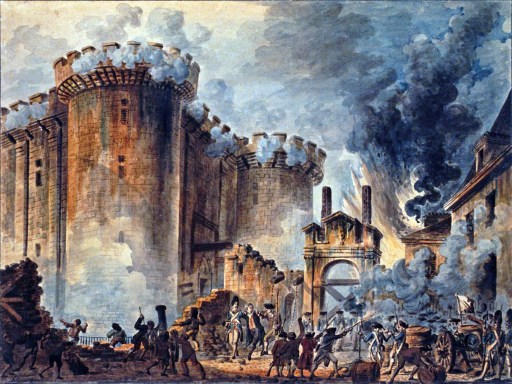
Fall of the Bastille

Last week the prime minister of Ukraine, Mykola Azarov, resigned under pressure from a series of intense riots that had spread from Kiev to the rest of the country. Photographs from the riots in The Atlantic blew my mind, like something out of a dystopian steampunk flic. Many of the rioters were dressed in gas masks that looked as if they had been salvaged from World War I. As weapons they wielded homemade swords, molotov cocktails, and fireworks. To protect their heads some wore kitchen pots and spaghetti strainers.

The protestors were met by riot police in hypermodern black suits of armor, armed with truncheons, tear gas, and shotguns, not all of them firing only rubber bullets. Orthodox priests with crosses and icons in their hands, sometimes placed themselves perilously between the rioters and the police, hoping to bring calm to a situation that was spinning out of control.

Even for Ukraine, it was cold during the weeks of the riots. A situation that caused the blasts from water cannons used by the police to crystalize shortly after contact. The detritus of protesters covered in sheets of ice like they had be shot with some kind of high tech freeze gun.

Students of mine from the Ukraine were largely in sympathy with the protestors, but feared civil war unless something changed quickly. The protests had been brought on by a backdoor deal with Russia to walk away from talks aimed at Ukraine joining the European Union. Protests over that agreement led to the passage of an anti-protest law that only further inflamed the rioters. The resignation of the Russophile prime minister  seemed to calm the situation for a time, but with the return of the Ukrainian president Viktor Yanukovych  to work (he was supposedly ill during the heaviest of the protests) the situation has once again become volatile. It was Yanukovych who was responsible  for cutting the deal with Russia and pushing through draconian limits on the freedom of assembly which had sparked the protests in the first place.

Ukraine, it seem, is a country being torn in two, a conflict born of demographics and history.  Its eastern, largely Russian speaking population looking towards Russia and its western, largely Ukrainian speaking population looking towards Europe. In this play both Russia and the West are no doubt trying to influence the outcome of events in their favor, and thus exacerbating the instability.

Yet, while such high levels of tension are new, the problem they reveal is deep in historical terms- the cultural tug of war over Ukraine between Russia and Europe, East and West, stretches at least as far back as the 14th century when western Ukraine was brought into the European cultural orbit by the Poles. Since then, and often with great brutality on the Russian side, the question of Ukrainian identity, Slavic or Western, has been negotiated and renegotiated over centuries- a question that will perhaps never be fully resolved and whose very tension may be what it actually means to be Ukrainian.

Where Ukraine goes from here is anybody’s guess, but despite its demographic and historical particularities, its recent experience adds to the growing list of mass protests that have toppled governments, or at least managed to pressure governments into reversing course, that have been occurring regularly since perhaps 2008 with riots in Greece.

I won’t compile a comprehensive list but will simply state the mass protests and riots I can cite from memory. There was the 2009 Green Revolution in Iran that was subsequently crushed by the Iranian government. There was the 2010 Jasmine Revolution in Tunisia which toppled the government there and began what came to be the horribly misnamed “Arab Spring”. By 2011 mass protests had overthrown Hosni Mubarak in Egypt, and riots had broken out in London. 2012 saw a lull in mass protests, but in 2013 they came back with a vengeance. There were massive riots in Brazil over government cutbacks for the poor combined with extravagant spending in preparation for the 2014 World Cup, there were huge riots in Turkey which shook the government of the increasingly authoritarian Recep Tayyip Erdoğan, and a military coup in the form of mass protests that toppled the democratically elected Islamist president in Egypt. Protesters in Thailand have be “occupying” the capital since early January. And now we have Ukraine.

These are just some of the protests that were widely covered in the media. Sometimes, quite large, or at least numerous protests are taking place in a country and they are barely reported in the news at all.  Between 2006-2010 there were 180,000 reported “mass incidents” in China. It seems the majority of these protests are related to local issues and not against the national government, but the PRC has been adept at keeping them free of the prying eyes of Western media.

The abortive 2009 riots in Iran that were the first to be called a “Twitter Revolution” by Western media and digerati.  The new age of revolution often explained in terms of the impact of the communications revolution, and social media. We have had time to find out that just how little a role Western, and overwhelmingly English language media platforms, such as Twitter and FaceBook, have played in this new upsurge of revolutionary energy, but that’s not the whole story.

I wouldn’t go so far as to say technology has been irrelevant in bringing about our new revolutionary era, I’d just put the finger on another technology, namely mobile phones. In 2008 the number of mobile devices had, in the space of a decade, gone from a rich world luxury into the hands of 4 billion people. By 2013, 6 billion of the world’s 7 billion people had some sort of mobile device, more people than had access to working toilets.

It is the very disjunction between the number of people able to communicate and hence act en masse and those lacking what we in the developed world consider necessities that should get our attention- a potentially explosive situation. And yet, we have known since Alexis de Tocqueville that revolutions are less the product of the poor who have always known misery than stem from a rising middle class whose ambitions have been frustrated.

Questions I would ask a visitor from the near future if I wanted to gauge the state of the world a decade or two hence would be if the rising middle class in the developing world had put down solid foundations, and if, and to what extent, it had been cut off at the legs from either the derailment of the juggernaut of the Chinese economy, rising capacity of automation, or both?

The former fear seems to be behind the recent steep declines in the financial markets where the largest blows have been suffered by developing economies. The latter is a longer term risk for developing economies, which if they do not develop quickly enough may find themselves permanently locked out of what has been the traditional development arch of capitalist economic development moving from agriculture to manufacturing to services.

Automation threatens the wage competitiveness of developing economy workers on all stages of that scale. Poor textile workers in Bangladesh competing with first world robots, Indians earning a middle class wage working at call centers or doing grunt legal or medical work increasingly in competition with more and more sophisticated ,and in the long run less expensive, bots.

Intimately related to this would be my last question for our near future time traveler; namely, does the global trend towards increasing inequality continue, increase, or dissipate? With the exception of government incompetence and corruption combined with mobile enabled youth, rising inequality appears to be the only macro trend that these revolts share, though, this must not be the dominant factor, otherwise, protests would be the largest and most frequent in the country with the fastest growing inequality- the US.

Revolutions, as in the mobilization of a group of people massive enough and active enough to actually overthrow a government are a modern phenomenon and are so for a reason. Only since the printing press and mass literacy has the net of communication been thrown wide enough where revolution, as opposed to mere riots, has become possible. The Internet and even more so mobile technology have thrown that net even further, or better deeper, with literacy no longer being necessary, and with the capacity for intergroup communication now in real time and no longer in need of or under the direction of a center- as was the case in the era of radio and television.

Technology hasn’t resulted in the “end of history”, but quite the opposite. Mobile technology appears to facilitate the formation of crowds, but what these crowds mobilize around are usually deep seated divisions which the society in which protests occur have yet to resolve or against widely unpopular decisions made over the people’s head.

For many years now we have seen this phenomenon from financial markets one of the first area to develop deep, rapidly changing interconnections based on the digital revolution. Only a few years back, democracy seemed to have come under the thumb of much more rapidly moving markets, but now, perhaps, a populist analog has emerged.

What I wonder is how the state will respond to this, or how this new trend of popular mobilization may intersect with yet another contemporary trend- mass surveillance by the state itself?

The military theorist Carl von Clausewitz came up with his now famous concept of the “fog of war” defined as “the uncertainty in situational awareness experienced by participants in military operations. The term seeks to capture the uncertainty regarding one’s own capability, adversary capability, and adversary intent during an engagement, operation, or campaign.”  If one understands revolution as a kind of fever pitch exchange of information leading to action leading to exchange of information and so on, then, all revolutions in the past could be said to have taken place with all players under such a fog.

Past revolutions have only been transparent to historians. From a bird’s eye view and in hindsight scholars of the mother of all revolutions, the French, can see the effects of Jean-Paul Marat’s pamphlets and screeds inviting violence, the published speeches of the moralistic tyrant Robespierre, the plotting letters of Marie-Antoinette to the Austrians or the counter-revolutionary communique of General Lafayette. To the actors in the French Revolution itself the motivations and effects of other players were always opaque, the origin, in part, of the revolution’s paranoia and Reign of Terror which Robespierre saw as a means of unmasking conspirators and hypocrites.

With the new capacity of governments to see into communication, revolutions might be said to be becoming transparent in real time. Insecure governments that might be toppled by mass protest would seem to have an interest in developing the capacity to monitor the communication and track the movement of their citizens. Moore’s Law has made what remained an unachievable goal of total surveillance by the state relatively cheap.

During revolutionary situations foreign governments (with the US at the top of the list), may have the inclination to peer into revolutions through digital surveillance and in some cases will likely use this knowledge to interfere so as to shape outcomes in its own favor. States that are repressive towards their own people, such as China, will likewise try to use these surveillance tools to ensure revolutions never happen or to steer them toward preferred outcomes if they should occur despite best efforts.

One can only hope that the ability to see into a revolution while it is happening does not engender the illusion that we can also control its outcome, for as the riots and revolutions of the past few years have shown, moves against a government may be enabled by technology imported from outside, but the fate of such actions is decided by people on the ground who alone might be said have full responsibility for the future of the society in which revolution has occurred.

Foreign governments are engaged in a dangerous form of hubris if they think they can steer outcomes in their favor oblivious to local conditions and governments that think technology gives them a tool by which they can ignore the cries of their citizens are allowing the very basis on which they stand to rot underneath them and eventually collapse. A truth those who consider themselves part of a new global elite should heed when it comes to the issue of inequality.

The Dark Side of a World Without Boundaries

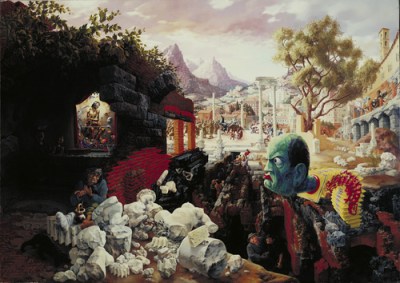
Peter Blume: The Eternal City

Peter Blume: The Eternal City

The problem I see with Nicolelis’ view of the future of neuroscience, which I discussed last time, is not that I find it unlikely that a good deal of his optimistic predictions will someday come to pass, it is that he spends no time at all talking about the darker potential of such technology.

Of course, the benefit to paralyzed, or persons otherwise locked tightly in the straitjacket of their own skull, of technologies to communicate directly from the human brain to machines or to other human beings is undeniable. The potential to expand the range of human experience through directly experiencing the thoughts and emotions of others is, also, of course, great. Next weekend being Super Bowl Sunday, I can’t help but think how cool it would be to experience the game through the eyes of Peyton Manning, or Russell Wilson. How amazing would a concert or an orchestra be if experienced likewise in this way?

Still, one need not necessarily be a professional dystopian and unbudgeable cassandra to come up with all kinds of quite frightening scenarios that might arise through the erosion of boundaries between human minds, all one needs to do is pay attention to less sanguine developments of the latest iteration of a once believed to be utopian technology, that is, the Internet and the social Web, to get an idea of some of the possible dangers.

The Internet was at one time prophesied to user in a golden age of transparency and democratic governance, and promised the empowerment of individuals and small companies. Its legacy, at least at this juncture, is much more mixed. There is little disputing that the Internet and its successor mobile technologies have vastly improved our lives, yet it is also the case that these technologies have led to an explosion in the activities of surveillance and control, by nefarious individuals and criminal groups, corporations and the state. Nicolelis’ vision of eroded boundaries between human minds is but the logical conclusion of the trend towards transparency. Given how recently we’ve been burned by techno-utopianism in precisely this area a little skepticism is certainly in order.

The first question that might arise is whether direct brain-to-brain communication (especially when invasive technologies are required) will ever out-compete the kinds of mediated mind-to-mind technology we have had for quite sometime time, that is, both spoken and written language. Except in very special circumstances, not all of them good, language seem to retain its advantages over direct brain-to-brain communication, and, in cases where the advantage of language over such direct communication are used it be may be less of a gain in communicative capacity than a signal that normalcy has broken down.

Couples in the first rush of new love may want to fuse their minds for a time, but a couple that been together for decades? Seems less likely, though there might be cases of pathological jealousy or smothering control bordering on abuse when one half of a couple would demand such a thing. The communion with fellow human beings offered by religion might gain something from the ability of individuals to bridge the chasm that separates them from others, but such technologies would also be a “godsend” for fanatics and cultists. I can not decide whether a mega-church such as Yoido Full Gospel Church in a world where Nicolelis’ brain-nets are possible would represent a blessed leap in human empathetic capacity or a curse.

Nicolelis seems to assume that the capacity to form brain-nets will result in some kind of idealized and global neural version of FaceBook, but human history seems to show that communication technology is just as often used to hermetically seal group off from group and becomes a weapon in the primary human moral dilemma ,which is not the separation of individual from individual, so much as the rivalry between different groups. We seem unable to exit ourselves from such rivalry even when the stakes are merely imagined- as many of us will do next Sunday, and has Nicolelis himself should have known from his beloved soccer where the rivalry expressed in violent play has a tendency to slip into violent riots in the real world.

Direct brain-to-brain communication would seem to have real advantages over language when persons are joined together in teams acting as a unit in response to a rapidly changing situation. Groups such as fire-fighters. By far the greatest value of such capacities would be found in small military units such as Platoons, members who are already bonded in a close experiential and deep emotional bond, as in on display in the documentary- Restrepo. Whatever their virtuous courage, armed bands killing one another are about as far as you can get from the global kumbaya of Nicolelis’ brain-net.

If such technologies were non-invasive, would they be used by employers to monitor the absence of sustained attention while on the job? What of poor dissidents under the thumb of a madman like Kim Jong Un .Imagine such technologies in the hands of a pimp, or even, the kinds of slave owners who, despite our obliviousness, still exist.

One of the problems with the transparency paradigm, and the new craze for an “Internet of things” where everything in the environment of an individual is transformed into Web connected computers is the fact that anything that is a computer, by that very fact, becomes hackable. If someone is worried about their digital data being sucked up and sold on an elaborate black market, about webcams being used as spying tools, if one has concern that connecting one’s home to the web might make one vulnerable, how much more so should be worried if our very thoughts could be hacked? The opportunities for abuse seem legion.

Everything is shaped by personal experience. Nicolelis whose views of the collective mind were forged by the crowds that overthrew the Brazilian military dictatorship and his beloved soccer games. But the crowd is not always wise. I being a person who has always valued solitude and time with individuals and small groups over the electric energy of crowds have no interest in being part of a hive mind to any degree more than the limited extent I might be said to already be in such a mind by writing a piece such as this.

It is a sad fact, but nonetheless true, that should anything like Nicolelis’ brain-net ever be created it can not be under the assumptions of the innate goodness of everyone. As our experience with the Internet should have taught us, an open system with even a minority of bad actors leads to a world of constant headaches and sometimes what amount to very real dangers.

The World Beyond Boundaries

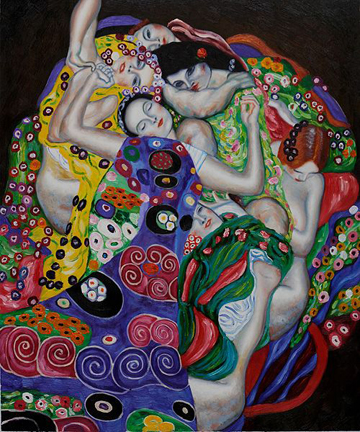
360 The Virgin Oil Painting by Gustav Klimt

                                                                                              https://www.artsy.net/artist/gustav-klimt

I  first came across Miguel Nicolelis in an article for the MIT Technology Review entitled The Brain is not computable: A leading neuroscientist says Kurzweil’s Singularity isn’t going to happen. Instead, humans will assimilate machines. That got my attention. Nicolelis, if you haven’t already heard of him, is one of the world’s top researchers in building brain-computer interfaces. He is the mind behind the project to have a paraplegic using a brain controlled exoskeleton make the first kick in the 2014 World Cup. An event that takes place in Nicolelis’ native Brazil.

In the interview, Nicolelis characterizes the singularity “as a bunch of hot air”. His reasoning being that “The brain is not computable and no engineering can reproduce it,”. He explains himself this way:

You can’t predict whether the stock market will go up or down because you can’t compute it,” he says. “You could have all the computer chips ever in the world and you won’t create a consciousness.”

This non-computability of consciousness, he thinks, has negative implications for the prospect of ever “downloading” (or uploading) human consciousness into a computer.

“Downloads will never happen,” he declares with some confidence.

Science journalism, like any sort of journalism needs a “hook” and the hook here was obviously a dig at a number of deeply held beliefs among the technorati; namely, that AI was on track to match and eventually surpass human level intelligence, that the brain could be emulated computationally, and that, eventually, the human personality could likewise be duplicated through computation.

The problem with any hook is that they tend to leave you with a shallow impression of the reality of things. If the world is too complex to be represented in software it is even less able to be captured in a magazine headline or 650 word article. For that reason,  I wanted a clearer grasp of where Nicolelis was coming from, so I bought his recent and excellent, if a little dense, book, Beyond Boundaries: The New Neuroscience of Connecting Brains with Machines—and How It Will Change Our Lives. Let me start with a little of  Nicolelis’ research and from there flesh out the neuroscientist’s view of our human-machine future, a view I found both similar in many respects and at the same time very different from perspectives typical today of futurists thinking about such things.

If you want to get an idea of just how groundbreaking Nicolelis’ work is, the best thing to do is to peruse the website of his lab.  Nicolelis and his colleagues have done conducted experiments where a monkey has controlled the body of a robot located on the other side of the globe, and where another simian has learned to play a videogame with its thoughts alone. Of course, his lab is not interested in blurring the lines between monkeys and computers for the heck of it, and the immediate aim of their research is to improve the lives of those whose ties between their bodies and their minds have been severed, that is, paraplegics. A fact which explains Nicolelis’ bold gamble to successfully demonstrate his lab’s progress by having a paralyzed person kickoff the World Cup.

For how much the humanitarian potential of this technology is inspiring, it is the underlying view of the brain the work of the Nicolelis Lab appears to experimentally support and the neuroscientist’s longer term view of the potential of technology to change the human condition that are likely to have the most lasting importance. They are views and predictions that put Nicolelis more firmly in the trans-humanist camp than might be gleaned from his MIT interview.

The first aspect of Nicolelis’ view of the brain I found stunning was the mind’s extraordinary plasticity when it came to the body. We might tend to think of our brain and our body as highly interlocked things, after all, our brains have spent their whole existence as part of one body- our own. This a reality that the writer, Paul Auster, turns into the basis of his memoir Winter Journal which is essentially the story of his body’s movement through time, its urges, muscles, scars, wrinkles, ecstasies and pains.

The work of Nicolelis’ Lab seems to sever the cord we might thinks joins a particular body and the brain or mind that thinks of it as home. As he states it in Beyond Boundaries:

The conclusion from more than two decades of experiments is that the brain creates a sense of body ownership through a highly adaptive, multimodal process, which can, through straightforward manipulations of visual, tactile, and body position (also known as proprioception) sensory feedback, induce each of us, in a matter of seconds, to accept another whole new body as being the home of our conscious existence. (66)

Psychologists have had an easy time with tricks like fooling a person into believing they possess a limb that is not actually theirs, but Nicolelis is less interested in this trickery than finding a new way to understand the human condition in light of his and others findings.

The fact that the boundaries of the brain’s body image are not limited to the body that brain is located in is one way to understand the perhaps almost unique qualities of the extended human mind. We are all ultimately still tool builders and users, only now our tools:

… include technological tools with which we are actively engaged, such as a car, bicycle, or walking stick; a pencil or a pen, spoon, whisk or spatula; a tennis racket, golf club, a baseball glove or basketball; a screwdriver or hammer; a joystick or computer mouse; and even a TV remote control or Blackberry, no matter how weird that may sound. (217)

Specialized skills honed over a lifetime can make a tool an even more intimate part of the self. The violin, an appendage of a skilled musician, a football like a part of the hand of a seasoned quarterback. Many of the most prized people in society are in fact master tool users even if we rarely think of them this way.

Even with our master use of tools, the brain is still, in Nicolelis’ view,trapped within a narrow sphere surrounding its particular body. It is here where he sees advances in neuroscience eventually leading to the liberation of the mind from its shell. The logical outcome of minds being able to communicate directly to computers is a world where, according to Nicolelis:

… augmented humans make their presence felt in a variety of remote environments, through avatars and artificial tools controlled by thought alone. From the depths of the oceans to the confines of supernovas, even to the tiny cracks of intracellular space, human reach will finally catch up to our voracious appetite to explore the unknown. (314)

He characterizes this as Mankind’s “epic journey of emancipation from the obsolete bodies they have inhabited for millions of years” (314) Yet, Nicolelis sees human communication with machines as but a stepping stone to the ultimate goal- the direct exchange of thoughts between human minds. He imagines the sharing of what has forever been the ultimately solipsistic experience of what it is like to be a particular individual with our own very unique experience of events, something that can never be fully captured even in the most artful expressions of,  language. This exchange of thoughts, which he calls “brainstorms” is something Nicolelis does not limit to intimates- lovers and friends- but which he imagines giving rise to a “brain- net”.

Could we one day, down the road of a remote future, experience what it is to be part of a conscious network of brains, a collectively thinking true brain-net? (315)

… I have no doubt that the rapacious voracity with which most of us share our lives on the Web today offers just a hint of the social hunger that resides deep in human nature. For this reason, if a brain- net ever becomes practicable,  I suspect it will spread like a supernova explosion throughout human societies. (316)

Given this context, Nicolelis’ view on the Singularity and the emulation or copying of human consciousness on a machine is much more nuanced than the impression one is left with from the MIT interview. It is not that he discounts the possibility that “advanced machines may come to dominate and even dominate the human race” (302) , but that he views it as a low probability danger relative to the other catastrophic risks faced by our species.

His views on prospect of human level intelligence in machines is less that high level machine intelligence is impossible, but that our specific type of intelligence is non-replicable. Building off of Stephen Jay Gould’s idea of the “life tape”  the reason being that we can not duplicate through engineering the sheer contingency that lies behind the evolution of human intelligence. I understand this in light of an observation by the philosopher Daniel Dennett, that I remember but cannot place, that it may be technically feasible to replicate mechanically an exact version of a living bird, but that it may prove prohibitively expensive, as expensive as our journeys to the moon, and besides we don’t need to exactly replicate a living bird- we have 747s. Machine intelligence may prove to be like this where we are never able to replicate our own intelligence other than through traditional and much more exciting means, but where artificial intelligence is vastly superior to human intelligence in many domains.

In terms of something like uploading, Nicolelis does believe that we will be able to record and store human thoughts- his brainstorms- at some place in the future, we may be able to record  the whole of a life in this way, but he does not think this will mean the preservation of a still experiencing intelligence anymore than a piece by Chopin is the actual man. He imagines us deliberately recording the memories of individuals and broadcasting them across the universe to exist forever in the background of the cosmos which gave rise to us.

I can imagine all kinds of wonderful developments emerging should the technological advances Nicolelis imagines coming to pass. It would revolutionize psychological therapy, law, art and romance. It would offer us brand new ways to memorialize and remember the dead.

Yet, Nicolelis’ Omega Point- a world where all human being are brought together into one embracing common mind, has been our dream at least since Plato, and the very antiquity of these urges should give us pause, for what history has taught us is that the optimistic belief that “this time is different” has never proved true. A fact which should encourage us to look seriously, which Nicolelis himself refuse to do, at the potential dark side of the revolution in neuroscience this genius Brazilian is helping to bring about. It is less a matter of cold pessimism to acknowledge this negative potential as it is a matter of steeling ourselves against disappointment, at the the least, and in preventing such problem from emerging in the first place at best, a task I will turn to next time…

Silicon Secessionists

Moore's Utopia

Lately, there have be weird mumblings about secession coming from an unexpected corner. We’ve come to expect that there are hangers on to the fallen Confederate States of America, or Texans hankering after their lost independent Republic, but Silicon Valley? Really? The idea, at least at first blush, seems absurd.

We have the tycoon founder of PayPal and early FaceBook investor, Peter Thiel, whose hands seem to be in every arch-conservative movement under the sun, and who is a vocal supporter of utopian seasteading. The idea of creating a libertarian oasis of artificial islands beyond the reach of law, regulation and taxes.

Likewise, Zoltan Istvan’s novel The Transhumanist Wager uses the idolatry of Silicon Valley’s Randian individualism and technophilia as lego blocks with which to build an imagined “Transhumania”.  A moveable artificial island that is, again, free from the legal and regulatory control of the state.

A second venture capitalist, Tim Draper, recently proposed shattering mammoth California into six pieces, with Silicon Valley to become its own separate state. There are plans to build a techno-libertarian Galt’s Gulch type city-state in Chile, a geographical choice which given Chile’s brutal experience with right-wing economics via Pinochet and the Chicago-school is loaded with historical irony.

Yet another Silicon Valley tech entrepreneur, Elon Musk, hopes to do better than all of these and move his imagined utopian experiment off of the earth, to Mars. Perhaps, he could get some volunteer’s from Winnipeg whose temperature earlier this month under a “polar vortex” was colder than that around the Curiosity Rover tooling around in the dead red dust of the planet of war.

What in the world is going on?

By far the best articulation of Silicon Valley’s new secessionists urges I have seen comes from  Balaji Srinivasan, who doesn’t consider himself a secessionist along the lines of John C Calhoun at all. In an article for Wired back in November  Srinivasan laid out what I found to be a quite intriguing argument for a kind of Cambrian explosion of new polities. The Internet now allows much easier sorting of individuals based on values and its only a step or two ahead to imagine virtual associations becoming physical ones.

I have to say that I find much to like in the idea of forming small, new political societies as a means of obtaining forms of innovation we sorely lack- namely political and economic innovation. I also think Srinivasan and others  are onto something in that that small societies, which get things right, seem best positioned to navigate the complex landscape of our globalized world. I myself would much prefer a successful democratic-socialist small society, such as a Nordic one like Finland, to a successful capitalist-authoritarian on like Singapore, but the idea of a plurality of political systems operating at a small scale doesn’t bother me in the least as long as belonging to such polities is ultimately voluntary.

The existence of such societies might even help heal one of the main problems of the larger pluralist societies, such as our own, to which these new communities might remain attached. Pluralist societies are great on diversity, but often bad on something older, and invariably more intolerant types of society had in droves; namely the capacity of culture to form a unified physical and intellectual world- a kind of home- at least for those lucky enough to believe in that world and be granted a good place within it.

Even though I am certain that, like most past efforts  have, the majority of these newly formed polities would fail, as have the utopian experiments in the past, we would no doubt learn something from them. And some might even succeed and become the legacy of those bold enough to dream of the new.

One might wonder, however, why this recent interest in utopian communities has been so strongly represented both by libertarians and Silicon Valley technolphiles? Nothing against libertarian experiments per se, but there are, after all a whole host of other ideological groups that could be expected to be attracted to the idea of forming new political communities where their principles could be brought to fruition. Srinivasan, again, provides us with the most articulate answer to this question.

In a speech I had formerly misattributed to one of the so-called neo-reactionaries (apologies), Srinivasan lays out the case for what he calls “Silicon Valley’s ultimate exit”.

He begins by asking in all seriousness “Is the USA the Microsoft of Nations?”and then goes on to draw the distinction between two different types of responses to institutional failure- Voice versus Exit. Voice essentially means aiming to change an institution from within whereas Exit is flight or in software terms “forking” to form a new institution whether that be anything from a corporation to a state. Srinivasan thinks Exit is an important form of political leverage pressuring a system to adopt reform or face flight.

The problem I see is the logic behind the choice of Exit over Voice which threatens a kind of social disintegration. Indeed, the rationale for Exit behind libertarian flight which Srinivasan draws seems not only to assume an already existent social disintegration, but proposes to act as an accelerant for more.

Srinivasan’s argument is that Silicon Valley is on the verge of becoming the target of the old elites which he calls “The Paper Belt: based in:Boston with higher ed; New York City with Madison Avenue, books, Wall Street, and newspapers; Los Angeles with movies, music, Hollywood; and, of course, DC with laws and regulations, formally running it.” That Silicon Valley with it’s telecommunications revolution was “putting a horse head in all of their beds. We are becoming stronger than all of them combined.” That the elites of the Paper Belt  “are basically going to try to blame the economy on Silicon Valley, and say that it is iPhone and Google that done did it, not the bailouts and the bankruptcies and the bombings…” And that  “What they’re basically saying is: rule by DC means people are going back to work and the emerging meme is that rule by us is rule by Terminators. We’re going to take all the jobs.”

Given what has actually happened so far Srinivasan’s tone seems almost paranoid. Yes, the shine is off the apple (pun intended) of Silicon Valley, but the most that seems to be happening are discussions about how to get global tech companies to start paying their fair share of taxes. And the Valley has itself woken up to the concerns of civil libertarians that tech companies were being us by the US as a giant listening device.

Srinivasan himself admits that unemployment due to advances in AI and automation is a looming crisis, but rather than help support society, something that even a libertarian like Peter Diamandis has admitted may lead to the requirement for a universal basic income, Srinivasan instead seems to want to run away from the society he helped create.

And therein lies the dark side of what all this Silicon Valley talk of flight is about. As much as it’s about experimentation,or Exit, it’s also about economic blackmail and arbitrage. It’s like a marriage where one partner, rather than engage even in discussions where they contemplate sacrificing some of their needs threatens at the smallest pretense to leave.

Arbitrage has been the tool by which the global, (to bring back the good old Marxist term) bourgeoisie, has been able to garner such favorable conditions for itself over the past generation. “Just try to tax us, and we will move to a place with lower or no taxation”, “Just try to regulate us and we will move to a place with lower or no regulation”, it says.

Yet, both non-excessive taxation, and prudent regulation are the way societies keep themselves intact in the face of the short-sightedness and greed at the base of any pure market. Without them, shared social structures and common infrastructure decays and all costs- pollution etc- are externalized onto the society as a whole. Maybe what we need is not so much more and better tools for people to opt out, which Srinivasan proposes, than a greater number and variety of ways for people to opt in. Better ways of providing the information and tools of Voice that are relevant, accessible, and actionable.

Perhaps what’s happened is that we’ve come almost full round from our start in feudalism. We started with a transnational church and lords locked in the place of their local fiefdoms and moved to nation-states where ruling elites exercised control over a national territory where concern for the broad society underneath along with its natural environment was only fully extended with the expansion of the right to vote almost universally across society.

With the decline of the national state as the fundamental focus of our loyalty we are now torn in multiple directions, between our country, our class, by our religious and philosophical orientations, by our concern for the local or its invisibility, or our concern for the global or its apparent irrelevance.  Yet, despite our virtuality we still belong to physical communities, our neighborhood, country and our shared earth.

Closer to our own time, this hope to escape the problems of society by flight and foundation of new uncorrupted enclaves is an idea buried deep in the founding myth of Silicon Valley. The counter-culture from which many of the innovators of Silicon Valley emerged wanted nothing to do with America’s deep racial and Cold War era problems. They wanted to “drop out” and instead ended up sparking a revolution that not only challenged the whitewashed elites of the “Paper Belt”, but ended up creating a new set of problems, which the responsibility of adulthood should compel them to address.

The elite that has emerged from Silicon Valley is perhaps the first in history dis-attached from any notion of physical space, even the physical space of our shared earth. But “ultimate exit” is an illusion, at least for the vast majority of us, for even if we could settle the stars or retreat into an electron cloud, the distances are far too great and both are too damned cold.

Knowledge and Power, Or Dark Thoughts In Winter

???????????????????????????????

For people in cold climes, winter, with its short days and hibernation inducing frigidity,  is a season to let one’s pessimistic imagination roam. It may be overly deterministic, but I often wonder whether those who live in climates that do not vary with the seasons, so that they live where it is almost always warm and sunny, or always cold and grim, experience less often over the course of a year the full spectrum of human sentiments and end up being either too utopian for reality to justify, or too dystopian for those lucky enough to be here and have a world to complain about in the first place.

The novel I wrote about last time, A Canticle for Leibowitz, is a winter book because it is such a supremely pessimistic one. It presents a world that reaches a stage of technological maturity only to destroy itself again, and again.

What we would consider progress occurs only in terms of Mankind’s technological not its moral capacity. The novel ends with yet another nuclear holocaust only this time the monks who hope to preserve knowledge set out not for the deserts of earth, but the newly discovered planets around nearby stars -the seeds of a new civilization, but in all likelihood not the beginning of an eternal spring.

It’s a cliche to say that among the biggest problems facing us is that our moral or ethical progress has not kept pace with our technological and scientific progress, but labeling something a cliche doesn’t of necessity mean it isn’t true. Miller, the author of  A Canticle for Leibowitz was tapping into a deep historical anxiety that this disjunction between our technological and moral capacity constituted the ultimate danger for us, and defined the problem in a certain, and I believe ultimately very useful way.

Yet, despite Miller’s and others’ anxiety we are still here, so the fear that the chasm between our technological and moral capacity will destroy us remains just that, an anxiety based on a projected future. It is a fear with a long backstory.

All cultures might have hubris myths or warnings about unbridled curiosity, remember Pandora and her jar, or Icarus and his melted wings, but Christianity had turned this warning against pride into the keystone for a whole religious cosmology. That is, in the Christian narrative, especially in the writings of Augustine, death, and with it the need for salvation, comes into the world out of the twin sins of Eve’s pride and curiosity.

It was an ancient anxiety, embedded right in the heart of Christianity, and which burst into consciousness with renewed vigor, during the emergence of modern science, an event that occurred at the same time as Christian revival and balkanization. A kind of contradiction that many thinkers during the early days of the scientific revolution from Isaac Newton, to Francis Bacon, to John Milton to Thomas More found themselves faced with; namely, if the original sin of our first parents was a sin of curiosity, how could a deeply religious age justify its rekindled quest for knowledge?

It is probably hard for most of us to get our minds around just how religious many of the figures during the scientific revolution were given our own mythology regarding the intractable war between science and religion, and the categories into which secular persons, who tend to rely on science, and religious persons, who far too often exhibit an anti-scientific bias, now often fall. Yet, a scientific giant like Newton was in great measure a Christian fundamentalist by today’s standards. One of the most influential publicists for the “new science” was Francis Bacon who saw as the task of science bringing back the state of knowledge found in the “prelapsarian” world, that is, the world before the fall of Adam and Eve.

As I have written about previously, Bacon was one of the first to confront the contradiction between the urge for new (in his view actually old) knowledge and the traditional Christian narrative regarding forbidden knowledge and the sin of pride. His answer was that the millennium was at hand and therefore a moral revival of humanity was taking place that would parallel and buffer the revival of knowledge. Knowledge was to be used for “the improvement of man’s estate”, and his new science was understood as the ultimate tool of Christian charity. In Bacon’s view, such science would only prove ruinous were it used for the sinful purposes of the lust for individual and group aggrandizement and power.

Others were not so optimistic.

Thomas More, for instance, who is credited with creating the modern genre of utopia wasn’t sketching out a blueprint for a perfect world as he was critiquing his own native England, while at the same time suggesting that no perfect world was possible due to Man’s sinfulness, or what his dear friend, Erasmus called “folly”.

Yet, the person who best captured the religious tensions and anxieties present when a largely Christian Europe embarked on its scientific revolution was the blind poet, John Milton. We don’t normally associate Milton with the scientific revolution, but we should. Milton, not only visited the imprisoned Galileo, he made the astronomer and his ideas into recurring themes, presented in a positive light, in his Paradise Lost. Milton also wrote a stunning defense on the freedom of thought, the Areopagitica, which would have made Galileo a free man.

Paradise Lost is, yes, a story in the old Christian vein of warnings against hubris and unbridled curiosity, but it is also a story about power. Namely, how the conclusion that we are “self-begot”, most likely led not to a state of utopian-anarchic godlessness, but the false belief that we ourselves could take the place of God, that is, the discovery of knowledge was tainted not when we, like Adam in Milton’s work, sought answers to our questions regarding the nature of the world, but the minute this knowledge was used as a tool of power against and rule over others.

From the time of Milton to the World Wars of the 20th century the balance between a science that had “improved man’s estate” and that which had served as the tool of power leaned largely in the direction of the former, though Romantics like Percy and Mary Shelley gave us warnings.

The idea that science and technology were tools for the improvement of the conditions of living for the mass of mankind rather than instruments in the pursuit of the perennial human vices of greed and ambition was not the case, of course, if one lived in a non-scientifically empowered non-Western civilization and were at the ends of the barrels of Western gun boats, a fact that we in the West need should not forget now that the scientific revolution and its technology for good and ill is now global. In the West itself, however, this other, darker side, of science and technology was largely occulted even in the face of the human devastation of 19th century wars.

The Second World War, and especially, the development of nuclear weapons brought this existential problem back fully into consciousness, and A Canticle for Leibowitz is a near pitch-perfect representative of this thinking, almost the exact opposite of another near contemporary Catholic thinker, Teilhard de Chardin’s view of technology as the means to godhead in his Phenomenon of Man.

There are multiple voices of conscience in A Canticle for Leibowitz all of which convey a similar underlying message, that knowledge usurped by power constitutes the gravest of dangers.  There is the ageless, wandering Jew on the search for a messiah that never manifests himself and therefore remains in a fallen world in which he lives a life of eternal exile. There is the Poet who in his farcical way condemns the alliance between the holders of knowledge, both the Memorabilia, and the new and secular collegium, and the new centers of military power.

And then there are the monks of the Albertian Order of Leibowitz itself. Here is a dialogue between the abbot Dom Paulo and the lead scholar of the new collegium, Thon Taddeo, on the later’s closeness with the rising satrap,  Hannegan. It is a dialogue which captures the essential message behind A Canticle for Leibowitz. 

Thon Taddeo:

Let’s be frank with each other, Father. I can’t fight the prince that makes my work possible- no matter what I think of his policies or his politics. I appear to support him, superficially, or at least to overlook him- for the sake of the collegium. If he extends his lands, the collegium may incidentally profit. If the collegium prospers, mankind will profit from our work.

What can I do about it? Hannegan is prince, not I.

Dom Paulo:

But you promise to begin restoring Man’s control over nature. But who will govern the use of that power to control natural forces? Who will use it? To what end? How will you hold him in check.  Such decisions can still be made. But if you and your group don’t make them now, others will soon make them for you. (206)

And, of course, the wrong decisions are made and power and knowledge are aligned a choice which unfolds in the book’s final section as another abbot, Dom Zerchi reflects on a world on the eve of another nuclear holocaust:

Listen, are we helpless? Are we doomed to do it again, and again and again? Have we no choice but to play the Phoenix in an unending sequence of rise and fall?

Are we doomed to it, Lord, chained to the pendulum of our own mad clockwork helpless to stop its swing? (245)

The problem, to state it simply, is that we are not creatures that are wholly, innately good, a fact which did not constitute a danger to human civilization or even earthly life until the 20th century. Our quenchless curiosity has driven a progressive expansion of the scale of our powers which has reached the stage where it has the dangers of intersecting with our flaws, and not just our capacity to engage in evil actions, but our foolishness and our greed, to harms billions of persons, or even destroy life on earth.  This is the tragic view of the potential dangers of our newly acquired knowledge.

The Christian genealogy of this tragic view provides the theological cosmology behind A Canticle for Leibowitz, yet we shouldn’t be confused into thinking Christianity is the only place where such sober pessimism can be found.

Take Hinduism: Once, when asked what he thought of Gibbon’s Decline and Fall of the Roman Empire Gandhi responded that Gibbon was excellent at compiling “vast masses of facts”, but that the truth he revealed by doing so was nothing compared to the ancient Hindu classic the Mahabharata. According to Pankaj Mishra, Gandhi’s held that:

 The truth lay in the Mahabharata‘s portrait of the elemental human forces of greed and hatred: how they disguise themselves as self-righteousness and lead to a destructive war in which there are no victors, only survivors inheriting an immense wasteland.

Buddhism contains similar lessons about how the root of human suffering was to be found in our consciousness (or illusion) of our own separateness when combined with our desire.

Religions, because they in part contain Mankind’s longest reflections on human nature tend to capture this tragic condition of ultimately destructive competition between sentient beings with differing desires and wills, a condition which we may find are not only possessed by our fellow animals, but may be part of our legacy to any sentient machines that are our creations as well. Original sin indeed!

Yet recently, religion has been joined by secular psychology that is reviving Freudian pessimism though on a much more empirically sound basis. Contemporary psychology, the most well known of which is the work of Daniel Kahneman, has revealed the extent to which human beings are riddled with cognitive and moral faults which stand in the way of rational assessment and moral decisions- truths about which the world religions have long been aware.

The question becomes, then, what, if anything, can we do about this? Yet, right out of the gate we might stumble on the assumption behind the claim that our technological knowledge has advanced while our moral nature has remained intractably the same. That assumption is claim that the Enlightenment project of reforming human nature has failed.

For the moment I am only interested in two diametrically opposed responses to this perceived failure. The first wants to return to the pre-Enlightenment past, to a world built around the assumptions of Mankind’s sinfulness and free of the optimistic assumptions regarding democracy, equality and pluralism while the second thinks we should use the tools of the type of progress that clearly is working- our scientific and technological progress- to reach in and change human nature so that it better conforms to where we would like Mankind to be in the moral sense.

A thinker like, Glenn W. Olsen, the author of The Turn to Transcendence: The Role of Religion in the Twenty-first Century, is a very erudite and sophisticated version, not exactly of fundamentalism, but a recent reactionary move against modernity. His conclusion is the the Enlightenment project of reforming Mankind into rational and moral creatures has largely failed, so it might be best to revive at least some of the features of the pre-Enlightenment social-religious order that were built on less optimistic assumptions regarding Mankind’s animal nature, but more optimistic ones about our ultimate spiritual transcendence of those conditions which occur largely in the world to come.

Like the much less erudite fellow travelers of Olsen that go by the nom de guerre of neo-reactionaries, Olsen thinks this need to revive pre-Enlightenment forms of orientation to the world will require abandoning our faith in democracy, equality, and pluralism.  

A totally opposite view, though equally pessimistic in its assumptions regarding human nature, is that of those who propose using the tools of modern science, especially modern neuroscience and neuropharmacology, to cure human beings of their cognitive and moral flaws. Firmly in this camp is someone like the bio-ethicist, Julian Savulescu who argues that using these tools might be our only clear escape route from a future filled with terrorism and war.

Both of these perspectives have been countered by Steven Pinker in his monumental The Better Angels of Our Nature. Pinker’s is the example par excellence for the argument that the Enlightenment wasn’t a failure at all- but actually worked. People today are much less violent and more tolerant than at any time in the past. Rather than seeing our world as one that has suffered moral decay at worst, and the failure of progressive assumptions regarding human nature at best, Pinker presents a world where we are in every sense morally more advanced than our ancestors who had no compunction in torturing people on The Wheel or enslaving millions of individuals. So much for the nostalgia of neo-reactionaries.

And Pinker’s argument seems to undermine the logic behind the push for moral enhancement as well, for if current “technologies” such as universal education are working, in that violence has been in almost precipitous decline, why the need to push something far more radical and intrusive?

Here I’ll add my own two-cents, for I can indeed see an argument for cognitive and moral enhancement as a humane alternative to our barbaric policy of mass incarceration where many of the people we currently lock up and conceal in order to hide from ourselves our own particular variety of barbarism are there because of deficits of cognition and self-control. Unlike Savulescu, however, I do not see this as an answer to our concerns with security whether in the form of state-vs-state war or a catastrophic version of terrorism. Were we so powerfully that we could universally implement such moral enhancements and ensure that they were not used instead to tie individuals even closer together in groups that stood  in rivalry against other groups then we would not have these security concerns in the first place.

Our problem is not that the Enlightenment has failed but that it has succeeded in creating educated publics who now live in an economic and political system from which they feel increasingly alienated. These are problems of structure and power that do not easily lend themselves to any sort of technological fix, but ones that require political solutions and change. Yet, even if we could solve these problems other more deeply rooted and existential dangers might remain.

The real danger to us, as it has always been, is less a matter of individual against individual than tribe against tribe, nation against nation, group against group. Reason does not solve the problem here, because reason is baked into the very nature of our conflict, as each group, whether corporation, religious sect, or country pursues its own rational good whose consequence is often to the detriment of other groups.

The danger becomes even more acute when we realize that as artificial intelligence increases in capability many of our decisions will be handed over to machines, who, with all rationality, and no sense of a moral universe that demands something different,  continue the war of all against all that has been our lot since the rebellion of “Lucifer’s angels in heaven”.

Preparing for a New Dark Age

Monk Scribe

Back what now itself seems a millennium ago, when I was a senior in high school and freshman in college, I used to go to yard sales. I wasn’t looking for knickknacks or used appliances, but for cheap music and mostly for books. If memory serves me you could usually get a paperback for 50 cents, four of them for a dollar, and a hard cover for a buck.

I have no idea what made me purchase the particular books I did, and especially works of fiction. At that point in my life I didn’t so much know what literature was as I had heard rumors that there was something out there called literature I’d likely be interested in. Unlike Stephen Greenblatt, who I wrote about last time, I certainly didn’t buy books for the sexually suggestive covers, and thankfully, for given the area I was living at the time, I would now be surrounded by shelves of harlequin romances- though, come to think of it, it might have made me more skillful in love.

I don’t buy so many books anymore, having become a Kindle man where I press a button and wallah a work I’m after appears magically on my little screen. I also live in an area with very good libraries- both public and university- which for a bibliophile like myself is about as good as Florida for a person who worships the sun.

Yet, I still have maybe a hundred books surrounding me that I own but have never read. Sometimes, I’ll rummage through my shelves to pick out a book I probably haven’t even opened since I bought it, and the untouched pages will be brittle and break under  my clumsy fingers. The other day, I came across Walter M. Miller, Jrs’ novel A Canticle for Leibowitz. I’ve been working on a story with Catholic and dystopian/utopian technological themes and thought it might be a good idea to read this science-fiction classic before I proceeded any further into the labyrinth of the tale I was crafting because I knew it dealt with similar ideas.

I did not anticipate the power for me of this wonderful little novel. It touched on themes I had been thinking about for sometime- the search for a long range view that looked to the past as well as the future, the tension between knowledge and power, and the understanding that this tension was an existential component of the human condition, the brake on all our utopian aspirations, and perhaps the “original sin” that would ultimately sink us.            

I will look at the deeper lessons of A Canticle for Leibowitz sometime in the future, for now I just want to talk about its suggestions for the long range human future and specifically one aspect of that long range future- how do we preserve human knowledge so as to avoid ever going through another long dark age?   

A Canticle for Leibowitz was published in 1960. Had Miller sketched out rather than merely stated the apocalyptic conditions that precede the world portrayed in the novel it would have certainly given our own generations versions of the apocalypse with shows like The Walking Dead a run for their money. The novel occurs after the world has been destroyed in a nuclear holocaust known as The Flame Deluge. After the horrors unleashed by the war, including the creation hordes of radioactive mutants from “the demon Fall Out” , the masses seek revenge on the holders of knowledge they deem responsible- murdering them and destroying their works Khmer Rouge style in a world-wide intellectual genocide known as the Simplification.

A Jewish electrical engineer, Isaac Edward Leibowitz,,who had been working for the US military in the run up to the war joins the Catholic Church, perhaps the only long lived institution able to survive the Simplification, and founds a monastic order and monastery known as the Albertian Order of Leibowitz. The order is committed to preserving human knowledge from the Simplification by book smuggling (booklegging) and afterwards aims to store and preserve this knowledge in their Utah desert monastery, a collection of thoughts from the past which they call the Memorabilia.

Unlike our own apocalyptic anxieties which seem so artificial, as if we’ve become addicted to the adrenaline high of scarring ourselves nearly to death, the fears Miller was giving voice to were frighteningly real. Three years after his novel’s publication we really did almost destroy ourselves in a Flame Deluge with the Cuban Missile Crisis and only escaped our own destruction by a hair’s breath.

Yet, even with these real world anxieties, or perhaps because they were so real, A Canticle for Leibowitz is a rip-roaring funny book, Canterbury Tales funny or even Monty Python funny. Especially the first part, which deals with a hapless monk- Francis- who discovers original manuscripts of the soon to be sainted Lebowitz himself. The rest of the book is not as humorous, much more tragic, as we watch humanity make the same mistake over again with knowledge being used in the name of the lust for power, and that lust for power enabled by knowledge again nearly destroying us.    

Miller, of course, was playing with real history, the way the Christian monasteries had preserved knowledge in Western Europe after the fall of Rome. It was a theme explored, though from a much different angle, by Isaac Asimov some years earlier in his Foundation Series where the preservation of knowledge through the establishment of two different “foundations” at the ends of the galaxy is a deliberate effort to shorten a galactic dark age from tens of thousands to a “mere” thousand years.

Monks of the Albertian Order of Leibowitz risked themselves to gather and preserve their Memorabilia, knowledge which they did not understand, willing to wait thousands of years if necessary for the day when “an Interrogator would come, and things would be fitted together again.”  (62)

If I take the picture presented by Stephen Greenblatt in his The Swerve: How the World Became Modern as historically accurate, the reasons our  historical monks ended up preserving knowledge was much more accidental than their analogous novelization by Miller. According to Greenblatt, the monasteries ended up preserving knowledge due to a contingent rule of some orders that monks spend some of their time reading. To read, of course, requires something written and monasteries became one of the few places in the early middle ages to not only collect but preserve books through copying.

Still, according to Greenblatt, we shouldn’t be confused that they were doing so in anticipation of a rebirth of learning, and weren’t all that intellectually engaged with the books they preserved and copied. During reading or copying monks were forbidden to discuss the books they had in front of them, which is probably good for us. They became instead immense hive-mind photocopiers cloning and shelving a hodge podge of surviving works from the ancients, a task which had someone not done with detail and regularity would have quickly led to the disappearance of the vast intellectual heritage of the classical world.  The thoughts preserved on papyrus and animals skins would have in a short time been eaten away by literal book worms.

There is an argument out there, Francis Fukuyama’s is the one that comes to mind, that we are unlikely to experience the kinds of cyclical declines and dark ages seen in prior periods of human history because knowledge is now global. I think there are some other holes in that argument, but for now I won’t quibble, and want to focus on only one chasm- the possibility that the entire globe could experience some hammer blow that would shatter civilization everywhere all at one go.

These are catastrophic risks, things that we should be intensely focused on avoiding in the first place, as The Global Catastrophic Risks Institute, and Future of Humanity Institute among others, have been urging us to, but which we should also implement ways of absorbing the hit should it come. Basically catastrophic risks are disasters, natural or man-made that would have the effect of devastating human civilization on a global not just a local scale. They are not likely but have a chance that is less than zero.

Though we dogged the bullet that haunted Miller, we might still be faced with the threat of global thermonuclear war at some point in the future. Current saber rattling in the Pacific is not a good sign. We could be whacked by a massive object from outer space such as the one which wiped out the dinosaurs, or zapped by a gamma-ray burst, or crushed by the super-intelligences we are trying to build in an AI apocalypse, there could be a super-pandemic, perhaps created deliberately by some group of technologically proficient, nihilistic maniacs trying to kill us all, or a truly runaway greenhouse effect triggered by a methane release in the warming artic. In other words, there are a lot of things that might near push us back to the stone age even if no one of them are particularly likely.

To return to my question above: in the face of a catastrophic scenario how could we preserve human knowledge so as to avoid ever going through another long dark age? The first issue that strikes me when I start thinking about this is the quite practical one of what medium would be best to store information for the long haul?

Right now, of course, we are all about digital copying and storage. Google has so far scanned a little over 20 million books, a service I love, and that has kept my acidic fingers off of a gem like the first publication of Adam Smith’s Moral Sentiments, though the company’s public service in doing this has not been without controversy.

You’ve also got to hand it to the scandinavians who seem to do everything with meditative forethought. (I credit the six months of darkness.) The Norwegians not only have the Svalbard global seed bank which preserves the world’s agricultural inheritance in a Norad like facility in the icy north near the north pole, but are now aiming to digitize and make available all the world’s books in Norwegian.  Should a global catastrophe occur having done so might have cause in the words of Alexis Madrigal:

…Norwegians become to 27th-century humans what the Greeks were to the Renaissance. Everyone names the children of the space colonies Per and Henrik, Amalie and Sigrid. The capital of our new home planet will be christened Oslo.

Even absent Google, Americans aren’t totally left in the dust as archivers by our polar- bear- pale brethren up north. We have the quite respectable Internet Archive and the world oldest (although the word “old” seems strange here) digital library, Project Guttenberg.  

Yet, there are a number of possible catastrophic scenarios, such as an AI Apocalypse, where this capacity to easily store and recover digitized information might be irrevocably lost. You also need functioning electricity grids and/or battery production manufacturing capacity both of which seem at danger should a truly big-one occur. Disturbing on this score is the fact that a number of libraries are eliminating their physical collections as they embrace digitization, something that the Internet Archive is now trying to rectify by collecting actual physical copies of books.

Venerable institutions such as The Library of Congress and The Smithsonian Institution already have extensive physical collections, not just of books, but of physical artifacts as well, and should they somehow survive a global catastrophe, I picture them being our equivalent of the Library of Alexandria where people will flock to access not just books but working versions of vital technologies that might otherwise have been lost, such as electrical lighting, which the monk, Brother Kornhoer, in A Canticle for Leibowitz has to jerry- rig back into existence almost from scratch.

The use of paper as a medium to store our books and blueprints at first seems like the tried and true option, after all it served us so well in the past, but as anyone knows who has a book more than 50 years old, modern paper decays very fast. And using paper as our medium of storage also assumes that whatever catastrophic event has happened has left us with enough trees. Even the antique version of paper, sometimes made from animal skins, succumbs after a few centuries to the literal “book worm”, and you also need either printing presses or whole human institutions of scriveners such as the monasteries and monks to make copies.

The late classical world already had monastic institutions that were widespread before the loss of knowledge- a loss which took a long time to unfold. Our own loss of knowledge, should it (however unlikely) occur, seems less likely to creep into being then come along with a bang, and in the age of Scarlett Johansson who wants to be a monk?

As always thinking about the deep future, the The Long Now Foundation has its Rosetta Project where it preserves the world’s languages on electroformed solid-nickel disk, a model which might serve as a template for long-term information storage. Here’s their description:

The Rosetta Disk fits in the palm of your hand, yet it contains over 13,000 pages of information on over 1,500 human languages. The pages are microscopically etched and then electroformed in solid nickel, a process that raises the text very slightly – about 100 nanometers – off of the surface of the disk. Each page is only 400 microns across – about the width of 5 human hairs – and can be read through a microscope at 650X as clearly as you would from print in a book. Individual pages are visible at a much lower magnification of 100X.

Something like the Rosetta Disk avoids the ravages of the book worm, and will certainly last a long time, but you do need a microscope to read it, and it’s pretty easy to imagine a future where microscopes are a rare or even non-existent tool. We could make larger versions of the Rosetta Disk so that the text is readable to the naked eye, but then we run into the limitations of cost: we can’t very well copy even more than a handful of the books in existence using this method.  And they would only be reproducible on a large scale basis it seems by using one of the other methods.

Then again, we could always look to nature. Life on earth has over 3 billion year leg up on human beings when it comes to storing and passing along information- it’s called DNA. You can put an amazingly large amount of information on an equally amazingly small segment of DNA as in about half a million DVDs of storage on half a gram!  In the beginning of 2013 researchers in the UK were able to encode Shakespeare’s sonnets, and MLK’s “I have a dream!” speech among other things on DNA. Much more than any medieval abbot, nature abhors copying errors, and therefore DNA makes not merely a great storage medium, as long as where it is stored is cool and dry it can last for thousands of years, but a means to make copies with near hundred percent fidelity.

DNA exceeds digital media for storage and copying and matches something like the Rosetta Disk for longevity, the problem is the technology to make, store, and read such DNA texts is relatively high tech, and therefore vulnerable or unworkable in many catastrophic scenarios. It’s also much less readily searchable than digital media or even indexed paper texts.

Perhaps what we need to make sure a good bulk of the world’s knowledge survives a global catastrophe is a tiered system of preservation with only the most essential technical and scientific information, including how to build and use other forms of information dissemination and storage, put on something like large Rosetta Disks, a second level of not as essential but important and culturally significant knowledge being stored on long-lasting paper, almost everything on digital media, and absolutely everything we could get our hands on stored on DNA.

All of these things would have to be done before the occurrence of any catastrophic event that lunged us backward into a new dark age. Once the lights went out we certainly shouldn’t expect, like Miller, that the Catholic Church would play the same role in preserving knowledge as it had in the past, for, as Mark Twain said, “history doesn’t repeat, it rhymes”.  Indeed, should we create the kinds of information preservation mechanisms I outlined above, we would need an organization already dedicated to those mechanisms to manage those efforts, and in today’s world such an organization seems likely to be secular.

I can imagine a type of global organization whose members were in their day-to-day reality scattered across differing organizations we have in place today for disseminating and storing knowledge: universities, major libraries, scientific institutions such as the Royal Society a small number of whom would in a pre-catastrophe world run the types of information preservation efforts I have sketched out who, in the unlikely case that a global catastrophic event occurred, would work slowly and over generations to re-establish the world’s learning.

I have already suggested ways we might pay for this.

The great bulk of what we would need to re-establish should a large chunk of the world’s knowledge be destroyed would be technological and scientific. Knowledge that would be essential would be things like, agricultural techniques and science, the Germ theory of disease and the techniques behind vaccinations, how to build and maintain infrastructure such as sewage and plumbing disposal, energy utilizing systems including electrical grids, civil engineering, and the technology behind knowledge behind storing and sharing information. Above all, the scientific method would need to be put firmly back in place.

One of the problems I foresee should an almost complete blackout occur are gaps in knowledge domains that are essentially unpredictable before hand. That is, it seems a safer bet to assume that not only will knowledge have been lost but the knowledge of how to understand whatever knowledge has remained might be lost as well.

It would certainly be an interesting interdisciplinary project to design the kinds of texts that would be necessary to re-establish some field of science should it almost completely disappear. To do so would probably require philosophers and historians of science, mathematicians, practitioners of the science itself, linguists, cultural anthropologists, and instructional designers who were adept at teaching complex ideas to those with minimum starting points in terms of literacy and numeracy.

Given that the source of a global catastrophe is perhaps most likely to come via our own scientifically induced prowess it’s quite sensible to ask if we should be making all this effort to salvage our scientific and technological capacity in the first place? This relationship between our knowledge and our possible destruction is a question dealt with on a profound level in A Canticle for Leibowitz, and I’ll turn to it next time. Yet, as we know man does not live on bread alone, so what of the preservation less material knowledge, the art and wisdom that is the legacy of our global civilization?

Hopefully we would be able to preserve at least some of our human cultural legacy. Thinking about what we might save from our culture under severe constraints in terms of number might be an interesting and perhaps even revealing parlor game ,so I’ll end this post by inviting you to play.

If you could save only 10 books, 10 songs, and 10 artworks from all of human history that should make it through a catastrophic event which would you choose?

An Epicurean Christmas Letter To Transhumanists

Botticelli Spring- Primivera

Whatever little I retain from my Catholic upbringing, the short days of the winter and the Christmas season always seem to turn my thoughts to spiritual matters and the search for deeper meanings. It may be a cliche, but if you let it hit you, the winter and coming of the new year can’t help but remind you endings, and sometimes even the penultimate ending of death. After all, the whole world seems dead now,  frozen like some morgue-corpse, although this one, if past is prelude, really will rise from the dead with the coming of spring.

Now, I would think death is the last thing most people think of, especially during what for many of us is such a busy, drowned in tinsel, time of the year. The whole subject is back there buried with the other detritus of life, such as how we get the food we’ll stuff ourselves with over the holidays, or the origin of the presents, from tinker-toys to diamond rings, that some of us will wrap up and hide under trees. It’s like the Jason Isbell song The Elephant that ends with the lines:

There’s one thing that’s real clear to me,


no one dies with dignity.


We just try to ignore the elephant somehow

This aversion to even thinking about death is perhaps the unacknowledged biggest obstacle for transhumanists whose goal, when all is said and done, is to conquer death. It’s similar to the kind of aversion that lies behind our inability to tackle climate change.Who wants to think about something so dreadful?

There are at least some people who do want to think of something so dreadful, and not only that, they want to tie a bow around it and make it appear some wonderful present left under the tree by Kris Kringle. Maria Konovalenko recently panned a quite silly article in the New York Times by Daniel Callahan who was himself responding to the hyperbolic coverage of Google’s longevity initiative, Calico. Here’s Callahan questioning the push for extended longevity:

And exactly what are the potential social benefits? Is there any evidence that more old people will make special contributions now lacking with an average life expectancy close to 80? I am flattered, at my age, by the commonplace that the years bring us wisdom — but I have not noticed much of it in myself or my peers. If we weren’t especially wise earlier in life, we are not likely to be that way later.

Perhaps not, but neither did we realize the benefits of raising life expectancy from 45 to near 80 between 1900 and today, such as The Rolling Stones. Callahan himself is a still practicing heart surgeon- he’s 83- and I’m assuming, because he’s still here, that he wouldn’t rather be dead. And even if one did not care about pushing the healthy human lifespan out further for oneself, how could one not wish for such an opportunity for one’s children? Even 80 years is really too short for all of the life projects we might fulfill, barely long enough to feel at home into the “world in which we’re thrown” ,quite literally, like the calf the poet Diane Ackerman helped deliver and described in her book Deep Play:

When it lifted its fluffy head and looked at me, its eyes held the absolute bewilderment of the newly born. A moment before it had enjoyed the even, black nowhere of the womb, and suddenly its world was full of color, movement, and noise. I have never seen anything so shocked to be alive. (141)

And if increased time to be here would likely be good for us as individuals, sufficient time to learn what we should learn and do what we should do, I agree as well with Vernor Vinge that greatly expanded human longevity would likely be an uncomparable good for society not least because it might refocus the mind on the longer term health of the societies and planet we call home.

That said, I do have some concern that my transhumanists friends are losing something by not acknowledging the death elephant given that they’re are too busy trying to push it out of the room. The problem I see is that many transhumanists are, how to put this, old, and can’t afford or aren’t sufficiently convinced in the potential of cryonics to put faith in it as a “backup”. Even when they embrace being deep- froze many of their loved ones are unlikely to be so convinced ,and, therefore, they will watch or have knowledge of their parents, siblings, spouse and friends experiencing a death that transhumanists understand to be nothing short of dark oblivion.

Lately it seems some have been trying to stare this oblivion in the face. Such, I take it, is the origin of classical composer David Lang’s haunting album Death Speaks. I do not think Lang’s personification of death in the ghostly voice of Shara Worden, or the presentation of the warm embrace of the grave as a sort of womb, should be considered “deathist”, even if death in his work is sometimes represented as final rest from the weariness of life, and anthropomorphized into a figure that loves even as she goes about her foul business of killing us.  Rather, I see the piece as merely the attempt to understand death through metaphor, which is sometimes all we have, and personally found the intimacy both chilling and thought provoking.

This is the oblivion we are all too familiar of biological death, which given sufficient time for technological advancement we may indeed escape as we might someday even exit biology itself, but I suspect that even over the very, very long run, some sort of personal oblivion regardless of how advanced our technology is likely inevitable.

As I see it, given the nature of the universe and its continuous push towards entropy we are unlikely to ever fully conquer death so much as phase change into new timescales and mechanisms of mortality. The reason for us thinking otherwise is, I think, our insensitivity to the depth of time. Even a 10,000 year old you is a mayfly compared to the age of our sun, let alone the past and future of the universe. What of “you” today would be left after 10,000 years, 100,000, a million, a billion years of survival? I would think not much, or at least not much more than would have survived on smaller time scales that you pass on today- your genes, your works, your karma. How many of phase changes exist between us today and where the line through us and our descendants ends is anyone’s guess, but maintaining the core of a particular human personality throughout all of these transformations seems like a very long shot indeed.

Even if the core of ourselves could be kept in existence through these changes what are the prospects that it would survive into the end of the universe, not to mention beyond?  As Lawrence Krauss pointed out, the physics seem to lean in the direction that in a universe with a finite amount of energy which is infinitely expanding no form of intelligence can engage in thinking for an infinite amount of time. Not even the most powerful form of intelligence we can imagine, as long as we use our current understanding of the laws of physics as boundary conditions, can truly be immortal.

On a more mundane level, even if a person could be fully replicated as software or non-biological hardware these systems too have their own versions of mortality (are you still running Windows ME and driving a Pinto?), and the preservation of a replicated person would require continuous activity to keep this person as software and/or non-biological hardware in a state of existence while somehow retaining the integrity of the self.

What all this adds up to is that if one adopts a strict atheism based on what science tells us is the nature of reality one is almost forced to come to terms with the prospect of personal oblivion at some point in the future, however far out that fate can be delayed. Which is not to say that reprieve should not be sought in the first place, only that we shouldn’t confuse the temporal expansion of human longevity, whether biological or through some other means, with the attainment of actual immortality. Breaking through current limits to human longevity would likely confront us with new limits we would still be faced with the need to overcome.

Some transhumanists who are pessimistic about the necessary breakthroughs to keep them in existence occurring in the short run, within their lifetime, cling to a kind of “Quantum Zen”, as Giulio Prisco recently put it, where self and loved ones are resurrected in a kind of cosmic reboot in the far future. Speaking of the protagonist of Zoltan Istvan’s Transhumanist Wager here’s how Prisco phrased it:

Like Jethro, I consider technological resurrection (Tipler, quantum weirdness, or whatever) as a possibility, and that is how I cope with my conviction that indefinite lifespans and post-biological life will not be developed in time for us, but later.

 To my eyes at least, this seems less a case of dealing with the elephant in the room than zapping it with a completely speculative invisible-izing raygun. If the whole moral high ground of secularists over the religious is that the former tie themselves unflinchingly to the findings of empirical science, while the latter approach the world through the lens of unquestioning faith, then clinging to a new faith, even if it is a faith in the future wonders of science and technology surrenders that high ground.

That is, we really should have doubts about any idea, whatever its use of scientific language, that isn’t falsifiable and is based on mere speculation (even the speculation of notable physicists) on future technological potential. Shouldn’t we want to live on the basis of what we can actually know through proof, right now?

How then, as a secular person, which I take most transhumanists to be, do you deal with idea of personal oblivion? It might seem odd to turn to a Roman Epicurean natural philosopher and poet born a century before Christ to answer such a question, but Titus Lucretius Carus, usually just called Lucretius, offered us one way of dampening the fear of death while still holding a secular view of the world.  At least that’s what Stephen Greenblatt found was the effect of  Lucretius’ only major work- On the Nature of Things.

Greenblatt found his secondhand copy of On the Nature of Things in a college book bin attracted as much by the summer- of- love suggestiveness of the 1960’s cover as anything else. He cracked it open that summer and found a book that no doubt seemed to reflect directly the spirit of the times, beginning as it does with a prayer to the goddess of love, Venus, and a benediction to the power of sexual attraction over even Mars the god of war.

It was also a book in the words of Lucretius whose purpose was to “ to free men’s minds from fear of the bonds religious scruples have imposed” (124) As Greenblatt describes it in his book The Swerve: How the World Became Modern, in Lucretius’ On the Nature of Things he found refuge from his own painful experience not with death, but the thought of it, and not even the fear of his own oblivion, but that of his mother’s fear of the same.  As Greenblatt writes of his mother:

It was death itself- simply ceasing to be- that terrified her. From as far back as I can remember, she brooded obsessively on the imminence of her end, invoking it again and again, especially at moments of parting. My life was full of operatic scenes of farwell. When she went with my father from Boston to New York  for the weekend, when I went off to summer camp, even- when things were especially hard for her- when I left the house for school, she clung tightly to me, speaking of her fragility and of the distinct possibility that I would never see her again. If we walked somewhere together, she would frequently come to a halt, as if she were about to keel over. Sometimes she would show me a vein pulsing in her neck, and taking my finger, make me feel it for myself, the sign of her heart dangerously racing. (3)

The Swerve tells the history of On the Nature of Things, its loss after the collapse of Roman civilization, its nearly accidental preservation by Christian monks, rediscovery in the early Renaissance and deep and all but forgotten impact on the sentiment of modernity having had an influence on figures as diverse as Shakespeare, Bruno, Galileo, More, Montesquieu and Jefferson. Yet, Greenblatt’s interest in On the Nature of Things was born of a personal need to understand and dispel anxiety over death, so it’s best to look at Lucretius’ book itself to see how that might be done.

Lucretius was a secular thinker before there was even a name for such a thing. He wanted a naturalistic explanation of the world where the gods, if they existed, played no role either in the workings of nature or the affairs of mankind. The basis to everything he held was a fundamental level of particles he sometimes called “atoms” and it was the non-predetermined interaction of these atoms that gave rise to everything around us, from stars and planets to animals and people.

From this basis Lucretius arrived at a picture of the universe that looked amazingly like our own. There is an evolution of the universe- stars and planets- from simpler elements and the evolution of life. Anything outside this world made of atoms is ultimately irrelevant to us. There is no need to placate the unseen gods or worry what they think of us.

Everything we experience for good and ill including the lucky accident of our own existence and our ultimate demise is from the “swerve” of underlying atoms. The Lucretian world makes no sharp division, as ancients and medievals often did, between the earthly world and the world of the sky above our heads.

The universe is finite in matter if infinite in size, and there are likely other worlds in it with intelligent life like our own. In the Copernican sense we are not at the center of things either as a species or individually. All we can experience, including ourselves, is made of the same banal substance of atoms going about their business of linking and unlinking with one another. And, above all, everything that belongs to this universe built of atoms is mortal, a fleeting pattern destined to fall apart.

On the Nature of Things is the strangest of hybrids. It is a poem, a scientific text and a self-help book all at the same time. Lucretius addresses his poem to Gaius Memmius an unknown figure whom the author aims to free from the fear of the gods and death. Lucretius advises Memmius  that death is nothing to fear for it will be no different to us than all the time that passed before we were born. To rage against no longer existing through the entirety of the future is no more sensical than raging that we did not exist through the entirety of the past.

Think how the long past age of hoary time

Before our birth is nothing to us now

This in a mirror

Nature shows to us

Of what will be hereafter when we’re dead

Does this seem terrible is this so sad?

Is it not less troubled than our daily sleep? (118)

______________________________

I know, I know, this is the coldest of cold comforts.

Yet, Lucretius was an Epicurean whose ultimate aim was that we be wise enough to keep in our view the simple pleasures of being alive, right now, in the moment in which we were lucky enough to be living. While reading On the Nature of Things I had in my ear the constant goading whisper- “Enjoy your life!” Lucretius’ fear was that we would waste our lives away in fear and anticipation of life, or its absence, in the future. That we would be of those:

Whose life was living death while yet you live

And see the light who spend the greater part

Of life in sleep still snoring while awake.( 122-123)

It is not that Lucretius advises us to take up the pleasure seeking life of hedonism, but he urges us to not waste our preciously short time here with undue anxiety over things that are outside of our control or in our control to only a limited extent. On The Nature of Things admonishes us to start not from the position of fear or anger that the universe intends to eventually “kill” us, but from one of gratitude that out of a stream of randomly colliding atoms we were lucky enough to have been born in the first place.

This message in a bottle from an ancient Epicurean reminded me of the conclusion to the aforementioned Diane Ackerman’s Deep Play where she writes to imagined inhabitants of the far future that might let her live again and concludes in peaceful lament:

If that’s not possible, then I will have to make due with the playgrounds of mortality, and hope that at the end of my life I can say simply, wholeheartedly that it was grace enough to be born and live. (212)

 Nothing that happens, or fails to happen, within our lifetimes, or after it, can take away this joy that it was to live, and to know it.

Don’t Be Evil!

Panopticon Prisoner kneeling

However interesting a work it is, Eric Schmidt and Jared Cohen’s The New Digital Age is one of those books where if you come to it as a blank slate you’ll walk away from it with a very distorted chalk drawing of what the world actually looks like. Above all, you’ll walk away with the idea that intrusive and questionable surveillance was something those other guys did, the bad guys, not the American government, or US corporations, and certainly not Google where Schmidt sits as executive chairman . Much ink is spilt on explaining the egregious abuses of Internet freedom by the likes of countries like China and Iran, or what in the vast majority of cited cases, are abuses by non-Western companies,  but when it comes to the US itself or any of its corporations engaging in similar practices the book is eerily silent.

I may not know what a mote is, but I do know I am supposed to pluck my own out of my eye first. Only then can I get seriously down to the business of pointing out the other guy’s mote, or even helping him yank it out.

The New Digital Age (I’ll call it the NDA from here on on to shorten things up), is full of the most reasonable and vanilla sort of advice on the need to balance our conflicting needs for security and privacy, but given its silence on the question of what the actual security/surveillance system in the US actually is, we’re left without the information needed to make such judgements. Let me put that silence in context.

The publication date for the NDA was April, 23 2013. The smoke screen of conspicuous- for- their- absence facts that are never discussed extends not only forward in time- something to be expected given the Edward Snowden revelations were one month out (May, 20 2013)- but, more disturbingly backward in time as well.  That is, Schmidt and Cohen couldn’t really be expected, legally if not morally, to discuss the revelations Snowden would later bring to light. Still, they should be expected to have addressed serious claims about the relationship between American technology companies and the US security state which were already public knowledge.

There had been extensive reporting on the intersection of technology and US government spying since at least 2010. These weren’t stories by Montana survivalists or persons camped out at Area 51, but hard hitting journalists with decades covering national security; namely, the work of Dana Priest and the Washington Post. If my memory and the book’s index serves me, neither Priest nor the Post are mentioned in the NDA.

Over a year before NDA was published Wired’s James Bamford had written a stunning piece on the NSA’s construction of its huge data center in Bluffdale, Utah, the goal of which was to suck up and store indefinitely the electronic records of all of us- which is the main thing we are arguing about. The main debate is over whether the government has a right to force private companies to provide all the digital data on their customers which the government will then synthesize, organize and store. If you’re an American you’re lucky enough to have the government require a warrant to look at your records. (Although the court in change of this-the FISA court- is not really known for turning such requests down). If you’re unlucky enough to not be an American then the government can peruse your records whenever the hell it wants to- thank you very much.

The NSA gets two pages devoted to it in the NDA’s 257 pages both of which are about how open minded and clever the agency is for hiring pimply- faced hackers. Say, what?

The more I think about what had to be the deliberate silence that runs throughout the whole of the NDA the more infuriating it becomes, but at least now Google et al have gotten religion- or at least I hope. On December, 9 2013 Google, Facebook, Apple, Microsoft, Twitter, Yahoo, LinkedIn, and AOL sent an open letter to the White House urging new restrictions on the government’s ability to seize, use and store information gleaned from them. This is a hopeful sign, but I am not sure we be handing out Liberty Medals just yet.

For one, this move against the government was not inspired by civil libertarians or even robust reporting, but by threats to the very business model upon which the companies who signed the document are based. As The Economist puts its:

The entire business model of firms like Google, FaceBook and Twitter relies on harvesting intimate information provided by users and then selling that data on to advertisers.

It was private firms that persuaded people to give up lists of their friends, their most sensitive personal communications, and to constantly broadcast their location in real-time. If you had told even the noisiest spook in 1983, that within 30 years, much of the populace would be carrying around a tracking device that kept a permanent record of everywhere they had ever visited, he’d have thought you mad.”

Let’s say you’re completely comfortable with the US government keeping such records on you. Perhaps the majority of Americans are unconcerned about this and think it the price of safety. But I doubt Americans would feel as blaise if it was the Chinese or the Russians or heaven forbid the French or any other government whose apparatchiks could go through their online personal and financial records at will. Therein lies the threat to American companies whose ultimate aspirations are global.  Companies that are seen, rightly or wrongly, as a tool of the US government will lose the trust not mainly of US citizens but of international customers. An ensuing race to the exits and nationalization of the Internet would most likely be driven not by Iranian Mullahs or a testosterone- charged Vladimir Putin paddling around in a submersible like a Bond villain,  but by Western Europeans and other democratic societies who were already uncomfortable with the idea that corporations should be trusted by individuals who had made themselves as transparent as the Utah sky.

The Germans, to take one example, were already freaked out by Google Street View of all things and managed to have the company abandon that service there. Revulsion at the Snowden revelations is perhaps the one thing that unites the otherwise bickering nationalities of the EU. TED, an event that began as a Silicon Valley lovefest looked a lot different when it was held in Brussels in October, with Mikko Hypponen urging the secession of Europeans from the American Internet infrastructure and the creation of their own open-sourced platforms. It’s the fear of being thought of as downright Orwellian that seems most likely to have inspired Google’s move to abandon facial recognition on Google Glass.

With the Silicon Valley Letter we might think we’re in the home stretch of this struggle to re-establish the right to privacy, but the sad fact is this fight’s just beginning. As the Economist pointed out none of the giants that provide the hardware and “plumbing” for the Internet, such as Cisco, and AT&T signed the open letter, less afraid, it seems, of losing customers because these are national brick-and-mortar companies in a way the eight signatories of the open letter to the Obama Administration are not.  For civil libertarians to win this fight Americans have to not only get those hardware companies on board, but compel the government to deconstruct a massive amount of spying infrastructure.

That is, we need to get the broader American public to care enough to exert sustained pressure on the government and some of the richest companies in the country to reverse course. Otherwise, the NSA facility at Bluffdale will continue sucking up its petabytes of overwhelmingly useless information like some obsessive Mormon genealogist until the mechanical levithan lurches to obsolescence or is felled by the sheppard’s stone of better encryption.

The NSA facility that stands today in the Utah desert may offer a treasure trove for the historian of the far future, a kind of massive junkyard of collective memory filled with all our sense and non-sense. If we don’t get our act straight, what it will also be is a historical monument to the failure of our two centuries and some old experiment with freedom.

Maps:how the physical world conquered the virtual

World map 1600

If we look back to the early days when the Internet was first exploding into public consciousness, in the 1980’s, and even more so in the boom years of the 90’s, what we often find is a kind of utopian sentiment around this new form of “space”. It wasn’t only that a whole new plane of human interaction seemed to be unfolding into existence almost overnight, it was that “cyberspace” seemed poised to swallow the real world- a prospect which some viewed with hopeful anticipation and others with doom.

Things have not turned out that way.

The person who invented the term “cyberspace”, William Gibson, the science fiction author of the classic- Neuromancer- himself thinks that when people look back on the era when the Internet emerged what will strike them as odd is how we could have confused ourselves into thinking that the virtual world and our work-a-day one were somehow distinct. Gibson characterizes this as the conquest of the real by the virtual. Yet, one can see how what has happened is better thought of as the reverse by taking even a cursory glance at our early experience and understanding of cyberspace.

Think back, if you are old enough, and you can remember, when the online world was supposed to be one where a person could shed their necessarily limited real identity for a virtual one. There were plenty of anecdotes, not all of them insidious, of people faking their way through a contrived identity the unsuspecting thought was real: men coming across as women, women as men, the homely as the beautiful. Cyberspace seemed to level traditional categories and the limits of geography. A poor adolescent could hobnob with the rich and powerful. As long as one had an Internet connection, country of origin and geographical location seemed irrelevant.

It should not come as any surprise, then, that  an early digital reality advocate such as Nicole Stenger could end her 1991 essay Mind is a leaking rainbow with the utopian flourish:

According to Satre, the atomic bomb was what humanity had found to commit collective suicide. It seems, by contrast, that cyberspace, though born of a war technology, opens up a space for collective restoration, and for peace. As screens are dissolving, our future can only take on a luminous dimension! / Welcome to the New World! (58)

Ah, if only.

Even utopian rhetoric was sometimes tempered with dystopian fears. Here is Mark Pesce the inventor of VRML code in his 1997 essay Ignition:

The power over this realm has been given to you. You are weaving the fabric of perception in information perceptualized. You could – if you choose – turn our world into a final panopticon – a prison where all can been seen and heard and judged by a single jailer. Or you could aim for its inverse, an asylum run by the inmates. The esoteric promise of cyberspace is of a rule where you do as you will; this ontology – already present in the complex system know as Internet – stands a good chance of being passed along to its organ of perception.

The imagery of a “final panopticon” is doubtless too morbid for us at this current stage whatever the dark trends. What is clear though is that cyberspace is a dead metaphor for what the Internet has become- we need a new one. I think we could do worse than the metaphor of the map. For, what the online world has ended up being is less an alternative landscape than a series of cartographies by which we organize our relationship with the world outside of our computer screens, a development with both liberating and troubling consequences.

Maps have always been reflections of culture and power rather than reflections of reality. The fact that medieval maps in the West had Jerusalem in their centers wasn’t expressing a geologic but a spiritual truth although few understood the difference. During the Age of Exploration what we might think of as realistic maps were really navigational aids for maritime trading states, a latent fact present in what the mapmakers found important to display and explain.

The number and detail of maps along with the science of cartography rose in tandem with the territorial anchoring of the nation-state. As James C. Scott points out in his Seeing Like a State maps were one of the primary tools of the modern state whose ambition was to make what it aimed to control “legible” and thus open to understanding by bureaucrats in far off capitals and their administration.

What all of this has to do with the fate of cyberspace, the world where we live today, is that the Internet, rather than offering us an alternative version of physical space and an escape hatch from its problems has instead evolved into a tool of legibility. What is made legible in this case is us. Our own selves and the micro-world’s we inhabit have become legible to outsiders. Most of the time these outsiders are advertisers who target us based on our “profile”, but sometimes this quest to make individuals legible is by the state- not just in the form of standardized numbers and universal paperwork but in terms of the kinds of information a state could only once obtain by interrogation- the state’s first crack at making individuals legible.      

A recent book by Google CEO Eric Schmitt co-authored with foreign policy analyst Jared Cohen- The New Digital Age is chalk full of examples of corporate advertisers’ and states’ new powers of legibility. They write:

The key advance ahead is personalization. You’ll be able to customize your devices- indeed much of the technology around you- to fit your needs, so that the environment reflects your preferences.

At your fingertips will be an entire world’s worth of digital content, constantly updated, ranked and categorized to help you find the music, movies, shows, books, magazines, blogs and art you like. (23)

Or as journalist Farhad Manjoo quotes Amit Singhal of Google:

I can imagine a world where I don’t even need to search. I am just somewhere outside at noon, and my search engine immediately recommends to me the nearby restaurants that I’d like because they serve spicy food.

There is a very good reason why I did not use the world “individuals” in place of “corporate advertisers” above- a question of intent. Whose interest does the use of such algorithms to make the individual legible ultimately serve? If it my interest then search algorithms might tell me where I can get a free or even pirated copy of the music, video etc I will like so much. It might remind me of my debts, and how much I would save if I skip dinner at the local restaurant and cook my quesadillas at home. Google and all its great services, along with similar tech giants aiming to map the individual such as FaceBook aren’t really “free”. While using them I am renting myself to advertisers. All maps are ultimately political.

With the emergence mobile technology and augmented reality the physical world has wrestled the virtual one to the ground like Jacob did to the angel. Virtual reality is now repurposed to ensconce all of us in our own customized micro-world. Like history? Then maybe your smartphone or Google Glasses will bring everything historical around you out into relief. Same if you like cupcakes and pastry or strip clubs. These customized maps already existed in our own heads, but now we have the tools for our individualized cartography- the only price being constant advertisements.

There’s even a burgeoning movement among the avant garde, if there can still be said to be such a thing, against this kind of subjection of the individual to corporate dictated algorithms and logic. Inspired by mid-20 century leftists such as Guy Debord with his Society of the Spectacle practitioners of what is called psychogeography are creating and using apps such as Drift  that lead the individual on unplanned walks around their own neighborhoods, or Random GPS that have your car’s navigation system remind you of the joys of getting lost.

My hope is that we will see other versions of these algorithm inverters and breakers and not just when it comes to geography. How about similar things for book recommendations or music or even dating? We are creatures that sometimes like novelty and surprise, and part of the wonder of life is fortuna–  its serendipitous accidents.

Yet, I think these tools will most likely ramp up the social and conformist aspects of our nature. We shouldn’t think they will be limited to corporate persuaders. I can imagine “Catholic apps” that allow one to monitor one’s sins, and a whole host of funny and not so funny ways groups will use the new methods of making the individual legible to tie her even closer to the norms of the group.

A world where I am surrounded by a swirl of constant spam, or helpful and not so helpful suggestions, the minute I am connected, indeed, a barrage that never ends except when I am sleeping because I am always connected, may be annoying, but it isn’t all that scary. It’s when we put these legibility tools in the hands of the state that I get a little nervous.

As Schmitt and Cohen point out one of the most advanced forms of such efforts at mapping the individual is an entity called Platforma Mexico which is essentially a huge database that is able to identify any individual and tie them to their criminal record.

Housed in an underground bunker in the Secretariat of Public Security compound in Mexico City, this large database integrates intelligence, crime reports and real time data from surveillance cameras and other inputs from across the country. Specialized algorithms can extract patterns, project social graphs and monitor restive areas for violence and crime as well as for natural disasters and other emergencies.  (174)

The problem I have here is the blurring of the line between the methods used for domestic crime and those used for more existential threats, namely- war. Given that crime in the form of the drug war is an existential threat for Mexico this might make sense, but the same types of tools are being perfected by authoritarian states such as China, which is faced not with an existential threat but with growing pressures for reform, and also in what are supposed to be free societies like the United States where a non-existential threat in the form of terrorism- however already and potentially horrific- is met with similar efforts by the state to map individuals.

Schmitt and Cohen point out how there is a burgeoning trade between autocratic countries and their companies which are busy perfecting the world’s best spyware. An Egyptian firm Orascom owns a 25 percent share of the panopticonic sole Internet provider in North Korea. (96) Western companies are in the game as well with the British Gamma Group’s sale of spyware technology to Mubarak’s Egypt being just one recent example.

Yet, if corporations and the state are busy making us legible there has also been a democratization of the capacity for such mapmaking, which is perhaps the one of the reasons why states are finding governance so difficult. Real communities have become almost as easy to create as virtual ones because all such communities are merely a matter of making and sustaining human relationships and understanding their maps.

Schmitt and Cohen imagine virtual governments in exile waiting in the wings to strike at the precipitous moment. Political movements can be created off the shelf supported by their own ready made media entities and the authors picture socially conscious celebrities and wealthy individuals running with this model in response to crises. Every side in a conflict can now have its own media wing whose primary goal is to shape and own the narrative. Even whole bureaucracies could be preserved from destruction by keeping its map and functions in the cloud.

Sometimes virtual worlds remain limited to the way they affect the lives of individuals but are politically silent. A popular mass multiplayer game such as World of Warcraft may have as much influence on an individual’s life as other invisible kingdoms such as those of religion. An imagined online world becomes real the moment its map is taken as a prescription for the physical world.  Are things like the Hizb ut-Tahrir which aims at the establishment of a pan-Islamic caliphate or The League of the South which promotes a second secession of American states “real” political organizations or fictional worlds masking themselves as political movements? I suppose only time will tell.

Whatever the case, society seems torn between the mapmakers of the state who want to use the tools of the virtual world to impose order on the physical and an almost chaotic proliferation using the same tools by groups of all kinds creating communities seemingly out of thin air.

All this puts me in mind of nothing so much as China Mieville’s classic of New Weird fiction City and the City. It’s a crime novel with the twist that it takes place in two cities- Beszel  and Ul Qoma that exist in the same physical space and are superimposed on top of one another. No doubt Mieville was interested in telling a good story, and getting us thinking about the questions of borders and norms, but it’s a pretty good example of the mapping I’ve been talking about- even if it is an imagined one.

In City and the City an inhabitant of Beszel  isn’t allowed to see or interact with what’s going on in Ul Qoma and vice versa otherwise they commit a crime called “breach” and there’s a whole secretive bi-city agency called Breach that monitors and prosecutes those infractions. There’s even an imaginary (we are led to believe) third city “Orciny” that exist on-top of Beszel and Ul Qoma and secretly controls the other two.

This idea of multiple identities- consumer, political- overlaying the same geographical space seems a perfect description of our current condition. What is missing here, though, is the sharp borders imposed by Breach. Such borders might appear quicker and in different countries than one might have supposed thanks to the recent revelations that the United States has been treating the Internet and its major American companies like satraps. Only now has Silicon Valley woken up to the fact that its close relationship with the American security state threatens its “transparency” based business- model with suicide. The re-imposition of state sovereignty over the Internet would mean a territorialization of the virtual world- a development that would truly constitute its conquest by the physical. To those possibilities I will turn next time…