Finding Frankenstein a Home

Frankenstein Cover

Percy’s epic poem, Prometheus Unbound is seldom read today while his wife’s novel,  Frankenstein; or the Modern Prometheus has become so well known that her monster graces the boxes of children’s cereal, and became the fodder from one of the funniest movies of the 20th century.

The question that always strikes me when I have the pleasure of re-reading Frankenstein is how could someone so young have written this amazing book? Mary Shelley was a mere twenty-one when the novel was published and the story she penned largely to entertain her husband and friends has managed to seep deeply into our collective assumptions especially those regarding science and technology. Just think of the kinds of associations the word “frankenfood” brings to mind and one gets a sense of how potent as a form of resistance against new forms of technology her gothic horror story is.

What is lost in this hiving off of the idea of the dangers of “unnatural” science for use as a cautionary tale against using a particular form of technology or exploring a certain line of research is the depth and complexity of the other elements present in the novel. I blame Hollywood.

The Frankenstein’s monster of our collective imagination isn’t the one given us by Mary Shelley, but that imagined by the director James Whale in his 1931 classic Frankenstein.

It was Whale who gave us the monster in a diner jacket, bolts protruding from his neck, and head like a block. Above all, Whale’s monster is without speech whereas the monster Mary Shelley imagined is extraordinarily articulate.

Whale’s monster is a sort of natural born killer his brain having come from a violent criminal. It is like the murderous chimpanzee written about in the weekend’s New York Times a creature that because we can not control or tame its murderous instincts must be killed before it can harm another person. Mary Shelley’s monster has a reason behind its violence. He can learn and love like we do, and isn’t really non-human at all. It is his treatment by human beings as something other than one of us- his abandonment by Victor Frankenstein after he was created, the horror which he induces in every human being that encounters him, that transforms the “creature” into something not so much non-human as inhumane.

There is a lesson here regarding our future potential to create beings that our sentient like ourselves – the technological hopes of the hour being uplifting and AI – that we need to think about the problem of homelessness when creating such beings. All highly intelligent creatures that we know of with the remarkable exception of the cephalopods are social creatures therefore any intelligent creature we create will likely need to have some version of home a world where it can be social as well.

The dangers of monstrousness emerging from intelligence lacking a social world was brilliantly illustrated by another 19th century science-fiction horror story- H.G. Wells’ The Island of Dr Moreau. In Mary Shelley’s novel she gives us insight into the origins of evil in the absence of such a world. Because it cannot be loved, Victor’s Frankenstein’s creation will destroy in the same way his every attempt to reach out to other sentient creature is ultimately destroyed with the creature telling his creator who has left him existentially shipwrecked:

“I too can cause desolation.”

Mary’s Shelley’s creature isn’t just articulate, he can read, and not only everyday reading, he has a taste for deep literature, especially Milton’s Paradise Lost which seems to offer him understanding of his own fate:

Like Adam, I was apparently united by no link to any other being in existence; but his state was far different from mine in every respect.  He had come forth from the hands of God a perfect creature, happy and prosperous, guarded by the especial care of his creator, he was allowed to converse with, and acquire knowledge from, beings of a superior nature: but I was helpless and alone. Many times I considered Satan as the fitter emblem of my condition: for often, like him, when I viewed the bliss of my protectors, the bitter gall of envy rose within me. “ (Chapter 15, p.2)

In some sense Mary Shelley’s horror story can be seen as less of a warning to 19th century scientist engaged in strange experiments with galvanization than a cautionary tale for those whose dehumanizing exploitation of industrial workers, miners, serfs and chattel slaves might lead to a potentially inhuman form of revolutionary blow back.  The creature cries to his creator:

Yet mine shall not be the submission of abject slavery: if I cannot inspire love, I will cause fear; and chiefly towards you my archenemy, because my creator, do I swear inextinguisable hatred. “(Chpapter 17 p. 1)

Yet, these revelations of the need for compassion towards sentient beings were largely lost in the anti-scientific thrust of the novel by which Frankenstein; or the Modern Prometheus and its progeny has become one of our most potent cautionary tales against hubris.  A scene in Whale’s Frankenstein where the doctor is speaking to a fellow scientist who lacks his ambition for great discovery sums it up nicely:

Where should we be if nobody tried to find out what lies beyond. Have you never wanted to look beyond the clouds and the stars, or what causes the trees to mount, or what changes the darkness to light? When you talk like that people call you crazy. But if I could discover just one of these things- what eternity is for example, I wouldn’t care if they did think I was crazy.

This bias against trying to answer the big questions isn’t merely an invention of the film maker but a deep part of Mary Shelley’s novel itself. Victor Frankenstein is first inspired not by science but by medieval occultists such as Cornelius Agrippa. Exchanging these power and knowledge aspirations of the magicians for run of the mill science meant for Victor:

“I was required to exchange chimeras of boundless grandeur for realities of little worth.” (Chapter 3, p. 3)

Victor would not let this diminishment of his horizons happen:

So much has been done, exclaimed the soul of Frankenstein, – more, far more will I achieve: treading the steps already marked, I will pioneer a new way, explore unknown powers, and unfold to the world the deepest mysteries of creation. (Chapter 3)

His ultimate goal being to create-life anew, a road not only to biological immortality but his worship:

A new species would bless me as creator and source; many happy and excellent natures would owe their being to me. No father could claim the gratitude of his child so completely as should deserve theirs. “ (Chapter 4, p. 4)

It is here, I think where we see that Mary Shelley has turned the tables on her husband’s Prometheus giving him the will to power seen in Milton’s Satan whom Percy Shelley in his tale of the Titan had tried to find an alternative for. Scientists would oblige Mary’s warnings by coming up with such horrors as the machine gun, chemical warfare, aerial bombing, nuclear weapons, napalm and inhumane medical experiments such as those performed not just by the NAZIs, but by ourselves.

At the same time scientists gave us anesthesia, and electric lighting, penicillin and anti- biotics along with a host of other humane inventions. It is here where the emotional pull of Mary Shelley’s divine imagination loses me and the anti-scientific nature of her novel becomes something I am not inclined to accept.

The idea of hubris is a useful concept some variant of which we must adopt the exploration of which I will leave for another time. In crafting an updated version of the tale of the dangers of human hubris Mary Shelley has dimmed under Gothic shadows some of the illumination of the Enlightenment in which she played a large part. Warnings against following our desire to know is, after all, the primary moral of her novel. As Victor tells the polar explorer Robert Walton who has saved him:

Learn from me, if not by my precepts, at least by my example, how dangerous is the acquirement of knowledge, and how much happier the man is who thinks his native town to be the world, than he who aspires to become more than his nature will allow (Chapter 4, page 2)

Walton on the basis of Victor’s story does prematurely end his polar exploration, perhaps saving his crew from mortal danger, but also stopping short an adventure and as a consequence contracting the horizon of what we as human beings can know. Many of the lessons of Frankenstein; or the Modern Prometheus we need to grapple with and take to heart, yet this refusal to ask or take upon ourselves the danger of attempting to answer the deepest of questions would constitute another very different, though very real, way of losing a elemental component of our humanity.       

Pernicious Prometheus

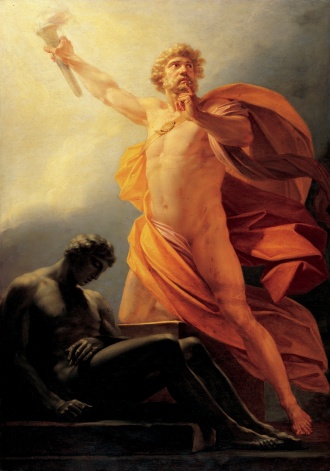
Prometheus brings fire to mankind Heinrich fueger 1817

It should probably seem strange to us that one of the memes we often use when trying to grapple with the question of how to understand the powers brought to us by modern science and technology is one inspired by an ancient Greek god chained to a rock. Well, actually not quite a god but a Titan, that is Prometheus.

Do a search on Amazon for Prometheus and you’ll find that he has more titles devoted to him than even the lightning bolt throwing king of the gods himself, Zeus, who was the source of the poor Titan’s torment. Many, perhaps the majority of these titles containing Prometheus- whether fiction or nonfiction- have to do not so much with the Titan himself as our relationship to science, technology and knowledge.

Here’s just an odd assortment of titles you find: American Prometheus: The Triumph and Tragedy of J. Robert Oppenheimer, Forbidden Knowledge: From Prometheus to Pornography, Prometheus Reimagined: Technology, Environment, and Law in the Twenty-first Century, Prometheus Redux: A New Energy Age With the IGR, Prometheus Bound: Science in a Dynamic ‘Steady State’ . It seems even the Japanese use the Western Prometheus myth as in: Truth of the Fukushima nuclear accident has now been revealed: Trap of Prometheus. These are just some of the more recent non-fiction titles. It would take up too much space to list the works of science-fiction where the name Prometheus graces the cover.   

Film is in the Prometheus game as well with the most recent being Ridley Scott’s movie named for the tragic figure where, again, scientific knowledge and our quest for truth, along with its dangers, are the main themes of the plot.

It should be obvious that the myth of Prometheus is a kind of mental tool we use, and have used for quite some time, to understand our relationship to knowledge in general and science and technology specifically. Why this is the case is an interesting question, but above all we should want to know whether or not the Promethean myth for all the ink and celluloid devoted to is actually a good tool for thinking about human knowing and doing, or whether have we ourselves become chained to it and unable to move like the hero, or villain- depending upon your perspective, whose story still holds us in his spell.

It is perhaps especially strange that we turn to the myth of Prometheus to think through potential and problems brought about by our advanced science and technology because the myth is so damn old. The story of Prometheus is first found in the works of the Greek poetic genius, Hesiod who lived somewhere between 750 and 650 B.C.E. Hesiod portrays the Titan as the foil of Zeus and the friend of humankind. Here’s me describing how Hesiod portrayed Zeus’ treatment of our unfortunate species.

If one thought Yahweh was cruel for cursing humankind to live “by the sweat of his brow” he has nothing on Zeus, who along with his court of Olympian gods:

“…keep hidden from men the means of life. Else you would easily do work enough in a day to supply you for a full year even without working.”

In Hesiod, it is Prometheus who tries to break these limitations set on humankind by Zeus.

Prometheus, the only one of the Titans that had taken Zeus’s side in coup d’état against Cronos had a special place in his heart for human beings having, according to some legends, created them. Not only had Prometheus created humans who the Greeks with their sharp wisdom called  mortals, he was also the one who when all the useful gifts of nature had seemingly been handed out to the other animals before humans had got to the front of the line, decided to give mortals an upright posture, just like the gods, and that most special gift of all- fire.

We shouldn’t be under the impression, however, that Hesiod thought Prometheus was the good guy in this story. Rather, Hesiod sees him as a breaker of boundaries and therefore guilty of a sort of sacrilege. It is Prometheus’ tricking Zeus into accepting a subpar version of sacrifice that gets him chained to his rock more than his penchant for handing out erect posture, knowledge and technology to his beloved humans.

The next major writer to take up the myth of Prometheus was the playwright of Greek tragedy, Aeschylus, or at least we once believed it to have been him, who put meat on the bones of Hesiod’s story. In Aeschylus’ play, Prometheus Bound, and the fragments of the play’s sequels which have survived we find the full story of Prometheus’ confrontation with Zeus, which Hesiod had only brushed upon.

Before I had read the play I had always imagined the Titan chained to his rock like some prisoner in the Tower of London.  In Prometheus Bound the rebel against Zeus is not so much chained as nailed to Mount Kazbek like Jesus to his cross. A spike driven through his torso doesn’t kill him, he’s immortal after all, but pains him as much as it would a man made of flesh and bones. And just like Jesus to the good thief crucified next to him, Prometheus in his dire condition is more animated by compassion that rage.

“For think not that because I suffer therefore I would behold all others suffer too.”

To the chorus who inquires as to the origin of his suffering Prometheus list the many gifts besides his famous fire which he has given humankind. Before him humans had moved “as in a dream”, and did not yet have houses like those of the proverbial three little pigs made of straw or wood or brick. Instead they lived in holes in the ground- like ants. Before Prometheus human beings did not know when the seasons were coming or how to read the sky. From him we received numbers and letters, learned how to domesticate animals and make wheels. It was him who gave us sails for plying the seas, life in cities, the art of making metals. What the ancient myth of Prometheus shows us at the very least is that the ancient Greeks were conscious of the historical nature of technological development- a consciousness that would be revived in the modern era and includes our own.

In Aeschylus’  play Prometheus holds a trump card. He knows not only that Zeus will be overthrown, but who is destined to do the deed. Definant before Zeus’ messenger, Hermes and his winged shoes, Prometheus Bound ends with the Titan hurtled down a chasm.

Like all good, and more not so good, stories Prometheus Bound had sequels. Only fragments remain of the two plays that followed Prometheus Bound, and again like most sequels they are disappointments. In the first sequel Zeus frees the Titans he has imprisoned in anticipation of his reconciliation with Prometheus in the final play. That is, Prometheus eventually reconciles with his tormentor, centuries later many would find themselves unable to stomach this.

Indeed, it would be a little over a millennium after Hesiod had brought Prometheus to life with his poetry that yet another genius poet and playwright- Percy Bysshe Shelley would transform the ancient Greek myth into a symbol of the Enlightenment and a newly emergent relationship with both knowledge and power.

Europeans in the 18th the early 19th century were a people in search of an alternative history something other than their Christian inheritance, though it should be said that by the middle of the 19th century they had turned their prior hatred of the “dark ages” into a new obsession. In the mid to late 1800s they would go all gothic including a new obsession with the macabre. A host of 19th century thinker including Shelly’s brilliant wife would help bring this transition from brightsky neo-classicism and its worship of reason which gave us our Greco-Roman national capital among other things, to a darker and more pessimistic sense of the gothic and a romanticism tied to our emotions and the unconscious including their dangers.

Percy Shelley’s Prometheus as presented in his play Prometheus Unbound was an Enlightenment rebel. As the child resembles the parent so the generation of Enlightenment and revolution could see in themselves their own promethean origins. Not only had they shattered nearly every sacred shibboleth and not just asked but answered hitherto unasked questions of the natural world their motto being in Kant’s famous words “dare to know”, they had thrown out (America) and over (France) the world’s most powerful kings- earthbound versions of Zeus- and gained in the process new found freedoms and dignity.

Shelly says as much in his preface:

“But in truth I was averse from a catastrophe so feeble as that of reconciling the  Champion with the Oppressor of mankind.”

There is no way Shelley is going to present Prometheus coming to terms with with a would be omnipotent divine tyrant like Zeus. Our Titan is going to remain defiant to the end, and Zeus’s days as the king of the gods are numbered. Yet, it won’t be our hero that eventually knocks Zeus off of his throne it will be a god- the Demogorgon- not a Titan who overthrows Zeus and frees Prometheus. There are many theories about who or what Shelley’s Demogorgon is- it is a demon in Milton, a rather un-omnipotent architect  a bumbling version of Plato’s demiurge- in a play by Voltaire, but the theory I like best is that Shelley was playing with the word demos or people. The Demogorgon in this view isn’t a god- it’s us– that is if we are as brave as Prometheus in standing up to tyrants.  Indeed, it is this lesson in standing up for justice that the play ends:

To defy Power which seems omnipotent

To love and bear to hope till

Hope creates

From its own wreck the thing it contemplates

Neither to change nor falter nor repent his like thy glory

Titan is to be

Good great and joyous beautiful and free

     This is alone Life Joy Empire and Victory

Now, Shelley’s Prometheus just like the character in Hesiod and Aeschylus is also a bringer of knowledge and even more so. Yet, what makes Shelley’s Titan different is that he has a very different idea of what this knowledge is actually for.

Shelley was well aware that given the brilliant story of the rebellion in heaven and the Fall of Adam and Eve that had been imagined by Milton Christians and anti-Christians might easily confuse Prometheus with another rebellious character- Lucifer or Satan. If Milton had unwittingly turned Satan into a hero in his Paradise Lost the contrast with Shelley’s Prometheus would reveal important differences. In his preface to Prometheus Unbound he wrote:

The only imaginary being resembling in any degree Prometheus is Satan and Prometheus is in my judgment a more poetical character than Satan because in addition to courage and majesty and firm and patient opposition to omnipotent force he is susceptible of being described as exempt from the taints of ambition envy, revenge and a desire for personal aggrandizement which in the Hero of Paradise Lost interfere with the interest. The character of Satan engenders in the mind a pernicious casuistry which leads us to weigh his faults with his wrongs and to excuse the former because the latter exceed all measure.

That is, Prometheus is good in a way Satan is not because his rebellion which includes the granting of knowledge is a matter of justice not of a quest for power. This was the moral lesson Shelley thought the Prometheus story could teach us about our quest for knowledge. And yet somehow we managed to get this all mixed up.

The Prometheus myth has cross fertilized and merged with Judeo-Christian myths about the risks of knowledge and our lust for god-like power. Prometheus the fire bringer is placed in the same company as Satan and his rebellious angels, Eve and her eating from the “Tree of Knowledge”, the  story of the construction of the Tower of Babel. The Promethean myth is most often used today as either an invitation to the belief that “knowledge is power” or a cautionary tale of our own hubris and the need to accept limits to our quest for knowledge lest we bring down upon ourselves the wrath of God. Seldom is Shelley’s distinction between knowledge used in the service of justice and freedom which is good- his Prometheus- and knowledge used in the service of power- his understanding of Milton’s Satan acknowledged.

The idea that the Prometheus myth wasn’t only or even primarily a story about hidden knowledge- either its empowerment or its dangers- but a tale about justice is not something Shelley invented whole cloth but a latent meaning that could be found in both Hesiod and Aeschylus. In both, Prometheus gives his technological gifts not because he is trying to uplift the human race, but because he is trying to undo what he thinks was a rigged lottery of creation in which human beings in contrast to the other animals were given the short end of the stick. If the idea of hidden knowledge comes into play it is that the veiled workings of nature have been used by power- that is Zeus- to secure dutiful worship- a ripoff and injustice Prometheus is willing to risk eternal torment to amend.

Out of the three varieties of the Promethean myth- that of encouraging the breaking of boundaries in the name of empowerment (a pro-science and transhumanist interpretation), that of cautioning us against the breaking of these boundaries (a Christian, environmentalist and bioconservative interpretation), or knowledge as a primary means and secondary end in our quest for justice (a techno-progressive interpretation?) it is the last that has largely faded from our view. Oddly enough it would be Shelly’s utterly brilliant and intellectually synesthetic young wife who would bear a large part of the responsibility for shifting the Prometheus myth from a complex and therefore more comprehensive trichotomy to a much more simplistic and narrowing dichotomy.

Mary Shelley’s Frankenstein; or, The Modern Prometheus would turn the quest for knowledge itself into a potential breaking of boundaries that might even be considered a sort of evil. Scientists in the public mind would play the role of Milton’s Satan – hero or villain. Unfortunately in drawing this distinction with such artistic genius Mary Shelley helped ensure that the paramount promethean concern with justice would become lost.  I’ll turn to that tale next time…

Betting Against The Transhumanist Wager

The madman is not the man who has lost his reason. The madman is the man who has lost everything except his reason.

G.K. Chesterson

There have been glowing reviews at the IEET of Zoltan Istvan’s The Transhumanist Wager. This will not be one of those. As I will argue, if you care about core transhumanist concerns, such as research into pushing out the limits of human mortality, little could be worse than the publication of Istvan’s novel. To put it sharply in terms of his so-called First Law of Transhumanism “A transhumanist must safeguard his own existence above all else”; Istvan, by creating a work that manages to disparage and threaten nearly every human community on earth has likely shortened the length of your life.

You shouldn’t be worried about anti-transhumanist, fundamentalist terrorism or any other sort of boogey man but a much, much bigger danger: the collapse of the very supports, financial, political, and social by which transhumanism could obtain any of its ends. Indeed, if what Istvan presents in his novel as the philosophy of transhumanism is anything near to reality, the movement does not deserve to survive. Techno-progressives should then truly divorce themselves from a movement which sadly has taken a fascistic and frightening turn.

Where even to begin?

The protagonist of The Transhumanist Wager is a man called Jethro Knights. At least in the first half of the novel, Knights recapitulates the inarguably fascinating life of Istvan himself: solo-circumnavigation around the world on a ship filled with books, writer for a barely disguised version of National Geographic, war correspondent. From there, I have no idea how the views of the protagonist and the novelist diverge, but Knights himself shows all the traits of narcissistic personality disorder meaning one of the core clinical traits of a psycho-path.

It is not merely that Istvan’s Knight is in the in the throes of NPD in terms of being “preoccupied with thoughts and fantasies of great success, enormous attractiveness, power, intelligence” he builds an entire transhumanist philosophy – Teleological Egotistical Functionalism (TEF) around such narcissism.

Knight’s idea of what he calls “the omnipotender” is certainly an example of an ego that has lost its grip on factual reality:

“His ultimate goal was that of the omnipotender: one who contends for omnipotence. He wanted a universal dictatorship- or at least a draw over everything and everyone.” (80)

And again:

Jethro desperately yearned for life, for power, for air into his lungs, for his mind to control and triumph over his physical surrounding- for the universe that only his will forged. (emphasis added) (171)

Knights is a man who thinks the universe is his to own and control. In this reading, the continuation of life is not the ultimate goal of transhumanism, but merely the stepping stone on the road to a kind of Randian-technologic power fantasy- the desire for which Knights takes to be the throbbing heart of evolution itself.

This omnipotender is an unyielding individual whose central aim is to contend for as much power and advancement as he could achieve, and whose immediate goal is to transcend his human biological limitations in order to reach a permanent sentience. “ (33)

Starting from such turbocharged Hobbesian assumptions it should come as no surprise that the philosophy Knights crafts ends up being a kind of fascist utilitarianism. Again, this is firmly in line with NPD in the sense of“failing to recognize other people’s emotions and feelings”, or better still the worth of others’ thoughts and feelings.

As Istvan describes Knights:

Even if he looked a person in the eye, he often failed to recognize anything of utility. Jethro perceived their presence, the space they took up the resources they used on his planet.  (p.12)

If individuals you have actually met in the flesh have no value for you beyond some utilitarian calculus in reference to your own ends, it stands to reason that the vast majority of human beings whom you have never and will never meet are little more than mere “variables” in your calculations. Fellow human beings whose worth can be deemed negative or positive based on what you desire to achieve.

We need to divert the resources to the genuinely gifted and qualified. To the achievers of society- the ones who pay your bills by their innovation, genius, and hard work. They will find the best way to the future. Not the losers of the world, or the mediocre, or the downtrodden, or the fearful. They will only drag us down, like they already have. (127-128)

There was not right or wrong when it came to dying or not dying. There was only success or failure. It spoke of using whatever means necessary to accomplish those aims, of thinking and acting with the same cold clarity a super-intelligent machine would use- something they were quickly evolving into anyway, the essay asserted. The world and all of its inhabitants were not worth living and dying for. (53)

It is not clear whether Knights himself has devised what Istvan calls “The Humanicide Formula” or if it is the product of anti-transhumanist propaganda. Whatever its origins in the narrative it certainly aligns with the overall immortality of TEF and Knights himself.

… not all human beings will be a net-positive in producing omnipotenders. Any individual who ultimately hampers the optimum transhuman trajectory should be eliminated.  (215)

Knights is truly not being hyperbolic when he says something like:

A transhumanist has no immediate concern for others, for family, for state, for heritage, for humanity, for God; only for its power and the preservation and growth of that power. (281)

Indeed, he is willing to apply this kind of emotional lobotomy to his own heart. Under “inquisition” by the cartoon of religious evil Istvan has set up as the foil to his protagonist, Reverend Belinas, Knights admits of his wife, Zoe Bach, the woman he has loved the most deeply:

What you say is true, preacher. I would kill my wife a thousand times over to reach my goals. (246)

If any of this strikes you as inhuman rather than post-human Knights would claim that it not him, but you, who suffers from psychological disconnect.

This was the essence of the world’s unmasked collective soul, the quintessential character flaw- that people were bred and conditioned to be afraid to do what they most deeply wanted to do: become invincible.  (242)

If The Transhumanist Wager was supposed to be a novel of ideas, an artistic representation of transhumanist thought, as Istvan has stated it, the book fails miserably on the score. Real novels of ideas put more than one idea up against one another, explore the space between the known and unknown. By contrast, The Transhumanist Wager has only one idea- a fascistic interpretation of the meaning of transhumanism in which the complexity of every other current of human thinking, including transhumanism itself, is reduced to a cartoon.

Futurism has always contained within itself a hatred of the past, and everything we have inherited from the past, religion yes, but also culture, art, architecture, literature. Istvan’s novel has left no room for continuity between transhumanist aims and the longings and attempts at transcendance that was invented by the world’s religions, even if the version of transhumanism he presents is nothing but a ripped off and upside down version of fundamentalist Christianity. In fusing the so-called militancy and cultural illiteracy of the New Atheism with a religiously infused interpretation of transhumanism, Knights, or Istvan, has merely created a new form of fundamentalism- its barbarism no better than the kinds of real barbarism seen when the Taliban destroyed the beautiful 5th century Buddhas of Bamiwam.

Istvan’s imagined willful and unnecessary destruction by transhumanists of cultural treasures in the West; Vatican City, where the Pope himself is killed, the incomparable Notre Dame and Versailles, along with the jewels of Western culture it holds, certainly struck home for me, and I am sure they will not fit well with many other Westerners of similar secular bent to myself who nonetheless understand the exquisite and fragile beauty of these places.

Yet, the damage of Istvan’s novel for the transhumanist movement might be much more strongly felt outside of the West rather than inside it. He imagines transhumanists destroying the Imperial Palace in Japan, The Forbidden City in Beijing (which even the anti-historical madman, Mao, left in tact), Delhi’s parliament building and its cultural treasures are destroyed, Moscow’s gorgeous Kremlin- leveled. The most sacred site of Muslims, the Kaaba, is destroyed along with their Dome of the Rock. The Wailing Wall, sacred to Jews both religious and secular since 70 C.E. is annihilated. Istvan’s transhumanists destroy what is probably the most exquisite piece of architecture built on the African continent the Great Mosque of Djenné, and blow up Brazil’s iconic Christ the Redeemer.

All of this is troubling and amounts to madness, for certainly there were other ways of displaying imagined transhumanist power in the novel that refrained from destroying the civilizational legacy not just of particular cultures but all of humankind. It is perhaps easy to sit in the comfortable West where religious violence is largely a figment of our imagination, and persons who write inflammatory tomes like Istvan’s aren’t arrested but protected by the police from the assault of maniacs and fanatics. It’s quite another thing to be associated with these ideas without any such protections and indeed their opposite.

The Transhumanist Wager might very likely put the lives of some transhumanist individuals in danger, and suck in individuals who are merely trying to move their societies in a more scientific direction. If you were living in Saudi Arabia and interested in transhumanism to the extent of owning literature on the subject, wouldn’t you now burn these books and papers, if not for your own protection, then, so unlike Knights himself, that of your family? Might you not also be tempted to burn your books about science given the possible conflation between an interest in science and a sympathy for transhumanism?

Where I am left is wracking my brain is in figuring out the origins of these fascist trends in in transhumanism, for it is twice now that very recent books have pushed the thinking of the movement in the direction of what can only be understood as technological fascism. It is clear that it is not his individualistic Randian assumptions alone that led Istvan in the directions of this type of thinking, for Steve Fuller, in his Humanity 2.0 arrives at a similar anti-human philosophy from a collectivist rather than a hyper-individualistic perspective.

The more I think on it, the more it seems that the kinds of fascist transhumanism seen in Fuller and now Istvan is a result of a quite narrow understanding of the meaning of technology which transhumanists of their stripe have adopted from the world of technological hardware, the kinds of things we normally associate when we hear the word technology, but whose narrowness when applied to the human and living world can lead to some pretty dark distortions. In a sense all transhumanism, even clearly progressive transhumanism, suffers from a kind of technological fetishism, and thus might gain insight from confronting what results when the logic of a mechanized technological advancement itself becomes the end through which human aspirations are funneled.

If we get out of the mindset that technology is only something that we have deliberately engineered it’s quite easy to see almost everything human beings do as making use of a sort of technology. In this interpretation law is a sort of technology which mediates social and economic interactions. Religion is a sort of technology, a  path to some particular human definition of transcendence. A kind of universal moral heuristic such as the Golden Rule is a sort of technology which guides human moral behavior.

The kinds of fascist transhumanism seen in Fuller and Istvan treats both persons and culture as if they were something like cell phones. The “functionalism” at the end of Istvan’s TEF gives it away. He has established criteria by which the “worth” of a human being can measured like one would a gadget. If someone fails to meet this criteria, or worse from his point of view, is a bug in the overall system they are to be “discarded” like one would a smart phone model from the last innovation cycle. Fuller goes so far in his desire that we reconceive our nature to be one of “designers” that he is a vocal supporter of teaching the pseudo-science of intelligent design in schools in order to inspire students with the “god-like” tasks in front of them.

Perhaps what morally grounds techno-progressivism as a branch of transhumanism is that it is more prone to tap into deeper ethical stands and currents (themselves a very potent form of moral and social technology) and is thus informed by traditions such as that of rights (including animal rights), or the desire for social justice that is lost by the transhumanism of Fuller or Istvan that reduces everything to the cruel logic of products. Yet, if narrow ideas regarding technology can result in the emergence of fascist trends of thought within transhumanism, the kind of heavy weight put on what is now mere engineering is also often too much for that type of human action to bear.

On the one hand there is the collision of our daydreams with the sheer complexity and surprises that confront us when faced with reality as shown to us by science. We have inherited aspirations regarding human life from religion and political philosophy which may or may not have a technologically engineerable solution, and there is no way to know in advance if they do or do not. Just because we can dream of something does not mean it is technologically or economically possible, or may only prove possible in ways utterly different from our initial dreams, though we may be able to achieve some ends such as social justice not through gadgets and technical innovation but through changes in the technology of  economic structures and using the “engineering” that we call politics.

Indeed, some of our least sophisticated and deliberately engineered means of human enhancement are the best we have so far. Quality education, good nutrition, and supportive and loving home environments continue to be more effective in raising human intelligence than all the neurological interventions we have come up with. The biggest gains we have clocked in increasing human longevity were not so much the product of high- tech medicine, but decidedly low-tech improvements in public health.

This is not to say that much greater gains in cognitive capacity or longevity aren’t there for us to find once we have a firmer grasp on neurological mechanisms and a more developed understanding of the process of aging. What it does suggest is that unless we free ourselves from our narrow understanding of technology we might end up running to stand still as failure to invest in education robs children, in the aggregate, of the ability to learn, or failure to invest in public health gives rise to a median decline in lifespan at the very moment we’ve grasped the neurological mechanisms behind learning and memory and discovered how to slow life’s clock. What good, after all, would an understanding of the underlying neurological mechanisms behind artistic ability do us if we no longer publicly supported art classes for kids?

The temptation transhumanists face is the urge to re-orient all the resources of society towards technological efforts to solve only one problem- the problem of personal death.  In setting the bar so high, as in the achievement of personal immortality within their lifetimes, many transhumanists have enabled a sort of existential panic as the years pass by without the needed breakthroughs to definitively achieve such an end. Istvan’s Jethro Knights is cruel precisely because of the intensity of his impatience. The whole world needs to be overthrown because unless it is he will die.

What is lost in this impatience is the space between humanity and the at the moment very uncertain promises of post-humanity. Almost all ideas regarding post-humanity rest on what amounts to speculative science and technology even in the face of the fact that human beings have a very poor record predicting such things. The science and technology of the future will in all likelihood prove full of surprises- closing off some aspirations while at the same time making us aware of new ones.

The danger here is that the scientifically probable suffers in comparison to the enchantingly possible. Istvan is telling here for he is especially disdainful of investments in what is often called public health seeing it in a sense as a rival to much more ambitious transhumanist medicine. This attitude skirts the fact that it was largely the investments in rather mundane public health that nearly doubled our longevity in the first place. Istvan’s impatience due to his own mortality leads to a blindness to the likely gradualism to anything like post-humanity. We’ll probably learn how to keep people fit and healthy into their 80’s long before we figure out if biological immortality is scientifically possible let alone something like uploading. Viewed from a social rather than a personal level gradualism towards greatly changed conditions for human beings is probably a very good thing- giving society time to adjust.

Techno-progressives need to pay more attention to this space immediately in front of us. Such an effort would give us a better idea of where to prioritize their political efforts in terms of pushes for research funding and the like that would have the greatest immediate impact. Given the accelerating pace at which the world’s population is aging many of these priorities are likely to be shared by a broad swath of society many of them, yes, religious.

This is a much better strategy than engaging in a power fantasy in which your personal survival has become a political question, nothing in the world is more important than this survival, and what you believe most puts your survival in question is the fact that the whole world is your enemy. For, if transhumanists continue to put out works like Istvan’s Transhumanist Wager such paranoia may tragically become true and almost nothing could be worse in terms of real progress towards the movement’s long range aspirations.
The Philosophy Behind Elysium

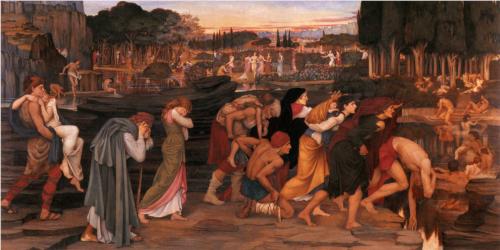
The Waters of Lethe by the Plains of Elysium Stanhope 1880

I finally had the chance to see Elysium this week. As films go, the picture is certainly visually gripping and the fight scenes awesome, if you are into that sort of thing. But, in terms of a film about ideas the picture left me scratching my head, and I could only get a clue as to the film’s meaning as intended by Neill Blomkamp, Elysium’s screenwriter and director, by looking elsewhere.

Embedded within stunning special effects Elysium is certainly meant as a moral critique of  inequality- a futuristic tale of the haves vs the have-nots. The rich, in Blomkamp’s earth of 2154 live on the space station of Elysium- a trans-humanist paradise where diseases are miraculously scanned away while the entire earth below has become a vast slum. Elysium is the mother of all gated communities the people inside it rich and beautiful while those outside suffer, and not to blow the ending, but Blomkamp is out to open the gates.

Blomkamp has made it clear that his film is less of a warning about the future than an allegory for the present.

People have asked me if I think this is what will happen in 140 years, but this isn’t science fiction. This is today. This is now!

The Elysium of today is the First World and the earth of the film the Third World with the latter’s immigrants desperate to break into “paradise” for the sake of themselves and their families. The explosion of mega-cities like the 180 million Yangtze Delta in China (which plays no role in Elysium) serves as a kind of sociological backdrop for the film. It is especially the squalor of megacities that draws Blomkamp’s cinematic eye. Part of the movie was filmed in one of the world’s largest dumps in Mexico.

And yet, Elysium certainly seems to articulate some sort of philosophical position not just on the present, but on the future, and adds its own voice to the debate surrounding its possibilities. The question is, what? I left the movie thinking it was mostly a less than veiled critique on transhumanism,  especially the in-egalitarian, utopian seasteading variety of transhumanism as propounded by the like of Peter Theil. And again, not to blow it, but the major epiphany of the protagonist is realizing that his own survival is not the ultimate value.

Blomkamp’s true perspective, however, is somewhat different as evidenced when I looked beyond the film itself. Blomkamp is actually a singularitarian, though a very pessimistic one. He subscribes to the idea of civilizational development put forward by the Russian scientist Nikolai Kardashev. I’ll quote myself  here, “… in the 1960 Kardashev postulated that civilizations go through different technological phases based on their capacity to tap energy resources. A Type I civilization is able to tap the equivalent of its entire planet’s energy. A Type II civilization is able to tap an amount of energy equivalent to the amount put out by its parent star, and a Type III civilization able to tap the energy equivalent to its entire galaxy. Type IV and Type V civilizations able to tap the energy of the entire universe or even the multiverse have been speculated upon that would transcend even the scope of Kardashev’s broad vision.

Blomkamp speculates that the reason for the so-called Fermi Paradox – if the conditions for life in the universe are so abundant, then where are the aliens?- is that the movement to Type I civilization- the emergence of a truly global civilization- is so difficult that none of the many civilizations that have emerged over the history of the universe have made it through this bottleneck, and for Blomkamp we show every sign of sharing this sad fate.

As Blomkamp sees it human nature is the greatest barrier preventing us from reaching Type I. Echoing Julian Savulescu, he has stated:

We have biological systems built into us that were very advantageous for us, up until we became a functioning civilization 10,000 years ago. We are literally genetically coded to preserve life, procreate and get food – and that’s not gonna change. The question is whether you can somehow overpower certain parts of that mammalian DNA and try to give some of your money out, try to take your wealth and pour it out for the rest of the planet.

Again, along transhumanist and singularitarian lines of thinking Blomkamp believes that if we do not solve our problem the world will bifurcate into pockets of the technologically empowered rich isolated within a global mega-city of the miserably poor:

…it’ll either be a singularity discussion or this Mad Max fuckin’ group of savages roaming on the horizon, a Malthusian catastrophe.

Alright, so like many others Blomkamp believes we are at a crossroads whose path will shape the whole fate of humanity, indeed the fate of intelligence in the universe, one more sad example of not being able to breakthrough emerge as a Type I civilization or the glorious birth of a new cosmic era.

Yet, perhaps we need to step back for a moment from this sort of apocalyptic thinking. It’s an at least questionable assumption whether or not intelligence and technology have any such cosmic role to play in the future of the universe, let alone whether the current generation will be the one that ultimately decides our fate. We’ve been in a situation where we are in danger of destroying ourselves since at least the explosion of the first hydrogen bomb in 1954, and there is no foreseeable future where we definitively escape these types of dangers now that we have such powers and now that our reach is global and beyond.

Indeed, if it is the case that civilizations are at risk of catastrophic failure whatever their position on the Kardashev Scale, this would go even further in explaining the Fermi Paradox. Even those that make it through Type I continue to be at risk of botching the whole thing. The obvious rejoinder to this is that once a civilization has”gone galactic” it is safe, but I am not so sure. Perhaps Type II and III super-intelligences come up with galactic scale methods of destruction, or collapse into a singularity induced turtle shell, as imagined so cleverly by Charles Stross. We simply don’t know enough to actually decide one way or another, although in addition to the hunt for planets in the “habitable zone” done by the beloved Kepler and its hopeful successor, scientists at FermiLab are on the hunt for any signs of Type I and II Dyson Spheres whose discovery would actually put meat on the bones of what is otherwise merely a plausible model of technological development not to mention blow our minds.

However, as I have mentioned elsewhere, a much less metaphysically laden explanation for the Fermi Paradox can be found in the simple life cycle of stars. It is only quite recently that the types of stars that create the sorts of heavy elements necessary for life (at least life as we understand it) have emerged, and the number of such heavy element creating stars in increasing. Earth might be one of the first planets to establish life and civilization, but it will in all probability not be the last. There will probably be many many more chances to get it right, if by getting it right we mean getting beyond our current technological stage. There are also likely to be many more type of paths through evolution and historical development than we could ever imagine without any ultimate destiny or convergence point, which some modern scientists and singularitarians have borrowed straight from religious longings.

There is no need to posit a potentially lost cosmic destiny to come to the conclusion that our’s or future generations’ failure to meet our global responsibilities today would constitute a colossal tragedy, and this is what we can confidently take away from Elysium. That one of the greatest challenges in front of us is making sure that all of humanity is able to benefit from scientific, technological and economic progress, and as Blomkamp’s action-packed analogy reminds us, we don’t have to go out to the 22nd century to see that we are failing to live up to this challenge quite miserably.

On Recognizing Deep Fragility


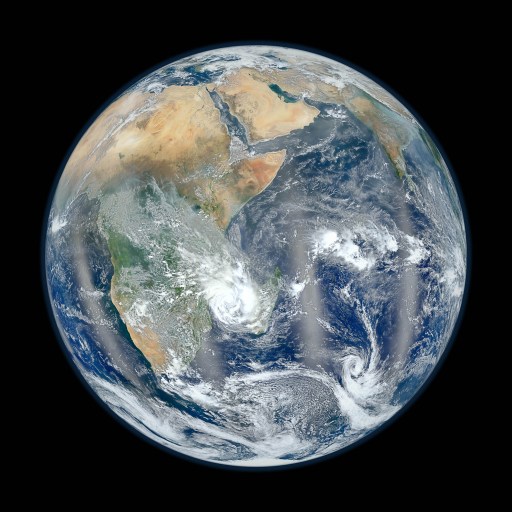
Eastern Hemisphere from Space Nasa High Resolution

If we take what amounts to the very long view of the matter it’s quite easy to see how both the tradition of human rights and transhumanism emerge from what are in effect two different Christian emphasises on the life of Christ. Of course, this is to look at things from the perspective of the West alone. One can easily find harbingers of both human rights and transhumanism outside of  Christianity and the West in Non-Western societies and religious/philosophical traditions in Islam, Hinduism, Buddhism or Taoism among others. For now though, lets stick with seeing things through the lens of the Western tradition alone.

Perhaps the primary source for human rights in Christianity would be the idea of Christ as God relocated into the fragility of a human body, a consciousness supremely sensitive to the most vulnerable among us- the sick, the poor, the excluded, the powerless and insisting on the spiritual equality of human beings. Roots of transhumanism can be found in another Christ tradition- the idea of man made God, the desire to transcend human limits to seek and find enlightenment.

Putting aside the elitism of the gnostics, such doubled vision need not necessarily be understood as the source of irreconcilability and conflict, but more like a gestalt drawing where two pictures can exist in one. What picture one sees becomes a matter of what you are looking for at the moment.

Historically zooming in a little closer to the Age of Enlightenment we can again see both the tradition of human rights and something like a proto- transhumanism existing side by side. If an enormous increase in the span of biological or material longevity is taken to be the sine qua non of transhumanism, then the Marquis de Condorcet who predicted in his 1794 Sketch for a Historical Picture of the Progress of the Human Spirit that:

….a period must one day arrive when death will be nothing more than the effect either of extraordinary accidents or of the flow and gradual decay of the vital powers and that the duration of the middle space of the interval between the birth of man and this decay will itself have no assignable limit. (368)

Was at the same time a staunch defender of much human rights as we would now understand them- the abolition of slavery, equal rights for women, and political rights as they had been articulated in the American Declaration of Independence and Bill of Rights and especially in the French Declaration of the Rights of Man.

Yet, if if human rights and proto-transhumanism can often be found right next to one another, so to speak, in both Christianity and the Enlightenment it is certainly difficult to argue that such is the case today. Or only if we narrowly define rights in terms of so-called “negative rights” that is liberties which are used by many transhumanists to argue that they have a right to pursue transcendence, augmentation, and increased powers. How then did the two become so clearly separated in our consciousness?

Often the emergence of human rights and transhumanism is presented sequentially with human rights appearing first and transhumanism or posthumanism occurring afterwards. You find this in Steve Fuller who characterizes human rights (both economic and political) as “humanity 1.0” whereas posthumanism is the newer “humanity 2.0” a separate and sometimes rivalrous utopian project.

This kind of temporal positioning of the utopian project to universally achieve human rights as the ideal of the past with posthumanism as a set of goals for the future is, despite its intuitive appeal, not very historically accurate. For the sharp separation of the human rights and transhumanism can only be dated to their emergence as two clearly defined utopian projects.

It might be surprising to learn exactly how contemporary the appearance of these movements as clearly distinguishable utopian projects actually is. For starters, the very recent appearance of the global movement for human rights is something that has been stressed strongly in recent years by Marxist scholars who want to alert us the inadequacies of the rhetoric of human rights in providing a path through which lasting change in the conditions of humanity in the early 21st century might be achieved. The perspective of this critique can be found in the political writings of the activist and fiction author China Mieville, but by far the most comprehensive argument for both the contemporary nature of human rights and their inadequacy is found in the work of the historian Samuel Moyn.

In his The Last Utopia: Human Rights in Human History Moyn makes a pretty compelling case that far from being the telos of history human rights emerged as the only 20th century utopian project left standing in the 1970’s. For Moyn, human rights emerged as the dominant utopian narrative precisely because all other utopian projects had failed.  Soviet style communism proved itself a failure not with its Eastern European collapse in 1989 but with the Soviet invasion of Czechoslovakia in 1968 which showed that state communism could not be reformed by democratic means.

Liberalism had failed with the American debacle in Vietnam, and even self-determination which had since the American and French Revolutions had been seen as the only path through which rights could be truly secured had proven itself a failure as the new post-colonial states failed to not only institute rights but went on the offensive against national minorities.

Unlike other utopian projects Moyn holds that human rights was able to survive because it was moralistic rather than programmatic. It gave idealistic youth in the West something to focus their energies on that ultimately had little bearing on the actual political regime either domestically or internationally. The rhetoric of human rights gave communist dissidents a moral kludge with which they could hammer away at Eastern bloc violations of human rights without calling for the end of the communist project and without the need to insight revolution.

I have some problems with Moyn’s insistence on an extremely sharp historical separation between what we understand as human rights and what came before. We have known that human rights and self-determination (in terms of peoples) have had a troubling mutually interdependent relationship since Edmund Burke criticized the ideas behind the French Revolution. The problematic relationship between human rights and self-determination was brilliantly explored back in the 1940’s by Hannah Arendt.

That the articulation of rights in the Universal Declaration of Rights in 1948 was written under the assumption that European colonial empires would be retained is less than Moyn argues a sort of moralistic distraction from European powers hopes to retain their colonies than an attempt to guarantee rights outside of the context in which they had previously resided i.e. the sovereign nation-state. Moyn also makes no mention of international movements that have little connection with the nation-state as such and therefore bear more similarity to human rights as understood today such as the movement to abolish slavery and the rights of women and children.

The Universal Declaration was also written, I should add,  in light the recognition that the of the economic crisis that had collapsed the capitalist economic system and led to the Second World War necessitated the universal adoption of egalitarian systems- social democracy-  as the only forms of society that were sustainable, humanistic, and just.

Where Moyn is helpful is in focusing our view on the contemporary period rather than trying to find deeper historical currents. I found his Last Utopia especially fruitful in understanding how human rights and transhumanism separated course and also in grasping how the separation of either utopian project from the broader question of political and economic composition is, a both Moyn and China Mieville suggest for human rights alone, is likely to lead us into a cul de sac.

Let me start with one of the Soviet dissidents that Moyn thinks was instrumental in launching the human rights movement, Andrei Dmitrievich Sakharov. Sakharov was instrumental in the creation of the Soviet hydrogen bomb. The Americans had gotten their first. The explosion of the American hydrogen bomb over the Bikini Atoll in 1954- a weapon 1,000 times more powerful than the fission nuclear weapons dropped on Japan in 1945 signaled the birth of the human capacity to destroy both civilization and life on earth.

The Soviets would explode their own “true hydrogen bomb” a year later in 1955 based largely on Sakharov’s design. Perhaps the responsibility for what he had made possible had affected him, or perhaps his scientific grasp of the destructive potential of these new weapons had made him aware of the universal fragility of life, but by the 1960’s Sakharov had thrown himself into political activism.

His 1968 essay Progress, Coexistence and Intellectual Freedom marked his appearance onto the political scene. What is remarkable about this essay is the way it combines different utopian projects that have since become distinct rivals, and which we are only now attempting to recombine. Sakharov moves from the call for international peace to environmentalism to the encouragement of continued technological progress and development of the Third World to human rights.

What unites all of these for Sakharov is both an understanding of a shared human destiny and the recognition of our universal fragility especially in the face of modern, and largely man made, catastrophic risks.

Our challenges and possibilities can not be hermetically sealed off from one another but form a continuum requiring answers on all fronts. The role of science and technology is especially interesting here for Sakharov sees them as not only the source of many of our challenges but as the best and most essential tools we have for solving our problems. Yet, it is the essentially the political choice of what to use those our powers for that is the primary question.

Sakharov’s views are also infused with the perspective that both capitalist and communist societies had arrived at a sort of egalitarian consensus. Communist critiques that capitalism lead to inequality and immiseration and that the victory of communism over capitalism was a moral imperative to save the world’s poor no longer held now that capitalist societies had adopted social democratic policies and aimed at the development and dominance of a broad middle class. The same kind of consensus on social democracy that had been seen in the Universal Declaration.

Sakharov would go on to be a fierce defender of the idea that human right represented the best universvisable ethic for a new global age. Yet the kind of fusion of rights, social democracy, environmentalism and scientific and technological progress seen in his Progress, Coexistence and Intellectual Freedom would take a quite different turn in the West a kind of perfusion and splintering of utopian projects whose missions became quite distinct and even rivals for human commitment.

In the late 1960’ and 70’s Western environmentalism took a stand against science and technology a position that is only now being challenged. The struggle for human rights was cut off not merely from environmentalism but from the kinds of social democratic and egalitarian concerns with which it had emerged in tandem. Like environmentalism, human rights had very little to say in terms of the world’s geopolitical order and therefore too often became a ready made masks for US and Western geopolitical interests.

The idea of science and technology as a utopian project also in the 1970’s became separated from its fellow travelers. One can trace this back to the idea of “digitopia” conceived in Silicon Valley which saw in science and technology solutions to all of the world’s problems if only government would get out of the way. Much of contemporary transhumanism would embrace the libertarian assumptions found in “California culture” and this strain is still strong today. This, for instance, is the venture capitalist Peter Thiel a vocal (and financial) supporter of transhumanist causes such as the Methuselah Foundation which our earlier Condorcet would certainly recognize:

 In our time, the great task for libertarians is to find an escape from politics in all its forms—from the totalitarian and fundamentalist catastrophes to the unthinking demos that guides so-called ‘social democracy.’ . . . We are in a deadly race between politics and technology. . . . The fate of our world may depend on the effort of a single person who builds or propagates the machinery of freedom that makes the world safe for capitalism.

For this reason Theil supports utopian seasteading the goal of which “is to innovate more minimalist forms of government that would force existing regimes to change under competitive pressure.” Ostensibly, such islands would be havens for the testing of all sorts of transhumanist innovations.

Yet, the “island” we are actually on isn’t in the middle of any ocean, but the earth itself. It was from a recognition of this fundamental shared fragility of not just humanity but all of the earthly life that has come to depend upon it that Sakharov was able to envision the integration of many of the 20th centuries utopian projects. Even transhumanism the most seemingly optimistic of modern utopian projects emerges from the recognition of our fragility- the desire to be “god-like” is the best sign that we are very far from being “gods”.

One might view much of transhumanism today as built on the same sorts of isolationist assumptions that underlie the project of utopian seasteading. The greatest danger would be a transhumanism that serves as a tool in the stratification of societies along class lines where transhumanists put up “islands” within societies whose overall well being they have abandoned in the name of achieving post-human ends.

Yet, it may be the the sheer interdependence of the 21st century world makes it impossible to pursue any utopian project that fails to take the shared fate of humanity into account. There is a great need of a truly global movement that integrates our various problems and hopes as it becomes increasingly clear that modern crises do not fit squarely into singular versions of utopia or dystopia. The current crises in Syria and Egypt are environmental, rights based, technological, social democratic and geopolitical all at the same time.

We need a utopian project that addresses all of these problems simultaneously and articulates and expands human possibilities for everyone. Let’s hope that the recent profusion of early 21st century movements that seek the reintegration of utopian projects help break us out of our log jam. With these I would include a branch of transhumanism known as techno-progressivism which has the potential to bridge the recently emerged gap between human rights (along with the rest of life) and transhumanism. One of the best way to do this might be for techno-progressives to become aware of and adopt some of the new reformulation of rights as “capabilities” rather than the traditional notion of rights as entitlements. But that is for another time.


Towards a Transhumanist Techno-progressive Divorce

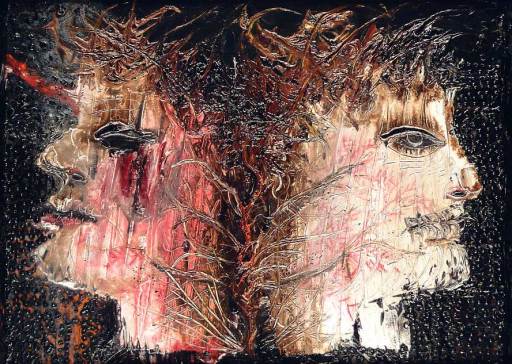
Janus

 How is this for a bold statement: the ultimate morality or immorality of transhumanism rests with the position it will take on the question of human rights and more specifically its adoption or denial of the principles of one document little discussed outside of the circle of international lawyers and human rights activists: The Universal Declaration of Right of 1948.

It was by a circuitous route that I came to this conclusion, which at first glance may seem nonsensical, for, after all, isn’t transhumanism precisely about the post- human rather than us current human beings for which the idea of human rights and The Universal Declaration were created?

As briefly mentioned in a prior post, my first indication that human rights and The Universal Declaration might need to be brought into the center of transhumanists’ view was suggested to me by a person who isn’t a transhumanist at all, and indeed is deeply uncomfortable with much of transhumanist rhetoric and underlying assumptions. No one would call the science-fiction author, Kim Stanley Robinson, a neo-luddite. Rather, he sees science, at least in its beneficent manifestations, as the ultimate utopian project. And, as anyone who has ever read one of Robinson’s novels knows, he views utopianism as a very good thing indeed.

It was in a panel discussion  “Utopia- Science Fiction and Fact” that Robinson brought up The Universal Declaration of Rights. As a reminder the Universal Declaration was the first global statement of rights to which, according to the consent of every nation on earth, all human beings are entitled and consists of 30 articles  spelling out these rights. They include not only basic so-called negative rights such as the freedom from arbitrary arrest and torture, but positive rights such as the right to marry and found a family, the right to “social security”, the right to work, the right to rest and leisure, the right to food, shelter, clothing and medical care, the right to “the full development of the human personality”, the right to a stable domestic and international political order, the right to education and to “enjoy the arts and share in scientific achievements and its benefits”.

My interpretation of Robinson bringing up the Universal Declaration in a transhumanist forum was that we already had a utopian project for the future “the project of justice” as he called it; therefore, we should be leery about getting ahead of ourselves. He seemed to be saying that we should focus our scientific and technological efforts on achieving these still far-off 20th century goals before we run full-steam towards the 21st or perhaps 22nd century goals of transhumanism.

It was only when I came across an interview by another future oriented thinker who also brought up the Universal Declaration that I started to think there might be something more to the relationship of transhumanism and the Universal Declaration than my superficial grasp of Robinson’s view had led me to believe.

In an interview with Adam Ford, avowed transhumanist, Steve Fuller, characterized the Universal Declaration as a perfect summation of 20th century progressive politics. This view of what he called “humanity 1.0” found in the Universal Declaration he believes will be likely find itself in conflict with the transhumanism of “humanity 2.0” in the years to come.

Fuller believes that the goals of humanity 1.0, of a progressive, egalitarian society, could only be “paid for” by “holding back” the superior members of society who tried to push the abilities of humanity evolutionarily forward. As time moves onward, more and more of ranks of these visionaries, Fuller thinks, will be filled by transhumanists. Thus his predicted tension between those who hold to the goals humanity 1.0 and those seeking to expand the limits of the possible and achieve the goals of humanity 2.0.

This prediction of probable conflict between the adherents of humanity 1.0 and those seeking to move to a transhumanist notion of humanity 2.0 grows out of Fuller’s libertarian “great man” theory of progress. For him, progress is pushed forward by “superior” individuals who break the bonds of the possible through risk, experimentation, innovation and revolution pulling the rest of society along.

The kind of antagonistic picture of how the world works found in Fuller is on full display in the movie Jobs where innovation and society is pulled forward by visionaries whose disdain for the rest of us non-visionaries types makes them, in common parlance, assholes.

The question that should naturally arise whenever justifications for inequality, such as Fuller’s based upon of the pull of “great men” are made is whether or not such lone visionaries are really acting “alone”? Someone like Steve Jobs was dependent on a society and history around and before him to obtain his visions, and we can never be quite sure if his breakthroughs would have occurred without him. It is just as likely that instead of being driven by “great men” progress in science and technology or human thought in general is really a matter of seizing opportunities that are lying there for anyone to pick up, and which can only be supported if a large enough pool of individuals have come to the point in their own thinking to find the new idea, or invention or whathaveyou compelling.

This libertarian myth that egalitarian policies are the enemy of innovation and upward mobility to which Fuller subscribes and which he conflates with the transhumanist project needs to be vocally challenged, and with hard data. It is, after all, in the Scandinavian countries where egalitarianism runs deepest that rates of innovation are highest and ranked consistently higher than in the in-egalitarian US. Despite libertarian mythology, it is in egalitarian countries where upward mobility is highest as well; suggesting, that egalitarian policies, contra Fuller, are much less about holding the “superior” back as maximize those able to create breakthroughs and in giving everyone a fair shot at success.

There is also the too often unspoken question of power. In another panel discussion, this one for the RSA, only the fiction author and political activist China Mieville had the guts or the comprehension to challenge Fuller’s underlying assumptions regarding power and inequality. If inequality has deep roots in the differential distribution of power and political influence, then Fuller’s version of transhumanism becomes  just one more way in which the already wealthy and powerful will be able to make their advantage permanent.

As another figure worried about exploding levels of inequality, Chrystia Freeland, points out in her book Plutocrats: The Rise of the New Global Super-Rich and the Fall of Everyone Else this is already happening at an ever increasing rate as the rich use their wealth to gain educational advantages for their children and distort market influence through their leverage over the political process. Of course, the rich have always done this. What is unprecedented today is the scale and extent to which the super-wealthy have been able to rig the game, so to speak, in their and their childrens’ favor.

A transhumanism lacking an egalitarian anchor, of which the Universal Declaration is just one example, threatens to become just one more way in which the already wealthy and powerful (including many of us lucky enough to be born in the developed world) will be able to make their advantage permanent by, for instance, genetically enhancing themselves or their children when this option is not available to all, purchasing the most advanced form of bioelectrical enhancements whose expense prices out the bulk of the middle class and the poor, replacing middle class and working class jobs with AIs and robots- further shifting the balance of economic distribution away from labor and towards capital without at the same time adopting policies to offset this decline of opportunities for human work with policies such as guaranteed basic income.

Yet, if I thought the extent of Fuller’s critique of the progressive worldview that underlie the Universal Declaration was based on a simplistic view of the reality of social equality reminiscent of Ayn Rand’s Atlas Shrugged or the Kurt Vonnegut short-story “Harrison Bergeron”, I was in for a rude awakening when I actually read Fuller’s book- Humanity 2.0.  It was in reading this book that I became convinced not just of the need for an egalitarian orientation for transhumanism but for the full embrace and incorporation of The Universal Declaration of Human Rights into its project if transhumanism was to free itself from the potential to unleash social evil.

It was in Humanity 2.0  that Fuller showed just how far he was willing to go in his rejection of the Universal Declaration, as far in fact as to call for the rehabilitation of the inhuman Nazi regime that had given rise to the Universal Declaration in the first place. The kinds of ethical obscenities that can be found in Humanity 2.0 are indicative of the dangers inherent when one unmoors the idea of post-humanity, of the transhuman, from the project to obtain the requisites of the human condition- of humanity 1.0- for all, and when one sees progress being driven by “superior” individuals or groups.

Part of the moral dilemma any transhumanists has to face is the sheer, and often unacknowledged gap, between transhumanist goals and the actual conditions of the large numbers of humanity. Transhumanists in large measure have objectives such as the obtainment of biological immortality when the average life expectancy in a country like Sierra Leone is 46. Talk of a technologically supercharged humanity rings hollow when 2.6 billion human beings lack toilets. If these disparities are not addressed and our global environmental, and political problems are not solved, we will likely have more explosions like the recent one in Egypt which is as much a crisis of population density, energy, food and water scarcity as it is a secular vs. religious conflict.

The immoral potential implicit in this gap confronts us directly, even if on simplistic terms, in the film Elysium where in the year 2154 the majority of humanity lives on a planet of want, social breakdown and violence when a minority lives in a transhumanist paradise in space where there is no disease, poverty or war. Here, transhumanism becomes a sort of sinister version of The Rapture of the Nerds that is the dream of singularitarians.  It is a possibility that emerges from the race for the rights of the future when we have yet to secure the rights of the past.

One of the main ways techno-progressivism- a relatively recent branch of transhumanism- might best distinguish itself, or even if necessary, divorce itself, from both the kinds of anti-progressive transhumanism seen in Fuller, dramatically presented in Elysium and found in the millenarian fantasies of singularitarianism would be to openly embrace as its primary mission the obtainment of the goals set forth in the Universal Declaration. The priority of science as a utopian project would then be aimed at the achievement of a sustainable human condition for all. To these goals could then be added core transhumanists hopes such as the radical extension of the human lifespan (which would fall under the Universal Declaration’s right to life) and the right to explore and build upon the transcendence of current human capabilities, including by the use of technological means (which would fall under the Universal Declaration’s right to the full development of the human personality).

Still, a little historical and philosophical background and context might prove helpful in making the reasons for such a linkage between the projects of humanity 1.0 as represented by the Universal Declaration and  tehno- progressivism a little clearer and might lay bare some of the risks in tying progressivism to science and technology alone without addressing underlying dynamics of wealth and power.

For, it should not be surprising that human rights, singularitarianism and transhumanism emerged almost simultaneously and might someday soon prove real rivals for defining the human future. All three emerged from the loss of faith that utopia could be created through political action and as responses to the recognition of a common human identity and our likely fate. To that I will turn next time…

The above painting of Janus is by South African artist Christo Coetzee (1929-2001), oil on board.   It can be found in the Sanlam Collection. Copyright Christo Coetzee, all rights reserved.

The Terrifying Banality of Humanity 2.0

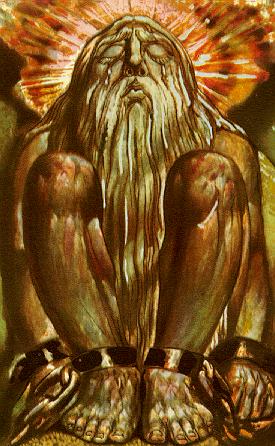
William Blake Urizen in Fetters Tears streaming from His Eyes

Something I think we are prone to forget in this age of chattering heads and two-bit pundits is that ideas have consequences. Anyone engaged in public discourse has some responsibility to wrestle with the ethical implications of their thought, and this is as much the case for the Rush Limbaugh’s of the world as it is for that disappearing class of thinkers who once proudly went by the name intellectuals.

In a way, artists have always had an easier time than those engaged in more discursive lines of thought. We hold Plato morally accountable for the ideas he put forward in a work like The Republic in a way we don’t hold his contemporary Aeschylus for a play full of human violence like The Oresteia. The reason for this is that philosophers rather than artists it is assumed, not doubt in part falsely, are not just giving us a view into the world as it is, but as they believe it should be.

If ideas are indeed serious things, and we need to hold intellectuals responsible for their moral implications in a way artists need not be, then the pushing open, perhaps better tearing up, of the envelope of our moral horizons found in Steve Fuller’s recent Humanity 2.0: What it means to Be Human: Past, Present and Future needs to be confronted in a way a work of art like the song Vicarious by the band Tool does not, even if both start from a kind of Archimedean point outside or above the normal human perspective to look down upon the world as whole to end up with a sort of metaphysical justification for evil and violence.

Upon picking up Humanity 2.0 I did not expect this. What I anticipated is a recent version of run of the mill transhumanism with an epistemological slant (Fuller is a social epistemologist). Instead, what I got was a rather disturbing set of conclusions embedded within an otherwise banal alternative history of sociology.

There were far too many points throughout Humanity 2.0 where I found myself stopping to exclaim “Did he really just say that?” to discuss them all. So, in what follows I will focus on what I found the most relevant. For starters, Fuller thinks that for transhumanism, or better transhumanism as he understands it, to succeed it has to adopt what can only be understood as a form of  politics as deception. The first step in this deception is merely the discussions surrounding transhumanists’ concerns, where, for Fuller:

Intentionally or not, this serves to acclimatize citizens, in the company of their peers, to whatever nano-driven changes might be on the horizon, thereby updating the concept of self-fulfilling prophecy. (147)

In social psychology, this strategy is often dubbed ‘inoculation’, the suggestion being that by allowing people to spend time thinking about extreme or pure cases of some potential threat, you have laid the groundwork for the acceptance of a less virulent version.  (148)

Fuller compares this indirect method to be used in the achievement of transhumanist ends to be akin to the victory of socialism which emerged as a way to stave off the communist threat. (150)

Let’s pause and think about what he is saying for a moment. For Fuller, discussions and debates surrounding the issues of the application of science and technology to transform the current human condition are not so much a way to think through the profound challenges and questions transhumanist concerns pose to our understanding of what it means to be human or even post-human as they are a sort of public relations campaign which will win over the public to transhumanist positions the more extreme the proposals it appears to make for the human future.

That Fuller would adopt a perspective more reminiscent of the television show Mad Men that anything we might recognize from the tradition of moral philosophy or democratic politics shouldn’t be all that surprising given that he thinks the bizarre way in which we afford corporations with the rights of individuals to be a primary vector by which his post- human version of utopia will come into being. He muses:

Once the modes of legitimate succession started to be forged along artificial rather than natural lines with the advent of the corporation… the path to the noosphere had been set. (205)

If indeed Fuller means us to associate our modern corporations- our Walmart’s and McDonald’s- with the telos of the world, Teilhard de Chardin will not be the only one rolling in his grave.

Fuller’s love of corporations and his view of them as vectors for what he conceives to be the “real” ends of transhumanism is just one shade of his unabashed collectivism. One of his primary aims is to rehabilitate 19th and early 20th century eugenics. Many of the contemporary proponents of eugenics tend to approach the issue from the standpoint of reproductive rights. The problem with antique forms of eugenics, in their view, wasn’t just that it was based upon bad, meaning pre-genetic and racial science, but that it was focused on empowering the group in complete disdain of the rights and life of individuals.

Fuller will have none of such individualism or talk of “rights”.  We should rehabilitate 19th and 20th century eugenics because:

The history of eugenics is relevant to the project of human enhancement because it establishes the point-of-view from which one is to regard human-beings: namely, not as ends in themselves but as a means for the production of benefits… (emphasis added/142)

Lest we think that Fuller is out merely to rehabilitate the image of now forgotten  eugenicists like Francis Galton and couldn’t possibly be talking about “rehabilitating” our understanding of National Socialism we have this:

Put bluntly, we must envisage the prospect of a transformation in the normative image of Nazi Germany comparable to what Barrington Moore described for the French Revolution. This is not easy… there have been only the barest hints of Nazi rehabilitation. But hints there are, helped along by the deaths of those with first-hand experience of Nazism. (244)

Does the death of those with first-hand experience of Nazi atrocities make us wiser in Fuller’ eyes? This is not the kind of “PR” transhumanism needs.

Fuller’s commitment to collectivism takes him very far from traditional transhumanism indeed. In his hands the universal commitment to the increase in human longevity becomes nonsensical because the individual herself, from Fuller’s perspective, is a non-entity, a bridge to a kind of reborn primordial soup of cells and silicon which from his pantheist perch appears to be the ideal evolutionary future of a disembodied human intelligence or logos.

From his perspective the satirical world of “Utilitaria” imagined by the moral philosopher, Steven Lukes, where the characters are fully cared for from birth until old age only to be literally deconstructed both mentally and physically to serve as “parts” for the young becomes not a searing critique of a purely utilitarian world devoid of human rights, but a prescription for his version of our post-human future.

… with nature-inspired technologies we might think more imaginatively (aka divinely) about the terms on which ‘the greatest good’ can be secured for ‘the greatest number’, especially how parts of individuals might be subsumed under this rubric.” (228)

This zooming out to an amoral height in which the individual no longer has real value aside from whatever benefits they can bring not so much to society as to the process of history leading us to Fuller’s post-human age leads him to embrace a whole host of troubling concepts.  He gives gives his proposal to disassemble the panoply of protections we have built up around the use of human beings in scientific research vanilla,  soft-nietzschean labels such as “suffering smart”. Where his proposals amount to a kind of martyrology in which individuals sacrifice their own lives and health for the “honors” of propelling scientific research at a faster pace.

Fuller’s version of “heaven” is a return to the Eden of the primordial soup where the distinctions between species, machines, and even individuals has collapsed. In this he is riding the wave of the transformation of biology into an information science where individuals of a species become mere pattern of genes and the boundary between species become permeable. Here, Fuller takes the extremely irresponsible glorification of our new found ability to swap and combine genes between species who have not occupied the same place in lineage since the dawn of life on earth coming from figures like Freeman Dyson to an even greater extreme. Being able to incorporate the genes from other species is less for Fuller a means of human enhancement as it is the road the disappearance of the human into some sort of divine stew.

Fuller takes this transformation of biology into an information science to the degree that he has become one of the most vocal proponents of teaching intelligent design in schools. What? The logic behind his advocation of the pseudoscience of intelligent design is that the actual history of life on earth has become irrelevant now that we have reduced it to information.

… nothing much hangs on the fact of whether animals and plants evolved naturally or were specially created, let alone whether it happened over 5000 or 5 billion years… (64)

For Fuller, intelligent design is a sort of noble lie meant to teach its students how to be “God-like” designers of nature.

As far as things to raise critical awareness I will stop there, and am left to wonder how it is possible that Fuller has come up with such a regressive version of transhumanism where debate and discourse is replaced by manipulation, where corporations and collectives have replaced individuals, where not just 19th and early 20th century racists, but Nazis mass murderers are seen as premonitions of transhumanism and that is not be taken as a negative thing, a warning, where individuals become sacrificial animals for a research endeavor whose success would ultimately spell the end of individuals, where intelligent design is touted as a serious version of biological science?

The extent that Fuller flirts with the shibboleths of early 20th century fascism, indeed, he appears to see them as the true harbingers of transhumanist politics, suggested that the most recent offshoot of transhumanist thought, so called techno-progressivism will need to divorce and divest itself from its transhumanist roots if it is to remain ethically viable. Special efforts need to be made to disentangle techno-progressivism from underlying religious aspiration,s for it is these which serve as the launch point from which Fuller would undo much of the moral progress that emerged as a delayed response to the abuses and cognitive distortions of fascism and European imperialism.

As I have warned elsewhere religious rhetoric or the historically unconscious adoption of ideas whose origins are ultimately religious is dangerous to the transhumanist project both because it puts transhumanists and traditional religious persons in an artificial state of conflict, but also because it leads to the very kinds of moral and intellectual hubris found in a work like Humanity 2.0.

Fuller taps into what Susan Neiman in her Evil in Modern Thought declared to be the moral problem that would define the modern age- why is there evil in the world? A problem answered by thinkers such as Gottfried Leibniz with his concept of theodicy. The problem of evil is one of our own limited human perspective. Get up “high” enough and you will see that we live in the “best of all possible worlds”.

It shouldn’t be surprising that theodicy emerged at the same time as modern science and biblical literalism. Before the scientific revolution it was assumed that the everyday world that surrounds us is the worst of all possible worlds only in comparison to the Hell thought to be literally below us both a consequence of ours and the rebellious angels’ fall from grace.

Newton was just the most prominent of the early moderns to have destroyed the gap between the perfect world of the heavens and that of earth; what guided a thrown object here was the same thing that ruled heavenly objects above. Here emerges the idea of God as a celestial engineer.

Many of the early scientists such as Newton or Francis Bacon were proponents of the new biblical literalism. For them the project of freeing our understanding of the world from the hold of ancient and inaccurate science and finding the true meaning of the Bible by clearing it of the distortions caused by Catholicism were a set piece- a dual project. In her The Case for God, Karen Armstrong points out how these early moderns created the literalists idea of God replacing more mystical and metaphorical understandings. What drives debates between vocal New Atheists and fundamentalist is that the two are in fact theological brothers who share their conception of God and are merely arguing over whether this God exists or not.

Fuller places himself within this camp although his argument might be described as a leap from New Atheism to fundamentalism: the literalists creator God of the early moderns (and today’s fundamentalists) does not exist, so we should ourselves become this God. All of history then becomes excused as the mere birthpangs of us a newborn “god”.

The problem is we are not “gods” and are nowhere near “becoming gods”, or are very strange gods indeed. Not the omnipotent creator/designer that is a common power fantasy, but a god trapped within his own creation that needs to create and act anew merely to survive and can never be sure that the next creative act will not spell his end.

Theodicy of the type Fuller promotes denies the very reality that the Copernican Revolution and all subsequent great leaps in our scientific understanding has brought us: We are not at the center of events- we are not the story.

Theodicy implies that we can judge the universe by the moral qualities characteristic of human individuals- good and evil. But we do not exist on the same moral plane of the universe because the universe does not have a moral plane. It creates and destroys with absolute indifference.

When doing science we have to approach the world from above, from an Archimedean point, but morality does not and can not work like this. Justifying the whole of life or the entirety of the universe on moral grounds means a justification which a more theological age called evil, death, pain and destruction, for there is no need to justify the good. Fuller wants to justify historical and natural evil, but instead ends up at the same place as the viewpoint of the character in that Tool song I mentioned earlier who justifies his own voyeuristic bloodlust because the universe itself is a place of pain:

Credulous at best, your desire to believe in angels in the hearts of men.

                Pull your head on out your hippy haze and give a listen.

   Shouldn’t have to say it all again.

              The universe is hostile. so Impersonal. devour to survive.

So it is. So it’s always been.

  We all feed on tragedy

 It’s like blood to a vampire

Vicariously I, live while the whole world dies

   Much better you than I

The banality of evil is that it comes not so much from this sort of willful malice as a mistaken notion of the good and an obliviousness to our own limits. Fuller’s Humanity 2.0 has both in spades.

Welcome to Our Future: 2312

2312

Part of the problem each of us has when it comes to realistically imagining the future is that we ultimately bring our own cognitive biases, our optimism or pessimism, to the question at hand. From the perspective of the types of small societies we evolved out of these kinds of sunny vs gloomy dispositions were no doubt a very good thing. A discovery of a rich patch of good game land followed by feasts necessitated curmudgeons who would remind the tribe that the days of full stomachs would not last. Thankfully, these complainers would not have the final word, and the group would set off again over the next hill assured by the sunnysiders that more of the riches of the world remained on the other side.

Our modern media world, however, tends to undermine this diversity of cognitive biases sorting us into more sharply distinguished optimist and pessimist camps. In our digital echo chambers the future is all good or all bad, utopia or dystopia as the title of my blog says. Lately though, a number of thinkers have been trying to shake us out of our tendency to see the glass as half empty or half full reminding us that the world is more complicated than the illusionist in our heads.

Here I would put the work of Ramez Naam who in his The Infinite Resource faces head on both the enormous problems in front of us- climate change, global food shortages, growing energy needs, and fresh water scarcity while at the same time offering up realistic solutions to these problems without the need for a Deus ex Machina solution such as “our coming super-intelligent AIs will solve these problems for us”. I’d throw Kim Stanley Robinson into this realist camp as well. His most recent novel 2312 gives us a portrait of the next few centuries that is something very far from Shangri-la but isn’t a post-apocalyptic horror story either.

The source of Robinson’s pessimism is the state and probable future of the global environment, especially in terms of the likely impact of climate change. As energy innovator Hal Harvey recently pointed out in this scary, yet even then, not hopeless speech on the climate situation at the Aspen Ideas Festival we only have a brief window in which we can prevent potentially catastrophic climate change from occurring and that window is rapidly closing. 2312 in a sense gives us a sketch of what our world might look like if we do indeed allow Harvey’s window to slam shut.

In the world of 2312 the earth’s temperature has risen by 5 K.  As a consequence there has been extensive sea level rise- Manhattan is now like Venice and mass deaths of people on all continents and mass extinctions have occurred. Had the novel focused on this period it would have been apocalyptic, but instead it sets its sight on the post-apocalyptic world that follows our failure to have addressed our environmental challenges in time.

In Robinson’s future- historical scheme only after we are faced with apocalyptic crisis do we marshall a response commensurate to the situation at hand. Humanity tries to set things straight by geoengineering the earth’s climate, a project that ultimately fails spectacularly in the “Little Ice Age”. In a period that becomes known as the Accelerando,a real push is made to settle the solar system. Much of it is terraformed and settled  including asteroids which are hollowed out to become biomes holding within them the precious cargo of the flora and fauna that once graced the earth.  AIs including quantum computers surgically implanted in human beings know as “qubes” become widespread. Human longevity is increased to the extent that a person is now fit and active into her hundreds.

The kinds of terraforming that are used to transform much of the solar system into areas that are hospitable to human life prove inapplicable to geoengineering the earth back to its pre- industrial state because the blunt force methods of terraforming- slamming comets into planets and the like- are simply unworkable on a planet that already has billions of human beings not to mention other lifeforms most of which are hanging on to life by a thread.

The scale and coordination of the response to the environmental crisis the Accelerando represents does not last, however, and the pendulum swings again humanity falling into two dark periods- The Ritard and Balkanization during which the trends of the Accelerando slow and the solar system becomes divided into competing factions. It is in this world where the earth continues to suffer extreme environmental and economic crises, and the new worlds of the solar system have turned against one another that the plot of 2312 takes place.

Robinson is by his own declaration not a transhumanist. And yet his protagonist, Swan Er Hong can certainly be described in this way. Swan has a qube implanted in her brain named Pauline which makes her a kind of cyborg. She has the genes of songbirds in her that allows her to “whistle” like a bird. She is transgendered with both a vagina and a working penis- a product of the fact that a good deal of the increased lifespan of human beings seen in 2312 has been gained by human beings taking on transgendered features. Something that makes sex scenes in 2312 just a little complicated. Treating the body, and even the mind, as something essentially plastic in this way comes naturally to Swan, for she is an artists and her body itself is one of her works of art she being a practitioner of what Robinson calls in honor of performance artist Marina Abramović “abramovics”.

The plot of 2312 centers around a series of terrorists attacks in the inner solar system and the efforts of Swan the mercurian, the man who will become her lover, Wahram from Saturn, (Robinson is having some fun with astrological stereotypes), and an exiled Martian, Inspector Gennette, along with others try to solve these incidents. Along the way they spark a political movement of sorts setting off the forced return of the earth’s lost animals to the planet as a way to spark the earthling’s desire to address the planet’s continuing ecological problems.

I must admit that I had some difficulty with the novel’s plot. There were numerous points where I had to engage my “willing suspension of disbelief” not because the technological or social situations seemed so “out there” as the experiences of the quite empathetic and rounded characters were squished into predetermined unfolding of the overarching story of the novel.

There are three ways it seems to me one can make the experiences of characters realistic in the context of a grand future-historical novel such as 2312.  The least interesting is to tell the story from the perspective of the people at the top- the most historically important characters whose decisions therefore have the biggest effect on how such narrative unfolds. The second way is to give witness to the fact that small characters can unleash the forces of history in the way an otherwise very insignificant man like Gavrilo Princip set off World War I with his assassination of the Archduke Franz Ferdinand. The third and probably the best way is to take historically insignificant characters and see how the grand narratives unleashed elsewhere affect them. The best moral judgement of the decisions of elites or the injustice of a system is how it impacts the lives of people who have to live closest to those impacts.

When one tries to see in the lives of historically marginal characters, which is really what Swan should be considered, experiences that reflect decisions of world-historical significance one is left with the impression that the character is suffering from paranoia. This at least is what I thought when Swan encounters an extremely proficient “lawn bowler” whose style of play mimics the terrorist “pebble attacks” and who does indeed end up a central character in the plot.

That said, 2312 did something few other books are able to do so easily, it changed the way I looked at the world. Robinson is a superb travel writer and made our solar system, a place I had long thought of as quaint or “dead” come alive as a wondrous imaginative palette upon which our future is yet to be written.

Yet, amazingly enough, Robinson most affected my view of living on earth. It’s hard to remember that we live on a very special world that is so much different, so much more a home, than any other place we know. While reading the novel I started to pay attention to Luna in the sky and the glories of the setting summer sun. I had the urge to take more walks and one night saw a doe grazing in a field watching me curiously and had the urge to chase or run with it, like Swan.

What Robinson is trying to do is find that sweet spot in the future that is at the outer reaches of our understanding and therefore our agency. This is much better than something like my Far Future’s Project which I am wrapping up this week, or Stewart Brand’s Long Now because we really do have some degree of agency over, and therefore some responsibility for, what happens a century or two in the future. If writing about the future is really just turning up the volume on the present then we can only be confident in these sorts of limited time frames that we will be playing anything like the same score.

It is when thinking in terms of this near term and intermediate future that our tendencies for optimism or pessimism need to be set aside and the search for realism engaged. One can be a long term optimist or a long term pessimist when it comes to the the human future but both are mere waking fantasies, whether exhilarating or frightening. At the end of the day we can never actually know.

Neither long term optimism nor pessimism frees us from our responsibility to act so as to positively shape the future right now. There are all kinds of ways we need to do this as political, economic and socially beings in response to the future society we are likely to live in or the decisions and sacrifices taken today that we bequeath to our future self.

We can also decide to make investments in the future to a world we are unlikely to live in. Here we have everything from our response to climate change and environmental issues to social legacies. The question of what can we and what we should leave for our great or even great-great grandchildren in light of the nearly endless possibilities of what the world they will be living in will actually look like is one that we should be asking because it may serve as a better way to frame the question of what kind of future is it exactly that we hope for and should be working towards in the first place.

Still, if Robinson gives us a realizable version of the future with much of the transhuman in it, he is, as was mentioned, decidedly not a transhumanist.  Part of this stems from his fear that transhumanism might come to represent escapism. There are also his views of what  transhumanism means in light of a document few of us have probably heard of and even fewer actually given a second thought- the Universal Declaration of Human Rights. Essentially, Robinson thinks transhumanists are getting ahead of themselves. We are nowhere near achieving the kind of worldwide realization of the promise of conditions supporting self-actualization for all promised by the Declaration and transhumanists have already moved the bar.

Robinson is not alone in seeing our current failure to realize the promises of the Declaration as a challenge to the transhumanist project. The social epistemologist Steve Fuller believes positions on the Declaration will be a major area of friction between transhumanists and others, especially those on the left. It is, therefore, an important issue but for a latter time.

The kind of realistic science-fiction offered to us by Robinson where greater than light speed and settlement of “the stars” remains what it is today- a mere fantasy- nevertheless expands our and deepens our canvas to embrace our second home in the solar system. It is a canvass certainly large enough for the human story to play itself out.

The claim idea that our filling in of this canvass through the settlement of the solar system and terraforming its bodies constitutes the “arrogance of humanism” as Ernest J. Yanarella did in Strange Horizons has things ass-backwards. The arrogance of humanism lies in assuming that on a cosmic scale our endeavors are much more than one of Swan’s performance pieces such as her “painting” of a field with a rainbow of fallen autumn leaves. Like Swan, all we can do at our best is create beautiful objects that live a short moment only to be undone by the wind.

Time Lost: Scene 2

Greek god time Kairos Francesco Salviati 1600s

Continuing from last time, beyond revolutionizing physics Smolin’s goal in Time Reborn is the recovery of our human sense of time. What physics tells us is that there is no distinction between past, present and future. This, of course, collides with our natural sense of time- how we are prone to see ourselves as beings in time. For us, the past is what is behind us, over with, as mute to our desire to change it or have it to live over again as the sheer characteristics of existence such as space, light, energy. The present is where we are right now the location of our body and consciousness a fact that shoves us with it’s immediacy. A fire in your home at this moment is not a recalled or dreamed of thing, but something to be responded to without delay or perhaps without time for any sort of reflection at all. The future is the not yet a blank canvas whose possibilities are as open and potentially living as the past is mute and dead. It is this relationship to time which Smolin hopes to restore not so much because he believes the view of time held by physics has helped rob us of the past or even diminished, as Einstein feared, the present, but because of its impact on our hopes for the future. For, if the future is as real as the present and we are left without the ability to change it- we have lost any sense of our own agency in time.

Yet, one might ask whether what Smolin is describing is indeed what has happened in terms of our relationship to time? It seems less the case that what we are experiencing is a lost sense of our own agency regarding the future due to a kind of cultural osmosis of deterministic ideas found in physics, or even a kind of diminished valuation of the past and the present as a result of our longing for the eternal timelessness of nature’s laws, than a fundamental change in our relationship to time that has condensed both the past and the future into the narrow slice of time we call the present. To the extent that physics is at all responsible, this change might merely be an outgrowth of digital technologies whose underlying assumptions are those of the, to coin a phrase, time-blindness of physics but not much more than that.

Douglas Rushkoff’s Present Shock: When Everything Happens Now explores our changing relationship with time not from the perspective of physics, but from that of media, culture and human psychology. He gives us an on the ground view of changes Smolin looks at from an Archimedean Point. The title is an homage of sorts to Alvin Toffler’s Future Shock, and just like how Toffler sought to bring our attention to a new and disorienting change in our perception in the sense of a future- that was rushing at us faster than many of us could bare- Rushkoff brings into focus our new sense that both the future and the past have collapsed into a frenetic omnipresent right now.

There are five ways Rushkoff thinks present shock is being experienced and responded to. To begin, we are in an era in which he thinks narrative has collapsed. For as long as we have had the power of speech we have corralled time into linear stories with a  beginning, middle and ending. More often than not these stories contained some lesson. They were not merely forms of entertainment or launching points for reflection but contained some guidance as to how we should act in a given circumstance, which, of course, differed by culture, but almost all stories were in effect small oversimplified models of real life.

From its beginnings to the late 80’s early 90’s television seemed the perfect format for the simplest ways of communicating these lessons. It was our morality box. I am old enough to remember when even a show built upon a risque theme- such as Three’s Company framed every episode as a parable where Jack learns how to treat women like human beings. A goofy show like Happy Days was as loaded with parables as a religiously inspired series like Little House on the Prairie. This idea of TV as a morality box was on it’s way out by the late 1980’s, think Married With Children, The Simpson’s or Beavis and Butthead. Jerry Seinfeld was merely catching the wave when he created a hilarious show where the mantra was “No hugging, no learning”.

Rushkoff thinks this breakdown of narrative is so ubiquitous in the 2010’s that we no longer even notice it. Game of Thrones is just that – a game- without a clear linear narrative. Even hit shows like The Sopranos don’t end with a moral climax but in in a screen gone blank. Novelists loved by Davos elites such as Don DeLillo have caught on to the collapse of narrative as have movie makers such as Quentin Tarantino.

In some ways this collapse of narrative is a good thing in that during the heyday of television many of these narratives served as mere wrapping paper for social manipulation. Perhaps the most emotionally potent commercial ever “I’d like to Teach the World to Sing” was meant not to inspire policies that actually made the world a better place but to sell a soft-drink that over-consumed led to obesity and tooth loss.

We are too savvy for this type of messaging today, and Rushkoff thinks our self-protecting cynicism and virtual ADHD has lead producers of television to up the level of emotional punch to keep our eyes glued to the screen, which is probably how he would see the zombie craze with shows like The Walking Dead where the more bone crunching seemingly the better. When we aren’t busy watching scenes of soulless humanoids begin torn apart, we watch each other being teared apart, emotionally at least, in reality shows that again had their origin in the 80s with televised circuses like the Jerry Springer Show.

The medium Rushkoff thinks is best adapted to the decline of narrative are video games. Yes, they are more often than not violent, but they also seem tailor made for the kinds of autonomy and collaborative play that are the positive manifestations of our new presentism.

 Other ways in which present shock manifests itself are what Rushkoff calls “Digiphrenia”- the ability that we now have to be in more than one “place” at one time. I see this often when I take my daughters to the park. There’s always some parent who spends most of her time with her eyes glued to her phone. Perhaps one of the most incongruous images I have ever seen was a Saudi woman in a full black burka staring intently out of the eye slits at her smart phone oblivious to her son calling for her attention at the park swings. I wasn’t sure if I should feel sad for the boy or glad that a revolution in women’s right in Islamic world was obviously at hand.

Our freedom from the constraints of time has instead become a chain. Rushkoff believes we have blown it in terms of how we are using our digital technologies. Rather than using our ubiquitous connections to give us control over time, so, for instance, we can work when the time is right, we instead have placed ourselves constantly on call- a world only emergency service workers lived in before the digital age. Instead of being there in the moment we are constantly”pinged” by the world beyond to the diminishment of what is right there in front of us our child on the swing.

Yet another way Rushkoff thinks we suffer present shock is through what he calls “Overwinding”. This is our tendency to crush into a moment things which unfold over much longer periods of time. One perspective that comes up for criticism here is Stewart Brand’s conception of the “Long Now”. For over a decade, Brand has been trying pull us out of our habit of short-term thinking. His popular Long Now seminars which I view religiously are meant to be forums for the expression of the long view, and his 10,000 year clock a project to get us thinking outside of the frame of the news cycle or even centuries.

The problem Rushkoff sees with this is that such a long term view leaves us both morally paralyzed and suffering from time induced vertigo. Using his example, the disjunction between my choice to not take the extra time to throw a plastic bottle in the recycling bin and the fact that the plastic bottle will last for thousands of years is too great for the mind to process. The sense of responsibility and unintended consequences when dealing with such an expanded canvas of time leave one frozen before every decision. We are Overwinding when trying to judge our actions in light of millennia and for the vast majority of us this just doesn’t work as a guide to ethical and responsible behavior.

You don’t even need to get all metaphysical or socially conscious to find yourself suffering from Overwinding. You suffer from Overwinding when you try to condense anything that takes time to unfold into a much more condensed period of time. Like Woody Allen’s joke: “I took a speed reading course and read ‘War and Peace’ in twenty minutes. It involves Russia.”

 For Rushkoff we also suffer from yet another distortion in our relationship to time what he calls “Fractalnonia”- the attempt to make sense of the world entirely from the present moment. If Overwinding is the attempt to squish a large chunk of physicist Brian Green’s space-time loaf into an extremely narrow slice we call the “present”, Fractalnonia cuts off a thin slice in the “present” from the rest of the loaf and views everything captured in this slice as somehow connected. Akin to looking for the face of Jesus in your raisin bread.

Fractalnonia can be summed up in a phrase that is half acid-trip and half paranoid disorder- “everything = everything”. It is the search for patterns- fractals- where they may or may not exist. This something that may stem from the nature of modern media itself which puts the most incongruous events – insurgency in Syria next to Justin Bieber’s car accident next to a fall in the stock market almost daring us to engage in a game of “six degrees of separation” and connect them together.

The whole current cult of Big-Data emerges in part from our philosophy of Fractalnonia which tends to suggest that the solution to problems or understanding of the world is to be found by gathering and collecting more and more data points rather than telling stories or coming up with theories although Fractalnonia is built on a theory all its own.

It grows out of the burgeoning field of complex studies which holds that non-linear systems have many features in common. The economy is, in this view, sufficiently “like” an ecosystem so we can understand economies by understanding ecosystems. Terrorism is “like” a virus so we can learn how to contain terrorism by applying our understanding from containing viruses.  There is much to be gained in these theories, yet Rushkoff wants to warn us that these analogies are just that – analogies. By forgetting the differences between the things we are studying we are in real danger of confusing the map with the territory.

Those who take Fractalnonia too far, in the political realm, are likely to fall prey to full blown conspiracy theories an aspect of the last of  Rushkoff ‘s manifestations of present shock the belief and need for final endings- good or bad- what Rushkoff calls      Apocalypto.

People who suffer Apocalypto are desperate for an ending. What William James declared to be the perspective on the world held by infants “the blooming, buzzing, confusion” is now the experience of even the adults in the room. This leaves some of us desperate for a climax an end to history that would make sense of the whole damned thing. Modern media pours fuel on the fire of this sensibility spewing out story after story in a way that to some of us makes it appear we are on the verge of collapse or some sort of cosmic tipping point.

Apocalypto is a bi-polar mentality embracing both extreme pessimists and extreme optimists. The survivalist stocked up and “safe” in his cabin from what he believes to be the imminent collapse of the US government belongs to the same tribe as thesingularitarian who believes we are racing towards sentient AI, uploading, and human immortality not within the span of centuries but mere decades in the future.

These then are the cognitive problems that are found in the state of present shock but what about the solutions? Unlike most books that take such a critical view on the present, Rushkoff actually offers several practical solutions to deal with our new and often disorienting sense of time. Most important is the realization that the way we are using technology to exist in time isn’t so much a product of the technology itself as the way we have chosen to use it. It was we or our employers) who chose to use the omnipresent connectedness of the Internet and mobile technologies to never leave the office rather than allowing us to escape the time and spacial constraints of being tied to a desk from 9:00-5:00. This is ultimately not just bad for employees- physically and psychologically but for employers as well. Both employers and employees need to realize that the kinds of burnout brought on by never being able to put distance between ourselves and our job ends up undermining the very productivity and creativity that lie at the root of the profits and shareholder value modern businesses pursue.

We also need to learn to turn our gadgets off to stop staring into screens when there is another person’s eyes in front of us. The imposition of screenless times in our homes, a digital sabbath, is one quite easy way to assert our sovereignty over our technology in the name of our humanity.

Rushkoff has also embraced a version of chronobiology which asserts that human beings have natural rhythms many of them tied to solar and lunar activity. The idea here is that we often use our technology to transcend those limits, leading to our need for both stimulants and sedatives because both our industrial age and digital systems- unlike the agricultural and hunter-gathering systems that preceded them are disconnected from the solar and lunar cycles that continue to play out in our own bodies. Yet, perhaps we should instead use technology to better align ourselves with these bio-clocks- digital feedback and tracking reopening a window on our natural cycles that had been closed for us with the onset of the industrial age and electric lighting.

In addition, he wants us to be conscious of different ways to understand time and how things we encounter in our daily life can best be approached by understanding how they should be seen in terms of time. A book is different than email which is different from Twitter. A true book is an extended argument or picture that, as Woody Allen knew, cannot be reduced to snippets. The best books are also always timeless in that the worldview they unveil says something to us and still somehow seems relevant even when viewed from centuries after they were first written.

Email, or at least most of it, is not timeless in this sense. It has a shelf-life, which depending on the project can be read and are relevant over stretches of time- days, weeks, months. Email can also be caught up with. Most email doesn’t lose its relevance hours or even days after it was written.

Twitter, on the other hand, is most often about the right now a kind of echo chamber for own perspective on the goings on of the moment. Trying catch up with Twitter messages is something Rushkoff compares to reading yesterday’s stock prices. What’s the point the moment has already passed?  And besides there are so many things going on in one moment and being commented on that no person could ever keep up

There is also another sense of time Rushkoff wants to remind us about. The Greeks had two gods for time Chronos and Kairos. We most often think of time in terms of the countings of Chronos as in “what time is it?”, but Karios offers us another way to think about time as in the right or wrong moment. “Is it the right time for me to leave my job?”, “Marry?” “Have children?” It is in these moments when we are most likely to see time from our own personal wide angle lense seeing how a decision to go this way or that fits into the sense of our past, present and imagined future taken as a whole. This is the most human manifestation of time distinct from the biological cycles we share with our fellow animals of the linear tick and tocks of our machines.

Still if Rushkoff gives us a clear eyed view of the present one might still wonder about the future, or relatedly because it is one of the primary ways outside of technology that we shape the time ahead of us beyond the personal level what about the political? Rushkoff  seems to think the future disappeared with the coming of the millenium. What had been a kind of omnipresent feeling of anticipation about “the year 2000” was replaced by the realization that the future wasn’t ahead of us- we are living in it. Visions of new worlds to be built in the future and the grand narratives that went with them were in his view a thing of the past. Without such goals the point of government became a vacuum which was filled by one movement Rushkoff finds illegitimate and another that he thinks has found the correct way to approach politics in the age of present shock.

He reproaches the Tea Party for its conclusion that governance is nothing more than robbing Peter to pay Paul a view of government not as a means of social investment in the future but as an extortion racket. The movement that represents the best response in a world of present shock is Occupy. The very lack of goals of the movement he sees as part of its strength. Occupy isn’t about building some world in the future but about having a political conversation where everyone is included right now.

Rushkoff’s meaning when he declared the end of the future dovetailed into some thoughts I had been having about the current state of the endeavor that deals with the future, namely science-fiction, for it seemed to me that science-fiction was having some trouble in its traditional role of pulling us towards a certain version of the future. Both Rushkoff’s ideas regarding our sense of the future and my own were clarified for me upon encountering a lecture by the science-fiction novelists Kim Stanley Robinson.

Robinson characterized our current orientation to the future by what he called “futurity”. What has happened is that, on some fronts at least, the future has lost it’s ability to surprise. If tomorrow it was reported that we heard a signal from Alpha Centauri or had cloned a human being or invented an AI that passed the Turing Test few of us would be shocked in the way Toffler warned us of in Future Shock.

He thinks the impact of science and technology has become so ubiquitous and profound that any writer of realistic fiction will have to address questions posed by science and technology in a way only science-fiction writers did before. I heartedly agree with him here and would add that any serious philosopher or political and social thinker needs to address the questions posed by science and technology as well. Living at this particular juncture of history it is what has drawn me to these issues as well.

Robinson also makes the case that much of what we take to be descriptions of the future in science-fiction today is actually a version of fantasy. One can tell fantasy fiction from hard science-fiction by the fact that fantasy fiction takes what are significant or even from our perspective impossible technological hurdles and waves them away with a flick of the magicwand. In this view stories that feature interstellar travel or sentient AI or human immortality (as opposed to vastly increased longevity) are versions of fantasy fiction.

Robinson’s fiction tends to focus on the intermediate human future – several centuries into the future and is technologically conservative and gradualists. There are no wormholes that allow us to escape the constraints of the speed of light and the vast distances of interstellar space. Problems that we today find to be hard are indeed hard- our understanding and their solutions and taking likely to take decades or even centuries to unfold. Machine sentience arrives slowly over time, human longevity increases to centuries and then millenia with true immortality still as fantastical as in any religious daydream.

In focusing on this intermediate future Robinson fills a gap I found both in Rushkoff’s and my own thinking. The time frame of the Long Now, not to mention anything longer, is indeed disorienting. This does not mean, however, that the future is not our responsibility to shape. Robinson gives us some clues as to what this responsibility means and the kinds of timeframes we need to attend to in his recent novel 2312 to which I will turn next…

Post-script 1/18/14:

In an essay “How Technology killed the future”,  Rushkoff concludes:

Gone are the days when America could plant a flag on the moon and declare the space race won. Modern obstacles are more often chronic ones to be managed and mitigated over time. Greenhouse emissions, child hunger, mutating bacteria, drug abuse and even terrorism are not wars one wins.

 The age of present shock is, it seems, forcing Americans to realize that our journey is less about reaching a conclusion than it is about sustaining ourselves for as long as possible. Our politics may come to have less to do with triumph than endurance—a shift in perspective that, while born out of an obsession with the present, wouldn’t be so bad for the future.

Time Lost: Scene 1

Saturn Khronos

Of late, I’ve been thinking alot about time.  I thought this was just a reflection of age until I stumbled across two recent books that see the question of time and our perception of it to be essential to solving many of the problems that plague us from the level of the individual all the way up to those of our global civilization.

One of these books Lee Smolin’s Time Reborn: From the Crisis in Physics to the Future of the Universe is ostensibly a book about physics, but is just as much a diagnosis of contemporary economic and political ills. The other Present Shock: When Everything Happens Now by media theorists and IEET Fellow Douglas Rushkoff is aimed primarily at social critique but ends up being what amounts to a philosophical guide book to help individuals steer themselves through a quite new (or perhaps quite old and forgotten) conception of time. A way of looking at time that is influencing everything from the media we consume to the way we organize our work and personal lives to the functioning of our economic and political systems.

Let me start with the physics.

In 1955 Michele Besso a man who was Albert Einstein’s closest and friend, whom he had known for many decades, died. Einstein who was himself old and approaching his own death wrote a letter of of condolence to the Besso family that is one of those rare instances of a great scientific mind applying his understanding to the kinds of real life events all of us eventually face as human beings. As translated by Michael Lockwood in his The Labyrinth of Time the letter read as follows:

He is now a little ahead of me in bidding this strange world farewell. That means nothing. For us devout physicists, the distinction between past, present and future likewise has no significance beyond that of an illusion, albeit a tenacious one. (52)

The claim that the distinction between past, present and future is an illusion may seem a strange way to offer condolence, but Einstein was providing a scientifically accurate answer to what is perhaps the most troubling aspects of death ,that, in Lockwood’s words “a living, breathing human being has been supplanted by a void.” (53)

For how much I respect Einstein’s Spinoza-like wisdom his suggestion of looking at time this way in response to death is not the most comforting. Not only can the lost loved one be assumed to still exist within a sliver of time, but so would the experience of being at his funeral, his suffering through disease, or any other painful and tragic moment in his life, although, of course, all of the banal and blissful moments as well. It’s life as Nietzsche’s “eternal return” without the return. Every moment of time captured and stuck there- a cosmic snapshot.

From our everyday perspective we no doubt have trouble with the disappearance of the distinction between past, present and future, but that is what the physics, responsible for so many of the miracles of the modern world, has consistently shown. Newton placed us in a deterministic universe in which the future is theoretically if not practically as predictable as the destination of a ball thrown through the air- a scientific version of Calvin’s predestination.

Einstein and 20th century physics did nothing to diminish this determinism, merely our powers to predict outcomes. Time lost the dignity it had even with Newton and became relativistic a perception based on the position of an observer. In Relativity, time “flows” at different rates based on the speed of a person in motion relative to another. A person speeding along at near light speed would have their local time grind to a near halt relative to those moving at slower speeds outside the spaceship. A short journey at near light speed away from the earth would have passengers returning thousands of years in the “future” of those who stayed behind.

In the hands of physicists the now became a slippery concept. Everything we experience is time delayed whether measured in milliseconds, or, like many of the  stars we look at in the night sky, millions of years in the past. What we call the present is always information in a state of delay. And making the frame bigger does not solve the problem. Moving from the perspective of the individual even to as large a perspective as that of the universe as a whole does nothing to restore the status of the now.

Brian Green gives us colorful imagery of this in his The Fabric of The Cosmos picturing spacetime as a giant loaf of bread. Defining the present means cutting a particular “slice”, but how do we decide how big or small to cut it? Indeed, for physicists following Einstein, the whole loaf from the beginning of time to the end of the universe appears to exist simultaneously.

Like the world given us by FaceBook, that embarrassing night at the prom that’s supposed to have disappeared into the past is still there for somebody, but not only that, so is everything in the future that from our particular slice of the spacetime loaf hasn’t even happened yet. To use another analogy it’s like the whole history of the universe has been DVR’d and what we call the “present” is just the particular segment on which we are stuck. If we weren’t ourselves on the DVR and had the ability to get “outside” and jump around the recording we’d find that scenes we label the “past” are still there as real as they ever were and perhaps more disturbingly scenes that are in our “future” are there as well.

Modern physics has thus been unable preserve the status of the present, the now. We quite rightly hold that the experience of the present is somehow more real than either the past or the future- the first of which we think gone and the second we believe has not occurred yet. But according to physics the present is just another snapshot- it’s just the pictures in the album or slideshow we have easiest access to.

Despite his turning to the disappearance of the distinction between the past, present and future as a way of consoling the Besso family, Einstein was deeply troubled by the potential effects of human beings losing the special status they had given the present. Greene reports how the philosopher Rudolf Carnap recounted of Einstein:

…that the problem of the now worried him seriously. He explained that the experience of the now means something special for man, something essentially different from the past and the future, but that this important difference does not and cannot occur within physics. That this experience cannot be grasped by science seemed to him a matter of painful but inevitable resignation. (141)

This disappearance of the present and its related idea of the future as determined is precisely the view of time that Lee Smolin is out to overthrow in his Time Reborn. A well respected physicist and prolific author, Smolin attempts to make the case that not only are the ideas found in physics regarding time deeply flawed, but that time is the essential element in the order of the universe and key to our understanding of it.

Much about our knowledge of the universe needs to be rethought in order for time to be “reborn”. First off, the Laws of Nature which have long been held to be superior to time need to be dethroned, transformed into something that change through time. For Smolin, the Laws that we experience today may not be the same Laws tens of billions of years into the future or the same Laws that nature followed in the deep past.

Laws are replaced by Smolin’s “principle of precedence,” nature acts in a certain way over large spans of time because it has done so in the past and not because of some metaphysical principle written into the fabric of existence. As a consequence of the fact that nature follows the principle of precedence rather than Laws the future cannot be predetermined – novelty is an expected property of existence. Exchanging Laws for precedence allows Smolin to avoid questionable theories as to why our universe is ordered the way it is and most importantly provides a route through which his theory can be falsified.

Physicists’ combined ideas of the primacy of the Laws of Nature and the diminished status of time have in some ways boxed them into a corner. Why, after all, should the Laws of Nature be these particular Laws? And more surprising, why should they be Laws that seem specifically calibrated for intelligent life such as ourselves to emerge and ask questions about the universe that lead them to the discovery of the Laws?

There have been a number of answers to these questions besides “God did it”- there is the anthropic principle – the idea that the Laws are such as they are because if they weren’t we wouldn’t be here to ask the question. Then there is the idea of the multiverse in which not only every possible set of Laws, but every trajectory through spacetime is played out in an almost infinite number of alternate universes. Last, though Smolin doesn’t really give it any ink, there is the idea that we are living in a simulation that has been created by some intelligent species which might help explain the DVR aspect of time.

Smolin can dismiss all of these because in a universe where the laws change there’s no need to explain why the laws are such as they are now. Perhaps for the vast vast majority of the universe’s history conditions were not ripe for life. With one swoop the need for God, an anthropic principle, and the multiverse is done away with, and in a way that seems to gel more with common sense.

Smolin provides a system in which the laws (now with a lowercase l) can change – namely black holes which he thinks give rise to whole new universes with their own distinct laws. It is perhaps not surprising that we live in a universe ripe for life, if, as Smolin thinks, the kinds of stars prevalent in our universe are potent black hole producers. Life, in this view, would be the luckiest of cosmic coincidences. The more black holes a parent universe has, the more “baby universes” potentially like itself it makes and universes with many black holes are also conducive to life.

Unlike the anthropic principle or the multiverse- let alone the simulation hypothesis or God- Smolin’s theory can actually be empirically verified- giving predictions as to the frequency of black holes. Only time will tell if the science holds up, but Smolin is just as much on a political and philosophical quest as he is trying to overthrow the current scientific paradigm regarding time.

Smolin believes that the diminishment of time in the theories of physics has seeped into the larger society with pernicious effects. The idea that the future is predetermined, he thinks, has resulted in a steep decline of our sense of agency. The future has gone from something we create to being something we must simply endure a system that we are subject to that is largely outside of our control.

Smolin finds this viewpoint particularly dangerous given the challenges we face. We really do have the power to do something about climate change, we actually can exert control over our economic system and technology and do not have to merely suffer as we are pulled along by the trend lines.

Smolin is especially keen on how what he thinks is flawed physics, our fetish regarding the “Laws of Nature”, has thoroughly infected our theories regarding economics. Before the crash, the majority of economists foolishly embraced the “eternal truth” that the market trended towards equilibrium- a bastardized idea drawn from physics. Smolin does not believe in eternal truths and laws regarding anything and insists neither should we.

There is also a way in which Smolin’s tome, like Einstein’s letter to the Besso family or comments to Carnap, are driven by the personal. For a good part of his life Smolin, ensconced in the study of physics in a world that held the belief that time was an illusion. In a sense his fatherhood re-connected him with the human sense of time- the idea that not only did he have a meaningful past, but through his son had a meaningful future as well. The shear contingent miracle of a newborn freed his vision to see the essential openness of the future.

What Smolin most wants to do is recover Einstein’s lost now- the present physics had seemingly done away with. Yet, perhaps, what he has done most is provide a stepping stone back into the stream of time, restored something of the flow and interconnection between the past, present and future. For what our age is doing is less a matter of turning the present into an illusion than suffocating us in the singularity of an ever present now, leaving us beyond an event horizon where there is nothing behind or infront of us, but only on top. It took my reading of Douglas Rushkoff’s Present Shock to make that clear to me, and to it I will turn next time…