Looking Backward

Imagine, if you will, the following scenario taking place today: A, to this point failed, novelist writes an updated version of Rip-Van Winkle where his protagonists falls asleep to be awakened a century or so in the future. Through this protagonist the reader is then given a tour through a future in which the social problems of his own day have been completely resolved, the linchpin of their solution being a new and revolutionary economic system.  To add a human element to the story the protagonist finds love in this future-world in the form of the great-great granddaughter of the woman he loved a century in the past, a love that his coma had tragically stopped short.

My guess is that today such a novel would be judged, though not in these words, a mere “ fairy tale of social felicity” (Bellamy)  If it was lucky, it would find itself on the shelf at Barnes and Noble next to works by J.R. Tolkien, or J.K. Rowling. What is most unlikely is that the book would become the third largest best seller in US history, and that it would spawn the formation of “clubs” throughout the country where professionals: doctors, lawyers, professors, and scientists would gather round to discuss whether the book offered a blueprint for solving society’s economic and political ills. It would seem out of the ordinary for such a book today to engender actual debate among political theorists, let alone in the form of other utopian novels that tried to play out rival versions of the future. Nor would it seem likely that real-world revolutionaries would take such a piece of pulp-fiction seriously. I mean Rip-Van Winkle? Come on!

And yet, all these things were precisely what happened to Edward Bellamy’s novel Looking Backward: 2000-1887. The novel tells the story of Julian West who falls into a coma like sleep in 1887 and wakes up in the year 2000. The world in which Julian awakes is one which has solved the endemic problems of capitalism: class war, economic instability, and inequality and constitutes a socialist utopia where the means of production are under the centralized control of the federal government. Something Bellamy, almost a half-century before Hitler would steal the phrase, called “national socialism”.

Bellamy got at least the general outlines of some future economic and technological developments right, though his Victorianism gives his vision of the future a decidedly steampunk feel. He imagines goods being bought in centralized warehouses tied together in a complex, super-fast, and efficient nation-spanning logistics system: a system managers at Wal- Mart and Amazon would certainly recognize. Bellamy envisions a kind of telephone/radio that would allow live performances to be piped in from anywhere in the country to anyone’s home. He imagines all purchases being made with something like a credit card. Although, because this income comes from the government, it has a stronger resemblance to the “Access Cards” given to the needy to purchase food, medical care, and other necessities.

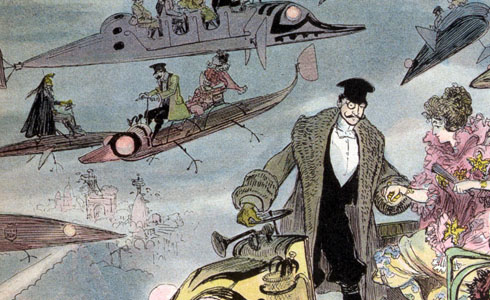
What meaning this Victorian tale could have for today is discussed in an excellent recent essay in Lapham’s Quarterly by, Ben Tarnoff, entitled “Magical Thinking. (The picture above is taken from that article).  Tarnoff thinks we can take away two things by considering Looking Backward. The first is how the novel, and the spirit which it represents, can be contrasted with our own anti-utopian sentiments, the product he thinks, of our encounter with the most horrific versions of “utopianism” in the early 20th century. The second is that Tarnoff sees the novel as emerging out of the problems of capitalism. Problems that Bellamy in his own way was trying to solve, and which we ourselves relate to in a much different way.

Rather than having ever solved those problems Tarnoff believes we have come to accept them:

The twenty-first century bears little resemblance to Bellamy’s future; the closer comparison would be to his present, to the late nineteenth century that the hero of his novel happily escapes. This was a society defined by tremendous income inequality, financial uncertainty, sleazy politics—in other words, much like our own. The contradictions of modern capitalism haven’t resolved themselves, as Bellamy assumed. Rather, they’ve become deeply embedded in American life, and the new economic world created after the Civil War has come to feel so natural, so inescapable, that even many of its staunchest critics have trouble imagining an alternative.

I agree with Tarnoff’s first point, that our ability to imagine alternatives is stunted compared to the very creative era in which Bellamy lived, but I want to qualify Tarnoff’s second point that this lack of imagination can be explained by the fact that we’ve somehow come to live with the kinds of problems Bellamy thought just couldn’t go on without giving rise to the demand for an alternative.

In our own era utopian science-fiction and political philosophy, let alone economic theory have seemingly completely parted company. There are exceptions to this- Ayn Rand has a cult following among libertarians, and Ursula Le Guin has captured the hearts of anarchists, but these are exceptions. (If anyone has other examples please, please share in the comments section).

The very word utopian is a kind of intellectual insult that means you just aren’t serious about what you are saying and need better acquaintance with the limiting reality of facts.

Taroff believes we have come to this stunted imagination because we have come to accept the kinds of economic and political conditions that Bellamy found intolerable, but this position becomes somewhat less clear when we take the longer view.

Bellamy was writing during a period of intense economic dislocation, labor unrest, and stagnating economic growth that began during the 1870’s and is known as the Long Depression. In her book Imperialism (book 2 of the Origins of Totalitarianism) the political theorist, Hannah Arendt, credits this economic crisis with the great wave of largely European imperialism at the end of the 19th century. Imperialism didn’t solve the economic crisis, and what occurred instead is that the crisis was met by a whole series of measures starting in the United States to solve some of the the endemic problems of “late capitalism”, by for instance, preventing the rise of monopolies.

Yet, truly revolutionary forces pushing towards an alternative economic system to capitalism would only come to the fore in the aftermath of the First World War, in the collapsed Russian Empire, forces that would gain traction in Western countries with the collapse of the world economy in the Great Depression. Thereafter, public policy, even in a society convinced of the virtues of free-enterprise, such as the United States, would push in the direction of a “tamed” capitalism and a more equal society in which the abuses, instabilities and inequality of capitalism were contained. Technological and demographic developments would dovetail with these efforts and result in an unprecedented period of widespread prosperity and economic calm, though perhaps also one lacking economic innovation, and certainly one of endemic inflation and general stagnation.

When this age of growth began to peter-out in the 1970s the logic seemed to be that the way back to more innovative and less inflationary growth would be to return to at least some of the conditions of capitalism in the era of Bellamy: a return to less regulated markets, tougher competition between labor- including American workers with lower paid workers abroad- a less generous welfare-state, and an acceptance of inequality as the byproduct of success in economic competition.

It should not come as a surprise at all that the kind of utopianism found in the 1950s and 60s wasn’t really proposing an alternative form of society and economics, but instead was a super-technological, Popular Mechanics, version of the consumer society that had, after all, only just come into being after the horrors of Depression and War. Nor, should it seem shocking that utopianism, again as  a serious alternative version of the current economic and political order, was so silent after the 1970s. The spirit of the times was that it was our utopian aspirations that had gotten us into the mess we were in in the first place.

Christian Caryl, in an excellent article for the magazine Foreign Policy, 1979: The Great Backlash offers the argument that the contemporary era, whatever we might choose to call it, should be dated not from the end of the Cold War or 9/11, but the year 1979. Caryl pools together some of the most seemingly different cast of characters in modern history: Margaret Thatcher, Deng Zhou Ping (the post Mao premier of China), the Ayatollah  Khomeini, and Pope John Paul II. Ronald Reagan would join this crew with his election in 1981.  Caryl contends that all of  these figures, in their very different ways pushed the world in the direction of a common goal:

The counterrevolutionaries of 1979 attacked what had been the era’s most deeply held belief: the faith in a “progressive” vision of an attainable political order that would be perfectly rational, egalitarian, and just. The collapse of the European empires after World War I and the Russian Revolution, the Great Depression, and the triumph of wartime bureaucracy and planning during World War II all gave forward thrust to this vision; postwar decolonization and the rapid spread of Marxist regimes around the world amplified it. By the 1970s, however, disillusionment had begun to set in, with a growing sense in many countries that heartless (and in some cases violent) elites had tried to impose a false, mechanistic vision on their countries, running roughshod over traditional sensibilities, beliefs, and freedoms. As a result of the late 1970s revolt, we live today in a world defined by pragmatic and traditional values rather than utopian ones.

For three decades we have lived in this world where the utopian imagination has been expelled from the intellectual field. For my money, the question is: do we still live in this world?

We might answer this question by looking at the current state of the counter-revolutions of 1979.  The Thatcher-Reagan revolution that pushed the idea of a less regulated market based society seems to have hit a wall with the 2008 financial crisis. Even before then, the idea that unleashing market forces would result in a general prosperity, rather than serve to heighten economic inequality, was already in doubt. A Romney-Ryan victory in the elections might give these ideas a new lease on life, for a time, but their administration is unlikely to solve the problems at the root of the current crisis because their philosophy itself was born out of a distinct set of economic and social problems that either no longer exist or are not the real problem: runaway inflation, the stranglehold of powerful unions, stifling regulation of the financial markets, welfare dependency. (It should be added that a continued Obama-Biden administration has no real solutions to our current problems either.)

It also seems quite clear that the capitalist revolution begun by Deng Zhou Ping in China seems to have played itself out. China is facing daunting demographic, environmental, political and socio-economic challenges that undermine its model of export led growth and one-party dictatorship. China cannot continue its rate of blistering growth because its disastrous one-child-policy has resulted in a society “that may grow old before it becomes rich”, even the slower growth it has been experiencing of late may be too fast for its fragile environment to sustain. The one-party dictatorship rather than representing the rule of wise, red-robed  mandarins is rot-through with corruption and increasingly incapable of rational decisions- China builds bullet trains, but fails to build the practical infrastructure of a city like Beijing, so that the city experiences dangerous floods in which hundreds are killed.

Post-Khomeini Iran is a basket case in terms of its economy. It is unable to engage in needed reforms- as witnessed when it crushed the Green Revolution, and though it might have gained a huge strategic windfall with the American’s foolish overthrow of Iran’s worse enemy- Saddam Hussein’s Iraq- it has seeming squandered these gains. It has squandered the goodwill of the Arab populace in the wider region by supporting its murderous ally in Syria, and by obstinately pursuing the technology for atomic weaponry which alienates Arab governments, has resulted in the US strangling the country economically, and may result in an actual attack by Israeli or US forces- or both, which will further set back this great and historic people.

Lastly, the Catholic Church which saw the charismatic John Paul II succeeded by the papal bureaucrat of Pope Benedict, has seen its moral authority eroded by its secretive response to the tragedy of child sexual abuse by its clergy. The very conservatism that
served the Church so well when it fought against communism threatens now to not so much destroy the Church as radically shrink it. Rather than focus its energies on the real problem of rapidly disappearing numbers of priests, which might be solved by embracing women, and/or allowing priest to marry, it rewrites the liturgy to make it more historically authentic. American Bishops even goes so far as to threaten Church members who do not fully embrace politically all of the Church’s thinking with “soft-excommunication” in the form of being banned from receiving communion.

A good case can be therefore be made that the anti-utopian counter-revolution begun in 1979, is in many respects, a spent force.

There are ways in which the critical observations of late 19th century society offered up by Bellamy in Looking Backward eerily resemble the problems of our own day. The novel begins with the narrator lamenting the sad state of the relations between labor and capital.

Strikes had become so common at that period that people had ceased to inquire into their particular grounds In one department of industry or another they had been nearly incessant ever since the great business crisis of 1873. In fact it had come to be the exceptional thing to see any class of laborers pursue their avocation steadily for more than a few months at a time.

What we did see was that industrially the country was in a very queer way. The relation between the workingman and the employer between labor and capital appeared in some unaccountable manner to have become dislocated. The working classes had quite suddenly and very generally become infected with a profound discontent with their condition and an idea that it could be greatly bettered if they only knew how to go about it On every side with one accord they preferred demands for higher pay shorter hours better dwellings better educational advantages and a share in the refinements and luxuries of life demands which it was impossible to see the way to granting unless the world were to become a great deal richer than it then was.  (LB-19-21)

Bellamy describes the relationship between the minority of the rich and the majority of the poor in the 1880s as that of the rich seated in a coach being pulled by an army of the poor.

The driver was hunger and permitted no lagging though the pace was necessarily very slow. Despite the difficulty of drawing the coach at all along so hard a road the top was covered with passengers who never got down even at the steepest ascents.

Naturally such places were in great demand and the competition for them was keen everyone seeking as the first end in life to secure a seat on the coach for himself and to leave it to his child after him. (LB 11-12)

How did the rich feel about the condition of the poor?

Was not their very luxury intolerable to them by comparison with the of their brothers and sisters in the harness the knowledge that their own weight added their toil? Had they no compassion for beings from whom fortune only them? Oh yes commiseration was expressed by those who rode for those had to pull the coach especially when vehicle came to a bad place in the road it was constantly doing or to a steep hill.

It was agreed that it was a great pity that the coach should be so hard to pull and there was a sense of general relief when the specially bad piece of road was gotten over This relief was not indeed wholly on account of the team for there was always some danger at these bad places of a general overturn in which all would lose their seats.

It must in truth be admitted that the main effect of the spectacle of the misery of the toilers at the rope was to enhance the passengers sense of the value of their seats upon the coach and to cause them to hold on to them more desperately than before. If the passengers could only have felt assured that neither they nor their friends would ever fall from the top it is probable that beyond contributing to the funds for liniments and bandages they would have troubled themselves extremely little about those who dragged the coach. (LB 13-15).   

The financial panic of 1873 and the economic depression that followed, the conditions which inspired Bellamy to write Looking Backward,  have been replaced in our imagination by the Great Depression of the 1930s. Aside from economic historians, few people probably even known that there was a collapse of financial markets in the 1870s ,or that it was followed by a period of very slow growth that saw acute struggles between capital and labor for society’s diminishing returns. This lack of historical knowledge is sad because it blinds us to the historical scenario that is perhaps the best analogy to our own. Whereas the Great Depression saw a financial crisis followed by severe unemployment, the Long Depression began with a financial crisis in 1873 and was followed by a generation of mass underemployment and deflation. This point that 1873 and its aftermath are the better analogy to our own day has been made by many economists-including Paul Krugman.  

The times, therefore, might be ripe for an upsurge in utopian imagination, a utopianism conscious of its own colossal failures and the crimes committed in its name.

Looking Backward: 2100-2012, anyone?
Ameritopia Revisited

Ameritopia is a recent book by the conservative political writer and radio commentator Mark Levin. Though the book made the New York Times bestseller list, it has largely been ignored by mainstream media. This is a shame, not because Levin provides us with anything radically new on the subject of utopia, but because his view is poised to become the prism through which a large number of Americans define the very idea of utopia, and therefore what this idea means to America’s past, present and future. A more balanced reading of America’s utopian history might permit Americans, whatever their political stripe, to take something positive from our utopian heritage.

Levin structures his book by taking four authors as exemplary of the utopian mind-set: Plato, Thomas More, Hobbes and Karl Marx and contrasting them to what he believes to be thinkers in the anti-utopian camp: Montesquieu, John Locke, James Madison and Alexis de Tocqueville. Plato, More, Hobbes and Marx respectively represent rule by an intellectual elite (guardians), the suppression of human ambition and inequality, total control by the state, and the abolition of property. Their counterpoise respectively represent the separation of powers as a means to prevent tyranny, natural right and God given rights as the basis of a necessarily limited government power, the idea of American government as a limited form of government, the dangers of pursuing economic equality as opposed to the necessary equality of political and legal rights.

Levin uses selected writings of Montesquieu, Locke, Madison and De Tocqueville to define what he understands to be the American philosophical and political tradition a tradition that views utopianism such that:

Looked at another way, the utopian models of Plato’s republic, More’s Utopia, Hobbes Leviathan, and Marx’s Communist Manifesto could not be more repugnant to America’s philosophical and political foundation. Each of these utopias, in their own way, are models for totalitarian regimes that rule over men as subjects. 122

Right around the same time I was slogging my way through Ameritopia the Canadian novelist, Margaret Atwood, had a piece in the New York Times with the fanciful title: Hello, Martians. Let Moby-Dick Explain.  In the article Atwood is having an imaginary discussion with a group of Martians who are asking her to explain the United States.  Even though she is Canadian she gives it a shot with the following:

“America has always been different from Europe,” I said, “having begun as a utopian religious community. Some have seen it as a dream world where you can be what you choose, others as a mirage that lures, exploits and disappoints. Some see it as a land of spiritual potential, others as a place of crass and vulgar materialism. Some see it as a mecca for creative entrepreneurs, others as a corporate oligarchy where the big eat the small and inventions helpful to the world are stifled. Some see it as the home of freedom of expression, others as a land of timorous conformity and mob-opinion rule.”

Thing is, while Levin sees America as the heroic anti-utopia that through its political traditions and institutions has resisted utopian fantasies that have reigned elsewhere, Atwood sees America as the land of utopia defined by that dream more than any other society. Both can’t be right, or can they?

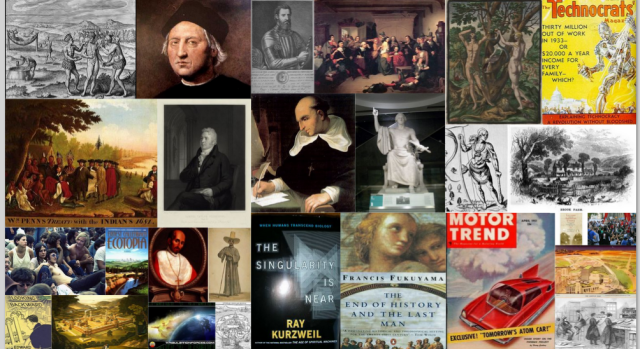
Soon after I finished Ameritopia and read Atwood’s article I began to compile a list of American utopias or strands of utopian thought in America. The list soon became so long and tedious that I was afraid I’d lull my poor readers to sleep if I actually wrote the whole thing out. There had to be a better way to get all this information across, so I decided to make a slideshow.

Immediately below is what I take to be a general history of utopia in America.  Anyone interested in specifics can consult the slideshow. It should be noted from the outset that I probably missed more than I included and may have made some errors on multiple points. Any suggestions for corrections would be of help.

The idea of America has been intertwined with the idea of utopia from the day Europeans discovered the New World. The discovery of the Americas became tied to anticipation and anxiety about the end of the world and the beginning of the reign of Christ on earth, it inspired a new golden age of utopian literature beginning with Thomas Moore, it became one of the main vectors through which the myth of the noble savage became popular in Europe. Many of the initial European settlements in the Americas either were themselves utopian experiments or gave rise to such experiments. America was seen as the place where utopian aspirations such as the end of poverty could in fact be realized, and the American republic was built from utopian themes such as equality.

Throughout the early 19th century the United States was the primary location for utopian communities seeking to overcome the problems associated with industrial civilization. By the end of that century large numbers of Americans had placed their utopian hopes with technology and government control over the economy, a position that was not fundamentally shaken until the late 1960s when utopian aspirations in the United States flowered and took on a more communitarian, spiritual, liberation, and environment centric form.

The end of the Cold War saw a further upsurge in utopian thought this time seen as an end to history and a further acceleration of wealth. Both aspirations were done in by political events such as 9-11, and the crash of stock market bubbles in 2000 and 2008.
Even in such technologically advanced times apocalyptic utopianism remained a major strain of American thought, a new breed of secular utopians and technophiles had also emerged that held their own idea of an approaching technological apocalypse. Lastly,
the era since the economic collapse has seen the rise of political movements which exhibit a combination of ideas from America’s utopian past. The story of utopia in America is not over…

Click on image above to watch the slideshow.

Given all this it is fair to ask how Levin could have gotten things so horribly wrong.

Sometimes we are wrong about something precisely because we are right about something closely related to it. And Levin is write about this: that the founders well aware that they were engaged in a kind of bold continental sized experiment wanted to make sure that experiments of such a scale would be incredibly difficult to initiate in the future. They were especially leery of national experiments that might originate from the two major strands of utopian thinking in the past- economic and religious.

Here is the primary architect of the American system of government, James Madison, in Federalist Number 10:

The influence of factious leaders may kindle a flame within their particular States, but will be unable to spread a general conflagration through the other States. A religious sect may degenerate into a political faction in a part of the Confederacy; but the variety of sects dispersed over the entire face of it must secure the national councils against any danger from that source. A rage for paper money, for an abolition of debts, for an equal division of property, or for any other improper or wicked project, will be less apt to pervade the whole body of the Union than a particular member of it; in the same proportion as such a malady is more likely to taint a particular county or district, than an entire State.

No matter how critical we are of the gridlock of today which prohibits necessary systematic change it was probably one of the factors that helped prevent the radicalization of American society during the tumultuous first half of the 20th century- a period that saw much of the rest of the world succumb to fascist and communist dictatorships. For all its flaws, the system probably still keeps us safe from the extremes on either side of the political spectrum, and we should therefore be aware of what we are doing when we try to change it.

Be that as it may, Levin gets this right and as a consequence misses the actual legacy of utopian thought in America. When large scale social and political experiments go wrong they can hurt a lot of people, the Soviet Union was one such experiment as is the European Union whose ultimate fate is today in doubt. The United States itself almost failed in its Civil War, which was the point made by Lincoln in his Gettysburg Address: “Now we are engaged in a great civil war, testing whether that nation or any nation so conceived and so dedicated can long endure”.

Small scale utopias or even imagined utopias are much less dangerous. When they fail, as almost all do, they burn a lot less people. At the same time they serve as laboratories in which new ways of being in the world can be tested. The aspirations inspired by purely imagined utopias often spur real reform in society in which the real tries to meet the standard of the dreamed.

In many ways the utopian tradition helped give rise to the society we have today. Certainly not utopia, but much more humane and just than the America these utopias were responding to in the 18th and 19th centuries. That is Ameritopia.

The Sixth Age

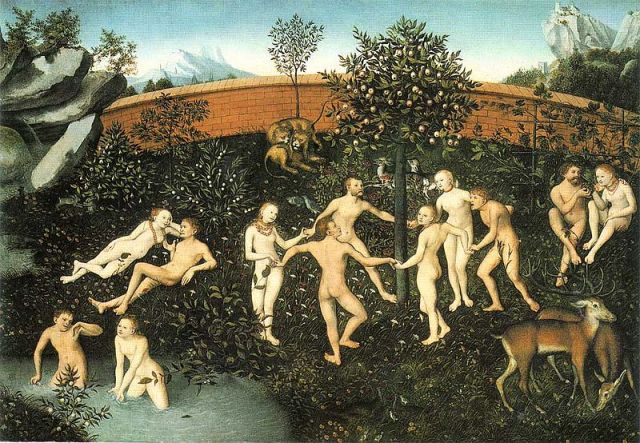
An almost universal myth found in agricultural civilizations is that of a lost paradise or golden age placed in the beginning of human history, or if still supposed to be in existence, beyond the sprawl of civilization, a prehistoric utopia frozen in amber.

The paradise myth we are most familiar with, of course, is that of the Biblical Garden of Eden and the story of the Fall. Yet, there were other myths similar in content that exist elsewhere. In the West, the biggest rival to the story of Adam and Eve and their paradise was that of the Greek poet Hesiod (sometime between 750-650 B.C.E) and his Ages of Man, a concept found in his Works and Days.  It was a myth once as well known as that of the Garden of Eden, but isn’t much talked about now. That’s a shame, because it has some very important things to tell us. So let me try…

The first of Hesiod’s ages, the Golden Age was a period when:

First of all the deathless gods who dwell on Olympus made a golden men who lived in the time of Cronos when he was reigning in heaven. And they lived like gods without sorrow of heart, remote and free from toil and grief: miserable age rested not on them; but with legs and arms never failing they made merry with feasting beyond the reach of all evils. When they died, it was as though they were overcome with sleep, and they had all good things; for the fruitful earth unforced bare them fruit abundantly and without stint. They dwelt in ease and peace upon their lands with many good things, rich in flocks and loved by the blessed gods.

It was all downhill from there.

How exactly this golden age ends isn’t precisely clear, but, Zeus, the new head of the universe after his Titan predecessor, Cronos, is deposed ends up destroying the human race of the Golden Age. The people of the Silver Age that follows are neither as long lived or as content as their golden ancestors. For the first time human beings are forced to seek shelter from the elements and build houses. They are also forced to work for a living and start fighting among themselves. Understandably, the people of the Silver Age are also less than deferential to the gods, and Zeus ends up destroying them too.

The Bronze Age that followed ends up being even more violent than the Silver. Human beings were in a constant state of war and strife. Like turtles or hermit crabs they take shelter from one another in hard houses, made of bronze, of course. Even the none- too- compassionate Zeus was appalled by their barbarity. Yahweh like, he destroyed them in a flood.

There is a pause in the seemingly endless degeneration of humanity with the Heroic Age that follows the Bronze. People here are pious and brave if still violent, and this is the period that we see the world’s heroes, such as Achilles take the stage. But, make no mistake this is only a pause.

The age which follows, the age in which Hesiod finds himself, is the Iron Age. It is the worst yet of the lot for men here are destined to labor to preserve their existence, and continue their strife, with even parents and children coming to blows. If the people of the Golden Age lived long lives, and died peacefully by the end of the Iron Age people will be born with grey hair and die soon after.

Hesiod seems to hold out hope that something better will follow.  At least that is how I understand him when he says:

Thereafter, would that I had not been born in the fifth generation, but either had died before or been born afterward.

But Hesiod gives us no insight into what the sixth age of man will be like.

For me, one of the things I find fascinating is just how many features Hesiod’s Works and Days and the opening chapters of the Book of Genesis share.  Both see the movement from paradise into the world as a metamorphosis from a life of ease to a life of labor. Both seem to take a certain negative stance towards knowledge. Genesis against the knowledge of good and evil, and Hesiod against technology. If one thought Yahweh was cruel for cursing humankind to live “by the sweat of his brow” he has nothing on Zeus, who along with his court of Olympian gods:

…keep hidden from men the means of life. Else you would easily do work enough in a day to supply you for a full year even without working.

What a strange idea- that what has made the mysteries of nature so difficult to discover and control is that they have been hidden by the gods. Here, I think, a seed had been sown in the Western mind. The return to paradise would entail the discovery of the “means of life” that had been hidden by the gods. It was a seed that when full grown would give us science and the power over nature, but I will leave that subject for the future.

Instrumental in this “knowledge war” between Zeus and humanity are the characters of Prometheus and Pandora. Again, like Genesis, Works and Days is really not one story but two.

The myth of Prometheus is found in Hesiod’s Works and Days along with his Theogony. The essence of the story is this: Prometheus, the only one of the Titans that had taken Zeus’s side in coup d’état against Cronos had a special place in his heart for human beings having, according to some legends, created them. Not only had Prometheus created humans, who the Greeks with their sharp wisdom called mortals, he was also the one who, when all the useful gifts of nature had seemingly been handed out to the other animals before humans had got to the front of the line, decided to give mortals an upright posture, just like the gods, and that most special gift of all- fire.

Prometheus was up to something.

Having a special place in his heart for the mortals, and a special disdain for Zeus and his cronies who had destroyed his fellow Titans, Prometheus tricked Zeus into accepting worthless bones wrapped in fat rather than the prime parts of an animal for sacrifice, which human would thereafter keep for themselves.  Incensed by this trick Zeus took not only fire from the mortals, but hid from them the ways of nature casting them into a world of unending scarcity.

Prometheus is punished by being chained for eternity to a rock. His liver pecked out daily by an eagle only to regenerate during the nights on account of his nature as an immortal like the medical fantasies of nanotechnologist.

The other famous character in Hesiod’s story is Pandora.  In yet another way that Hesiod’s Works and Days and Theogony resemble the first chapters of Genesis, Hesiod manages to blame women for all of humankind’s problems. It appears that women didn’t exist before the gods got it into their heads to payback the mortals for Prometheus’ trick with the sacrificial meat. The gods create the beautiful figure of the first woman Pandora, who with her famous box, would bring upon humanity all of its ills with the gift of hope remaining when Pandora shut the lid.

Hesiod’s understanding of the arc of history no doubt strikes modern ears as strange. We are apt to see history as progressive rather than regressive. Longevity increases rather than decreases, material goods and ease increase not decrease, the present is better than the past and the future will be better still. The Golden Age is in front of us rather than, in Hesiod’s scheme, in our distant past.

In recent years the case for general progress has been made by a whole slew of thinkers who, if they take the current crisis into account at all, see it as a mere bump on the road to an inexorably improving  human condition. Steven Pinker, for example, in his
Better Angels of Our Nature argues that, despite the news, violence and discrimination have been in steep decline since the Enlightenment. Not only are a lesser number of human beings injured or killed by one another, relative to the population, but the last few centuries have seen the end of slavery, the emancipation of women, the disappearance of state sponsored racism, the recognition of the rights of homosexuals, and the acknowledgement of the rights of animals.

Another recent book, this one by Stephen Moore and called It’s Getting Better All the Time makes a similar case that the world since the beginning of the 20th century has witnessed unprecedented progress. The book has an interesting back story in that Moore crafted the book from the notes of the late Julian Simon who is famous for his bet with the modern day Malthusian Paul Erlich. Erlich’s dystopian work The Population Bomb   predicted a Malthusian crisis for the end of the 20th century as the explosive  growth of the human population, he thought, would lead to an era of starvation, scarcity and environmental catastrophe. Simon and Erlich wagered on the price of five commodities, Simon predicting that their price would fall, Erlich that they would rise.
Erlich lost the bet, but the argument continues, and Malthusians continue to make quite reasonable arguments that we are headed off the end of a cliff. It’s just taking longer than expected to fall.

It is easy to see this argument tracing its way back to Hesiod. Those who side with technology are in the camp of Prometheus, and those who see our golden age in the primitive, unspoiled past, like Hesiod take the side of Zeus.

Whether the Sixth Age will represent a permanent end to Zeus’ curse or yet another movement away from paradise- only the future will tell.

Accelerando II

Were it merely the case that all Charles Stross was offering in his novel Accelerando was a kind of critique of contemporary economic trends veiled in an exquisitely Swiftian story the book would be interesting enough, but what he gives us transcends that. What it offers up is a model for how technological civilizations might evolve which manages to combine the views of several of his predecessors in a fascinating and unique way.

Underlying Stross’s novel is an idea of how technological civilizations develop known as the Kardashev scale.  It is an idea put forward by the Russian physicists Nikolai Kardashev in the early 1960s. Kardashev postulated that civilizations go through different technological phases based on their capacity to tap energy resources. A Type I civilization is able to tap the equivalent of the solar radiation present its home planet, and he thought that civilization as of 1964 had reached that level. A Type II civilization in his scheme is able to tap an amount of energy equivalent to the amount put out by its parent star, and a Type III civilization able to tap the energy equivalent to its entire galaxy. Type IV and Type V civilizations able to tap the energy of the entire universe or even multiverse have been speculated upon that would transcend even the scope of Kardashev’s broad vision.  Civilizations of this scale and power would indeed be little different from gods, and in fact would be more powerful than any god human beings have ever imagined.

Kardashev lays most of his argument out in an article On the Inevitability and Possible Structures of Supercivilizations.   It is a fascinating piece, and I encourage you to follow the link and check it out. The article was published in 1984, a poignant year given Orwell’s dystopia, and at the apex of the Second Cold War, with tensions running high between the superpowers. Kardashev, of course, has no idea that within a few short years the Soviet Empire will be no more. Beneath his essay one can find lurking certain Marxist assumptions about technological capacity and the cult of bigness. He seems to think that the dynamic of civilization will require bigger and bigger solutions to problems, and that there is no natural limit to how big such solutions could become. Technological civilizations could expand indefinitely and would re-engineer the solar system, galaxy, or even the universe to their purposes.

Yet, this “bigger is better” ideology is just that, an ideology, not a truth. It is the ideology that led the Soviets to pump out more and more steel without asking themselves “steel for what?” The idea of throwing more and more resources at a problem might have saved Russia during the Second World War, but in its aftermath it resulted in an extremely complex and inefficient machine that was beyond the capacity of intelligent direction, which ultimately proved itself incapable of providing a standard of living on par with the West. We are, thankfully, no longer enthralled to such gigantism.

Stross, for his part, does not challenge these assumptions, but rather build’s his story upon them.  Three other ideas serve as the prominent backdrop of the story: Dyson Sphere’s, Matrioshka Brains, and the Singularity. Let me take each in turn.

In Accelerando, as human civilization rapidly advances towards the Singularity it deconstructs the inner planets and constructs a series of spheres around the sun in order to capture all of the sun’s energy. These, so called, Dyson Sphere’s are an idea Stross borrows from the physicist Freeman Dyson, an idea that Kardashev directly cites in his On the Inevitability and Possible Structures of Supercivilizations.  Dyson developed his idea back in 1960 in his article Search for Artificial Stellar Sources of Infra-Red Radiation, which proposed 24 years before Kardashev, that one of the best ways to find extraterrestrial intelligence would be to look for signs that solar systems had undergone similar sorts of engineering.  Dyson himself found the inspiration for his sphere’s in Olaf Stapledon’s brilliant 1937 novel Star Maker, which was one of the first novels to tackle the question of the evolution of technological society and the universe.

A second major idea that serves as a backdrop of Stross’s novel is that of a Matrioshka Brain. This was an idea proposed by the computer scientist and longevity proponent, Robert Bradbury, who in sad irony, died in 2011 at the early age of 54. It is also rather telling and tragic that in light of his dream of eventually uploading his mind into the eternal electronic cloud, all of the links I could find to his former longevity focused entity Aeiveos appear to be dead links, seeming evidence that our personhood really does remain embodied and disappears with the end of the body.

Matrioshka Brains builds off of the idea of Dyson Spheres, but while the point of the latter is to extract energy the point of the former is to act as vast spheres of computation nestled one inside the other like the Russian dolls after which the Matrioshka Brain is named. In Accelerando, human-machine civilization has deconstructed the inner planets not just to capture energy, but to serve as computers of massive scale.

Both of these ideas, Dyson Sphere’s and Matrioshka Brain put me in mind of the idea of the crystal spheres which the ancients imagined surrounded and circled the earth and held the planets and stars. It would be the greatest of ironies if the very science which had been born when men such as Copernicus, Kepler, and Galileo overthrew this conception of the cosmos gave rise to an engineered solar system that resembled it.

The major backdrop of Accelerando is, of course, the movement of human begun technological civilization towards the Singularity. In essence the idea of the Singularity is that at some point the intelligence of machines that originated with human technological civilization will eventually exceed human intelligence. Just as human beings were able to design machines that were smarter than themselves, machines will be able to design machines smarter than themselves, and this process will accelerate to an increasing degree with the time between the creation of one level of intelligence and the next falling to shorter and shorter intervals.  At some point the reality that emerges from this growth of intelligence becomes unimaginable to current human intelligence- like a slug trying to understand humanity and its civilization. This is the point of the singularity- an idea Vernor Vinge in his 1993 article The Coming Technological Singularity: How to Survive in the Post-Human Era, borrowed from the physics of black holes. It is the point over the event horizon over which no information can pass.

If you follow any link in this article I would highly recommend that you read Vinge’s piece, for unlike the optimist Ray Kurzweil, Vinge is fully conscious of the existential risks that the Singularity poses and the philosophical questions it raises.

Stross’s novel, in its own wonderful way, also raises, but does not grapple, with these risks and questions. They remain for us to think our way through before our thinking is done for us.

Accelerando I

The New Earth Archive has a list of 70 books that help us think our way through the future that every educated person concerned with our fate is encouraged to read. Though his book is a novel, Charles Stoss’s Accelerando should be at the top of that list. Perhaps even, at the very top.

I picked up a copy of Accelerando after I heard an interview with Venor Vinge, one of the founders of the Singularity Movement, who praised the work as one of the few examples of fiction that tried to peer behind the dark veil of the singularity. I had originally intended to do a review of Accelernado all in one post, but then realized how much it made my head hurt, but in a good way. I figured that I might make my readers’ heads hurt in the same way if I tried to explain the book all in one go.  Accelerando is so bizarre, profound, and complex that it needs to be described in digestible doses, the same way I found myself wrestling with the novel. To take it all on in one post is a fool’s errand.

What follows below then is a general sketch of the plot of Accelerando. I then dive into what I think are some very important things Stross has to say about our current economic model through the medium of his novel. In a future post I’ll try to tackle something even more important he takes on in the book- the nature and evolution of technological civilization, and the fate of the human species.

The plot of the novel centers- around the story of four generations of the Macx clan: Manfred, Amber, Sirhan, and Manni.  All of the Macx’s are befriended/manipulated by the robotic cat, Aienko, who plays a central role in the story.  The book begins with Manfred Macx, a kind of Julian Assange/George Soros who is hated by almost everybody- especially tax hungry IRS agents and his ex-wife, Pamela, (who happen to be one of the same) for giving his brilliant ideas away for free.

Manfred is an example of a type of human being Stross sees just over the horizon, constantly plugged-in, with so much of his self offloaded into the cloud, that he loses his identity the minute his” glasses”, which are his interface with net, are stolen.

He is also a new type of political figure managing to revive a form of communism by creating a centralized-planning algorithm that can interface with market based systems.  At the same time he is a pioneer in granting rights to increasingly sentient emergent AIs of whom a group of uploaded lobsters originally created by the KGB  can be counted.

If Manfred represents the first stage of the singularity, the stage we can now be said to be in, and are therefore somewhat familiar, his daughter Amber represents the stage that follows. Purposefully enslaving herself on a slave ship on a mission to mine a moon of Jupiter, Amber eventually sets up a “kingdom” on a small asteroid.  At this point the story becomes fantastical. The line between the real and the virtual essentially disappears, persons at this stage are able to split themselves into virtual “ghosts”, and Amber and her crew eventually set off in a star-ship the size of a Coke can, the crew able to embed themselves in its virtual world. Their destination is the source of alien messages some three light years away from Jupiter. What they discover are a particularly intelligent and ravenous group of space lobsters, who Manfred had liberated from the KGB years before, who exist as scavengers upon a civilization that has collapsed under the weight of their own singularity- more on the latter in a moment.

When the “virtual” Amber returns from her space mission she finds that the “real” Amber has married and had a child, named Sirhan, with Sadeq- the fundamentalist Muslim theologian who had come to the Jupiter system to bring the word of Muhammad to the aliens beyond the solar system, and found himself, instead, caught up in the legal struggles between Amber and her mother, Pamela.  The site of their empire now centers around Saturn.

What Amber and her crew discovered on their trip to the alien router outside the solar system was a dark fact about the singularity.  Many, indeed most, civilizations that reach the stage of singularity collapse, having consumed itself along with the original wet-ware species that had given it birth. What is left, or passersby, huddling closely to their parent star- a closed network.

Knowing this is their likely fate Amber, and her family, launch a political party the Accelerationista that is pushing a referendum to flee into the Milky Way from the “Vile Offspring” that have been created in the singularity, have consumed the inner planets in their quest for energy and processor space, and will soon consume what is left of the earth.  The Accelerationista lose the election to the conservative party who prefer to stay put, but Amber and her family still manage to get a large number of people to make a break for it with the help of the space lobsters. In exchange the lobsters want to send a cohort of humans, including a version of Manfred off to explore a strange cloud that appears to be another version of the singularity out in the further depths of the universe

It’s a wild plot, but not as mind blowing as the deep philosophical questions Stross is raising with the world he has envisioned.

Right off the bat there’s the issue of economics, and here Stross attempted to bring to our attention problems that were largely off the public radar in 2005, but hold us in their grip today.

The protagonist of the story, Manfred Macx, doesn’t believe in the profit economy anymore. He gives his ideas away for free, and indeed Stross himself seemed to be following this philosophy, releasing the novel under a Creative Commons license.  In the novel copyright comes under the “protection” of mafias that will break your legs if you infringe on their copyright as they threaten to do to Manfred for giving away the musical legacy of the 20th century, again, for free. This battle between traditional copyright holders and the “sharing” economy has only become more acute since Stross published his novel, think SISPA and beyond.

Manfred’s attitude to money drives both the US government (and his ex-wife) crazy.  America is creaking under the weight of its debt as the baby boom generation retires en mass, but stubbornly refuses to die.  Since Accelerando was published debt politics and the consequences of demographic decline have come to the forefront of political debate in the US, but especially in Europe. One thing Stoss got definitively wrong, or better probably will have gotten wrong, is that he imagines a strong European supra-state in our near-future.  From our current angle it seems hard to imagine how even the relatively weak union Europe has now will survive the current crisis.

Stross also seems to be criticizing, or at least bringing to our attention, the hyper-innovative nature of financial instruments and legal contracts and doing this several years before the financial crisis of 2008 made financial exotica like Credit Default Swaps household terms. For, it is precisely in this world of virtual finance and “creative” law where Manfred excels at being innovative.  Manfred may be like Julian Asange in his nomadic lifestyle, and revolutionary ideology, which manages to piss-off just above everyone, but in other ways he resembles George Soros in that many of his best innovations are the result of Soros-like arbitrage, exploiting the gaps between reality and expectation and especially the differences between states.  Manfred displays this skill when he frees his daughter Amber from her mother by having Amber sell herself into slavery to a company based in Yemen, where her slave owner will trump the custody rights of her mother.

Stross also plays with the idea of how crazy the world of virtual trading, and image management on platforms such as FaceBook  have become, imagining bubbles and busts of bizarre bits of ether such as those traded in his “reputation market”.

Stross’s critique of capitalism may even run somewhat deeper for he has Manfred align himself with the old school communist Gianni to bring the command economy back from the dead using artificial intelligence able to link up with market mechanism- what exactly that means and would look like is really not all that clear, but that order is quickly superseded by another period of hyper-competition known as Economics 2.0

Indeed, this updated version of capitalism Stross portrays as the biggest threat to civilization as it approaches the singularity. Such hyper-capitalism built around  “corporations” that are in reality artificial intelligences might not be a phenomenon of human begun civilization alone,  Stross seems to be providing us with one possible explanation to Fermi’s Paradox – the silence of the universe seemingly so ripe for life.  Civilizations that reach the singularity are often so ravenous for resources, including the intelligence of the very beings that sparked the singularity in the first place, that they cannibalize themselves, and end up huddled around their parent star with little desire to explore or communicate after collapse.

The fate Stross paints for Economy 2.0 societies reminded me of a quote by Hannah Arendt who interpreted the spirit of Western capitalism and imperialism in the desire of the arch-imperialist Cecil Rhodes to “annex the planets”, and Thomas Hobbes conception of human kind’s limitless lust for more and more power that became the core assumption of the modern age:

But when the last war has come and every man has been provided for, no ultimate peace is established on earth: the power accumulating machine, without which the continual expansion would not have been achieved needs more material to devour in its never ending process. If the last victorious Commonwealth cannot proceed to” annex the planets” it can only proceed to destroy itself in order to begin anew the never-ending process of power generation*

I will leave off here until next time…

*Origins of Totalitarianism, Imperialism, 147

Saving Alexandria

One of the most dangerous speeches given by a public intellectual in recent memory was that of Richard Dawkins at the just held Atheist Rally in Washington DC.  Dawkins is a brilliant scientist, and a member of what the philosopher and fellow atheist Daniel Dennett has termed “the brights” a movement seeking to promote a naturalistic as opposed to supernatural view of the world. All this is for the good, and the brights were originally intended to be an inclusive movement that aimed to pull religious as well as non-religious people into a dialogue regarding some of the deeper questions of existence in so far as religious persons shared the same materialist assumptions and language as the secular and scientific mainstream of the movement.

This inclusiveness might have resulted in some very interesting public conversations, something that the neuroscientist David Eagleman has called possibilism– the space between what science definitively knows, and what religion and philosophy imagine. Instead, we have Dawkins’ speech in which he calls on atheist to challenge, “mock”, and “ridicule” the beliefs of religious people. Not only is this an invitation to incivility- where atheist are encouraged to intellectually mug religious persons who probably have not asked to engage in such conversations- it threatens to inflame the very anti-scientific tendencies of modern religion that Dawkins, rightly, opposes and detest.

To challenge religion where it has an immoral, intolerant, or dangerous effect on the larger political society is a duty of all citizens whatever their non-religious or religious persuasions.  Persons of a secular bent, among whom I include myself, need to constantly remind overly zealous religious people that theirs is not the only view and that the separation of church and state exists, not merely for their own, but for all of our protection.

Yet, the last thing science needs is to get into a fist-fight with sincerely religious people about subjects that have no effect whatsoever on the health of the public sphere. When the crowds roared in support of Dawkins’ call that they mock people who hold what he considers absurd beliefs such as that of Catholics regarding transubstantiation (an example he actually uses) one is left wondering whether the barbarians of the future might just as likely come from the secular rather than religious elements in society.

Continued in this vein, Dawkins would transform the otherwise laudable atheist movement into a lightening rod aimed right at the heart of science. No one should want a repeat of what Piss-Christ did to public funding for the arts.

Up until now, the ire of religion towards science has remained remarkably focused- evolution, reproductive technology, and, to a limited and much more dangerous extent- global warming- the last thing we need is for it to be turned on physics- cosmology, neurology or computer science.

Should the religious ever turn their attention to the singularity movement, which, after all, is a religion masking itself as science, they could stifle innovation and thus further exacerbate inequality. If the prophets of the singularity prove to be correct, they may find themselves in a state of war with traditional religion. A cynical minority of religious people may see the singularity as a major threat to their “business model”, but the majority may be reasonably inspired by their dispute with singularians over the necessarily spiritual question of what it means to be human, something the religious hold, with justification, to be their own turf.

Here, the religious may ironically actually hold the humanist higher ground. For it is difficult to see how the deep extension of the human lifespan and creation of artificial forms of intelligence promised by the singularity movement are humanistic ends given the divergence in mortality rates and educational levels between the developing and developed world. In other words, a humanist, as opposed to a trashumanist version of the future would aim at increasing the life expectancy of countries such as Chad, where a person is not expected to live past 50, rather than trying to extend ever outward the lifespan of the wealthy in the developed world. It would also be less inclined to race towards creating a new species of intelligent beings than towards making the most of the intelligent beings who are already here-us- through the old fashioned methods such as education- especially for girls.

In the not too far-off future, class and religious struggles might merge in dangerous and surprising ways, and the explosive growth of religion in the developing world might be mobilized in the name of traditional belief, and in the humanist cause of protecting the species.

Even should none of this dystopian scenario come to pass, religion is already full of anxiety in regards to science, and science imperialistic in its drive to submit every aspect of reality human and non-human alike to its “models” of reality. This anxiety and imperialism has been detrimental for religion and science both.

The confrontation between religion and science has resulted in religion becoming vulgar in the need to translate religious concepts into the “truths” of science- think the Shroud of Turin or the Creation Museum.

At the same time, science turns it sights not so much on undermining the religious world-view as the very nature of belief itself. It is equally vulgar for scientist to strap electrodes onto someone’s brain in the hopes of finding “the god spot” or some such nonsense- as if it means anything that religious belief is “proven” to be a part of neuro-anatomy- what else could it be?

We have known since the ancient Greeks that there are better ways to describe the natural world than religion. Religion isn’t, or shouldn’t be about that. It’s about the mystery of being, the search for meaning, on a human scale, a scale that science cannot provide, about good and evil.

Science may be extremely good at explaining a mental disease such as schizophrenia, and devising effective interventions. What it cannot do, what religion does so well, is to turn the devastating nature of such an illness into a sphere of meaning that can rescue purpose from the cold indifference of the universe. Without some variant of it we will freeze to death.

Koestler, Kurzweil, Wakefulness

I first looked into the work of Arthur Koestler after I had heard that he had something particularly interesting to say about Pythagoras.  Koestler is one of those writers who, sadly, lies largely forgotten. This is striking given that he was one of the most popular writers of the mid-20th century, and showed a degree of versatility almost unheard of today, writing not only the great anti-Stalinists novel Darkness at Noon, but also penetrating works on the history of science such as The Sleepwalkers.  The value of the man’s work is obscured not just by forgetfulness, but by personal scandal, the most damning of which is an allegation of rape by the wife of Koestler’s friend. An allegation, it must be said, that was made after Koestler had died, and against which he, therefore, was never able to defend himself.

For anyone interested the CBC has a detailed biography of Koestler over at IDEAS.

There are several lessons that can be taken away from The Sleepwalkers, written in the 1950s, that are extremely relevant to the present, most especially when one applies the insight of Koestler with those of a current mystic/scientist- Ray Kurzweil.

Koestler’s The Sleepwalkers reminds us of the spiritual origins of science. This was the case with Pythagoras, who was the first person to conceive of the universe as a mathematical model, right down through Kepler and Newton who were both on a spiritual quest to uncover the “mind of God”.

Koestler also brings to our attention the zig-zag nature of what we would call progress.  There are long dark spells in the history of human knowledge such that “the world in 1500 knew less mathematics than at the time of Archimedes “, and also long plateaus where nothing really interesting seems to happen.   Periods of progress are the exception not the norm, though such periods can be spectacular in how they revolutionize human life.

If we step back to take in the big picture we do indeed see something like an almost linear advance of human knowledge and power over nature the progress from “cavemen to spacemen” in Koestler’s corny characterization.  What we do not see, and this was something that would have been especially apparent to Koestler writing just after the horror-show of World War II, is anything like a corresponding moral progress of human kind.  In fact, periods of the greatest technological and scientific advancement also saw the greatest extension of human cruelty.  And it is this technical progress coupled with moral immaturity that Koestler sees as our greatest danger.

What does all of this have to do with Ray Kurzweil? Well, Kurzweil is the best known prophet of what is known as the Singularity- a distinction which won him a profile in Time Magazine a few years back. The Singularity movement essentially holds that the exponential growth in computer power will eventually result in machines that match and then quickly exceed human intelligence.  This world of post-human intelligence will solve the perennial problems that are now largely in the realm of religion- especially the problem of death. Human beings will be able to integrate themselves with superior machine intelligences, and be able to avoid death by uploading to a digital “cloud”.

Kurzweil is like an Al Gore from the other- side of the sun. He is famous for his slideshows and graphs which show exponential progress of almost everything, but especially the ability of computers. Exponential curves grow very slowly at first and then explode with incredible impact, like the proverbial lilies on a pond that seem to cover almost none of the water until their final set of doublings where they expand to cover everything.  By the middle of this century technological progress will become so rapid and so overwhelming that we will leap into a post-human world seeming overnight.

Members of the Singularity movement certainly bear a striking resemblance to the mystic-scientists of Koestler’s imagining- the very people who gave birth to the scientific world-view in the first place.  It would be a colossal mistake to dismiss Singularians as a bunch of sci-fi addicted kooks. Kurzweil himself is a genius inventor and the figures of some of the very largest tech companies, such as Sergey Brin at Google, are disciples of the movement. Indeed some of the best and brightest in the fields of computer and genetic science are consciously pursuing the religious goals that are at the root of the Singularity movement.

Believers in the Singularity will be the first to insist that theirs is not a utopian movement, which is the best give away that we are dealing with a true utopian line of thought. Indeed, from where I sit, it is hard to see the Singularity as anything less than the mother of all utopias with its promise of immortality, universal abundance, machine sentience, and omniscient intelligence. Like other utopian ideologies we’ve seen before Singularians exhibit a weird mix of determinism and human freedom. The Singularity is said to be written in the stars, the destiny of the universe once intelligent life emerges, and at the same time is relentlessly pursued by individual inventors and thinkers.

The Sleepwalkers should provide a cautionary tale for true believers in the Singularity. Koestler makes us aware of the non-linear nature of progress when viewed in the time frame of an individual life, and even centuries. Sometimes humanity gets stuck and just spins its wheels, and even lurches backward. In fact, some of the best critics of the assumptions regarding the current rates of progress held by Singularians today comes from the school that might be called “where is my jetpack?!” These thinkers argue that not only has present realty failed to live up to all of the hype from the middle of the last century- instead of bases on Mars and cold fusion we have the iPhone- but that the very lack of technological progress is the true source of our current economic ills. There is mounting evidence that we may have even hit a plateau in terms of scientific discovery.

Singularians appear almost fanatically driven by the desire to make their vision come true right now. One wonders why someone would push so hard to reach what they consider an inevitable destination, especially where trying to get there so fast potentially puts humanity in such grave danger- how could the earth possibly survive if people physically lived, not just a century, but centuries, and under conditions of hyper-abundance? What will people do to sustain themselves if we ever actually do manage to create sentient machines? And these are only material questions, the moral questions aren’t dealt with at all including the existential value of the fact that we die, so beautifully articulated by one of the few giants of the tech industry who didn’t believe in the Singularity- Steve Jobs.  One wonders, what is the rush?  Only to realize the hurry is because of the fact that the Singularians themselves hope to defeat death. They are terrified of death, in fact so terrified they are willing to risk humanity itself so that they personally will not have to die.

And this is another thing that The Sleepwalkers points out to us. That technical and scientific knowledge does not entail our moral development- quite the opposite. That technological change, especially rapid technological change, seems to go hand in hand with the periods when human beings treat each other the worst from Iron Age warfare, to the religious wars fueled by the Guttenberg printing press, to the industrial revolution and total war.  For Koestler we were at a crossroads hurtling towards utopia or dystopia, and The Sleepwalkers was meant as a warning.  He wrote:

Thus within the foreseeable future, man will either destroy himself or take off for the stars. It is doubtful whether reasoned argument will play a role in the ultimate decision, but if it does, a clearer insight into the evolution of the ideas that led us to the current predicament perhaps may serve of some value.

(It) may serve as a cautionary tale against the hubris of science, or rather, the philosophical outlook based on it.

Our hypnotic enslavement to the numerical aspects of reality has dulled our perception of non-quantitative moral value: the resultant end-justifies-the-means ethics may be a major factor in our undoing.

(Koestler hoped his tale) may have some sobering effect on the worshipers of the new Baal lording it over the moral vacuum with his electronic brain.  *

Perhaps we could have avoided all the carnage and dislocation that occurred in past periods of technological change had we kept our wits about us and thought things through before we acted.  Kurzweil himself has acknowledged that there may be some “bumps in the road” as we approach the Singularity, but working as a consultant for the US Military, and founding a “university” in search of ways to contain the ill effects of a reality he himself is trying to create seems a little like sub-contracting out strategies for climate change adaptation to Exxon-Mobile.

Kurweil himself does not believe in regulating technology. The future is for the technologist not the government to decide. But to the extent that in a democracy we are the government he leaves no role for all of us to have a say in the future world that both we and our children will inhabit.

I have no idea how we might choose our technology in a way that has never been done before, in a reflective way, but I do know one thing, while I may not have time, we have time to think about what we are doing before we cross what may be very dangerous thresholds- we have the chance to finally cease being sleepwalkers and wakeup.

* The Sleepwalkers, 1959, Arthur Koestler, pp. 552-553

We Are, Panem!

Any good work of dystopian literature has a number of hurdles to cross.  By far, the biggest of these hurdles is that the work needs to provide its readers with a survivor’s and rebel’s guide to any version of the dystopian world projected in that work. Anyone who has read and taken seriously, for instance, Orwell’ 1984 will be forever on the lookout for anything that smacks of totalitarian surveillance or an over intrusive state. The phrase “big brother” is a protective meme, a warning sign that would hopefully prevent the public from blithely accepting the expansion of the power to survey or control the lives of individuals.

If the Hunger Games Trilogy ultimately provides us with just such a survivor’s and rebel’s guide, as in the case of Orwell’s work, it will only be shown over time. What is clear now is that these books, and the movie that has grown out of them, have without doubt proven enormously popular, which must somehow reflect the underlying anxieties of our society. A good question to ask, then, is what exactly the anxieties the trilogy reflects might be?

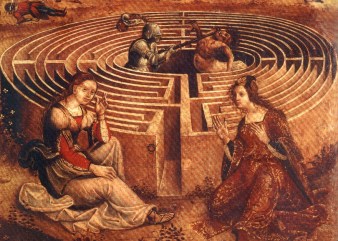
The story of the first book, which is the only one dealt with here, is essentially an updtaed version of the myth of Theseus.  The tale is set in some not far off post-American dystopia, called Panem, where the children of the twelve districts of which the state is composed are forced to kill one another for the entertainment of an aloof and decadent elite based in a city west of the Rockies known as the Capitol. This yearly event is called the Hunger Games. The event is part Olympics and part Oscars and is viewed universally throughout Panem either by desire or compulsion.  Only one of the children can ultimately come out of the games alive.

The first book is the story of  Katniss Evergreen, a sixteen year old girl from District 12, what is now West Virginia- a skilled hunter and survivalist.  She forms a partnership with a boy from the same district- Peeta Mellark. Together both of them are able to survive the Hunger Games on account of their skill and romance which stops the game when they both agree to commit suicide rather than kill one another.

Almost everything is fine in moderation, but clearly, the book reflects some of the anxieties surrounding our crossing a dangerous threshold with our, violence, gambling, sexuality, and celebrity/transparency obsessed culture. Suzanne Collins herself stated that the idea for the story originated with her watching “reality” television juxtaposed with footage from the Iraq War. She is trying to hold up a mirror to our own society. We shouldn’t like what we see.

There is nothing inherently wrong with sports, which represent one of the heights of drama and undoubtedly are among the forms of human excellence. There are ways, however, in which this passion for sports can go horribly wrong such as when fanatics from Penn State rioted over the firing of their idol Joe Paterno for doing nothing about the rape of at least one young boy by assistant coach Jerry Sandusky. This was a more violent reaction than that to any political event, ever, at that school, and revealed a kind of morally blinding tribalism under seemingly innocuous slogans such as “We Are, Penn State”! -the battle cry of the university’s superb football team.

There are also ways in which, especially professional sports, clearly resemble the games at the Roman Coliseum, and the Hunger Games.  Kids from poor “districts”, many of them black, see a career as “gladiators” as one of the few valid paths out of a world of poverty. It is certainly the case that we are more humane than the Romans- we do not allow our gladiators to kill one another.  But make no mistake, the most violent of our sports can be crippling, and the types of sports that garner the attention of the masses are increasingly more violent

At least our society does not condone death as a form of entertainment.  Scratch that. Our society does not condone real death as a form of entertainment.  Fake murder, however, is one of the most thriving businesses in an otherwise stagnant economy.  The first person shooter game Call of Duty has 40 million players, more people than all of the people in Iraq, and had the biggest release of any video game in history with 400 million in revenue.  

In the Hunger Games gambling is the passion of the elites of the Capitol who place bets on who will ultimately win the games. In our society, gambling, given one excludes the stock market, is largely limited to the poor, another one of the few conceivable roads out of poverty.  In the United States the poor spend roughly 9% of their income on lottery tickets an insidious invisible tax on the most vulnerable in society.  Those in the middle class with more money to spend are more apt to waste their money in a modern day dystopia like Las Vegas or at one of the gambling islands states have thrown up to counter balance declining revenues from the rich and middle class alike.

The Hunger Games itself has nothing really to say on the issue of sex, it’s a children’s book after all, and its Romeo and Juliet romance is almost nostalgic.  Our own culture, however, is much, much different.  The porn site Xvideos has an incredible 4 billion viewers per month! If each of these viewers was a separate individual that would be more than the population of China and India combined, and more than half the population of planet earth, which given the 50/50 split between males and females, might, on second glance, make sense.  Can anyone even imagine the impact of a political site that had this many viewers?  In fact over 30% of internet traffic is related to pornography. If the internet does ever wake up and become conscious as some propose we may be faced with a globe sized middle-aged pornography obsessed superbrain.

The book shines a light most severely at our culture of celebrity. As others have pointed out, show like America Idol, are like an updated form of the cults of human sacrifice. We are obsessed with the rise, and much more so the fall, of the artificial demi-gods we have created- think the slow destruction of a person such as Lindsay Lohan who goes through the Christian cycle of fall and redemption.

While in the arena of the Hunger Games no privacy is possible, everything the characters do is observed and televised resulting in the need to fake emotions in order to obtain benefits from “sponsors” watching the games. The result is actual confusion regarding the most private of feelings and suspicion regarding the feelings of others as everything is put on display and is meant to serve a utilitarian social purpose. Does Katniss really have feelings for Peeta or are her actions merely for the benefit of the audience? What are Peeta’s true feelings for Katniss? One wonders what effects social media such as FaceBook are having on the internal emotional lives of their users as the social value of their own emotions and thoughts is subject to constant scrutiny and feedback. All of us have become celebrities in our own constructed dramas.

The people of the districts themselves were once constantly watched by the mocking-jay- a genetically engineered spying bird. This is certainly poetic, and has a deeper literary significance for Collins’ plot, but the sad reality is that all any dystopian government would need to do to obtain full-spectrum surveillance of its people would be to reestablish FaceBook and Google and demand full access to their records.

The Hunger Games, with its fast paced style, and the thrilling narrative of the struggle between Katniss and her allies and the brutal “Careerers” who have spent their childhoods training to kill at the games, indeed, reads like the one is watching a television show such as Survivor, where Collins got the inspiration for her novel.  We become caught up in the very type of spell Collins hopes to free us from. Whether or not that was intentional on Collins’ part I do not know, but one weakness, at least with the first book in the trilogy, is that I found myself no more armed against the society of spectacle than I was before I opened the book- perhaps even less so.   In that sense the first book fails to provide the sort of survivor’s and rebel’s guide to be hoped for.

One can wish the remaining works in the trilogy live up to the high standard set by the genius creators of dystopias past, and provide us with the tools to combat dystopias of the future, though undoubtedly; Collins has given us insight into the dystopian aspects of the present.

Blame Zarathustra

The story in its most simplified form goes something like this: the world has fallen into a deep state of chaos and death. All the old ways have collapsed and everyone is confused and does not know what to do, they are lost. The reason this is happening is that there is a war enveloping the cosmos.  A force of disorder, an order based upon the power of lies, has set itself against the peace and good of the world. They have launched a war for the possession of the future. Each individual must now choose sides in the great and coming battle. They can choose to join the side of evil, lies and disorder or the side of the good, truth and peace. Ultimately, the good will prevail, the unjust will be punished and the peace of the world will be restored, not just for a time, but for all eternity.  This will be the final battle, the birth of paradise.

This narrative makes for great story telling- just think of the world of J.R. Tolkien or Star Wars, and were it the case that such stories were only part of our fantasies there would be no issue, and they would remain what they should be, a great piece of childish fun.

The problem, of course, occurs when such narratives are overlain on political and social reality, for the passion and blindness these kinds of stories engender can be found behind some of the bloodiest events of human history. To name only the most prominent: the religious wars of the Reformation and Counter Reformation, including the English Civil War, the Inquisition, the Terror of the French Revolution, the American Civil War, the internal terror of the Stalinist Soviet Union, Nazism, the Second World War, the Red Scare, the Cold War, Islamist terrorism, and the wars in Afghanistan and Iraq.

Something about these types of stories seem to tap into a primal element in human beings, nevertheless, their origin can be traced to historical time.

Zarathustra, otherwise known as Zoroaster, was probably the person most responsible for having first created and popularized a version of this story around 1200 B.C.E. What he had discovered was a “technology” that enabled human beings to engage in a kind of mass tribalism. Dividing whole societies or even all of human-kind into two warring armies created what were in effect super-tribes joined to one another with the kind of depth of feeling and exclusiveness that was once the monopoly of extended kin-groups.  It was a passion that was able to override biological instinct and turn “brother against brother”, and allowed human beings to murder one another in “good conscience” on the grounds that they were waged in battle with an army of demons.

Zarathustra was not trying to do this. What he was seeking after was a path to peace.

The Aryan society in which he lived had gone from an age of idyllic pastoralists to one of warriors. The catalyst for this transition had been, as it has been many times since, technological transformation.  Aryans living in what is now southern Russia had come in contact with the more advanced civilizations in Armenia and Mesopotamia to the south.  From these societies the Aryans learned the art of iron weaponry and the chariot, which sparked a wave of war and banditry, as the whole of the steppe was consumed in violence. The gentle gods of the Arayans gave way to the cult of the militarized Indra- the dragon slayer.

Zarathustra, a priest of the old Aryan gods sought out an answer to the bloodshed. Dreams and visitations came to him. Nothing took place on earth which was not a reflection of the things of heaven. Perhaps Indra and his devas- the shining ones- had brought war not just upon the earth, but upon the just gods of old, the amesha- the immortals.

Then, Zarathustra was visited by the greatest of the amesha- Mazda- lord of wisdom and justice.  Lord Mazda told Zarathustra that he was to mobilize the people for a coming holy war against the forces of evil.

Who could challenge the great Lord Mazda, the most powerful of the amesha?  Zarathustra reasoned that Mazda must have a divine opposite, a god of equal power dedicated to disorder and evil- the god of the lie- Angra Mainyu.

Every human being was called to choose sides in the great and looming battle. ..

It was here that Zarathustra introduced his greatest innovation, for he abandoned the cyclical view of history that had been perhaps the only way human beings, up until then, had thought about time.  In cyclical history time spun round and round within regular cycles of birth, strength, decay and death, historical seasons to match the natural one.  Zarathustra broke free from this cycle. The world was racing toward an end of history- a climax and day of judgment. The great battle would end in the victory of Lord Mazda over the forces of the wicked. A blazing river of fire would run from the heavens into hell and destroy forever the spirit of evil. The world would become a final paradise. . .

Zarathustra crafted his tale on the eve of the Axial Age, a period of religious awakening that gave us some of the deepest, most influential, and compassionate figures of human history: the Buddha, Socrates, Confucius.  But his story lived on. It lived on in the The Book of Revelation, in the 12th Iman of the Shia branch of Islam, it lived on in the religious wars, the idea of world revolution found in communism, in Hitler’s anti-Semitic insanity… in the current apocalyptic logic behind the looming confrontation with Iran.

It is the world’s most dangerous fairy-tale, and if we do not someday soon break its spell, its dark side will come true.

Arrested Development

When I was a kid, the original Star Wars trilogy seemed to correspond to my own moral development, at least up until The Return of the Jedi. Star Wars, the first of the three was a classic good vs. evil morality /adventure tale- perfect for my own understanding of the world at the time. The world was simple, clear cut. There were good guys and bad guys, and the best one could hope for was to end up one of the key players on the side of the good guys. The sheer nobodyness of the main characters- Luke was just some kid living on a desert planet, Han and Chewy like futuristic truck drivers, the lowly droids a couple of clowns, contrasted with the sheer scale of what they were up against was democratizing- you couldn’t just be one of the good guys- you could be ONE of the good guys.

The Empire Strikes Back, for my money by far the best of the 3, was released in 1980.  The movie itself introduced elements of mysticism and mythology in its plot line, and also an element of moral ambiguity. Vader, we find out, is Luke’s father- the lines between good guy and bad guy had been slightly smudged.

But if things in the movies were getting morally complicated, things in the real world took on a surreal good vs. evil dichotomy.  It is impossible for me to explain to someone who was not of a certain age during this period of time- and was a boy- how the flare up of the Cold War that took place during this time colored the imagination.  This was the period of Regan’s Evil Empire Speech, and his SDI, aptly panned the Star Wars initiative.

Hollywood and the culture were amplifying the political reality to infuse the world, at least for a particular breed of media-tuned young boys, with an air of looming showdown and apocalypse.  Adults, should have known better, but as a kid I was too busy preparing myself for a hero’s role in a real life version of Red Dawn , amassing troops on my Risk board, listening to jets fly overhead at night thinking “this is it!” and begging my parents to see the horror show of The Day Afterwhich had they let me might have scared me straight.

By the time we get to the Return of the Jedi, the ambiguity is gone. The bad guy is converted, the good guys win, the Evil Empire is defeated. The progress towards adulthood, with the exception of sexy Leia, has stopped. Adults it seems never grow beyond the realm of fairy-tales. Even if, in the real world, such fairy-tales never make sense.

Whether Regan’s aggressive policy towards the Soviet Union precipitated the collapse of  the Eastern Bloc is an interesting historical question, and one in which I have an open mind. The fact of the matter remains that the outcome was not the matter of some “force” of good working for the survival of the human race and freedom, but a piece of extremely good luck. Barring any such force, he might just as likely have gotten us all blown up.

Perhaps the only time this good vs. evil rhetoric made sense was when the Allies battled against the Nazis. But even then, the Allies managed to cross over to the “dark side”, or at the very least, gave the conflict a shade of grey, when they began deliberately killing civilians from the air, and brought Stalin, Hitler’s doppelganger, into the lighter side of the force.

As an adult, the dangers of this arrested development and simplified moral imagination were brought home to me with the disaster of the Second Iraq war.  Adults holding to a vision of  the universe as a drama of good against evil not only made stupid policy mistakes, but also fell into the most grotesquely immoral behavior on a individual level.

Unfortunately, the 9-11 wars, from where I sit, have not proven to be a painful initiation to adulthood, but another version of the Return of the Jedi.  Both the right, and the left,  continue to paint one another as not just misguided, but demonic as the country drifts towards oblivion.

All this got me wondering where this whole good vs. evil fairy tale that is so dangerous, and politically crippling given our destructive capacities, and need for cooperation on enormously complex problems, actually originated.

Some might blame the heritage of a particular aspect of the Abrahamic religions, Christianity, Judaism, and Islam.  For my part, I go a little further back, and blame a bewildered searching prophet who lived on the steppes of Central Asia around 1200 B.C.E.  I blame Zarathustra….