The World Beyond Boundaries

360 The Virgin Oil Painting by Gustav Klimt

                                                                                              https://www.artsy.net/artist/gustav-klimt

I  first came across Miguel Nicolelis in an article for the MIT Technology Review entitled The Brain is not computable: A leading neuroscientist says Kurzweil’s Singularity isn’t going to happen. Instead, humans will assimilate machines. That got my attention. Nicolelis, if you haven’t already heard of him, is one of the world’s top researchers in building brain-computer interfaces. He is the mind behind the project to have a paraplegic using a brain controlled exoskeleton make the first kick in the 2014 World Cup. An event that takes place in Nicolelis’ native Brazil.

In the interview, Nicolelis characterizes the singularity “as a bunch of hot air”. His reasoning being that “The brain is not computable and no engineering can reproduce it,”. He explains himself this way:

You can’t predict whether the stock market will go up or down because you can’t compute it,” he says. “You could have all the computer chips ever in the world and you won’t create a consciousness.”

This non-computability of consciousness, he thinks, has negative implications for the prospect of ever “downloading” (or uploading) human consciousness into a computer.

“Downloads will never happen,” he declares with some confidence.

Science journalism, like any sort of journalism needs a “hook” and the hook here was obviously a dig at a number of deeply held beliefs among the technorati; namely, that AI was on track to match and eventually surpass human level intelligence, that the brain could be emulated computationally, and that, eventually, the human personality could likewise be duplicated through computation.

The problem with any hook is that they tend to leave you with a shallow impression of the reality of things. If the world is too complex to be represented in software it is even less able to be captured in a magazine headline or 650 word article. For that reason,  I wanted a clearer grasp of where Nicolelis was coming from, so I bought his recent and excellent, if a little dense, book, Beyond Boundaries: The New Neuroscience of Connecting Brains with Machines—and How It Will Change Our Lives. Let me start with a little of  Nicolelis’ research and from there flesh out the neuroscientist’s view of our human-machine future, a view I found both similar in many respects and at the same time very different from perspectives typical today of futurists thinking about such things.

If you want to get an idea of just how groundbreaking Nicolelis’ work is, the best thing to do is to peruse the website of his lab.  Nicolelis and his colleagues have done conducted experiments where a monkey has controlled the body of a robot located on the other side of the globe, and where another simian has learned to play a videogame with its thoughts alone. Of course, his lab is not interested in blurring the lines between monkeys and computers for the heck of it, and the immediate aim of their research is to improve the lives of those whose ties between their bodies and their minds have been severed, that is, paraplegics. A fact which explains Nicolelis’ bold gamble to successfully demonstrate his lab’s progress by having a paralyzed person kickoff the World Cup.

For how much the humanitarian potential of this technology is inspiring, it is the underlying view of the brain the work of the Nicolelis Lab appears to experimentally support and the neuroscientist’s longer term view of the potential of technology to change the human condition that are likely to have the most lasting importance. They are views and predictions that put Nicolelis more firmly in the trans-humanist camp than might be gleaned from his MIT interview.

The first aspect of Nicolelis’ view of the brain I found stunning was the mind’s extraordinary plasticity when it came to the body. We might tend to think of our brain and our body as highly interlocked things, after all, our brains have spent their whole existence as part of one body- our own. This a reality that the writer, Paul Auster, turns into the basis of his memoir Winter Journal which is essentially the story of his body’s movement through time, its urges, muscles, scars, wrinkles, ecstasies and pains.

The work of Nicolelis’ Lab seems to sever the cord we might thinks joins a particular body and the brain or mind that thinks of it as home. As he states it in Beyond Boundaries:

The conclusion from more than two decades of experiments is that the brain creates a sense of body ownership through a highly adaptive, multimodal process, which can, through straightforward manipulations of visual, tactile, and body position (also known as proprioception) sensory feedback, induce each of us, in a matter of seconds, to accept another whole new body as being the home of our conscious existence. (66)

Psychologists have had an easy time with tricks like fooling a person into believing they possess a limb that is not actually theirs, but Nicolelis is less interested in this trickery than finding a new way to understand the human condition in light of his and others findings.

The fact that the boundaries of the brain’s body image are not limited to the body that brain is located in is one way to understand the perhaps almost unique qualities of the extended human mind. We are all ultimately still tool builders and users, only now our tools:

… include technological tools with which we are actively engaged, such as a car, bicycle, or walking stick; a pencil or a pen, spoon, whisk or spatula; a tennis racket, golf club, a baseball glove or basketball; a screwdriver or hammer; a joystick or computer mouse; and even a TV remote control or Blackberry, no matter how weird that may sound. (217)

Specialized skills honed over a lifetime can make a tool an even more intimate part of the self. The violin, an appendage of a skilled musician, a football like a part of the hand of a seasoned quarterback. Many of the most prized people in society are in fact master tool users even if we rarely think of them this way.

Even with our master use of tools, the brain is still, in Nicolelis’ view,trapped within a narrow sphere surrounding its particular body. It is here where he sees advances in neuroscience eventually leading to the liberation of the mind from its shell. The logical outcome of minds being able to communicate directly to computers is a world where, according to Nicolelis:

… augmented humans make their presence felt in a variety of remote environments, through avatars and artificial tools controlled by thought alone. From the depths of the oceans to the confines of supernovas, even to the tiny cracks of intracellular space, human reach will finally catch up to our voracious appetite to explore the unknown. (314)

He characterizes this as Mankind’s “epic journey of emancipation from the obsolete bodies they have inhabited for millions of years” (314) Yet, Nicolelis sees human communication with machines as but a stepping stone to the ultimate goal- the direct exchange of thoughts between human minds. He imagines the sharing of what has forever been the ultimately solipsistic experience of what it is like to be a particular individual with our own very unique experience of events, something that can never be fully captured even in the most artful expressions of,  language. This exchange of thoughts, which he calls “brainstorms” is something Nicolelis does not limit to intimates- lovers and friends- but which he imagines giving rise to a “brain- net”.

Could we one day, down the road of a remote future, experience what it is to be part of a conscious network of brains, a collectively thinking true brain-net? (315)

… I have no doubt that the rapacious voracity with which most of us share our lives on the Web today offers just a hint of the social hunger that resides deep in human nature. For this reason, if a brain- net ever becomes practicable,  I suspect it will spread like a supernova explosion throughout human societies. (316)

Given this context, Nicolelis’ view on the Singularity and the emulation or copying of human consciousness on a machine is much more nuanced than the impression one is left with from the MIT interview. It is not that he discounts the possibility that “advanced machines may come to dominate and even dominate the human race” (302) , but that he views it as a low probability danger relative to the other catastrophic risks faced by our species.

His views on prospect of human level intelligence in machines is less that high level machine intelligence is impossible, but that our specific type of intelligence is non-replicable. Building off of Stephen Jay Gould’s idea of the “life tape”  the reason being that we can not duplicate through engineering the sheer contingency that lies behind the evolution of human intelligence. I understand this in light of an observation by the philosopher Daniel Dennett, that I remember but cannot place, that it may be technically feasible to replicate mechanically an exact version of a living bird, but that it may prove prohibitively expensive, as expensive as our journeys to the moon, and besides we don’t need to exactly replicate a living bird- we have 747s. Machine intelligence may prove to be like this where we are never able to replicate our own intelligence other than through traditional and much more exciting means, but where artificial intelligence is vastly superior to human intelligence in many domains.

In terms of something like uploading, Nicolelis does believe that we will be able to record and store human thoughts- his brainstorms- at some place in the future, we may be able to record  the whole of a life in this way, but he does not think this will mean the preservation of a still experiencing intelligence anymore than a piece by Chopin is the actual man. He imagines us deliberately recording the memories of individuals and broadcasting them across the universe to exist forever in the background of the cosmos which gave rise to us.

I can imagine all kinds of wonderful developments emerging should the technological advances Nicolelis imagines coming to pass. It would revolutionize psychological therapy, law, art and romance. It would offer us brand new ways to memorialize and remember the dead.

Yet, Nicolelis’ Omega Point- a world where all human being are brought together into one embracing common mind, has been our dream at least since Plato, and the very antiquity of these urges should give us pause, for what history has taught us is that the optimistic belief that “this time is different” has never proved true. A fact which should encourage us to look seriously, which Nicolelis himself refuse to do, at the potential dark side of the revolution in neuroscience this genius Brazilian is helping to bring about. It is less a matter of cold pessimism to acknowledge this negative potential as it is a matter of steeling ourselves against disappointment, at the the least, and in preventing such problem from emerging in the first place at best, a task I will turn to next time…

Caves, Creationism and the Divine Wonder of Deep Time

The Mutiliation of Uranus by Saturn

Last week was my oldest daughter’s 5th birthday in my mind the next “big” birthday after the always special year one. I decided on a geology themed day one of whose components were her, me and my younger daughter who’s 3 taking a trip to a local limestone cave that holds walk through tours.

Given that we were visiting the cave on a weekday we had the privilege of getting a private tour: just me, the girls and our very friendly and helpful tour guide. I was really hoping the girls would get to see some bats, which I figured would be hibernating by now. Sadly, the bats were gone. In some places upwards of 90% of them had been killed by an epidemic with the understated name of “White Nose Syndrome” a biological catastrophe I hadn’t even been aware of and a crisis both for bats and farmers who depend on them for insect control and pollination.

For a local show-cave this was pretty amazing- lots of intricate stalactites and stalagmites, thin rock in the form of billowing ribbons a “living” growth moving so slowly it appears to be frozen in time. I found myself constantly wondering how long it took for these formations to take shape. “We tell people thousands of years” our guide told us. “We have no idea how old the earth is”. I thought to myself that I was almost certain that we had a pretty good idea of the age of the earth – 4.5 billion, but did not press- too interested in the caves features and exploring with the girls. I later realized I should have, it would have likely made our guide feel more at ease.

Towards the end of our tour we spotted a sea shell embedded in the low ceiling above us, and I picked up the girls one at a time so they could inspect it with their magnifying glass. I felt the kind of vertigo you feel when you come up against deep time. Here was the echo of a living thing from eons ago viewed by the living far far in its future.

Later I found myself thinking about our distance in time from the sea shell and the cave that surrounded it. How much time separated us and the shell? How old was the cave? How long had the things we had seen taken to form? Like any person who doesn’t know much about something does I went to our modern version of Delphi’s Oracle- Google.

When I Googled the very simple question: “how old are limestone caves?” a very curious thing happened. The very first link that popped up wasn’t Wikipedia or a geology site but The Institute for Creation Research.  That wasn’t the only link to creationist websites. Many, perhaps the majority, of articles written on the age of caves were by creationists, the ones that I read in seemingly scientific language, difficult for a non-scientist/non-geologist to parse. Creationists seem to be as interested in the age of caves as speleologist, and I couldn’t help but wonder, why?

Unless one goes looking or tries to remain conscious of it, there are very few places where human beings confront deep time- that is time far behind (or in front) of thousands of years by which we reckon human historical time.  The night sky is one of these places, though we have so turned the whole world into a sprawling Las Vegas that few of us can even see into the depths of night any more. Another place is natural history museums where prehistoric animals are preserved and put on display. Creationists have attempted to tackle the latter by designing their very own museums such as The Creation Museum replete with an alternative history of the universe where, among other things, dinosaurs once lived side-by-side with human beings like in The Flintstones.

Another place where a family such as my own might confront deep time is in canyons and caves. The Grand Canyon has a wonderful tour called The Trail of Time that gives some idea of the scale of geological time where tourists start at the top of the canyon in present time and move step by step and epoch by epoch to the point where the force of the Colorado River has revealed a surface 2 billion years old.

Caves are merely canyons under the ground and in both their structure and their slow growing features- stalactites and the like- give us a glimpse into the depths of geologic time. Creationists feel compelled to steel believers in a 5,000 year old earth against the kinds of doubts and questions that would be raised after a family walks through a cave. Hence all of the ink spilt arguing over how long it takes a stalagmite to grow five feet tall and look like a melting Santa Claus. What a shame.

It was no doubt the potential prickliness of his tourists that led our poor guide to present the age of the earth or the passage of time within the cave as open questions he could not address. After all, he didn’t know me from Adam and one slip of the word “million” from his mouth might have resulted in what should have been an exciting outing turning into a theological debate. As he said he was not, after all, a geologist and had merely found himself working in the cave after his father had passed away.

As regular readers of my posts well known, I am far from being an anti-religious person. Religion to me is one of the more wondrous inventions and discoveries we human beings have come up with, but religion, understood in this creationist sense seems to me a very real diminishment not merely of the human intellect but of the idea of the divine itself.

I do not mean to diminish the lives of people who believe in such pseudo-science. One of the most hardworking and courageous persons I can think of was a man blinded by a mine in Vietnam. Once we were discussing what he would most like to see were his sight restored and he said without hesitation “The Creation Museum!”. I think this man’s religious faith was a well spring for his motivation and courage, and this, I believe is what religions are for- to provide strength for us to deal with the trials and tribulations of human life. Yet, I cannot help but think that the effort to black- hole- like suck in and crush our ideas of creation so that it fits within the scope of our personal lives isn’t just an assault on scientific truth but a suffocation of our idea of the divine itself.

The Genesis story certainly offers believers and non-believers alike deep reflection on what it means to be a moral creature, but much of this opportunity for reflection is lost when the story is turned into a science text book. Not only that, both creation and creator become smaller. How limited is the God of creationists whose work they constrict from billions into mere thousand of years and whose overwhelming complexity and wonder they reduce to a mere 788,280 human words!  With bitter irony creationists diminish the depth of the work God has supposedly made so that man can exalt himself to the center of the universe and become the primary character of the story of creation. In trying to diminish the scale and depth of the universe in space and time they are committing the sin of Milton’s Satan- that is pride.

The more we learn of the universe the deeper it becomes. Perhaps the most amazing projects in NASA’s history were two very recent one- Kepler and Hubble. Their effects on our understanding of our place in the universe are far more profound than the moon landings or anything else the agency has done.

Hubble’s first Deep Field image was taken over ten consecutive days in December of 1995. What it discovered in the words of Lance Wallace over at The Atlantic:

What researchers found when they focused the Hubble over those 10 days on that tiny speck of darkness, Mather said, shook their worlds. When the images were compiled, they showed not just thousands of stars, but thousands of galaxies. If a tiny speck of darkness in the night sky held that many galaxies, stars and—as scientists were beginning to realize—associated planets … the number of galaxies, stars, and planets the universe contained had to be breathtakingly larger than they’d previously imagined.

The sheer increased scale of the universe has led scientist to believe that it is near impossible that we are “alone” in the cosmos. The Kepler Mission has filled in the details with recent studies suggesting that there may be billions of earth like planets in the universe.   If we combine these two discoveries with the understanding of planet hunter Dimitar Sasselov, who thinks that not only are we at the very beginning of the prime period for life in the universe because it has taken this long for stars to produce the heavy elements that are life’s prerequisites, but that we also have a very long time perhaps as much as 100 billion years for this golden age of life to play out, we get an idea of just how prolific creation is and will be beside which a God who creates only one living planet and one intelligent species seems tragically sterile.

To return underground, caves were our first cathedrals- witness Lascaux. It is even possible that our idea of the Underworld as the land of the dead grew out of the bronze age temple complex of Alepotrypa inspiring the Greek idea of Hades that served as the seed through which the similar ideas of Sheol held by the Jews and revved up by Christians to the pinnacle of horror shows with the idea of Hell.

I like to think that this early understanding of the Underworld as the land of the dead and the use of caves as temples reflects an intuitive understanding of deep time. Walking into a cave is indeed, in a sense, entering the realm of the dead because it is like walking into the earth’s past. What is seen there is the movement of time across vast scales. The shell my daughter’s peered at with their magnifying glass, for instance, was the exoskeleton of a creature that lived perhaps some 400 million years ago in the Silurian Period when what is now Pennsylvania was located at the equator and the limestone that was the product of decay the shells inhabitant’s relatives began to form.

Recognition of this deep time diminishes nothing of the human scale and spiritual meaning of this moment taken to stop and stare at something exquisite peeking at us from the ceiling- quite the opposite. Though I might be guilty of overwinding,  it was a second or two 400 million years or perhaps one might say 13 billion years in the making- who couldn’t help thanking God for that?

Finding Frankenstein a Home

Frankenstein Cover

Percy’s epic poem, Prometheus Unbound is seldom read today while his wife’s novel,  Frankenstein; or the Modern Prometheus has become so well known that her monster graces the boxes of children’s cereal, and became the fodder from one of the funniest movies of the 20th century.

The question that always strikes me when I have the pleasure of re-reading Frankenstein is how could someone so young have written this amazing book? Mary Shelley was a mere twenty-one when the novel was published and the story she penned largely to entertain her husband and friends has managed to seep deeply into our collective assumptions especially those regarding science and technology. Just think of the kinds of associations the word “frankenfood” brings to mind and one gets a sense of how potent as a form of resistance against new forms of technology her gothic horror story is.

What is lost in this hiving off of the idea of the dangers of “unnatural” science for use as a cautionary tale against using a particular form of technology or exploring a certain line of research is the depth and complexity of the other elements present in the novel. I blame Hollywood.

The Frankenstein’s monster of our collective imagination isn’t the one given us by Mary Shelley, but that imagined by the director James Whale in his 1931 classic Frankenstein.

It was Whale who gave us the monster in a diner jacket, bolts protruding from his neck, and head like a block. Above all, Whale’s monster is without speech whereas the monster Mary Shelley imagined is extraordinarily articulate.

Whale’s monster is a sort of natural born killer his brain having come from a violent criminal. It is like the murderous chimpanzee written about in the weekend’s New York Times a creature that because we can not control or tame its murderous instincts must be killed before it can harm another person. Mary Shelley’s monster has a reason behind its violence. He can learn and love like we do, and isn’t really non-human at all. It is his treatment by human beings as something other than one of us- his abandonment by Victor Frankenstein after he was created, the horror which he induces in every human being that encounters him, that transforms the “creature” into something not so much non-human as inhumane.

There is a lesson here regarding our future potential to create beings that our sentient like ourselves – the technological hopes of the hour being uplifting and AI – that we need to think about the problem of homelessness when creating such beings. All highly intelligent creatures that we know of with the remarkable exception of the cephalopods are social creatures therefore any intelligent creature we create will likely need to have some version of home a world where it can be social as well.

The dangers of monstrousness emerging from intelligence lacking a social world was brilliantly illustrated by another 19th century science-fiction horror story- H.G. Wells’ The Island of Dr Moreau. In Mary Shelley’s novel she gives us insight into the origins of evil in the absence of such a world. Because it cannot be loved, Victor’s Frankenstein’s creation will destroy in the same way his every attempt to reach out to other sentient creature is ultimately destroyed with the creature telling his creator who has left him existentially shipwrecked:

“I too can cause desolation.”

Mary’s Shelley’s creature isn’t just articulate, he can read, and not only everyday reading, he has a taste for deep literature, especially Milton’s Paradise Lost which seems to offer him understanding of his own fate:

Like Adam, I was apparently united by no link to any other being in existence; but his state was far different from mine in every respect.  He had come forth from the hands of God a perfect creature, happy and prosperous, guarded by the especial care of his creator, he was allowed to converse with, and acquire knowledge from, beings of a superior nature: but I was helpless and alone. Many times I considered Satan as the fitter emblem of my condition: for often, like him, when I viewed the bliss of my protectors, the bitter gall of envy rose within me. “ (Chapter 15, p.2)

In some sense Mary Shelley’s horror story can be seen as less of a warning to 19th century scientist engaged in strange experiments with galvanization than a cautionary tale for those whose dehumanizing exploitation of industrial workers, miners, serfs and chattel slaves might lead to a potentially inhuman form of revolutionary blow back.  The creature cries to his creator:

Yet mine shall not be the submission of abject slavery: if I cannot inspire love, I will cause fear; and chiefly towards you my archenemy, because my creator, do I swear inextinguisable hatred. “(Chpapter 17 p. 1)

Yet, these revelations of the need for compassion towards sentient beings were largely lost in the anti-scientific thrust of the novel by which Frankenstein; or the Modern Prometheus and its progeny has become one of our most potent cautionary tales against hubris.  A scene in Whale’s Frankenstein where the doctor is speaking to a fellow scientist who lacks his ambition for great discovery sums it up nicely:

Where should we be if nobody tried to find out what lies beyond. Have you never wanted to look beyond the clouds and the stars, or what causes the trees to mount, or what changes the darkness to light? When you talk like that people call you crazy. But if I could discover just one of these things- what eternity is for example, I wouldn’t care if they did think I was crazy.

This bias against trying to answer the big questions isn’t merely an invention of the film maker but a deep part of Mary Shelley’s novel itself. Victor Frankenstein is first inspired not by science but by medieval occultists such as Cornelius Agrippa. Exchanging these power and knowledge aspirations of the magicians for run of the mill science meant for Victor:

“I was required to exchange chimeras of boundless grandeur for realities of little worth.” (Chapter 3, p. 3)

Victor would not let this diminishment of his horizons happen:

So much has been done, exclaimed the soul of Frankenstein, – more, far more will I achieve: treading the steps already marked, I will pioneer a new way, explore unknown powers, and unfold to the world the deepest mysteries of creation. (Chapter 3)

His ultimate goal being to create-life anew, a road not only to biological immortality but his worship:

A new species would bless me as creator and source; many happy and excellent natures would owe their being to me. No father could claim the gratitude of his child so completely as should deserve theirs. “ (Chapter 4, p. 4)

It is here, I think where we see that Mary Shelley has turned the tables on her husband’s Prometheus giving him the will to power seen in Milton’s Satan whom Percy Shelley in his tale of the Titan had tried to find an alternative for. Scientists would oblige Mary’s warnings by coming up with such horrors as the machine gun, chemical warfare, aerial bombing, nuclear weapons, napalm and inhumane medical experiments such as those performed not just by the NAZIs, but by ourselves.

At the same time scientists gave us anesthesia, and electric lighting, penicillin and anti- biotics along with a host of other humane inventions. It is here where the emotional pull of Mary Shelley’s divine imagination loses me and the anti-scientific nature of her novel becomes something I am not inclined to accept.

The idea of hubris is a useful concept some variant of which we must adopt the exploration of which I will leave for another time. In crafting an updated version of the tale of the dangers of human hubris Mary Shelley has dimmed under Gothic shadows some of the illumination of the Enlightenment in which she played a large part. Warnings against following our desire to know is, after all, the primary moral of her novel. As Victor tells the polar explorer Robert Walton who has saved him:

Learn from me, if not by my precepts, at least by my example, how dangerous is the acquirement of knowledge, and how much happier the man is who thinks his native town to be the world, than he who aspires to become more than his nature will allow (Chapter 4, page 2)

Walton on the basis of Victor’s story does prematurely end his polar exploration, perhaps saving his crew from mortal danger, but also stopping short an adventure and as a consequence contracting the horizon of what we as human beings can know. Many of the lessons of Frankenstein; or the Modern Prometheus we need to grapple with and take to heart, yet this refusal to ask or take upon ourselves the danger of attempting to answer the deepest of questions would constitute another very different, though very real, way of losing a elemental component of our humanity.       

Pernicious Prometheus

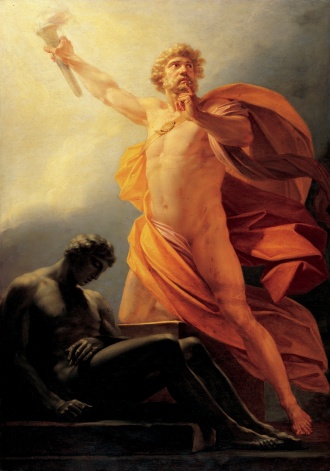
Prometheus brings fire to mankind Heinrich fueger 1817

It should probably seem strange to us that one of the memes we often use when trying to grapple with the question of how to understand the powers brought to us by modern science and technology is one inspired by an ancient Greek god chained to a rock. Well, actually not quite a god but a Titan, that is Prometheus.

Do a search on Amazon for Prometheus and you’ll find that he has more titles devoted to him than even the lightning bolt throwing king of the gods himself, Zeus, who was the source of the poor Titan’s torment. Many, perhaps the majority of these titles containing Prometheus- whether fiction or nonfiction- have to do not so much with the Titan himself as our relationship to science, technology and knowledge.

Here’s just an odd assortment of titles you find: American Prometheus: The Triumph and Tragedy of J. Robert Oppenheimer, Forbidden Knowledge: From Prometheus to Pornography, Prometheus Reimagined: Technology, Environment, and Law in the Twenty-first Century, Prometheus Redux: A New Energy Age With the IGR, Prometheus Bound: Science in a Dynamic ‘Steady State’ . It seems even the Japanese use the Western Prometheus myth as in: Truth of the Fukushima nuclear accident has now been revealed: Trap of Prometheus. These are just some of the more recent non-fiction titles. It would take up too much space to list the works of science-fiction where the name Prometheus graces the cover.   

Film is in the Prometheus game as well with the most recent being Ridley Scott’s movie named for the tragic figure where, again, scientific knowledge and our quest for truth, along with its dangers, are the main themes of the plot.

It should be obvious that the myth of Prometheus is a kind of mental tool we use, and have used for quite some time, to understand our relationship to knowledge in general and science and technology specifically. Why this is the case is an interesting question, but above all we should want to know whether or not the Promethean myth for all the ink and celluloid devoted to is actually a good tool for thinking about human knowing and doing, or whether have we ourselves become chained to it and unable to move like the hero, or villain- depending upon your perspective, whose story still holds us in his spell.

It is perhaps especially strange that we turn to the myth of Prometheus to think through potential and problems brought about by our advanced science and technology because the myth is so damn old. The story of Prometheus is first found in the works of the Greek poetic genius, Hesiod who lived somewhere between 750 and 650 B.C.E. Hesiod portrays the Titan as the foil of Zeus and the friend of humankind. Here’s me describing how Hesiod portrayed Zeus’ treatment of our unfortunate species.

If one thought Yahweh was cruel for cursing humankind to live “by the sweat of his brow” he has nothing on Zeus, who along with his court of Olympian gods:

“…keep hidden from men the means of life. Else you would easily do work enough in a day to supply you for a full year even without working.”

In Hesiod, it is Prometheus who tries to break these limitations set on humankind by Zeus.

Prometheus, the only one of the Titans that had taken Zeus’s side in coup d’état against Cronos had a special place in his heart for human beings having, according to some legends, created them. Not only had Prometheus created humans who the Greeks with their sharp wisdom called  mortals, he was also the one who when all the useful gifts of nature had seemingly been handed out to the other animals before humans had got to the front of the line, decided to give mortals an upright posture, just like the gods, and that most special gift of all- fire.

We shouldn’t be under the impression, however, that Hesiod thought Prometheus was the good guy in this story. Rather, Hesiod sees him as a breaker of boundaries and therefore guilty of a sort of sacrilege. It is Prometheus’ tricking Zeus into accepting a subpar version of sacrifice that gets him chained to his rock more than his penchant for handing out erect posture, knowledge and technology to his beloved humans.

The next major writer to take up the myth of Prometheus was the playwright of Greek tragedy, Aeschylus, or at least we once believed it to have been him, who put meat on the bones of Hesiod’s story. In Aeschylus’ play, Prometheus Bound, and the fragments of the play’s sequels which have survived we find the full story of Prometheus’ confrontation with Zeus, which Hesiod had only brushed upon.

Before I had read the play I had always imagined the Titan chained to his rock like some prisoner in the Tower of London.  In Prometheus Bound the rebel against Zeus is not so much chained as nailed to Mount Kazbek like Jesus to his cross. A spike driven through his torso doesn’t kill him, he’s immortal after all, but pains him as much as it would a man made of flesh and bones. And just like Jesus to the good thief crucified next to him, Prometheus in his dire condition is more animated by compassion that rage.

“For think not that because I suffer therefore I would behold all others suffer too.”

To the chorus who inquires as to the origin of his suffering Prometheus list the many gifts besides his famous fire which he has given humankind. Before him humans had moved “as in a dream”, and did not yet have houses like those of the proverbial three little pigs made of straw or wood or brick. Instead they lived in holes in the ground- like ants. Before Prometheus human beings did not know when the seasons were coming or how to read the sky. From him we received numbers and letters, learned how to domesticate animals and make wheels. It was him who gave us sails for plying the seas, life in cities, the art of making metals. What the ancient myth of Prometheus shows us at the very least is that the ancient Greeks were conscious of the historical nature of technological development- a consciousness that would be revived in the modern era and includes our own.

In Aeschylus’  play Prometheus holds a trump card. He knows not only that Zeus will be overthrown, but who is destined to do the deed. Definant before Zeus’ messenger, Hermes and his winged shoes, Prometheus Bound ends with the Titan hurtled down a chasm.

Like all good, and more not so good, stories Prometheus Bound had sequels. Only fragments remain of the two plays that followed Prometheus Bound, and again like most sequels they are disappointments. In the first sequel Zeus frees the Titans he has imprisoned in anticipation of his reconciliation with Prometheus in the final play. That is, Prometheus eventually reconciles with his tormentor, centuries later many would find themselves unable to stomach this.

Indeed, it would be a little over a millennium after Hesiod had brought Prometheus to life with his poetry that yet another genius poet and playwright- Percy Bysshe Shelley would transform the ancient Greek myth into a symbol of the Enlightenment and a newly emergent relationship with both knowledge and power.

Europeans in the 18th the early 19th century were a people in search of an alternative history something other than their Christian inheritance, though it should be said that by the middle of the 19th century they had turned their prior hatred of the “dark ages” into a new obsession. In the mid to late 1800s they would go all gothic including a new obsession with the macabre. A host of 19th century thinker including Shelly’s brilliant wife would help bring this transition from brightsky neo-classicism and its worship of reason which gave us our Greco-Roman national capital among other things, to a darker and more pessimistic sense of the gothic and a romanticism tied to our emotions and the unconscious including their dangers.

Percy Shelley’s Prometheus as presented in his play Prometheus Unbound was an Enlightenment rebel. As the child resembles the parent so the generation of Enlightenment and revolution could see in themselves their own promethean origins. Not only had they shattered nearly every sacred shibboleth and not just asked but answered hitherto unasked questions of the natural world their motto being in Kant’s famous words “dare to know”, they had thrown out (America) and over (France) the world’s most powerful kings- earthbound versions of Zeus- and gained in the process new found freedoms and dignity.

Shelly says as much in his preface:

“But in truth I was averse from a catastrophe so feeble as that of reconciling the  Champion with the Oppressor of mankind.”

There is no way Shelley is going to present Prometheus coming to terms with with a would be omnipotent divine tyrant like Zeus. Our Titan is going to remain defiant to the end, and Zeus’s days as the king of the gods are numbered. Yet, it won’t be our hero that eventually knocks Zeus off of his throne it will be a god- the Demogorgon- not a Titan who overthrows Zeus and frees Prometheus. There are many theories about who or what Shelley’s Demogorgon is- it is a demon in Milton, a rather un-omnipotent architect  a bumbling version of Plato’s demiurge- in a play by Voltaire, but the theory I like best is that Shelley was playing with the word demos or people. The Demogorgon in this view isn’t a god- it’s us– that is if we are as brave as Prometheus in standing up to tyrants.  Indeed, it is this lesson in standing up for justice that the play ends:

To defy Power which seems omnipotent

To love and bear to hope till

Hope creates

From its own wreck the thing it contemplates

Neither to change nor falter nor repent his like thy glory

Titan is to be

Good great and joyous beautiful and free

     This is alone Life Joy Empire and Victory

Now, Shelley’s Prometheus just like the character in Hesiod and Aeschylus is also a bringer of knowledge and even more so. Yet, what makes Shelley’s Titan different is that he has a very different idea of what this knowledge is actually for.

Shelley was well aware that given the brilliant story of the rebellion in heaven and the Fall of Adam and Eve that had been imagined by Milton Christians and anti-Christians might easily confuse Prometheus with another rebellious character- Lucifer or Satan. If Milton had unwittingly turned Satan into a hero in his Paradise Lost the contrast with Shelley’s Prometheus would reveal important differences. In his preface to Prometheus Unbound he wrote:

The only imaginary being resembling in any degree Prometheus is Satan and Prometheus is in my judgment a more poetical character than Satan because in addition to courage and majesty and firm and patient opposition to omnipotent force he is susceptible of being described as exempt from the taints of ambition envy, revenge and a desire for personal aggrandizement which in the Hero of Paradise Lost interfere with the interest. The character of Satan engenders in the mind a pernicious casuistry which leads us to weigh his faults with his wrongs and to excuse the former because the latter exceed all measure.

That is, Prometheus is good in a way Satan is not because his rebellion which includes the granting of knowledge is a matter of justice not of a quest for power. This was the moral lesson Shelley thought the Prometheus story could teach us about our quest for knowledge. And yet somehow we managed to get this all mixed up.

The Prometheus myth has cross fertilized and merged with Judeo-Christian myths about the risks of knowledge and our lust for god-like power. Prometheus the fire bringer is placed in the same company as Satan and his rebellious angels, Eve and her eating from the “Tree of Knowledge”, the  story of the construction of the Tower of Babel. The Promethean myth is most often used today as either an invitation to the belief that “knowledge is power” or a cautionary tale of our own hubris and the need to accept limits to our quest for knowledge lest we bring down upon ourselves the wrath of God. Seldom is Shelley’s distinction between knowledge used in the service of justice and freedom which is good- his Prometheus- and knowledge used in the service of power- his understanding of Milton’s Satan acknowledged.

The idea that the Prometheus myth wasn’t only or even primarily a story about hidden knowledge- either its empowerment or its dangers- but a tale about justice is not something Shelley invented whole cloth but a latent meaning that could be found in both Hesiod and Aeschylus. In both, Prometheus gives his technological gifts not because he is trying to uplift the human race, but because he is trying to undo what he thinks was a rigged lottery of creation in which human beings in contrast to the other animals were given the short end of the stick. If the idea of hidden knowledge comes into play it is that the veiled workings of nature have been used by power- that is Zeus- to secure dutiful worship- a ripoff and injustice Prometheus is willing to risk eternal torment to amend.

Out of the three varieties of the Promethean myth- that of encouraging the breaking of boundaries in the name of empowerment (a pro-science and transhumanist interpretation), that of cautioning us against the breaking of these boundaries (a Christian, environmentalist and bioconservative interpretation), or knowledge as a primary means and secondary end in our quest for justice (a techno-progressive interpretation?) it is the last that has largely faded from our view. Oddly enough it would be Shelly’s utterly brilliant and intellectually synesthetic young wife who would bear a large part of the responsibility for shifting the Prometheus myth from a complex and therefore more comprehensive trichotomy to a much more simplistic and narrowing dichotomy.

Mary Shelley’s Frankenstein; or, The Modern Prometheus would turn the quest for knowledge itself into a potential breaking of boundaries that might even be considered a sort of evil. Scientists in the public mind would play the role of Milton’s Satan – hero or villain. Unfortunately in drawing this distinction with such artistic genius Mary Shelley helped ensure that the paramount promethean concern with justice would become lost.  I’ll turn to that tale next time…

Science, a religious or utopian project?

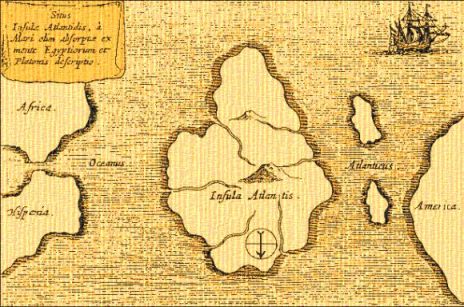
New Atlantis Island

It is interesting at least to wonder what the scientific revolution would have looked like had it occurred somewhere other than in the West. What latent goals and assumptions might the systematic and empirical study of nature have had if it had arisen somewhere in what were at the time more technologically and scientifically advanced civilizations: in the lands of Islam, in Confucian-Daoist-Buddhist China, in the Hindu lands of southern India?

We will never know, for what we think of as modern science emerged only once and in the context of a Christian civilization, although also one shaped by classical mythology, though more on that another time. Modern science’s latent goals and assumptions, for good an ill, are likely, then, to have been refracted through Christian religious ideas, ideas which are in many ways, I believe, again for good and ill, still with us.

Modern science emerged in a period of increasing rather than declining religious enthusiasm and its earliest proponents such as Descartes, Newton and Francis Bacon were religious and Christian men. The spread of religious literacy to the masses that grew out of the Reformation provided a wealth of ideas around which the project of understanding nature empirically,which was the essence of the new science, could be conceptualized.

One passage of the book of Genesis would prove especially important in the way the scientific project would be understood and granted theological justification.

And God said, Let us make man in our image, after our likeness: and let them have dominion over the fish of the sea, and over the fowl of the air, and over the cattle, and over all the earth, and over every creeping thing that creepeth upon the earth. Genesis 1:26

As Carolyn Merchant has written:

The problem of domination becomes the problem of the Scientific Revolution. Does humanity remain the victim of nature, fatalistically accepting the hand that nature deals in the form of failed harvests and deaths from unknown diseases, droughts, and fires? Or can humanity, by understanding those causes through science and manipulating them through technology, gain the upper hand? As William Leiss pointed out in The Domination of Nature, “the consequence of this view is to set the relationship of man and the world inescapably in the context of domination: man must either meekly submit to these natural laws (physical and economic) or attempt to master them.”

And yet, surely it matters what exactly this idea of dominion actually means, and it is our confusion over what this strange status of being a “lord” over nature is actually for and what its limits are that I believe are at the root of many of our contemporary debates about the proper relationship of science and technology to society and the natural world.

One of the key figures in the shift from pre-scientific to scientific thinking and its move to control nature was Francis Bacon. His utopia, The New Atlantis, reads today like a description of a research university. The members of the scientific institution which governs the island- Solomon’s House- focus their energies on observation and experimentation. They set up weather stations, work on understanding the properties of metals, research remedies on improving human health and longevity. They send out missions that are essentially involved in scientific and technological espionage seeking to bring back to their island of Bensalem useful knowledge discovered by other peoples all the while trying to keep their own knowledge and even their very existence hidden.

Bacon’s works, and not just The New Atlantis are surrounded by Christian themes and motifs. The inhabitants of Bensalem are given special revelation of the Christian gospels, their governing institution traces its roots to the Old Testament’s King Solomon. Many scholars such as the political theorist Howard B. White in his Peace Among the Willows have argued that this religious talk was all a clever ruse by Bacon, and that what he was really after was a reconceptualized idea of power that would strengthen the nascent modern state.

Yet White’s is not the only view. Stephen A. McKnight in his The Religious Foundations of Francis Bacon’s Thought makes a compelling case that we should take Bacon’s religious rhetoric seriously. Indeed, if McKnight is correct the idea of dominion found in Bacon leans science much more in the direction of being a humanist and compassionate utopian project than being a road to human power.

As was the case with many of his fellow travelers in the early days of the scientific revolution, McKnight argues that Bacon was deeply influenced by religious ideas and their tumult swirling around him. He too spring boarded off of Genesis 1:26 to come up with new ideas about humanity’s relationship to nature and the development of knowledge over time.

More precisely, Bacon had the idea that in the “prelapsarian” state before Adam and Eve’s Fall human beings understood the work handiwork of God- nature- perfectly and without effort. Just as Protestants had revived millennial expectations that at last human beings were bringing into being the true nature of the Christian message,and therefore the possibility even in a postlapsarian world of living a Christian life,  Bacon believed that his “new science” would restore in some measure the dominion over nature promised to Adam and the knowledge of the natural world that the first parents possessed in their prelapsarian state.

Yet what was such dominion actually for, and why would God, in Bacon’s eyes allow such a restoration of human powers? There is a one word answer to this question- charity.

Here is McKnight:

It is well known that Bacon repeatedly links the knowledge of nature with the ability to bring relief to man’s estate. Most often this linking is associated with knowledge as power. What is often overlooked is Bacon’s emphasis on charity as the motive for using the knowledge of nature for the benefit of humankind. It is wrong, therefore, to link Bacon to a Faustian exercise of egomaniacal power. The understanding of nature enables humanity to enjoy the blessings that God provides.” (43)

If you don’t believe him, here is McKnight quoting Bacon himself speaking of the three types of reasons for which the dominion over nature that came from unveiling its secrets might be exercised:

The first is of those who desire to extend their own power in their own native country; which kind is vulgar and degenerate. The second is of those who labor to extend the power of their country and its dominion among men. This certainly has more dignity if not less covetousness.  But if a man endeavor to establish and extend the power dominion of the human race itself over the universe, his ambition (if ambition it can be called) is without doubt a more wholesome thing and more noble than the other two.  (97)

In other words, science is a project that can be directed by individuals against other individuals, by human groups (and we should include corporations) over and against other groups or is a project that is aimed at the benefit of humankind as a whole,which is how Bacon understood charity as in the improvement of “man’s estate.” We’ve essentially been faced with these three choices ever since.

McKnight is at pains to show that even the restoration of humanity’s prelapsarian control of nature did not mean, for Bacon, that human beings had assumed “God-like” powers. Man was an imitator not a creator. Bacon would have considered our confusion of our own powers with the powers of God a form of idolatry- turning our ideas and capabilities into idols to be worshiped. It was this question of the idolatry latent in the new science that would be the launch point of another great thinker of this period- John Milton.

I have written on Milton’s Paradise Lost before, so I will quote myself.

[Paradise Lost] is the tale of Lucifer and his angelic allies’ rebellion against God, the Son of God, and the angels that remain loyal to their Creator. Lucifer’s rebellion is sparked by his claim that angels are “self-begot”, and therefore owe no worship to God and his Son. The rebels are single-handedly casts out of Heaven by the Son of God, and into the depths of Hell, where they become monstrous, shift-shaping demons. Under the encouragement of the demon, Mammon, (literally “money”), they build Hell’s capital of glittering gold, Pandemonium. This city is supposed to replicate the glorious visages of Heaven, but, though more splendid than any earthly city, remains but Heaven’s pale shadow.

Satan plots his revenge against God, and finds his opportunity in the weak link of God’s new creation- Adam and Eve. After a courageous and epic journey through the depths of Hell, Satan makes his way to the earthly Garden of Eden, where in the form of a serpent, he convinces Eve that the Tree of  Knowledge of Good and Evil God had commanded her and Adam not to eat of on pain of death, is instead the means to upgrade to a god herself.

Ye eat thereof, your eyes that seem so clear,
Yet are but dim, shall perfectly be then
Open’d and clear’d, and ye shall be as gods. (PL 286)

Eve takes the bait, and Adam the ever dutiful husband follows her lead. Rather than leading to godhood, eating from the Tree of Knowledge results in the couple’s expulsion from the Garden and the beginning of the sad fate of human beings until the arrival, promised to Adam by the archangel, Michael, of the Messiah.

If Bacon was trying to recover a prelapsarian knowledge of nature with his new science, Milton might be thought of as trying to unveil this prelapsarian world itself through his enormous powers of intuition, imagination and poetry. Yet, in Milton we also find a kind of moral critique that warns us not to confuse our new found material powers with the ability to self-generate, to actually be gods which is the driving force behind his version of Satan’s rebellion, and the Fall itself.

And this is what people today who talk of us “becoming gods” or “omnipotenders” or any such thing are engaged in- a category error thinkers and poets such as Bacon and Milton warned us against. Or, in secular terms they have taken but one piece of religious mythology, inverted it, and have confused themselves into thinking it is real. God in Christian mythology can be the architect, designer and controller of nature because he is thought to be somehow “outside” or “above” nature like a player of Simcity.

I often wonder whether the type of science we have would have emerged absent this Christian originating confusion that we are somehow “outside” of nature, or if science could have emerged at all without such confusion? There are no real answers to those questions. What we do know is that we are actually inside of nature and therefore incapable of exercising god-like sovereignty over it because affecting one thing means changing another which then affects us and so on and so on ad infinitum. There is no return to a prelapsarian state as either fully empowered human beings or as gods because no such state ever existed- it was a myth which allowed us to launch and exercise a new form of still very limited control over our surroundings. And still, we can not forget that such limited control is real and its results are astounding, but the powers themselves are morally neutral. The question is what should we use them for?

As Bacon pointed out, such control over nature can be used for a host of different ends. On the more disturbing side science and technology have increased our ability to exercise power over other individuals, and groups to lord over rival groups (including our fellow animals) though the most horrific and truly apocalyptic of these powers are those of states aimed against states, at least to date.

Even so it is undeniably the case that, at the same time, absolutely nothing has improved “man’s estate” more than science and technology. Because of the revolution Bacon helped spark we live better and longer and there are more of us than ever before. This science used for the benefit of others should be understood in broadest terms as Bacon’s charity. Freed from its Christian derived prejudice that only the well-being of human beings count because they are considered the only creature made in the “image of God” such charity is easily extendable outward to the animal world or perhaps someday sentient machines.

Though its exact boundaries and priorities are likely to be forever contentious, charity, unlike the similarly Christian derived desire to become “godlike”, is sensible and translates across a wide range of human value systems both secular and religious. Buddhists understand it, as do Muslims. As mentioned the urge to charity can be found at the heart of the secular left. And yet science is not often understood in this Baconian sense of charity ,or perhaps worse the best path to charity is too little seen in science.  Imagine, for instance, a world where a good portion of the Muslim obligation to charity, the zakat, estimated to be fifteen times global humanitarian aid went to science and technology to improve the lot of people in the poorer parts of the Islamic world.

In our diverse modern world Baconian charity is perhaps the only almost universally acceptable utopian project possible and our best road to survive as a species. Bacon’s question of whether or not we use science and technology primarily as our greatest tools for improving “man’s estate” as in charity, or instead use the as a means of power and control that serves our individual ambitions and group rivalries will inevitably decide whether or not newfound form of knowledge that we call science was ultimately a blessing- or a curse.

Time Lost: Scene 1

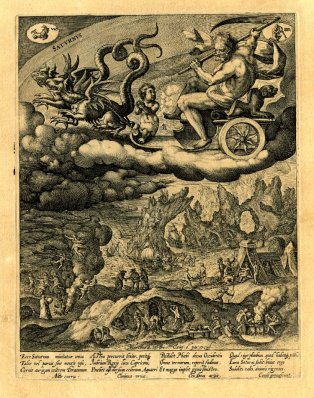
Saturn Khronos

Of late, I’ve been thinking alot about time.  I thought this was just a reflection of age until I stumbled across two recent books that see the question of time and our perception of it to be essential to solving many of the problems that plague us from the level of the individual all the way up to those of our global civilization.

One of these books Lee Smolin’s Time Reborn: From the Crisis in Physics to the Future of the Universe is ostensibly a book about physics, but is just as much a diagnosis of contemporary economic and political ills. The other Present Shock: When Everything Happens Now by media theorists and IEET Fellow Douglas Rushkoff is aimed primarily at social critique but ends up being what amounts to a philosophical guide book to help individuals steer themselves through a quite new (or perhaps quite old and forgotten) conception of time. A way of looking at time that is influencing everything from the media we consume to the way we organize our work and personal lives to the functioning of our economic and political systems.

Let me start with the physics.

In 1955 Michele Besso a man who was Albert Einstein’s closest and friend, whom he had known for many decades, died. Einstein who was himself old and approaching his own death wrote a letter of of condolence to the Besso family that is one of those rare instances of a great scientific mind applying his understanding to the kinds of real life events all of us eventually face as human beings. As translated by Michael Lockwood in his The Labyrinth of Time the letter read as follows:

He is now a little ahead of me in bidding this strange world farewell. That means nothing. For us devout physicists, the distinction between past, present and future likewise has no significance beyond that of an illusion, albeit a tenacious one. (52)

The claim that the distinction between past, present and future is an illusion may seem a strange way to offer condolence, but Einstein was providing a scientifically accurate answer to what is perhaps the most troubling aspects of death ,that, in Lockwood’s words “a living, breathing human being has been supplanted by a void.” (53)

For how much I respect Einstein’s Spinoza-like wisdom his suggestion of looking at time this way in response to death is not the most comforting. Not only can the lost loved one be assumed to still exist within a sliver of time, but so would the experience of being at his funeral, his suffering through disease, or any other painful and tragic moment in his life, although, of course, all of the banal and blissful moments as well. It’s life as Nietzsche’s “eternal return” without the return. Every moment of time captured and stuck there- a cosmic snapshot.

From our everyday perspective we no doubt have trouble with the disappearance of the distinction between past, present and future, but that is what the physics, responsible for so many of the miracles of the modern world, has consistently shown. Newton placed us in a deterministic universe in which the future is theoretically if not practically as predictable as the destination of a ball thrown through the air- a scientific version of Calvin’s predestination.

Einstein and 20th century physics did nothing to diminish this determinism, merely our powers to predict outcomes. Time lost the dignity it had even with Newton and became relativistic a perception based on the position of an observer. In Relativity, time “flows” at different rates based on the speed of a person in motion relative to another. A person speeding along at near light speed would have their local time grind to a near halt relative to those moving at slower speeds outside the spaceship. A short journey at near light speed away from the earth would have passengers returning thousands of years in the “future” of those who stayed behind.

In the hands of physicists the now became a slippery concept. Everything we experience is time delayed whether measured in milliseconds, or, like many of the  stars we look at in the night sky, millions of years in the past. What we call the present is always information in a state of delay. And making the frame bigger does not solve the problem. Moving from the perspective of the individual even to as large a perspective as that of the universe as a whole does nothing to restore the status of the now.

Brian Green gives us colorful imagery of this in his The Fabric of The Cosmos picturing spacetime as a giant loaf of bread. Defining the present means cutting a particular “slice”, but how do we decide how big or small to cut it? Indeed, for physicists following Einstein, the whole loaf from the beginning of time to the end of the universe appears to exist simultaneously.

Like the world given us by FaceBook, that embarrassing night at the prom that’s supposed to have disappeared into the past is still there for somebody, but not only that, so is everything in the future that from our particular slice of the spacetime loaf hasn’t even happened yet. To use another analogy it’s like the whole history of the universe has been DVR’d and what we call the “present” is just the particular segment on which we are stuck. If we weren’t ourselves on the DVR and had the ability to get “outside” and jump around the recording we’d find that scenes we label the “past” are still there as real as they ever were and perhaps more disturbingly scenes that are in our “future” are there as well.

Modern physics has thus been unable preserve the status of the present, the now. We quite rightly hold that the experience of the present is somehow more real than either the past or the future- the first of which we think gone and the second we believe has not occurred yet. But according to physics the present is just another snapshot- it’s just the pictures in the album or slideshow we have easiest access to.

Despite his turning to the disappearance of the distinction between the past, present and future as a way of consoling the Besso family, Einstein was deeply troubled by the potential effects of human beings losing the special status they had given the present. Greene reports how the philosopher Rudolf Carnap recounted of Einstein:

…that the problem of the now worried him seriously. He explained that the experience of the now means something special for man, something essentially different from the past and the future, but that this important difference does not and cannot occur within physics. That this experience cannot be grasped by science seemed to him a matter of painful but inevitable resignation. (141)

This disappearance of the present and its related idea of the future as determined is precisely the view of time that Lee Smolin is out to overthrow in his Time Reborn. A well respected physicist and prolific author, Smolin attempts to make the case that not only are the ideas found in physics regarding time deeply flawed, but that time is the essential element in the order of the universe and key to our understanding of it.

Much about our knowledge of the universe needs to be rethought in order for time to be “reborn”. First off, the Laws of Nature which have long been held to be superior to time need to be dethroned, transformed into something that change through time. For Smolin, the Laws that we experience today may not be the same Laws tens of billions of years into the future or the same Laws that nature followed in the deep past.

Laws are replaced by Smolin’s “principle of precedence,” nature acts in a certain way over large spans of time because it has done so in the past and not because of some metaphysical principle written into the fabric of existence. As a consequence of the fact that nature follows the principle of precedence rather than Laws the future cannot be predetermined – novelty is an expected property of existence. Exchanging Laws for precedence allows Smolin to avoid questionable theories as to why our universe is ordered the way it is and most importantly provides a route through which his theory can be falsified.

Physicists’ combined ideas of the primacy of the Laws of Nature and the diminished status of time have in some ways boxed them into a corner. Why, after all, should the Laws of Nature be these particular Laws? And more surprising, why should they be Laws that seem specifically calibrated for intelligent life such as ourselves to emerge and ask questions about the universe that lead them to the discovery of the Laws?

There have been a number of answers to these questions besides “God did it”- there is the anthropic principle – the idea that the Laws are such as they are because if they weren’t we wouldn’t be here to ask the question. Then there is the idea of the multiverse in which not only every possible set of Laws, but every trajectory through spacetime is played out in an almost infinite number of alternate universes. Last, though Smolin doesn’t really give it any ink, there is the idea that we are living in a simulation that has been created by some intelligent species which might help explain the DVR aspect of time.

Smolin can dismiss all of these because in a universe where the laws change there’s no need to explain why the laws are such as they are now. Perhaps for the vast vast majority of the universe’s history conditions were not ripe for life. With one swoop the need for God, an anthropic principle, and the multiverse is done away with, and in a way that seems to gel more with common sense.

Smolin provides a system in which the laws (now with a lowercase l) can change – namely black holes which he thinks give rise to whole new universes with their own distinct laws. It is perhaps not surprising that we live in a universe ripe for life, if, as Smolin thinks, the kinds of stars prevalent in our universe are potent black hole producers. Life, in this view, would be the luckiest of cosmic coincidences. The more black holes a parent universe has, the more “baby universes” potentially like itself it makes and universes with many black holes are also conducive to life.

Unlike the anthropic principle or the multiverse- let alone the simulation hypothesis or God- Smolin’s theory can actually be empirically verified- giving predictions as to the frequency of black holes. Only time will tell if the science holds up, but Smolin is just as much on a political and philosophical quest as he is trying to overthrow the current scientific paradigm regarding time.

Smolin believes that the diminishment of time in the theories of physics has seeped into the larger society with pernicious effects. The idea that the future is predetermined, he thinks, has resulted in a steep decline of our sense of agency. The future has gone from something we create to being something we must simply endure a system that we are subject to that is largely outside of our control.

Smolin finds this viewpoint particularly dangerous given the challenges we face. We really do have the power to do something about climate change, we actually can exert control over our economic system and technology and do not have to merely suffer as we are pulled along by the trend lines.

Smolin is especially keen on how what he thinks is flawed physics, our fetish regarding the “Laws of Nature”, has thoroughly infected our theories regarding economics. Before the crash, the majority of economists foolishly embraced the “eternal truth” that the market trended towards equilibrium- a bastardized idea drawn from physics. Smolin does not believe in eternal truths and laws regarding anything and insists neither should we.

There is also a way in which Smolin’s tome, like Einstein’s letter to the Besso family or comments to Carnap, are driven by the personal. For a good part of his life Smolin, ensconced in the study of physics in a world that held the belief that time was an illusion. In a sense his fatherhood re-connected him with the human sense of time- the idea that not only did he have a meaningful past, but through his son had a meaningful future as well. The shear contingent miracle of a newborn freed his vision to see the essential openness of the future.

What Smolin most wants to do is recover Einstein’s lost now- the present physics had seemingly done away with. Yet, perhaps, what he has done most is provide a stepping stone back into the stream of time, restored something of the flow and interconnection between the past, present and future. For what our age is doing is less a matter of turning the present into an illusion than suffocating us in the singularity of an ever present now, leaving us beyond an event horizon where there is nothing behind or infront of us, but only on top. It took my reading of Douglas Rushkoff’s Present Shock to make that clear to me, and to it I will turn next time…

Why the Global Brain needs a Therapist

Gaia Greek Mythology

The idea that the world itself could be considered an overarching form of mind can trace its roots deep into the religious longings of pantheism- the idea that the universe itself is God, or the closest thing we will ever find to our conception of God. In large part, I find pantheists to be a noble group. Any club that might count as its members a philosophical giant like Spinoza, a paradigm shattering genius such as Einstein, or a songbird like Whitman I would be honored to belong to myself. But alas, I have my doubts about pantheism- at least in particular its contemporary manifestation in the form of our telecommunications and computer networks being granted the status of an embryonic “global brain”. I wish it were so, but all the evidence seems to point in the other direction.

Key figures in this idea that our communications networks might constitute the neural passageways of a great collective brain predate the Internet by more than a generation. The great prophet of sentience emerging from our ever growing and intertwined communications networks was the Jesuit Priest Pierre Teilhard de Chardin. He stated it this way:

We are faced with a harmonized collectivity of consciousness, the equivalent of a sort of super-consciousness. The idea is that of the earth becoming enclosed in a single thinking envelope, so as to form, functionally, no more than a single vast grain of thought on the cosmic scale …

A more dystopian take on this was brought to us via the genius of Arthur C. Clarke in his 1961 short- “Dial F for Frankenstein” in which the telephone network “wakes up” and predictable chaos ensues. Only one year later the poetic and insightful Marshall Mcluhan gave us a view mixed with utopian and dystopian elements. We were weaving ourselves together into what Mcluhan called a “global village” filled both the intimacy and terror that was the hallmark of pre-literate societies. De Chardin  looked to evolution as the source of comparison to the emergence of his “Noosphere”, Mcluhan looked to the human brain. We had, he thought, “extended our central nervous system in a global embrace, abolishing space and time as far as our planet is concerned.”

 The phrase “global brain” itself would have to await until the 1980s and the New Age philosopher Peter Russell. Russell pushed the analogy between telecommunications networks and and the human brain even deeper managing to fuse together the two major views of the meaning of our telecommunications networks: Chardin’s evolutionary analogy with Mcluhan’s view of telecommunications networks as a nascent global brain. Russell saw the emergence of the human brain itself as an evolutionary leap towards even more interconnectivity- a property of the universe that had been growing at least since the appearance of life and reaching an apogee with the new computer networks tying individuals together.

In a period of rising communications across the nascent Internet, Russell held that the 10 billion neural connections of the human brain represented a phase change in the evolution of consciousness that would be replicated when the projected persons living on earth in the early 21st century would themselves be connected to one another via computer networks giving rise to a true “global brain”. With the age of the Internet just beginning, Russell would soon have company.

During the heady early 1990’s when the Internet was exploding into public consciousness the idea that a global brain was emerging from the ether graced the pages of tech mags such as Wired. There, journalists such as Jennifer Cobb Kreisberg could quote without any hint of suspicion Internet gurus like John Perry Barlow to the effect that:

We stand today at the beginning of Teilhard’s third phase of evolution, the moment at which the world is covered with the incandescent glow of consciousness. Teilhard characterized this as “evolution becoming conscious of itself.” The Net, that great collectivizer of minds, is the primary tool for our emergence into the third phase. “With cyberspace, we are, in effect, hard-wiring the collective consciousness,” says Barlow.

In 2002 Francis Heylighen of the Free University of Brussels could state his hopes for the emerging global brain this way:

The global brain will moreover help eliminate conflicts. It in principle provides a universal channel through which people from all countries, languages and cultures of this world can communicate. This will make it easier to reduce mutual ignorance and misunderstandings, or discuss and resolve differences of opinion. The greater ease with which good ideas can spread over the whole planet will make it easier to reach global consensus about issues that concern everybody. The free flow of information will make it more difficult for authoritarian regimes to plan suppression or war. The growing interdependence will stimulate collaboration, while making war more difficult. The more efficient economy will indirectly reduce the threat of conflict, since there will be less competition for scarce resources.

The Global Brain/Mind is one of those rare ideas in history that prove resilient whatever happens in the real world. 9-11 did not diminish Heylighen’s enthusiasm for the idea, which shouldn’t be surprising because neither did anything that occurred in the decade that followed his 2002 essay; including, the invasion of Iraq, the global economic crisis, failure to tackle world impacting phenomena such as climate change, increasing tensions between states, rapidly climbing economic inequality, or the way in which early 21st century global revolutions have played out to date. The hope that our networks will “wake up” and give rise to something like Chardin’s “Omega Point” continues to be widely popular in technology circles, both in the Kurzweilian Singularity variety and even in guises more aligned with traditional religious thinking such as that expounded by the Christian Kevin Kelly in his recent book What Technology Wants.

Part of the problem with seeing our telecommunications networks and especially the Internet as an embryonic form of global brain is that the idea of what exactly a brain is seems stuck in time and has not kept up with the findings of contemporary neuroscience. Although his actual meaning was far more nuanced, Mcluhan’s image of a “global village” suggests a world shrunk to a comfortably small size where all human being stand in the relation of “neighbors” to one another.

The meaning would have been much different had Mcluhan chosen the image of a refugee camp or the city of Oran from Albert Camus’ novel, The Plague. Like the community in Stephen King’s new TV production Under the Dome, Camus’ imagined Oran is hermetically sealed off from the outside world. A self-contained entity that is more a form of suffocation than community.

Much more than Mcluhan, thinkers such as Russell, Barlow or Heylighen see in the evolution of a single entity an increase of unity. The deepening of our worldwide communication networks will in Heylighen’s words “help eliminate conflicts”, and “make it easier to reach global consensus”. This idea that the creation of one entity embracing all the world’s peoples along with the belief that the development of self-awareness by this network is the threshold event both stem from an antiquated understanding of neuroscience. The version of the human brain proponents of the global brain hope the world’s telecommunications networks evolves into is a long discredited picture from the 1960’s, 70’s and 80’s. If the Internet and our other networks are evolving towards some brain like state it’s pretty important that we have an accurate picture of how the brain actually works.

As far as popular tours through the ganglia of contemporary neuroscience are concerned,none is perhaps better than David Eagleman’s Incognito The Secret Lives of the Brain.  In Incognito, Eagleman shows us how neuroscience has upended one of the deepest of Western assumptions – that of the unity of the self. Here he is in an interview on NPR’s Fresh Air:

EAGLEMAN: Yeah. Intuitively, it feels like there’s a you. So when somebody meets Terry Gross, they feel like: Oh, yeah, that’s one person. But in fact, it turns out what we have under the hood are lots of neural populations, lots of neural networks that are all battling it out to control your behavior.

And it’s exactly a parliament, in the sense that these different political parties might disagree with one another. They’re like a team of rivals in this way, to borrow Kearns Goodwin’s phrase of this. They’re like a team of rivals in that they all feel they know the best way to steer the nation, and yet they have different ways of going about it, just like different political parties do.

You need not be Ulysses who had himself strapped to the stern of his ship so that he could both listen to the song of the Sirens and resist their murderous call to have some intuitive sense of divisions within the self. Anyone who has resisted the urge to hit the snooze button one more time understands this. What is remarkable is how deep modern neuroscience has revealed these internal divisions to be. A person need not suffer Dissociative Disorder with multiple personalities or be a drug addict. The internal rivalry over who we really are is manifest in every decision where we feel pulled in two or more directions at once.

The related idea that Eagleman tries to convey in Incognito is just how small a role self-awareness plays in the workings of the human brain. The vast majority of what the brain does is actually outside of the perception of the consciousness. Indeed, one of the primary roles of self- consciousness is to learn new stuff only to bury it outside of conscious access where further interference from the self-conscious brain will only end up screwing things up. Once you know how to play the piano, ride a bike, or tie your shoelaces actually thinking about it is sure to turn you into a klutz. It’s not even that the self-conscious part of the brain is like George W. Bush “the decider” of our actions. It’s more like the news report of whatever neural faction within us has its hold on the reins of power. Like journalists in general, the self-conscious “I” thinks itself more important than those actually calling the shots.

What is perhaps surprising is that this updated version of the human brain actually does look a lot like the “global mind” we actually have, if not the one we want. The equivalent of the brain’s “neural populations” are the rivalrous countries, corporations,terrorist organizations, criminal groups, NGOs, cooperating citizens and others who populate the medium of the internet. Rival, and not so rival, as in the recent case of the US spying on EU officials, states, use the internet as a weapon of espionage and “cyber war” corporations battle one another for market share, terrorist and criminal entities square off against states and each other. NGOs and some citizen groups try to use the Internet to leverage efforts to make the world a better place.

As for this global brain, such as it is, obtaining self-awareness: if self-awareness plays such a small role in human cognition, why should we expect it to be such a defining feature of any “true” global brain? As Eagleman makes clear, the reason that the human brain exhibits self-awareness is largely a matter of its capacity to learn new things. The job of self-awareness is to make this learning unconscious like the pre- programmed instincts and regulatory functions of the body. Only once they are unconscious is their performance actually efficient. If any global brain follows the pattern of the one between our ears the more efficient it is- the less self-aware it will be.

This understanding of how the brain works has counter-intuitive, and what I think to be largely unexplored implications outside of the question of any global brain. Take the issue of uploading. The idea behind uploading is that our minds are a kind of software where our thoughts and memories can be uploaded offering us a form of immortality. Uploading seems to necessitate its flip-side of downloading as well. In the future if I want to learn how to play the oboe instead of painful practice I will be able to download into my mind all the skills needed to play and in a flash I’ll be hitting out the tunes like Jack Cozen Harel.

Our current understand of the brain seems to throw a wrench into uploading and downloading as far as thoughts are concerned. For one, the plural nature of the brain leaves one wondering which of our neural populations make into into the afterword or whether they should make it through as one entity at all? The gregarious part of myself has never like the introverted bookworm. At death, maybe before, why not make the divorce final and let the two go their separate ways?

Seeing the downloading of thoughts in light of contemporary neuroscience opens up other interesting questions as well. If our self-awareness is most in play when we are going through the tedious steps of learning something new perhaps we should describe it as a slow bandwidth phenomenon? An increase in the efficiency in getting new things into our heads may come at the cost of self-awareness. The more machine like we become the less self-aware we will be.

Those are interesting questions for another time. To return to the global brain: Eagleman made use of Doris Kearns Goodwin’s characterization of Lincoln’s cabinet as “a team of rivals”. With the Civil War fresh in our memories, perhaps we could extend the analogy to say that recent efforts by countries such as China to de-internationalize, or de-Americanize the Internet are something like the beginning of a movement to “secede” from the global brain itself.  As a pre-publication review of Eric Schmidt and Jared Cohen’s The New Digital Age: Reshaping the Future of People, Nations and Business:

Ultimately, Schmidt and Cohen even foresee the possibility of the world’s countries deliberately breaking the Internet into several distinct Internets. According to Gara’s reading of the book, the authors “speculate that the Internet could eventually fracture into pieces, some controlled by an alliance of states that are relatively tolerant and free, and others by groupings that want their citizens to take part in a less rowdy and open online life.

Whether such a fracturing would constitute the sort of deep loss Schmidt and Cohen present it as or something much less dire depends on how one values the global brain as it exists today. As I see it, our networks are nowhere near the sort of sentient and essential globe spanning consciousness the global brain’s most vocal advocates wish it to be.

We do, however, have hints of what such a true global brain might look like in things like IBM’s Smart Cities Initiative which allows cities like New York and Rio to get instant feedback from their citizens along with a network of sensors that allow these cities to respond accordingly and target their services.

Yet, what makes something like Smart Cities work is that this feedback is plugged into services and governance with clear paths of response. A similar network of sensors and feedback systems that instead spanned the earth itself would need somewhere to be plugged into. A brain needs a body, but where? As of yet our tools of global governance are not even up to the information steaming from the limited global brain we have. This would allow us to, among much else, not just monitor but care for our earth. To take on the responsibilities of the terrestrial, if not cosmic, adults we are.

As long as we hold that there is some degree of similarity between the network under our skulls and the network civilization we have been constructing since the first telegraph message in 1844- “What hath God wrought?”, then we need to update our understanding of what a global brain would actually be. This needs to be based both on current neuroscience and where our networks are themselves trending in addition to our commitment to actually heed what such networks might tell us. To do otherwise is to be blinded to the truth by our deep longing for a pantheist deity: hugging close like the earth- mother of a child’s fable.

The Far Futures Project

Zodiac Man 1413

When I was a kid there was a series on Nostradamus narrated by an Orson Welles surrounded in cigar smoke and false gravitas. I had not seen The Man Who Saw Tomorrow for over 30 years, though thanks to the miracle of Youtube I was able to find it here.  Amazingly enough, I still remember Part 9 of the series in which the blue- turbaned, Islamic, 3rd antichrist allied with the Soviet Union plunges the world into thermonuclear war. I also remember the ending- scenes of budding flowers and sunshine signaling the rebirth of nature and humanity, a period of peace and prosperity to last 1,000 years. I think what must have made an impression on my young mind was the time frame of Nostradamus’ supposed predictions- with the Third World War to start sometime between the years 1994-1999, a time frame that was just close enough to scare the bejesus out of an already anxiety prone 9 year old. Thankfully, I was able to escape the latent fear induced by this not so well produced premonition when the USSR went belly up in 1991. Predicting the future is a tough job.

And what does it mean to predict the future anyway? Any idea that the future is somehow foreseeable seems to rely on some concept of determinism, but it’s not quite clear that all aspects of existence experienced by human beings are equally deterministic. Astrology seems to be a good example of how this works. Some of the things we experience do indeed seem to be determined, or better, their course stays essentially the same over vast stretches of time. It makes sense, even though it doesn’t work, to repackage and apply this determinism at the human level giving us a false but confidence building sense of control. The crazy thing, at least in terms of the future of society as opposed to the future of individuals,  is that human beings seem prone to making predictions with bad outcomes, just consult the prophet of your choice. So, one wonders why something that is supposed to relieve anxiety- knowing what will happen- ends up doing the exact opposite and instead fills us with nostrodemian dred?

Maybe its all about the scale of the market. Palm readers who inform too many of their customers that their lives are about to go into the toilet probably go out of business pretty fast. When you’re dealing with mass markets though- fear sells. Better to write a book on the looming terrorist threat than one on just how peaceful modern societies are. You get more eyeballs when your piece has the word armageddon in the title than if it contains the word utopia.

Then there is the question of time horizon. As Stewart Brand suggested to the religious scholar Elaine Pagels the attraction of the ambiguity of a “prophetic” text like the Book of Revelation is that one can insert one’s own mortal timeline into it. Ray Kurzweil isn’t the first to predict the end of normal human affairs perilously close to the limit of his own likely lifespan.

Perhaps almost all predictions regarding the future are merely reflections of our own current anxieties, but this is not to say that our relationship to the future is merely all in our heads. Human beings and our societies exist along a continuum of time and this not only ties us to the what-is-not of the past but the what-is-not of the future as well. What we do today, if it proves relevant, will shape the future as much as the decisions made by those who preceded us shapes us today. To deny this is to deny something as real as the very present in front of us.

Yet, this future horizon is not merely something that applies to human civilization but to the earth and universe as a whole. Unless there is some cosmic mystery currently hidden from us, the earth will exists for something approaching 5 billion years before being consumed by the sun, and our universe, however dispersed because of expansion, will continue to have organized structures such as stars and galaxies- likely prerequisites for life- for far far longer than it has been in existence (13.5 billion years) into the realm of the unimaginable range of 100 trillion years.

There exists, then, a very likely future if not for our mortal selves or even humanity, for the cosmos and most likely life and intelligent life. We have something to predict about however silly such predictions will appear in retrospect. This gives us, I think, a great opportunity for a sort of “game”, an attempt to stretch our imaginations outward not so much in the hope that we can see like Welles’ Nostradamus the future that lies before for us so much as to see how broadly we can paint the canvas of what- might- be.

In this spirit, I invite you to participate in what I am calling The Far Futures Project.Those who wish can come up with their own predictions for the near and far future. Send them to farfuturesproject@gmail.com and I will post them on my blog Utopia or Dystopia. My only requirements are that you follow the template in terms of years found in my predictions below:  500, 10,000, 1 million, 1 billion, though I understand they will appear arbitrary to many. My second requirement is that you follow normal editorial standards with the awareness that these posts are geared towards general audience. Also, please provide some identifying information that will allow readers to connect with your ideas- especially links to your own work. My hope is to run the project for about a month, so here’s your chance.

You can see the first response to the call of  the project in this entry by my friend and fellow blogger James Cross here. 

As for me, here I go…

Rick Searle’s Far Future

500 years

The often painful transition that can be traced to changes in human society initiated by the industrial revolution in the 1800s has finally begun to reach equilibrium. Historians in the 2500s tend to see developments since the start of the industrial revolution as a set piece where humanity had to adjust itself to a new technological order, a new relationship with nature, new forms of inter-relations between and among peoples, and above all a need for humanity to decide both what it was and what it should be.

The technological question that the industrial revolution posed which took nearly 7 centuries to resolve was what would be the relationship between human beings and the rapidly evolving kingdom of machines?

Well before the 26th century there emerged a kind of modus-vivendi between human beings and machines, especially machines of the intelligent type. The employment crisis of the early to mid-21st century revolved around the widespread application of machine intelligence to all fields of economic, cultural, and political life, although no one yet could claim such machines possessed features of human intelligence such as consciousness.  True Artificial General Intelligence or AGI remained a ways off, and never really replicated human intelligence, but would prove to be something quite different.

The consequence of the exponentially increasing processing power of computers was the ability to automate almost any formerly human process from the most intellectually challenging – classical composition or scientific discovery to the most simple production procedure. The capacity of machines to do almost any conceivable type of work road atop the ability to tap into human networks and feedback systems resulting in a kind of symbiosis between human intelligence and machines that whatever its human component left far too many people without gainful employment and would prove unsustainable not only economically but emotionally.

Numerous solutions to this dilemma were tried until a genuine modus vivendi was achieved. One attempted solution was to hive off human life from machines by providing people with a guaranteed income and allowing them to opt out of economic, intellectual and cultural pursuits- a solution that at the end of the day proved unsatisfying for far too many to be sustainable.

Another attempted solution was to tie human intelligence even closer to the new forms of machine intelligence by fusing the human mind with that of machines. This solution proved not so much unsustainable as unreachable in the form it had been articulated. Part of the problem stemmed from the fact that those parts of the human brain that were responsible for emotions, which human beings shared with other mammals, moved at such a glacial pace that they proved incompatible with the lightening fast cognition of machines. To propel emotional cognition faster seemed to inevitably result in various unwanted conditions from emotional deadening, to hyper-anxiety, to an accelerated sense of subjective time that canceled out the very longevity human beings had succeeded in creating.

The long lived humans of the 22th century embraced a slower and more reflective notion of time than their 21st century forebears and sought to limit machine intelligence from impinging on activities which embedded human life across the arch of time from the creation of art to the raising of children, the latter which came back into vogue after the prolonged “baby bust”.

Under what became the new post-capitalist order that took hold almost everywhere humans and machines were each given their unique domains based upon the question of scale and speed. Intelligent machines were extremely effective at running large scale entities- cities, armies, markets, coordinating reactions to pandemics and disasters for which the human mind was ill designed. There were also areas where the wetware of the brain proved far too slow- including moving human beings across space in the various incarnations of the 20th century automobile and airplane, fighting under conditions of modern, war or performing emergency surgery.

Machines were also able to fill dangerous (and degrading) economic niches human beings were ill suited to perform. This issue of scale and niche would prove the key to the future evolution of machines, an embedded tendency that someone in the far future when machines became the dominant “lifeform” in the universe would likely be unable to trace to its mundane economic and psychological origins.

A second question that had been raised by the industrial revolution was what the relationship between the natural world and humanity should be, a question that was intimately related to the issue of human population? Since the industrial revolution various societies had gone through a series of stages in terms of their relationship to the natural world a period of brute force rapaciousness unconcerned with environmental impacts followed by growing awareness and idealization of the natural world followed in the end by an increase in biological knowledge that allowed human beings to reverse, minimize, and isolate their impact on the biosphere.

Especially starting in the 22nd century, vast projects were launched that aimed to restore the natural world not merely to its conditions before the industrial revolution, but to those before human beings emerged from Africa over 10,000 years before. The rain forests of the world were restored.  The auroch was genetically recreated and re-established in much of Eurasia along with more common species such as wolves and boar. The ancient chestnut forests and species that relied on them such as the passenger pigeon have been restored in North America, and the estuaries are alive with fish in a way they have not been since at least the 19th century. All the major African species, especially the great apes, have been restored to pre-modern numbers and prehistoric hominids resurrected and established in their ancient homeland of the African savannah. Long extinct species likely killed off by the hunting prowess of early humans- the Woolly Mammoth, Saber Tooth Tiger, Ground Sloth, and Giant Beaver brought back into existence and reestablished in the tundra of Siberia, Canada, and an iceless Greenland.

A solid majority of human beings- nearly 70%- now live in high density cities a move that has not merely aided in decreasing human population because of city-dweller’s smaller family sizes, but shifted the human impact on the environment from diffuse to compact allowing nature to reclaim enormous tracts of non-urbanized space. Especially important in this decreased spatial impact is the movement of farming into the cities. Vast aeroponic vertical farms in urban centers now produce the majority of the world’s food. Much of the Great Plains in North America has reverted to grassland and wildflowers. The return of the Buffalo has even resulted in a small number of Native American Blackfoot to return to their long lost traditional lifestyle- though they have kept the post-columbus horse.

For the first time in history there is effective global management of the earth’s biosphere. The global environment is constantly monitored not only from satellites but from a whole host of animal embedded sensors and cameras that provide real-time 24/7 monitoring of the earth’s environment. Invasive species and destructive diseases are caught, isolated and removed at lightening fast speeds.

Sophisticated AI directed modeling allows for extremely detailed predictions as to environmental impact permitting the tailoring of industrial and agricultural projects to promote healthy ecosystems, and directs the movement and actions within the human geography to best meet the needs of wildlife and the larger ecosystem.

This earth-scale environmental management is just one sign of the vastly increased capacity for global governance that was developed from the late 21st century forward. It origins lie in crises of both an environmental and geopolitical nature which that century was thankfully able to overcome.

Various times from the 19th through the 21st century the world was torn between different imperial orders. The 19th century imperial order of the Europeans was replaced by the 20-21st century American (and for a shorter spell, Soviet) imperial regime. From the early 21st century not just East Asia but the world had to adjust to the appearance of China in the global arena.

The world was on the verge of thermonuclear war not one but 3 times: The Cuban Missile Crisis (1963)  the Russo-Japanese-Sino War fought over Chinese incursions into booming Siberia and the northern Pacific (2054) the Sino–Indian War, between China and India over China’s attempt to divert water from the Himalayas (2085). There was also a deep conflict between an alliance of “hot” countries and “cold” countries, that is between countries where the effects of climate change were sharp and devastating and those that had largely benefited from the change.

The Russo-Sino-Japanese war and the Sino-Indian war were both products not merely of the international order adjusting to the power of China but were responses to the reality of climate change. This eventually led to an alliance between China and many of the other hot countries that launched a policy to geo-engineer the world’s climate starting in 2095. In spite of worldwide protests and threats of war by the US and Russia, the hot countries began spewing tons of sunlight blocking sulfates into the atmosphere for a time turning the sky of the earth a gaudy orange. This did however have the intended effect, cooling the earth by almost 2 degrees and bringing rain and temperature distributions back to early 21st century norms. Disaster was averted but only at an incredible costs to humanity’s sense of itself and its relationship to the earth. The act did, however, start humanity on the right course.

Not even the massive migration flows of refugees fleeing from climate change got the world attention as much as the earth’s blue skies turning orange. The world came perilously close to war when an alliance of arctic countries- Russia, the US and Canada began shooting the tethered sulphur spewing Verne like Chinese dirigibles out of the sky. The Reykjavik Treaty which ended this conflict sparked a new era not only in the way human beings related to the earth’s environment but in the international relations between states. This new era of international cooperation was supported by a convergence in the systems of government found in most of the world’s countries and all of its major powers. The old argument between democracy and autocracy was no more.

Since the American (1776) and French (1789) revolutions people had been arguing over whether democracy was the best form of government. What occurred by the late 21st century was a convergence in both democratic and authoritarian regimes towards a form of government sometimes called responsive democracy that was neither representative nor direct but continuously scanned the public for feedback and direction as to government policy in the same way companies used social media to establish consumer preferences. Critics of responsive democracy claimed that it was easily manipulated by vested interests who were able shape citizen preferences, and that it robbed the public of its democratic responsibility to deliberate and decide. Yet, the model seemed unstoppable and by giving people a real voice in the face of the dominant oligarchies did seem to quell social pressures in countries as vastly different as the US and China.

In the centuries between 1800 – 2500 the major religious, philosophical, and cultural disputes would center around the question of what humanity was and what it should become. The dispute could be traced to Charles Darwin’s publication of The Origins of Species in 1857. What did it mean for the present and future of humanity to say that it had evolved from “lesser” species?

The 19th and early 20th centuries had seen the application of the darker aspects of the idea of human evolution with both racially justified imperialism and the Nazis. From the 21st through the 23rd century conflicts raged between the traditionally religious, environmentalists, and various shades of transhumanism, disputes that included not merely ideological struggles but  inquisitions on all sides. Eventually, however, a widespread consensus began to take hold, a set of philosophical assumptions that lie underneath post-21st century understandings of the relationship between human beings and machines, the environment, and both domestic and international politics.

Humanity in a general sense was to be preserved on earth. Whatever their profound changes in health and longevity human beings  in this era were essentially the same as human beings 10,000 years before. Earthbound machines were preserved as servants, while those of above human intelligence sequestered in a slim number of domains. Genetic transformation of human beings outside the realm of increasing health, strength, longevity or biological intelligence was discouraged, and biological cures promoted over bio-mechanical ones.

Those who wanted bold experiments such as creating a race of chimeras with mixed human and mechanical features, to merging into collective intelligences, could still have them, they just had to be pursued, given their perceived dangers to the survival of humanity, outside of the earth. Mars became the key destination in this regard, a kind of laboratory for all things post-human, but there would also be great floating cities in the solar system and even the first colonies sent out to closest living planets beyond the solar system…

10,000 years

Human civilization has reached the 10% milestone. 20,000 years living settled life in cities. During this period human beings have been the dominant form of intelligence and, on earth at least, have succeeded in suppressing the new evolutionary kingdom  of the machines. This age is now coming to a close and traditional humans, still safe and thriving largely on earth, have receded far  into the background of the evolutionary story now playing out in the Milky Way.

Despite their diminished status in the grand scheme of things, life for earthbound human beings has never been better. The average human being can be expected to live over 1,000 years. With so much investment in what in formerly human terms was the long term prosperity of society human beings have never been so inclined not to wage war against one another or let their society go to rot. The commitments of individuals to society, to an art, to persons, are long indeed, although few human relationships can be sustained over such time periods and as a consequence there are well developed rituals for “letting go” of marriage partners of friends and for a surprisingly large number even life itself. By far the greatest human works of art are created in this period as are the deepest works of philosophy. This is the true age of the “long form” single songs that run for months, novels comprised of hundreds of individual books, memoirs of love and loss felt over centuries.

Outside of the earth, humans and many more post-humans have terra-formed Mars and perhaps a billion now call that planet home. Over the millennia an innumerable number of sister earths have been discovered within a thousand light years of the solar system, though no other technological civilization has been discovered so far. Post-humans settlers have long reached the nearest living planets.

The descendants and creations of humanity that have continued to evolve and differentiate into a bewildering variety of forms across the width of a 5,000 light year span surrounding the earth. A large number of these creatures  are the descendants of the silicon based forms humanity had invented far back in the 20th century- although silicon is no longer the dominant substrate and instead can be found a huge multiplicity of underlying elements.

1 million years

Humanity is now nearing the 2 million year mark, the average lifespan for a species.It has long since retired from the heart of things and watches with a mixture of awe and fear the goings on of the “gods” in the heavens.

Machines in space have begun an enormous surge of evolution akin to the Cambrian Explosion in the earth’s ancient history.  From the big-picture view it can be seen that the kingdom of machines has been a way for life to overcome its limitations and expand into a much greater range of cosmic real estate. Carbon based life had evolved and could only thrive in a very narrow niche of the universe- stellar bodies that were not so large that the effects of gravity overwhelmed those of chemical reactions and not so small  where the chemical reactions on which life was built did not occur with regularity.

Anywhere there is usable energy machines can be found, and in a diversity that matches that found in carbon based life- from the geothermal vents of a body like IO, where organisms are metallic-slugs able to withstand intense heat and pressure to the clouds of the gaseous giants where colonies of microscopic smart dust live off the planetary winds.

To study these forms in 21st century terms would require someone who combined the skills of an archaeologist an engineer and a biologist. Each machine form having a genealogy that tied it to some idiosyncrasy of human need and design in the distant past as well as evolving to meet the specific requirements of its own unique environment. Inside some of these machines can also be found still living biological cores- the machine itself being merely a means of survival and replication. One can only speculate as to the internal life of such beings whether the environment in which they currently live is the fabric of their consciousness or whether they live in a dream world of their past animal existence unaware as to their own current strangely transformed state.

If machine evolution allowed life to expand into vastness of space where gravitational dominance and chemical equilibrium formerly prevented it from taking root, there was also an expansion of life into brand new scales. The largest living organism ever found on earth, The Great Coral Reef, was a little over 1,200 miles (2000 km).  In terms of social animals a Roman Empire like ant colony grew to be nearly 4,000 (6000 km) on the European Mediterranean and Atlantic coasts.  Human civilization grew from the African Savannah  to the earth, to the solar system, and near galactic living planets.  Still nothing would match the superorganisms that would emerge from machines which would eventually grow to reach not merely a planetary, stellar, or solar system, but galactic and multi-galactic scales.

There were also scales below that of molecular that life, especially complex life, was unable to tap. Only the simplest of living organisms could exist on such small scales. Machine life, however, was able to move a million scales down to the range of atoms themselves becoming not merely the “living atomic scale matter” of some larger forms which thus even more strongly resembled organic life, but became a whole habitable zone unto itself, the home of the mechanical versions of bacteria the truly dominant form of both the organic and the mechanical world.

All this is very dangerous for organic life ,which not only continues to exist but thrives in the “cracks”- areas that are free from the terrestrially unbound silicon descendants. An enormous explosion of life, including intelligent life, is taking root in these cracks.  Some of these are descendants of earth based life, but most have arisen completely independently. Whole civilizations rise and fall unaware of the story that plays out above them in the realm of the stars. And still, this remains merely the beginning of the beginning…

1 billion years

Humanity has long ceased to exist though the ultimate cause of their demise is unknown. The most likely scenario being that its defenses were worn down by the forays of some superorganism though there are rumors that the machine defenses humanity had built were themselves the culprit. Life, in one form or another, however, continues to move on. In fact, we have entered the golden age of life in both carbon based and silicon forms. The increasing amount of complex elements, especially of carbon from stars means that life is taking root on more and more planets, the story of evolution playing out across a diverse landscape of enormous scope. In this “lower world”, the world under the stars, stems a vast cacophony of forms- the splendor of life filling all the spaces of its possibility.  Among these are a plethora of intelligent species and civilizations a great number which live out histories of creation and destruction with far too many destroying themselves upon reaching nuclear maturity.

Still, a good number, perhaps a slim majority, survive. From these civilizations come not merely art, music, stories, ideas, but also biographies- beings who have not merely lived but  represent as it were a path of life, a story, embedded in the very fabric of reality. Silicon descendants, not just from the earth, but many places besides are likewise entering a new and golden phase.

Organic life is somewhat protected from the intrusions, exploitation or destruction at the hands of silicon based forms by the vastness of space and from the sheer diversity of environments where silicon forms are able to find usable energy. There is also, however, a new tendency for silicon protect the carbon based life from which it ultimately emerged.

It is unknown how this happened but it is thought that some especially prudent civilization programmed its machines with the purpose of protecting its organic progenitor. Somehow this purposing went rogue and there are quite a number of silicon forms that offer spheres of protection to not just the organic life forms from which they emerged but for all organic life they come across.

There appears to have been an unforeseen evolutionary advantage to this strategy.  With the evolutionary experiments that emerges out of carbon based life being seen like the ancient invention of sex- a way to gain new “genes” and through diversity increase resilience. Some very patient and hands- off silicon based forms use carbon-based worlds as running simulations from which they can glean ways to increase their own internal complexity. Though, a good number have taken to actually “cultivating” intelligence on worlds- driving evolution in the direction of creating an intelligent species with technological potential from which they can glean even more diversity.

For those still living on planets the night sky has become even more brilliant than in the age of lifeless stars. A show of lights in unspeakably brilliant patterns the glow of enormous silicon descendants “talking” to one another across the vast stretches of space. Now is the age in which the “music of the spheres” has become real for not only is there light the cities in the skies sing to one another as well in music we can not even dream.
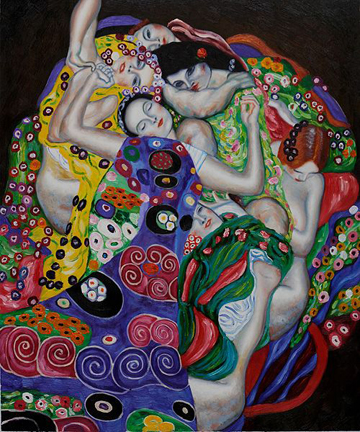
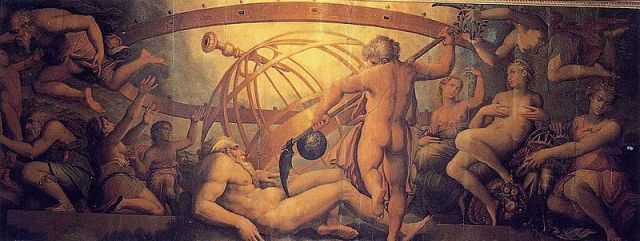
Return to the Island of Dr. Moreau

The Island of Dr Moreau

Sometimes a science-fiction novel achieves the impossible, and actually succeeds in reaching out and grasping the future, anticipating its concerns, grappling with its possibilities, wrestling with its ethical dilemmas. H.G. Wells’ short 1886 novel, The Island of Dr. Moreau, is like that. The work achieved the feat of actually being relevant to our own time at the very least because the scientific capabilities Well’s imagined in the novel have really only begun to be possible today, and will be only more so going forward. The ethical territory he identified with his strange little book ones we are likely to be increasingly called upon to chart our own course through.

The novel starts with a shipwreck. Edward Prendick, an Englishman who we later learn studied under the Darwinian, Thomas Huxley, is saved at sea by a man named Montgomery. This Montgomery along with his beast like servant, M’ling, is a passenger aboard a ship shepherding a cargo of exotic animals including a puma to an isolated island. Prendick is a man whose only type of luck seems to be bad, and he manages to anger the captain of the ship and is left to his fate on the island with Montgomery a man in the service of a mad scientific genius- Dr Moreau.

Prendick soon discovers that his new island home is a house of horrors. Moreau is a “vivisectionist” meaning he conducts experiments on live animals and does so without any compunction as to the pain these animals experience. The natural sounds of the island are drowned out by cries of suffering Prendrick hears from the puma being surgically transformed into a “man” at the hands of Moreau. This is the goal of Moreau who has been chased out of civilization for pursuing his mission, to use the skills of vivisection and hypnosis to turn his poor animals into something like human beings giving them not only a humanoid forms but human abilities such as speech.

The list of the “beast folk” transformed in such a way include not only M’ling and the puma but other creatures trapped in the space between human beings and their original animal selves or are a blend of purely animal forms. There is the Leopard-Man, and the Ape-Man, the satanic looking Satyr-Man a humanoid formed from a goat. There is smallish Sloth-Man who resembles a flayed child. Two characters, the Sayer of the Law and the Fox-Bear-Witch, revere and parrot the “Law” of their creator Moreau which amount to commandments to act like human beings or not act like animals: “Not to go on all Fours”, “Not to suck up Drink”, “Not to claw Bark of Trees” “Not to chase other Men” (81)

There is also the chimera of the Hyena-Swine the only animal that seems able to deliberately flaunt the commandments of Moreau and which becomes the enemy of Prendick after the death of the mad scientist at the hands of his last creation- the puma man. Montgomery, giving into his own animal instincts dies shortly after his master’s demise in the midst of a mad alcoholic revelry with the Beast Men.

Prendrick escapes the island before the Hyena-Swine and his allies are able to kill him by setting sail on a life raft which comes near shore on which the dead bodies of the captain who had abandoned him on the island and his shipmate are found. Eventually the scarred castaway makes his way back to England where his experience has seemed to shatter his connection with his fellow human beings who now appear to Prendick as little more than Beast Men in disguise.

Why did Wells write this strange story? In part, the story grew out of an emerging consciousness of cruelty to animals and calls for animal rights. As mentioned, Moreau is an expert in the practice of  “vivisection”  an old term that means simply animal experimentation whether the animals are anesthetized or not. He thinks the whole question of the pain experienced by his animals to be a useless hindrance to the pursuit of knowledge which he needed to overcome to free him for his scientific quest. “The colorless light of these intellectual desires” from the fetters of empathy.  The animals he experiments upon become no longer “a fellow creature, but a problem”. Free to pursue his science on his island he is “never troubled by matters of ethics”, and notes that the study of nature can only lead to one becoming “as remorseless as Nature” itself. (104)

It is often thought that the idea of animal rights emerged first in the 1970s with the publication of the philosopher, Peter Singer’s Animal Liberation. Yet the roots of the movement can be traced back nearly a century earlier and emerged in response to the practice of  vivisection. Within two years of Wells’ story the British Union for the Abolition of Vivisection would be founded- a society which has advocated the end of animal experimentation ever since. In the years immediately following the publication of The Island of Dr. Moreau protests would begin erupting around experiments on live animals, especially dogs.

It is almost as if the moment the idea of common kinship between humans and animals entered the public mind with the publication of Darwin’s Origins of Species in 1859 the idea of treating animals “humanely” gathered moral force.  Yet, however humane and humanistic a figure Darwin himself was, and in terms of both there is no doubt, his ideas also left room for darker interpretations. The ethical questions opened up by Darwin was whether the fact that humankind shared common kinship with other animals meant that animals should be treated more like human beings, or whether such common kinship offered justification for treating fellow human beings as we always had treated animals? The Origins of Species opened up all sorts of these anxieties surrounding the narrowness of the gap between human beings and animals. It became hard to see which way humanity was going.

The Island of Dr. Moreau gives us a first hand experience of this vertigo. Prendick initially thinks Moreau is transforming human beings into animals, and only finds out later that he is engaged in a form of uplift. Moreau wants to find out how difficult it would be to turn an animal into something like a human being- if the gap can be bridged on the upside. However, the Beast Men that Moreau creates inevitably end up slipping back to their animal natures- the downside pressures are very strong and this suggests to Prendick that humankind itself is on a razors edge between civilization and the eruption of animal instincts.

This idea of the de-generative potential evolution was one of the most deadly memes to have ever emerged from Western civilization. It should come as no surprise that Adolf Hitler was born three years after the publication of The Island of Dr. Moreau and ideas about the de-generation of the “race” would become the putrid intellectual mother’s milk on which Hitler was raised. The anxiety that humanity might evolve “backward”, which came with a whole host of racially charged assumptions, would be found in the eugenics movements and anti-immigrant sentiments in both Great Britain and the United States in the early 20th century following the publication of Well’s novel. It was the Nazis, of course, who took this idea of de-generative evolution to its logical extreme using this fear as justification for mass genocide.

It’s not that no one in the early 20th century held the idea that course of evolution might be progressive at least once one stepped aside from evolution controlled by nature and introduced human agency. Leon Trotsky famously made predictions about the Russian Revolution that sound downright transhumanist such as:

Man will make it his purpose to master his own feelings, to raise his instincts to the heights of consciousness, to make them transparent, to extend the wires of his will into hidden recesses, and thereby to raise himself to a new plane, to create a higher social biologic type, or, if you please, a superman.

Yet, around the same time Trotsky was predicting the arrival of the New Soviet Man, the well respected Soviet scientist, Il’ya Ivanov tried to move the arrow backward. Ivanov almost succeeded in an attempt to see if African women, who were not to be informed of the nature of the experiment, could be inseminated with the sperm of chimps. The idea that Stalin had hatched this plan to create a race of ape-men super soldiers is a myth  often played up by modern religious opponents of Darwin’s ideas regarding human evolution. But, what it does show that Well’s Dr. Moreau was no mere anti-scientific fantasy but a legitimate fear regarding the consequences of Darwin’s discovery- that the boundary between human beings and animals was the thinnest of ice and that we were standing on it.

Yet the real importance of the questions raised by The Island of Dr. Moreau would have to wait over a century, until our own day to truly come to the fore. This is because the type of sovereignty over animals in terms of their composition and behavior really wasn’t possible until we actually not only understood the directions that guided the development and composition of life, something we didn’t understand until the discovery of the hereditary role of DNA in 1952, but how to actually manipulate this genetic code, something we have only begun to master in our own day.

Another element of the true import of the questions Well’s posed would have to wait unit recently when we developed the capacity to manipulate the neural processes of animals.  As mentioned, in the novel Moreau uses hypnotism to get his animals to do what he wants. We surely find this idea silly, conjuring up images of barnyard beasts staring mindlessly at swinging pendulums. Yet meaning of the term hypnotism in The Island of Dr. Moreau would be better expressed with our modern term “programming”. This was what the 19th century mistakenly thought it had stumbled across when it invented the pseudo-science of hypnotism- a way to circumvent the conscious mind and tap into a hidden unconscious in such a way as to provide instructions for how the hypnotized should act. This too is something we have only been able to achieve now that microelectronics have shrunk to a small enough size that they and their programs can be implanted into animals without killing them.

Emily Anthes balanced and excellent book Frankenstein’s Cat gives us an idea of what both this genetic manipulation and programming of animals through bio-electronics looks like. According to Anthes, the ability to turn genes on and off has given us an enormous ability to play with the developmental trajectory of animals such as that poor scientific workhorse- the lab mouse. We can make mice that suffer human like male pattern baldness, can only make left turns, or grow tusks. In the less funny department we can make mice riddled with skin tumors or that suffer any number of other human diseases merely by “knocking out” one of their genes. (FC 3-4).

As Anthes lays out, our increasing control over the genetic code of all life gives us power over animals (not to mention the other kingdoms of living things) that is trivial, profound, and sometimes disturbing. We can insert genes from one species into another that could never under natural circumstances mix- so that fish with coral genes inserted can be made to glow under certain wavelengths of light, and we can do the same with the button noses of cats or even ourselves if we wanted to be a hit at raves. We can manipulate the genes of dairy animals so that they produce life saving pharmaceuticals in their milk or harvest spider’s silk from udders. We have inserted human growth hormone into pigs to make them leaner- an experiment that resulted in devastating diseases for the pigs concerned and a large dose of yuck factor.

Anthes also shows us how we are attempting to combine the features of our silicon based servants with those of animals, by creating creatures such as remote controlled rats through the insertion of microelectronics. The new field of optogenetics gives us amazing control over the actions of animals using light to turn neurons on and off. Something that one of the founders of the science, Karl Deisseroth. thinks is raising a whole host of ethical and philosophical questions we need to deal with now as it becomes possible to use optogenetics with humans.  These cyborg experiments have even gone D.I.Y. The company Backyard Brains sells a kit called Robo Roach that allows amature neuro-scientists to turn a humble roach into their own personal insect cyborg.

The primary motivation for Well’s Dr. Moreau was the discovery of knowledge whatever its cost. It’s hard to see his attempt to turn animals into something with human characteristics as of any real benefit to the animals themselves given the pain they had to suffer to get there. Moreau is certainly not interested in any benefit his research might bring to human beings either. Our own Dr. Moreaus- and certainly many of the poor creatures who are subject to our experiments would see the matter that way- are indeed driven by not just human welfare, but as Anthes is at pains to point out animal welfare as well. If we played our genetic knowledge cards right the kinds of powers we are gaining might allow us to save our beloved pets from painful and debilitating diseases, lessen the pain of animals we use for consumption or sport, revive extinct species or shield at least some species from the Sixth Great Extinction which human beings have unleashed. On the latter issue, there is always a danger that we will see these gene manipulating powers as an easy alternative to the really hard choices we have to make regarding the biosphere, but at the very least our mastery of genetics and related areas such as cloning should allow us to mitigate at least some of the damage we are doing.

Anthes wants to steer us away from moral absolutes regarding biological technologies. Remote controlled rats would probably not be a good idea either for the rats or other people were they sold as “toys” for my 12 year old nephew. The humane use of such cyborgs creations to find earthquake victims, even if disturbing on its face, is another matter entirely.

At one point in The Island of Dr. Moreau Well’s mad scientist explains himself to Pendrick with the chilling words:

I wanted- it was the only thing I wanted- to find out the extreme limit of plasticity in a living shape. (104)


Again, the achievement of such plasticity as Dr. Moreau longed for had to wait until the mastery of genetics and in addition to Anthes’ Frankenstein’s Cat this newfound technological power is explored in yet another excellent recent book this time by the geneticist George Church. In Regenesis Church walks us through the revolution in molecular biology and especially the emerging field of synthetic biology. The potential implied in our ability to re-engineer life at the genetic level or to create almost from scratch and design life on the genetic plane are quite simply astounding.

According to Church, we could redesign the true overlords of nature- bacteria- to do an incredible number of things including creating our fuel, growing our homes, and dealing with major challenges such as climate change. We could use synthetic bacteria to create our drugs and chemicals and put them to work as true nanotech assemblers.We could design “immortal” human organs and restore the natural environment to its state before the impact of our dominant and destructive species including resurrecting species that have gone extinct using reverse engineering.

Some of Church’s ideas might be scientifically sound, but nonetheless appear fanciful, including his idea for creating a species of “mirror” humans whose cellular handedness is reversed. Human beings with reversed cellular handedness would be essentially immune forever from the scourge of viruses because these diseases rely on shared handedness to highjack human cells. Aside from the logistics, part of the problem is that a human being possessing the old handedness would be unable to have children with a person possessing the new version. Imagine that version of Romeo and Juliet!

Church’s projections and proposals are all pretty astounding and none to me at least raise overly red flags in an ethical sense except for one in which he goes all Dr. Moreau on us.  Church proposes that we resurrect Neanderthals:

If society becomes comfortable with human cloning and sees value in human diversity, then the whole Neanderthal creature itself could be cloned by a surrogate mother chimp- or by an extremely adventurous female human. (10)

The immediate problem I see here is not so much that the Neanderthal is brought back into existence as that Church proposes the mother of this “creature” (why does he use this word and not the more morally accurate term- person?) should be a chimp.  Nothing against chimpanzees, but Neanderthals are better thought of as an extinct variant of ourselves rather than as a different species, the clearest evidence of which is that homo sapiens and Neanderthals could produce viable and fertile offspring, and we still carry the genes from such interbreeding. Neanderthals are close enough to us- they buried their dead surrounded by flowers after all- that they should be considered kin, and were such a project ever to take place they should be carried by a human being and raised as one of us with all of our rights and possibilities.

Attempting to bring back other hominids such as Homo Habilis or Australopithecus would raise similar Moreau type questions and might be more in line with Church’s suggestion regarding the resurrection of Neanderthals. Earlier hominids are distinct enough from modern humans that their full integration into human society would be unlikely. The question then becomes what type of world are we bringing these beings into because it is certainly not our own?

One of the ethical realities that The Island of Dr. Moreau is excellent at revealing is the idea of how the attempts to change animals into something more like ourselves might create creatures that are themselves shipwrecked, forever cut off from both the life of their own species and also the human world where we have attempted to bring them. Like modern humans, earlier hominids seem to have been extremely gregarious and dependent upon rich social worlds. Unless we could bring a whole society of them into existence at a clip we might be in danger of creating extremely lonely and isolated individuals who would be unable to find a natural and happy place in the world.

Reverse engineering the early hominids by manipulating the genomes of all the higher primates, including our own, might be the shortest path to the uplift of animals such as the chimpanzee a project suggested by George Dvorsky of the IEET in his interview with Anthes in Frankenstein’s Cat. The hope, it seems, is to give to other animals the possibilities implicit in humanity and provide us with a companion at something closer to our level of sentience.  Yet the danger here, to my lights, is that we might create creatures that are essentially homeless- caught between human understanding of what they could or “should” be and the desire to actualize their own non-human nature which is the result of millions of years of evolution.

This threat of homelessness applies even in cases where the species in question has the clear potential to integrate into human society. What would it feel like to be the first Neanderthal in 10,000 years? Would one feel a sense of pride in one’s Neanderthal heritage or like a circus freak constantly subject since childhood to the prying eyes of a curious public? Would there be a sense of interminable pressure to act “Neanderthal like” or constant questions by ignorant Lamarckians as to the nature of a lost Neanderthal society one knows nothing about?  Would there be pressure to mate with only other Neanderthals?  Harping on about the need for a “royal wedding” of “caveman” and “cavewoman”? What if one was only attracted to the kinds of humans seen in Playboy? Would it be scandalous for a human being to date a Neanderthal, or could the latter even find a legitimate human mate and not just weird people with a caveman fetish? In other words, how do we avoid this very practical and ethical problem of homelessness?

On the surface these questions may appear trivial given the existential importance of what creating such species would symbolize, but they are after all, the types of questions that would need to be addressed if we are thinking about giving these beings the possibility for a rich and happy life as themselves and not just answering to our own philosophic and scientific desires. We can only proceed morally if we begin to grapple with some of these issues and here we’ll need the talents of not just scientists and philosophers, but novelists as well. We need to imagine what it will feel like to live in the kinds of worlds and as the beings we are creating.  A job that as Bruce Sperling has pointed out is the very purpose of science-fiction novelists in the first-place. We will need more of our own versions of The Island of Dr. Moreau.


References:
H.G. Wells, The Island of Dr.  Moreau, Lancer Books, 1968 First published 1886.
Emily Anthes, Frankenstein’s Cat: Cuddling up to biotech’s brave new beasts, Scientific American Books, 2013
George Church and Ed Regis, Regenesis: How Synthetic Biology will Reinvent Nature and Ourselves, Basic Books, 2012  

How Science and Technology Slammed into a Wall and What We Should Do About It

Captin Future 1944

It might be said that some contemporary futurists tend to use technological innovation and scientific discovery in the same way God was said to use the whirlwind against defiant Job, or Donald Rumsfeld treated the poor citizens of Iraq a decade ago. It’s all about the “shock and awe”. One glance at something like KurzweilAI.Net leaves a reader with the impression that brand new discoveries are flying off the shelf by the nanosecond and that of all our deepest sci-fi dreams are about to come true. No similar effort is made, at least that I know of, to show all the scientific and technological paths that have led  into cul-de-sac, or chart all the projects packed up and put away like our childhood chemistry sets to gather dust in the attic of the human might-have- been.  In exact converse to the world of political news, in technological news it’s the jetpacks that do fly we read about not the ones that never get off the ground.

Aside from the technologies themselves future oriented discussion of the potential of technologies or scientific discovery tends to come in two stripes when it comes to political and ethical concerns: we’re either on the verge of paradise or about to make Frankenstein seem like an amiable dinner guest.

There are a number of problems with this approach to science and technology, I can name more, but here are three: 1) it distorts the reality of innovation and discovery 2) it isn’t necessarily true, 3) the political and ethical questions, which are the most essential ones, are too often presented in a simplistic all- good or all-bad manner when any adult knows that most of life is like ice-cream. It tastes great and will make you fat.

Let’s start with distortion: A futurists’ forum like the aforementioned, KurzweilAI.Net,  by presenting every hint of innovation or discovery side-by-side does not allow the reader to discriminate between both the quality and the importance of such discoveries. Most tentative technological breakouts and discoveries are just that- tentative- and ultimately go nowhere. The first question a reader should ask is whether or not some technique process or prediction has been replicated.  The second question is whether or not the technology or discovery being presented is actually all that important. Anyone who’s ever seen an infomercial knows people invent things everyday that are just minor tweaks on what we already have. Ask anyone trapped like Houdini in a university lab-  the majority of scientific discovery is not about revolutionary paradigm shifts ala Thomas Kuhn but merely filling in the details. Most scientists aren’t Einsteins in waiting. They just edit his paperwork.

Then we have the issue of reality: anyone familiar with the literature or websites of contemporary futurists is left with the impression that we live in the most innovative and scientifically productive era in history. Yet, things may not be as rosy as they might appear when we only read the headlines. At least since 2009, there has been a steady chorus of well respected technologists, scientists and academics telling us that innovation is not happening fast enough, that is that our rates of technological advancement are not merely not exceeding those found in the past, they are not even matching them. A common retort to this claim might be to club whoever said it over the head with Moore’s Law; surely,with computer speeds increasing exponentially it must be pulling everything else along. But, to pull a quote from ol’ Gershwin “ it ain’t necessarily so”.

As Paul Allen, co-founder of Microsoft and the financial muscle behind the Allen Institute for Brain Science pointed out in his 2011 article, The singularity isn’t near, the problems of building ever smaller and faster computer chips is actually relatively simple, but many of the other problems we face, such as understanding how the human brain works and applying the lessons of that model- to the human brain or in the creation of AI- suffer what Allen calls the “complexity break”. The problems have become so complex that they are slowing down the pace of innovation itself. Perhaps it’s not so much of a break as we’ve slammed into a wall.

A good real world example of the complexity break in action is what is happening with innovation in the drug industry where new discoveries have stalled. In the words of Mark Herper at Forbes:

But the drug industry has been very much a counter-example to Kurzweil’s proposed law of accelerating returns. The technologies used in the production of drugs, like DNA sequencing and various types of chemistry approaches, do tend to advance at a Moore’s Law-like clip. However, as Bernstein analyst Jack Scannell pointed out in Nature Review’s Drug Discovery, drug discovery itself has followed the opposite track, with costs increasing exponentially. This is like Moore’s law backwards, or, as Scannell put it, Eroom’s Law.”

It is only when we acknowledge that there is a barrier in front of our hopes for innovation and discovery that we can seek to find its source and try to remove it. If you don’t see a wall you run the risk of running into it and certainly won’t be able to do the smart things: swerve, scale, leap or prepare to bust through.

At least part of the problem stems from the fact that though we are collecting a simply enormous amount of scientific data we are having trouble bringing this data together to either solve problems or aid in our actual understanding of what it is we are studying. Trying to solve this aspect of the innovation problem is a goal of the brilliant young technologist,Jeffrey Hammerbach, founder of Cloudera. Hammerbach has embarked on a project with Mt. Sinai Hospital to apply tools for organizing and analyzing the overwhelming amounts of data gather by companies like Google and FaceBook to medical information in the hopes of spurring new understanding and treatments of diseases. The problem Hammerbach is trying to solve as he acknowledged on a recent interview with Charlie Rose is precisely the one identified by Herper in the quote above, that innovation in treating diseases like mental illness is simply not moving fast enough.

Hammerbach, is our Spiderman. Having helped create the analytical tools that underlie FaceBook he began to wonder if it was worth it quipping: “The best minds of my generation are thinking about how to make people click ads”.  The real problem wasn’t the lack of commercial technology it was the barriers to important scientific discoveries that would actually save people’s lives. Hammerbach’s conscientious objection to what technological innovation was being applied for vs what it wasn’t is, I think, a perfect segway (excuse the pun) to my third point the political and ethical dimension, or lack thereof, in much of futurists writing today.

In my view, futurists too seldom acknowledges the political and ethical dimension in which technology will be embedded. Technologies hoped for in futurists communities such as brain-computer interfaces, radical life extension, cognitive enhancements or AI are treated in the spirit of consumer goods. If they exist we will find a way to pay for them. There is, perhaps, the assumption that such technologies will follow the decreasing cost curves found in consumer electronics: cell phones were once toys for the rich and now the poorest people on earth have them.

Yet, it isn’t clear to me that the technologies hoped for will actually follow decreasing curves and may instead resemble health care costs rather than the plethora of cheap goods we’ve scored thanks to Moore’s Law. It’s also not clear to me that should such technologies be invented to be initially be affordable only by the rich that this gap will at all be acceptable by the mass of the middle class and the poor unless it is closed very, very fast. After all, some futurists are suggesting that not just life but some corporal form of immortality will be at stake. There isn’t much reason to riot if your wealthy neighbor toots around in his jetpack while you’re stuck driving a Pinto. But the equation would surely change if what was at stake was a rich guy living to be a thousand while you’re left broke, jetpackless, driving a Pinto and kicking the bucket at 75.

The political question of equity will thus be important as will much deeper ethical questions as to what we should do and how we should do it. The slower pace of innovation and discovery, if it holds, might ironically, for a time at least, be a good thing for society (though not for individuals who were banking on an earlier date for the arrival of technicolored miracles) for it will give us time to sort these political and ethical questions through.

There are 3 solutions I can think of that would improve the way science and technology is consumed and presented by futurists, help us get through the current barriers to invention and discovery and build our capacity to deal with whatever is on the other side. The first problem, that of distortion, might be dealt with by better sorting of scientific news stories so that the reader has some idea both where the finding being presented lies along the path of scientific discovery or technological innovation and how important a discovery is in the overall framework of a field. This would prevent things occurring such as a preliminary findings regarding the creation of an artificial hippocampus in a rat brain being placed next to the discovery of the Higgs Boson, at least without some color coating or other signification that these discoveries are both widely separated along the path of discovery and of grossly different import.

As to the barriers to innovation and discovery itself: more attempts such as those of Hammerbach’s need to be tried. Walls need to be better identified and perhaps whole projects bringing together government and venture capital resources and money used to scale over or even bust through these blocked paths. As Hammerbach’s case seems to illustrate, a lot of technology is fluff, it’s about click-rates, cool gadgets, and keeping up with the joneses. Yet, technology is also vitally important as the road to some of our highest aspirations. Without technological innovation we can not alleviate human suffering, extend the time we have here, or spread the ability to reach self-defined ends to every member of the human family.

Some technological breakthroughs would actually deserve the appellation. Quantum computing, if viable, and if it lives up to the hype, would be like Joshua’s trumpets against the walls of Jericho in terms of the barriers to innovation we face. This is because, theoretically at least, it would answer the biggest problem of the era, the same one identified by Hammerbach, that we are generating an enormous amount of real data but are having a great deal of trouble organizing this information into actionable units we actually understand. In effect, we are creating an exponentially increasing data base that requires exponentially increasing effort to put the pieces of this puzzle together- running to standstill. Quantum computing, again theoretically at least, would solve this problem by making such databases searchable without the need to organize them beforehand. 

Things in terms of innovation are not, of course, all gloom and doom. One fast moving  field that has recently come to public attention is that of molecular and synthetic biology perhaps the only area where knowledge and capacity is not merely equalling but exceeding Moore’s Law.

To conclude, the very fact that innovation might be slower than we hope- though we should make every effort to get it moving- should not be taken as an unmitigated disaster but as an opportunity to figure out what exactly it is we want to do when many of the hoped for wonders of science and technology actually arrive. At the end of his recent TED-Talk on reviving extinct species, a possibility that itself grows out of the biological revolution of which synthetic biology is a part, Stewart Brand, gives us an idea of what this might look like. When asked if it was ethical for scientist to “play God” in doing such a thing he responded that he and his fellow pioneers were trying to answer the question of if we could revive extinct species not if we should. The ability to successfully revive extinct species, if it worked, would take some time to master, and would be a multi-generational project the end of which Brand, given his age, would not see. This would give us plenty of time to decide if de-extinction was a good idea, a decision he certainly hoped we would make. The only way we can justly do this is to set up democratic forums to discuss and debate the question.

The ex-hippie Brand has been around a long time, and great evidence to me that old age plus experience can still result in what we once called wisdom. He has been present long enough to see many of our technological dreams of space colonies and flying cars and artificial intelligence fail to come true despite our childlike enthusiasm. He seems blissfully unswept up in all the contemporary hoopla, and still less his own importance in the grand scheme of things, and has devoted his remaining years to generation long projects such as the Clock of the Long now, or the revival of extinct species that will hopefully survive into the far future after he is gone.

Brand has also been around long enough to see all the Frankenstein’s that have not broken loose, the GMOs and China Syndromes and all those oh so frightening “test tube babies”.  His attitude towards science and technology seems to be that it is neither savior nor Shiva it’s just the cool stuff we can do when we try. Above all, he knows what the role of scientists and technologists are, and what is the role of the rest of us. Both of the former show us what tricks we can play, but it is up to all of us as to how or if we should play them.