Turing and the Chinese Room 2

I propose to consider the question, “Can machines think?”

Thus began Alan Turing’s 1950 essay Computing Machinery and Intelligence without doubt the most import single piece written on the subject of what became known as “artificial intelligence”.

Straight away Turing insists that we won’t be able to answer this question by merely reflecting upon it. If we went about it this way we’d get all caught up in arguments over what exactly “thinking” means. Instead he proposes a test.

Turing imagines an imitation game composed of 3 players: (A) a man, (B) a woman, and (C) an interrogator with the role of the latter being to ask questions of the 2 players and determine which one is a man. Turing then transforms this game by exchanging the man with a machine, and replacing the woman with the man. The interrogator is then asked to figure out which is the real man:

We now ask the question, “What will happen when a machine takes the part of A in this game?” Will the interrogator decide wrongly as often when the game is played like this as he does when the game is played between a man and a woman? These questions replace our original, “Can machines think?”

The machine in question Turing now narrowly defines as a digital computer, which consists of 3 parts (i) Store, that is the memory, (ii) Executive Unit, that is the part of the machine that performs the operations, (iii) The Control, the part of the machine that makes sure the Executive Unit performs operations based upon instructions that make up part of the Store. Digital computers are also “discrete state” machines, that is they are characterized by clear on-off states.

This is all a little technical so maybe a non-computer example will help. We can perhaps best understand digital technology by comparing it to its old rival analog. Think about a selection of music stored on your iPod versus, say, your collection of vintage ‘70s
8 tracks.  Your iPod has music stored in a discrete state- represented by 1s and 0s. It has an Executive Unit that allows you to translate these 1s and 0s into sound, and a Control that keeps the whole thing running smoothly and allows you, for example, to jump between tracks. Your 8 tracks, on the other hand, store music as “impressions” on a magnetic tape, not as discrete state representations, the “head”, in contact with the tape  reverses this process and transforms the impressions back into sound, you move between the tracks by causing the head to actually physically move.

Perhaps Turing’s choice of digital over analog computers can be said to amount to a bet about how the future of computer technology would play out. By compressing information into 1s and 0s – as representation- you could achieve seemingly limitless Storage/Control capacity. Imagine if all the songs on your iPod needed to be stored on 8 tracks! If you wanted to build an intelligent machine using analog you might as well just duplicate the very biological/analog intelligence you were trying to mimic. Digital technology represented, for Turing, a viable alternative path to intelligence other than the biological one we had always known.

Back to his article. He rephrases the initial question:

Let us fix our attention on one particular digital computer C. Is it true that by modifying this computer to have an adequate storage, suitably increasing its speed of action, and providing it with an appropriate programme, C can be made to play satisfactorily the part of A in the imitation game, the part of B being taken by a man?

If we were able to answer this question in the affirmative, Turing insisted, then such a machine could be said to possess human level intelligence.

Turing then runs through and dismisses what he considers the most likely objections to the idea of whether or not a machine that could think could be built:

The Theological Objection– computers wouldn’t have a soul. Turing’ reply: Wouldn’t God grant a soul to any other being that possessed human level intelligence? What was the difference between bringing such an intelligent vessel for a soul into the world by procreation and by construction?

Heads in the Sand Objection– The idea that computers could be as smart as human is too horrible to be true.  Turing’s reply: Ideas aren’t true or false based on our wishing them so.

The Mathematical Objection- Machines can’t understand logically consistent sentences such as “this sentence is false”.  Turing’s reply: Okay, but, at the end of the day humans probably can’t either.

The Argument from Consciousness- Turing quotes a professor Lister: “”Not until a machine can write a sonnet or compose a concerto because of thoughts and emotions felt, and not by the chance fall of symbols, could we agree that machine equals brain-that is, not only write it but know that it had written it.” Turing’s reply:  If this is to be the case, why don’t we apply the same prejudice to people. How do I really know that another human being thinks except through his actions and words?

The Argument from Disability- Whatever a machine does it will never be able to do X.  Turing’s reply: These arguments are essentially making unprovable claims based on induction- that I’ve never seen a machine do X therefore no machine will ever do X.
Many of them are also alternative arguments from consciousness:

The claim that a machine cannot be the subject of its own thought can of course only be answered if it can be shown that the machine has some thought with some subject matter. Nevertheless, “the subject matter of a machine’s operations” does seem to mean something, at least to the people who deal with it. If, for instance, the machine was trying to find a solution of the equation x2 – 40x – 11 = 0 one would be tempted to describe this equation as part of the machine’s subject matter at that moment. In this sort of sense a machine undoubtedly can be its own subject matter.

Lady Lovelace’s Objection- Lady Lovelace, friend of Charles Babbage whose plans for his Analytical Engine in the early 1800s were probably the first fully conceived modern computer, and Lovelace perhaps the author of the first computer program had this to say:

The Analytical Engine has no pretensions to originate anything. It can do whatever we know how to order it to perform”

 Turing’s response: this is yet another argument from consciousness. The computers he works with surprise him all the time with results he did not expect.

Argument from the Continuity of the Nervous System: The nervous system is fundamentally different from a discrete state machine therefore the output of the two will always be fundamentally different. Turing’s response: The human brain is analogous to a  “differential analyzer” (our old analog computer discussed above), and solutions of the two types of computers are indistinguishable. Hence a digital computer is able to do at least some things the analog computer of the human brain does.

Argument from the Informality of Behavior: Human beings, unlike machines, are free to break rules and are thus unpredictable in a way machines are not. Turing’s response: We cannot really make the claim that we are not determined just because we are able to violate human conventions. The output of computers can be as unpredictable as human behavior and this emerges despite the fact that they are clearly designed to follow laws i.e. are programmed.

Argument from ESP: Given a situation in which the man playing against the machine possesses some yet understood telepathic power he could always influence the interrogator against the machine and in his favor. Turing’s response: This would mean the game was rigged until we found out how to build a computer that could somehow balance out clairvoyance. For now, put the interrogator in a “telepathy proof room”.

So that, in a nutshell, is the argument behind the Turing test. By far, the most well known challenge to this test was made by the philosopher, John Searle, (relation to the author has been lost in the mist of time). Searle has so influenced the debate around the Turing test that it might be said that much of the philosophy of mind that has dealt with the question of artificial intelligence has been a series of arguments about why Searle is wrong.

Like Turing, Searle in his 1980 essay, Minds Brains and Programs, will introduce us to a thought experiment:

Suppose that I’m locked in a room and given a large batch of Chinese writing. Suppose furthermore (as is indeed the case) that I know no Chinese, either written or spoken, and that I’m not even confident that I could recognize Chinese writing as Chinese writing distinct from, say, Japanese writing or meaningless squiggles. To me, Chinese writing is just so many meaningless squiggles.

Now suppose further that after this first batch of Chinese writing I am given a second batch of Chinese script together with a set of rules for correlating the second batch with the first batch. The rules are in English, and I understand these rules as well as any other native speaker of English. They enable me to correlate one set of formal symbols with another set of formal symbols, and all that ‘formal’ means here is that I can identify the symbols entirely by their shapes. Now suppose also that I am given a third batch of Chinese symbols together with some instructions, again in English, that enable me to correlate elements of this third batch with the first two batches, and these rules instruct me how to give back certain Chinese symbols with certain sorts of shapes in response to certain sorts of shapes given me in the third batch.

With some additions, this is the essence of Searle’s thought experiment, and what he wants us to ask: does the person in this room moving around a bunch of symbols according to a set of predefined rules actually understand Chinese? And our common sense answer is- “of course not!”

Searle’s argument is actually even more clever than it seems because it could having been taken right from one of Turing’s own computer projects. Turing had written a computer program that could have allowed a computer to play chess. I say could have allowed because there wasn’t actually a computer at the time sophisticated enough to run his program. What Turing did then was to use the program as a set of rules he used to play a human being in chess. He found that by following the rules he was unable to beat his friend in chess. He was, however, able to beat his friend’s wife! (No sexism intended).

Now had Turing given these rules to someone who knew nothing about chess at all they would have been able to play a reasonable game. That is, they would have played a reasonable game without having any knowledge or understanding of what it was they were actually doing.

Searle’s goal is to bring into doubt what he calls “strong AI” the idea that the formal manipulation of symbols- syntax- can give rise to the true understanding of meaning- semantics. He identifies part of our problem in our tendency to anthropomorphize our machines:

The reason we make these attributions is quite interesting, and it has to do with the fact that in artifacts we extend our own intentionality; our tools are extensions of our purposes, and so we find it natural to make metaphorical attributions of intentionality to them; but I take it no philosophical ice is cut by such examples. The sense in which an automatic door “understands instructions” from its photoelectric cell is not at all the sense in which I understand English.

Even with this cleverness, Searle’s argument has been shown to have all sorts of inconsistencies. Among the best refutations I’ve read is one of the early ones- Margaret A. Boden’s 1987 essay Escaping the Chinese Room.  In gross simplification Boden’s argument is this: Look, normal human consciousness is made up of a patchwork of “stupid” subsystems that don’t understand or possess what Searle claims is the foundation stone of true thinking- intentionality- “subjective states that relate me to the rest of the world”- in anything like his sense at all. In fact, most of what the mind does is made up of these “stupid” processes. Boden wants to remind us that we really have no idea how these seemingly dumb processes somehow add up to what we experience as human level intelligence.

Still, what Searle has done has made us aware of the huge difference between formal symbol manipulation and what we would call thinking.  He made us aware of the algorithms (a process or set of rules to be followed in calculations or other problem-solving operations) that would become a simultaneous curse and backdrop of our own day. A day when our world has become mediated by algorithms in its economics, its warfare, in our choice of movies and books and music, in our memory and cognition (Google)  in love (dating sites) and now it seems in its art (see the excellent presentation by Kevin Slavin How Algorithms Shape Our World). Algorithms that Searle ultimately understood to be lifeless.

In the words of the philosopher Andrew Gibson on Iamus’ Hello World!:

I don’t really care that this piece of art is by a machine, but the process behind it is what is problematic. Algorithmization is arguably part of this ultra-modern abstractionism, abstracting even the artist.

The question I think that should be asked here is how exactly Iamus, the algorithm that composed, Hello World! worked? The composition Hello World! was created using a very particular form of algorithm known as a genetic algorithm, or, in other words Iamus is a genetic algorithm. In very over-simplified terms a genetic algorithm works like evolution. There is (a) a “population” of randomly created individuals (in Iamus’ case it would be sounds from a collection of instruments). Those individuals are the selected against (b) an environment for the condition of best fit (I do not know in Iamus’ case if this best fit was the judgement of classically trained humans, some selection of previous human created compositions, or something else), the individual that survive (are chosen to best meet the environment) are then combined to form new individuals (compositions in Iamus’ case) (c) an element of random features is introduced to individuals along the way to see if they help individuals better meet the fit. The survivor that best meets the fit is your end result.

Searle would obviously claim that Iamus was just another species of symbol manipulation and therefore did not really represent something new under the sun, and in a broad sense I fully agree. Nevertheless, I am not so sure this is the end of the story because to follow Searle’s understanding of artificial intelligence seems to close as many doors as it opens in essence locking Turing’s machine, forever, into his Chinese room. Searle writes:

I will argue that in the literal sense the programmed computer understands what the car and the adding machine understand, namely, exactly nothing. The computer understanding is not just (like my understanding of German) partial or incomplete; it is zero.

For me, the line he draws between intelligent behavior or properties emerging from machines and those emerging from biological life is far too sharp and based on rather philosophically slippery concepts such as understanding, intentionality, causal dependence.

Whatever else intentionality is, it is a biological phenomenon, and it is as likely to be as causally dependent on the specific biochemistry of its origins as lactation, photosynthesis, or any other biological phenomena.

Taking Turing’s test and Searle’s Chinese Room together leaves us, I think, lost in a sort of intellectual trap. On the one side we having Turing arguing that human thinking and digital computation are essentially equivalent. All experience points to the fact that this is false. On the other side we have Searle arguing that digital computation and the types of thinking done by biological creatures are essentially nothing alike. An assertion that is not obviously true. The problem here is that we lose what are really the two most fundamental questions and that is how are computation and thought alike, and how are they different?

Instead what we have is something like Iamus “introduced” to the world, along with its creation as if it were a type of person, by the Turing faction when in fact it has almost none of these qualities that we consider to be constitutive of personhood.  A type of showmanship that put me in mind of the wanderings of the Mechanical Turk.  The 18th century mechanical illusion that for a time fooled  the courts of Europe into thinking a machine could defeat human beings at chess. (There was, of course, a short person inside.)

To this, the Searle faction responds with horror and utter disbelief aiming to disprove that such a “soulless” thing as a computer could ever, in the words of Turing’s Lister: “write a sonnet or compose a concerto”, that was not a product of nothing other than” the chance fall of symbols”.  The problem with this is that our modern day Mechanical Turks are no longer mere illusions- there is no longer a person hiding inside- and our machines really do defeat grand masters in chess, and win trivia games, and write news articles, and now compose classical music. Who knows where this will stop, if it indeed if it will stop, and how many what have long been considered the most  human defining activities qualities will be successfully replicated, and even surpassed, by such machines.

We need to break through this dichotomy and start asking ourselves some very serious questions. For only by doing so are we likely to arrive at an understanding both of where we are as a technology dependent species and where what we are doing is taking us. Only then will we have the means to make intentional choices about where we want to go.

I will leave off here with something shared with me by Andrew Gibson. It is a piece by his friend Amanda Feery composed in memory of Turing’s centenary entitled “Turing’s Epitath”.

And I will leave you with questions:

How is this similar to Iamus’ Hello World!?  And how is it different?
Turing and the Chinese Room 1

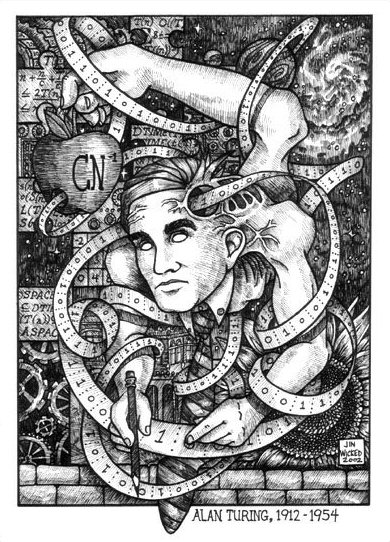
Two-Thousand-and-twelve marks the centenary of Alan Turing’s birth. Turing, of course, was a British mathematical genius who was preeminent among the “code -breakers”, those who during the Second World War helped to break the Nazi Enigma codes and were thus instrumental in helping the Allies win the war. Turing was one of the pioneers of modern computers. He was the first to imagine the idea of what became known as a Universal Turing Machine, (the title of the drawing above) the idea that any computer was in effect equal to any other and could, therefore, given sufficient time, solve any problem whose solution was computable.

In the last years of his life Turing worked on applying mathematical concepts to biology. Presaging the work of, Benoît Mandelbro, he was particularly struck by how the repetition of simple patterns could give rise to complex forms. Turing was in effect using  computation as a metaphor to understand nature, something that can be seen today in the work of people such as Steven Wolfram in his New Kind of Science, and in fields such as chaos and complexity theory. It also lies at the root of the synthetic biology being pioneered, as we speak, by Craig Venter.

Turning is best remembered, however, for a thought experiment he proposed in a 1950 paper Computing Machinery and Intelligence, that became known as the “Turing test”, a test that has remained the pole star for the field of artificial intelligence up until our own day, along with the tragic circumstances the surrounded the last years of his life.

In my next post, I will provide a more in-depth explanation of the Turing test. For now, it is sufficient to know that the test proposes to identify whether a computer possesses human level intelligence by seeing if a computer can fool a person into thinking the computer is human. If the computer can do so, then it can be said, under Turing’s definition, to possess human level intelligence.

Turing was a man who was comfortable with his own uniqueness,  and that uniqueness included the fact that he was homosexual at a time when homosexuality was considered both a disease and a crime. In 1952, Turning, one of the greatest minds ever produced by Britain, a hero of World War Two, and a member of the Order of the British Empire was convicted in a much publicized trial for having engaged in homosexual relationship. It was the same law under which Oscar Wilde had been prosecuted almost sixty years before.

Throughout his trial, Turing maintained that he had done nothing wrong in having such a relationship, but upon conviction faced a series of nothing- but- bad options, the least bad of which he decided was hormone “therapy” as a means of controlling his “deviant” urges, a therapy he chose to voluntarily undergo given the alternatives which included imprisonment.

The idea of hormone therapy represented a very functionalist view of the mind. Hormones had been discovered to regulate human sexual behavior, so the idea was that if you could successfully manipulate hormone levels you could produce the desired behavior. Perhaps part of the reason Turing chose this treatment is that it had something of the input-output qualities of the computers that he had made the core of his life-work. In any case, the therapy ended after the period of a year- the time period he was sentenced to undergo the treatment. Being shot through with estrogen did not have the effect of mentally and emotionally castrating Turing, but it did have nasty side effects such as making him grow breasts and “feminizing” his behavior.

Turing’s death, all evidence appears to indicate, came at his own hand,  ingesting an apple laced with poison in seeming imitation of the movie Snow White. Why did Turing commit suicide, if in fact he did so? It was not, it seems, an effect of his hormone therapy, which had ended quite some time before. He did not appear especially despondent to his family or friends in the period immediately before his death.

One plausible explanation is that, given the rising tensions of the Cold War, and the obvious value Turing had as an espionage target, Turing realized that on account of his very public outing, he had lost his private life. Who could be trusted now except his very oldest and deepest friends? What intimacy could he have when everyone he met might be a Soviet spy meant to seduce what they considered a vulnerable target, or an agent of the British or American states sent there to entrap him?  From here on out his private life was likely to be closely scrutinized: by the press, by the academy, by Western and Soviet security agencies. He had to wonder if he would face new trials, new tortuous “treatments”, to make him “normal” perhaps even imprisonment.

What a loss of honor for a man who had done so much to help the British win the war the reason, perhaps, that Turing’s death occurred on  or very near the ten year anniversary of the D-Day landing he had helped to make possible. What outlets could there be for a man of his genius when all of the “big science” was taking place under the umbrella of the machinery of war, where so much of science was regarded as state secrets and guarded like locked treasures and any deviation from the norm was considered a vulnerability that needed to be expunged? Perhaps his brilliant mind had shielded him from the reality of what had happened and his new situation after his trial, but only for so long, and that once he realized what his life had become the facts became too much to bear.

We will likely never truly know.

The centenary of Turing’s birth has been rightly celebrated with a bewildering array of tributes, and remembrances. Perhaps, the most interesting of these tributes, so far, has been the unveiling of a symphony composed entirely by a computer, and performed by the London Symphony Orchestra on July, 2, 2012..  This was a piece (really a series of several pieces) “composed” by a computer algorithm- Iamus, and entitled:  “Hello World!”

Please take a listen to this piece by clicking on the link below, and share with me your thoughts. Your ideas will help guide my own thoughts on this perplexing event, but my suspicion right now is that “Hello World!” represents something quite different than what either its sympathizers or distractors suggest, and gives us a window into the meaning and significance of the artificial intelligences we are bringing into what was once our world alone.

Hello World!”   

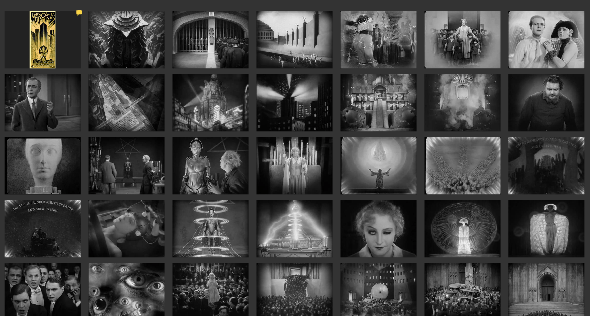
The Janus Face of Metropolis

Last week my post consisted of a Voice Thread presentation on the 1927 science-fiction silent-film by Fritz Lang, Metropolis. My thanks to John  for participating, and to everyone who gave me positive comments and feedback. One of the drawbacks of Voice Thread is that you have to sign up to participate, and though relatively painless, I can understand why someone wouldn’t sign up for yet another web application- I know I wouldn’t if I didn’t have to, or if it didn’t obviously add something helpful to my life.  Feedback was good enough, however, that I think I will try such presentations again, where they fit with the subject, but for this week I am back to my usual fare.

You can get the background for the post that follows below from that presentation. Click on the image above to access.  Be forewarned you’ll have live through my nasally voice and might want to have a cup of coffee at the ready. There are reasons I don’t work in Hollywood.

In any case, what struck me about the film Metropolis was how the film could be so forward looking and so backward at the same time. As I mentioned in the presentation Lang supposedly got his inspiration for the film from a few years before ‘27 when he first set eyes on the skyline of New York.  Now that the modernism of urban landscapes has moved elsewhere, the cityscape of the film put me as much in mind of hypermodern Shanghai,  Abu Dhabi, or Tokyo than my near and familiar New York.

Lang’s idea of air-travel was just a little off, after all, we don’t really have biplanes anymore, except for hobbyist, let alone biplanes as a means of traveling between skyscrapers, but for a certain strata of the elite you do have helicopters, which do just about the same. If memory serves me, in cities where the automobile traffic is horrendous, such as Mexico city, helicopter travel is the preferred way for elites to get from place to place, and avoid all the “undesirable” neighborhoods. I guess they haven’t caught on to Lang’s idea of hiding the poor underground.

Lang also has a pretty good grasp of just how dominant the automobile is going to be as a form of transportation. At this time the German autobahn was just an idea floating in some German engineers’ heads, and the ever present freeways of Metropolis were merely a dream, a prediction which Lang got roughly right, even if our expressways don’t, as his do, stretch into the heavens between the skyscrapers.

Yet if Lang, and let’s not forget his wife, Thea Von Harbou, who co-wrote the film, get these technological details right, they get the social,  historic, and economic forces propelling the world toward the uncertain and dangerous future both foresaw horribly wrong.

Think about the year the film was released- 1927.  What’s going on in 1927? This is ten years after the Russian Revolution, Vladimir Lenin had died three years earlier and been replaced by Joseph Stalin who would prove to be one of the most murderous rulers in human history. Five years before Metropolis had been released Mussolini had brought fascism to the world with his new form of dictatorship in Italy. In 1923, inspired by Mussolini’s “March on Rome” a little known nationalist maniac in Lang’s own Germany  attempted to duplicate Mussolini’s revolution with something that became known as “The Beer Hall Putsch”. The revolution would fail, and the maniac would be thrown in prison, but Adolf Hitler would be back. Within two years of Metropolis’ release the entire capitalist-industrial world Lang’s Metropolis portrays had collapsed, although, I suppose, he can not be blamed for having not seen that.

Lang’s answer to this is “Christian Brotherhood”. He is saying to the elites in effect: “the workers are your brothers in Christ, do not mistreat them”. Lang can perhaps be forgiven for not having read his Nietzsche who declared God to be dead and for there to thus be great storms on the horizon. Or, for having not read or understood the Christian message of Dostoevsky who predicted that the godlessness of European society made inevitable savage inhumanity the likes of which had never been seen. Still, Lang and his wife can be blamed for not reading the newspapers, not seeing how the concept of Christian charity was a thin and already broken reed on which to place the solutions to the enormous pressures society was undergoing.

Indeed, the Catholic Church, whose imagery we find throughout Metropolis would fall into the same moral vortex that swept up every other element of European society, and would fail to mount any real defence to save the Jews of Europe who found themselves in the center of the storm.

Metropolis demonstrates the enormous flexibility of the story of the Book of Revelation which can be used as a way to give meaning to almost any dystopian predicament and in a bewildering diversity of historical circumstances. The problem with being overly reliant on this or any other myth or sets of myths, such as that of the Tower of Babel, or the legend of Golem, which Lang also taps into to give meaning to events, is that as often as not they blind you to the actual historical situation you are facing.

The world of the 1920s-30s was facing enormous challenges: the dysfunction of industrial-capitalism, the utter incompetence of parliamentary democracy, the spread of nihilism throughout Western society, both on account of the savagery of the First World War, and the moral vacuum opened up as the traditional religious worldview gave to a scientific and secular one. And, of course, there was the specter of a workers’ revolution inspired by the example or machinations of the Soviet Union. Fascism was one “answer” to this, and Lang’s wife Thea Von Harbou herself became a Nazi, a decision that caused the two to split. Fascism offered social protection to the workers in exchange for the disavowal of revolution, indeed in exchange for rabid nationalism and anti-communism.

After the Second World War, the democracies, especially in Europe, but to a lesser extent even in the United States, found that they could short-circuit communism and its by offering this same social protection to its workers. But, instead of those protections coming attached to a militaristic, expansionist regime in the form of fascism theses protections, again I am speaking primarily about Europe, were attached to the softer nationalism of the democratic nation-state. Elites took care of the poor as fellow members of the nation, and as a historical result of the contest between fascism and communism for the loyalty of the people.

But now we face a dilemma. The worker protections and social welfare programs that were created in the middle of the 20th century were inspired by the fear of elites  communism- that is fear of revolution. In Europe this system is premised on the nation-state. Europe is now a supranational entity, but it is difficult to imagine how its version of social democracy can survive unless Europeans treat one another like a common people- that is rich individuals provide some support for poorer countries and individuals.

In the US the much thinner system of social support has proven much easier to erode, and the social gospel has been supplanted by the “prosperity gospel”.

All signs point to the fact that the old system is giving way, but there appears to be nothing in the offing at the ready to take its place. We are back, in a sense, in the world Metropolis has shown us and faced with the question Lang failed to answer.  What bond is there between elites and non-elites, between the rich and the poor, that will limit exploitation and make society liveable, or in Lang’s lame phrase, what unites the head and the hands in a world without heart?


Defining Home

One would be hard-pressed to find two thinkers as distinct as Jane Jacobs and Jaron Lanier. Jacobs, who passed away in 2006, was a thinker concerned with the concrete reality of real-world communities, and most especially, how to preserve them. Lanier is a pioneer in the field of virtual reality, having coined the phrase, with deep ties to the culture of Silicon Valley. This is why I found it so surprising upon reading relatively recent books from both of these authors that they provided an almost synergistic perspective in which each author appeared to inform the work of the other resulting in a more comprehensive whole.

I’ll start with Jane Jacob’s. The purpose of her last and by far most pessimistic book Dark Age Ahead, published in 2004, was to identify what she saw as some major dystopian trends in the West that if not checked might result in the appearance of a new dark age. Jacob’s gives what is perhaps one of the best descriptions of what a dark age is that I have ever seen; A state of “mass amnesia” in which not only have certain aspects of a culture been lost, but the fact that these aspects have been lost is forgotten as well.

In Dark Age Ahead, Jacobs identifies five dystopian trends which she thinks are leading us down the path of a new dark age: the decline of communities and the family, the decline of higher education, the decline of science, the failure of government, and the decay of culture. One of the things that make Jacobs so interesting is that she defies ideological stereotypes. Looking at the world from a perspective of the community allows her to cast her net much wider in the search for explanations than what emerges from “think tanks” of both the right and the left. Want a reason for the decline of the family? How about consumerism, the need for two incomes, and the automobile, rather than the right’s claim of declining moral standards. Want a reason for the failure of government?
What about the loss of taxing authority by local governments to the national government, and the innate inability of national bureaucracies to craft effective policies based on local conditions, rather than, as some on the left would have it, the need for a more expansive federal government.

Jacob’s unique perspective gained her prescience.  Over three years before the housing bubble burst and felled the US economy she was able to see the train wreck coming. (DA P.32). This perspective grows out of her disdain for ideology, which is one of her main targets in Dark Age Ahead. Something like ideology can be seen in what Jacobs understands to be the decline of science. Openness to  feedback from the real- world is the cornerstone of true science, but, in what Jacob’s sees as a far too often occurrence scientists, especially social scientists,  ignore such feedback because it fails to conform to the reigning paradigm. Another danger is when fields of knowledge without an empirical base at all successfully pass themselves off as “science”.

But where the negative effect of ideology is most apparent is at the level of national government where the “prefabricated answers” ideology provides become one-size-fits-all “solutions” that are likely to fail, firstly, because profound local differences are ignored, and secondly, because national imperatives and policies emerge from bureaucratic or corporate interests that promote or mandate solutions to broad problems that end up embedding their own ideology and agenda, rather than actually addressing the problem at hand.

Sometimes we are not even aware that policies from distant interests are being thrusts upon us. Often what are in fact politically crafted policies reflecting some interest have the appearance of having arisen organically as the product of consumer choice. Jacobs illustrates this by showing how the automobile centric culture of the US was largely the creation of the automobile industry, which pushed for the deconstruction of much of the public transportation system American cities. Of course, the federal government played a huge role in the expansion of the automobile as well, but it did not do so in order to address the question of what would be the best transportation system to adopt, but as a means of fostering national security, and less well known, to promote the end of national full-employment, largely blind to whatever negative consequences might emerge from such a policy.

Jacobs ideas regarding feedback- whether as the basis of real science, or as the foundation of effective government policies- have some echoes, I think, of the conservative economist Friedrich Hayek. Both Hayek and Jacobs favored feedback systems such as the market, in Hayek’s case, or, for Jacobs the community (which includes the economy but is also broader) over the theories of and policies crafted by and imposed by distant experts.

A major distinction, I think, is that whereas Jacob looked to provide boundaries to effective systems of feedback- her home city of Toronto was one such feedback system rather than the economy of all of Canada, North America, or the world- Hayek, emerging from the philosophy of classical liberalism focused his attention sharply on economics, rather than broadening his view to include things such as the education system, institutions of culture and the arts, or local customs. Jacob saw many markets limited in geographic scope, Hayek saw the MARKET a system potentially global in scale, that is given the adoption of free- trade, would constitute a real, as opposed to a politically distorted, feedback system which could cover the whole earth. Jacobs is also much more attuned to areas that appear on the surface to be driven by market mechanisms- such the idea that consumer choice led to the widespread adoption of the automobile in the US- that on closer inspection are shown to be driven by influence upon or decisions taken by national economic and political elites.

Anyone deeply familiar with either Hayek or Jacobs who could help me clarify my thoughts here would be greatly appreciated, but now back to Lanier.

Just as Jacobs sees a naturally emergent complexity to human environments such as cities, a complexity that makes any de-contextualized form of social engineering likely to end in failure, Lanier, in his 2009 manifesto, You Are Not A Gadget, applies an almost identical idea to the human person, and challenges the idea that any kind of engineered “human-like” artificial intelligence will manage to make machines like people. Instead, Lanier claims, by trying to make machines like people we will make people more like machines.

Lanier is not claiming that there is a sort of “ghost in the machine” that makes human beings distinct. His argument is instead evolutionary:

I believe humans are the result of billions of years of implicit, evolutionary study in the school of hard knocks. The cybernetic structure of a person has been refined by a very  large, very long, and very deep encounter with physical reality.( 157)

Both human communities and individuals, these authors seem to be suggesting, are the products of a deep and largely non-replicable processes. Imagine what it would truly mean to replicate, as software, the city of Rome. It is easy enough to imagine that we could reproduce within amazing levels of detail the architecture and landscape of the city, but how on earth would we replicate the all the genealogical legacies that go into a city: its history, culture, language- not to mention the individuals who are the carriers of such legacies?The layers that have gone into making Rome what it is stretch deep back into human, biological, and physical time: beginning with the Big Bang, the formation of the Milky Way, our sun, the earth, life on earth from the eons up until human history, prehistoric settlements, the story of the Roman Republic and Empire, the Catholic Church, Renaissance city states, national unification, Mussolini’s fascist dictatorship down to our own day. Or, to quote Lanier: “What makes something fully real is that it is impossible to represent it to completion”.  (134)

Lanier thinks the fact that everything is represented in bits has lead to the confusion that everything is bits. The result of this type of idolatry is for representation and reality to begin to part company a delusion which he thinks explains the onset of the economic crisis in 2008.( It’s easy to see why he might think this when the crisis was engendered by financial frankensteins such as Credit Default Swaps which displaced traditional mortgages where the borrowers credit was a reality lenders were forced to confront when granting a loan.)

Lanier also thinks it is far beyond our current capacity to replicate human intelligence in the form of software, and when it appears we have actually done so, what we have in fact achieved is a massive reduction in complexity which has likely stripped away the most human aspects of whatever quality or activity we are trying to replicate in machines. Take the case of chess where the psychological aspects of the game are stripped away to create chess playing machines and the game is reduced to the movement of pieces around a board. Of course, even in this case, it really isn’t the chess playing machine that has won but the human engineers and programmers behind it who have figured out how to make and program such a machine. Lanier doesn’t even think it is necessary to locate a human activity on a machine for that activity to be stripped of its human elements. He again uses the case of chess only this time chess played against a grandmaster not by a machine but by a crowd wherein individual choices are averaged out to choose the move of the crowd “player”. He wants us to ask whether the human layer of chess, the history of the players their psychological understanding of their opponent is still in evidence in the game-play of this “hive- mind”. He thinks not.

Like Jacobs and her example of the origins of the US transportation system in the machinations of the automotive industry and the influence of the American government to promote an economy built around the automobile for reasons that had nothing to do with transportation as such- namely national security and the desire for full-employment, Lanier sees the current state of computer technology and software as not a determined outcome, but as a conscious choice that has been imposed upon the broader society by technologist. What he sees as dangerous here is that any software architecture is built upon a certain number of assumptions that amount to a philosophy, something he calls “digital-lock-in”.That philosophy then becomes the technological world in which we live without ever having had any broader discussion in society around the question of if this is truly what we want.

Examples of such assumptions are the non-value of privacy, and the idea that everything is a vehicle for advertising. Lanier thinks the current treatment of content producers as providers of a shell for advertisement are driving artists to the wall. Fact is, we all eventually become stuck with these models once they become universal. We all end up using FaceBook and Google because we have to if we want to participate in the online world. But we should realize that the assumptions of these architectures was a choice, and did not have to be this way.

It is my hope that, in terms of the Internet, the market and innovation will likely provide solutions to these problems even the problem of how artist and writers are to find a viable means of living in conditions of ubiquitous copyable content. But the market is far from perfect, and as Jacob’s example of the development of the US transportation system shows, are far too often distorted by political manipulation.

A great example of this is both the monopolization of the world’s agriculture by a handful of mammoth agribusinesses, a phenomenon detailed by Giulio Caperchi, of the blog The Geneaology of Consent.  In his post , Food Sovereignty, Caperchi details how both the world food system is dominated by a small number of global firms and international organizations. He also introduces the novel concept of epistemological sovereignty “the right to define what systems of knowledge are best suited for particular contexts”.  These are ideas that are desperately needed, for if Lanier is right, we are about to embark on an even more dangerous experiment by applying the assumptions of computer science to the natural world, and he cites an article by one of the patriarchs of 20th century physics- Freeman Dyson- to show us that this is so.

There must be something with me and Freeman Dyson, for this is the second time in a short period that I have run into the musings of the man, first in doing research for a post I wrote on the science-fiction novel Accelerando, and now here. In Our Biotech Future  Dyson lays out what he thinks will be the future of not just the biotech industry and biological sciences but the future of life itself.

Citing an article by Carl Woese on “the golden age” of life before species had evolved and gene transfer between organisms was essentially unbounded and occurred rapidly. Dyson writes:

But then, one evil day, a cell resembling a primitive bacterium happened to find itself one jump ahead of its neighbors in efficiency. That cell, anticipating Bill Gates by three billion years, separated itself from the community and refused to share. Its offspring became the first species of bacteria and the first species of any kind reserving their intellectual property for their own private use.

And now, as Homo sapiens domesticates the new biotechnology, we are reviving the ancient pre-Darwinian practice of horizontal gene transfer, moving genes easily from microbes to plants and animals, blurring the boundaries between species. We are moving rapidly into the post-Darwinian era, when species other than our own will no longer exist, and the rules of Open Source sharing will be extended from the exchange of software to the exchange of genes. Then the evolution of life will once again be communal, as it was in the good old days before separate species and intellectual property were invented.

Dyson looks forward to an age when:

Domesticated biotechnology, once it gets into the hands of housewives and children, will give us an explosion of diversity of new living creatures, rather than the monoculture crops that the big corporations prefer. New lineages will proliferate to replace those that monoculture farming and deforestation have destroyed. Designing genomes will be a personal thing, a new art form as creative as painting or sculpture.

Dyson, like Lanier and Jacobs praises complexity: he thinks swapping genes is akin to cultural evolution which is more complex than biological evolution ,and that the new biological science, unlike much of the physical sciences, will need to reflect this complexity. What he misses, what both Jacobs and Lanier understand ,is that the complexity of life does not emerge just from combination, but from memory, which acts as a constraint and limits choices. Rome is Rome, a person is a person, a species is a species because choices were made which have closed off alternatives.

Dyson is also looking at life through the eyes of the same reductionist science he thinks has reached its limits. I want to make a kitten that glows in the dark, so I insert a firefly gene etc. In doing this he is almost oblivious to the fact that in complex systems the consequences are often difficult to predict beforehand, and some could be incredibly dangerous both for natural animals and plants and the ecosystems they live in and for us human beings as well. Some of this danger will come from bio-terrorism- persons deliberately creating organisms to harm other people- and this would include any reinvigorated effort to develop such weapons on behalf of states as it would the evil intentions of any nihilistic group or individual. Still, a good deal of the danger from such a flippant attitude towards the re-engineering of life could arise more often from unintended consequences of our actions. One might counter that we have been doing this re-engineering at least since we domesticated plants and animals, and we have, though not on anything like the scale Dyson is proposing. It is also to forget that one of the unintended consequences of agriculture was to produce diseases that leap from domesticated animals to humans and resulted in the premature deaths of millions.

Applying the ideas of computer science to biology creates the assumption that life is software. This is an idea that is no doubt pregnant with discoveries that could improve the human condition, but in the end it is only an assumption- the map not the territory. Holding to it too closely results in us treating all of life as if it was our plaything, and aggressively rather than cautiously applying the paradigm until, like Jacob’s decaying cities or Lanier’s straight-jacket computer technologies, or Caperchi’s industrialized farming it becomes the reality we have trapped ourselves in without having ever had a conversation about whether we wanted to live there.

The First Prophet and His Legacy

Out of all the post I’ve made on this blog, so far, one in particular solicited the sharpest criticism. It probably had something to do with the title. Naming the post Blame Zarathustra and then connecting the ancient sage to the invention of what I characterized as an extremely dangerous strand of dualistic thinking that normally goes by the name of a later prophet and his religion- Mani and Manichaeism- brought forth much justified criticism from still practicing Zoroastrians and scholars of his ancient faith.

I decided I should do a little homework before holding to such sweeping assertions. I was, in other words, in search of the real Zarathustra, and that search led me to a book of exactly that title: the wonderful In Search of Zarathustra by Paul Kriwaczek.

Kriwaczek’s aim is to uncover both the truth and the legacy of the figure of Zarathustra (or Zoroaster), a man he characterizes as the first prophet. His quest takes him throughout Asia and Europe through both the past and the present.  For Kriwaczek the new vision that Zarathustra, brought to the world was that:

Unlike other prophets of antiquity, Zarathustra had taught that history was neither cyclic nor eternal. The struggle described between good and evil would one day be brought to as head in a great battle, and after many troubles and torments, the forces of good would be victorious.

Evil would be vanquished; history- the world as we know it-would come to an end. (148)

Zarathustra thus brought two ideas into history that were to be of enormous consequence. The first was the view of history as a battle between the forces of good and evil. The second was the promise that the ugly reality of not just human history but the natural world would come to a beneficent and final end. This latter idea has proven perhaps the most potent for it broke with the much older traditions of a cyclical and therefore irredeemable history. Cyclical views of history and nature were those such as the Hindu idea of Yugas or epochs- a golden age, Satya-Yuga, inevitably giving way to successively worse ages until the total decay of the Kali-Yuga ended and the cycle began all over again. Other cyclical theories of history, such as that of the Greek poet, Hesiod, were almost identical to the Yugas.

Kriwaczek thinks these two ideas: the war between good and evil, and the idea that history is linear and leading to a positive end state, influenced the almost as ancient Hebrew idea of God as an actor in human history. Kriwaczek holds that the ideas of the Hebrews regarding “the end of the world” that were developed independently and can be found in the books of Isaiah, Ezekiel, among others,  were far more this-worldly in nature than the vision of Zarathustra. The early prophets foretold the coming of a messiah and the reordering of the political world in which the Jews would play the role in world affairs we ascribe to conquering and imperial peoples such as the Romans. What the early Hebrew messianic visions did not hold was the idea that history itself, and the relationship of humankind with the world would be revolutionized, which was the view of
the Zoroastrians. ( 149-150)

Kriwaczek sees the Book of Daniel, with its intense imagery and prophesy of a world transformed, which was compiled from earlier stories during the Maccabean revolt of the Jews against the Greeks, as a bridge linking the Hebrew messianic and the apocalyptic  legacy of Zarathustra. The Maccabean revolt resulted not in Jewish independence, let alone,Palestine becoming the center of a new and divinely sanctioned world power, but to the intervention of the Roman general Pompey and the Jews absorption  by the growing Roman Empire. Under these conditions, Judaism abandoned its worldly millennialism for a concept of an end of the world that would transform the very nature of the human relationship with God, nature, and each other- ideas much closer to Zoroastrianism. (160)

These ideas regarding the imminent end of the current world and the birth of a new one were especially popular among so called “God-fearers”, gentiles who had adopted elements of the Jewish faith. (166) The Roman Empire provided a vast network for the interchange of ideas, people, and products. In these conditions Judaisms became a proselytizing faith actively seeking converts in all corners of the Empire. Before the destruction of the Temple in 70 C.E. this “open” Judaism was perhaps the most numerous and widespread faith in the Roman world. Perhaps, one of the major reasons Rome crushed the revolt in Palestine with such violence as depicted in The Jewish War of Josephus.

One uses the singular term Judaism for the faith during this period, but in fact Judaism was a spectacularly diverse religion during the late periods B.C.E and early periods of the Common Era giving rise not just to the schools of the Pharisees and Sadducees depicted in the New Testament, but to apocalyptic sects such as the Essenes and, of course, Christianity.

If Kriwaczek gives us a good grounding in Zoroastrianism and Judaism we need other scholars to move further afield.  The religious scholar, Elaine Pagels, in her Book Of Revelation explores how a  group of Christians best represented by John of Patmos, author of the Book of Revelation, built upon earlier beliefs to create their own version of a world that was soon to undergo a second creation, after an epic confrontation between the forces of good and evil.

John of Patmos lived in truly apocalyptic times, especially for early Christians. Not only was there the evil decadence of figures such as the emperor Nero, there was the brutal persecution of Christians, the before mentioned invasion of Judea and burning of the Temple in Jerusalem by Roman legions, and the eruption of Mount Vesuvius, which must have truly made it seem that the world itself was coming to an end.

John of Patmos must have been tapping into a deep need for apocalyptic narratives for Christianity’s great rival during its first centuries was an even more dualistic faith in the form of  Manichaeism founded  by the prophet Mani (216-276 C.E.).  Manichaeism was a form of gnosticism, a broad array of beliefs on the nature of humankind and the world to the divine that if it had one broadly shared feature it was the idea that the material world was corrupt and the individual, therefore, was called to free his spirit from its spell. Manichaeism  imagined a world torn between a world of light and a world of darkness. It was an amazingly flexible faith able to spread from societies as diverse as the Roman Empire, Safavid Iran, India and even China.

After Mani, the best known Manichean was a man who converted from that faith to Christianity- Saint Augustine. Augustine probably did more than any other person to move the Church away from its apocalyptic and utopian strain. His great work The City of God reimagined the Christian community as mystical city, not the seed for some type earthly paradise.

Of course, dualistic ideas regarding the battle between good and evil, and the understanding of history as the unfolding and eventual conclusion of this epic struggle didn’t disappear within Christianity because of Augustine. The philosopher John Gray in his excellent book, Black Mass, traces these beliefs from the figure of the mystic, Joachim of Fiore (1135-12o2 C.E.), through the Reformation and English Civil War, right up until the secular utopias of the 20th century with their own dualistic, apocalyptic narratives- Communism and Nazism.

Part of the inadequacy of Gray’s otherwise compelling book is that he seems to think no good has ever come out of this strain of thinking. I believed this fervently myself until I began to look more deeply into the matter, and came across a figure such as Bartolomé de las Casas (1484-1566). This Catholic friar who lived in the Americas was perhaps the first hero of the movement for human rights, bravely defending the rights of Native Americans against Spanish atrocities. He was also a man whose world view was steeped in dualistic and apocalyptic thought believing the end of the world which would start with the conquest of Europe by Muslim armies to be imminent, and the New World to represent a last refuge for Christian civilization.

How could both of these views be compatible, I thought? And then I remembered my readers’ criticism of my initial post about Zarathustra. “I just didn’t get it”, they seemed to be saying. Zarathustra was talking about something more internal- in the mind and heart- than external, located in the political realm. It seems to me now that what Zarathustra invented, contrary to the parody of him by the genius Friedrich Nietzsche who saw the first prophet as the source of the tortured conscience of humanity, the very possibility of moral progress. As individuals, and as societies, we are called by this ancient sage to choose between good and evil, and in choosing the good, day by day, we can move the world toward ever brighter light.

Would Kierkegaard Tweet?

Recently I had one of those incidents of intellectual synchronicity that happen to me from time to time. I had grudgingly, after years of resistance, set up a Twitter account (I still won’t do Facebook). For whatever reason Twitter reminded me of a book I had read eons ago by the Danish philosopher Søren Kierkegaard called The Present Age.  I decided to dig the book out from the catacombs of my dusty attic to find out what my memory was hinting at.  More on that synchronicity I mentioned later.

The Present Age is Kierkegaard’s 1846 attempt to think through the spiritual and existential consequences of the new condition of a cheap and ubiquitous press.  The industrial revolution wasn’t only about the accelerated production of goods, but also enabled the mass production of information.  The art of printing was ripe for a revolution having remained essentially unchanged since Guttenberg in the 1400s.

In 1814 the Times of London acquired a printing press with a speed of 1,100 impressions per minute. The widespread adoption of this technology gave rise to extremely cheap publications, the so-called, “penny press”, that were affordable for almost anyone who could read.  The revolution in printing lit a fire under the mass literacy that had started with Guttenberg extending the printed word downward to embrace even the poorest segments of society and was facilitated by the spread of public education throughout the West.

This revolution had given rise to “the public” the idea of a near universal audience of readers. While some authors, such as Charles Dickens, used this 19th century printing revolution to aim at universal appeal Søren Kierkegaard really wasn’t after a best seller status giving his works such catchy titles as Fear and Trembling.

What Kierkegaard is for can be neatly summed up in one quote from The Present Age:

If you are capable of being a man, then danger and the harsh judgment of reality will help you to become one. (37)

Kierkegaard wanted individuals to make choices. Such choices came with very real and often severe ethical consequences that the individual was responsible for, and that could not be dismissed. The ethical life meant a life of commitments which were by their very nature hard for the individual to fulfill.

One of the main problems Kierkegaard saw with the new public that had been generated by the cheap press was that it turned everyone into a mere spectator.

The public is a concept that could not have occurred in antiquity because the people en masse, in corpore, took part in any situation which arose, and were responsible for the actions of the individual, and moreover, the individual was personally present and had to submit at once to the applause or disapproval for his decision. Only when the sense of association in society is no longer strong enough to give life to concrete realities is the Press able to create that abstraction ‘the public’, consisting of unreal individuals who never are and can never be united in an actual situation or organization- and yet are held together as a whole”  (60).

The issue for Kierkegaard here is that, since the rise of the press, the world had become enveloped in this kind of sphere of knowledge which had become disconnected from our life as ethical and political beings. A reader had the illusion of being a participant in, say, some distant revolution, famine, or disaster, but it was just that, an illusion. Given how much this world commanded our ethical and political attention, when in reality we could do nothing about it, Kierkegaard thought people were likely to become ethically paralyzed in terms of those issues where we really could, and should, take individual responsibility.

And now back to that synchronicity I had mentioned. Right around the same time I had dug up my dusty copy of The Present Age I was walking through the local library and happened to pass a 2011 book by Evgeny Morozov called The Net Delusion. On a whim I brought the book home and when I cracked it open to my surprise saw that he had a chapter dedicated to the Danish philosopher- Why Kierkegaard Hates Slacktivism.  Morozov’s point was that the internet gives us this illusion of participation and action that requires very little on our part. We sign this or that petition or make this or that donation and walk away thinking that we have really done something. Real change, on the other hand, probably requires much more Kierkegaard-like levels of commitment. These are the types of commitments that demand things like the loss of our career, our personal life, and in the case of challenging dictatorships, perhaps the loss life itself.  The ease of “doing something” offered by the internet, Morozov thought might have a real corrosive effect on these kinds of necessary sacrifices.

It is here that synchronicity plot thickens, for both Kierkegaard and Morozov, despite their brilliance, miss almost identical political events that are right in front of them.  As  Walter Kaufmann in the introduction of my old copy of The Present Age points out Kierkegaard totally misses the coming Revolutions of 1848 that were to occur two years after his book came out.

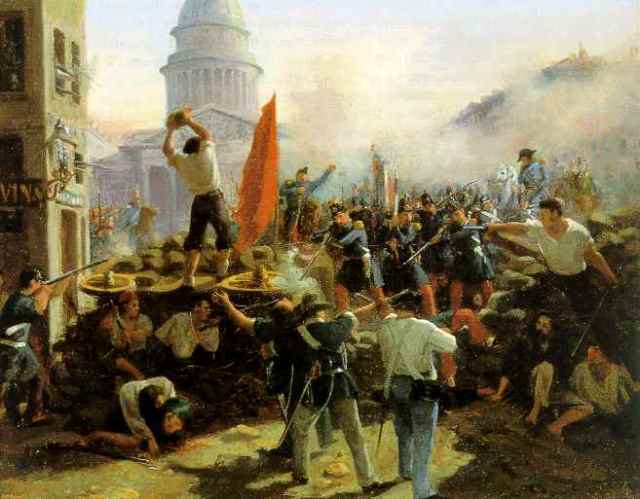
The Revolutions of 1848 were a series of revolts that ricocheted across the world challenging almost every European aristocracy with the demand for greater democratic and social rights. Rather than having acted as a force suppressing the desire for change, the new press allowed revolution to go viral with one revolt sparking another and then another all responding to local conditions, but also a reflecting a common demand for freedom and social security. Individuals acting in such revolutions were certainly taking on very real existential risks as states cracked down violently on the revolts.

Similarly, Morozov’s Net Delusion, published just before the beginning of the 2011 Arab Spring, missed a global revolution that, whatever the impact of new technologies such as Twitter, were certainly facilitated rather than negatively impacted by such technologies.  The Arab revolutions which spread like wild-fire inspired similar protests in the West such as the Occupy Wall Street Movement that seemed to require more than just pressing the “like button” on Facebook for the committed individuals that were engaged in the various occupations.

When it came to the Revolutions of 1848, Kierkegaard was probably proven to be right in the end as the revolutions failed to be sustained in the face of conservative opposition paving the way for even more revolutionary upheaval in Europe in the next century.  Only time will tell if a similar fate awaits the revolutions of 2011 with conservative forces regrouping in autocratic societies to stem any real change, and Western youth becoming exhausted by the deep ethical commitments required to achieve anything more than superficial change.

  • Søren Kierkegaard, The Present Age , Translated by Alexander Dru, Introduction Walter Kaufmann, Harper Torchbooks, 1962
  • Evgeny Morozov, The Net Delusion, Public Affairs, 2011

Accelerando I

The New Earth Archive has a list of 70 books that help us think our way through the future that every educated person concerned with our fate is encouraged to read. Though his book is a novel, Charles Stoss’s Accelerando should be at the top of that list. Perhaps even, at the very top.

I picked up a copy of Accelerando after I heard an interview with Venor Vinge, one of the founders of the Singularity Movement, who praised the work as one of the few examples of fiction that tried to peer behind the dark veil of the singularity. I had originally intended to do a review of Accelernado all in one post, but then realized how much it made my head hurt, but in a good way. I figured that I might make my readers’ heads hurt in the same way if I tried to explain the book all in one go.  Accelerando is so bizarre, profound, and complex that it needs to be described in digestible doses, the same way I found myself wrestling with the novel. To take it all on in one post is a fool’s errand.

What follows below then is a general sketch of the plot of Accelerando. I then dive into what I think are some very important things Stross has to say about our current economic model through the medium of his novel. In a future post I’ll try to tackle something even more important he takes on in the book- the nature and evolution of technological civilization, and the fate of the human species.

The plot of the novel centers- around the story of four generations of the Macx clan: Manfred, Amber, Sirhan, and Manni.  All of the Macx’s are befriended/manipulated by the robotic cat, Aienko, who plays a central role in the story.  The book begins with Manfred Macx, a kind of Julian Assange/George Soros who is hated by almost everybody- especially tax hungry IRS agents and his ex-wife, Pamela, (who happen to be one of the same) for giving his brilliant ideas away for free.

Manfred is an example of a type of human being Stross sees just over the horizon, constantly plugged-in, with so much of his self offloaded into the cloud, that he loses his identity the minute his” glasses”, which are his interface with net, are stolen.

He is also a new type of political figure managing to revive a form of communism by creating a centralized-planning algorithm that can interface with market based systems.  At the same time he is a pioneer in granting rights to increasingly sentient emergent AIs of whom a group of uploaded lobsters originally created by the KGB  can be counted.

If Manfred represents the first stage of the singularity, the stage we can now be said to be in, and are therefore somewhat familiar, his daughter Amber represents the stage that follows. Purposefully enslaving herself on a slave ship on a mission to mine a moon of Jupiter, Amber eventually sets up a “kingdom” on a small asteroid.  At this point the story becomes fantastical. The line between the real and the virtual essentially disappears, persons at this stage are able to split themselves into virtual “ghosts”, and Amber and her crew eventually set off in a star-ship the size of a Coke can, the crew able to embed themselves in its virtual world. Their destination is the source of alien messages some three light years away from Jupiter. What they discover are a particularly intelligent and ravenous group of space lobsters, who Manfred had liberated from the KGB years before, who exist as scavengers upon a civilization that has collapsed under the weight of their own singularity- more on the latter in a moment.

When the “virtual” Amber returns from her space mission she finds that the “real” Amber has married and had a child, named Sirhan, with Sadeq- the fundamentalist Muslim theologian who had come to the Jupiter system to bring the word of Muhammad to the aliens beyond the solar system, and found himself, instead, caught up in the legal struggles between Amber and her mother, Pamela.  The site of their empire now centers around Saturn.

What Amber and her crew discovered on their trip to the alien router outside the solar system was a dark fact about the singularity.  Many, indeed most, civilizations that reach the stage of singularity collapse, having consumed itself along with the original wet-ware species that had given it birth. What is left, or passersby, huddling closely to their parent star- a closed network.

Knowing this is their likely fate Amber, and her family, launch a political party the Accelerationista that is pushing a referendum to flee into the Milky Way from the “Vile Offspring” that have been created in the singularity, have consumed the inner planets in their quest for energy and processor space, and will soon consume what is left of the earth.  The Accelerationista lose the election to the conservative party who prefer to stay put, but Amber and her family still manage to get a large number of people to make a break for it with the help of the space lobsters. In exchange the lobsters want to send a cohort of humans, including a version of Manfred off to explore a strange cloud that appears to be another version of the singularity out in the further depths of the universe

It’s a wild plot, but not as mind blowing as the deep philosophical questions Stross is raising with the world he has envisioned.

Right off the bat there’s the issue of economics, and here Stross attempted to bring to our attention problems that were largely off the public radar in 2005, but hold us in their grip today.

The protagonist of the story, Manfred Macx, doesn’t believe in the profit economy anymore. He gives his ideas away for free, and indeed Stross himself seemed to be following this philosophy, releasing the novel under a Creative Commons license.  In the novel copyright comes under the “protection” of mafias that will break your legs if you infringe on their copyright as they threaten to do to Manfred for giving away the musical legacy of the 20th century, again, for free. This battle between traditional copyright holders and the “sharing” economy has only become more acute since Stross published his novel, think SISPA and beyond.

Manfred’s attitude to money drives both the US government (and his ex-wife) crazy.  America is creaking under the weight of its debt as the baby boom generation retires en mass, but stubbornly refuses to die.  Since Accelerando was published debt politics and the consequences of demographic decline have come to the forefront of political debate in the US, but especially in Europe. One thing Stoss got definitively wrong, or better probably will have gotten wrong, is that he imagines a strong European supra-state in our near-future.  From our current angle it seems hard to imagine how even the relatively weak union Europe has now will survive the current crisis.

Stross also seems to be criticizing, or at least bringing to our attention, the hyper-innovative nature of financial instruments and legal contracts and doing this several years before the financial crisis of 2008 made financial exotica like Credit Default Swaps household terms. For, it is precisely in this world of virtual finance and “creative” law where Manfred excels at being innovative.  Manfred may be like Julian Asange in his nomadic lifestyle, and revolutionary ideology, which manages to piss-off just above everyone, but in other ways he resembles George Soros in that many of his best innovations are the result of Soros-like arbitrage, exploiting the gaps between reality and expectation and especially the differences between states.  Manfred displays this skill when he frees his daughter Amber from her mother by having Amber sell herself into slavery to a company based in Yemen, where her slave owner will trump the custody rights of her mother.

Stross also plays with the idea of how crazy the world of virtual trading, and image management on platforms such as FaceBook  have become, imagining bubbles and busts of bizarre bits of ether such as those traded in his “reputation market”.

Stross’s critique of capitalism may even run somewhat deeper for he has Manfred align himself with the old school communist Gianni to bring the command economy back from the dead using artificial intelligence able to link up with market mechanism- what exactly that means and would look like is really not all that clear, but that order is quickly superseded by another period of hyper-competition known as Economics 2.0

Indeed, this updated version of capitalism Stross portrays as the biggest threat to civilization as it approaches the singularity. Such hyper-capitalism built around  “corporations” that are in reality artificial intelligences might not be a phenomenon of human begun civilization alone,  Stross seems to be providing us with one possible explanation to Fermi’s Paradox – the silence of the universe seemingly so ripe for life.  Civilizations that reach the singularity are often so ravenous for resources, including the intelligence of the very beings that sparked the singularity in the first place, that they cannibalize themselves, and end up huddled around their parent star with little desire to explore or communicate after collapse.

The fate Stross paints for Economy 2.0 societies reminded me of a quote by Hannah Arendt who interpreted the spirit of Western capitalism and imperialism in the desire of the arch-imperialist Cecil Rhodes to “annex the planets”, and Thomas Hobbes conception of human kind’s limitless lust for more and more power that became the core assumption of the modern age:

But when the last war has come and every man has been provided for, no ultimate peace is established on earth: the power accumulating machine, without which the continual expansion would not have been achieved needs more material to devour in its never ending process. If the last victorious Commonwealth cannot proceed to” annex the planets” it can only proceed to destroy itself in order to begin anew the never-ending process of power generation*

I will leave off here until next time…

*Origins of Totalitarianism, Imperialism, 147

Arrested Development

When I was a kid, the original Star Wars trilogy seemed to correspond to my own moral development, at least up until The Return of the Jedi. Star Wars, the first of the three was a classic good vs. evil morality /adventure tale- perfect for my own understanding of the world at the time. The world was simple, clear cut. There were good guys and bad guys, and the best one could hope for was to end up one of the key players on the side of the good guys. The sheer nobodyness of the main characters- Luke was just some kid living on a desert planet, Han and Chewy like futuristic truck drivers, the lowly droids a couple of clowns, contrasted with the sheer scale of what they were up against was democratizing- you couldn’t just be one of the good guys- you could be ONE of the good guys.

The Empire Strikes Back, for my money by far the best of the 3, was released in 1980.  The movie itself introduced elements of mysticism and mythology in its plot line, and also an element of moral ambiguity. Vader, we find out, is Luke’s father- the lines between good guy and bad guy had been slightly smudged.

But if things in the movies were getting morally complicated, things in the real world took on a surreal good vs. evil dichotomy.  It is impossible for me to explain to someone who was not of a certain age during this period of time- and was a boy- how the flare up of the Cold War that took place during this time colored the imagination.  This was the period of Regan’s Evil Empire Speech, and his SDI, aptly panned the Star Wars initiative.

Hollywood and the culture were amplifying the political reality to infuse the world, at least for a particular breed of media-tuned young boys, with an air of looming showdown and apocalypse.  Adults, should have known better, but as a kid I was too busy preparing myself for a hero’s role in a real life version of Red Dawn , amassing troops on my Risk board, listening to jets fly overhead at night thinking “this is it!” and begging my parents to see the horror show of The Day Afterwhich had they let me might have scared me straight.

By the time we get to the Return of the Jedi, the ambiguity is gone. The bad guy is converted, the good guys win, the Evil Empire is defeated. The progress towards adulthood, with the exception of sexy Leia, has stopped. Adults it seems never grow beyond the realm of fairy-tales. Even if, in the real world, such fairy-tales never make sense.

Whether Regan’s aggressive policy towards the Soviet Union precipitated the collapse of  the Eastern Bloc is an interesting historical question, and one in which I have an open mind. The fact of the matter remains that the outcome was not the matter of some “force” of good working for the survival of the human race and freedom, but a piece of extremely good luck. Barring any such force, he might just as likely have gotten us all blown up.

Perhaps the only time this good vs. evil rhetoric made sense was when the Allies battled against the Nazis. But even then, the Allies managed to cross over to the “dark side”, or at the very least, gave the conflict a shade of grey, when they began deliberately killing civilians from the air, and brought Stalin, Hitler’s doppelganger, into the lighter side of the force.

As an adult, the dangers of this arrested development and simplified moral imagination were brought home to me with the disaster of the Second Iraq war.  Adults holding to a vision of  the universe as a drama of good against evil not only made stupid policy mistakes, but also fell into the most grotesquely immoral behavior on a individual level.

Unfortunately, the 9-11 wars, from where I sit, have not proven to be a painful initiation to adulthood, but another version of the Return of the Jedi.  Both the right, and the left,  continue to paint one another as not just misguided, but demonic as the country drifts towards oblivion.

All this got me wondering where this whole good vs. evil fairy tale that is so dangerous, and politically crippling given our destructive capacities, and need for cooperation on enormously complex problems, actually originated.

Some might blame the heritage of a particular aspect of the Abrahamic religions, Christianity, Judaism, and Islam.  For my part, I go a little further back, and blame a bewildered searching prophet who lived on the steppes of Central Asia around 1200 B.C.E.  I blame Zarathustra….