Of Art, Algorithms and Humanity

Lascaux

We are at the strangest of crossroads, a series of changes that challenge and upend what have been the core elements of the human experience since the beginning of our species. Nothing perhaps cuts so close to that core as what is happening and will happen to the meaning and place of art in our lives. Art here understood as everything from the music we compose to our paintings and drawings to the stories we tell or the films and videos we create.

For all of our history it has been we ourselves who created art, and perhaps we might even twist Ben Franklin who defined us as a “tool making animal”  to say that humankind is an art making animal. Just now we are beginning to have companions and competitors in these acts of creation. Joining us are increasingly intelligent machines- art creating algorithms that are not only already producing art, but are daily getting better at it. It’s a good time, then, to stop and wonder what the rise of these algorithmic artists will mean.

Human beings have been making art seemingly since our very beginning. We didn’t need the rise of complex human societies in the form of cities to create it.  Like the lost sketches of our childhood, most of our initial art didn’t make it into the future succumbing to dissolution by the elements, creating a great gap of silence between us and our prehistoric forebears, a fact that made the discovery of the Lascaux caves in 1940 all the more astounding. Today, you couldn’t see the Lascaux caves even if you had the wherewithal to get yourself to southern France- they have been sealed off for the caves’ protection. Modern humans with our numbers and our groping are rightly considered a new form of destructive element that can destroy what it loves through its very curiosity. But, thanks to the miracle of the Internet one can visit the wondrous caves without ever leaving the comfort of one’s home.

What strikes me as question begging in seeing the caves if only in this limited way is just how clearly its artists were versions of us. Their drawings putting me in mind of nothing so much as the chalk sketches of my daughters. And yet, we are so different from these artists in terms of the world we live in and the understanding we have of it that the gap between us is a chasm. Or better, we can understand, even if to a limited extent these artists but were we able to rip them from the past and bring them into the present it is very unlikely that they would ever understand us.

???????????????????????????????

Over and above human biology, what it seems we share most with the artists of Lascaux is the natural desire to create these sorts of representations. No human society has ever existed without art. We are born with the desire to create these strange models of our world. From the moment my daughters could pick up a crayon they were drawing, from the instant they could hit one object off of another they were making music. With sentences came incredible stories and “plays”.

There is a debate currently raging as to whether one form of art, literature, makes us more moral the best response to which I have seen is that it makes us more human. But perhaps we should say more than human. Art, or good art at least, has the capacity to expand human consciousness far out beyond the boundaries of the self and therefore is part and parcel of those other endeavors of our intelligence such as mathematics, science, philosophy,  history and religion that allow us to spread out the fabric of our awareness over all that we can see. The creation and even consumption of art is a mark of our intelligence and it can therefore be assumed that as our machines become more intelligent they will become more artistic as well. It is already happening.

Algorithms already shape our artistic choices. A program at Amazon suggests what books you should buy, and similar algorithms at Pandora or Netflix knows your tastes in music or movies as well or perhaps better than you do. It isn’t only that algorithms guide our artistic choices in some cases they are used to decide what gets made or heard.

As pointed out by Christopher Steiner in his Automate This a company like Epagogix is being used by film production companies to decide what movies get made or how much to invest in particular films allowing movie companies to recognize a flop before the director even shouts “action”. (75) Steiner shows us how the same thing is being done for music with a company like Music X-Ray which allows musicians to upload their songs into a huge database that can be searched by music producers for, among other things, potential hits. Lady Gaga and Justin Bieber beware. (87)  I have little doubt that similar technologies will eventually be applied to books allowing publishers to find the “Harry Potters” among the flood of manuscripts they receive every day.

In the most basic sense the way in which these film and music sorting algorithms work is that some target criteria is defined, say films grossing over a certain amount, and then the massive data searching capacities of artificial intelligence are applied. At least at this stage technology seems to have empowering potential for individual artists. Their work still exists within a sea of other creations but now at least can be found.

At the moment, on account of its expense, this AI sorting only benefits those producing hits- that is work with the broadest commercial appeal, which most of us hopefully realize is not necessarily the best or most groundbreaking art. We can at least hope that as the cost to create and run these sorts of algorithms decline they will be used to sort for artistic criteria beyond mere commercial appeal.

That’s how algorithms are being used to sort art, but what about actually making it? Music, perhaps because it so closely resembles the mathematics of intelligent machines has been the first to fall here. As only one example: in 2012 on the centenary of Alan Turing’s birth the London Symphony Orchestra performed Hello World! a set of musical pieces composed purely by an algorithm named IAMUS. It does not seem a huge step from algorithms sorting through really big data sets to find hit songs to them being used as tools to allow artists to create hit songs or other productions in the first place or even composing such songs themselves.

The next few decades are likely to experience a tension regarding the question of what these artistic algorithms are actually for?  This will not be another version of the tired  neo-luddite vs technophile dispute but a debate over how to use technology based on different interpretations of its meaning. Are artistic algorithms tools to help human beings create art and find audiences or are they artists themselves? I have no good answer to the question.

Two seemingly contradictory things seem clear to me. The first is that algorithms and artificial intelligence will further expand the fabric of our consciousness. As Jeff Hawkins put it in a recent interview about the future of AI:

When I ask myself, What’s the purpose of life?, I think a lot of it is figuring out how the world works. These machines will help us do that. Many, many years from now, we’ll be able to build machines that are super-physicists and super-mathematicians, and explore the universe. The idea that we could accelerate our accretion of knowledge is very exciting.

Such expansion seems unlikely to be be limited to our models of the universe,  biology or social structure, but will embrace our artistic horizon as well.

The second thing that rings true is that as long as we continue to posses the type of intelligence that defines us as humans we will continue to create art for we are born artists just as we are born scientists and spiritual seekers. How those two aspects of our artistic future resolve themselves is beyond me but perhaps a hint at the major possibilities can be found in the caves of Lascaux.

Perhaps, as in the caves, we will establish places where we can practice our art free from the threat of dissolution that comes from contact with the world. However, the world against which our art will need to be preserved will not be the natural world but what Andrew McAfee calls the New Machine Age we are entering. Art is for human beings to create machines are tools.

Another possibility is that we will have a version of Stanislaw Lem’s Incommunicability Thesis. Machines will become extremely proficient in composing music or perhaps even writing books but they will just be running sophisticated algorithms and have no idea what these productions actually mean. Likewise,for the majority of human beings who are not high level programmers the art the machines create will provide no reflection whatsoever of the internal states, the “thoughts” of the machine. If Lem had been an anthropologist he would have been the strictest of cultural relativists. In this view, not only could the artists of Lascaux never understand us, we could never understand them. You need to live in the worldview of a culture to understand it beyond the level of a nearly empty abstraction.

As a last possibility, maybe the coming age of artistic algorithms will so expand our imaginative horizons that it will appear that our past was nothing more than being trapped in a cave of shadows. That we will have at long last emerged into the sublime brilliance of the light.


The Far Futures Project

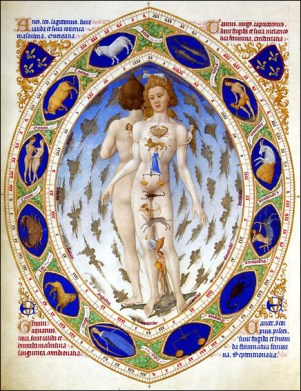
Zodiac Man 1413

When I was a kid there was a series on Nostradamus narrated by an Orson Welles surrounded in cigar smoke and false gravitas. I had not seen The Man Who Saw Tomorrow for over 30 years, though thanks to the miracle of Youtube I was able to find it here.  Amazingly enough, I still remember Part 9 of the series in which the blue- turbaned, Islamic, 3rd antichrist allied with the Soviet Union plunges the world into thermonuclear war. I also remember the ending- scenes of budding flowers and sunshine signaling the rebirth of nature and humanity, a period of peace and prosperity to last 1,000 years. I think what must have made an impression on my young mind was the time frame of Nostradamus’ supposed predictions- with the Third World War to start sometime between the years 1994-1999, a time frame that was just close enough to scare the bejesus out of an already anxiety prone 9 year old. Thankfully, I was able to escape the latent fear induced by this not so well produced premonition when the USSR went belly up in 1991. Predicting the future is a tough job.

And what does it mean to predict the future anyway? Any idea that the future is somehow foreseeable seems to rely on some concept of determinism, but it’s not quite clear that all aspects of existence experienced by human beings are equally deterministic. Astrology seems to be a good example of how this works. Some of the things we experience do indeed seem to be determined, or better, their course stays essentially the same over vast stretches of time. It makes sense, even though it doesn’t work, to repackage and apply this determinism at the human level giving us a false but confidence building sense of control. The crazy thing, at least in terms of the future of society as opposed to the future of individuals,  is that human beings seem prone to making predictions with bad outcomes, just consult the prophet of your choice. So, one wonders why something that is supposed to relieve anxiety- knowing what will happen- ends up doing the exact opposite and instead fills us with nostrodemian dred?

Maybe its all about the scale of the market. Palm readers who inform too many of their customers that their lives are about to go into the toilet probably go out of business pretty fast. When you’re dealing with mass markets though- fear sells. Better to write a book on the looming terrorist threat than one on just how peaceful modern societies are. You get more eyeballs when your piece has the word armageddon in the title than if it contains the word utopia.

Then there is the question of time horizon. As Stewart Brand suggested to the religious scholar Elaine Pagels the attraction of the ambiguity of a “prophetic” text like the Book of Revelation is that one can insert one’s own mortal timeline into it. Ray Kurzweil isn’t the first to predict the end of normal human affairs perilously close to the limit of his own likely lifespan.

Perhaps almost all predictions regarding the future are merely reflections of our own current anxieties, but this is not to say that our relationship to the future is merely all in our heads. Human beings and our societies exist along a continuum of time and this not only ties us to the what-is-not of the past but the what-is-not of the future as well. What we do today, if it proves relevant, will shape the future as much as the decisions made by those who preceded us shapes us today. To deny this is to deny something as real as the very present in front of us.

Yet, this future horizon is not merely something that applies to human civilization but to the earth and universe as a whole. Unless there is some cosmic mystery currently hidden from us, the earth will exists for something approaching 5 billion years before being consumed by the sun, and our universe, however dispersed because of expansion, will continue to have organized structures such as stars and galaxies- likely prerequisites for life- for far far longer than it has been in existence (13.5 billion years) into the realm of the unimaginable range of 100 trillion years.

There exists, then, a very likely future if not for our mortal selves or even humanity, for the cosmos and most likely life and intelligent life. We have something to predict about however silly such predictions will appear in retrospect. This gives us, I think, a great opportunity for a sort of “game”, an attempt to stretch our imaginations outward not so much in the hope that we can see like Welles’ Nostradamus the future that lies before for us so much as to see how broadly we can paint the canvas of what- might- be.

In this spirit, I invite you to participate in what I am calling The Far Futures Project.Those who wish can come up with their own predictions for the near and far future. Send them to farfuturesproject@gmail.com and I will post them on my blog Utopia or Dystopia. My only requirements are that you follow the template in terms of years found in my predictions below:  500, 10,000, 1 million, 1 billion, though I understand they will appear arbitrary to many. My second requirement is that you follow normal editorial standards with the awareness that these posts are geared towards general audience. Also, please provide some identifying information that will allow readers to connect with your ideas- especially links to your own work. My hope is to run the project for about a month, so here’s your chance.

You can see the first response to the call of  the project in this entry by my friend and fellow blogger James Cross here. 

As for me, here I go…

Rick Searle’s Far Future

500 years

The often painful transition that can be traced to changes in human society initiated by the industrial revolution in the 1800s has finally begun to reach equilibrium. Historians in the 2500s tend to see developments since the start of the industrial revolution as a set piece where humanity had to adjust itself to a new technological order, a new relationship with nature, new forms of inter-relations between and among peoples, and above all a need for humanity to decide both what it was and what it should be.

The technological question that the industrial revolution posed which took nearly 7 centuries to resolve was what would be the relationship between human beings and the rapidly evolving kingdom of machines?

Well before the 26th century there emerged a kind of modus-vivendi between human beings and machines, especially machines of the intelligent type. The employment crisis of the early to mid-21st century revolved around the widespread application of machine intelligence to all fields of economic, cultural, and political life, although no one yet could claim such machines possessed features of human intelligence such as consciousness.  True Artificial General Intelligence or AGI remained a ways off, and never really replicated human intelligence, but would prove to be something quite different.

The consequence of the exponentially increasing processing power of computers was the ability to automate almost any formerly human process from the most intellectually challenging – classical composition or scientific discovery to the most simple production procedure. The capacity of machines to do almost any conceivable type of work road atop the ability to tap into human networks and feedback systems resulting in a kind of symbiosis between human intelligence and machines that whatever its human component left far too many people without gainful employment and would prove unsustainable not only economically but emotionally.

Numerous solutions to this dilemma were tried until a genuine modus vivendi was achieved. One attempted solution was to hive off human life from machines by providing people with a guaranteed income and allowing them to opt out of economic, intellectual and cultural pursuits- a solution that at the end of the day proved unsatisfying for far too many to be sustainable.

Another attempted solution was to tie human intelligence even closer to the new forms of machine intelligence by fusing the human mind with that of machines. This solution proved not so much unsustainable as unreachable in the form it had been articulated. Part of the problem stemmed from the fact that those parts of the human brain that were responsible for emotions, which human beings shared with other mammals, moved at such a glacial pace that they proved incompatible with the lightening fast cognition of machines. To propel emotional cognition faster seemed to inevitably result in various unwanted conditions from emotional deadening, to hyper-anxiety, to an accelerated sense of subjective time that canceled out the very longevity human beings had succeeded in creating.

The long lived humans of the 22th century embraced a slower and more reflective notion of time than their 21st century forebears and sought to limit machine intelligence from impinging on activities which embedded human life across the arch of time from the creation of art to the raising of children, the latter which came back into vogue after the prolonged “baby bust”.

Under what became the new post-capitalist order that took hold almost everywhere humans and machines were each given their unique domains based upon the question of scale and speed. Intelligent machines were extremely effective at running large scale entities- cities, armies, markets, coordinating reactions to pandemics and disasters for which the human mind was ill designed. There were also areas where the wetware of the brain proved far too slow- including moving human beings across space in the various incarnations of the 20th century automobile and airplane, fighting under conditions of modern, war or performing emergency surgery.

Machines were also able to fill dangerous (and degrading) economic niches human beings were ill suited to perform. This issue of scale and niche would prove the key to the future evolution of machines, an embedded tendency that someone in the far future when machines became the dominant “lifeform” in the universe would likely be unable to trace to its mundane economic and psychological origins.

A second question that had been raised by the industrial revolution was what the relationship between the natural world and humanity should be, a question that was intimately related to the issue of human population? Since the industrial revolution various societies had gone through a series of stages in terms of their relationship to the natural world a period of brute force rapaciousness unconcerned with environmental impacts followed by growing awareness and idealization of the natural world followed in the end by an increase in biological knowledge that allowed human beings to reverse, minimize, and isolate their impact on the biosphere.

Especially starting in the 22nd century, vast projects were launched that aimed to restore the natural world not merely to its conditions before the industrial revolution, but to those before human beings emerged from Africa over 10,000 years before. The rain forests of the world were restored.  The auroch was genetically recreated and re-established in much of Eurasia along with more common species such as wolves and boar. The ancient chestnut forests and species that relied on them such as the passenger pigeon have been restored in North America, and the estuaries are alive with fish in a way they have not been since at least the 19th century. All the major African species, especially the great apes, have been restored to pre-modern numbers and prehistoric hominids resurrected and established in their ancient homeland of the African savannah. Long extinct species likely killed off by the hunting prowess of early humans- the Woolly Mammoth, Saber Tooth Tiger, Ground Sloth, and Giant Beaver brought back into existence and reestablished in the tundra of Siberia, Canada, and an iceless Greenland.

A solid majority of human beings- nearly 70%- now live in high density cities a move that has not merely aided in decreasing human population because of city-dweller’s smaller family sizes, but shifted the human impact on the environment from diffuse to compact allowing nature to reclaim enormous tracts of non-urbanized space. Especially important in this decreased spatial impact is the movement of farming into the cities. Vast aeroponic vertical farms in urban centers now produce the majority of the world’s food. Much of the Great Plains in North America has reverted to grassland and wildflowers. The return of the Buffalo has even resulted in a small number of Native American Blackfoot to return to their long lost traditional lifestyle- though they have kept the post-columbus horse.

For the first time in history there is effective global management of the earth’s biosphere. The global environment is constantly monitored not only from satellites but from a whole host of animal embedded sensors and cameras that provide real-time 24/7 monitoring of the earth’s environment. Invasive species and destructive diseases are caught, isolated and removed at lightening fast speeds.

Sophisticated AI directed modeling allows for extremely detailed predictions as to environmental impact permitting the tailoring of industrial and agricultural projects to promote healthy ecosystems, and directs the movement and actions within the human geography to best meet the needs of wildlife and the larger ecosystem.

This earth-scale environmental management is just one sign of the vastly increased capacity for global governance that was developed from the late 21st century forward. It origins lie in crises of both an environmental and geopolitical nature which that century was thankfully able to overcome.

Various times from the 19th through the 21st century the world was torn between different imperial orders. The 19th century imperial order of the Europeans was replaced by the 20-21st century American (and for a shorter spell, Soviet) imperial regime. From the early 21st century not just East Asia but the world had to adjust to the appearance of China in the global arena.

The world was on the verge of thermonuclear war not one but 3 times: The Cuban Missile Crisis (1963)  the Russo-Japanese-Sino War fought over Chinese incursions into booming Siberia and the northern Pacific (2054) the Sino–Indian War, between China and India over China’s attempt to divert water from the Himalayas (2085). There was also a deep conflict between an alliance of “hot” countries and “cold” countries, that is between countries where the effects of climate change were sharp and devastating and those that had largely benefited from the change.

The Russo-Sino-Japanese war and the Sino-Indian war were both products not merely of the international order adjusting to the power of China but were responses to the reality of climate change. This eventually led to an alliance between China and many of the other hot countries that launched a policy to geo-engineer the world’s climate starting in 2095. In spite of worldwide protests and threats of war by the US and Russia, the hot countries began spewing tons of sunlight blocking sulfates into the atmosphere for a time turning the sky of the earth a gaudy orange. This did however have the intended effect, cooling the earth by almost 2 degrees and bringing rain and temperature distributions back to early 21st century norms. Disaster was averted but only at an incredible costs to humanity’s sense of itself and its relationship to the earth. The act did, however, start humanity on the right course.

Not even the massive migration flows of refugees fleeing from climate change got the world attention as much as the earth’s blue skies turning orange. The world came perilously close to war when an alliance of arctic countries- Russia, the US and Canada began shooting the tethered sulphur spewing Verne like Chinese dirigibles out of the sky. The Reykjavik Treaty which ended this conflict sparked a new era not only in the way human beings related to the earth’s environment but in the international relations between states. This new era of international cooperation was supported by a convergence in the systems of government found in most of the world’s countries and all of its major powers. The old argument between democracy and autocracy was no more.

Since the American (1776) and French (1789) revolutions people had been arguing over whether democracy was the best form of government. What occurred by the late 21st century was a convergence in both democratic and authoritarian regimes towards a form of government sometimes called responsive democracy that was neither representative nor direct but continuously scanned the public for feedback and direction as to government policy in the same way companies used social media to establish consumer preferences. Critics of responsive democracy claimed that it was easily manipulated by vested interests who were able shape citizen preferences, and that it robbed the public of its democratic responsibility to deliberate and decide. Yet, the model seemed unstoppable and by giving people a real voice in the face of the dominant oligarchies did seem to quell social pressures in countries as vastly different as the US and China.

In the centuries between 1800 – 2500 the major religious, philosophical, and cultural disputes would center around the question of what humanity was and what it should become. The dispute could be traced to Charles Darwin’s publication of The Origins of Species in 1857. What did it mean for the present and future of humanity to say that it had evolved from “lesser” species?

The 19th and early 20th centuries had seen the application of the darker aspects of the idea of human evolution with both racially justified imperialism and the Nazis. From the 21st through the 23rd century conflicts raged between the traditionally religious, environmentalists, and various shades of transhumanism, disputes that included not merely ideological struggles but  inquisitions on all sides. Eventually, however, a widespread consensus began to take hold, a set of philosophical assumptions that lie underneath post-21st century understandings of the relationship between human beings and machines, the environment, and both domestic and international politics.

Humanity in a general sense was to be preserved on earth. Whatever their profound changes in health and longevity human beings  in this era were essentially the same as human beings 10,000 years before. Earthbound machines were preserved as servants, while those of above human intelligence sequestered in a slim number of domains. Genetic transformation of human beings outside the realm of increasing health, strength, longevity or biological intelligence was discouraged, and biological cures promoted over bio-mechanical ones.

Those who wanted bold experiments such as creating a race of chimeras with mixed human and mechanical features, to merging into collective intelligences, could still have them, they just had to be pursued, given their perceived dangers to the survival of humanity, outside of the earth. Mars became the key destination in this regard, a kind of laboratory for all things post-human, but there would also be great floating cities in the solar system and even the first colonies sent out to closest living planets beyond the solar system…

10,000 years

Human civilization has reached the 10% milestone. 20,000 years living settled life in cities. During this period human beings have been the dominant form of intelligence and, on earth at least, have succeeded in suppressing the new evolutionary kingdom  of the machines. This age is now coming to a close and traditional humans, still safe and thriving largely on earth, have receded far  into the background of the evolutionary story now playing out in the Milky Way.

Despite their diminished status in the grand scheme of things, life for earthbound human beings has never been better. The average human being can be expected to live over 1,000 years. With so much investment in what in formerly human terms was the long term prosperity of society human beings have never been so inclined not to wage war against one another or let their society go to rot. The commitments of individuals to society, to an art, to persons, are long indeed, although few human relationships can be sustained over such time periods and as a consequence there are well developed rituals for “letting go” of marriage partners of friends and for a surprisingly large number even life itself. By far the greatest human works of art are created in this period as are the deepest works of philosophy. This is the true age of the “long form” single songs that run for months, novels comprised of hundreds of individual books, memoirs of love and loss felt over centuries.

Outside of the earth, humans and many more post-humans have terra-formed Mars and perhaps a billion now call that planet home. Over the millennia an innumerable number of sister earths have been discovered within a thousand light years of the solar system, though no other technological civilization has been discovered so far. Post-humans settlers have long reached the nearest living planets.

The descendants and creations of humanity that have continued to evolve and differentiate into a bewildering variety of forms across the width of a 5,000 light year span surrounding the earth. A large number of these creatures  are the descendants of the silicon based forms humanity had invented far back in the 20th century- although silicon is no longer the dominant substrate and instead can be found a huge multiplicity of underlying elements.

1 million years

Humanity is now nearing the 2 million year mark, the average lifespan for a species.It has long since retired from the heart of things and watches with a mixture of awe and fear the goings on of the “gods” in the heavens.

Machines in space have begun an enormous surge of evolution akin to the Cambrian Explosion in the earth’s ancient history.  From the big-picture view it can be seen that the kingdom of machines has been a way for life to overcome its limitations and expand into a much greater range of cosmic real estate. Carbon based life had evolved and could only thrive in a very narrow niche of the universe- stellar bodies that were not so large that the effects of gravity overwhelmed those of chemical reactions and not so small  where the chemical reactions on which life was built did not occur with regularity.

Anywhere there is usable energy machines can be found, and in a diversity that matches that found in carbon based life- from the geothermal vents of a body like IO, where organisms are metallic-slugs able to withstand intense heat and pressure to the clouds of the gaseous giants where colonies of microscopic smart dust live off the planetary winds.

To study these forms in 21st century terms would require someone who combined the skills of an archaeologist an engineer and a biologist. Each machine form having a genealogy that tied it to some idiosyncrasy of human need and design in the distant past as well as evolving to meet the specific requirements of its own unique environment. Inside some of these machines can also be found still living biological cores- the machine itself being merely a means of survival and replication. One can only speculate as to the internal life of such beings whether the environment in which they currently live is the fabric of their consciousness or whether they live in a dream world of their past animal existence unaware as to their own current strangely transformed state.

If machine evolution allowed life to expand into vastness of space where gravitational dominance and chemical equilibrium formerly prevented it from taking root, there was also an expansion of life into brand new scales. The largest living organism ever found on earth, The Great Coral Reef, was a little over 1,200 miles (2000 km).  In terms of social animals a Roman Empire like ant colony grew to be nearly 4,000 (6000 km) on the European Mediterranean and Atlantic coasts.  Human civilization grew from the African Savannah  to the earth, to the solar system, and near galactic living planets.  Still nothing would match the superorganisms that would emerge from machines which would eventually grow to reach not merely a planetary, stellar, or solar system, but galactic and multi-galactic scales.

There were also scales below that of molecular that life, especially complex life, was unable to tap. Only the simplest of living organisms could exist on such small scales. Machine life, however, was able to move a million scales down to the range of atoms themselves becoming not merely the “living atomic scale matter” of some larger forms which thus even more strongly resembled organic life, but became a whole habitable zone unto itself, the home of the mechanical versions of bacteria the truly dominant form of both the organic and the mechanical world.

All this is very dangerous for organic life ,which not only continues to exist but thrives in the “cracks”- areas that are free from the terrestrially unbound silicon descendants. An enormous explosion of life, including intelligent life, is taking root in these cracks.  Some of these are descendants of earth based life, but most have arisen completely independently. Whole civilizations rise and fall unaware of the story that plays out above them in the realm of the stars. And still, this remains merely the beginning of the beginning…

1 billion years

Humanity has long ceased to exist though the ultimate cause of their demise is unknown. The most likely scenario being that its defenses were worn down by the forays of some superorganism though there are rumors that the machine defenses humanity had built were themselves the culprit. Life, in one form or another, however, continues to move on. In fact, we have entered the golden age of life in both carbon based and silicon forms. The increasing amount of complex elements, especially of carbon from stars means that life is taking root on more and more planets, the story of evolution playing out across a diverse landscape of enormous scope. In this “lower world”, the world under the stars, stems a vast cacophony of forms- the splendor of life filling all the spaces of its possibility.  Among these are a plethora of intelligent species and civilizations a great number which live out histories of creation and destruction with far too many destroying themselves upon reaching nuclear maturity.

Still, a good number, perhaps a slim majority, survive. From these civilizations come not merely art, music, stories, ideas, but also biographies- beings who have not merely lived but  represent as it were a path of life, a story, embedded in the very fabric of reality. Silicon descendants, not just from the earth, but many places besides are likewise entering a new and golden phase.

Organic life is somewhat protected from the intrusions, exploitation or destruction at the hands of silicon based forms by the vastness of space and from the sheer diversity of environments where silicon forms are able to find usable energy. There is also, however, a new tendency for silicon protect the carbon based life from which it ultimately emerged.

It is unknown how this happened but it is thought that some especially prudent civilization programmed its machines with the purpose of protecting its organic progenitor. Somehow this purposing went rogue and there are quite a number of silicon forms that offer spheres of protection to not just the organic life forms from which they emerged but for all organic life they come across.

There appears to have been an unforeseen evolutionary advantage to this strategy.  With the evolutionary experiments that emerges out of carbon based life being seen like the ancient invention of sex- a way to gain new “genes” and through diversity increase resilience. Some very patient and hands- off silicon based forms use carbon-based worlds as running simulations from which they can glean ways to increase their own internal complexity. Though, a good number have taken to actually “cultivating” intelligence on worlds- driving evolution in the direction of creating an intelligent species with technological potential from which they can glean even more diversity.

For those still living on planets the night sky has become even more brilliant than in the age of lifeless stars. A show of lights in unspeakably brilliant patterns the glow of enormous silicon descendants “talking” to one another across the vast stretches of space. Now is the age in which the “music of the spheres” has become real for not only is there light the cities in the skies sing to one another as well in music we can not even dream.

Visions of Immortality and the Death of the Eternal City

Vangough Flowers in a blue  vase

It was a time when the greatest power the world had yet known suffered an attack on its primary city which seemed to signal the coming of an age of unstoppable decline.The once seemingly unopposable power no longer possessed control over its borders,it was threatened by upheaval in North Africa,  unable to bring to heel the stubborn Iranians, or stem its relative decline. It was suffering under the impact of climate change, its politics infected with systemic corruption, its economy buckling under the weight of prolonged crisis.

Blame was sought. Conservatives claimed the problem lie with the abandonment of traditional religion, the rise of groups they termed “atheists” especially those who preached the possibility of personal immortality. One of these “atheists” came to the defense of the immortalist movement arguing not so much that the new beliefs were not responsible for the great tribulations in the political world, but that such tribulations themselves were irrelevant. What counted was the prospect of individual immortality and  the cosmic view- the perspective that held only that which moved humanity along to its ultimate destiny in the universe was of true importance. In the end it would be his movement that survived after the greatest of empires collapsed into the dust of scattered ruins….

Readers may be suspicious that I am engaged in a sleight of hand with such an introduction, and I indeed am; however much the description above resembles the United States of the early 21st century, I am in fact describing the Roman Empire of the 400s C.E. The immortalists here are not contemporary transhumanists or singularitarians but early Christians whom many pagans considered not just dangerously innovative, but also, because they did not believe in the pagan gods, were actually labeled atheists- which is where we get the term. The person who came to the defense of the immortalists and who laid out the argument that it was this personal immortality and the cosmic view of history that went with it that counted rather than the human drama of politics history and culture was not Ray Kurzweil or any other figure of the singularitarian or transhumanist movements,  but Augustine who did so in his work The City of God.

Now, a book with such a title not to mention one written in the 400s might not seem like it would be relevant to any secular 21st century person contemplating our changing relationship with death and time, but let me try to show you why such a conclusion would be false. When Augustine wrote The City of God he was essentially arguing for a new version of immortality. For however much we might tend to think the dream of immortality was invented to assuage human fears of personal death the ancient pagans (and the Jews for that matter) had a pretty dark version of it. Or, as Achilles said to Odysseus:

“By god, I’d rather slave on earth for another man—some dirt-poor tenant farmer who scrapes to keep alive—than rule down here over all the breathless dead.”

For the pagans, the only good form of immortality was that brought by fame here on earth. Indeed, in later pagan versions of paradise which more resembled the Christian notion “heaven” was reserved for the big-wigs. The only way to this divinity was to do something godlike on earth in the service of one’s city or the empire. Augustine signaled a change in all that.

Christianity not only upended the pagan idea of immortality granting it to everybody- slaves no less than kings, but, according to Augustine,  rendered the whole public world the pagans had found so important  irrelevant. What counted was the fact of our immortality and the big picture- the fate that God had in store for the universe, the narrative that got us to this end. The greatest of empires could rise and fall what they will, but they were nothing next to the eternity of our soul our God and his creation. Rome had been called the eternal city- but it was more mortal than the soul of its most powerless and insignificant citizen.

Of course, from a secular perspective the immortality that Augustine promised was all in his head. If anything, it served as the foundation not for immortal human beings nor for a narrative of meaning that stretched from the beginning to the the end of time- but for a very long lived institution- the Catholic Church- that has managed to survive for two millennia, much longer indeed than all the empires and states that have come and gone in this period, and who knows, if it gets its act together may even survive for another thousand years.

All of this might seem far removed from contemporary concerns until one realizes the extent to which we ourselves are and will be confronting a revolutionary change in our relationship to both death and time akin to and of a more real and lasting impact than the one Augustine wrestled with. No matter what way one cuts it our relationship to death has changed and is likely to continue to change. The reason for this is that we are now living so long, and suspect we might be able to live much longer. A person in the United States in 1913 could be expected to live just shy of the ripe old age of 53. The same person in 2013 is expected to live within a hair’s breath of 79. In this as in other departments the US has a ways to go. The people of Monaco, the country with the highest life expectancy, live on average a decade longer.

How high can such longevity go? We have no idea. Some, most famously Aubrey de Gray, think there is no theoretical limit to how long a human being can live if we get the science right. We are likely some ways from this, but given the fact that such physical immortality, or something close to it, does not seem to violate any known laws of nature, then if there is not something blocking its appearance, say complexity, or more ominously, expense, we are likely to see something like the defeat of death if not in this century then in some further future that is not some inconceivable distance from us.

This might be a good time,then, to start asking questions about our relationship to death and time, and how both relate to the societies in which we live. Even if immortality remains forever outside our grasp by exploring the topic we might learn something important about death time and ourselves in the process. It was exactly these sorts of issues that Augustine was out to explore.

What Augustine argued in The City of God was that societies, in light of eternal life had nothing like the meaning we were accustomed to giving them. What counted was that one lead a Christian life (although as a believer in predestination Augustine really thought that God would make you do this if he wanted to). The kinds of things that counted in being a good pagan were from Augustine’s standpoint of eternity little but vanity. A wealthy pagan might devote money to his city, pay for a public festival, finance the construction of a theater or forum. Any pagan above the level of a slave would likely spend a good deal of time debating the decisions of his city, take concern in its present state and future prospects. As young men it would be the height of honor for a pagan to risk his life for his city. The pagan would do all these things in the hope that they might be remembered. In this memory and in the lives of his descendants lie the possibility of a  good version of immortality as opposed to the wallowing in the darkness of Hades after death. Augustine countered with a question that was just as much a charge: What is all this harking after being remembered compared to the actual immortality offered by Christ?

There are lengths in the period of longevity far in advance of what human beings now possess where the kinds of tensions between the social and pagan idea of immortality and the individual Christian idea of eternal life that Augustine explored do not yet come into full force. I think Vernor Vinge is onto something (@36 min) when he suggests that extending the human lifespan into the range of multiple centuries would be extremely beneficial for both the individual and society. Longevity on the order of 500 years would likely anchor human beings more firmly in time. In terms of the past such a lifespan would give us a degree of wisdom we sorely lack, allowing us to avoid almost inevitably repeating the mistakes of a prior age once those with personal experience of such mistakes or tragedies are no longer around to offer warnings or even who we could ask- as was the case with our recent financial crisis once most of those who had lived through the Great Depression as adults had passed.

500 years of life would also likely orient us more strongly towards the future. We could not only engage in very long term projects of all sorts that are impossible today given our currently limited number of years, we would actually be invested in making sure our societies weren’t making egregious mistakes- such as changing the climate- whose full effects wouldn’t be felt until centuries in the future. These longer-term horizons, at least when compared to what we have now, would cease being abstractions because it would no longer be our great grandchildren that lived there but us.

The kinds of short-termism that now so distort the politics of the United States might be less likely in a world where longevity was on the order of several centuries. Say what one might about the Founding Fathers, but they certainly took the long-term future of the United States into account and more importantly established the types of lasting institutions that would make that future a good one. Adams and Jefferson created our oldest and perhaps most venerable cultural institution- The Library of Congress. Jefferson founded the University of Virginia. Later American political figures, such as Lincoln, not only did the difficult work of keeping the young nation intact, but developed brillant institutions such as Land-Grant Colleges to allow learning and technological know-how to penetrate the countryside. In addition to all this, the United States invented the idea of national parks, the hope being to preserve for centuries or even millennia the natural legacy of North America.

Where did we get this long term perspective and where did it go? Perhaps it was the afterglow of the Enlightenment’s resurrection of pagan civic virtues. We certainly seem no longer capable of taking such a long view- the light has gone out. Politicians today seem unable to craft policy that will deal with issues beyond the next election cycle let alone respond to issues or foster public investments that will play out or come to fruition in the days of their grandchildren. Individuals seem to have lost some of the ability to think beyond their personal life span, so perhaps, just perhaps, the solution is to increase the lifespan of individuals themselves.

Thinking about time, especially long stretches of time, and how it runs into the annihilation of death, seems to inevitably lead to reflections about human society and the relationship of the young with the old. Freud might have been right when he reduced the human condition to sex and death for something in the desire to leave a future legacy inspired by death does seem to resemble sex- or rather procreation- allowing us to pass along imperfect “copies” of ourselves even if, when it comes to culture, these copies are very much removed from us indeed.

This bridging of the past and the future might even be the ultimate description of what societies and institutions are for. That is, both emerge from our confrontation with time and are attempts to win this conflict by passing information, or better, knowledge, from the past into the future in a similar way to how this is accomplished biologically in the passing on of genes through procreation. The common conception that innovation most likely emerges from youth, if it is true, might be as much a reflection of the fact that the young have quite simply not been here long enough to receive this full transmission and are on that account the most common imperfect “copies” of the ideas of their elders. Again, like sex, the transmission of information from the old to the new generation allows novel combinations and even mutations which if viable are themselves passed along.

It’s at least an interesting question to ask what might happen to societies and institutions that act as our answer to the problem of death if human beings lived for what amounted to forever? The conclusion Augustine ultimately reached is once you eliminate death you eliminate the importance of the social and political worlds. Granting the individual eternity means everything that now grips our attention become little but fleeting Mayflies in the wind. We might actually experience a foretaste of this, some say we are right now, even before extreme periods of longevity are achieved if predictions of an ever accelerating change in our future bear fruit. Combined with vastly increased longevity accelerating change means the individual becomes the only point in history that actually stands still. Whole technological regimes, cultures, even civilizations rise and fall under the impact of technological change while only the individual- in terms of a continuous perspective since birth or construction- remains. This would entail a reversal of all of human history to this point where it has been the institutions that survive for long periods of time while the individuals within them come and go. We therefore can’t be sure what many of the things we take as mere background to our lives today- our country, culture, idea of history, in such circumstances even look like.

What might this new relationship between death and technological and social change  do to the art and the humanities, or “post-humanities”?  The most hopeful prediction regarding this I have heard is again Vinge, though I can not find the clip. Vinge discussed the possibility of extended projects that are largely impossible given today’s average longevity. Artists and writers probably have an intuitive sense for what he means, but here are some examples- though they are mine not his. In a world of vastly increased longevity a painter could do a flower study of every flower on earth or portraits of an entire people. A historian could write a detailed history of a particular city from the palaeolithic through the present in pain staking detail, a novelist could really create a whole alternative imagined world filled with made up versions of memoirs, religious texts, philosophical works and the like. Projects such as these are impossible given our limited time here and on account of the fact that there are many more things to care about in life besides these creations.

Therefore, vastly increased longevity might mean that our greatest period of cultural creation- the world’s greatest paintings, novels, historical works and much else besides will be found in the human future rather than its past. Increased longevity would also hopefully open up scientific and technological projects that were centuries rather than decades in the making such as the recovery of lost species and ecosystems or the move beyond the earth. One is left wondering, however, the extent to which such long term focus will be preserved in light of an accelerating speed of change.

A strange thing is happening in that while the productive lifespan of an individual artist is increasing- so much for The Who’s “hope I die before I get old”–  the amount of time it takes an artist to create any particular work is, through technological advancement, likely decreasing. This should lead to more artistic productivity, but one is left to ponder what any work of art would mean if the dreams of accelerating technological change come true at precisely the same time that human longevity is vastly increased? Here is what I mean: when one tries to imagine a world where human beings live for lengths of time that are orders of magnitude longer than those today and where technological change proves to be in a persistently accelerating state what you get is a world that is so completely transformed within the course of a generation that it bears as much resemblance to the generation before it as we do to the ancient Greeks. What does art mean in such a context where the world it addresses no longer exists not long after it has been made?

This same condition of fleetingness applies to every other aspect of life as well from the societies we live in down to the relationships with those we love.  It was Augustine’s genius to realize that if one looks at life from the perspective of individual eternity it is not the case that everything else becomes immortal as well, but that the mortality of everything we are not becomes highlighted.

This need not spell the end of all those things we currently take as the vastly important long lasting background of our mortal lives, but it will likely change their character. To use a personal story, cultural and political creations and commitments in the future might still be meaningful in the sense that my Nana’s flower garden is meaningful. My Nana just turned 91 and still manages to plant and care for her flowers that bloom in spring only to disappear until brought back by her gentle and wise hands at the season’s return. Perhaps the longer we live the more the world around us will get its meaning not through its durability but as a fleeting beauty brought forth because we cared enough to stop for a moment to orchestrate and hold still, if even for merely a brief instant, time’s relentless flow.


Return to the Island of Dr. Moreau

The Island of Dr Moreau

Sometimes a science-fiction novel achieves the impossible, and actually succeeds in reaching out and grasping the future, anticipating its concerns, grappling with its possibilities, wrestling with its ethical dilemmas. H.G. Wells’ short 1886 novel, The Island of Dr. Moreau, is like that. The work achieved the feat of actually being relevant to our own time at the very least because the scientific capabilities Well’s imagined in the novel have really only begun to be possible today, and will be only more so going forward. The ethical territory he identified with his strange little book ones we are likely to be increasingly called upon to chart our own course through.

The novel starts with a shipwreck. Edward Prendick, an Englishman who we later learn studied under the Darwinian, Thomas Huxley, is saved at sea by a man named Montgomery. This Montgomery along with his beast like servant, M’ling, is a passenger aboard a ship shepherding a cargo of exotic animals including a puma to an isolated island. Prendick is a man whose only type of luck seems to be bad, and he manages to anger the captain of the ship and is left to his fate on the island with Montgomery a man in the service of a mad scientific genius- Dr Moreau.

Prendick soon discovers that his new island home is a house of horrors. Moreau is a “vivisectionist” meaning he conducts experiments on live animals and does so without any compunction as to the pain these animals experience. The natural sounds of the island are drowned out by cries of suffering Prendrick hears from the puma being surgically transformed into a “man” at the hands of Moreau. This is the goal of Moreau who has been chased out of civilization for pursuing his mission, to use the skills of vivisection and hypnosis to turn his poor animals into something like human beings giving them not only a humanoid forms but human abilities such as speech.

The list of the “beast folk” transformed in such a way include not only M’ling and the puma but other creatures trapped in the space between human beings and their original animal selves or are a blend of purely animal forms. There is the Leopard-Man, and the Ape-Man, the satanic looking Satyr-Man a humanoid formed from a goat. There is smallish Sloth-Man who resembles a flayed child. Two characters, the Sayer of the Law and the Fox-Bear-Witch, revere and parrot the “Law” of their creator Moreau which amount to commandments to act like human beings or not act like animals: “Not to go on all Fours”, “Not to suck up Drink”, “Not to claw Bark of Trees” “Not to chase other Men” (81)

There is also the chimera of the Hyena-Swine the only animal that seems able to deliberately flaunt the commandments of Moreau and which becomes the enemy of Prendick after the death of the mad scientist at the hands of his last creation- the puma man. Montgomery, giving into his own animal instincts dies shortly after his master’s demise in the midst of a mad alcoholic revelry with the Beast Men.

Prendrick escapes the island before the Hyena-Swine and his allies are able to kill him by setting sail on a life raft which comes near shore on which the dead bodies of the captain who had abandoned him on the island and his shipmate are found. Eventually the scarred castaway makes his way back to England where his experience has seemed to shatter his connection with his fellow human beings who now appear to Prendick as little more than Beast Men in disguise.

Why did Wells write this strange story? In part, the story grew out of an emerging consciousness of cruelty to animals and calls for animal rights. As mentioned, Moreau is an expert in the practice of  “vivisection”  an old term that means simply animal experimentation whether the animals are anesthetized or not. He thinks the whole question of the pain experienced by his animals to be a useless hindrance to the pursuit of knowledge which he needed to overcome to free him for his scientific quest. “The colorless light of these intellectual desires” from the fetters of empathy.  The animals he experiments upon become no longer “a fellow creature, but a problem”. Free to pursue his science on his island he is “never troubled by matters of ethics”, and notes that the study of nature can only lead to one becoming “as remorseless as Nature” itself. (104)

It is often thought that the idea of animal rights emerged first in the 1970s with the publication of the philosopher, Peter Singer’s Animal Liberation. Yet the roots of the movement can be traced back nearly a century earlier and emerged in response to the practice of  vivisection. Within two years of Wells’ story the British Union for the Abolition of Vivisection would be founded- a society which has advocated the end of animal experimentation ever since. In the years immediately following the publication of The Island of Dr. Moreau protests would begin erupting around experiments on live animals, especially dogs.

It is almost as if the moment the idea of common kinship between humans and animals entered the public mind with the publication of Darwin’s Origins of Species in 1859 the idea of treating animals “humanely” gathered moral force.  Yet, however humane and humanistic a figure Darwin himself was, and in terms of both there is no doubt, his ideas also left room for darker interpretations. The ethical questions opened up by Darwin was whether the fact that humankind shared common kinship with other animals meant that animals should be treated more like human beings, or whether such common kinship offered justification for treating fellow human beings as we always had treated animals? The Origins of Species opened up all sorts of these anxieties surrounding the narrowness of the gap between human beings and animals. It became hard to see which way humanity was going.

The Island of Dr. Moreau gives us a first hand experience of this vertigo. Prendick initially thinks Moreau is transforming human beings into animals, and only finds out later that he is engaged in a form of uplift. Moreau wants to find out how difficult it would be to turn an animal into something like a human being- if the gap can be bridged on the upside. However, the Beast Men that Moreau creates inevitably end up slipping back to their animal natures- the downside pressures are very strong and this suggests to Prendick that humankind itself is on a razors edge between civilization and the eruption of animal instincts.

This idea of the de-generative potential evolution was one of the most deadly memes to have ever emerged from Western civilization. It should come as no surprise that Adolf Hitler was born three years after the publication of The Island of Dr. Moreau and ideas about the de-generation of the “race” would become the putrid intellectual mother’s milk on which Hitler was raised. The anxiety that humanity might evolve “backward”, which came with a whole host of racially charged assumptions, would be found in the eugenics movements and anti-immigrant sentiments in both Great Britain and the United States in the early 20th century following the publication of Well’s novel. It was the Nazis, of course, who took this idea of de-generative evolution to its logical extreme using this fear as justification for mass genocide.

It’s not that no one in the early 20th century held the idea that course of evolution might be progressive at least once one stepped aside from evolution controlled by nature and introduced human agency. Leon Trotsky famously made predictions about the Russian Revolution that sound downright transhumanist such as:

Man will make it his purpose to master his own feelings, to raise his instincts to the heights of consciousness, to make them transparent, to extend the wires of his will into hidden recesses, and thereby to raise himself to a new plane, to create a higher social biologic type, or, if you please, a superman.

Yet, around the same time Trotsky was predicting the arrival of the New Soviet Man, the well respected Soviet scientist, Il’ya Ivanov tried to move the arrow backward. Ivanov almost succeeded in an attempt to see if African women, who were not to be informed of the nature of the experiment, could be inseminated with the sperm of chimps. The idea that Stalin had hatched this plan to create a race of ape-men super soldiers is a myth  often played up by modern religious opponents of Darwin’s ideas regarding human evolution. But, what it does show that Well’s Dr. Moreau was no mere anti-scientific fantasy but a legitimate fear regarding the consequences of Darwin’s discovery- that the boundary between human beings and animals was the thinnest of ice and that we were standing on it.

Yet the real importance of the questions raised by The Island of Dr. Moreau would have to wait over a century, until our own day to truly come to the fore. This is because the type of sovereignty over animals in terms of their composition and behavior really wasn’t possible until we actually not only understood the directions that guided the development and composition of life, something we didn’t understand until the discovery of the hereditary role of DNA in 1952, but how to actually manipulate this genetic code, something we have only begun to master in our own day.

Another element of the true import of the questions Well’s posed would have to wait unit recently when we developed the capacity to manipulate the neural processes of animals.  As mentioned, in the novel Moreau uses hypnotism to get his animals to do what he wants. We surely find this idea silly, conjuring up images of barnyard beasts staring mindlessly at swinging pendulums. Yet meaning of the term hypnotism in The Island of Dr. Moreau would be better expressed with our modern term “programming”. This was what the 19th century mistakenly thought it had stumbled across when it invented the pseudo-science of hypnotism- a way to circumvent the conscious mind and tap into a hidden unconscious in such a way as to provide instructions for how the hypnotized should act. This too is something we have only been able to achieve now that microelectronics have shrunk to a small enough size that they and their programs can be implanted into animals without killing them.

Emily Anthes balanced and excellent book Frankenstein’s Cat gives us an idea of what both this genetic manipulation and programming of animals through bio-electronics looks like. According to Anthes, the ability to turn genes on and off has given us an enormous ability to play with the developmental trajectory of animals such as that poor scientific workhorse- the lab mouse. We can make mice that suffer human like male pattern baldness, can only make left turns, or grow tusks. In the less funny department we can make mice riddled with skin tumors or that suffer any number of other human diseases merely by “knocking out” one of their genes. (FC 3-4).

As Anthes lays out, our increasing control over the genetic code of all life gives us power over animals (not to mention the other kingdoms of living things) that is trivial, profound, and sometimes disturbing. We can insert genes from one species into another that could never under natural circumstances mix- so that fish with coral genes inserted can be made to glow under certain wavelengths of light, and we can do the same with the button noses of cats or even ourselves if we wanted to be a hit at raves. We can manipulate the genes of dairy animals so that they produce life saving pharmaceuticals in their milk or harvest spider’s silk from udders. We have inserted human growth hormone into pigs to make them leaner- an experiment that resulted in devastating diseases for the pigs concerned and a large dose of yuck factor.

Anthes also shows us how we are attempting to combine the features of our silicon based servants with those of animals, by creating creatures such as remote controlled rats through the insertion of microelectronics. The new field of optogenetics gives us amazing control over the actions of animals using light to turn neurons on and off. Something that one of the founders of the science, Karl Deisseroth. thinks is raising a whole host of ethical and philosophical questions we need to deal with now as it becomes possible to use optogenetics with humans.  These cyborg experiments have even gone D.I.Y. The company Backyard Brains sells a kit called Robo Roach that allows amature neuro-scientists to turn a humble roach into their own personal insect cyborg.

The primary motivation for Well’s Dr. Moreau was the discovery of knowledge whatever its cost. It’s hard to see his attempt to turn animals into something with human characteristics as of any real benefit to the animals themselves given the pain they had to suffer to get there. Moreau is certainly not interested in any benefit his research might bring to human beings either. Our own Dr. Moreaus- and certainly many of the poor creatures who are subject to our experiments would see the matter that way- are indeed driven by not just human welfare, but as Anthes is at pains to point out animal welfare as well. If we played our genetic knowledge cards right the kinds of powers we are gaining might allow us to save our beloved pets from painful and debilitating diseases, lessen the pain of animals we use for consumption or sport, revive extinct species or shield at least some species from the Sixth Great Extinction which human beings have unleashed. On the latter issue, there is always a danger that we will see these gene manipulating powers as an easy alternative to the really hard choices we have to make regarding the biosphere, but at the very least our mastery of genetics and related areas such as cloning should allow us to mitigate at least some of the damage we are doing.

Anthes wants to steer us away from moral absolutes regarding biological technologies. Remote controlled rats would probably not be a good idea either for the rats or other people were they sold as “toys” for my 12 year old nephew. The humane use of such cyborgs creations to find earthquake victims, even if disturbing on its face, is another matter entirely.

At one point in The Island of Dr. Moreau Well’s mad scientist explains himself to Pendrick with the chilling words:

I wanted- it was the only thing I wanted- to find out the extreme limit of plasticity in a living shape. (104)


Again, the achievement of such plasticity as Dr. Moreau longed for had to wait until the mastery of genetics and in addition to Anthes’ Frankenstein’s Cat this newfound technological power is explored in yet another excellent recent book this time by the geneticist George Church. In Regenesis Church walks us through the revolution in molecular biology and especially the emerging field of synthetic biology. The potential implied in our ability to re-engineer life at the genetic level or to create almost from scratch and design life on the genetic plane are quite simply astounding.

According to Church, we could redesign the true overlords of nature- bacteria- to do an incredible number of things including creating our fuel, growing our homes, and dealing with major challenges such as climate change. We could use synthetic bacteria to create our drugs and chemicals and put them to work as true nanotech assemblers.We could design “immortal” human organs and restore the natural environment to its state before the impact of our dominant and destructive species including resurrecting species that have gone extinct using reverse engineering.

Some of Church’s ideas might be scientifically sound, but nonetheless appear fanciful, including his idea for creating a species of “mirror” humans whose cellular handedness is reversed. Human beings with reversed cellular handedness would be essentially immune forever from the scourge of viruses because these diseases rely on shared handedness to highjack human cells. Aside from the logistics, part of the problem is that a human being possessing the old handedness would be unable to have children with a person possessing the new version. Imagine that version of Romeo and Juliet!

Church’s projections and proposals are all pretty astounding and none to me at least raise overly red flags in an ethical sense except for one in which he goes all Dr. Moreau on us.  Church proposes that we resurrect Neanderthals:

If society becomes comfortable with human cloning and sees value in human diversity, then the whole Neanderthal creature itself could be cloned by a surrogate mother chimp- or by an extremely adventurous female human. (10)

The immediate problem I see here is not so much that the Neanderthal is brought back into existence as that Church proposes the mother of this “creature” (why does he use this word and not the more morally accurate term- person?) should be a chimp.  Nothing against chimpanzees, but Neanderthals are better thought of as an extinct variant of ourselves rather than as a different species, the clearest evidence of which is that homo sapiens and Neanderthals could produce viable and fertile offspring, and we still carry the genes from such interbreeding. Neanderthals are close enough to us- they buried their dead surrounded by flowers after all- that they should be considered kin, and were such a project ever to take place they should be carried by a human being and raised as one of us with all of our rights and possibilities.

Attempting to bring back other hominids such as Homo Habilis or Australopithecus would raise similar Moreau type questions and might be more in line with Church’s suggestion regarding the resurrection of Neanderthals. Earlier hominids are distinct enough from modern humans that their full integration into human society would be unlikely. The question then becomes what type of world are we bringing these beings into because it is certainly not our own?

One of the ethical realities that The Island of Dr. Moreau is excellent at revealing is the idea of how the attempts to change animals into something more like ourselves might create creatures that are themselves shipwrecked, forever cut off from both the life of their own species and also the human world where we have attempted to bring them. Like modern humans, earlier hominids seem to have been extremely gregarious and dependent upon rich social worlds. Unless we could bring a whole society of them into existence at a clip we might be in danger of creating extremely lonely and isolated individuals who would be unable to find a natural and happy place in the world.

Reverse engineering the early hominids by manipulating the genomes of all the higher primates, including our own, might be the shortest path to the uplift of animals such as the chimpanzee a project suggested by George Dvorsky of the IEET in his interview with Anthes in Frankenstein’s Cat. The hope, it seems, is to give to other animals the possibilities implicit in humanity and provide us with a companion at something closer to our level of sentience.  Yet the danger here, to my lights, is that we might create creatures that are essentially homeless- caught between human understanding of what they could or “should” be and the desire to actualize their own non-human nature which is the result of millions of years of evolution.

This threat of homelessness applies even in cases where the species in question has the clear potential to integrate into human society. What would it feel like to be the first Neanderthal in 10,000 years? Would one feel a sense of pride in one’s Neanderthal heritage or like a circus freak constantly subject since childhood to the prying eyes of a curious public? Would there be a sense of interminable pressure to act “Neanderthal like” or constant questions by ignorant Lamarckians as to the nature of a lost Neanderthal society one knows nothing about?  Would there be pressure to mate with only other Neanderthals?  Harping on about the need for a “royal wedding” of “caveman” and “cavewoman”? What if one was only attracted to the kinds of humans seen in Playboy? Would it be scandalous for a human being to date a Neanderthal, or could the latter even find a legitimate human mate and not just weird people with a caveman fetish? In other words, how do we avoid this very practical and ethical problem of homelessness?

On the surface these questions may appear trivial given the existential importance of what creating such species would symbolize, but they are after all, the types of questions that would need to be addressed if we are thinking about giving these beings the possibility for a rich and happy life as themselves and not just answering to our own philosophic and scientific desires. We can only proceed morally if we begin to grapple with some of these issues and here we’ll need the talents of not just scientists and philosophers, but novelists as well. We need to imagine what it will feel like to live in the kinds of worlds and as the beings we are creating.  A job that as Bruce Sperling has pointed out is the very purpose of science-fiction novelists in the first-place. We will need more of our own versions of The Island of Dr. Moreau.


References:
H.G. Wells, The Island of Dr.  Moreau, Lancer Books, 1968 First published 1886.
Emily Anthes, Frankenstein’s Cat: Cuddling up to biotech’s brave new beasts, Scientific American Books, 2013
George Church and Ed Regis, Regenesis: How Synthetic Biology will Reinvent Nature and Ourselves, Basic Books, 2012  

The Lost Art of Architectonic

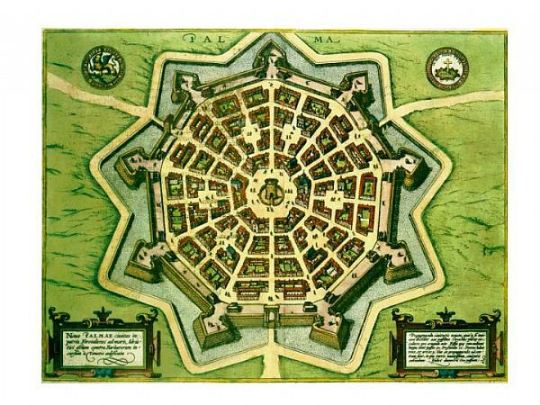
Palmanova

One of the things that most strikes me when thinking on the subject of our contemporary discourse regarding the future is just how seldom those engaged in the discussion aim at giving us a vision of society as a whole. There are books that dig deep but remain narrow  such as Eric Topol’s: The Creative Destruction of Medicine: How the Digital Revolution Will Create Better Health Care, and George Church’s recent Regenesis: How Synthetic Biology Will Reinvent Nature and Ourselves. Many of these books are excellent, but one walks away from reading them with a good idea of where a particular field or part of our lives might be headed rather than society as a whole.

Even when authors try to extend the reach of speculation out more broadly they tend to approach things from certain lens that ends up constraining them. Steven Johnson’s Future Perfect tries to apply the idea of peer-networks to areas as diverse as politics, education, economics and the arts while Peter Diamandis, and Steven Kotler in Abundance appear to project the mindset and passions of Silicon Valley: exponential growth in computers, the D.I.Y movement, billionaire philanthropy, and the spread of the benefits of technology to the world’s poorest, into a future where human potential can finally be met.  However good these broader approaches are they seldom leave you with an idea of how all the necessary parts of the future societies they hint at and depict fit together let alone what it might be like to actually live within them.

What seems to be missing in many works on the future is the sense of a traveler’s perspective on worlds they depict. The interesting thing about being a traveler is that you both experience the society you are traveling in as an individual and are at the same time outside of it, able to take a bird’s eye view that allows you to see connections and get a sense for how the whole things fits together like an artful building designed by an architect.

We used to have a whole genre devoted to this architectonic way of looking at the future, the literature of utopia. Writing utopias may seem very different from envisioning positive versions of the future, but perhaps not as much as we might think. Like futurists, many utopian writers tried to extrapolate from technological trends. Way back in 1833, John Adolphus Etzler, wrote a utopia  The Paradise Within the Reach of All Men, that bears remarkable similarity to the arguments of Diamandis and Kotler though the technology that was thought would finally end human want was nascent industrial era machines, and Etzler embedded his argument in a narrative that gave the reader an idea of what living in such a society should look like. More famous example of such extrapolations are Edward Bellamy’ s Looking Backward, 1887 or the incomparable H.G. Wells’ A Modern Utopia, 1905.

One might object that futurism is a predictive endeavor whereas utopianism tries to prescribe what would be best and therefore what we should do. Again, I am not quite sure this distinction holds, for much of futurists writing is as much arguments about potential and are meant to coax us into some possible future, or as Diamandis and Kotler put it in Abundance: “The best way to predict the future is to create it yourself.” (239). Utopianism is at least transparent in the fact that it is being prescriptive as opposed to futurism which often tries to come across as tomorrow’s news.

I am not quite sure who we could blame for this state of affairs, but surely Friedrich Engels of  the duo Marx and Engels would bear part of the responsibility. Back in 1880 Engels in his essay Socialism: Utopian and Scientific made the case that Marxism as opposed to the utopianism such found in figures such as Robert Owen was “scientific” in that it was based upon an understanding of the future as determined. Marxists in this view weren’t trying to influence the course of history they were just responding to and playing a role in underlying forces that would unfold to an inevitable conclusion anyway.  Whether he wanted to or not, Engels had removed human agency when it came to the issue of deciding what the human future would look like, or rather he drove such agency into the shadows, unacknowledged and occult.

One might ask, what about futurism that is focused not on good scenarios at least from the author’s point of view, but bad outcomes- predictions of disaster and explorations of risk? Even here, I think, futurists are trying to shape the future as much as predict it like a fortune teller. It’s a sadistic prophet indeed who merely tells you your society will be destroyed without giving you someway to avoid that fate. Futurism that focuses on negative futures are largely warnings that we need to take steps to prevent something terrible from happening or at the very least prepare.

We can find utopian literature in this world of negative futures too or at least the doppelganger of utopia- the realm of dystopia. Indeed, dystopian literature has provided us with some of the best early warning systems we have ever had such as Yevgeny Zamyatin’s novel We which warned us about Soviet totalitarianism, Jack London’s The Iron Heel which provided us with a premonition of fascism or Aldous Huxley’s Brave New World which has proved a better reflection of the future with its depiction of the dystopia of consumer society than George Orwell’s 1984.

The one place where compelling architectonic versions of the future continue to be found is in science-fiction. Writers of science-fiction continue to play this social role, and often do so with brilliance as this praise for Kim Stanley Robinson’s recent novel 2312 attests. This teasing out and wrestling with both the positive and negative possible worlds we might arrive at given our current course or with some changes in our trajectory lend evidence to the observation that science-fiction whose surface often seems so silly is in fact the most socially and philosophically serious form of fiction we have.

Yet there are differences between science-fiction and utopian literature not the least of which is utopia’s demand to convey an architectonic vision of possible worlds. The desire in utopias to get every detail right down to how people dress and what they eat make utopian literature some of the worst we have because it takes away from the development of characters. In a utopia the normal way fiction is organized is inverted: the world portrayed is the real character whereas the protagonists and others are the mere backdrops  for this world.

Unlike much of science-fiction, the focus of utopia is more on social organization than science and technology  although even in one of the earliest and the most famous utopia- Plato’s Republic- science and technology play a role, just not in a form we would readily recognize. Plato based his work on some of the most advanced applied-sciences of his day: pedagogy, dialectical philosophy, geometry, musicology, medicine/athletics, and animal husbandry. Yet these sciences and technologies were not the driver of his utopia. They were the building blocks he used to create a certain form of social organization.

In the sense that they were often seen as proposing a blueprint for the human world utopian literature was often serious in a way science-fiction need not be. Etzler did not merely write a utopia he tried to build one in Venezuela based upon his ideas. Edward Bellamy is a mere footnote in American literature compared to the geniuses who shared the stage with him during his era: Herman Melville, Henry James or Mark Twain. Yet, Bellamy’s work was considered serious enough that it inspired clubs to debate his ideas regarding the future of industrialism all throughout the United States and  influenced real revolutionaries such as V.I. Lenin. Would any serious social thinker today dare to write a version of the future in the form of a utopia?

Perhaps what we need today is less a revival of utopia as a literary form- something it was never very good at- than a new way to imagine architectonic possible futures. Given the fact that we are a long way off from the day when a person like H.G. Wells could conjure up a vision of utopia sure in the belief that he had some working knowledge of everything under the sun this new form of utopia would need to be collaborative rather than springing from the mind of just one individual.

I can imagine gathering together a constellation of individuals from across different disciplines in a room: scientists, engineers, artists, fiction writers, philosophers, economists, social scientists etc and asking them to design together the “perfect” city. They would ask and answer questions such how their imagined city provides for its basic needs, how it is layed out, how it fits into the surrounding ecosystem, how its economy works,  how its educational system functions, its penal system. Above all it would attempt to create a society whose pieces fit together in an architectonic whole. Unlike past utopian literature, such exercises wouldn’t present themselves as somehow final and perfected, but merely provide us with glimpse of destinations to which we might go.

The Ethics of a Simulated Universe

Zhuangzi-Butterfly-Dream

This year one of the more thought provoking thought experiments to appear in recent memory has its tenth anniversary.  Nick Bostrom’s paper in the Philosophical Quarterly “Are You Living in a Simulation?”” might have sounded like the types of conversations we all had after leaving the theater having seen The Matrix, but Bostrom’s attempt was serious. (There is a great recent video of Bostrom discussing his argument at the IEET). What he did in his paper was create a formal argument around the seemingly fanciful question of whether or not we were living in a simulated world. Here is how he stated it:


This paper argues that at least one of the following propositions is true: (1) the human species is very likely to go extinct before reaching a “posthuman” stage; (2) any posthuman civilization is extremely unlikely to run a significant number of simulations of their evolutionary history (or variations thereof); (3) we are almost certainly living in a computer simulation. It follows that the belief that there is a significant chance that we will one day become posthumans who run ancestor-simulations is false, unless we are currently living in a simulation.

To state his case in everyday language: any technological civilization whose progress did not stop at some point would gain the capacity to realistically simulate whole worlds, including the individual minds that inhabit them, that is, they could run realistic ancestor simulations. Technologically advanced civilizations either die out before gaining the capacity to produce realistic ancestor simulations,  there is  something stopping such technologically mature civilizations from running such simulations in large numbers or, we ourselves are most likely living in such a simulation because there are a great many more such simulated worlds than real ones.

There is a lot in that argument to digest and a number of underlying assumptions that might be explored or challenged, but I want to look at just one of them, #2. That is, I will make the case that there may be very good reasons why technological civilizations both prohibit and are largely uninterested in creating realistic ancestor simulations. Reasons that are both ethical and scientific. Bostrom himself discusses the possibility that ethical constraints might prevent  technologically mature civilizations from creating realistic ancestor simulations. He writes:

One can speculate that advanced civilizations all develop along a trajectory that leads to the recognition of an ethical prohibition against running ancestor-simulations because of the suffering that is inflicted on the inhabitants of the simulation. However, from our present point of view, it is not clear that creating a human race is immoral. On the contrary, we tend to view the existence of our race as constituting a great ethical value. Moreover, convergence on an ethical view of the immorality of running ancestor-simulations is not enough: it must be combined with convergence on a civilization-wide social structure that enables activities considered immoral to be effectively banned.

I think the issue of “suffering that is inflicted on the inhabitants of a simulation” may be more serious than Bostrom appears to believe. Any civilization that has reached the stage where it can create realistic worlds that contain fully conscious human beings will have almost definitely escaped the two conditions that haunt the human condition in its current form- namely pain and death. The creation of realistic ancestor simulations will have brought back into existence these two horrors and thus might likely be considered not merely unethical but perhaps even evil. Were our world actually such a simulation it would confront us with questions that once went by the name of theodicy, namely, the attempt to reconcile the assumed goodness of the creator (for our case the simulator)  with the existence of evil: natural, moral, and metaphysical that exists in the world.

Questions as to why there is, or the morality of there being, such a wide disjunction between the conditions of any imaginable creator/simulator and those of the created/simulated is a road we’ve been down before as the philosopher Susan Neiman so brilliantly showed us in her Evil in Modern Thought: An Alternative History of Philosophy.  There, Neiman points out that the question of theodicy is a nearly invisible current that swept through the modern age. As a serious topic of thought in this period it began as an underlying assumption behind the scientific revolution with thinkers such as Leibniz arguing in his Essays on the Goodness of God, the Freedom of Man and the Origin of Evil that “ours is the best of all possible worlds”. Leibniz having invented calculus and been the first to envision what we would understand as a modern computer was no dope, so one might wonder how such a genius could ever believe in anything so seemingly contradictory to actual human experience?

What one needs to remember in order to understand this is that the early giants of the scientific revolution, Newton, Descartes, Leibniz, Bacon weren’t out to replace God but to understand what was thought of as his natural order. Given how stunning and quick what seemed at the time a complete understanding of the natural world had been formulated using the new methods it perhaps made sense to think that a similar human understanding of the moral order was close at hand. Given the intricate and harmonious picture of how nature was “designed” it was easy to think that this natural order did not somehow run in violation of the moral order. That underneath every seemingly senseless and death-bringing natural event- an earthquake or plague- there was some deeper and more necessary process for the good of humanity going on.    


The quest for theodicy continued when Rousseau gave us the idea that for harmony to be restored to the human world we needed to return to the balance found in nature, something we had lost when we developed civilization.  Nature, and therefore the intelligence that was thought to have designed it were good. Human beings got themselves into trouble when they failed to heed this nature- built their cities on fault lines, or even, for Rousseau, lived in cities at all.


Anyone who has ever taken a serious look at history (or even paid real attention to the news) would agree with Hegel that: “History… is, indeed, little more than the register of the ‘crimes, follies, and misfortunes’ of mankind”. There isn’t any room for an ethical creator there, but Hegel himself tried to find some larger meaning in the long term trajectory of history. With him, and Marx who followed on his heels we have not so much a creator, but a natural and historical process that leads to a fulfillment an intelligence or perfect society at its end. There may be a lot of blood and gore, a huge amount of seemingly unnecessary human suffering between the beginning of history and its end, but the price is worth paying.

Lest anyone think that these views are irrelevant in our current context, one can see a great deal of Rousseau in the positions of contemporary environmentalists and bio-conservatives who take the position that it is us, that is human beings and the artificial technological society we have created that is the problem. Likewise, the views of both singularitarians and some transhumanists who think we are on the verge of reaching some breakout stage where we complete or transcend the human condition, have deep echoes of both Hegel and Marx.

But perhaps the best analog for the kinds of rules a technologically advanced civilization might create around the issue of realistic ancestor simulations might lie not in these religiously based philosophical ideas but  in our regulations regarding more practical areas such as animal experimentation. Scientific researchers have long recognized that the pursuit of truth needs humane constraints and that such constraints apply not just to human research subjects, but to animal subjects as well. In the United States, standards regarding research that use live animals is subject to self-regulation and oversight based on those established by the Institutional Animal Care and Use Committee (IACUC). Those criteria are as follows:

The basic criteria for IACUC approval are that the research (a) has the potential to allow us to learn new information, (b) will teach skills or concepts that cannot be obtained using an alternative, (c) will generate knowledge that is scientifically and socially important, and (d) is designed such that animals are treated humanely.

The underlying idea behind these regulations is that researchers should never unnecessarily burden animals in research. Therefore, it is the job of researchers to design and carry out research in a way that does not subject animals to unnecessary burdens. Doing research that does not promise to generate important knowledge, subjecting animals to unnecessary pain, doing experiments on animals when the objectives can be reached without doing so are all ways of unnecessarily burdening animals.

Would realistic ancestor simulations meet these criteria? I think realistic ancestor simulations would probably fulfill criteria (a), but I have serious doubts that it meets any of the others. In terms of simulations offering us “skills or concepts that cannot be obtained using an alternative” (b), in what sense would a realistic simulations teach skills or concepts that could not be achieved using something short of such simulations where those within them actually suffer and die? Are there not many types of simulations that would fall short of the full range of subjective human experiences of suffering that would nevertheless grant us a good deal of knowledge regarding such types of worlds and societies?  There is probably an even greater ethical hurdle for realistic ancestor simulations to cross in (c), for it is difficult to see exactly what lessons or essential knowledge running such simulations would bring. Societies that are advanced enough to run such simulations are unlikely to gain vital information about how to run their own societies.

The knowledge they are seeking is bound to be historical in nature, that is, what was it like to live in such and such a period or what might have happened if some historical contingency were reversed? I find it extremely difficult to believe that we do not have the majority of information today to create realistic models of what it was like to live in a particular historical period, a recreation that does not have to entail real suffering on the part of innocent participants to be of worth.

Let’s take a specific rather than a general historical example dear to my heart because I am a Pennsylvanian- the Battle of Gettysburg. Imagine that you live hundreds or even thousands of years into the future when we are capable of creating realistic ancestor simulations. Imagine that you are absolutely fascinated by the American Civil War and would like to “live” in that period to see it for yourself. Certainly you might want to bring your own capacity for suffering and pain or to replicate this capacity in a “human” you, but why do the simulated beings in this world with you have to actually feel the lash of a whip, or the pain of a saw hacking off an injured limb? Again, if completely accurate simulations of limited historical events are ethically suspect, why would this suspicion not hold for the simulation of entire worlds?

One might raise the objection that any realistic ancestor simulation would need to possess sentient beings with free will such as ourselves that possess not merely the the ability to suffer, but to inflict evil upon others. This, of course, is exactly the argument Christian theodicy makes. It is also an argument that was undermined by sceptics of early modern theodicy- such as that put forth by Leibniz.    

Arguments that the sentient beings we are now (whether simulated or real) require free will that puts us at risk of self-harm were dealt with brilliantly by the 17th century philosopher, Pierre Bayle, who compared whatever creator might exist behind a world where sentient beings are in constant danger due to their exercise of free will to a negligent parent. Every parent knows that giving their children freedom is necessary for moral growth, but what parent would give this freedom such reign when it was not only likely but known that it would lead to the severe harm or even death of their child?

Applying this directly to the simulation argument any creator of such simulations knows that we will kill millions of our fellow human beings in war and torture, deliberately starve and enslave countless others. At least these are problems we have brought on ourselves,but the world also contains numerous so-called natural evils such as earthquakes and pandemics which have devastated us numerous times. Above all, it contains death itself which will kill all of us in the end.    

It was quite obvious to another sceptic, David Hume, that the reality we lived in had no concern for us. If it was “engineered” what did it say that the engineer did not provide obvious “tweaks” to the system that would make human life infinitely better? Why, are we driven by pain such as hunger and not correspondingly greater pleasure alone?

Arguments that human and animal suffering is somehow not “real” because it is simulated seem to me to be particularly tone deaf. In a lighter mood I might kick a stone like Samuel Johnson and squeak “I refute it thus!” In a darker mood I might ask those who hold the idea whether they would willingly exchange places with a burn victim. I think not! 

If it is the case that we live in a realistic ancestor simulation then the simulator cares nothing for our suffering on a granular level. This leads us to the question of what type of knowledge could truly be gained from running such realistic ancestor simulations. It might be the case that the more granular a simulation is the less knowledge can actually be gained from it. If one needs to create entire worlds with individuals and everything in them in order to truly understand what is going on, then the results of the process you are studying is either contingent or you are really not in possession of full knowledge regarding how such worlds work. It might be interesting to run natural selection over again from the beginning of life on earth to see what alternatives evolution might have come up with, but would we really be gaining any knowledge about evolution itself rather than a view of how it might have looked had such and such initial conditions been changed? And why do we need to replicate an entire world including the pain suffered by the simulated creatures within before we can grasp what alternatives to the path evolution or even history followed might have looked like. Full understanding of the process by which evolution works, which we do not have but a civilization able to create realistic ancestor simulations doubtless would, should allow us to envision alternatives without having to run the process from scratch a countless number of times.

Yet, it is in the last criteria (d) that experiments are  “designed such that animals are treated humanely” that the ethical nature of any realistic ancestor simulation really hits a wall. If we are indeed living in an ancestor simulation it seems pretty clear that the simulator(s) should be declared inhumane. How otherwise would the simulator create a world of pandemics and genocides, torture, war, and murder, and above all, universal death?

One might claim that any simulator is so far above us that it takes little concern of our suffering. Yet, we have granted this kind of concern to animals and thus might consider ourselves morally superior to an ethically blind simulator. Without any concern or interest in our collective well-being, why simulate us in the first place?

Indeed, any simulator who created a world such as our own would be the ultimate anti-transhumanist. Having escaped pain and death “he” would bring them back into the world on account of what would likely be socially useless curiosity. Here then we might have an answer to the second half of Bostrom’s quote above:


Moreover, convergence on an ethical view of the immorality of running ancestor-simulations is not enough: it must be combined with convergence on a civilization-wide social structure that enables activities considered immoral to be effectively banned.

A society that was technologically capable of creating realistic ancestor simulations and actually runs them would appear to have on of two features (1) it finds such simulations ethically permissible, (2) it is unable to prevent such simulations from being created. Perhaps any society that remains open to creating such a degree of suffering found in realistic ancestor simulations  for anything but the reason of existential survival would be likely to destroy itself for other reasons relating to such lack of ethical boundaries.

However, it is (2) that I find the most illuminating. For perhaps the condition that decides if a civilization will continue to exist is its ability to adequately regulate the use of technology within it. Any society that is unable to prevent rogue members from creating realistic ancestor simulations despite deep ethical prohibitions is incapable of preventing the use of destructive technologies or in managing its own technological development in a way that promotes survival. A situation we can perhaps see glimpses of in our own situation related to nuclear and biological weapons, or the dangers of the Anthropocene.

This link between ethics, successful control of technology and long term survival is perhaps is the real lesson we should glean from Bostrom’s provocative simulation argument.

To see forward, look back!

Thomas Cole the Course of Empire

“The farther backward you look, the farther forward you are likely to see.”  

Winston Churchill


The above quote is taken from Ian Morris’ recent and fascinating Why the West Rules- For Now: The patterns of history and what they reveal about the future.  Indeed, the whole point of Morris’ book can be seen in Churchill’s quip. Morris, a trained archaeologist and historian, aims to find a pattern in the broad arc of human history beginning with the birth of civilization, take us into the present age, and project current trends outward into the next century and perhaps beyond.

This is, needless to say, a pretty ballsy thing to do, at least if one wants to remain safe in the cocoon of respectable academia where scholars can spend a decade glued like a car door on Magneto to a subsection of one obscure historical text, or stuck for seven years, as Morris himself was, to the excavation of one ancient room.  Writing a meta-narrative like Morris’ is somewhat less ballsy if one intends to enter that rare breed of academic/journalist that has managed to reach the publishing industry’s version of celebrity status. Perhaps the fastest way to reach the top of today’s non-fiction bestseller list is to write a book with the words “America” or the “West” with the verb “decline” attached or- perhaps the flip-side- the words “China” and “Rise”. And who could blame the public for lapping this stuff up, hell, with “Euro-crises”, and “fiscal cliffs” and “debt ceilings” all over the news when everything in the rest of the world, and China especially, seems a go-go-go?    

Morris, however, is not some poor soul lost forever to the seriousness of academia and possessed by the spirit of Oswald Spengler, nor is he some dry professor presenting yet another version of those angels- on- the- head- of- a- pin arguments that force closed the eyelids of popular readers. Rather, he has managed the seemingly impossible task of presenting serious scholarship in a way that succeeds in keeping readers not only engaged but entertained. His book is full of creative leaps in which he uses the instruments and insights from one field of human intellectual and artistic endeavor to help understand history in new ways. Above all, Morris takes seriously what are in fact very important questions- problems which modern historians burned by the hubris and prejudice of their 19th and early 20th century predecessors tend to ignore, questions which nonetheless, should be important to all of us as human beings- where did we come from? and where are we going?

The way that Morris frames these questions of origins and destiny is to see them through the prism of the “rise of the West”. Is this Euro-centric? Perhaps, but the facts remain that it was from an obscure corner of Eurasia that the first civilization arose that managed to tie the globe together into one unit, that it was from there that a brand new form of civilization emerged a scientific-industrial-technological civilization that would force all the world to adapt to it or face decline and domination. Why this happened, and where this process unleashed by the West might be leading is not a matter of increasing Westerner’s self-esteem in a period where the two cores of Western civilization- Europe and the United States- seem to be racing one another down the slope of decadence and decline, but are questions that should concern everyone regardless of the accidents of geography.

Morris is trained as an archaeologist specializing in the classical age in the West. One might, therefore, expect him to fall into the category of those 19th century historians who thought there was something very special about the West culturally, or some, with tragic effects argued racially, about the West that made its dominance over the rest of the world’s cultures inevitable. Usually these “long-term lock-in” theories start from something about the ancient Greeks and how they escaped the hold of superstition by the application of reason to both nature and society.

Morris grapples with these explanations from culture only to dismiss them. There are just far too many periods in history where civilizations other than the West hold first place in the realms of science and technology. Think, for example, of what are considered the penultimate technologies that launched the modern age: long range sailing ships, the compass, the printing press and gunpowder. All of these were invented in China.

Something historians attempting to compare civilizations or talking about their rise or decline is by what basis do you say one civilization is more “advanced” than another? How can you tell if a civilization is rising or declining?

It is in coming up with a new way to answer these questions that Morris makes the first of his many leaps found in Why the West Rules, For Now. Morris turns to a model from contemporary development studies- the UN Human Development Index (HDI) which is a combined statistic that compares development between countries on measures such as life-expectancy, education and income as a template for creating his own measure that will allow him to compare levels of development historically between countries and across an historical period that begins with the appearance of civilization in the “Hilly Flanks” of the modern Middle East with the Neolithic Revolution around 12,000 years ago.

Morris comes up with four key measures that allow him to compare development between civilizations and across time: energy capture (how much energy is taken for work), organizational capacity (measured by the size of urban centers), information technology (measured by literacy rates) and military capacity (measured by the size of armies).  Morris is well aware that he should not give a value judgment to scores on his scale, and he also fully admits that what he has invented is a rather rough instrument. His is a starting point for a larger discussion- not the final destination.

Applying his measure to history since the dawn of civilization here is what he finds:The West, meaning not just Europe, but the western half of Eurasia and North Africa beginning in Mesopotamia was indeed ahead in developmental terms from Eastern civilization, whose core he place in China, for much of its history. Only in the late middle ages from around 900 AD- 1700 AD was the East ahead of the West. Yet, in a version of the theory put forward by Jared Diamond in his landmark Germs Guns and Steel, Morris argues that the fact that the West was for so long more advanced than the East according to his measure is to be explained not in terms of culture but as a consequence of geography.

Intensive agriculture along with permanent human settlements emerged around 12,000 years ago in a region known as the “Hilly Flanks” an area on the edge of the area around the Tigris and Euphrates. Why here? It just so happens that this area has an overwhelming number of that very small group of naturally occurring plants and animals that are suitable for domestication. Agriculture in the Hilly Flanks spread to the nearby Tigris and Euphrates valley in which, under harsh conditions of a new Ice Age it gave rise to what we would recognize as both cities and states which had grown up as solutions to the problem of how to provide food under conditions of intense scarcity.

The West had a further geographic advantage over the East after the center of its civilization moved into the Mediterranean whose sea provided a transmission belt for food, products, people and ideas. Even after China built its Grand Canal it would have nothing to compete with the Mediterranean. The Roman Empire took the West to the very height of social development in terms of Morris’ scale-the number of trees felled for fuel, of cities at a massive scale, soldiers armed for war, or literate persons would not return to those found in the Roman Empire in its height- for Western countries that is- until the 1700s. Rome had hit what Morris calls a “hard-ceiling” and was eventually felled by his “four horsemen of the apocalypse”: climate change, famine, state failure, and disease”.

After 900, China with its Song Dynasty finally caught up to and surpassed the West reaching Roman levels of social development according to Morris’ measure. How exactly it was able to do this isn’t exactly clear, but certainly part of it had to do with the incorporation of rice producing regions in China’s south- perhaps facilitated by climate change. China’s relative isolation would have offered it some protection against epidemic diseases and it had come up with an effective “barbarian policy” that at the very least allowed China to avoid the fate of a city such as Baghdad that around 1200 was absolutely destroyed by a Mongolian horde.

In any case, with the discovery of the Americas in the 1400s the West would begin its crawl back to the levels of social development found in the Roman Empire this time by creating a new version of the Mediterranean world in the Atlantic Civilization and its Columbian Exchange. But by the 1700s when Thomas Malthus realized that all civilizations in the past had collapsed once their population overran their ability to produce food, it seemed like the hard-ceiling was about to be hit again, only this time, as Kenneth Pomeranz pointed out in his The Great Divergence the West would find in the industrial revolution a way not just to poke above the hard-ceiling, but to shatter it.

Here’s what it looks like as a graph:

Ian Morris Great Divergence Graph   


The last 200 or so odd years have essentially been the story of the West taking advantage of this new form of industrial civilization it created to dominate the rest of the globe until non-Western societies adopted and replicated it. Now that countries such as China and India have embraced modernization the fate of the rule of the West is written on the wall. Within a century, the great divergence will have run its course, and perhaps that’s the big story under today’s headlines. But Morris doesn’t think so.

Instead, what he sees is another hard-ceiling out ahead which unless we break through it may result in the end of civilization, what he, borrowing from Isaac Asimov calls Nightfall. If one takes one of Morris measures, say urbanization, and plays out the trend line, what one gets is cities on the order of 140 million people! He sees no way of measuring up to these trend lines unless the hopes of the singularians for radical technological change within the next half century prove correct. The four horsemen of
climate change, famine, state failure, and disease are already out of their stable and only a breakthrough of greater magnitude than the industrial revolution would prove capable of pushing them back in.

If we fail to achieve a breakthrough our particular civilization’s collapse- accompanied by nuclear weapons- will likely, according to Morris, be the last. For him, like the title of this blog the future is one of either utopia or dystopia.

Pinker, Foucault and Progress

Panopticon (1)

As readers may know, a little while back I wrote a piece on Steven Pinker’s Better Angels of Our Nature a book that tries to make the case that violence has been on a steady decline throughout the modern era. Regardless of tragedies such as the horrendous school shooting at Newtown, Pinker wants to us know that things are not as bad as they might seem, that in the aggregate we live in the least violent society to have ever existed in human history, and that we should be thankful for that.

Pinker’s book is copiously researched and argued, but it leaves one with a host of questions. It is not merely that tragic incidents of violence that we see all around us seem to fly in the face of his argument, it is that his viewpoint, at least for me, always seems to be missing something, to have skipped over some important element that would challenge its premise or undermine its argument, a criticism that Pinker has by some sleight of hand skillfully managed to keep hidden from us.

I think an example of this can be seen in Pinker’s treatment of the decline of torture and fall in the rates of violent crime. Both of these developments, at least in Western countries, are undeniable. The question is how are these declines to be explained.  What puzzled me is that Pinker nowhere even mentions the work of the late philosopher, Michel Foucault,  a man who whatever the flaws and oversimplifications of his arguments, thought long  and hard about the questions of both torture and crime. In fact, Foucault is the scholar whose work is most associated with these questions.  It is a very strange oversight, for Pinker does not bring up Foucault even briefly to dismiss his views.

It seems, I am not the only person who asked this question for on his website addressing frequently asked questions Pinker gives the following explanation for ignoring Foucault:

Questioner: You obviously must discuss Michel Foucault’s Discipline and Punish, the book that explains the decline of judicial torture in Europe.

Pinker: Actually, I don’t. Despite being a guru in the modern humanities, Foucault is not the only scholar to have noticed that European states eliminated gruesome punishments, and his theory in particular strikes me as eccentric, tendentious, and poorly argued. See J. G. Merquior “Charting carceral society” in his book Foucault (UC Press, 1985), for a lucid deconstruction.

I wanted to see what this “lucid deconstruction” of Foucault by  Merquior (Pinker is nothing if not clever- Foucault is a patron saint to literary deconstructionist), so I checked it out.

Here is how Merquior introduces Foucault’s Discipline and Punish:

 Foucault once called it ‘my first book’ and not without reason: for it is a serious contender for first place among his books as far as language and structure, style of organization and ordering of parts go. It is not a bit less engrossing than Madness and Civilization, nor less original than the order of things.  Once again Foucault unearths the most unexpected of primary sources; once again his reinterpretation of the historical record is as bold as it is thought provoking.” ( Foucault p. 86)

This is the guy Pinker asks us to turn to for a rebuttal of Foucault?

Merquior does have some very valid arguments to make against Foucault, more on that towards the end, but first the views that Pinker does not discuss- Foucault’s view of the rise of the prison.

The theory that Foucault lays out in his Discipline and Punish which provides a philosophical history of the modern prison is essentially this: The prison emerged in the late 18th and 19th centuries not as a humanitarian project of Enlightenment philosophes, but as a disciplinary apparatus of society in conjunction with other disciplinary institutions- the insane asylum, the workhouse, the factory, the reformatory, the school, and branches of knowledge- psychology, criminology, that had as their end what might be called the domestication of human beings. It might be hard for us to believe but the prison is a very modern institution- not much older than the 19th century. The idea that you should detain people convicted of a crime for long periods perhaps with the hope of “rehabilitating” them just hadn’t crossed anyone’s mind before then. Instead, punishment was almost immediate, whether execution, physical punishment or fines. With the birth of the prison,  gone was the emotive wildness of the prior era- the criminal wracked by sin and tortured for his transgression against his divine creator and human sovereign. In its place rose up the patient, “humane” transformation of the “abnormal”, “deviant” individual into a law and norm abiding member of society.

For Foucault, the culmination of all this, in a philosophical sense, is the Panopticon prison designed by Jeremy Bentham (pictured above). It is a structure that would give prison officials a 24/7 omniscient gaze into the activities of the individual prisoner and at the same time leaves the prisoner completely isolated and atomized. In the panopticon Foucault sees the metaphor for our own homogenizing conformist and totalizing society.

What Foucault succeeded in doing in Discipline and Punish was putting the horrific judicial torture of the pre-Enlightenment era and post-Enlightenment policy of mass imprisonment side-by-side. In doing this he goads us to ask whether the system we have to today is indeed as humane, as enlightened, compared to what came before as we are prone to believe.

This is exactly what Pinker responding to a question on imprisonment does not allow us to do:

Questioner:What about the American imprisonment craze?

Pinker: As unjust as many current American imprisonment practices are, they cannot be compared to the lethal sadism of criminal punishment in earlier centuries

Okay, true enough, but for me, this answer misses the point of the question. The underlying assumption behind the question seems to be “yes, violence might have declined, but isn’t locking up millions of people – six million to be exact – a number larger than those of Stalin’s gulag archipelago, 60 % of whom are there for nonviolent offenses, a form of violence?” Or perhaps “might the decline in violence be the result of mass imprisonment?” Admitting either would force Pinker to accept that the moral progress he details is perhaps not as unequivocal as he wants us to believe.

Here, I think, is where Pinker’s attachment to the Enlightenment idea of progress leads clearly to complacency. Pinker loves graphs, so here’s a graph:

U.S._incarceration_rates_1925_onwards

Source: http://en.wikipedia.org/wiki/United_States_incarceration_rate

It seems frankly obtuse to not connect the decline in crime with the sheer number of people now being locked up. It is tragic, but the connection between rising rates of imprisonment and declining crime rates can be seen even in Pinker’s vaunted Western Europe where the rate of imprisonment rose– though to nothing like the obscene rate it rose in the United States- and the crime rate fell in tandem.

Yet, unless the scale of imprisonment is put in context we are likely to see imprisonment of nonviolent offenders as less than morally problematic, and merely as an unfortunate consequence of the need to protect ourselves from violent crime by throwing the net of criminal justice as wide as it can be thrown, something Pinker seems to do when he states:

A regime that trawls for drug users or other petty delinquents will net a certain number of violent people as a by-catch, further thinning the ranks of the violent people who remain on the streets. (BA 122)

The strange thing here is that the uniquely American practice of locking up every law breaker without distinguishing between the risks posed by the accused is not only clearly disproportional and unjust it has makes no apparent effect on the actual rate of violent crime. The US incarcerates a whopping 743 persons per 100,00 whereas Great Britain lock up 154 per the same amount  and the US still has an intentional homicide rate 4 times higher than in the UK.

By seeing modern history almost exclusively through the lens of moral progress, Pinker blinds himself to the question of whether or not our own age is engaged in practices that a more progressive future will regard with horror.

The question of imprisonment and its relationship to the decline of crime is not the only place where Pinker in his Better Angels of Our Nature dismisses a messy, often harsh, reality in the name of a simplified Enlightenment notion of progress. This can be seen in Pinker’s notions regarding contemporary slavery and war.

In a strange way, Pinker’s insistence that we recognize the reality of moral and social progress might short-circuit our capacity for progress in the future. You can see this in his treatment of “human trafficking” a modern day euphemism for slavery. As always, Pinker wants to let us know that current figures are exaggerated, as always, he reminds us that what we have here is no comparison to the far crueler reality of slavery found in the past. But this viewpoint comes at the cost of continuity. Anti-slavery advocates such as those of the organization Free the Slaves assume a moral continuity between themselves and the earlier abolition movements- and well they should. But Pinker’s rhetoric is less “we have almost reached the summit” than one of undermining the moral worth of their struggle with his damned proportionality- that things are better than ever now because “proportional to world population” not as many people are murdered, die in war, or are enslaved.

Numbers off or not- anywhere even in the ballpark of 25 million slaves today- the high estimate- still constitute an enormous amount of human suffering- such as innumerable rapes, beatings, and forced labor (no doubt Pinker would try to put a number on them)- suffering Pinker does not explore.

What holds for slavery in Better Angels holds for war as well. He is at pains to point out the casualty figures of the most savage conflict of the last generation- a conflict most westerners have probably not even heard about- The Great War of Africa– are grossly exaggerated, that the war only killed 1.5 million- not the 5 million human beings often reported.

Pinker’s right about one thing- wars between the world’s most powerful states have, at least for the moment disappeared.Wars between the great powers have always been the greatest killers in history, and we haven’t had any of those since 1945, and the question is- why? Pinker will not allow the obvious answer to his question, namely, that the post 1945 era is the age of nuclear weapons, that for the first time in history, war between great powers meant inevitable suicide. His evidence against the “nuclear peace” is that more nations have abandoned nuclear weapons programs than have developed such weapons. The fact is perhaps surprising but nonetheless accurate. It becomes a little less surprising, and a little less encouraging in Pinker’s sense, when you actually look at the list of countries who have abandoned them and why. Three of them: Belarus, Kazakhstan and the Ukraine are former Soviet republics and were under enormous Russian and US pressure- not to mention financial incentives- to give up their weapons after the fall of the Soviet Union. Two of them- South Africa and Libya- were attempting to escape the condition of being international pariahs. Another two- Iraq and Syria had their nuclear programs derailed by foreign powers. Three of them: Argentina, Brazil, and Algeria faced no external existential threat that would justify the expense and isolation that would come as a consequence of  their development of nuclear weapons and five others: Egypt, Japan, South Korea, Taiwan and Germany were woven tightly into the US security umbrella.

Countries that face a perceived existential threat from a nuclear power or conventionally advanced power (and Argentina never faced an existential threat from Great Britain, that is Britain never threatened to conquer the county during the Falklands War) would appear to have a pretty large incentive to develop nuclear weapons insofar as they do not possess strong security guarantees from one of the great powers.

Pinker believes that Kant’s democratic peace theory (that democracies tied together by links of trade and international organization do not fight one another) helps explain the decline of war, but that does not explain why the US and Soviet Union did not go to war or India and Pakistan, or Taiwan and China, or South and North Korea. He pins his hopes on the normative change against nuclear weapons found in a Global Zero a movement that includes an eclectic  group of foreign policy figures including realists such as Henry Kissinger that hopes to rid the world of nuclear weapons.

While I find the goal of a nuclear weapons free world laudable, the problem I see in this is that weaker powers lacking advanced conventional weapons could very well understand this movement as a way for the big powers to preserve the rationality of war. In fact, the worse thing imaginable would be for great power war to regain its plausibility. If the recent success of Israel’s  “Iron Dome” is any indication we may end up there even without the world abandoning its nuclear weapons. Great powers, such as the US and China, may be more likely to engage in brinkmanship if they start to think they could survive a nuclear exchange. Recent confrontations between China and its neighbors and East Asia’s quite disturbing military buildup do not portend well for 21st century pacifism.

Global Zero might with tragic irony prove more dangerous that the current quite messy regime if it is not followed in parallel with an effort to solve the world’s outstanding disputes and to build a post- US- as- sole- superpower security architecture-not to mention efforts to limit conventional weapons which while we were sleeping have become just as deadly as nuclear weapons as well. Where everyone feels safe there is no need for everyone to be armed to the teeth.  

Pinker recoils from messy explanations or morally ambiguous reality because he is wedded to the idea that the decline in violence was driven by a change in norms- a change that he thinks began with the Enlightenment. In his eyes, we are indeed morally superior to our predecessors in that we have a more inclusive and humane moral sense. Pinker turns to the ethical philosopher- Peter Singer- and his idea of the “escalator of reason” for a philosophical explanation of this normative change. Singer thinks that overtime human generations reason their way to inclusiveness and humanity by expanding our “circle of empathy”. Once only one’s close kin sat in the circle of concern, then fellow members of one’s state or faith, now perhaps all of humanity or, as Singer himself is most famous for in his Animal Liberation, the circle can be extended to non-human species.


Singer, however, is an odd duck to peg yourself to as a kind of philosophical backdrop for modern moral progress. A reader of Better Angels who did not know about Singer would be left unaware of just how controversial Singer’s views are. If memory serves me correctly, this fact that his views are something less than mainstream is tucked away in a footnote at the back of Pinker’s book.

Here is Singer from his  Writings on an Ethical Life:

When the death of a disabled infant will lead to the birth of another infant with better prospects of a happy life, the total amount of happiness will be greater if the disabled infant is killed. (189)

I should be clear here that Singer is not talking about abortion, but infanticide, indeed he sees both practices as acceptable and morally equivalent:

That a fetus is known to be disabled is a widely accepted grounds for abortion. Yet in discussing abortion, we saw that birth does not mark a morally significant dividing line.  I can not see how one could defend the view that fetuses may be “replaced” before birth, but newborn infants may not be” (191)

If this is the escalator of reason I want to get off.

Much as with the case with Foucault, Pinker doesn’t spend even a page or two engaging with these ideas. With 802 pages to its name a few more pages would seem a small price to pay, but again they are ignored, perhaps largely because they detract from Pinker’s Enlightenment notions of moral progress. Even briefly grappling with these ideas, for me at least, seems to lead to all sorts of interesting and often quite disturbing possibilities that are outside the simplistic dichotomies of progress and anti-progress set up but Pinker and Foucault.

Our society has certainly made progress morally over past ages in its abolition of torture and slavery, in it’s extension of rights to the formerly oppressed , its inclusion of women in political, economic and intellectual life, its freedom of speech and thought,
not to mention the vast increases in our standards of living,  and yet…

May be our society has not so much progressed morally in the sense of empathy as it has become squeamish about violence, and physical coercion (real violence that is- media and video games seem to reveal an obsessive bloodlust).  What we have done is managed to effectively conceal violence, and wherever possible to have adopted social and psychological methods of manipulation and control- including surveillance– in place of, to use military speak, “kinetic” methods. Our factory farms kill and confine more animals than have ever suffered such a fate- only we never see it. (Perhaps that is part of the explanation for why our urbanizing world has become so squeamish about violence, the fact that so few of us are engaged in the violence against animals found in agricultural life). We do not physically torture but confine and conceal far more persons than were ever caught in the cruel but paltry nets of pre-modern states. Chattel slavery and its savagery are a thing of the past, but what we have now are millions of invisible slaves, kidnapped, locked in houses, people who are our very neighbors suffering the cruel tyranny of one human being over another.


Our wars are fought in regions deemed too dangerous to be covered by mainstream media and our images of them sanitized for prime-time viewing.  Our bloated and growing militaries represent bottled up potential energy that could level whole civilizations, indeed destroy the human species and the earth, should circumstances ever sweep us up and call it to burst forth. Yet, even our soldiers are averse to killing, so we are building machines capable of murdering more effectively and without conscience to replace them.

We do not expose our newborns on the rocks because they are girls or are disabled, but select against them in the womb so that 100 million girls have “gone missing” and whole categories of human beings are disappearing from the world, and some, such as the geneticist Julian Savulescu argue it is our “moral duty” to perform this “redesign” of the human species.

This returns me to the critic Merquior. Merquior makes the valid critique of Foucault that he is a sloppy historian, that he wants history to neatly fit his theory, which history can never do. Above all Merquior sees the flaws in Foucault’s argument stemming from his a prior position that the Enlightenment was less a humanitarian than a proto-totalitarian movement. This makes it impossible for Foucault to see the movement against torture and the creation of the modern prison system as anything more that an expression of a Nietzschean “will to power”.

But Merquior asks:

Why should the historian choose between the angelic image of a demo-liberal bourgeois order, unstained by class domination, and the hellish picture of ubiquitous coercion? Is not the actual historical record a mixed one, showing real libertarian and equalizing trends besides several configurations of class power and coercive cultural traits?  (98)  

Pinker might have done better had he employed Merquior’s critique of Foucault to himself, for, by seeing in modern developments the hand of progress from savagery to civilization, Pinker ends up blinding himself to the more complex historical picture as much as Foucault who saw in modern trends little but the move towards social totalitarianism. Indeed, Pinker could save his Better Angels by adding just one chapter as an afterward. The chapter would look at not where we have come from, but where we are and the struggles still left to us. It would provide a human face to the modern day suffering of those in our progressive age who are still enslaved and who continue to be killed and maimed by war. Those murdered and raped and those suffering behind bars for crimes that have harmed no one but themselves and those who love them. It would be a face Pinker had taken from them by turning them into numbers. It would seek to locate and avoid the many cliffs that might just plunge us downward, and say to all of us “we have just a little ways to go, but for the sake of our own enlightened legacy, we must have the forward thinking and endurance to climb onward, and above all, not to fall.”

* An earlier version of this post was published on December 30, 2011

A Utopian Reading of Pinker’s Better Angels Of Our Nature

Thomas More created the first modern version of an ideal society, giving his work the name that would stick for all such imaginings ever since, Utopia, in the year 1516.
More was an Englishman, and it might be good to gaze for a moment at the conditions for England in that year in order to gain some perspective on the changes that have since taken place.The life expectancy of an individual living in England near the year 1516 was around 38 years. That was, if you could make it to your tenth birthday. For, three out of ten children died before even reaching that age. Indeed, merely surviving up until that point depended on whether your parents had chosen to keep you alive rather than kill you shortly after birth. For, despite the prohibitions of the Church, many infants (we have no idea how many) died at the hands of their own parents who were unable to care for their newborns from either the condition of the newborn herself or the abject poverty of the infant’s family.

Famines had, thankfully, become somewhat less common in the England of the 1500s
than in prior centuries, but the lives of the island’s poorer farmers had not become any easier. The Enclosure movement, which turned England’s subsistence farms into pasture for sheep tossed many of the peasantry out into the world to fend, if they could, for themselves.  Thomas More himself, coming at the issue from a Christian-Humanist perspective, thought enclosure was a humanitarian disaster that drove displaced English peasants into a life of crime driven not by the evils of human nature but by hunger and extreme poverty. An issue he explores in Utopia.

The “criminals” who were caught did not have an easy time of it, and the definition of criminal, in today’s legal jargon, was an “overbroad” term. Persons could be executed not merely for murder, or even rape, robbery, and theft,  but for infractions such as “sodomy, gossiping, stealing cabbages, picking up sticks on the Sabbath, talking back to parents, and criticizing the royal garden”. During the reign of Henry VIII, the portund king who ruled in the time of Thomas More, there were “more than ten executions in London per week”. (Pinker BA 149)

Executions and punishment were not quick affairs either. Here is the punishment for a thief:

Rogues and vagabonds are often stocked and whipped; scolds are ducked upon cucking-stools (a kind of one-person see-saw) in the water. Such felons as stand mute, and speak not at their arraignment, (that is confess) are pressed to death by huge weights laid upon a board, that lieth over their breast, and a sharp stone under their backs
That’s the light stuff, I will spare you the horror show.Disease was an ever present danger as well. The Plague is only the most infamous of the diseases in the early 1500s that prematurely killed countless numbers of people,  which included;  influenza, dysentery, cholera, small pox, and a mysterious disease with the innocuous name of “English Sweat” that started with the chills and killed a person within a day.

Many of these diseases found their vector in the almost non-existent sanitary conditions of the time. Many simply threw their waste, including human waste, out onto the street.

As a further indicator of the general lack of sanitation and personal hygiene,Thomas More’s great friend, Erasmus, wrote one of the first books on manners that commended people urinating in public to face a wall rather than piss into public sight, refrain from licking their food dishes, or wiping their snotty noses onto tablecloths.

The 1500s and 1600s would witness cultural pandemics as well. Witch mania in which would leave up to 80,000 women in Europe dead, a large number by burning. If this was on the one hand a reflection of how horribly off course European religious ideas were moving, it is also gives us a glimpse into just how vulnerable lower-class women, lacking the protections of being the “property” of well-born males, were to the madness of clergy and crowd.

Witch burning, and public executions would pale, however, before the surge of violence of the European Wars of Religion which were just stirring as Thomas More penned his Utopia, the bloody conflict between the Catholic Church and the new Protestant groups that were sprouting up all over Europe. We would not see casualty rates like this again until the Second World War with perhaps over 5 million killed. The culmination of the conflict between Catholics and Protestants in England with the English Civil War (1642-1651) would kill a larger proportion of British citizens than World War I. (Pinker BA 142). These wars had a nationalistic or “nation-building” aspect as well, the prelude to the English Civil War was The Bishop’s War (1639-1640) a conflict that forcefully wed Scotland to England.

Thomas More himself would be caught up in the fanaticism of the European Religious Wars in many way abandoning the Christian-humanism that had informed his Utopia, for what some might call an extremist defense of Catholicism. For this, he paid with his life after having resisted the move by Henry VIII to declare himself head of the Church in England.  More was fortunately not killed in the typical way persons accused of treason were treated ,which would have been to be hung till near death, his body taken down and fastened to horses, to be pulled at until he was ripped into pieces. Rather, the executioner merely cut off his head.

If we had a time machine and brought Thomas More to England in the year 2012- almost 500 years after he wrote Utopia what would he see?

The life expectancy for an English male is now a little more than double what it was in 1516- 78 years (for women it is 82). A disturbing number, 36, infants are killed by their parents in England each year around, but we have every reason to suspect that this is not even near the number of infanticides per day in 1516.  The last peacetime famine in England proper was 1634. The last devastating pandemic was in 1918. The last act of capital punishment was in 1969. The last “witch” executed in 1684.
Today, according to British standards, the minimum provision of sanitary appliances for a private dwelling is: “One toilet for up to four people, two toilets for five people or more, a washbasin in or adjacent to every toilet, one bath or shower for up to four
people, one kitchen sink.”

The distinction in English attitudes to religion between the days of Thomas More and today can be seen in a great blog by a young ex-fundamentalist Christian, Jonny Scaramanga, called Leaving Fundamentalism which points out many of the absurdities of fundamentalism. In 1516, Jonny wouldn’t have lasted a day.

Of course, within the lifetime of people still living we did have The Second World War, which proportionally killed as many Europeans as the Wars of Religion, but we have seen nothing like it since. The very idea that Great Britain would fight another such conflict, especially against other European powers, within our lifetime, those of our children, or even the generation after them, seems, in a way it never has been before, ludicrous. Indeed, even in terms of nationalism we certainly live in a different age. Scotland looks likely to soon hold a referendum on independence from Great Britain, and absolutely no one thinks a verdict in favor of the Scotts going their own way will lead to civil war.

In other words, our time traveling Thomas More, were he to set foot in the England of today, would very likely think he had stepped into Utopia.

The side of this argument that takes note of the remarkable decline of violence in the modern era from the near end of judicial torture, of religious persecution, of slavery, of infanticide, of wife and children beating, of the use of the coercive power of the state to enforce moral norms (homosexuality, adultery), of the gratuitous abuse of animals, of genocide and politicide practiced by the big advanced powers, and the seeming disappearance of the willingness of those powers to go to war with one another is something meticulously laid out by Steven Pinker in his The Better Angels of Our Nature.  In part Pinker credits, or characterizes, this decline of violence to an expansion of human beings’ “circle of empathy”, an idea he borrows from the philosopher Peter Singer. Over time we have come to extend the kind of compassion human beings are naturally geared for, largely towards members of of own family or tribe, to other human beings, and even other animals.

Elsewhere I will offer an alternative reading of Pinker’s argument that sees these developments much less brightly than he does. For now, I will merely accept them as fact and turn my attention to Pinker’s attitude towards what I have called elsewhere “the utopian tradition”. For Pinker sees in utopia a major source of past violence, and as a consequence misses the very real and positive role the utopian imagination played in getting us to the conditions of today he so praises.

In setting out to identify both the reason the first half of the 20th century was so violent, and why, the world since has been so much less so, Pinker identifies a culprit in the rise and fall in the idea of utopia.

Why does the idea of utopia lead to violence?

“In utopia, everyone is happy forever, so its moral value is infinite”.  The scale of such a promise leads to an abandonment of any limit on the price to be paid for utopia , especially in terms of the lives of others. Pinker: “How many people would it be permissible to sacrifice to attain that infinite good? A few million can seem like a pretty good bargain.” (BA 328)

Another way in which Pinker thinks utopia inspires violence because those who oppose such an infinite good can only be motivated by its opposite- absolute evil. Pinker: “They are the only things standing in the way of a plan that could lead to infinite goodness. You do the math.”

In the mind of Pinker, utopian ideas also lead to genocide because they need to force people into a strictly laid plan:

“In utopia, everything is there for a reason. What about the people? Well groups of people are diverse. Some of them stubbornly, perhaps essentially, cling to values that are out of place in a perfect world…. “If you are designing a perfect society on a clean sheet of paper, why not write these eyesores out of the plan from the start”. (BA 329)

Pinker loves citations, and seemingly every paragraph in his 802 page Better Angels  has at least one. Except, that is, for these paragraphs, so I am not sure where Pinker is getting his version of the utopian mindset he finds so dangerous. Instead he turns to the a work by Ben Kiernan, Blood and Soil: A World History of Genocide and Extermination from Sparta to Darfur. Seemingly on the basis of that work, Pinker claims of utopian ideologies: “Time and again, they hark back to a vanished agrarian paradise, which they seek to restore to a healthful substitute for the prevailing urban decadence”. He contrasts these utopian purists to the “intellectual bazaar of cosmopolitan cities” from which grew the implicitly non-utopian, healthy and rational ideas of the Enlightenment. (BA 329).

This theory of the agrarian-utopians vs the cosmopolitan-rationalists seems to make a lot of sense, nevertheless it is wrong. If any revolution was the Enlightenment’s revolution it was the American, and many of America’s Enlightenment heavy weights spoke against the “vices” of the city and the “virtue” of the countryside. Jefferson is best known for this, but an Enlightenment thinker Pinker appears to admire even more- James Madison- was an agro-phile as well. Here’s Madison:

“Tis not the country that peoples either the Bridewells or the Bedlams. These mansions of wretchedness are tenanted from the distresses and vices of overgrown cities” (If Men were Angels p. 90).

Pinker is certainly right in asserting that a certain group of utopian ideologies: French Revolutionaries, Soviet Communists, Maoists in China and elsewhere, and Islamic Jihadists are a group with an incalculable amount of blood on their hands. He uses a  quote from the most blood-soaked of the French Revolutionaries as evidence that the crimes of utopians arise from their denial of human nature.

Robespierre: “The French people seem to have outstripped the rest of humanity by two thousand years; one might be tempted to regard them, living amongst them, as a different species”. (BA 186)

Yet, what is revealing to me about this quote is not its supposed denial of human nature as its clear indication that underneath Robespierre’s utopian ideology lay an idea of universal history. That is, he thought himself and his fellow revolutionaries were the people of the future, that this was ultimately where history was taking the human race, the French had just gotten there first.

And, when you look at it that way you see that all of Pinker’s bloodsoaked utopian ideologies were determinist theories of history in one way or another French Revolutionaries, yes, but also Nazis with their theory of history as a Darwinian struggle, and Soviet Communists, and Maoists with their ideas of history as a class war, and Jihadists along with Christian millennialist both of whom see history moving us towards a divine showdown.

But wait a second, isn’t Pinker’s own theory a determinist theory of history? Not if one takes his hedging at face value, but Kant’s theory which serves as a foundation of Pinker’s ideas certainly was one. Yet, neither Kant’s nor Pinker’s theories really build a positive role for violence in the movement of history. Certainly this must be the main thing: ideas that give rise to extreme violence tend to be theories of history that look at violence as somehow deeply embedded in the unfolding of history. Though, even here we need to be historically careful, for the American Civil War which resulted in abolition was itself infused with a millenarian based violence, so there is more to the story than meets the eye.

Pinker’s belief that utopian ideas are primarily a source of ideologically based violence blinds him to the way in which the idea of utopia helped move his humanitarian revolutions along. The list below is not meant to be comprehensive, and though each of these works or communities have deep flaws, when viewed from a modern perspective they no doubt helped moves things step-by-step forward to the place we are today:

Plato, The Republic: Often today viewed as a source of totalitarianism (more on that in a minute) A large part of The Republic is devoted to limiting the horrors of war- including the horrors of genocide, rape, and enslavement. The book also made the case for the political equality of women.

Thomas More, Utopia (1516): Religious tolerance: rather than heretics being killed even atheists are tolerated and encouraged to talk out their ideas. Violence: In More’s Utopia slavery is legal, but one should remember how why these slaves exists- that Utopia tries to avoid killing its enemies in war, and no longer executes common criminals. More’s use of his Utopia to criticize the inhumanity of the Enclosure movement was discussed above.

Francis Bacon, New Atlantis (1627): Imagined a society in which the general welfare of all would be raised by the application of the nascent scientific method.

Gabriel Plattes, A Description of the Famous Kingdom of Marciana (1641): Public health: “for they have an house or College of Experience where they deliver out yearly such medicines as they find out by experience and all such as shall be able to demonstrate any experiment for the health or wealth of men are honourably rewarded at the publick charge by which their skill in husbandy physick and surgery is most excellent”.

Margaret Cavendish, A Blazing World (1666): Womens’ rights, animal rights, and perhaps the first person to argue against the use of animals in scientific testing.

The Commowealth of Pennsylvania (1681): Religious Tolerance: In the 1700s no American colony so captured the European longing for utopia and paradise than my home state of Pennsylvania of which Voltaire said: ” So, William Penn might be said to have brought back the Golden Age which never existed save in Pennsylvania.”

Mary Astell,  A Serious Proposal to the Ladies (1694): Women’s rights, famous for her quote: “If all men are born free, how is it that all women are born slaves?”

David Hume, Idea of a Perfect Commonwealth (1742): The classical liberal’s utopian: separation of powers, extension of the franchise to all of the propertied, decentralization, separation of church and state.

Sarah Scott,  A Description of Millenium Hall and the Country Adjacent (1762): Women’s rights, universal education, and liberal economic equality.

Immanuel Kant, On Perpetual Peace (1802): Another classical liberal’s utopian: How the expansion of representative democracy, trade, and international law might result in the disappearance of war from human history.

Anonymous: Equality: a history of Lithconia (1802): Retirement, old age pensions.

Robert Owen’s Community at New Harmony (1824): In the midst of the horrendous working conditions of the early industrial revolution, Owen established experimental communities that tried to improve the general conditions of workers.

Northampton Association’s Abolitionist Utopia (1842): In 1842, a group of radical abolitionists and social reformers established the Northampton Association of Education and Industry, a utopian community in western Massachusetts organized around a collectively owned and operated silk mill. Members sought to challenge the prevailing social attitudes of their day by creating a society in which “the rights of all are equal without distinction of sex, color or condition, sect or religion.”

John Stuart Mill, Principles of Political Economy 3rd Edition (1852): Usually considered among the classical liberals, Mill postulates here an end to the logic of endless economic growth instead giving way to concentration of human beings moral and intellectual growth.

Jean-Baptiste Andre-Godin’s Phalanstery for Workers Families (1871): Another utopian experiment in ways to alleviate the miserable conditions of industrial workers.

H.G. Wells, A Modern Utopia (1905): Equal rights for women. Animal rights.

Aldous Huxley, Island (1962): Sexual liberation. Decriminalization of drug use.

The Civil Rights Movement 1960s: The Civil Rights Movement grew directly out three utopian claims. The first an Enlightenment claim of human equality, the second a Christian-millennialist claim of an age of universal brotherhood “I have a dream”,
and lastly the utopian aspirations of non-violence found in Ghandi.

1960’s Communes, Anti-War, and the birth of the Internet: The commune movement of the 1960s may seem in retrospect silly, and much of it was, but it did have some positive effects: it was part of the larger anti-war movement that put a premium on non-violence “all you need is love”, and many of its members went on to create what they thought would be the next liberating technology- the Internet.

Ernest Callenbach, Ecotopia: The Notebooks and Reports of William Weston (1975): Biodiversity: An increased status for natural animals, plants, and ecosystems.

So, if the utopian tradition played such an obvious role in the expansion of Pinker’s (and Singer’s) circle of empathy, indeed, if it played such an obvious role in the other utopian trends seen in modern life, how does Pinker miss it? My guess, is that his views have been biased by the work of two influential authors on the subject of utopia, the historian, Karl Popper, and Pinker himself.

Karl Popper was just the most prominent of scholars after the Second World War who in trying to understand what went wrong laid their finger on utopia. In his, Open Society and Its Enemies, Popper especially indicted Plato, Hegel, and Marx as three figures who had lead the world down a dangerous path to believing that utopian projects could be brought into reality, and that this had resulted in the great bloodshed of the 20th century.

Popper was reasonably reacting against what is called “The Authoritarian High Tide of Modernism”, which included among other things the belief by intellectuals that society could be re-engineered in whatever way they deemed. Popper wanted policy makers to adopt instead the viewpoint of “piecemeal social engineering” rather than think society’s problems might be fixed all at one go. Nothing wrong with that. The problem is more one of association. By bringing Plato, who had merely imagined an alternative society to his own, and by reading him out of his historical context with the eyes of a modern liberal whose society had morally and intellectually evolved by leaps and bounds over the world in the times of Plato- Popper seemed to indict the utopian tradition in its entirety.

Popper’s association of the attempt to redesign society whole cloth with inevitable violence is blind to the reality of what almost all real world utopias were- small scale experiments that grew out of the political, economic, and social problems of their day that while they almost universally would ultimately fail- killed no one, insofar as one makes exceptions for those few cases where the “utopia” in question was in reality a religious or New Age cult.

Just how far this downgrading of utopia has gone is reflected in the conservative writer, Mark Levin’s recent best selling book, Ameritopia, where Levin uses Popper’s mis-association of utopia with mass murder, to indict accomplishments in Western societies that utopian movements were often in the forefront of, such as old age pensions (Social Security), and government funded health care.

Still, if Popper was one of the influences that lead Pinker to his misreading of utopia there is also the influence of Pinker upon himself. Better Angels of Our Nature should be read in conjunction with his earlier book The Blank Slate to best understand where Pinker is coming from.

In The Blank Slate Pinker was responding to two phenomena in American academia in the 1990’s, the first was political correctness, and the second was the resistance to, or even the unwillingness to engage with, the rising fields of sociobiology and evolutionary psychology by many members of the academy.

I was a college student in the 1990s, so I know what Pinker means by political correctness. There was a general sense that any willingness to engage with conservative ideas or traditional morality somehow tainted one in the eyes of professors as a closet fascists, racists, misogynist, or homophobe. I think the reason for this is that many participants in the revolutionary 1960’s, unable to really change American society through the government, found themselves in the academy, something that encouraged groupthink, and given the resurgence of conservatism in the larger American society at the time led to a sense of siege that left made academics particularly prickly whenever such ideas found were expressed by students. Both the retirement of this generation of professors, and the obvious traction their ideas now have in the larger society seem likely to end this state of affairs.

But the primary thing Pinker is out to defend in his Blank Slate is the attitude towards the resurgence of the  human sciences of sociobiology and evolutionary psychology a
resurgence that began with the publication of E.O. Wilson’s Sociobiology the New Synthesis in 1975. Academics, most notably the late Stephen Jay Gould were particularly concerned with any attempts to explain human nature in terms of evolution, both because it appeared to justify an oppressive status quo and because of the association of these ideas with both past US racism, and the genocidal nature of the Nazi regime, an argument Gould and others made in their 1975 essay, Against Sociobiology.  

This overreaction to Wilson is understandable given the historical context- it was, after all, only 30 years since the defeat of the Nazis, and less than that from the victories of both the Civil and the Woman’s’ Rights Movement. Again, time seems to have ironed out these differences and sociobiology and evolutionary psychology have joined the rank of mundane social sciences- though in some sense the dystopian anxieties of Gould and others regarding these fields might ultimately prove to have some basis.

Pinker, in some ways correctly, associates utopia with the idea of the human mind and character as a blank slate, and sets out in his work of the same title to disprove that view of human nature. Pinker divides the intellectual world into two camps- those with what he calls a “Tragic Vision” which is conservative and sees human nature as largely unchangeable and those with a “Utopian Vision” who see human nature as a “blank slate” upon which what humans are can be redefined. He himself thinks that science backs up the Tragic Vision, and therefore sides with it, writing:
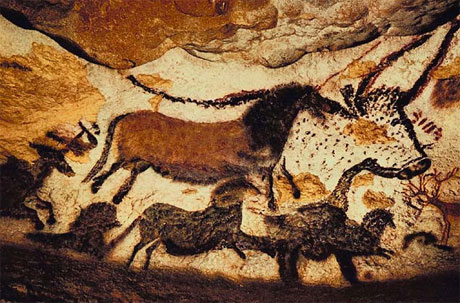

“My own view is that the new sciences of human nature really do vindicate some version of the Tragic Vision and undermine the Utopian outlook that until recently dominated large segments of intellectual life.” (BS 294)
The problem here is on the one hand the seeming incongruence with the argument Pinker lays out in his Better Angels, that human society had progressed away from violence and discrimination in the modern era;  far too short for any evolutionary changes to human beings to have truly taken place, and in seeming contradiction to every existent human society that had come before. Indeed, what Pinker sees as the false science based on the idea of the mind as a blank slate may have been wrong, but, nevertheless, was an an assumption behind many of the factors Pinker credits with leading to our current era of non-violence including universal education, non-coercive methods of child rearing, equal rights for women etc.The “new human sciences” might tell us what human nature is, but they can’t really define what human societies can or should be like. Much of the utopian tradition might be seen as both speculative and small scale experiments to explore how far the gap between what human beings are, and what they wish to be, can be extended outward. And in part we have that tradition to thank in breaking the bonds of the Tragic Vision of human nature and society and leading us to the much better society we have today, that Pinker has drawn our attention to.

Still, if Pinker’s Better Angels can be read from this utopian standpoint it be approached from a dystopian viewpoint as well. My subject next time….


Kant’s Utopian Daydream

I am currently reading a monster of a book. At 802 pages, Steven Pinker’s Better Angels of Our Nature, leaves even a voracious reader like myself a little winded. Pinker’s argument is that the world has become less and less violent over time, so much so that we now live in what is the most peaceful period of human history ever.
I know what you’re thinking, but Pinker should not be dismissed as just another Dr. Pangloss preaching that we live “in the best of all possible worlds”. The sheer volume of statistics, and studies ,and stories, Pinker brings together make a strong case that the world has become progressively less violent, though it is a case that does indeed have some holes. It will be best then to deal with his argument in digestible pieces rather than all in one gulp, something I will try to do in a series of installments.

But not in this post, for Pinker has managed to get me sidetracked by drawing my attention to the writings of Immanuel Kant, a philosophical giant who never left his native city of Koenigsberg, but whose imagination stretched out to embrace not just deep questions on the nature of thought and ethics, which I knew, but the history and fate of the species, and indeed the state and future of intelligence in the universe, something I did not.

I can vividly remember, many moons ago now, attending a philosophy class as an undergraduate with the professor trying to explain Kant’s noumenon (thing in itself) vs phenomenon (appearance) with the vague feeling coming over me that my head was about to explode. Those ideas from Kant’s Critique of Pure Reason and his famous guide to ethical behavior, the categorical imperative, which states: “Act only according to that maxim whereby you can, at the same time, will that it should become a universal law” were basically all I remembered of old Meister Kant.

Pinker’s fascinating argument, however, made me want to take a second look. Better Angels of our Nature, talks extensively about Kant’s essay On Perpetual Peace, but I became more interested in an essay of Kant’s Pinker mentions, but discusses much less,an essay entitled: Idea of a Universal History from A Cosmopolitical Point of View. (Except for Nietzsche, German philosophers are never easy on the ears.) Kant sets his sights pretty high in this essay where he explores whether, in the seemingly senseless tumult of human history, some pattern or purpose can be seen.

Like in his other works, Kant sets his argument in a series of propositions.  These propositions essentially give us his idea of progress, an 18th century idea that the human species had entered a new and brighter phase of history, an “enlightenment” after the cave- black barbarism of the “dark ages. “

What I found so interesting about Kant’s idea of progress in this essay was the way he seems to be groping towards ideas about human potential, the evolution of mind, the trajectory of human history, and even the possibilities of intelligence in the universe beyond the earth that we can, two centuries later, see much more clearly. These were ideas that could only be put into what we would recognize as a modern context by the theory of evolution, something that would have to wait 64 years into until Darwin published his Origin of Species.

Kant speculates that any creature will move towards the full manifestation of its potential, and that the full potential of all creatures are destined to be reached at least  over the long arc of time.  For human beings, this potential is definitively historical in that every generation builds on the accomplishments of the one before, so that the possibility space of human potential expands with each new person born into the world. (First and Second Propositions) .

These ideas are remarkably similar to Kevin Kelly’s idea of the relationship between human beings and the expanding possibilities opened up by technology found in his book What Technology Wants. For example, Kelly thinks that only a certain level of technological development in musical instruments could have allowed a genius like Mozart to achieve his full potential.  In Kelly’s religiously inspired view, God desires for there to exist the maximum number of perspectives and intelligences, who in turn realize their potential, and therefore constitute a reflection of God’s own divine intelligence.

They also echo the explorations of two fellow bloggers whose work I really love both of whom, from quite different perspectives, attempt to understand the evolution of human consciousness and spirituality in light of the findings of modern science and what it has told us about our place in the universe. These bloggers are John Hyland who writes the blog, John’s Consciousnessand James Cross who writes at Broad Speculations.   Check them out.

To return to Kant, in The Third and Fourth Propositions Kant reflects on how humankind had uniquely been granted almost nothing by nature except raw intelligence, and therefore, had to develop all of its capacities from their own powers of reason.  As mentioned earlier, Kant has no knowledge of the theory of evolution, though what he’s talking about in modern parlance is something we would probably call cultural evolution. And much like evolution in the biological sense, he sees innovation caused by both environmental pressures against which human beings have no natural protection, and competition for scarce resources, especially between human beings themselves. Kant deliciously calls this natural competition human beings’ “unsocial sociability”.  Humans have both a deep need to be social and the need to be separate and provide for themselves. They naturally compete with one another, and if they did not humankind would have found themselves stuck in a kind of effortless paradise reminiscent of the Eloi of H.G. Well’s The Time Machine or the Greek poet, Hesiod’s, Golden Age.  Kant writes:

Without those qualities of an unsocial kind out of which this Antagonism arises which viewed by themselves are certainly not amiable but which everyone must necessarily find in the movements of his own selfish propensities men might have led an Arcadian shepherd life in complete harmony contentment and mutual love but in that case all their talents would have forever remained hidden in their germ. As gentle as the sheep they tended such men would hardly have won for their existence a higher worth than belonged to their domesticated cattle they would not have filled up with their rational nature the void remaining in the Creation in respect of its final End.

Like other social contract theorists Kant thinks humankind’s natural antagonism leads to the creation of a coercive state which eventually gives way to mutually recognized law. The reason for the creation of a coercive state is that man as an animal needs a “master”, but this need for a master can not ultimately be fulfilled by other human beings because these “masters” are other animals as well. The answer is for human beings to place themselves under the rule of Law. For, to be ruled by Law is at one and the same time to be ruled by both an product of human intelligence and something that does not share in their animal nature.

As was the case for Hobbes, states, in Kant’s scheme, exist in a condition analogous to individuals before a the state has come into being. That is, in a condition of extreme and often violent competition. The solution Kant sees to this would be an international institution under which the world’s of representative democracies would voluntarily place themselves under in effect constraining their sovereignty with the limits of international law. An issue he more fully explores in On Perpetual Peace.

Here Kant gets interesting for he is indeed serious when he uses the phrase “cosmopolitical” in the title to his essay. The scope of his speculation expands beyond the earth and humankind to other worlds and different intelligent species. In a fascinating footnote he writes of alien worlds:

The part that has to be played by man is therefore a very artificial one. We do not know how it may be with the inhabitants of other planets or what are the conditions of their nature but if we execute well the commission of Nature we may certainly flatter ourselves to the extent of claiming a not insignificant rank among our neighbours in the universe. It may perhaps be the case that in those other planets every individual completely attains his destination in this life .With us it is otherwise only the species can hope for this.

I find this quote interesting for several reasons. For one, it seems we, or our children, will likely be the very first generation in human history to discover life elsewhere in the Milky Way. And not just bacteria, but fully developed biospheres like our own earth. People often wonder how this will affect humanity’s idea of itself, and it is a helpful reminder that for a long stretch of time after Galileo discovered “other-worlds” orbiting Jupiter, many people actually accepted, and expected , other fully developed sister-earths to exist and eventually be found. It wasn’t until telescopes were improved and long after probes sent out into space that we realized our own solar system was largely dead, and our living planet unique. In fact, the Church’s struggle with Galileo may have been much more about this implication of other earths being out than it was about any contradiction with scripture. If anyone knows of any books looking at Galileo from this angle, please share.

Kant also seems to be suggesting that human beings are collective in their intelligence in a way other species need not be, though I have no idea how to understand this without adopting the position that Kant was somehow blinded by his lack of knowledge regarding evolution- unable as I am to imagine any form of true intelligence that was truly fully formed to begin with and not the product of prior events or social in nature. Unless, that is, if he is thinking about the kinds of imagined intelligence found in immortals.

In his ninth and final proposition Kant seems to sum the whole thing up:

Much more than all this is attained by the idea of Human History viewed as founded upon the assumption of a universal plan in Nature. For this idea gives us a new ground of hope as it opens up to us a consoling view of the future in which the human species is represented in the far distance as having at last worked itself up to a condition in which all the germs implanted in it by Nature may be fully developed and its destination here on earth fulfilled.

In other words, Kant dreams that we will someday arrive in utopia, our potential fulfilled, our worst characteristics reformed.

There are intimations here not just of Kevin Kelly, and my fellow bloggers, but of Hegel, and Teilhard de Chardin, and Condorcet, and Francis Fukuyama, and Robert Wright, and Ray Kurzweil, and now, as I started this post, with Steven Pinker.

But here is where I have a bone to pick with Pinker who uses Kant as a launching point for his own progressive view of human history. For, the assumption found throughout Better Angels of Our Nature is that he (Pinker) and the and other prophet of progress who share his liberalism do real history, have a handle on reality, and are free from dangerous assumptions, while those “other guys”, the prophets of progress that he deems il-liberal, such as Marx or the French Revolutionaries, among others do “utopia”,  imagine a world which never was and can never be, and by even attempting to make it so show themselves to be lunatic, dangerous. But there is something not quite right about this view of ,and so, it is will be to this selective anti-utopianism on the part of Pinker that I will turn next time…