1984

Do you not begin to see, then, what kind of world it is we are creating? It is the exact opposite of the stupid hedonistic Utopias that the old reformers imagined.

A world of fear and treachery, a world of trampling and being trampled upon, a world that will grow not less but more merciless as it refines itself.


George Orwell, 1984

Even if it is the case, as I have argued elsewhere, that Aldous Huxley’s Brave New World is a better guide to our dystopian present than the much more brutal and barren world of Orwell’s 1984, the West, since 9-11 has been evolving in a decidedly Orwellian direction. This has been the case under both George W. Bush and perhaps even more so under President Obama, a reality that has proven highly upsetting to civil libertarians of all stripes who helped  sweep Obama into office in the hopes that he would end some of the worst practices of the Bush Administration.

It might be best then to take another look at Orwell’s 1984, a book most of us probably remember from high school or college, and then to see how Orwell’s warnings line up with reality today.  For he drew our attention to features of state power and put that power within a context that is perhaps more relevant today for political, technological, and economic reasons than at any time since the end of the Cold War.

1984 is the story of, Winston Smith, a “middle-class” member of the Outer Party of Oceania that works in the Ministry of Truth. His job is to doctor and destroy documents based upon the constantly shifting whims of what the Party which rules Oceania declares to be the “truth”.

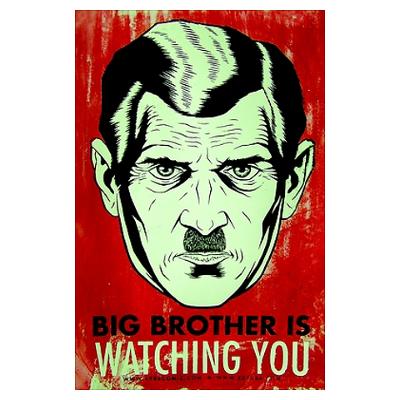
Oceania is a totalitarian state that would make even monsters like Stalin and Hitler green with envy.  Oceania which includes what was formerly Great Britain (now called Air-Strip One, on which Winston lives), the United States, Canada and Australasia is covered with telescreens which are a kind of two-way television that projects propaganda in, and can also watch for subversive activities, and microphones that monitor citizens almost anywhere 24/7.

Whereas the mass of citizens, the “proles” are left unmolested by the Party largely because of their ignorance and inability to organize, the Outer Party, especially is constantly monitored for “thought-crime” (even having a thought that challenges the orthodoxy of the Party) by the Thought Police who are housed in the Ministry of Love.

Orwell has a genius for playing with words, and his Oceania is a dystopia in a literal sense of being a world where everything is really its dark opposite: the Ministry of Truth is really an organization for creating lies, the Ministry of Love a hell-house of torture, the Ministry of Plenty a bureaucracy that administers privation, or the Ministry of Peace an institution of war.

One of the ultimate goals of the Party is to destroy the meaning of language itself- to fully institute the use of “Newspeak” so that all reference with the past and the truth has been destroyed. The Party then becomes the sole arbiter of what is real and what is fiction. The defiant act against the Party that would ultimately lead to Winston’s doom was when he started a diary. It was an act that declared what the Party found totally unacceptable- that a person could think for himself. Later, under the most brutal forms of torture, Winston would find himself compelled to deny the very sanity of trying to think outside of the iron grip of the Party:


   “He could not fight against the Party any longer. Besides, the Party was in the
right. It must be so: how could the immortal, collective brain be mistaken? By
what external standards could you check it judgements? Sanity was statistical.
It was merely a question of learning to think as they thought.” (228)

The Party of Oceania takes relativism, social construction, and collective solipsism to their logical extremes. It does not merely reflect a certain view of the world- it is the world- and can create and destroy the “truth” as it sees fit. Facts and the past are nothing but memory, so by controlling memory both individual and collective facts and history become whatever the Party wants them to be. Even logical, self-evident truths are capable of being overthrown- ideas such as 2 + 2 = 4. Under the proper pressure and manipulation even mathematics and science bend before the will of the Party.

Winston’s second crime against the Party is to engage in a secret love-affair with his co-worker Juila.  Much like in Plato’s Republic  Orwell’s Oceania will not countenance divided loyalties and passions, especially the kinds of loyalties and passions that grow out of love and sex. Unlike Plato, the Party has not ended the family, but has turned it into a nest of spies, where children betray their parents at any hint of unorthodoxy. The sexual instinct, especially for women, is channeled into the love of Big-Brother and hatred of the traitorous Goldstein, both of whose no doubt imaginary images are plastered , everywhere.

The emotions of the masses are constantly kept at a fever-pitch of hate against Oceania’s  geo-political enemies: Eurasia and East Asia. These two other great powers live under similar totalitarian systems as that in Oceania. Eurasia combines essentially the former Soviet Union and Europe, East Asia, China, Japan, the Koreas and nearby territories. The three great powers struggle with one another for what is left of the globe- essentially the Middle East and India. They fight not so much over resources or markets- all three are in essence self-contained, autarchic systems, as they do labor power, with the peoples of these up-for-grabs regions being enslaved by one region and then the other into making weapons. Weapons, which because world wars have become a thing of the past, are essentially useless.

If these were geo-political predictions, Orwell was on all accounts incorrect.  In terms of war, however, Orwell has some very interesting and prescient things to say, both for the Cold War period that followed his novel, and even more so, for today. The international environment in which Oceania exists is one of constant low-level or outright phony war between the big powers. Orwell in the mouth of the imaginary Goldstein muses that “war by becoming continuous has fundamentally changed its character” (163).

Orwell thinks that real wars- for all their horrors- served as a reality check on the state anchoring its delusions to the practical need of avoiding conquest. In the world of 1984 actual conquest of one great power by another had become impossible, and because of the vast resources which each of the 3 world powers possessed- unnecessary.  The reality check of war, therefore disappeared, and its very purpose which had once been the survival or aggrandizement of the state transformed into an instrument of internal control. Not merely did the phony war hypnotize the masses and bind them tightly to the Party, the creation of completely useless weapons was a way to steer surplus production away from the needs of the subject classes, therefore keeping them in a constant state of privation, in which the spread of general wealth and education that might threaten the grip of the Party was not allowed to come into being.

Winston’s third crime is to join the ranks of the secret revolutionary organization- The Brotherhood.   Like Big Brother, who serves as the face of the Party, or Goldstein who serves as the face of the revolution, The Brotherhood itself is a fiction created by the Party. In its name both Winston and Julia, in a act completely out of character, pledge themselves to crimes even against innocents, a subject that will be dealt with in my next post.

The Orwellian state imagined in 1984 is a sadistic-state the likes of which have never been seen. What makes it so horrendous even in light of its very real world rivals in this regard is its concept of power as a self-justifying force.  As Orwell puts in the mouth of Winston’s torturer O’Brien:

Progress in our civilization will be progress towards more pain. The old civilizations claimed that they were founded on love and justice. Our is founded on hatred. In our world there will be no emotions except fear, rage, triumph, and self-abasement. Everything else we shall destroy- everything.

If you want a picture of the future, imagine a boot stomping on a human face-forever. (220)

The scenes Orwell depicts of Winston’s imprisonment and torture are gut wrenching and horrifying. They starve him until he becomes skeletal and loses his hair, break most of his bones, smash his teeth, burn his insides with electrical shocks. We are forced to watch a once dignified man reduced to groveling, bargaining and betrayal. But it is not the physical abuse that so much reduces Winston as the psychological:

These other questioners saw to it that he was in constant slight pain, but it was not the pain that they chiefly relied on. They slapped his face, wrung his ear, pulled his hair, made him stand on one leg, refused to leave him urinate, shown glaring lights in his face until his eyes ran with water; but the aim of this was simply to humiliate him and destroy his power of arguing and reasoning. Their real weapon was their relentless questioning that went on hour after hour, tripping him up, laying traps for him, convicting him at every step of lies and contradiction, until he began weeping as much from shame as from nervous fatigue. (199)

The ultimate psychological torture comes at the end of the novel when Winston, whose greatest fear is rats, has a cage of starved rats attached to his face. Under the extremest of fear he betrays Julia not in the sense of turning her in, but in asking that she be put in his place. It is a real rather than a feigned request, and with it Winston has lost both his mind and his soul to the evil of the Party.

I think a good question to ask here is how Orwell thought such a horrifying world might come about? I think it would be a mistake to see Orwell as engaged in a sort of political phantasy that he thought was completely implausible, rather, 1984, is a kind of warning that given the continuation of certain trends this might be the world we ended up with. Orwell’s version of history up until the end of WWII can certainly not be considered a fiction, but a kind bird’s-eye-view of what had happened stretching back before the industrial revolution.

Orwell sees history as the story of class struggle between the 3 classes that have composed humanity since the Neolithic Age: the High, the Middle, and the Low. Consistently the Middle have overthrown the High by enlisting the Low taking the position of the High themselves and once victorious inevitably throwing the Low back into servitude. What would make the 20th century distinct is that the revolutionary forces of the Middle, which in the past had been partially fooled by their own rhetoric concerning the freedom of the masses that could be brought by revolution, became openly authoritarian and tyrannical in their aims.

Socialism, a theory which appeared in the early 19th century and was the last link in a chain of thought stretching back to the slave rebellions of antiquity, was still deeply infected with the Utopianism of past ages. But in each variant of Socialism that appeared from about 1900 onward the aim of establishing liberty and equality was more and more openly abandoned.  (167)

In part, Orwell saw this growing out of the new historical consciousness. According to the logic of the new revolutionaries: if society’s, instability- understood to be caused by war between classes- could be ended by the permanent domination of  ONE class, then, history itself would come to an end, the world, like that proposed in Plato’s Republic frozen forever in amber.

But the main reason Orwell saw for the new authoritarian revolutionaries was that machine based civilization had, for the first time in human history, made actual material equality possible. New groups wanting to seize power saw equality as no longer a bait for the masses, but as a threat to their own claims on power.

“The earthly paradise had been discredited at exactly the moment when it became realizable. Every new political theory, by whatever name it called itself, led back to hierarchy and regimentation”. (168)

The political ideology which Orwell imagined dominated his Oceania – Ingsoc- was foreshadowed by the Nazi and Soviet totalitarian movements who stripped of their Utopian veneer in his imagined ideologies and became mere will to power. The class which gave rise to Orwell’s ruling Party had been “brought together by the barren world of monopoly industry and centralized government” (169).

Their totalitarian order, he thought, would likely be enabled by new technologies of surveillance and control. Technologies such as the aforementioned ubiquitous telescreens and microphones, but also neuropharmacology, and mechanisms such as novel writing machines. Indeed, because it aimed to destroy independent thought and empirical science, Orwell’s dystopia is a world of technological decline and endemic scarcity; the only areas in which it excels being that of manipulation and control.

1984 gives us a lot to think about and not as something abstract, applied to some far off dystopia, but right here and now.  He brings to our attention the issues of technological surveillance, torture, continuous low-level war and propaganda and the abuse of language, along with questions about the history up- to- the- present of inequality and its origins. All the subject of my next post.

Only then will we be able to guess where such Orwellian trends might be leading, and how we might stop them.

* Nineteen Eighty-Four, George Orwell, Signet Classics,  New American Library of World Literature, Inc. 1961. First published 1949 

Defining Home 2

Something that has struck me over the course of the global economic crisis is the overlap between groups on the “far- left” best personified internationally by the Occupy Movement, and, at least in the United States, the “far-right” whose libertarian aspirations has been best encapsulated by Republican presidential candidate Ron Paul.

In my view of things, both the Occupy Movement and Ron Paul libertarians share a great many things in common. Both represent a systematic critique of the current economic and political order along with a strong desire to change that order. This sharing of basic assumptions by those on opposite ends of the political spectrum is not entirely new. In the early part of the 20th century the Communists and Nazis both offered systematic critiques of the then current order. What gives me hope today is that both the Occupy Movement and libertarians, unlike the Communist and Nazis, set themselves firmly against the coercive apparatus of the state both in its international and domestic manifestations.

The Occupy Movement is an anti-war movement (and war is now the constant condition in which our society exists)  in that it seeks to shed light upon and undermine the current practice of real politik and the injustice of American empire. The libertarians want, quite literally, to bring all of the boys home, that is to unwind the American empire and its globe straddling military apparatus that has been in existence since the Second World War.  Members of both movements hold deep respect for the dissident Julian Assange, and are deeply troubled by the increase of the state’s powers of covert surveillance and control.

Both movements seek an end to the collusion of finance and governments and the cronyism found in the relationship between the state and corporations. They both hold that the state should have little, if anything to do with the choices of individuals, and oppose use of the coercive powers of the state i.e. imprisonment to punish people for those choices, such as drug use.

The members of both movements, also, tend to be young, no doubt a reflection of the fact that this crisis has been particularly hard on the youngest members of society many of whose aspirations for the future have been clouded or destroyed by the crisis.  However, in this sad fact also lies my hope. For, if these young people, unlike the generation of the 1960s that abandoned their critique of the system for what was largely a return to the status quo, can hold firm to their principles then they might eventually bring to the system deep and truly systematic change.

In that vein, I hope the conversation below between two young and articulate voices from both sides of the political spectrum represents, in its very small way, the beginning of a philosophical discussion that rises above the sophistry of the current regime.

The discussion was sparked by a prior post Defining Home after which I tried to bring these two deep thinking bloggers into discussion (the dialogue below in its original form can be found in the comments section there).  On the surface the two could not be more different. Giulio Amerigo Caperchi is an Italian-American living in Italy who writes the excellent blog Geaneology of Consent  which looks at current events from the perspective of the political theory and represents an excellent window into the types of ideas that underlie the Occupy Movement. Henry Moore is a fervent Ron Paul supporter hailing from Yellowstone country, and a thoughtful voice for the sentiments of libertarians who writes for the blog http://keimh3regpeh2umeg.wordpress.com/.

The discussion below lays out the differing views of the two sides on the nature of and our relationship to the free market. This is the chasm that currently separates the Occupy Movement from libertarians, and, in my understanding only when this chasm is bridged will we really have a real possibility of any systematic reform of the crumbling world of the early 21st century.

_______________________________________________________

Giulio:

One of the key assumptions running through classical liberalism and neo-liberal theory (from Adam Smith, through Hayek, up to Milton Friedman) is that the market is the only place where true, spontaneous and un-biased information may be witnessed and analysed. The market, for these economists, is a site where individuals freely interact (“trade, truck and barter” as Adam Smith said) unhindered and on a completely voluntary basis. As such it is the only place where “real” human behaviour is expressed: “reality” thus occurs in the marketplace. The market is conceived as a neutral ground devoid of ideology and political influence.

This is a tremendous assumption with far-reaching consequences. And, more importantly, it is a key ideological manoeuvre. What neo-liberals like to claim is that seeing that they derive their social policies from feedback accruing from the “neutral” free market, they are ideologically un-biased. They contrast themselves to “big-government central planning” and socialism which apply one-size-fits-all social policy to intrinsically diverse populations. The crucial point is, however, that basing social policy on the utopian idea of perfectly working, self-regulating and unbiased free markets is itself a sublimely ideological assumption. The neo-liberal free-market is a utopia as much as the communist classless society is. In this respect forcing societies to conform to the rules of the free-market is itself a one-size-fits-all policy.(Joseph Stiglitz is probably the most important economist which shows that markets are VERY imperfect and VERY biased).

This is not to say that one should be completely relativist and refuse the idea that there is nowhere that one may garner social feedback with which to inform policy. But the deconstruction of what experts and technicians call “reality”, “truth”, and “natural law” is always necessary to reveal the ideological bias ALWAYS present in any idea, concept or science.

I therefore totally agree (Rick) with your powerfully stated conclusions, namely, that there is the need for constant discussion and deliberation on these “assumptions” which inform our private and public lives. The democratization of these assumptions is critically needed to reveal their ideological underpinnings and their nature as instruments (sometimes) of domination. That is why epistemological sovereignty (mostly at the local level of course) is a key instrument of resistance and a safeguard against the excesses of what experts (be they in Washington, in a university or on Wall Street) call “truth”.

Henry:

Giulio,

To me “neoliberal” is a loaded word. One that I am not ashamed to cast about myself, particularly for “Supply Siders” and other assorted Friedmanites. I do not put myself in that camp, though as an Austrian School lay-enthusiast, I see some common ground, though not as much as I would otherwise like.

I don’t know much about what neo-liberals think in terms of whether “the market is the only place where true spontaneous and un-biased information may be witnessed and analyzed.” I guess it really comes down to how you define “market”. Markets in the purely economic sense? Or markets in the more abstract sense?

If the former, and if your claim is correct, I would say that neo-liberals are quite narrow minded. If the latter, I would tend to agree with the neo-liberals. If this more abstract, conceptual marketplace, essentially an (I am loathe to use the word) aggregation of human action is indeed the only place to witness spontaneous and unbiased information, it is precisely because of how broad an idea it is. This is where the Austrian School often faces the most criticism: the theory that all human action can be deduced using the same (or superficially dissimilar) axioms as purely economic action.

So basically, ALL human action, spontaneous or otherwise is seen as part and parcel of the marketplace (which could, in effect really be an infinite amount of smaller marketplaces). Given this axiom, it is impossible for human action to exist outside of the marketplace, by definition. Based on this, the market would be the only place to witness spontaneous information.

And then there is the question of bias. Bias exists in the market. Whether this is desirable or not depends entirely on the human actors themselves. This includes those acting spontaneously and those acting more deliberately. Those acting deliberately (such as the state, regulators, corporations) are able to cause undesirable bias by distorting the market. They cannot do this without committing, perpetuating, or taking advantage of some form of coercion, explicit or implicit. At which point the FREE part of the Free Market goes out the window.

Under ideal circumstances, which may not even be attainable on a large scale, biases that occur are simply a reflection of the decisions of market actors. I fail to see the problem. If there is good, good. If there is bad, the fault is in the actors, not the system. I don’t think most libertarians believe in the perfectibility of the human condition, which to me is the defining characteristic of a utopian ideology. And certainly most would not suggest that the Free Market alone could accomplish this. Most hold that the Free Market, whether it might be considered to have inherent flaws or not, at least is the best allocator of resources and cause of economic growth. But the main reason some prefer the Free Market has little to do with how effective it is in these areas, but instead the fact that it is the most consistent with what are seen as natural rights. Some, myself included, would still advocate the Free Market even if it was not the “best” system for allocating resources and spurring growth. It is not the practical implications that are our chief concern. It is the ethical ones.

I agree that Markets are not, as you say, “perfectly working, self-regulating and unbiased”. I do hold, however that Markets are the best of all possibilities, but this is not perfection. That markets self-regulate to a point, which happens to be the same point at which the word FREE goes out the window. That bias is not undesirable, per se.

I am sure that you and I agree more than we would disagree on many an issue, this one included. It is not my intent to argue, though I am happy to engage in discussion. I am only here to express another point of view for the benefit of this blog’s readers and to, in someone else’s words, engage in a civil exchange of ideas between bloggers.


Giulio:

Hi Henry,

Thank you for your wonderful and very articulate response. You are indeed right, we do agree on many respects.

Essentially, what I am arguing for, and the chief reason I criticize utopian strands of free-market ideology, is for the separation of the the political sphere from the economic, and the refusal of subsuming politics and the public sphere to economic imperatives.

I do not agree with the fundamental neoliberal axiom that all human action may be explained in terms of rational individuals freely pursuing their interests. Coming from a more communitarian perspective (think Michael Sandel for example), there are certain types of behaviour that cannot be rationalized through market motivations. Patriotism and sacrifice, for example, elude the idea of rational interest-motivated behaviour. The virtues informing classical citizenship, also, are not informed by market behaviour but by respect and allegiance to the public sphere and to the common good of the “demos”.

More importantly, something like the social contract and the erection of democratic a order are not a spontaneous acts arising from the state of nature (as some neo-liberals and libertarians have it -think Nozick), but a conscious political effort of collective human agency.

On the question of bias, we thoroughly agree: very few believe in the infallibility of human behaviour and that there won’t always be bias/asymmetries/coercion in our societies. I also agree that it is not inherently the fault of the free market. However, I do think that a society informed by the rationale of laissez faire is more inclined to exacerbate such power imbalances that we naturally find in the human condition.

Finally, I am not arguing against the free market per se. But I am arguing that in CERTAIN domains the free market is NOT best suited to allocate resources or inform behaviour. For example (and here comes my European bias) healthcare, basic public transportation, the military, certain infrastructure, water provision, education, and the right to food are services and issues so essential to the unity and stability of the modern nation state that they cannot be exposed to the imbalances/biases/asymmetries inherent in the free market. In addition, I do not think that the free market is always most consistent with regimes ensuring natural rights. The ethical implications of natural rights, for me, do not arise spontaneously from a system of free-markets but from a united and concerted discussion within democracies on which ethical paradigm(s) best applies to particular contexts.


In conclusion, I agree with your final remarks saying that markets are not perfect but that they are better than many other catastrophic politico-economic systems witnessed throughout history. But we cannot remain blind to the economic and financial catastrophe caused by unbridled and corrupt free markets (with governments thoroughly compliant of course) unfolding before our very eyes. Yes to free markets – but constant vigilance of its inherent excesses (as in all things).

I therefore think that we must have a public discussion on WHERE markets are best suited to allocate resources and promote growth/innovation/creativity, and where they are not. While I am not a fan of government regulation (and this is my libertarian side coming out), prudential limits and legislative boundaries are essential to our stability as a nation and as a united people. Therefore, as Rick says in his post, we should have a public discussion on whether the neoliberal axiom we have discussed earlier should in fact inform societal and governmental behaviour.

Many thanks for taking the time to answer my points and engage in this fruitful discussion. Indeed this is what democratic deliberation is all about. I really do think we don’t disagree that much and that we both favour a democracy and an economic order where liberty is indeed maximised.


Rick:

Henry,

What I am curious about is this: I know from reading your blog that you are strongly anti-interventionist in terms of the government trying to manage the economy, and hold that many of the large-scale economic crises we have experienced were brought about by government interference in the market.

But do you think this always the case? Are markets, in your view, not so much perfect as impervious to catastrophic failure insofar as they are not subject to government distortions? Has the government no or only a minimum role in cushioning the public from such crises in your understanding?

Some further questions: Do you not hold the view that what are termed neo-liberal policies have the consequence of exacerbating sharp economic inequality? If you do believe neo-liberal policies can result in rising inequality why is this inequality not a danger to the survival of the market based society you wish to promote? At some point, it seems to me, some level of equality is necessary for the survival of the market itself. Isn’t it in a sense true that this is what natural property rights are meant to protect? Wouldn’t the right to hold property contradict itself in a society where only a tiny minority actually held property?


Henry:

Rick,

Please understand that I approach Free Markets from a Libertarian position, rather than an Egalitarian one. That is, from a love of liberty (which is simply the result of others’ duty to not aggress), regardless of its consequences, rather than a love of equality (which has many forms, some of which seem not to be compatible with others, and some which may be incompatible with liberty). Having said that, libertarianism and egalitarianism are not mutually exclusive. In fact, there is a “leftist” school of thought that emphasizes both. The left-libertarians, particularly Market Anarchists argue, pragmatically, that markets are best because they lead to equality and social justice, that monopolies rarely come into existence, and that when they do, it really is because they are the best and most efficient at what they do, rather than because their cronies did them a favor. To them, it is regulations that truly cause monopolies, rather than protect against them.

More right-leaning anarchists and libertarians (such as myself) would tend to agree, but with the caveat that even if markets did lead to inequality they are still better because they do not violate the non-aggression axiom. However, my heart does bleed more than others I could name.

Wikipedia says, “Neoliberalism is an ideology based on the advocacy of economic liberalizations, free trade, and open markets. Neoliberalism supports privatization of state-owned enterprises, deregulation of markets, and promotion of the private sector’s role in society. In the 1980s, much of neoliberal theory was incorporated into mainstream economics.”

Looking at the first sentence, it would seem that the libertarian groups I mentioned above all fit neatly into this camp. But neoliberalism, especially as it has been incorporated into mainstream economics does not seem to have much common ground, apart from a few general principles, with the more fringe (anarchists, deontological minarchists) elements of Free Market advocates.

First, Neoliberalism tends to accept things the way they are, even while advocating for a change of hands, from the public sector to the private sector. If there is already a monopoly, regardless of how it got there, so long as it is not a public entity (on paper), all is well. That is their take on economic liberalization. Rather than lead to inequality, this enshrines inequality that already exists.

Second, free trade to a Neoliberal, is not free at all, it is managed, often heavily-managed trade and consistent with the ideas of a state-corporate partnership that resembles a “benign” fascism, i.e., crony capitalism, and entangling alliances. That is not to say that one form of managed trade isn’t better than another form, but to call either free trade is a mockery.


Third, the concept of an open market is not the same as that of a free market. A free market is an open market that is always subject to market forces, and in that sense they are the same.

But an open market could in theory be a part of any economic system so long as none (perhaps meeting certain requirements like competency, liquidity, and/or competitiveness, perhaps not) are denied the right to enter that market as a merchant. Also, the otherwise laudable idea that all markets should be open markets leads to the more contemptible idea that “closed” markets should be forced open. This can amount to forced trade, or at the very least trade that favors one party over the other. Another variant of legal plunder.

Fourth, privatization of state-owned enterprises, may be all well and good for things such as railroads and communications and resources, but in the case of an entity that should not exist in the first place (Federal Reserve System, Federal National Mortgage Association, Federal Home Loan Mortgage Association, to name a few), privatization is just another road of economic fascism.

And finally, deregulation can mean any number of things. It can mean deregulation of certain entities or industries and not others, which is picking winners and losers. It can also mean the removal of regulations that were in place to paper over the problems caused by other regulations, or to remove the original regulations and leave the ones that only came about as a result of the original ones, when this may be a considerably worse thing to do than to just leave them all or remove them all. This sort of occurrence is fodder for the mainstream media which can then claim that deregulation is causing economic mischief and miscalculation.

So Neoliberalism, as practiced, does seem to promote inequality. Not a gradual inequality emanating from true competition and market forces, but an already present inequality solidified and then worsened in the process of so called “liberalization.”

Inequality such as this is indeed a danger. Partly because the sheer scope of it may squeeze out competition, thus harming potential competitors and consumers, and partly because it was brought about through coercion.

Some level of equality (though I am not sure how one would measure it) may be necessary to the progression of a market based system. If different players do not at least have similar chances, the one with the best chances will necessarily end up on the top. By the same token, if their chances are roughly equal, they can compete and keep the others from crowding them out. Even so, it is very hard to maintain front runner status, even with a huge head start (in terms of resources or capital), without being artificially propped up. There will always be those smaller (unequal) entities that are just able to do things more efficiently, provided the larger entity does not have some regulatory body fixing prices in its favor, which is just one example of being artificially propped up.

Can markets have serious downturns or crashes without large scale government intervention? The answer is yes. But something (the market, to me, is not a “something”, but rather the absence of “something”, it is negative, not positive) still must be the cause. Put in place of government intervention either wide-scale fraud or groupthink. I see no reason why these wouldn’t cause problems. But there are several differences between these things and government intervention.

Whereas the failures of government intervention can be used to excuse even more of it, when fraud or groupthink occur, because they are not thought to have the same irreproachable nature as the state, they are more readily dealt with. A downturn caused by government just leads to more such intervention and more problems. Look at the dot-com boom and bust. The government’s and the Fed’s policies resulting from it led to our current housing boom-bust, and those same policies in reaction to that are now leading to a sovereign debt boom and soon to be bust. But con artists and highly speculative fads, because they do not have power over whole jurisdictions simply cannot create as big of problems. And because they are not quite so sacrosanct as the state, they will be discovered, understood, and dealt with, and will have no chance of using their own blunders to save or perpetuate themselves.

In the case of fraud, there should be laws protecting against it, but they should be defensive in nature rather than aggressive. They should not forbid every single action that could, in theory become fraudulent, as they would tend to weed out perfectly safe and moral economic actions. And in the case of irrational or risky manias, no law can protect against these. There are too many variables. Should the Dutch government have banned tulips or the cultivation of tulips or any activity related to tulips even if it had known tulipomania would lead to a bust? But even in that example, the monetary environment was distorted by debasement of the currency. Crooks and speculators (who, unlike the former, serve a valuable purpose in the market) will always exist and always be problematic, but when they are enabled with regulations protecting them from bankruptcy and granting them monopolistic privilege; or with an elastic currency encouraging their risk-taking and misallocation of resources, then doesn’t the blame fall on the enablers as well?

That the government should cushion the blows of its own making is just another way it can get its foot in the door and create more distortions. I do not think the government should have the role in bailing out industries, especially when the time is coming when the government will be the one that is in need of a handout. I am a little less inclined to criticize welfare programs for their economic effects (which, as with a bailout or stimulus, are negative), as much as for their lack of necessity. I don’t see why charity and initiative (as opposed to just one, which may be insufficient) can’t more than replace welfare programs, especially in relatively normal economic times. During a crisis, drastic measures may be more necessary, but only because of how dependent some have become during more stable conditions.

I apologize for being so long- winded in answering your questions. When I really thought about them, they were much harder to answer than I thought they would be. To be honest, I wish I could say even more, but for both our sake I will leave things as they are. I also apologize for not answering things in the order you asked them and for stringing out some of my sentences.

Rick:

Giulio,

What I am curious about is this:

I know from reading your blog that you are especially interested in finding alternatives to the current economic and social order which you find to be dominated by corporate interests which use the tools of the state for their own ends and suppress what might be called “forms of living” that emerge spontaneously and organically from the people. I am thinking here of things like peasant movements and organic farming. Knowledge, in your view, is often an instrument of power.

My questions are, though you reject the idea Henry promotes that property rights are the basis of natural rights: Is there any natural limit to the power of the state acting as an instrument of the people to demand use or regulation of the property held by individuals? If yes, what limits do you think these might be? If no, is how is this not a kind of tyranny of the public, and why will it not give rise to the same sorts of injustices and epistemological imperialism you see now originating from the free market only now from a different set of players- bureaucrats, democratic factions, ethnic groups etc?


Giulio:

I thoroughly believe that there is absolutely no natural limit to what the state’s power can be used for. Be it guided by private, ethnic, religious or public interests, the modern state remains fundamentally a coercive apparatus with absolute sovereignty over its territory and citizens (in its classical Weberian definition). If an egalitarian-minded political movement claiming to represent “the people” were to take power tomorrow morning, there would be no internal or “natural” principle limiting its power: it would most probably coercively redistribute the hard-earned property of the well-off and may very well impose its own epistemological imperialism. History is rife with such occurrences.

My central point, however, is that principles of limitation of public and private power do in fact exist. The Declaration of the Rights of Man, the Declaration of Independence, the US Constitution, along with most of modern legal orders clearly limit the power first and foremost of the state (these were, after all, documents enshrining principles defending the private citizen from arbitrary power of centralized monarchies). In addition, most of the greatest minds of the enlightenment (both liberal and egalitarian) such as Montesquieu, Locke, Rousseau, along with practically all of the American Founding Fathers saw the separation of government’s powers as central to the architecture of any democratic nation.

So the first effective limits to state power come into existence with the birth of the modern democracy. We may safely state that the aforementioned “fathers” of liberal democracies were primarily concerned with the state NOT falling into corrupt hands (be them egalitarian or private-minded). Madison’s famous essays in the Federalist Papers are a prime example of this.

The limitations to state power are therefore, in my personal opinion, not “natural” limits based on axioms of non-aggression or conceptualizations of personal and property rights as libertarians have it. Rather, they are principles born out of historical struggle and resistance against various forms of oppression (in the enlightenment it was against absolutism and aristocracy). These principles may be “self-evident” and “universal”, but they do not exist in a void: if government were to retreat to nothingness tomorrow morning we would not in fact be left with our inviolable personal liberty. Liberty, as French philosopher Foucault once said, is relational: it exists solely in virtue of its mutual recognition.

This act of recognition is thoroughly a positive act, as it is born out of political struggle and out of democratic deliberation. Indeed, the recognition of rights to one another is the basis of a democratic society, of the social contract and is the very “stuff” of democracy. Thus, any limitation to the power of the state, for me, is not based on “negative” rights but on positive democratic deliberation over what those limitations should be. Which brings me to why I do not agree with libertarian tenets. Even though I agree with libertarians in asserting that government is essentially a coercive apparatus, I don’t believe that its simple retreat will leave us with more liberty. It is not a zero sum game of: more government = less liberty; or, less government = more liberty.

In this conceptualization, when government retreats out of the individual’s life we are left with the free market. But the free market is not a “negative” domain devoid of interests, morals and values; rather, it comes laden with specifically free-market ethics and morals (or lack thereof). For example, in the domain of free markets liberty is not primarily understood as the relationship between free and equal citizens in the public sphere, but is rather defined by, and exercised through, the exchanges between rationally motivated individuals pursuing their self interest. This is a momentous change in the very conceptualization of the citizen and her/his relationship within society.

In conclusion, I therefore argue for increased democratization of the spaces in which individuals interact: be it government or free market. The principles limiting the domains and extents of the public and the private are never given but always negotiated, fought over and forged through political contention. Let us use our democratic instruments to participate in the definition of our public and private life and not retreat to what some consider a “natural” form of human existence. What some deem “natural” (as some proponents of free markets do) is, in my personal opinion, an ideological paradigm no different from the ones we are familiar with today. For me, it is better to define our nature collectively through democratic means in positive political acts rather than allowing “natural” forces -such as inequality- strip us of our personal liberty and collective self-determination.


I thank you again Rick for allowing me to be part of this enlightened discussion, and please excuse me again for this late response. And Hank, thank you for clearly stating and elegantly expounding many of the key points of libertarianism, as well as helping me understand some of its areas which I had previously not been acquainted with. Although I do not agree with all libertarian tenets, I do remain fascinated by it and will now study it in a different light.

Henry:

You guys have been great and this has been a very informative discussion.

_____________________________________________________________

It is my belief that these are precisely the kinds of conversations we should be having, and I would like to make it a permanent feature of this blog to do so. If readers are interested in these types of conversations both through text, and perhaps actual discussions via SKYPE or some other medium, shoot me email: rsearle.searle@gmail.com. I hope to make this feature available on Utopia or Dystopia starting sometime this fall.


Rick Searle

The Sophists

Stranger: Of hunting on land there are two principal divisions 
Theaetetus: What are they?
Stranger: One is the hunting of tame, and the other of wild animals.
Theaetetus: But are tame animals ever hunted?
Stranger: Yes, if you include man under tame animals. But if you like you may say that there are no tame animals, or that, if there are, man is not among them; or you may say that man is a tame animal but is not hunted-you shall decide which of these alternatives you prefer.
Theaetetus: I should say, Stranger, that man is a tame animal, and I admit that he is hunted.

Plato, The Sophists

With the Republican convention this week American election season kicks into overdrive.
I am often hard-pressed to explain this peculiar species of collective insanity to my non-American students, but I think no better description can be found than one written 2,500 years ago in Plato’s Republic with his descriptions of Athenian democracy and the sophists.

Of course, Athenian direct democracy was much different from the representative type we have today. In Athens the gap between a decision made and a consequence felt was nothing like chasam we have today, and in the sense of choosing their future, the Athenians really were sovereign. When the Athenian Assembly fatefully voted for the Peloponnesian War, they were sending themselves, their sons, and their colleagues to their potential death in battle, and would bear ultimate responsibility for the conquest of their city and the destruction of its empire.

In perhaps no way but when they sit on juries are citizens of representative democracy sovereign in this sense, nor is the impact of the power we exercise in elections so immediate. The responsibility for political decisions is handed to representatives or the president, and our society is so large that it is often others, for instance soldiers and their families, that bear the brunt of decisions which are almost invisible to us.

In the sophists, however, we get a glimpse of features held in common between the Greek and our own form of democracy. The sophists were wandering teachers, who taught many things, but what they excelled in most, at least according to Plato, was the art of persuasion. It is hard to not see what we would call a “political consultant” in Plato’s description of the sophists that he puts in the mouth of Socrates in the Republic:

Why that all those mercenary individuals whom the many call Sophists and whom they deem to be their adversaries do in fact teach nothing but the opinion of the many that is to say the opinions of their assemblies and this is their wisdom I might compare them to a man who should study the tempers and desires of a mighty strong beast who is fed by him he would learn how to approach and handle him also at what times and from what causes he is dangerous or the reverse and what is the meaning of his several cries and by what sounds when another utters them he is soothed or infuriated and you may suppose further that when by continually attending upon him he has become perfect in all this he calls his knowledge wisdom and makes of it a system or art which he proceeds to teach although he has no real notion of what he means by the principles or passions of which he is speaking but calls this honourable and that dishonourable or good or evil or just or unjust all in accordance with the tastes and tempers of the great brute Good he pronounces to be that in which the beast delights and evil to be that which he dislikes and he can give no other account of them except that the just and noble are the necessary having never himself seen and having no power of explaining to others the nature of either or the difference between them which is immense.” (Republic 191-192)

What the sophist excel at, Plato seems to be saying, is the science of how to seduce the crowd, and you seduce the crowd by finding out what it wants, and giving it to it, or finding out what it hopes, and promising to deliver those hopes, or what it fears, and convincing them that you will protect them from those fears. To hell if what the crowd wants is foolish or unjust, or what it hopes for is an impossible fantasy, or what it fears an irrational paranoia.

I think nothing better sums up this years election and both the Democrats and Republicans are guilty here.

On the Democratic side, you have a campaign of micro-mobilization in which segments of the population are mobilized by fear. Something, I think, of the assumptions behind the political elites can be found in the comments of the former DNC Chair Howard Dean who said recently on an episode of This Week with George Stephanopoulos “Campaigns are not for educating”, (@39min).  The obvious assumptions here being both, that the public needs to be educated, and that the true purpose of campaigns is “mobilization”. What  we do not see here might be something we could learn from the ancient Greeks minus the sophists, that politics is about discussion and debate between adults around choosing the right course of action.

Republicans, of course, don’t escape this criticism. Not only was the micro-mobilization around fear, in this case homophobia, pioneered by Karl Rove , but Romney himself might be the best example we have had of Plato’s sophist, having given the liberal Massachusetts, while he was governor there,social goods such as publicly funded health care that he now wholly disowns to curry favor with the Republican base. Just the most prominent of his many flip-flops that include everything from abortion to global warming and then some.

In this atmosphere of politics as mass mobilization the Supreme Court’s 2010 Citizens United decision, declaring large portions of the Bipartisan Campaign Finance Reform Act, better known  Mccain-Feingold, unconstitutional is an unmitigated disaster.

Plato disliked oligarchy almost as much as he disliked democracy, and it’s easy to see why. In an oligarchy decisions are made on the basis of the interests of the rich, interest again, that more often than not bear little relationship with justice, or even the smart thing to do.

If the poll numbers actually reflect reality then this race really will come down to a matter of who had the best mobilization strategy and the differing strategies of the campaigns were dictated by their varied finances, which have largely been a reflection of their differing attitudes towards the super-rich.   Big money players, most notably George Soros, have largely soured on Obama this time around, something which has thinned the president’s war chest and forced him to follow a slow-and-steady ad-campaign strategy. Romney, on the other hand, flush with cash from mega-rich funders such as the casino magnate and Israel hawk Sheldon Adelson, intends to flood the airwaves with ads from the convention forward.

Surely, what these super-rich contributors hope to “buy” with their massive donations is some degree of influence on the president. Soros soured on Obama after the latter seemed uninterested in listening to the advice of the financial alchemist. Adelson wants lower taxes, and an aggressive stance towards Iran. Why American policy should be any more influenced by these men because they can fund political campaigns than by reasonable arguments about what is best for the country, arguments that can be made by experts and laymen alike, without a similar wherewithal to finance an untold number of television advertisements is beyond me.

Once you base your campaign on large donations from a select group of individuals whether they be what is typical- socially liberal Hollywood types on the left, or business tycoons on the right, what you profess is bound to the views of those paymasters, which is why the most interesting characters in American politics are often politicians with a very low level of support among the rich.  Here you find characters like, Ralph Nader, and on the totally other side of the political spectrum, Ron Paul, who despite his libertarian views is supported mostly by small donations from individuals.  Even, someone like, Ross Perot, was not so much supported by super- wealthy donors, as he was so rich himself that he was actually able to do that rare thing in politics- actually speak his mind.

For all that said, in this election, like all the others I will bite my tongue and vote, (though I can certainly understand why others, out of principle, will not)  for it is the only small piece of influence I have to exercise over the direction of my country, but there has to be a better way; there has to be a way to have more nuanced conversations, for citizens to actually deliberate on the questions at hand and decide on the course of the future for ourselves and our children. There has to be a way to break the spell of sycophants and regain the sovereignty of democracy, for how many more elections will we have to go through run by the logic of sophists?

Pandemonium, Kingdom of the Quants 3

THE SPELL-CASTERS 

Back in the stone age, when I was a teenager, I had the good fortune of hanging out with a pretty eclectic group of people. Among this group were a certain subset who might be called spell- casters. These were individuals who, quite literally, cast spells to deal with the problems of everyday life: to get the girl, the promotion, or even just pay the bills.  Hanging out with this crew didn’t score many points with the authorities at the conservative Catholic school I attended.  Some, no doubt well meaning, busybody actually informed my parents that my soul was in danger. Had this person , or the school priests, who wished to save my soul, actually been able to step inside my mind, they wouldn’t have sought to sever my ties to the “devil worshipers”; they would have confiscated my copies of Carl Sagan’s Dragons of Eden and Cosmos, they would have burned my worn out paperback of Nietzsche’s Beyond Good and Evil, and forced me to read the Christian heavy hitters of Kierkegaard  and Dostoevsky, the latter who I especially adored.

I was not a member of the spell- casters, I was more like their sceptic mascot. I really enjoyed sparring with them, and it may seem odd, but I think they felt the same. For both me, and for them our arguments were ways to clarify our own thinking, to chart our divergent spiritual paths. I don’t remember much of anything but the tenor of these discussions except for one, and it has stuck with me all of these years.

Once, I was asking one of the spell- casters to explain to me the physical mechanism for how they were supposedly able to influence others with their ritual mumbo-jumbo. Was it brain waves? Pheromones? What?

Without really hesitating he responded that“it was like money”.

What?!

He continued that “money was a talisman, that grants its holder power because others believe in its power” that he, as a spell-caster, really only had power over those who already believed he had power to begin with, that I, as a sceptic, was largely untouchable, in a way that those, such as the Church who believed in his magic, but just thought it came from a place of darkness, were not.

The idea stuck in my head… money was a talisman.

Years later I encountered this same idea in a totally different context in William Greider’s conspiratorial sounding: Secrets of the Temple, How the Federal Reserve Runs the Country. I have not been able to locate my old, no doubt, dust covered copy of Greider’s excellent book, and have not read it for perhaps a decade, but I will try to remember as best as I can, and will turn to Greider when I come to the issue of the Federal Reserve.

As far as money being a talisman, Greider, from what can I recall, repeated the same point as my spellcaster friend. Money had something of our primitive magical thinking behind it, we had to believe in it to make it real.

I came back to this idea in the context of this series of posts because it seemed to suggest something about the connection between our current economy and idolatry. I thought for sure I would be able to find all sorts of evidence for money having originated as a talisman- which, by the way, is different than what we would call a charm- say your lucky rabbit’s foot. A talisman is an amulet that covers certain powers, such as powers of seduction, or the power to attract wealth etc.

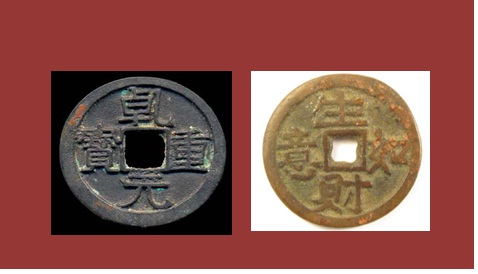
I was able to find anecdotal evidence that money came into the world as a talisman. Take the picture above. On the left is a picture of traditional Chinese coin (Tang Dynasty 7th and 8th centuries AD), and on the right is a traditional Chinese talisman. (Shang Dynasty 16th- 11th centuries BC).  I, for one can’t tell the difference, but such does not an argument make.

Instead of finding surefire evidence that money had originated as a talisman, in my search, I discovered a fascinating story about the origins of money and debt themselves: David Graeber’s Debt the First 5,000 years, and it is from there that I think this inquiry should continue.

Graeber sets out to tell the history of debt, but this seems to require that he provide a history of money, for the two are inseparably combined. Like many other people, I had always imagined that money had emerged as an advance over systems of barter.
But, as long as we take the findings of economic anthropologists and economic historians into account, this idea appears to be a myth. According to Graeber not one anthropological or historical example of money emerging spontaneously from barter has been observed.

Historically, money seems to have first appeared in Ancient Sumer as a form of temple credit, allowing priests to keep accounts with the local population, and then evolved into a more general system of credit-money.  Niall Ferguson, in his documentary, The Ascent of Money, has a cool scene (@9 min) in which he is holding one of these clay credit-money pieces in his hand. It’s inscription reads that the possessor of the tablet is owed so much grain by such-and-such. That “possessor” part is important because it implies that these tablets were transferable.

In Graeber’s tale, this credit money was supplanted by coinage with the rise of empires. He sees the dual-evolution of coinage and the state this way: the state needed to pay its new professional soldiers in some way, and money was an ingenious way they could do so.  The state created coins, gave them to its soldiers, and then asked for them “back”, not from the soldiers, but as a tax on its merchants and farmers. These merchants and farmers were thus compelled to accept payment for their goods from soldiers in the the form of the state’s coins. The state had created its own perpetual motion machine- for war.

Many people on the right today, at least in America, seem to associate “hard-money”, that is money backed by gold, with a weak state. Graeber thinks the relationship actually worked the other way around. Hard- money is the surest sign of a strong state, and the vector through which the state imposes taxes. Eras of hard-money are also incredibly violent, after all, they signal that large armies are marching around. They tend as well to be eras of mass slavery- classical, African. The two major hard-money eras, in the West, Graeber thinks, were those between the birth and fall of the Roman Empire, and the period from the early 1400s to the mid-20th century.

Hard-money has a rival in the form of credit-money, and the two tend to oscillate over great arcs of history and over a very wide historical expanse. The great period of credit-money was from the fall of the Roman Empire until the early 1400s, and its most important developments took place outside of the West. Both China, and the Islamic World, had thriving, credit-based economies for much of this era. The Islamic World, especially, developed a rich market-based economy that was largely free from government interference, and many of the financial innovations that later made their way to Europe were begun here.

Periods of credit-money have a tendency to also become eras of debt, and this debt can sometimes be horribly de-humanizing. As the father of two daughters, the idea of the “bride-price” struck me on a particularly visceral level. In certain eras and places daughters became “collateral” for loans. This was actually the standard by which the dark age Irish judged something’s worth, by the abstract value of not just another human being, but your very own child.

The answer that credit-based societies have come up with for the problem of debt is essentially to ban interest on loans, especially high rates of interest, or usury.  Graeber sees no anti-commerce logic to these bans on charging interest. Muslim society, for instance, has been, and is, an extremely commerce based society that, even to this day, largely looks askance at interest bearing loans.

The Catholic Church, having taken Aristotle seriously, held that interests bearing loans had something unnatural about them.  Money, in ages where it is based on credit and not coin, was seen as a social convention, nothing more, and nothing less. Charging interest on a “mere idea” seemed to the Medievals to be asking something lifeless to generate itself, to have “money beget money” in the same way life begat life.

The credit-money era of the Middle Ages did not so much end as became a hybrid-era of both credit-money and cold hard cash, and it was this hybrid quality which I think Graeber is suggesting helped give rise to capitalism, which really was something new under the sun.

A barbarian like Hernando Cortez was literally insatiable for the gold of the Americas, and it’s this insatiable quality which was somewhat new. Why did Cortez not rest free and easy on a caribbean island after he had won the lion’s share of the biggest of the biggest gold booty in history- the riches of Tenochtitlan?  Graeber suggest it was because he was in debt up to his eyeballs with interest bearing loans he could never hope to repay- even though he had conquered one of the greatest empires on the globe.

It was this idea of being designed for limitless growth that was new, something that came into being most clearly a half a century after the death of Cortez with the creation of the Dutch East India Company. This company was a public-private partnership whose mission was the domination of the spice trade, which paid its soldiers in gold coins, and was built from loans- in the form of shares- that could never be repaid but required the outlay of “dividends” to the stockholders. Issuing more stock for supplies for imperial expeditions, meant more dividends would have to be paid,  and therefore the gain of more control over the spice trade secured- a control that was largely “bought” by the force of arms.

Here I am going to step aside from Graeber, and lean on what I can remember from William Greider’s Secrets of the Temple, for while Graeber is great on economic history up until the slave trade, his take on contemporary history is a little thin and I think Greider can fill in that gap.

Since the 1700s, we seem to have been slowly moving back towards the idea that money is a social convention. Since then we have oscillated between hard-money (paper backed by gold) and soft-money (paper based on credit) with every era of hard-money seeming to end in a deflationary crisis as money dries up, goods plummet in value, and loans become unbearable, followed by an era of soft- money, in which credit chases its’ own tail, goods become too expensive to buy, and manic asset bubbles emerge, some large enough to take down whole economies.

The problem is simple to state, and incredibly hard to solve. If money is a convention then we can make as little of it or as much of it as we want, but neither choice is without huge consequences. Print too little, and the economy literally seizes up, like a car engine running without oil. Print too much, and everything rises in value, people find themselves drunk on inflating asset prices, and the whole balloon eventually bursts.

Governments tried to control the inflationary potential of paper money by pegging it to a high level of gold. The problem here is that this money was often way too hard, especially for debt holding farmers. William Jennings Bryan’s “Cross of Gold” speech was essentially a cry to east coast bankers to soften the value of the dollar and therefore ease the debt burden of Midwestern farmers.

After the Great Depression, capitalist countries tried to steer a middle course with the value of the new global currency- the dollar- pegged to gold under the Bretton Woods system, but with governments following an inflationary policy of high spending even in good times. In the early 1970s this system blew apart: Nixon abandoned the gold peg, and inflation took off like a rocket. This only ended when the central banks, most notably the US Federal Reserve was given real control over the value of the currency, and they took the side of hard-money, only this time it wasn’t based on gold, but on strictly limiting the supply of money itself.

In 1980-81 the chairman of the Federal Reserve, Paul Volcker, essentially convinced the markets that their inflationary expectations regarding the US currency were no longer true, by hanging a sword of Damocles over the American economy’s head. Whenever the American economy grew so fast as to cause inflation the FED would slam on the brakes of money creation and raise interests rates as high as they needed to go to constrict the money supply and squeeze out inflation- even if this lead to rates of unemployment touching 8 percent.

In terms of taming inflation, this certainly worked. In terms of American living standards- not so much. The strong dollar helped push high paying factory jobs overseas. Volcker, and his successor Alan Greenspan effectively ended the rise in American wages by keeping wage inflation, which had previously ran ahead of price inflation being linked to COLAS in labor contracts, under strict control.

Greider’s work leaves us off in the 1990s, but it is easy to pick up the story from there.

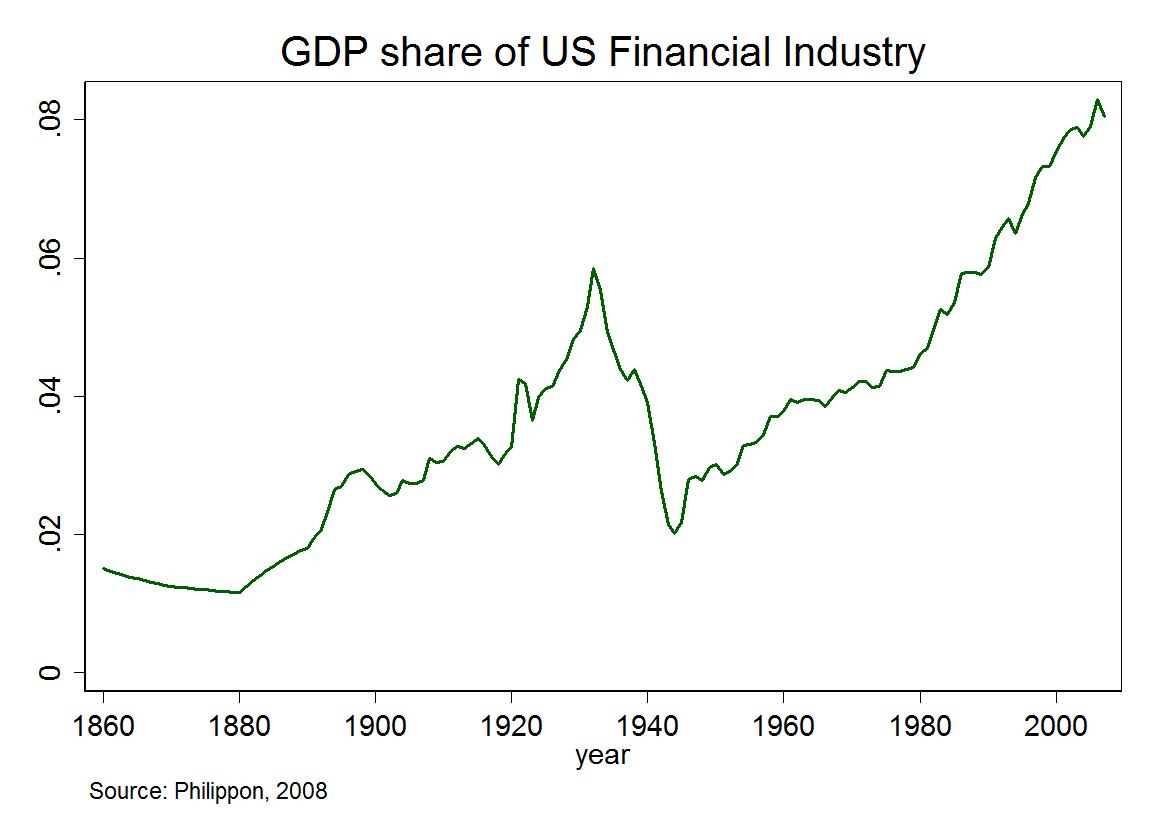
During the same time American wages stagnated, the financial innovations and speculation that were discussed in my post on the quants proceeded apace. The “net-worth” of the middle class became tied not to income, which was frozen in time, but to assets- the value of their homes, and their stock-portfolios, both of which seemed to expand towards the stars. Eventually the staid deposit-banks themselves wanted in on the action- the road to systemic collapse. For many, including the quants, the best way to make money, it seemed, was to have “money beget money”, in the Medieval phrasing, or, to use our modern flavorless terminology-  “financialization.”


The graph below captures the transformation:

We know where that led.

Whether or not it needed to be done to save the economy, it makes perfect sense that the FED, which had spent a generation fighting for hard-money despite its costs on the working class and poor, would totally reverse course and move towards soft money; it was saving itself. Opponents of the FED on the right have it only half correct- the problem with the FED isn’t that it aims at weakening the currency, the problem, it seems, is that the FED will only definitively do this when the interests of its primary constituency- the financial sector itself- is at stake, and not, it seems, for any broader public interest.

All this, by the most circuitous route imaginable leads me back to the spell-casters with whom I began this post. These were working class kids, and they really were just kids, even if they were living independently, who were living near Bethlehem, Pennsylvania- a place that a generation before had possessed one of the most vibrant steel industries in the world.  By the early 1990s the industry and its hard- but- certain road to the middle class was gone. These kids had no hope of college and made their living working in warehouses moving around goods made overseas, or in malls selling the same, both bought with strong American dollars.

How surprising is it then, that with a hard- but- certain road closed, they would turn to a seemingly easy, yet probabilistic one? The worldview of the spell-casters seems to resemble the fantasies and nightmares of the quants, in the same way Graeber writes of tribal peoples who projected the world of their Western conquerors into strange nightmares of warlocks and zombies. The spell-casters had their Aleister Crowley, and the quants had their Alpha. Both were trying to load the dice in their favor, for to not win the game was to look out onto a future of bleakness.

Pandemonium, Kingdom of the Quants 2

THE QUANTS

Quants is a term for a breed of mathematical wizards who, from the early 1970s forward, essentially built the computerized system of finance we have today. Before the quants, Wall Street types were largely made up of testosterone filled, play- by- the- gut traders- (think Gordon Gekko of the 80s classic- Wall Street- though no doubt with harrier  knuckles than Michael Douglas.) After the quants, Wall Street would be filled with refugees from the world of quantum physics or other math heavy branches of the sciences. Its myriad of financial transactions would be no longer be based on the gut instinct of human traders, but run by advanced algorithms that churned away the world’s daily business within a bewilderingly complex network tied together through satellites and fiber optic cables that literally circled the globe. The world for the first time had truly become “one world” with everything of value in it symbolized in electric strings of ones and zeros.

How did this come to be so?

A book probably destined to become the definitive story of the rise of the quants is the Wall Street Journal’s Scott Patterson’s The Quants: How a new breed of math whizzes conquered Wall Street and nearly destroyed it. Patterson begins his story with Ed Thorp, who started his career not as a Wall Street trader, but as an academic with a penchant for gambling.

The journey to quantdom began with the quest to beat the roulette wheel. Thorp was sure he could figure out a “scientific system” to predict where the ball would fall, and thus conquer chance and make himself a fortune. He found an unlikely ally in the economist, and gagater, Claude Shannon.

In a scene that reminded me of the 60s classic Get Smart, Patterson recounts how Thorp and Shannon invented a roulette computing computer that was placed in Shannon’s shoe. Shannon would relay the predictions to the roulette playing Thorp through a radio device in his ear. The scheme, of course, went nowhere, and could have ended up getting the both of them killed. Thorp, however was not to be deterred, chance could be beaten, even if it wasn’t the chance of the roulette wheel. He turned his attention to BlackJack, where he did, indeed, come up with a winning strategy that he would turn into a best selling book- Beat the Dealer.  With one kind of chance beaten, Thorp set out to conquer another, and he set his eyes on the biggest casino in the world, the one found on Wall Street. Thorp’s core method, as it would be for all quants, would be to use advanced computers, and highly sophisticated mathematics borrowed from the physical sciences, to divine the future of the market, the outcome of the great financial game, and in the process make a killing for himself.

Thorp, who with philosophy major, Jay Regan, started the computer based trading firm Thorp and Regan, was but the first of a flood of people with an advanced mathematical background who would stream into Wall Street, especially after the 1980s, enabled by financial deregulation, the explosion of super-fast and relatively inexpensive computing, and the development of sophisticated mathematical finance.

Thorp’s quant brethren, a good deal of whom also had a taste for gambling included: Ken Griffin (Citadel Investment Group), Cliff Asness (AQR Capital Management), Boaz Weinstein (Deutsche Bank), and Jim Simons, who emerged from the super-secret field of military cryptography to create what is perhaps the most successful quant fund in the world (Renaissance Capital Management).

I should step aside from Patterson’s narrative for a moment and provide a general picture of the historical circumstances that coincided with the rise of the quants. The quants were just one of many groups linked together by newfound faith in “the market” that had emerged from the failure of Keynesian economics. To overly simplify the matter, Keynesianism, which had grown out of the collapse of the global economy in the 1930s, held the position that government managers should interfere with the economy to prevent a rerun of the Great Depression, and perhaps more importantly, believed that such interference with the economy would work. This interference was largely what is called “counter-cyclical”. When recession struck the government would run up huge budget deficits to keep unemployment from going so high that it would derail consumer spending, thus, in theory, avoiding the vicious circle of unemployment-less spending-more unemployment that had characterized the Great Depression.

By the 1970s, Keynesianism was a spent force. Yes, another Great Depression hadn’t occurred, but Western economies became mired in unemployment and seemingly intractable inflation as this great sketch by comedian Father Guido Sarducci illustrates better than any economist could.

The revolution that Ronald Reagan (though Reagan with his oversized budget deficits was perhaps more of a Keynesian than some would admit) and Margaret Thatcher launched in the early 1980s would assert not only that markets were smarter than any government manager, but that giving the freest reign possible to the markets would eventually lead to prosperity for all.

The argument between those who favored some sort of government management of the economy, and the proponents of the wisdom of the markets, was at root an epistemological argument- an argument over how knowledge worked. The Keynesians might have argued that if an economy was to avoid the kinds of crises experienced in the 1930’s you needed able management at the top, an expert who kept the ship on course. The position of the market proponents was that knowledge was best processed from the bottom up, as individuals made decisions based on their interactions with one another. Based on these interactions, the sum of all individual interactions- the market- was an order of magnitude smarter than any individual bureaucrat who by necessity had to understand the economy on an abstract level, and thereby risked losing so much of the economy’s actual detail that they lost touch with reality itself.

To return to Patterson’s narrative, the strange thing about the quants is that they were both true believers in the free market, who simultaneously held that they were so smart that they could “beat the market”-the title of one of Thorp’s books.  This idea that the market could be outsmarted flew in the face of the prevailing theory of how markets worked, the so-called,  Efficient Market Hypothesis. The idea behind the EMH was that markets were always smarter than any individual or subgroup because markets reflected the total of information exchanged between individuals.  If you own what is called an “Index Fund”, through your 401K  at work, or for some other reason, your retirement future is built on the assumption of the EMH. That is, an Index Fund buys an entire market assuming that there is no way for human beings to be able to pick winners and losers- the hope being that winners out number losers over the long haul.

Quants certainly believed in the wisdom of the market. They even had a word for it “Alpha”, the website Seeking Alpha, and the hedge fund magazine Alpha get their name here. What the quants believed was not that the market was wrong, but that it was slow. If, through their sophisticated mathematical models and lightning fast computers, they could get to the “Truth” first- say by buying up a stock that their models told them was about to rise in price- they could make a killing. And many of them did just that.

Here’s Patterson on the quest for Truth of the quants:

The Truth was a universal secret about the way the market worked that could only be discovered through mathematics.  Revealed through studies of obscure patterns in the market, the Truth was the key to unlocking billions in profits. The quants built gigantic machines- turbocharged computers linked to financial markets around the globe- to search for the Truth, and to deploy it in their quest to make untold fortunes. The bigger the machine, the more Truth they knew, the more they could bet. And from that, they reasoned, the richer they would be. (The Quants, p. 8)

The quants, using their sophisticated mathematics were largely responsible for the creation of a whole host of financial exotica, such as Credit Default Swaps, that came to the public’s attention with the financial collapse of 2008. Many of their creations were meant to hedge risks, thereby “guaranteeing” profit, and became a large component of the delusion that human beings had gotten so smart that full-blown financial crises were a thing of the past. Economists called this lack of crises, what proved to be a mere calm before the storm “The Great Moderation”- a delusion that was believed in all the way up to Federal Reserve Chairman, Alan Greenspan himself. Once the valuation models the quants had devised to price their exotic financial instruments was shown to be an illusion, the financial institutions that held them started to unravel.  As the financial system verged on the edge of collapse in 2008, the quants models, which predicted that the market would soon return to equilibrium, stopped working. Panicked investors were not acting as the model of human beings as rational actors would suggest. Quant funds were forced to join in the massive selling, or risk being wiped out entirely, as the value of not just the exotic instruments they invented, but the market itself, evaporated in the biggest decline since the 1930s.

There had been lone prophets who tried to point out the fundamental errors in the models of the quants. One of these prophets was the mathematical genius Benoît Mandelbrot who, way back in the 1960s, observed that many markets rather than reflecting the smooth structure one would expect from a phenomenon of rational actors looking for the best price, was instead filled will all of these crazy spikes as prices alternatively soared then crashed. A more contemporary critic of the quants was the trader and writer, Nassim Taleb, who pointed out that the mathematical models of the quants, which were based on the physical sciences where predictable averages- Gaussian bell curves- were the order of the day (say the average human height- Mediocristan) did not work in the realm of economics because it was prone to extremes (say a sample of average income with Bill Gates in the mix-Extremistan).

The cries of the prophets were for-not until the whole system reached a point of near implosion.  An implosion that was only halted by a massive Keynesian intervention and reinflation in the form of bailouts and stimulus aimed largely at the financial sector, but also elsewhere (GM) by the world’s most powerful governments and their central banks. An action that almost certainly lacked much, if any, democratic legitimacy, and that, while probably having saved us from a full-scale implosion of the global economy, has not allowed us to escape what is proving to be a long“soft-depression”. Indeed, if the current crisis in the EU portends the future, governments may have merely postponed an economic reckoning that will likely now be centered on the bloated finances of the governments of the rich countries rather than the financial markets themselves.

This may seem like a particularly long and drawn out detour from what I had promised in the post preceding this one, that is, to apply what I had learned from David Hawkes’ reading of Paradise Lost to the quants. So, without further ado, let’s see where this takes us:

I should say right off the bat that what I am about to do is apply religious concepts to secular phenomenon. This might strike some as vulgar and a debasement of spiritual concerns. I understand this concern, and think it real myself, but nevertheless find this effort worthwhile. My suspicion is that when we peer underneath things we today believe to be wholly secular, we will find ideas that have their origins in religion. The reason we likely don’t recognize this is that ours is the first truly secular age,  that is, it is the first age whose social conventions are devoid of any explicitly religious context, or, in other words all other ages have approached both the human and the natural world through religious ideas. It is from this realization, not from any sense of my own personal religion or spirituality (I have little of either) that I think approaching the world using religious concepts is sometimes helpful, and this is the case even if the current religions are no more “real” than the religion of the Greek gods.

To continue: It would be a mistake, I think, to believe the quants were brought low by the vice of greed alone, and Milton/Hawkes can perhaps help us see why.  The broken relationship (sin) that underlies the whole of Paradise Lost is the sin of idolatry, and for our purposes, one can see this most especially in the construction of the capital of Hell, Pandemonium. The fallen angel Mammon (again meaning money) whose vision becomes the basis for Pandemonium was, while he was still in Heaven, transfixed by its beauteous gold. Mammon confuses this mere symbol of Heaven’s beauty for the beauty of Heaven itself. If its golden visages could be duplicated, in the logic of Mammon, then the fallen could recreate Heaven in what was actually Hell. It is this confusion, of the power brought to us by money, Milton seems to be telling us, with the powers of Heaven and of God, which is the danger point of our relationship with earthly wealth, rather than the animal-like greed for more and more. Mammon’s Pandemonium, is perhaps, like the beautifully decorated Anglican (and before that Catholic) cathedrals that dotted England in Milton’s day, a confusion of style over substance, an affront to the idea of God as the source of charity and love.

Ultimately, this boils down to an argument over what we should attend to during this short life of ours. The quants were, without doubt, brilliant individuals. Yet, they chose to use this brilliance not to seek out cures for disease, or find ways to aid the poor, or even to unveil the beauty of creation through science, but sought the generation of riches for themselves, and wealth for the already well off members of the hedge funds they managed. (Hedge funds, by law are limited to people with a minimum of a million dollars in assets).

The quants might respond that the wealth they were chasing would eventually make its way down to the lower classes like manna from Heaven. It would be a difficult argument for the quants to make in regards to the poor, given how hard the financial crisis, in part caused by the quants, has been on the least well off. It would be just as difficult a case for the quants to make for the middle class whose imaginary wealth- the value of their houses and stocks- disappeared as quickly as the electrons it was made of, once the power of cheap borrowing, of leverage, short- circuited.

It is not merely, however, the fact that the quants could be accused of idolatry in the sense of their worship of wealth, of which many could be accused, but that they were guilty of idolatry in that they both exalted their own idea of “truth” in a way that was almost quasi-religious, and that they practiced what was in a sense a form of divination.

On the first point: the mathematically inclined seem almost cognetally prone to a form of Platonism. That is, they tend to look at numbers not as mundane symbols to be manipulated for our purposes, but as part of some sort of higher reality whose truth stands above all human convention. You get this weird faith in the ability of numbers to capture reality in the most practical of people, “show me the numbers”, means the same thing as show me the truth, a phrase whose underlying assumption is that the truth can best be captured by abstract digits.

For the quants, “Alpha” was not some limited model of the financial world, but the deep, underlying truth of the it. Alpha was not a symbolic representation of the market, but was the market itself. The fact that this idea was neither rational, nor pragmatic, but instead constituted a sort of faith, can be seen in the fact that the quants’ belief in Alpha was not subject to doubt. Critics, such as Benoît Mandelbrot, or Nassim Taleb weren’t really engaged or answered, they were brushed aside because they didn’t conform to this “faith”. In an earlier age, such heretics might have been burned at the stake, but in our humane present, they were subject to the intellectual equivalent- they were ignored. This blind faith was only called into question by the quants when their “god” failed them and their models were shattered by the hammer blows of reality.

On the second point, I don’t think it is surprising that many of the quants started as gamblers, and not just because Wall Street is the greatest casino on earth, which it certainly is. Rather, gambling has a deep relationship with divination, and what the quants were really trying to do was peer into the non-existent future in order, as all divination does, to assert control over the existent present.

It’s a chicken-and-egg- question of whether gambling or divination came first in human history, and for all intents and purposes, it seems the further we go back the more indistinguishable the two probably become. The fact that a person’s future could be predicted using cards- the modern version of this is, of course, the Tarot deck, or dice, makes perfect sense if we put ourselves into an idolatrous frame of mind- which is essentially the frame of mind of almost all pre-scientific forms of thinking. The key mistake of idolatry is to confuse the symbol with the symbolized. This mistake seems to naturally imply that the more “like” the actual thing our symbol for something is, the more it actually is the thing being represented. An individual life is subject to chance, therefore, if we know the outcome of a game of chance we will be able to predict what will happen in an individual life.

The quants did almost precisely this with their models. What they did is construct extremely sophisticated chance games with one caveat: that the outcome of the chance games would trend towards the equilibrium of the Efficient Market Hypothesis. Like a fortune teller they played their Tarot decks, and then confused the outcome of these games with the economy the rest of us make our living in. Perhaps like the gut-level traders they replaced, and like the successful fortune teller, much of their initial luck arose as much from their intuition as their models. Perhaps, too, like the successful fortune teller, many of them were supremely good con-men who were quick to recognize and exploit the vulnerabilities of people who believed in their predictive power.

This world the quants had helped create only became supremely dangerous for the rest of us when the gap between their models and reality became too wide, or worse was ignored. The fall of idols is always difficult to bear, and given the fact that the larger economy had become tied up in the belief in these false models, their being proven false couldn’t help but affect the vast majority of us who had never heard of a quant or a hedge fund or, or algo-trading, or a credit default swap.

The markets were only saved when the public and quasi-public institutions, the world’s most powerful governments and central banks- (the latter, which especially, had up to that point, been the most vociferous proponents of the virtues of the free market) both turned tail and “got Keynesianism” flooding the markets with cheap cash. This magical elixir to cure the burdens of debt, however, was one limited to the richest institutions and elements of society. Financial deregulation and the exotic instruments devised by the quants had turned the creditors into their own debtors, and these debtors would be cured by the magic of cheap money, a concoction brewed by the world’s central banks who had previously treated even the hint of cheap money like poison.

Something seems to be seriously wrong with our financial system, something that reaches back long before the quants, and touches upon the fundamental assumptions behind the seemingly oldest elements of our economic life- money and debt. Which leads me to the last question along this train of thought:

How might something seemingly so essential to our lives as economic creatures, our money and our debt, be viewed through the lens of idolatry?

Until next time…

* Scott Patterson, The Quants: How a new breed of math whizzes conquered Wall Street and nearly destroyed it, Random House, 2010

Pandemonium, Kingdom of the Quants 1

You wouldn’t think an epic poem from the 17th century that dealt with a war in Heaven between the angels of God and Satan, the creation of Hell, and the fall of Adam and Eve, would have all that much to tell you about the 2008 financial crisis, or, on an even deeper level, would reveal the whole of modern economics to be based on a sort of magical illusion, but you would be wrong. John Milton’s great epic, Paradise Lost does both of those things, and perhaps much more besides.

For those of you who haven’t read Paradise Lost in high school or college I will briefly lay out the story below. I have to admit that I came very late to this book, and hadn’t read it in either high school or college. Once I had I was somewhat upset I hadn’t done so earlier- it is truly one of those books that grab you and change the way you look at the world. All I can say is read this book, and don’t think you can “wait for the movie”, it’s been canceled.

The story is one that probably anyone with even a modest Christian background in some sense already “knows” even if they’ve never heard of Milton. It is the tale of Lucifer and his angelic allies’ rebellion against God, the Son of God, and the angels that remain loyal to their Creator. Lucifer’s rebellion is sparked by his claim that angels are “self-begot”, and therefore owe no worship to God and his Son. The rebels are single-handedly casts out of Heaven by the Son of God, and into the depths of Hell, where they become monstrous, shift-shaping demons. Under the encouragement of the demon, Mammon, (literally “money”), they build Hell’s capital of glittering gold, Pandemonium. This city is supposed to replicate the glorious visages of Heaven, but, though more splendid than any earthly city, remains but Heaven’s pale shadow.

Satan plots his revenge against God, and finds his opportunity in the weak link of God’s new creation- Adam and Eve. After a courageous and epic journey through the depths of Hell, Satan makes his way to the earthly Garden of Eden, where in the form of a serpent, he convinces Eve that the Tree of  Knowledge of Good and Evil God had commanded her and Adam not to eat of on pain of death, is instead the means to upgrade to a god herself.

Ye eat thereof, your eyes that seem so clear,
Yet are but dim, shall perfectly be then
Open’d and clear’d, and ye shall be as gods. (286)

Eve takes the bait, and Adam the ever dutiful husband follows her lead. Rather than leading to godhood, eating from the Tree of Knowledge results in the couple’s expulsion from the Garden and the beginning of the sad fate of human beings until the arrival, promised to Adam by the archangel, Michael, of the Messiah.

You might be asking yourself by now what in the world such a religious epic from an era so unlike our own could possibly have to do with such a real world event as the financial crisis of 2008? Surely, the state of contemporary economics is not so bad that it needs to pull from the pages of religious mythology.

Allow me in what follows to engage in a flight of fancy. What I intend to do below is ride out what is a largely unsubstantiated set of assumptions, a claim, as it were, that has only the barest minimum of research behind it. CRITICISM of such a wild set of assumptions is not only to be expected, but HOPED FOR on my part. For the last thing I would want is to turn some random thought that entered my head into some sort of IDOL, that I refuse to allow to be criticized, or much worse, have DISPROVEN.

Here then is my idea: that one of the best ways to understand the financial crisis that broke upon us in 2008 is not through any of the competing economic models out there which have emerged largely ex post facto to explain the crash, but through the lens of an idea that emerged out of religion- the idea of idolatry.

This idea, in large part, was inspired by David Hawkes, the editor of the brilliant 2005 edition of Paradise Lost I have in front of me. It is Hawkes’ point that what Paradise Lost offers us is an extended meditation on idolatry, and that the concept of idolatry can provide us with a useful guidepost, even when severed from its original ground in the Jewish, Christian or Muslim faiths. That Milton’s great work might be read as a prophecy of our own age of secular idolatry.

Hawkes sees behind Milton’s Paradise Lost, though it is embedded in religious language, what was to become philosophy’s famous distinction between the “thing” and the “thing in itself”. The awareness that we can never know the world as it truly is, but only as it is mediated for us by our senses, and perhaps most especially by our ideas, one would today call them models of it.

The only being who can know the thing in itself, in Milton’s reading of it, is their Creator and thus the world of the created, including the angles, are in a state of alienation in reference to the world.  (XXX-XXXI)

Our inability to know the world as it truly is does not, however, stop us from trying. Far too often in our quest we believe we have reached that unreachable destination.

This seemingly innocent confusion of the map for the territory, the symbol for that which is symbolized, is not, in Hawkes’ terms “ethically neutral”. Instead the thing in itself, which only God can see, becomes confused with the image we hold in our hands or place upon an altar. The illusion that we are in possession of the “Truth”, like the voodoo dolls of witches. seems to lead straight to the illusion that we have God-like control over the actual thing we have symbolized. (XXXII)

In the words of Hawkes:

…. for Milton, sin consists in the refusal to recognize, and thus in the attempt to bridge, the world of experience and the world beyond experience. This is the sin of Satan, whose basic mistake is the failure to understand the difference between himself and God is qualitative rather than quantitative. (xxxvi)

The whole of Paradise Lost is a meditation on the dangers of confusing our idols for the thing in itself, our maps for the actual territory. This delusion is seen in Satan’s futile rebellion against an omnipotent God, in the building of Pandemonium, the capital of Hell, in which the demon Mammon thinks the glory of Heaven can be obtained in the gold of the earth. It is seen in the seduction of Eve by the serpent, when she confuses what she sees -the serpents human like power of speech- with the reality of what will be gotten from eating from the Tree of Life.

Hawkes wants us to connect Milton’s meditation on idolatry with the birth of capitalism that was happening right in front of the “eyes” of the blind prophet. Persons were being alienated from their labor as they were forced from their lands and forced to become wage earners, and more importantly for our purposes, money emerged as “an independent, self-generating force- an efficacious sign”. (XV)

Above all, Hawkes wants us to see Paradise Lost not as a mere epic poem that, despite its genius, is too embedded in a  religious language that offers little guidance to the problems of our secular age, but as what Milton intended it to be, a prophecy, that was meant to capture the outlines of the future. We are that future, and if Hawkes is right, Milton might have been able to peer into the way in which the world would unfold not out of any connection with the divine, but because his genius occurred at the very moment the modern world was coming into being, allowing him to grasps its fundamental assumptions.

Hawkes writes of us:

Our own “postmodern condition” is characterized by the virtually complete dominance of representation    over reality, but few twenty-first-century thinkers are capable of constructing an ethical critique of this situation. Paradise Lost offers such a critique, and that is why Milton’s poem is more pertinent today than ever before. (XXXIII)

What Hawkes interpretation of Paradise Lost provided me with was a model to understand the financial crisis. In particular, it gave me a way to understand the role of two forces which played a role in the outbreak of the crisis: the mathematical geniuses of Wall Street known as “quants” who created a whole new system of computer based finance during the 1980s, 1990s, 2000s  that imploded with the 2008 crisis, and the emergence of “fiat currency” in the early 1970s that engendered a credit boom the likes of which was never seen before, and that was ultimately based on the illusion that money could be created out of thin air- like magic.

Next time the Quants….

* John Milton, Paradise Lost, EDITED WITH AN INTRODUCTION BY David Hawkes, Barnes and Noble Classics, 2005 

What’s Wrong With Borgdom?

Lately, I’ve had superorganisms on the brain. My initial plan for my post this week was to do a piece comparing earthly superorganisms like the Leaf Cutter Ant with the most well known of science-fiction superorganisms- the Borg. Two things happened that diverted me from this path. First,  the blogger and minimalist beekeeper, James Cross, shared with me an article he wrote that largely said what I wanted to say about the Borg and insects as well or better than I could have. Second, during the course of my research I ran into a recent article that stuck in my craw, which I felt compelled to address.

Someday I will return to the Borg, but now for that article I mentioned. The article, by the author, Travis James Leland, I found on the Institute for Ethics and Emerging   Technologies website, and is entitled We Are the Borg, And That is a Good Thing.”.

Leland’s point in the article is that many of the positive changes from technology that have been brought to our lives in recent decades have first been imagined in science-fiction, and one of the most powerful of these visions has been that of Star Trek.
But, while Star Trek has this incredibly powerful vision of a hopeful technological world it also has a “dark-side” in the form of the Borg. This darker view of technology, Leland thinks, leads to neo-luddism: the phrase “resistance is futile”- with which the Borg “introduce” themselves to species they are about to assimilate, now greets every new technology, and frankly scares people into seeing our technological future in a much more dismal light than should be the case. Leland hopes to cast doubt on this pessimistic vision:

But is it such a bad thing for humanity to want to become a collective? Isn’t one of the main selling points of the internet, social media, etc. the fact that we are all now closer than ever? What I write on my Twitter account can be read by hundreds or even thousands of people instantly. They know what I am thinking, and I can see what is on the mind of all the people I follow. Facebook allows me to share videos, photos, music, status updates and more (although I rarely use Facebook anymore, but I plan on returning to it). Foursquare, Google+, LinkdIn, Skype, and all the other apps and social media are being used to keep us constantly “plugged in” to our peers, our favorite celebrities, causes, politicians, businesses and anyone or anything else we want.

Leland completely embraces the cyborg- transhumanist ideal of the merger of human beings with their technology. In other words, he wants to be a cyborg:

I have been keeping up on the research into Google Glasses, Augmented Reality, implanted microchips, prosthetic limbs, brain uploading and more and I have to say “bring it on!”

For Leland, opposition, or fear, of cyborg-transhumanism isn’t a matter of ethical, egalitarian, or spiritual objections- it’s all about bad “PR”, and we have Star Trek’s Borg partially to blame. If opposition to cyborg-transhumanism is all about spin, then what is needed to undo such opposition is spin in the opposite direction to make cyborg- transhumanism “sexier”. He states:

This one will all come down to advertising, I think.

Leland then shares two videos that he thinks make the positive case for cyborgs. The first one is of a young woman, deaf from birth, who has been granted the ability to hear via a cochlear implant. It is a very touching video. It may be a little too harsh to characterize Leland posting it as an advertisement for cyborg-transhumanism as despicable, but it was certainly disturbing enough for me to feel inspired to write this post.

The second video is, ehem, an advertisement for Corning Glass that pictures a near human future in which a family is blissfully connected to one another via technology, all embedded in glass, of course.

Let me first tackle the issue of social media. The best counter to Leland’s Corning Glass video, with its happy family and their augmented reality bubble, is a dark and frankly brilliant piece of design fiction called Sight  that was brought to my attention by the Atlantic blogger Kasia Cieplak-Mayr von Baldegg (that’s a mouthful).

Sight  is a very short film that shows us the potential dark side of a world of ubiquitous augmented reality and social profiles- a world in many ways scarier that the Borg because it seems so possible. In this film, which I really encourage you to check out for yourself, a tech- savvy hotshot, seduces, and we are led to believe probably rapes, a young woman using a “dating app” that gives him access to almost everything about her.

Sight  gets to the root of the potential problem with social media which isn’t the ability to interconnect and communicate with others , which it undoubtedly provides,  but the very real potential that it could also be used as a tool of manipulation and control.

Sight  is powerful because it shows this manipulation and control person to person, but on a more collective level manipulation and control is the actual objective of advertisement. It is the bread and butter of social media itself. It is quite right of us to wish to limit the ways our personal information can be used, and to ask questions of it such as: Does using a social media website mean that all my “friends” are bombarded with advertisements for product X because I recently bought X? Do social media companies have the right to sell to third parties my “social map” revealing my friends, my interests, my location? What the advertisement Leland shared from Corning Glass showed was a world of ubiquitous video displays against the backdrop of loving families almost without advertisements- the just as, if not more likely scenario, is the kind of nightmare of manipulation found in Sight  and a world of almost constant bombardment by personalized advertisements based on our location, what we are doing, and our “social map”.

Corporate abuse of social media goes well beyond targeted advertising. Upwards of 37% of  hiring managers use social media to prescreen applicants. Even if one would argue that such screening is merely due diligence on the part of corporations one must be aware of the extremely negative knock-on-effects this might be having on American democracy. I can’t tell you how many bloggers I have run into who are afraid to reveal their own names out of fear that what they might say could have a negative impact on their “employment prospects”. This leads me to wonder how many people are dissuaded from blogging or engaging in other forms of publicly accessible speech at all. What this means is that, on some level, people are beginning to become afraid of actually saying what they think which means social media, which should have the effect of facilitating democracy, is instead sucking the very lifeblood out of it.

If individuals or corporations with such deep information about us make some of our skin crawl, governments themselves in possession of such knowledge is just as, or even creepier. As an article in the Economist recently pointed out wiretapping laws have not kept pace with social media. What this means is that the governments essentially have open access to not merely our publicly accessible profiles, but all the background information such as where we went, who we called, emailed, SKYPED with etc. all without need of a warrant.

Conta-Leland being wary of the potential for abuse of social media, and fighting to short-circuit such abuse  is not neo-luddism, but a prerequisite for freedom in a world in which social media is here to stay- for good and for ill.

Leland engages in the very sort of manipulation that seems to underlie the dark side of social media when he essentially appropriates the private, even if shared,  experience of the young deaf woman regaining her hearing for his own ends.

His posting of this video as a form of “advertising” for the kind of cyborg-transhumanism he wishes for the future raises a whole set of questions: Are we supposed to think that questions, concerns or even opposition towards cyborg- transhumanism would mean keeping people deaf and blind? Why is this video so moving for viewers, and the experience of regaining her hearing bring such joy to the woman in the first place? Is it not that she has been given the capacity to do what most of us take for granted? Would our reaction not be different if instead of being brought into the human world of sound the woman was instead given an implant to be able to hear high frequency sounds that could be heard by bats or dogs? I think it most certainly would be.

One thing is clear, pressures are building among medical technology companies to extend the sort of technology that has brought the joy and wonder of sound to this young woman well beyond bringing people within the range of normal human experience or curring debilitating diseases, but first for the good news.

As a recent article in the Financial Times, Health Care: Into the Cortex , by Clive Cookson points out, at least some in the pharmaceutical industry think we are on the cusp of a bioelectronics revolution. Moncef Slaoui, head of research for the health care juggernaut GlaxcoSmithKline believes according to Cookson that:

…this is a moment comparable to the birth of the modern pharmaceuticals industry at the end of the19th and beginning of the 20th centuries, when chemical companies began to realize that they could design drugs with compound effects.

Here are some of the wonders of bioelectronics that have either already come down the pike, or are in process according to Cookson:

  • Paralyzed persons with bioelectronic implants being able to control robots with their just their thoughts.    
  • Bioelectronic communication with persons in a comatose state.
  • Robotic “suits” that give tetraplegics the ability to walk.
  • “Smart-Skin” implanted under the skin of epileptics to diminish/prevent seizures.
  • Deep brain stimulation to reduce the symptoms of Parkinson’s Disease, and although Cookson doesn’t mention this, clinical depression that is not responsive to existing treatments.
  • Stimulation of the peripheral  nervous system, outside of the brain, to treat conditions such as obesity.

All of these actual and potential inventions promise to reduce or end human suffering, and in that respect, are certainly a good thing. The danger, I think, will come from the fact that the shear economies of scale necessary to sustain medical bioelectronics is likely, as it has in the areas of pharmaceuticals and cosmetic surgery (the latter which began as a way to repair the horrendous scars of war suffered by some injured soldiers, and to help ease the emotional burden of women undergoing mastectomies), to demand the creation  of a mass market for bioelectronics, which will mean taking it beyond the treatment of disease.

I can imagine it working something like “plug-in-play” devices do now with people being able to essentially dock their brain into computerized systems to access networks instantly, or to communicate “telepathically” or to gain instant access to a new skill. I can see these products being aggressively marketed to quite healthy people, much as pharmaceuticals are aggressively marketed today. I can imagine all kinds of intense social pressures to use these products in order to effectively compete in the corporate world or the dating game. I cringe at the thought of how such hyper-expensive “enhancements” will further exacerbate an already pernicious social and economic inequality.  And I can lament like the words in the Arcade Fire song We Used to Wait, “that I hope that something pure can last”.

The ethical questions this type of cyborg-transhumanism will open up are real and are likely to be legion: questions about equity and individual rights and forced competition and peer pressure and morality and who decides what kind of world we live. The current field of bioethics, which currently deals with the ethical dilemmas posed by biological technology, will probably need to spawn a whole new subfield, or even new field of ethics itself, that will deal with the specific problems posed by bioelectronics. Let’s hope that the forums for discussing, debating, and deciding such issues are more open and democratic than the current ones for bioethics, which tends to be locked up in universities and exclusive publications. And let’s be fast in creating such forums because it seems very likely that we are about to plunge ourselves headlong into the dreams and nightmares of Leland’s borgdom.

Republic of Insects


There is a scene in Plato’s socratic dialogue, Phaedo, in which Socrates and a handful of his followers are discussing reincarnation. Phaedo, by way of explanation, is a moving dialogue which discusses the topic of immortality. Part of what makes it so moving is that it occurs on the eve of Socrates’ execution by the Athenian democracy for practicing a form of philosophy that many Athenians felt was a threat to their very existence: questioning its gods, its morality, its way of life.

In the scene discussing reincarnation, Socrates is trying to argue that where the soul of an individual finds itself in the next life is directly tied to its virtue, or lack of virtue, practiced in its’ prior life. Classic karma: human beings who practice virtue, but not philosophy, during their lives will have the happiest of lives to follow of all but the philosophers. He defines the happiest life this way:

Socrates: “I suppose the happiest people, and those that reach the best destination, are the ones who have cultivated the goodness of an ordinary citizen, so-called ‘temperance’ and ‘justice’, which is acquired by habit and practice without the aid of philosophy and reason”.

Cebes: “How are they the happiest?”

Socrates: “Because they will probably pass into some kind of social and disciplined creature like bees, wasps, and ants; or even back into the human race again, becoming decent citizens.” (141) [emphasis added].

The fact that Socrates thinks the better part of humanity, again excluding the philosophers, who he thinks will get off the wheel of birth-death-rebirth permanently, will find themselves in the bodies of bees, wasps, or ants and not what we would more likely consider a more noble animal- say lions, or wolves, or some such thing, probably strikes most of us as odd. Maybe Socrates is having a little fun at Cebes expense, we might ask?  After all, why in the world would any good person, even if they weren’t a philosopher, want to live the life of an ant?

One person who might understand what Socrates (or Plato speaking for Socrates) was getting at, who might even want to, if only for a brief period of time, actually live the life of an ant (who in fact did, imaginatively, in a section of his novel, Anthill) is the famed biologist, E.O. Wilson, who has made the study of ants and other social insects his life passion.  But Wilson is not merely “the king of the ants” .

Wilson is a public intellectual of the first order bringing the findings of the biological sciences to a general readership since the late 1960s. A scientist with a deep respect for the arts, he has tried to bridge the gap between science and the humanities (Consilience), and science and religion (The Creation).

He has also not been without controversy, being the founder of the field of sociobiology that attempts to explain human behavior from the standpoint of genetics and evolution (Sociobiology & On Human Nature).  The effort to explain human behavior in terms of biology, which Wilson helped start back in the 1970s, quite rightly, engendered a period of spirited opposition given the horrors that had emerged from the Nazi embrace of biological and evolutionary theories regarding the nature and future of humanity only a generation before. In our own day, these debates appear to be largely forgotten, and sociobiology has proven able to hold its own against less biologically inclined schools of social thought. Wilson’s latest book, The Social Conquest of Earth, however, might have the unintended result of reigniting these controversies, and leads one to doubt if the dangers implicit in socio-biological thinking are not as potent as ever.

At 83, Wilson’s, Social Conquest, may be his last major work. Its ambition certainly makes it seem that way, for in his book, he not only offers a major (and controversial) revision of the theory of evolution, he sets out to explain humanity itself- its culture, religion, art, and good and evil duality- all within the context of his new evolutionary theory.

What he did not intend was to give us insight into the meaning of Utopia, especially the earliest and most powerful Utopia ever conceived- Plato’s Republic. With Utopia being one of the subjects with which this blog is mostly concerned, I will ultimately focus on that, but let me begin by explaining what Wilson was definitely trying to say with his Social Conquest.

This, with some simplifications, is the way Wilson tells his story: Socio-biologists have, since the beginning, attempted to explain animal, and much more so, human behavior, in reference to evolution. They were able to make great strides, but one problem kept popping up, the problem of “goodness”, or better, they had no ironclad way to explain why goodness, or to use the fancier phrase- altruism- was so prevalent in the natural world. To state the matter crudely:  If everything in nature was supposed to be about passing on genes, then why, do people help others when there is no clear reproductive benefit in doing so? Why do firemen rush into burning buildings to save children who are not their own?

Many socio-biologists thought they had the solution when they came up with an idea called “kin-selection”. The idea is that people help others because they share identical genes, or that such aid somehow contributes to passing on their genes. The firefighter seems to risk his own reproductive future, but is actually trying to save it because the children in the burning building are really his nieces and nephews. If they are not, in fact, his nieces and nephews perhaps he is “confused”: his idea that he should save them a kind of hold over from the period in history when human societies were so small that any children he knew would have likely been close relatives.

The problem for socio-biologists is that, although the theory seemed to hold up pretty well for almost all animal behavior, (cute pictures of mother dogs raising tiger cubs aside) there were a lot more anomalies to the theory of kin-selection than just the case of brave firefighters when it came to human beings. To give just a short list of examples: how does one explain any war above the tribal level,  or celibate classes such as priests, or homosexuality? Shouldn’t there be pretty strong evolutionary pressure for individuals to distinguish between who is a relative and who is not, and only sacrifice their own reproductive future for the former? Socio-biologists kept tying themselves in knots trying to explain why human beings just didn’t seem to act like the theory of kin-selection said they should act. Wilson, thinks he has figured out how to untie these knots, and he has done it, no surprises, by looking at bugs.

Things is, in addition to human beings, who socio-biologists had a devil of a time fitting into their model of kin-selection, there is a very small group of insects who similarly resisted explanation under that same model. These insects who resisted explanation under the theory of kin-selection are the so-called eusocial insects. In terms of insect species they are a mere handful among millions and are largely composed of the: ants, termites, bees, and wasps (which, with the exception of termites, are exactly the “social and disciplined” insects Plato seems to hold as analogous to humans in his Phaedo.) Though only a small number in terms of species, their biomass is rivaled only by us human beings.

What makes eusocial insects so unique is not only that these insects live in colonies, but that the vast majority of their colonies’ populations foregoes any sort of reproduction at all. Instead, individuals devote themselves to the survival and “prosperity” of the colony as a whole: something that not only throws those the kin-selection crowd for a loop, but appears impossible under the theory of evolution as currently understood.

Wilson thinks he has found the solution to this conundrum, and in the process to have uncovered the root of human nature as well. His solution is something called group-selection. The long and short of it is that eusocial groups are under evolutionary pressure to develop altruism internally and competition externally. Species that have obtained a high level of internal altruism are poised for a remarkable level of complexity, and scale. (If you doubt it just take a look at the Leaf Cutter Ant). More of their collection of genes survive, and therefore, while any particular “individual” is likely to take a reproductive hit by belonging to such a group, in the aggregate more genes survive.  Eusociality is, therefore, an extremely effective evolutionary strategy. The reason it is so rare is that it takes a very peculiar evolutionary path to reach it because it flies against the grain of the standard evolutionary imperative for the individual to reproduce at all costs. Wilson claims that we humans too are one of those rare species that exhibit this quality of eusociality.

In his Social Conquest, Wilson lays two parallel journeys followed through what he describes as an “evolutionary maze” to reach the improbable state of eusociality by both the social insects and ourselves. I will not go into the details, but needless to say, Wilson sees the same forces of group selection he identifies in the eusocial insects to be going on in us. Human groups do better against other human groups if their members are less selfish towards one another and willing to sacrifice even to the point of surrendering the opportunity to reproduce- for instance someone willing to risk their life, before having children, in war.

But, if Wilson proposes that we are restrained, even to the point of sainthood to those of our “tribe”,  he holds it is a moral free-for-all outside because we are evolutionarily wired to be aggressive against outsiders, for here our evolutionary, individualistic imperatives take precedence. Wilson sees these contrary pulls as the origin of the angel/demon duality that appears a defining feature of the human condition.

Wilson writes in The Social Conquest :

The dilemma of good and evil was created by multilevel selection, in which individual selection and group selection act together on the same individual but largely in opposition to each other. …

Group selection shapes instincts that tend to make individuals altruistic towards one another (but not towards members of other groups). Individual selection is responsible for much of what we call sin, while group selection is responsible for the greater part of virtue. Together they have created the conflict between the poorer and better angels of our nature. (241)

Here I think we can see some of Wilson’s Baptist upbringing shinning through. I have multiple objections to this reading of human morality, not the least of which is that most sins are committed against people we know. Bad husbands beat their wives, not the women in a neighboring village etc. Nor, is there mention at all in Wilson’s book that his theory is opposed by the majority of socio-biologists and is thus scientifically controversial.  But I will set these moral and scientific objections aside for I think Wilson has provided us with a very important window into the idea of Utopia, so let me continue with that.

There is no mention of Plato in The Social Conquest, nor does the word Utopia occur even once, though, both, certainly should. Plato, as I will try to show anticipates Wilson’s Eusocial theory by 2,500 or so years, and in turn has placed the conflict between “group and individual selection” at the heart of the Utopian tradition from its very inception.

To provoke flashbacks of your Philosophy 101 course in college; Plato’s Republic lays out the structure of what Plato believed to be the perfect state. Now, in what follows, I do not want to suggest that the Republic is merely some piece of ancient entomology projected onto human society- I am well aware that the Republic is much, much more than that. I am merely pointing out that Plato wants to resolve something like the eusociality/individual Selection conflict that Wilson draws our attention to. More than that, Plato wants to solve it once and for all and make the new society unchangeable, like a bug frozen in amber.  To identify and solve this problem Plato had many models available, and as the Phaedo quote above makes clear, one of these models Plato had on hand was an entomological one, and he even used it directly in the Republic as I will show in a minute.

The Republic imagines a three tiered society composed of philosopher-rulers, the Guardians, the military, Auxiliaries, and under them a much larger producer class which will contain artisans, farmers and the like. While it is unclear what exact arrangement obtains for the producing class, Plato achieves almost perfect eusociality for his Guardians/Auxiliaries (who because Guardians emerge from the Auxiliaries the two can be treated as one in most respects).

Individual selection, that is the tendency for individuals to chose in favor of the reproduction of themselves and their own genes, is completely stripped from the Guardians/Auxiliary class through the control of breeding- that is, the mates of  Guardians/Auxiliaries are chosen based on social rules and regulations for breeding the healthiest offspring- not based on the individual’s choice of or ability to win a mate. The genetic origin of children are hidden from the Guardians/Auxiliaries, so that they will not show particular favor to their own offspring, and private property among the Guardians/Auxiliaries is eliminated, again, so this class is discouraged from following individualistic ends.

This extremely cohesive eusocial class of Guardians/Auxiliaries sits on top of a much larger producer class, much like the queen sits atop an insect colony. It is clear that the survival/propagation of the Guardians is the main purpose of Plato’s social arrangement,
just as the insect queen is protected and provided for by warrior and worker insects.

Plato severely limits the size of ideal state, which leads one to wonder what will happen if the producer class grows too large as long as we assume that their breeding too is not regulated by the Guardians? The idea of the danger of “drones” is found throughout the Republic– indeed Plato characterizes the disintegration of the non-ideal state as a growth in the population of human drones. (Drones are insect members of a hive that contribute nothing to the hives’ overall well- being, indeed can attack and destroy the hive from which they get their sustenance.)  We can get an idea for what Plato’s Guardians/Auxiliaries will do with human drones who get too numerous, fail to produce, or engage in criminal behavior/rebellion in his advice to the statesman:

…. and the State-physician, or legislator, must get rid of them, just as the bee-master keeps the drones out of the hive (Republic, 507).

In my reading of it when the producers get too numerous, or when some producers refuse to work or rebel they will be expelled from the Republic, and one can expect that if for some reason they can’t be expelled they would likely face an even worse fate.

The eusociality which Plato discovered, perhaps in part by looking at the social organization of insects, has been a hallmark of many Utopias ever since. But one is left to wonder whether Plato, and now Wilson, have really articulated something true about the human societies or merely found an example, in the world of insects, of the kinds of perfectly hierarchical and harmonious societies they wish human beings lived in, and in the process imagined us as more like insects than is actually the case.

One should never forget that democracy effectively murdered Plato’s friend and mentor, and thus became the target of revenge for an unparalleled genius able to articulate compelling visions of its opposite. Wilson, for all his genteel reasonableness in a world of fanatical hotheads appears to be no fan of democracy. Writing to second the views of the mathematical theorist Herbert A. Simon, Wilson states in The Social Conquest:

…hierarchies work better than unorganized assemblages and that they are easier for their rulers to understand and manage.  Put another way, you cannot expect success if assembly-line workers vote at executive conferences or enlisted men plan military campaigns” (99)

Such a statement might not amount to any kind of anti-democratic claim against Wilson, after all, even the most participatory form of democracy ever known, Plato’s Athens, thought experts should direct certain areas of human life, though they judged areas where true expertise existed, and thus should be deferred to, to be quite limited. But, given that the word “democracy” appears not even once in The Social Conquest, given that Wilson only mentions ancient Athens in the context of their brutal massacre of the Milesians, we might reasonably start to have our doubts.

Accusations that Wilson was misapplying what he had learned from his thoughtful gaze into the alien world of insects onto the much more complex society of human beings, and by such  simplifications was implicitly providing a naturalistic justification for the most insidious, if not necessarily most brutal, forms of hierarchical control and oppression, are nothing new and have been around since the 1970s.

Sadly, what may very well be Wilson’s last great work has done nothing to dispel such suspicions.

* Explanation for the picture above: According to Greek Mythology the Myrmidons (or “ant-people”, also “ants-nest”. ), according to one legend, were a people created when Zeus took the form of an ant and seduced the Princess Phthia. The Myrmidons were a fierce warrior-people, and their name later came to mean “a loyal follower, especially one who executes orders without question, protest, or pity – unquestioning followers.”

The illustration above is a science-fiction style rendering of a Myrmidon by the artist Russell M. Hossain.


Pagels’ Revelation 2, On Violence and Utopia

To return to the questions in the prior post:  Who was this John of Patmos, as he identifies himself, author of Revelation, and why did he write this strange book? As all reputable Biblical scholarship makes clear, he was not the disciple of Jesus named John, and/or the author one of the four key texts in the New Testament, the Gospel of John.

John of Patmos was Jewish believer in the message of Christ, that is, not quite yet a Christian (more on that in a bit).  Given the time in which he was living, and the beliefs he had adopted, his idea that the end of the world was at hand was no mere fantasy of the delusional, but reflected real, and current events. He seems to have written, first and foremost, for the reasons he said he had- to warn “all who could hear” about what he believed was the coming end of the world.

He was writing around 90 AD, and may very well have been a refugee from the incredibly violent Roman siege, starvation, and destruction of Jerusalem in 70 AD. Jesus had predicted the destruction of the famed Jewish temple in that holiest of cities- “that not one stone would remain”, and in essence it had happened. (Pagels believes this prophecy reported in the Gospels to be legit, and not, as some think a later embellishment R10).

The war in the homeland of the Jews, then called Judea, had broken out four years earlier as a rebellion of intensely religious Jews, known as the Zealots, who sought to throw out the Romans and establish a kingdom of the godly on earth. It was perhaps the world’s first truly civilizational religious war:  in part sparked by what many Jews considered to be Roman sacrilege of Jewish religious norms, whose rebels aimed at creating a religiously based political community to be ruled by their hoped for coming messiah. It was a revolt that was ultimately crushed by the Romans who in doing so took direct aim at the Jewish religion: desecrating its holy sites and burning its most sacred temple to the ground.

John may have seen this destruction himself, and even if he did not, he certainly had met the scores of refugees from the Roman war on the holy land. He would have heard, first hand, the stories of the destruction and sacrilege, the rape of Jewish women, the tale of the Jews under siege at the fortress of Masada who chose mass suicide rather than the murder or enslavement by the Roman army that surrounded them.  But this religious war would have only been part of John’s understanding of Rome’s violence against “God’s people”, he would also be confronted by the specter of Rome’s own cult of power, and its corresponding religious persecution.

In modern times, at least in Western countries, we tend to try to preserve a line, sharp or blurred ,depending on our particular national culture, between politics and religion. Political figures or movements that cross this line are usually criticized for using religion for political ends. In the Roman world, on the other hand, it was not merely that religion was co-opted by political forces- it was that religion possessed no real independent existence apart from the state.

As Pagel’s points out, the Imperial Cult of Rome, in which conquered peoples accepted and worshiped both Roman gods and the emperor, were a means by which conquered peoples showed their loyalty to the conqueror. To not give worship to Rome rulers and its gods constituted an act of political defiance. Any wonder then that Jews, and later Christians, aroused the suspicion of Rome, which sometimes resulted in the empire’s extremely cruel persecutions of these dissident groups even outside the religious wars between Romans and Jews. Such persecutions could include everything from crucifiction to being tortured and eaten alive by wild animals for public entertainment.

If the political world offered John plenty of endtime material, the natural world delivered as well. The massive eruption of Mount Vesuvius in 79 C.E. had not only turned people quite literally to stone, it had opened a vast crater that seemingly opened into the burning mouth of hell, and caused molten lava to rein from the heavens.

But if it is clear that we should not look at Revelation as a book that aimed its’ prophecy at some far-off human future, but instead was a dystopian perspective on the Roman Empire in  the present of its author, how should we make sense of John’s seeming obsession with the Jews, which is another underlying theme in the book? That is, how are we to understand that Revelation is told from the perspective of the Jewish fight for liberation and justice against the Romans when it author, John, seemingly has such horrible things to say about the Jews as well.

It was once typical to read John’s ravings about the Jews as an early example of Christian anti- semitism. A pathology, which as we all know, was to play such a disastrous role in later Western history. That’s how I always read Revelation, but Pagel offers an alternative explanation, one that seemed to make apparently nonsensical ravings such as ones against “those that say they are Jews and are not” scattered throughout Revelation actually make sense.

Pagel sees John as on the losing side of an argument about what Christianity was to become. Was it to present itself the fulfillment of the Jewish faith, concentrate on the conversion of fellow Jews, and retain Jewish law for converts such as dietary laws and the practice of circumcision? Or was it to open itself fully to non-Jews- the Gentiles- concentrate on their conversion rather than the conversion of fellow Jews, and largely abandon Jewish law for religious practices that would be more attractive to non-Jews?

Pagel sees John of Patmos as taking the position that Christianity should remain as close as possible to the Judaism it claimed to fulfill, whereas the apostle Paul, whose side ultimately won this debate, wanted, in a sense, to walk away from traditional Judaism and spread a new faith among the Gentiles.

So John in his Revelation is aiming at two primary targets: the Roman Empire, and those in his new religious movement centered on the figure of Jesus Christ (the Paul faction) who wanted to redefine the faith to embrace the Gentiles and abandon almost all of traditional Judaism.John’s seemingly anti-semitic statements can now be seen not as attacking the Jews but those early Christians who were abandoning much of Judaism and setting their sights on converting the pagans.

With this in mind we can start to answer the question of what all his crazy symbolism might mean. The Beast in all likelihood is the Roman Empire, with the “Whore of Babylon” being the great city of Rome itself, both after all,  sit upon seven hills. The Beast’s “seven heads” are likely the last seven emperors of Rome up until the madman emperor,  Nero.

The infamous Nero, who had murdered his own mother and was rumored to have deliberately set afire the city of Rome, could easily play the part of the last head (emperor) of the seven headed Beast (Rome). Nero had died of a self-inflicted wound to the head- just like the wound suffered by John’s Beast, but was rumoured to be still alive and plotting his return. A rumor John may have known and believed.

The so-called “mark of the beast” which people need to be able to “buy or sell” is probably a cryptic reference to Roman coins which often had images of the Roman emperor, Roman gods, or both, and which many observant Jews of the time faced a moral dilemma in using. (Though Jesus with his “Render what is Caesar’s unto Caesar and what is God’s unto God”, apparently, did not.)

The “false prophet” figure of the antichrist, though John doesn’t call him that, is likely a reference to one of the figures on the Paul side of the where-do-we-go-from-here? debate among early Christians. He might also be the author of a lost alternative end-of-time narrative to John’s own. Pagels shows us just how common these narratives were at the time, an obvious reflection of the enormous pressures society was undergoing at that time.

The figure of Jezebel is also likely one of these figures of early Christianity, and Pagels here too brings prominent Christian preachers who were women lost to time, or erased from official history back into view. Talk of  Jezebel’s “fornication” by John Pagels sees not so much as a puritanical slur as a reference of this prophetesses’ tendency to aim her preaching at “unclean” pagans.

This still leaves us with plenty of questions in terms of John’s symbolism, but a more practical question is how John’s Revelation came to be in the Bible at all if it was indeed a rival to the ultimately winning (Paul) side of the debate among early Christians regarding the future of the faith?

In fact, Pagels points out that including Revelation in the officially sanctioned books that make up the New Testament was highly contested and controversial. At the end of the day, Revelation had a number of opposing strengths that would lead to its eventual inclusion in the Bible.

For one, it offered hope, and ultimate justice and in doing so became popular with Christians who were even more brutally persecuted by the Romans during the 2nd century than they had been when John penned Revelation. The Romans considered the Christians “atheist” in that they didn’t believe in the gods, and though neither would admit it, Christianity and atheism have been the flip-side of one another ever since.

What was worse for the Romans is that this atheism was rapidly spreading and in sections of the population: slaves, women, the poor where such beliefs might foment revolution. The fact that many Christians would not disavow their beliefs, would suffer horrible tortures and death rather than pay homage to the emperor and the Roman gods, or would refuse to curse the name of this agitator- Jesus- whom the Romans had proved to be a charlatan when they crucified him over a century before, made Christians appear like dangerous fanatics in the eyes of Roman magistrates, a cancer on the Empire that needed to be stopped before it became impossible to do so.

Under conditions like this, for Christians, John’s Revelation didn’t read like prophecy- it read like the news. But then everything changed.

In 313 the Roman Emperor Constantine legalized Christianity. By the end of his reign Christianity would be the official religion of the empire that had tried to destroy it. Christian churches, not pagan temples, would be paid for with the taxes of Rome. Pagans, rather than Christians would find themselves under state persecution.  A betting man would have wagered that The Book of Revelation which had preached against the Roman Empire had had its day. Yet here, another strength of Revelation makes its appearance- that is the ambiguity of its symbolism. John never says “I am talking about the Roman Empire”, “the Whore of Babylon is Rome” etc. You can project onto Revelation any enemy you wish, which also means you can deny that its characters represent some particular power or person as well.

The person almost singularly responsible for getting the Book of Revelation included in the Bible was Athanasius, Bishop of Alexandria.  Athanasius was an impassioned proponent of a hierarchical and universal (catholic) church. His election to the position of Bishop in Alexandria in the early 300s was contested and the issue ultimately decided in his favor by Constantine with whom he had close connections. Many in the Egyptian church fought this decision and Athanasius fought a 40yr struggle to bring them to heel.

In this fight Athanasius found in Revelation a potent weapon. John’s warnings against “false prophets” would be used in Athanasius’ hands to mean any group of “heretics” that did not submit to the will of the Church which was now firmly aligned with the Roman Empire. This Athanasius was a major figure among the group of Church and Imperial officials that would create the Nicene Creed, the declaration of belief that Catholics recite at the beginning of religious services to this day. He was also a key player in the decision of what books were to make up the official Christian Bible, and he would argue for, and win the inclusion of Revelation.

This still leaves us with the last question, namely, what does The Book of Revelation mean for us? Here I will step away from Pagel and speak for myself. What it certainly is not is some sort of actual prophecy to be applied to our own time. Yet, given the ambiguity symbolism in the story, and its proven ability to be projected upon just about any political or religious environment, Revelation is likely to be used, or rather misused, in this way until human beings stop imagining the end of the world. A scenario that will probably only come about when there are no longer human beings around to worry about such things. That is, the end of Revelation, or some variant of it, will only come about once the world, at least for us human beings, really has ended.

As I have pointed out in the past, other myths that explained the world in terms of a battle of good against evil, that would end with the victory of the good and represent the end of history predate The Book of Revelation, but it is primarily this book that still holds us in its spell.

John’s strange images of violence, destruction, and evil incarnate take us into the world of our worst fears, but his story ends with the birth of a new world, and the end not merely of this particular experience of suffering in this specific time, but the end of all suffering, and, at least for the just, for all of time to come. In his vision not just human beings stop hurting and killing one another, but animals stop doing so to one another as well. The bloodshed of John’s end-times is a type of catharsis that purges, once and for all, the elemental relationship between violence and the living world. Revelation, as Pagels points out, is a vision of both our worst fears and most fervent hopes.

It is probably this idea of ending violence through violence that has proven to be the most deadly legacy of Revelation. You can see it in the revolutionary reigns of terror in both the French and Russian Revolutions where killing was justified on the basis that violence was being made a thing of the past- a new state to be reached, it was claimed, once the current violence was over. You find this same dangerous nonsense in “wars to end all wars” or “the war on terrorism”, which given that terrorism is a tactic amounts to “the war on war”.  The idea that violence waged against violence will be one that the side of “good violence” is destined to win is a dangerous illusion that has resulted in the most dangerous of gambles with the very survival of humanity.

Violence is good for only two things that I can think of: self-defense, and to stop other violence as it is occurring or right before it is about to occur. Violence can not end violence, and it effect is often exactly the opposite, it can only stop the violence of another group in its tracks. Violence is, thus, a purely negative force, and despite what you might have learned in your political science classes it is never the basis of anything. Even the cruelest of states use violence not as a basis of their power but as a means of making sure no one but those willing to collaborate with them is actually able to organize. As the Romans knew well there is no basis for empire without a sea of willing collaborators.

But if we can step back from this dangerous illusion in Revelation that violence can end violence we can see what I believe to be the true and lasting value of that bizarre book.  In a way that would have never occurred to the Romans who held violence to be an elemental, inescapable, and even praiseworthy feature of the world [these Romans who,  after all, built their famous Coliseum as a house-of-horrors to entertain vast crowds with animals killing animals, animals killing humans, and humans killing humans] that there was something wrong with this state of affairs, that a more perfect world would be one in which violence, even the natural violence of animals, never occurred.

But John, in his confrontation with the Roman Empire could see this, and was thus able to take a moral and imaginative leap into a world that was not, into a utopia, where violence was gone from the world. This is the same type of leap that was taken from a very different perspective by the Indian religion of Jainism that till this day practices nonviolence against all living things. Both Revelation and Jainism accuse the violent character of the natural and human worlds of being immoral on account of such violence, and imagine in its place something new.

A world purged of violence is without doubt utopian in the sense that it will never be realized, but the fact that so many of us have come to believe that violence is fundamentally wrong, that we have purged or tried to purge it from all the places where Roman civilization found it to be natural: from the family, from the economy, from criminal justice, from even our relationship with animals can give us hope that the arc of history moving away from violence, an arc that John of Patmos helped identify, is more than just the delusion of a madman but a destination we, with effort, can continuously move towards, if never reach.