Why the Global Brain needs a Therapist

Gaia Greek Mythology

The idea that the world itself could be considered an overarching form of mind can trace its roots deep into the religious longings of pantheism- the idea that the universe itself is God, or the closest thing we will ever find to our conception of God. In large part, I find pantheists to be a noble group. Any club that might count as its members a philosophical giant like Spinoza, a paradigm shattering genius such as Einstein, or a songbird like Whitman I would be honored to belong to myself. But alas, I have my doubts about pantheism- at least in particular its contemporary manifestation in the form of our telecommunications and computer networks being granted the status of an embryonic “global brain”. I wish it were so, but all the evidence seems to point in the other direction.

Key figures in this idea that our communications networks might constitute the neural passageways of a great collective brain predate the Internet by more than a generation. The great prophet of sentience emerging from our ever growing and intertwined communications networks was the Jesuit Priest Pierre Teilhard de Chardin. He stated it this way:

We are faced with a harmonized collectivity of consciousness, the equivalent of a sort of super-consciousness. The idea is that of the earth becoming enclosed in a single thinking envelope, so as to form, functionally, no more than a single vast grain of thought on the cosmic scale …

A more dystopian take on this was brought to us via the genius of Arthur C. Clarke in his 1961 short- “Dial F for Frankenstein” in which the telephone network “wakes up” and predictable chaos ensues. Only one year later the poetic and insightful Marshall Mcluhan gave us a view mixed with utopian and dystopian elements. We were weaving ourselves together into what Mcluhan called a “global village” filled both the intimacy and terror that was the hallmark of pre-literate societies. De Chardin  looked to evolution as the source of comparison to the emergence of his “Noosphere”, Mcluhan looked to the human brain. We had, he thought, “extended our central nervous system in a global embrace, abolishing space and time as far as our planet is concerned.”

 The phrase “global brain” itself would have to await until the 1980s and the New Age philosopher Peter Russell. Russell pushed the analogy between telecommunications networks and and the human brain even deeper managing to fuse together the two major views of the meaning of our telecommunications networks: Chardin’s evolutionary analogy with Mcluhan’s view of telecommunications networks as a nascent global brain. Russell saw the emergence of the human brain itself as an evolutionary leap towards even more interconnectivity- a property of the universe that had been growing at least since the appearance of life and reaching an apogee with the new computer networks tying individuals together.

In a period of rising communications across the nascent Internet, Russell held that the 10 billion neural connections of the human brain represented a phase change in the evolution of consciousness that would be replicated when the projected persons living on earth in the early 21st century would themselves be connected to one another via computer networks giving rise to a true “global brain”. With the age of the Internet just beginning, Russell would soon have company.

During the heady early 1990’s when the Internet was exploding into public consciousness the idea that a global brain was emerging from the ether graced the pages of tech mags such as Wired. There, journalists such as Jennifer Cobb Kreisberg could quote without any hint of suspicion Internet gurus like John Perry Barlow to the effect that:

We stand today at the beginning of Teilhard’s third phase of evolution, the moment at which the world is covered with the incandescent glow of consciousness. Teilhard characterized this as “evolution becoming conscious of itself.” The Net, that great collectivizer of minds, is the primary tool for our emergence into the third phase. “With cyberspace, we are, in effect, hard-wiring the collective consciousness,” says Barlow.

In 2002 Francis Heylighen of the Free University of Brussels could state his hopes for the emerging global brain this way:

The global brain will moreover help eliminate conflicts. It in principle provides a universal channel through which people from all countries, languages and cultures of this world can communicate. This will make it easier to reduce mutual ignorance and misunderstandings, or discuss and resolve differences of opinion. The greater ease with which good ideas can spread over the whole planet will make it easier to reach global consensus about issues that concern everybody. The free flow of information will make it more difficult for authoritarian regimes to plan suppression or war. The growing interdependence will stimulate collaboration, while making war more difficult. The more efficient economy will indirectly reduce the threat of conflict, since there will be less competition for scarce resources.

The Global Brain/Mind is one of those rare ideas in history that prove resilient whatever happens in the real world. 9-11 did not diminish Heylighen’s enthusiasm for the idea, which shouldn’t be surprising because neither did anything that occurred in the decade that followed his 2002 essay; including, the invasion of Iraq, the global economic crisis, failure to tackle world impacting phenomena such as climate change, increasing tensions between states, rapidly climbing economic inequality, or the way in which early 21st century global revolutions have played out to date. The hope that our networks will “wake up” and give rise to something like Chardin’s “Omega Point” continues to be widely popular in technology circles, both in the Kurzweilian Singularity variety and even in guises more aligned with traditional religious thinking such as that expounded by the Christian Kevin Kelly in his recent book What Technology Wants.

Part of the problem with seeing our telecommunications networks and especially the Internet as an embryonic form of global brain is that the idea of what exactly a brain is seems stuck in time and has not kept up with the findings of contemporary neuroscience. Although his actual meaning was far more nuanced, Mcluhan’s image of a “global village” suggests a world shrunk to a comfortably small size where all human being stand in the relation of “neighbors” to one another.

The meaning would have been much different had Mcluhan chosen the image of a refugee camp or the city of Oran from Albert Camus’ novel, The Plague. Like the community in Stephen King’s new TV production Under the Dome, Camus’ imagined Oran is hermetically sealed off from the outside world. A self-contained entity that is more a form of suffocation than community.

Much more than Mcluhan, thinkers such as Russell, Barlow or Heylighen see in the evolution of a single entity an increase of unity. The deepening of our worldwide communication networks will in Heylighen’s words “help eliminate conflicts”, and “make it easier to reach global consensus”. This idea that the creation of one entity embracing all the world’s peoples along with the belief that the development of self-awareness by this network is the threshold event both stem from an antiquated understanding of neuroscience. The version of the human brain proponents of the global brain hope the world’s telecommunications networks evolves into is a long discredited picture from the 1960’s, 70’s and 80’s. If the Internet and our other networks are evolving towards some brain like state it’s pretty important that we have an accurate picture of how the brain actually works.

As far as popular tours through the ganglia of contemporary neuroscience are concerned,none is perhaps better than David Eagleman’s Incognito The Secret Lives of the Brain.  In Incognito, Eagleman shows us how neuroscience has upended one of the deepest of Western assumptions – that of the unity of the self. Here he is in an interview on NPR’s Fresh Air:

EAGLEMAN: Yeah. Intuitively, it feels like there’s a you. So when somebody meets Terry Gross, they feel like: Oh, yeah, that’s one person. But in fact, it turns out what we have under the hood are lots of neural populations, lots of neural networks that are all battling it out to control your behavior.

And it’s exactly a parliament, in the sense that these different political parties might disagree with one another. They’re like a team of rivals in this way, to borrow Kearns Goodwin’s phrase of this. They’re like a team of rivals in that they all feel they know the best way to steer the nation, and yet they have different ways of going about it, just like different political parties do.

You need not be Ulysses who had himself strapped to the stern of his ship so that he could both listen to the song of the Sirens and resist their murderous call to have some intuitive sense of divisions within the self. Anyone who has resisted the urge to hit the snooze button one more time understands this. What is remarkable is how deep modern neuroscience has revealed these internal divisions to be. A person need not suffer Dissociative Disorder with multiple personalities or be a drug addict. The internal rivalry over who we really are is manifest in every decision where we feel pulled in two or more directions at once.

The related idea that Eagleman tries to convey in Incognito is just how small a role self-awareness plays in the workings of the human brain. The vast majority of what the brain does is actually outside of the perception of the consciousness. Indeed, one of the primary roles of self- consciousness is to learn new stuff only to bury it outside of conscious access where further interference from the self-conscious brain will only end up screwing things up. Once you know how to play the piano, ride a bike, or tie your shoelaces actually thinking about it is sure to turn you into a klutz. It’s not even that the self-conscious part of the brain is like George W. Bush “the decider” of our actions. It’s more like the news report of whatever neural faction within us has its hold on the reins of power. Like journalists in general, the self-conscious “I” thinks itself more important than those actually calling the shots.

What is perhaps surprising is that this updated version of the human brain actually does look a lot like the “global mind” we actually have, if not the one we want. The equivalent of the brain’s “neural populations” are the rivalrous countries, corporations,terrorist organizations, criminal groups, NGOs, cooperating citizens and others who populate the medium of the internet. Rival, and not so rival, as in the recent case of the US spying on EU officials, states, use the internet as a weapon of espionage and “cyber war” corporations battle one another for market share, terrorist and criminal entities square off against states and each other. NGOs and some citizen groups try to use the Internet to leverage efforts to make the world a better place.

As for this global brain, such as it is, obtaining self-awareness: if self-awareness plays such a small role in human cognition, why should we expect it to be such a defining feature of any “true” global brain? As Eagleman makes clear, the reason that the human brain exhibits self-awareness is largely a matter of its capacity to learn new things. The job of self-awareness is to make this learning unconscious like the pre- programmed instincts and regulatory functions of the body. Only once they are unconscious is their performance actually efficient. If any global brain follows the pattern of the one between our ears the more efficient it is- the less self-aware it will be.

This understanding of how the brain works has counter-intuitive, and what I think to be largely unexplored implications outside of the question of any global brain. Take the issue of uploading. The idea behind uploading is that our minds are a kind of software where our thoughts and memories can be uploaded offering us a form of immortality. Uploading seems to necessitate its flip-side of downloading as well. In the future if I want to learn how to play the oboe instead of painful practice I will be able to download into my mind all the skills needed to play and in a flash I’ll be hitting out the tunes like Jack Cozen Harel.

Our current understand of the brain seems to throw a wrench into uploading and downloading as far as thoughts are concerned. For one, the plural nature of the brain leaves one wondering which of our neural populations make into into the afterword or whether they should make it through as one entity at all? The gregarious part of myself has never like the introverted bookworm. At death, maybe before, why not make the divorce final and let the two go their separate ways?

Seeing the downloading of thoughts in light of contemporary neuroscience opens up other interesting questions as well. If our self-awareness is most in play when we are going through the tedious steps of learning something new perhaps we should describe it as a slow bandwidth phenomenon? An increase in the efficiency in getting new things into our heads may come at the cost of self-awareness. The more machine like we become the less self-aware we will be.

Those are interesting questions for another time. To return to the global brain: Eagleman made use of Doris Kearns Goodwin’s characterization of Lincoln’s cabinet as “a team of rivals”. With the Civil War fresh in our memories, perhaps we could extend the analogy to say that recent efforts by countries such as China to de-internationalize, or de-Americanize the Internet are something like the beginning of a movement to “secede” from the global brain itself.  As a pre-publication review of Eric Schmidt and Jared Cohen’s The New Digital Age: Reshaping the Future of People, Nations and Business:

Ultimately, Schmidt and Cohen even foresee the possibility of the world’s countries deliberately breaking the Internet into several distinct Internets. According to Gara’s reading of the book, the authors “speculate that the Internet could eventually fracture into pieces, some controlled by an alliance of states that are relatively tolerant and free, and others by groupings that want their citizens to take part in a less rowdy and open online life.

Whether such a fracturing would constitute the sort of deep loss Schmidt and Cohen present it as or something much less dire depends on how one values the global brain as it exists today. As I see it, our networks are nowhere near the sort of sentient and essential globe spanning consciousness the global brain’s most vocal advocates wish it to be.

We do, however, have hints of what such a true global brain might look like in things like IBM’s Smart Cities Initiative which allows cities like New York and Rio to get instant feedback from their citizens along with a network of sensors that allow these cities to respond accordingly and target their services.

Yet, what makes something like Smart Cities work is that this feedback is plugged into services and governance with clear paths of response. A similar network of sensors and feedback systems that instead spanned the earth itself would need somewhere to be plugged into. A brain needs a body, but where? As of yet our tools of global governance are not even up to the information steaming from the limited global brain we have. This would allow us to, among much else, not just monitor but care for our earth. To take on the responsibilities of the terrestrial, if not cosmic, adults we are.

As long as we hold that there is some degree of similarity between the network under our skulls and the network civilization we have been constructing since the first telegraph message in 1844- “What hath God wrought?”, then we need to update our understanding of what a global brain would actually be. This needs to be based both on current neuroscience and where our networks are themselves trending in addition to our commitment to actually heed what such networks might tell us. To do otherwise is to be blinded to the truth by our deep longing for a pantheist deity: hugging close like the earth- mother of a child’s fable.

The Algorithms Are Coming!

Attack of the Blob

It might not make a great b-movie from the late 50’s, but the rise of the algorithms over the last decade has been just as thrilling, spectacular, and yes, sometimes even scary.

I was first turned on to the rise of algorithms by the founder of the gaming company Area/Code , Ken Slavin, and his fascinating 2011 talk on the subject at TED.  I was quickly draw to one Slavin’s illustration of the new power of algorithms in the world of finance.  Algorithms now control more than 70% of US financial transactions meaning that the majority of decisions regarding the buying and selling of assets are now done by machines. I initially took, indeed I still take, the rise of algorithms in finance to be a threat to democracy. It took me much longer to appreciate Slavin’s deeper point that algorithms have become so powerful that they represent a new third player on the stage of human experience: Nature-Humanity-Algorithms. First to finance.

The global financial system has been built around the electronic net we have thrown over the world. Assets are traded at the speed of light. The system rewards those best equipped to navigate this system granting stupendous profits to those with the largest processing capacity and the fastest speeds. Processing capacity means access to incredibly powerful supercomputers, but the question of speed is perhaps more interesting.

Slavin points out how the desire to shave off a few milliseconds of trading time has led to the hollowing out of whole skyscrapers in Manhattan. We tend to think of the Internet as something that is “everywhere” but it actually has a location of sorts in the form of its 13 core root servers through which all of its traffic flows. The desire to get close to route servers and therefore be able to move faster has led not only to these internally re-configured skyscrapers, but the transformation of the landscape itself.

By far the best example of the needs of algorithms shaping the world is the 825 mile fiber optic trench dug from Chicago to New York by the company Spread Networks. Laying the tunnel for this cable was done by cutting through my formidable native Alleghenies rather than following, as regular communications networks do, the old railway lines.

Slavin doesn’t point this out, but the 13 milliseconds of trading advantage those using this cable is only partially explained by its direct route between Chicago and New York. The cable is also “dark fiber” meaning it does not need to compete with other messages zipping through it. It’s an exclusive line- the private jet of the web. Some alien archaeologist who stumbled across this cable would be able to read the economic inequality endemic to early 21st century life. The Egyptians had pyramids, we have a tube of glass hidden under one of the oldest mountain ranges on earth.

Perhaps the best writer on the intersection of digital technology and finance is the Wall Street Journal’s  Scott Peterson with books like his Quants, and even more so his Dark Pools: The Rise of the Machine Traders and the Rigging of the U.S. Stock MarketIn Dark Pools Peterson takes us right into the heart of new algorithm based markets where a type of evolutionary struggle is raging that few of us are even aware of. There are algorithms that exist as a type of “predator” using their speed to out maneuver slow moving “herbivores” such as the mutual funds and pension funds in which the majority of us little-guys, if we have any investments at all, have our money parked. Predators, because they can make trades milliseconds faster than these “slow” funds can see a change in market position- say selling a huge chunk of stock- and then pounce taking an advantageous position relative to the sale leaving the slow mover with much less than would have been gained or much more than would have been lost had these lightning fast piranhas not been able to strike.

To protect themselves the slow moving funds have not only established things like “decoy” algorithms to throw the predators off their trail, but have shifted much of their trading into non-public markets the “dark-pools” of Peterson’s title. Yet, even these pools have become infected with predator algos. No environment is safe- the evolutionary struggle goes on.

However this ends, and it might end very badly, finance is not the only place where we have seen the rise of the algorithms. The books recommended for you by Amazon or the movies Netflix informs you might lead to a good movie night are all based on sophisticated algorithms about who you are. The same kinds of algorithms that try to “understand” you are used by online dating services or even your interaction with the person on the other end of the line at customer service.

Christopher Steiner in his Automate This  points out that little ditty at the beginning of every customer service call “this call may be monitored…” is used not so much as we might be prone to think it is- a way to gauge the performance of the person who is supposed to help you with your problem as it is to add you to a database of personality types.  Your call can be guided to someone skilled in whatever personality type you have. Want no nonsense answers? No problem! Want a shoulder to cry on? Ditto!

The uber-dream of the big technology companies is to have their algorithms understand every element of our lives and “help” us to make decisions accordingly. Whether or not help should actually be in quotes is something for us as individuals and even more so as a society to decide with the main questions being how much of our privacy are we willing to give up in order to have smooth financial transactions, and is this kind of guidance a help or a hindrance to the self-actualization we all prize?

The company closest to achieving this algorithmic mastery over our lives is Google as Steven Kovach points out in a recent article with the somewhat over the top title Google’s plan to take over the world. Most of us might think of Google as a mere search company that offers a lot of cool compliments such as Google Earth. But, as its founders have repeatedly said, the ultimate goal of the company is to achieve true artificial intelligence, a global brain covering the earth.

 Don’t think the state, which Nietzsche so brilliantly called “the coldest of all cold monsters”  hasn’t caught on to the new power and potential of algorithms. Just as with Wall Street firms and tech companies the state has seized on the capabilities of advances in artificial intelligence and computing power which allow the scanning of enormous databases. Recent revelations regarding the actions of the NSA should have come as no surprise. Not conspiracy theorists, but reputable journalists such as the Washington Post’s Dana Priest  had already informed us that the US government was sweeping up huge amounts of data about people all over the world, including American citizens, under a program with the Orwellian name of The Guardian.  Reporting by James Bamford of Wired in March of last year had already informed us that:

In the process—and for the first time since Watergate and the other scandals of the Nixon administration—the NSA has turned its surveillance apparatus on the US and its citizens. It has established listening posts throughout the nation to collect and sift through billions of email messages and phone calls, whether they originate within the country or overseas. It has created a supercomputer of almost unimaginable speed to look for patterns and unscramble codes. Finally, the agency has begun building a place to store all the trillions of words and thoughts and whispers captured in its electronic net.

The NSA scandals have the potential of shifting the ground under US Internet companies, especially companies such as Google whose business model and philosophy are built around the idea of an open Internet. Countries have even more reason now to be energetic in pursuing “Internet sovereignty”, the idea that each county should have the right and power to decide how the Internet is used within its borders.

In many cases, such as in Europe, this might serve to protect citizens against the prying eyes of the US security state, but we should not be waving the flag of digitopia quite yet. There are likely to be many more instances of the state using “Internet sovereignty” not to protect its people from US snoops, but authoritarian regimes from the democratizing influences of the outside world. Algorithms and the ecosystem of the Internet in which most of them exists might be moving from being the vector of a new global era of human civilization to being just another set of tools in the arsenal of state power. Indeed, the use of algorithms as weapons and the Internet as a means of delivery is already well under way.

At this early date it’s impossible to know whether the revolution in algorithms will ultimately be for the benefit of tyranny or freedom. As of right now I’d unfortunately have to vote for the tyrants. The increase in the ability to gather and find information in huge pools of data has, as is well known, given authoritarian regimes such as China the ability to spy on its netizens that would make the more primitive totalitarians of the 20th century salivate. Authoritarians have even leveraged the capacity of commercial firms to increase their own power, a fact that goes unnoticed when people discuss the anti- authoritarian “Twitter Revolutions” and the like.

Such was the case in Tunisia during its revolution in 2011 where the state was able to leverage the power of a commercial company- FaceBook- to spy on its citizens. Of course, resistance is fought through the Internet as well. As Parmy Olson points out in her We Are Anonymous it was not the actions of the US government but one of the most politically motivated of the members of the hacktivist groups Anonymous and LulzSec, a man with the moniker “Sabu” who later turned FBI informant that was able to launch a pushback of this authoritarian takeover of the Internet. Evidence if there ever was any of that hacktivism even when using Distributed Denial of Service Attacks (DDOS) can be a legitimate form of political speech

Yet, unlike in the movies, even the rebels in this story aren’t fully human. Anonymous’ most potent weapon DDOS attacks rely on algorithmic bots to infect or inhabit host  computers and then strike at some set moment causing a system to crash  due to surges in traffic. Still, it isn’t this hacktivism of groups like Anonymous and LulzSec that should worry any of us, but the weaponization of the Internet by states, corporations and criminals.

Perhaps the first well known example of a weaponized algorithms was the Stuxnet Worm deployed by the US, Israel, or both, against the Iranian nuclear program. This was a very smart computer worm that could find and disable valuable pieces of Iran’s nuclear infrastructure leaving one to wonder whether the algo wars on Wall Street are just a foretaste of a much bigger and more dangerous evolutionary struggle.

Hacktivist groups like Anonymous or LulzSec have made DDOS attacks famous. What I did not know, until I read Parmy Olson, is that companies are using botnets to attack other companies as when Bollywood used the company AiPlex to attack the well known copyright violators such as Pirate Bay by using DDOS attacks. What this in all likelihood means is that AiPlex unknown to their owners infiltrated perhaps millions of computers (maybe your computer) to take down companies whose pirated materials you might never have viewed. Indeed, it seems the majority of DDOS attacks are little but a-political thuggery- mobsters blackmailing gambling houses with takedowns on large betting days and that sort of Sopranosesque type of thing.

Indeed, the “black-hats” of criminal groups are embracing the algorithmic revolution with abandon. A lot of this is just annoying: it’s algorithms that keep sending you all those advertisements about penis enlargement, or unclaimed lottery winnings, but it doesn’t stop there. One of the more disturbing things I took away from Mark Bowden’s Worm the First Digital War   is that criminals who don’t know the first thing about programming can buy “kits”, crime algorithms they can customize to, say, find and steal your credit card information by hacking into your accounts. The criminal behind this need only press a few buttons and whola! he’s got himself his very own cyber-burglar.

 The most advanced of these criminal algorithms- though it might be a weapon of some state or terrorist group, we just don’t know- is the Conficker Worm, the subject of Bowden’s book which was able to not only infects millions of computers by exploiting a whole in Windows- can you believe it?!- but has created the mother of all botnets, an algorithm capable of taking down large parts of the Internet if it chose, but for whatever reason just sits there without doing a damned thing.

As for algorithms and less kinetic forms of conflict, the Obama Campaign of 2012 combined the same mix of the capability to sort huge data sets combined with the ability to sort individuals based on psychological/social profiles that we see being used by tech companies and customer service firms. Just like the telemarketers or CSRs the Obama campaign was able to tailor their approach  to the individual on the other end of their canvasing – amplifying their persuasive power. That such mobilizing prowess has not also led to an actual capacity to govern is another matter.

All this is dark, depressing stuff, I know. So, I should end with a little light. As Steiner points out in his Automate This, our new found power to play with huge data sets, and,  in what sounds like an oxymoron, customize automation, promises a whole host of amazing benefits. One of these might be our ability to have a 24/7 personal AI “physician” that monitors our health and drastically reduces medical costs. A real bone for treating undeserved patients whether in rural Appalachia or the develping world.

Steiner is also optimistic when it comes to artists. Advanced algorithms now allow, and they’ll just get better, buyers  to link with sellers in a way that has never been possible before. A movie company might be searching for a particular piece of music for their film. Now, through a service like Music-Xray  the otherwise invisible musician can be found.

Here I have to put my pessimist cap back on for just a minute, for the idea that algorithms can help artists be viable, as of this writing, is just that a hope. Sadly, there is little evidence for it in reality. This is a point hit home by the recent Atlantic Online article: The Reality of the Music Business Today: 1 Million Plays = $16.89. The algorithm used by the Internet music service, Pandora, may have helped a million people find musician David Lowery and his song “Low”, but its business model seems incapable of providing even successful musicians with meaningful income. The point that the economic model we have built around the “guy with the biggest computer” has been a bust for artists of all sorts is most strongly driven home by the virtual reality pioneer and musician Jaron Lanier. Let’s hope Lanier is ultimately wrong and algorithms eventually provide a way of linking artists and their patrons, but we are far, far from there yet. At the very least they should provide artists and writers with powerful tools to create their works.

Their are more grounds for optimism. The advance of algorithms is one of the few lit paths out of our current economic malaise. Their rise appears to signal that the deceleration in innovation which emerged because of the gap between the flood of information we could gather, the new discoveries we were making, and our ability to model those discoveries coherently, may be coming to an end almost as soon as it was identified. Advanced algorithms should allow us to make potent and amazing new models of the natural world. In the long run they may allow us to radically expand the artistic, philosophical and religious horizons of intelligence creating visions of the world of which we can today barely dream.

On a more practical and immediate level, advanced algorithms that can handle huge moving pieces of information seem perfect for dealing with something like responding to a natural disaster or managing the day to day flows of a major city such as routing traffic or managing services- something IBM is pioneering with its Smart Cities Projects in New York City and Rio De Janeiro.

What algorithms are not good at, at least so far, and we can see this in everything from the Obama campaign in light of its political aftermath, to the war on terrorism, to the 300,000 person protests in Rio this past week despite how “smart” the city, is expanding their horizon beyond the immediate present to give us solutions for the long term political, economic and social challenges we confront, instead merely acting as a globe- sized amplifier of such grievances which can bring down governments but not creating a lasting political order.  To truly solve our problems we still need the mother of all bots, collective human intelligence. I am still old fashioned enough to call it democracy.

Of Art, Algorithms and Humanity

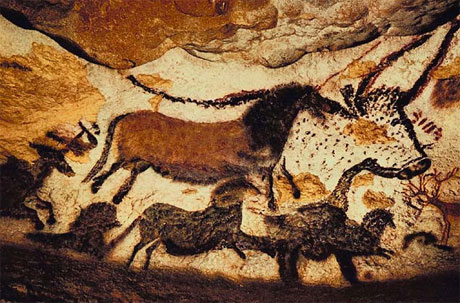
Lascaux

We are at the strangest of crossroads, a series of changes that challenge and upend what have been the core elements of the human experience since the beginning of our species. Nothing perhaps cuts so close to that core as what is happening and will happen to the meaning and place of art in our lives. Art here understood as everything from the music we compose to our paintings and drawings to the stories we tell or the films and videos we create.

For all of our history it has been we ourselves who created art, and perhaps we might even twist Ben Franklin who defined us as a “tool making animal”  to say that humankind is an art making animal. Just now we are beginning to have companions and competitors in these acts of creation. Joining us are increasingly intelligent machines- art creating algorithms that are not only already producing art, but are daily getting better at it. It’s a good time, then, to stop and wonder what the rise of these algorithmic artists will mean.

Human beings have been making art seemingly since our very beginning. We didn’t need the rise of complex human societies in the form of cities to create it.  Like the lost sketches of our childhood, most of our initial art didn’t make it into the future succumbing to dissolution by the elements, creating a great gap of silence between us and our prehistoric forebears, a fact that made the discovery of the Lascaux caves in 1940 all the more astounding. Today, you couldn’t see the Lascaux caves even if you had the wherewithal to get yourself to southern France- they have been sealed off for the caves’ protection. Modern humans with our numbers and our groping are rightly considered a new form of destructive element that can destroy what it loves through its very curiosity. But, thanks to the miracle of the Internet one can visit the wondrous caves without ever leaving the comfort of one’s home.

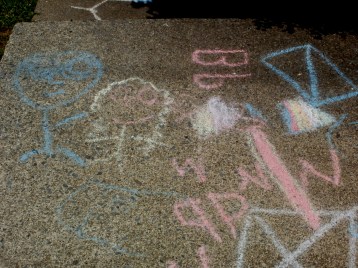
What strikes me as question begging in seeing the caves if only in this limited way is just how clearly its artists were versions of us. Their drawings putting me in mind of nothing so much as the chalk sketches of my daughters. And yet, we are so different from these artists in terms of the world we live in and the understanding we have of it that the gap between us is a chasm. Or better, we can understand, even if to a limited extent these artists but were we able to rip them from the past and bring them into the present it is very unlikely that they would ever understand us.

???????????????????????????????

Over and above human biology, what it seems we share most with the artists of Lascaux is the natural desire to create these sorts of representations. No human society has ever existed without art. We are born with the desire to create these strange models of our world. From the moment my daughters could pick up a crayon they were drawing, from the instant they could hit one object off of another they were making music. With sentences came incredible stories and “plays”.

There is a debate currently raging as to whether one form of art, literature, makes us more moral the best response to which I have seen is that it makes us more human. But perhaps we should say more than human. Art, or good art at least, has the capacity to expand human consciousness far out beyond the boundaries of the self and therefore is part and parcel of those other endeavors of our intelligence such as mathematics, science, philosophy,  history and religion that allow us to spread out the fabric of our awareness over all that we can see. The creation and even consumption of art is a mark of our intelligence and it can therefore be assumed that as our machines become more intelligent they will become more artistic as well. It is already happening.

Algorithms already shape our artistic choices. A program at Amazon suggests what books you should buy, and similar algorithms at Pandora or Netflix knows your tastes in music or movies as well or perhaps better than you do. It isn’t only that algorithms guide our artistic choices in some cases they are used to decide what gets made or heard.

As pointed out by Christopher Steiner in his Automate This a company like Epagogix is being used by film production companies to decide what movies get made or how much to invest in particular films allowing movie companies to recognize a flop before the director even shouts “action”. (75) Steiner shows us how the same thing is being done for music with a company like Music X-Ray which allows musicians to upload their songs into a huge database that can be searched by music producers for, among other things, potential hits. Lady Gaga and Justin Bieber beware. (87)  I have little doubt that similar technologies will eventually be applied to books allowing publishers to find the “Harry Potters” among the flood of manuscripts they receive every day.

In the most basic sense the way in which these film and music sorting algorithms work is that some target criteria is defined, say films grossing over a certain amount, and then the massive data searching capacities of artificial intelligence are applied. At least at this stage technology seems to have empowering potential for individual artists. Their work still exists within a sea of other creations but now at least can be found.

At the moment, on account of its expense, this AI sorting only benefits those producing hits- that is work with the broadest commercial appeal, which most of us hopefully realize is not necessarily the best or most groundbreaking art. We can at least hope that as the cost to create and run these sorts of algorithms decline they will be used to sort for artistic criteria beyond mere commercial appeal.

That’s how algorithms are being used to sort art, but what about actually making it? Music, perhaps because it so closely resembles the mathematics of intelligent machines has been the first to fall here. As only one example: in 2012 on the centenary of Alan Turing’s birth the London Symphony Orchestra performed Hello World! a set of musical pieces composed purely by an algorithm named IAMUS. It does not seem a huge step from algorithms sorting through really big data sets to find hit songs to them being used as tools to allow artists to create hit songs or other productions in the first place or even composing such songs themselves.

The next few decades are likely to experience a tension regarding the question of what these artistic algorithms are actually for?  This will not be another version of the tired  neo-luddite vs technophile dispute but a debate over how to use technology based on different interpretations of its meaning. Are artistic algorithms tools to help human beings create art and find audiences or are they artists themselves? I have no good answer to the question.

Two seemingly contradictory things seem clear to me. The first is that algorithms and artificial intelligence will further expand the fabric of our consciousness. As Jeff Hawkins put it in a recent interview about the future of AI:

When I ask myself, What’s the purpose of life?, I think a lot of it is figuring out how the world works. These machines will help us do that. Many, many years from now, we’ll be able to build machines that are super-physicists and super-mathematicians, and explore the universe. The idea that we could accelerate our accretion of knowledge is very exciting.

Such expansion seems unlikely to be be limited to our models of the universe,  biology or social structure, but will embrace our artistic horizon as well.

The second thing that rings true is that as long as we continue to posses the type of intelligence that defines us as humans we will continue to create art for we are born artists just as we are born scientists and spiritual seekers. How those two aspects of our artistic future resolve themselves is beyond me but perhaps a hint at the major possibilities can be found in the caves of Lascaux.

Perhaps, as in the caves, we will establish places where we can practice our art free from the threat of dissolution that comes from contact with the world. However, the world against which our art will need to be preserved will not be the natural world but what Andrew McAfee calls the New Machine Age we are entering. Art is for human beings to create machines are tools.

Another possibility is that we will have a version of Stanislaw Lem’s Incommunicability Thesis. Machines will become extremely proficient in composing music or perhaps even writing books but they will just be running sophisticated algorithms and have no idea what these productions actually mean. Likewise,for the majority of human beings who are not high level programmers the art the machines create will provide no reflection whatsoever of the internal states, the “thoughts” of the machine. If Lem had been an anthropologist he would have been the strictest of cultural relativists. In this view, not only could the artists of Lascaux never understand us, we could never understand them. You need to live in the worldview of a culture to understand it beyond the level of a nearly empty abstraction.

As a last possibility, maybe the coming age of artistic algorithms will so expand our imaginative horizons that it will appear that our past was nothing more than being trapped in a cave of shadows. That we will have at long last emerged into the sublime brilliance of the light.


Science Fiction and the occulted canvass of time

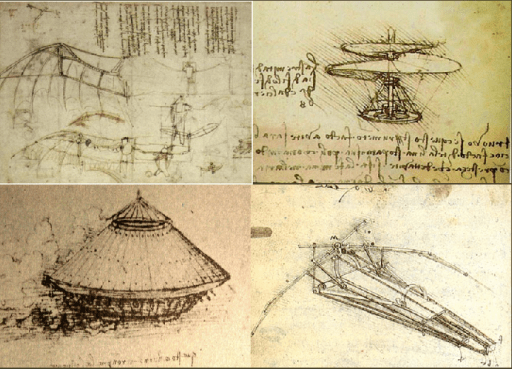
Leonardo Davinci's Inventions

In a recent interview the ever insightful and expansive Vernor Vinge laid out his thoughts on possibility and the future. Vinge, of course, is the man who helped invent the idea of the Singularity, the concept that we are in an era of ever accelerating change, whose future, beyond a certain point,- we cannot see. For me, the interesting thing in the Vinge interview is just how important a role he thinks imagination plays in pulling us forward into new technological and social possibilities. For Vinge, our very ability to imagine some new technological or social reality signals our ability to create it in the near future. Imagination and capability are tied at the hip.

One of his own examples should be sufficient to explain. It was a lack of imagination, not so much technological as social, which prevented the ancients from seeing Hero’s steam engine as something better than an amusing toy.  “For what,” an ancient anchored to the past of what had seemingly always been “ could be a more productive and efficient a system than slavery?”

The ancients were tied to the short chain of the past, we have a very different orientation to time- our gaze is forward not backward. In part, the accelerating rate of technological change today emerges out of this change in our imaginative orientation away from the past and towards the future. Many of us are both thinking about the future seriously, and have a broadened perspective on what is possible because we have learned how to dream. We are, in Vinge’s words “grabbing the fabric of reality and pulling it towards us” a great change in the attitude towards the future than could be found a mere 500 years ago.

Vinge is right about this, the idea of imagining the future as something fundamentally different from the past is a relatively recent human habit of mind. If the future was a painting one might say that for most of human history the painting remained monotonously the same with the new only added very slowly to it. To continue with this analogy, what one started to see beginning around the late 1200s was the appearance of blank space on an expanded canvas to which the new could be added, something that would eventually happen at an accelerating pace.

And it has been the kinds of imagination we associate with Vinge’s craft -science-fiction- that has played a large role in producing despite Ecclesiastes “new things under the sun”.  Science-fiction, its progenitors and its derivatives were one of the main vectors by which the new could be imagined. We merely had to await the improvement in our technical skill, our ability to “paint” them- to bring them into being. Here is one of the first and maybe the most powerful example. Way back in the late 1200s Roger Bacon in his Epistola de Secretis Operibus Artis et Naturae Magiae predicted the future with an accuracy that would make Nostradamus blush. Predicting:

Machines for navigation can be made without rowers so that the largest ships on rivers or seas will be moved by a single man in charge with greater velocity than if it were full of men. Also cars can be made so that without animals they will move with unbelievable rapidity… Also flying machines can be constructed so that a man sits in the midst of a machine revolving some engine by which artificial wings are made to flap like a bird… Also a machine can easily be made for walking in the seas and rivers, even to the bottom without danger.” (Aladdin’s Lamp  417-418)

Now, Roger Bacon seems to disprove part of Vinge’s ideas regarding imagination and the future, namely; the idea that if we can dream of something we are likely to make it happen right away, for it would take another seven centuries for us to be driving in cars or flying in airplanes. Yet this gap would disappear, in fact it would be measured in decades rather than centuries, for almost all of the history of science-fiction, up until recently that is. But I am getting ahead of myself.

Leonardo Da Vinci also still belongs to the age when the ability to imagine ran far out in front of our capacity to create in the real world. Da Vinci in  imagining flying machines or submarines or tanks- such as the speculative inventions pictured above- might be said to be practicing an early type of science- fiction, expanding the realm of what was imaginable and therefore potentially possible, but like the possibilities sketched out in Bacon they would take a long time in coming.

Related to this expansion in imaginative possibilities that began in early modern Europe that same region also experienced an expansion of the world itself.  During the Age of Exploration Europeans came face-to-face with the true size of the world, but it would be sometime before they knew the details about the human societies that inhabited it. This was a recipe for the imagination to run wild and provided an arena of fantasy in which European anxieties and hopes could be played out. One got all sorts of frightening stories about “cannibals”, but one also had Utopian lands presented as ideal cities rediscovered. These stories allowed Europeans to imagine alternatives to their own societies. After the discovery in the same period that the moon and planets were also “earth-like” worlds you get the birth of that staple of science-fiction- intelligent life on other planets- with works such as Bernard Le Bovier de Fontenelle’s Conversations on the Plurality of Worlds that allowed brave writers to explore alternative versions of their societies in yet another landscape.

By the 1800s the gap between what we dreamed and what we could do was closing incredibly fast. Not only was the world being transformed by industrialization it was also clear that technology was steadily improving and thus revolutionizing and expanding the prospects for human societies in the future – we now call this progress. Our canvas was being filled in, but was also being even further stretched out to allow for yet more possibilities. Science-fiction writers were to play a large role in driving  this expansion both of what we could do and what, because it was imaginable was deemed possible.

To name just a few of these visionaries: even if predicting the future of technology wasn’t his intention, Jules Verne expanded our technological horizon by dreaming up trips to the moon and undersea voyages. Then there was the cultural sensation of Edward Bellamy and the incomparable H.G. Wells.

Bellamy, in his futuristic Looking Backward 2000-1887 was just one of many who thought the new landscape of human flourishing would be found through the proper organization of the enormous powers of industrialization. Bellamy got a number of things right about the future, from department stores and credits cards to a version of the radio and the telephone that lay less than a century into the future.

H.G. Wells was even better, his trope of a time machine in lieu of a Rip-Van Winkle type sleep to get one of his protagonists into the future notwithstanding, he got some pretty important, though sadly dark, things from atomic bombs to aerial warfare essentially correct. Less than half a century after Wells had imagined his nightmare technologies they were actually killing people.

For a time the solar system itself, not because it contained living worlds resembling the earth as Fontenelle had imagined, but because it was at last reachable seemed to hold the hope of yet another canvas upon which different versions of the future could be drawn. The absolute master in presenting the sheer enormity of this canvas was Olaf Stapledon who in works like Last and First Men and Star Maker placed humanity’s emigration into space within the context of the history of life on earth and even the universe itself giving such a quest what can only be called a religious dimension.

Stapledon was thinking in terms of billions of years, but the technologies to take us into space spurred forward by the Second World War- Nazi V rockets, and then the Cold War “space race” seemed to be bringing his dreams into reality almost overnight.

This was the perfect atmosphere not only for pulp science-fiction and comics based around the exploration and settlement of space, but for much deeper fare such as that of Stapledon’s great heir, Arthur C. Clarke, who wrote his own religious versions of the meaning of the space race.

Yet,  it was our future in space where the narrowing gap between what we can dream and what we could do began to not only stop narrowing but actually to widen.  Clarke was eerily on the money when it came to the development of telecommunications and the personal computer, but wide off the mark when it came to our immediate future in space. His 1968 novel and movie 2001: A Space Odyssey has us taking manned missions to Jupiter in that millennial year which, sadly, has come and gone without even having men return to the moon.  Despite his hopes, his beautiful fiction did not inspire the creation of actual space ships twirling space stations and missions, but a whole series of big budget films and television series based in outer space. More on that in a minute.

Right around the time American astronauts were setting foot on the moon science-fiction  was taking some other and ultimately introspective turns more aligned with the spirit of the times. In the words of the man Fredric Jameson in his Archaeologies of the Future called the “Shakespeare of science-fiction”, Philip K. Dick:

Our flight must be not only to the stars but into the nature of our own beings. Because it is not merely where we go, to Alpha Centaurus or Betelgeuse, but what we are as we make our pilgrimages there. Our natures will be going there, too. “Ad astra” — but “per hominem.” And we must never lose sight of that. (The Android and The Human)

It would be a while until we’d make it to Alpha Centaurus or Betelgeuse, for humanity’s rabbit leap movement into the solar system sputtered to a turtle-like crawl with the end of the Apollo missions in 1972. Like the picture of our big blue marble from space seemed to tell us, we, serious science-fiction writers included, were going to have to concentrate on the earth and ourselves for a while, and no question here was as important perhaps than that implied by Dick of what exactly was our relationship with the technological world we had built and how to react in light of this world changing into something new with both promise and danger?

Even if the 70s and 80s were a period of retreat from the actual human settlement and exploration of space they were a heyday of dreaming about it. I was a kid then, and I loved it! There was Star Wars and Star Trek, Battlestar Galactica and a new Buck Rogers.  Special effects, even if they seem primitive by today’s standards had gotten so good that one felt, at least if you were 10, like you were really there. And yet, we were nowhere near the things that could be dreamed stuck instead in low-earth orbit like David Bowie’s Major Tom.

This very ability to produce such vivid dreams of what could be was itself driven by technological changes that actually were happening a fact that became even more the case with the development of computers that were fast enough and cheap enough to make realistic computer animation possible- CGI- possible. Our waking dreams will become even more lifelike given the resurrection and inevitable improvement of 3D.

This new gap between our dreams and reality has resulted in a weird sort of anxiety in the generation, and no doubt mostly men of that generation, who grew up with the idea “the year 2000” would be some magical technological era of cites in space and the next stage of our interstellar adventure. No one, perhaps, has been more vocal in expressing this mindset than the technologists and billionaire, Peter Thiel who in a 2011 interview in the New Yorker stated the case this way:

One way you can describe the collapse of the idea of the future is the collapse of science fiction,” Thiel said. “Now it’s either about technology that doesn’t work or about technology that’s used in bad ways. The anthology of the top twenty-five sci-fi stories in 1970 was, like, ‘Me and my friend the robot went for a walk on the moon,’ and in 2008 it was, like, ‘The galaxy is run by a fundamentalist Islamic confederacy, and there are people who are hunting planets and killing them for fun.’

Doubtless, Theil downplays the importance of the revolution in computers and telecommunications that occurred in this period- a revolution he himself helped push forward. While states provide incapable or unwilling or both of pursuing Arthur C. Clarke’s vision of our future in space, a generation of bohemians and tech geeks succeeded in making his dreams about personal computers and a global communications network which had rendered location irrelevant come true. Here is Bill Gates in his Spock- like hyper-rational yet refreshingly commonsensical way on Peter Thiel’s slogan for technological pessimism:

We wanted flying cars, instead we got 140 characters.

I feel sorry for Peter Thiel. Did he really want flying cars? Flying cars are not a very efficient way to move things from one point to another. On the other hand, 20 years ago we had the idea that information could become available at your fingertips. We got that done. Now everyone takes it for granted that you can look up movie reviews, track locations, and order stuff online. I wish there was a way we could take it away from people for a day so they could remember what it was like without it.

Yet, Thiel and the cohort around him are not ones for technological resignation or perhaps even realism. Instead, they are out to make something like the sci-fi space fantasies they were raised on as kids in the 70s and 80s come true. Such is the logic behind what, so far at least, has been the first successful foray of a private company into space exploration- Elon Musk’s Space X. Believe it or not, two companies plan to send missions to Mars in the very near future: Inspiration Mars which hopes to launch a manned orbital probe and the even more ambitious Mars One which hopes to send a human crew to Mars that will not return- permanent settlers- in 2023 with an unmanned mission sending supplies to be sent only three years from now.

In a twist that I am not sure is a dystopian space version of The Truman Show or a real world version of Kim Stanley Robinson’s thought provoking Mars Trilogy the whole experience of the deliberately marooned Mars colonists of Mars One is to be broadcast to us earthlings safe on our couches. If this ends up like the Truman Show what we’ll have is the reduction of Stapledon’s or Clarke’s vision of space as a canvas upon which human destiny is to be written to a banal and way too expensive version of interstellar product placement that would be farcical if it wasn’t ultimately also a suicide mission. Though, instead of virgins in heaven the Martian marooned will see their families made rich by advertising royalties with the only price that they will never see them in person and given the distance will never be able to speak with them in real time again. Yet there are reasons to be optimistic as well.

Perhaps the Mars One mission, if it is successful, will result in something  Robinson’s Mars Trilogy as described in Archeologies of the Future. According to Jameson, Robinson has provided us with a tableau in the form of human colonies on Mars upon which different definitions of what it means to be human and what the ideal society and what we should most value are played off against one another in a way that can never be finally and satisfactorily resolved. Mars One and missions of its type might give us a version of real-world science-fiction, where, as Philip K. Dick suggested it should be, the question is not where we are and what we can do but what we should be? Such adventures might help restore the canvass of the future, both by luring us away from our enticing versions of it which are too far from our grasp, and by allowing us to find some fate other than falling into the black pit of Vinge’s Singularity where our own still human future has been rendered irrelevant.

Then there is the future of science-fiction itself. As David Brin recently pointed out, his fellow science-fiction writer, Neal Stephenson, has launched a fascinating endeavor, Project Hieroglyph that encourages collaboration between science-fiction authors, artists and engineers in creating positive visions of the near human future.

Yet, there is another, even more important role I believe science-fiction can play.

Part of the reality of science and technology today is that it can be used to build radically different forms of society. As Douglas Rushkoff pointed out in this brilliant impromptu speech many of us thought the spread of the Internet was going to rise to one form of society- a society of free time and digital democracy, but instead the Internet has been used as a tool for the disappearance of the distinction between life and work, the application of ubiquitous surveillance by corporations and the government. In a time such as ours when the same technology can be used to pursue very different ends and used to support very different sorts of societies perhaps the primary role of science-fiction is to give us the intellectual and emotional skills necessary to negotiate our technological world- both as individuals and as a society. In this sense science-fiction, which seems to many just “kids’ stuff” is the most serious form of fiction we have, a tried and true road to the future.

Capitalism, Evolution and the Attack of the Giant Fungus

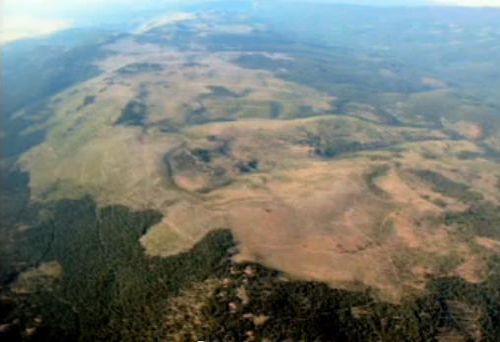
Armillaria ostoyae

One of the stranger features of our era is its imaginative exhaustion in terms of the future, which I realize is a strange thing to say here. This exhaustion is not so much of an issue when it comes to imagining tomorrow’s gadgets, or scientific breakthroughs, but becomes apparent once the question of the future political and economic order is at stake. In fact, the very idea that something different will almost inevitably follow the institutions and systems we live in seems to have retreated from our consciousness at the very time when the endemic failures of our political and economic order has shown that the current world can not last.

Whatever the failures of government in Washington no serious person is discussing an alternative to the continued existence of the United States or its constitutional form of government now over two centuries old. The situation is even more pronounced when it comes to our capitalist economic system which has taken root almost everywhere and managed to outlive all of its challengers. Discussions about the future economy are rarely ones about what might succeed capitalism but merely the ironing out of its contradictions so that the system itself can continue to function.

It’s not just me saying this, here is the anthropologists and anarchist philosopher David Graeber in his wonderful Debt the first 5,000 Years on our contemporary collective brain freeze when it comes to thinking about what a future economy might be like:

It’s only now, at the very moment when it’s becoming increasingly clear that current arrangements are not viable, that we suddenly have hit the wall in terms of our collective imagination.

There is very good reason to believe that, in a generation or so, capitalism itself will no longer exist-most obviously, as ecologists keep reminding us, because it’s impossible to maintain an engine of perpetual growth forever on a finite planet, and the current form of capitalism doesn’t seem to be capable of generating the kind of vast technological breakthroughs and mobilizations that would be required for us to start finding and colonizing any other planets. Yet faced with the prospect of capitalism actually ending, the most common reaction-even from those who call themselves “progressives”-is simply fear. We cling to what exists because we can no longer imagine an alternative that wouldn’t be even worse. (381-382)

There are all sorts of reasons why our imagination has become stuck. To begin with the only seemingly viable alternative to capitalism- state communism- proved itself a failure in the 1980’s when the Soviet Union began to kick the bucket. Even the socialist alternatives to capitalism were showing their age by then and began pulling themselves back from any sort of direct management of the economy. Then there is one word- China- which embraced a form of state capitalism in the late 1970’s and never looked back. To many of the new middle class in the developing world the globalization of capitalism appears a great success and can be credited with moving millions out of poverty.

Yet capitalism has its problems. There is not only the question of its incompatibility with survival on a finite earth, as Graber mentions, there are its recurrent financial crises, its run away inequality, its endemic unemployment in the developed and its inhuman exploitation in the developing world. One would have thought that the financial crisis would have brought some soul searching to the elites and a creative upsurge in thinking about alternative systems, but, alas, it has not happened except among anarchists like Graeber and the short-lived Occupy movement he helped inspire and old school unrepentant communists such as Slavoj Zizek.

At least part of our imaginative atrophy can be explained by the fact that capitalism, like all political-economic systems before has managed to enmesh itself so deeply into our view of the natural world that it’s difficult to think of it as something we ourselves made and hence can abandon or reconfigure if we wanted to. Egyptian pharaohs, Aztec chieftains, or Chinese emperors, all made claims to rule that justified themselves as reflections of the way the cosmos worked. The European feudal order that preceded the birth of capitalism was based on an imagined chain of being that stretched from the peasant in his field to the king on his throne through the “angelic” planets to God himself- out there somewhere in the Oort Cloud.

The natural order that capitalism is thought to reflect is an evolutionary one which amounts to a bias against design and control. Like evolution, the “market” is thought to be wiser than any intentional attempts to design steer or control in could ever be. This is the argument one can find in 19th century social Darwinist like Thomas Huxley, a 20th century iconoclast like Friedrich Hayek, or a 21st century neo-liberal like Robert Wright, all of whom see in capitalism a reflection of biological evolution in that sense. In the simplest form of this argument evolution pits individuals against one another in a competition to reproduce with the fittest individuals able to get their genes into the next generation. Capitalism pits producers and sellers against others dealing in similar products with only the most efficient able to survive.  History seemed to provide the ultimate proof of this argument as the command economy of the Soviet Union imploded in the 1980’s and country after country adopted some sort of pro-market system. The crash, however,  should have sparked some doubts.

The idea that the market is a social version of biological evolution has some strong historical roots. The late Stephen Jay Gould, in his essay “Of bamboos, cicadas and the economy of Adam Smith” drew our attention to the fact that this similarity between evolution and capitalism might hold not because the capitalist theory of economics emerged under the influence of the theory of evolution but the reverse. That the theory of evolution was discovered when it was because Darwin was busy reading the first theorist of capitalism- Adam Smith. I am unable to find a link to the essay, but here is Gould explaining himself.

The top down mercantilist economy Smith attacked in his Wealth of Nations, according to Gould, must have seemed to Darwin like the engineering God of William Paley in his Natural Philosophy. Paley was the man who gave us the analogy of God as “watchmaker”. If you found a watch on the beach and had never seen such a thing before you could reasonably assume it was designed by a creature with intelligence. We should then reason from the intricate engineering of nature that it was designed by a being of great intelligence.

Adam Smith was dealing with a whole other sort of question- how do you best design and manage an economy? Smith argued that the best way to do this wasn’t to design it from the top down, but  to let the profit motive loose from which an “invisible hand” would bring the best possible economic order into being. In the free market theory of Smith, Darwin could find a compelling argument against Paley. The the way you arrived at the complex order of living things was not to design it from on high but to let the struggle for reproduction loose and from an uncountable number of failures and successes would emerge the rich tapestry of life which surrounds us in words of a much later book on the topic by Richard Dawkins, the “designer” of nature was a Blind Watchmaker.

The problem with thinking our current economic system reflects the deep truth of evolution is not that the comparison lacks a grain of truth, and it certainly isn’t the case that the theory of evolution is untrue or is likely to be shown to be untrue as something like the Great Chain of Being that justified the feudal order was eventually shown to be untrue. Rather, the problem lies with the particularly narrow version of evolution with which capitalism is compared and the papering over of the way evolution often lacks the wisdom of something like Smith’s “invisible hand”.

Perhaps we should borrow another idea from Gould if we are to broaden our evolutionary analogy between evolution and capitalism. Gould pioneered a way to understand evolution known as punctuated equilibrium. In this view evolution does not precede gradually but in fits and starts with periods of equilibrium in which evolutionary change grinds to a halt are ended by periods of rapid evolutionary change driven by some disequilibrating event- say a rapid change in climate or the mass appearance of new species such as in the Columbian Exchange. This is then followed by a new period of equilibrium after species have evolved to best meet the new conditions, or gone extinct because they could not adapt and so on and so on.

The defining feature of late capitalism, or whatever you chose to call it, is that it is unable to function under conditions of equilibrium, or better, that its goal of ever increasing profits is incompatible with the kinds of equilibrium found in mature economies. This is part of the case the financial journalist Chrystia Freeland makes in her engaging book Plutocrats. The fact that so much Western money is now flowing into the developing world stems from the reality that the rapid transformation in such places makes stupendous profits possible. Part of this plethora of potential profits arises from the fact that areas such as the former Soviet Union China and countries that have undergone neo-liberal reforms- like India- are virgin territories for capitalist entrepreneurs. As Rosa Luxemburg pointed out during the last great age of globalization at the end of the 19th and beginning of the 20th century capitalism was the first system “that was calculated for the whole earth”.

To return to the analogy with evolution, it is like the meeting of two formerly separated ecosystems only one of which has undergone intense selective pressures. Capitalist corporations whether Western or imitated are the ultimate invasive species in areas that formerly lived in the zoo- like conditions of state socialism.   In the mature economies such as those of the United States, Europe, and Japan the kinds of disequilibrium which leads to the ever increasing profits at the root of capitalism have come in two very different forms- technological change and deregulation. The revolution in computers and telecommunications has been a source of disequilibrium upending everything from entertainment to publishing to education. In the process it has given rise to the sorts of economic titans, and sadly inequality,seen in a similar periods of upheaval. We no longer have Andrew Carnegie, but we do have Bill Gates. Standard Oil is a thing of the past, but we have Google and Facebook and Amazon.

The transformation of society that has come with such technological disequilibrium is probably, on net, a positive thing for all of us. But, we have also engendered self-inflicted disequilibrium without clear benefit to the larger society. The enormous growth in the profits and profile of the financial industry came on the back of the dismantling of Depression era controls making financiers and financial institutions into the wealthiest segment of our society. We know where that got us. It is as if a stable, if staid, island ecosystem suddenly invited upon itself all sorts of natural disasters in the hope of jump starting evolution and got instead little but mutants that threaten to eat everything in sight until the island became a wasteland. Late capitalism is like evolution only if we redact the punctuated equilibrium. It is we ourselves who have taken to imposing the kinds of stresses that upend the economy into a state of permanent disequilibrium.

The capitalism/evolution analogy also only works under conditions of a near perfect market where the state or some other entity not only preserves free competition at its heart but intervenes to dismantle corporations once they get too large. Such interference is akin to the balancing effect of predation against plants or animals that exhibit such rapid reproduction that if the majority of them were not quickly eaten they would consume entire ecosystems.  Such is the case with the common aphid which if left to its devices would have one individual producing 1,560,000,000,000,000,000,000,000 (1 heptillion, 560 hexillion) offspring!

The balance of nature is a constraint that every species is desperate to break out of just as at the root of every corporation lies the less than secret wish to have eliminated all of its competition. Most of the time predation manages to prevent the reproductive drive of any one species from threatening the entire ecosystem, but sometimes it fails. This is the case with the giant fungus Armillaria ostoyae whose relentless growth kills the trees above it and smothers the diverse forest ecosystem from which it had emerged.

We can complain that the failure of the government to break up giant corporations has let loose the like of Armillaria ostoyae. Calls to dismantle the big banks after the financial crisis fell on deaf ears. Big banks and mega-corporations can now point to their global presence and competition against other behemoths to justify their survival. We couldn’t dismantle Google if we wanted too because everything left would be swallowed by Baidu.

And it’s not only that the government is failing to preserve market competition by letting companies get too big, it’s also distorting the economic ecosystem to favor the companies that are already there. The corruption of democracy through corporate lobbying has meant that the government, to the extent that it acts at all, is not preserving free competition but distorting it. To quote from Plutocrats:

“Most lobbying seeks to tilt the playing field, in one direction or another, not level it.” (262)

Another, and for my part much more galling oversight of the capitalism/evolution analogy is that it tends to treat any attempt at design, guidance or intention on the part of the society at large as somehow “unnatural” interference in what would otherwise be a perfectly balanced system. What this position seems to conveniently forget is that the discovery of Natural Selection didn’t somehow lead to the end of Artificial Selection– instead quite the opposite. We don’t just throw a bunch of animals in a room and cross our fingers that some miracle of milk or egg production will result. What we do is meticulously shape the course of evolution using some constraint based on our hoped for result.

It we who have established the selective criteria of maximizing and increasing profits and growth to be the be all and end all of a corporation’s existence when we could have chosen a much different set of selection criteria that would give rise to completely different sorts of economic entities. Governments already do this when they force industries to comply with constraints such as health and safety or environmental requirements. Without these constraints we get the evolution of economic entities that are focused on maximizing profits and growth alone, man made creatures which giant fungus like care little for the people and societies underneath them.

Related to this is another evolutionary assumption shared by proponents of the unfettered free market, this one with somewhat dubious scientific validity. Those who believe capitalism can run itself seem to subscribe to an economic version of James Lovelock’s “Gaia Hypothesis”.  Recall, that Lovelock proposed that the earth itself was a kind of living organism that had evolved in such a way as to be self-regulating towards an environment that was optimal for life. Human beings, if they were crazy enough to challenge this Gaian equilibrium were asking for extinction, but life itself would go on until it faced a challenger it would be unable to best- the earth’s beloved sun.

Belief that the technological world is a kind of superorganism can be found thought like these of the journalist Robert Wright that I have quoted elsewhere:

Could it be that, in some sense, the point of evolution — both the biological evolution that created an intelligent species and the technological evolution that a sufficiently intelligent species is bound to unleash — has been to create these social brains, and maybe even to weave them into a giant, loosely organized planetary brain? Kind of in the way that the point of the maturation of an organism is to create an adult organism?”

In this quote can be found both of the great forces of disequilibrium unleashed by late capitalism, both the computer and communications revolution and globalization. But it seem that this planetary brain lacks the part of our neural architecture that makes us the most human- the neocortex, by which we are able to act intentionally and plan.

The kinds of hair-trigger threads we are weaving around society are good in many respects, but are not an answer to the problem of our long term direction and can even, if they are not tempered by foresight, themselves lead to the diminution of long term horizons in the name of whatever is right in front of our nose, and spark crises of uninformed panic lacking any sense of perspective. Twitter was a helpful tool in helping to overthrow Middle Eastern dictators, but proved useless in actually establishing anything like democracy.

Supercomputers using sophisticated algorithms now perform a great deal of the world’s financial transactions in milliseconds,  and sometimes lead to frightening glitches like the May 2010 “flash crash” that may portend deeper risks lying underneath a world where wealth is largely detached from reality and become a sea of electrons. Even if there are no further such crashes our ever shortening time scale needs to be somehow tempered and offset with an idea of the future where the long term horizon extends beyond the next financial quarter.

 Late 21st century capitalism with its focus on profit maximization and growth, where corporations have managed to free themselves from social constraints, and where old equilibriums are overturned in the name of creating new opportunities is just one version of a “natural” economic system.  We are free to imagine others. As Graeber hoped we would start to wonder what different kinds of economic systems might be possible besides the one we live in. The people we would do best turn to when it comes to imagining such alternatives are unlikely to come from the ranks of economists who are as orthodox as any medieval priesthood, or our modern fortune-tellers- the futurists- who are little better than “consultants” for the very system we might hope to think our way beyond.

No, the people who might best imagine a future alternative to capitalism are those who are the most free of the need to intellectually conform so as to secure respectability, tenure, promotion, or a possible consulting gig, and who have devoted their lives to thinking about the future. The people who best meet this description today are the authors of science and speculative fiction. It will be to their success and failure in this task that I will turn next time…

Inventing a New World

As the sun is setting into the Pacific Ocean at the end the terminus of Western Civilization, Western Civilization ends here in California at Venice Beach, so we stood there inventing a new world…

                                                                                                                                                 Ray Manzarek

I had been anxiously awaiting Stewart Brand’s scheduled talk at The Long Now which he gave this last Tuesday. Revive and Restore Brand’s project which will explore the prospect of bringing back extinct species is just the latest project of this intellectual maverick and pied-piper of the digital, and what may now be the opening rounds of the biological age. Brand has been a sort of weathervane for the cultural winds of American, or rather a very influential subset of American culture.

He began his career as an ecologist, but quickly became a sort of Forrest Gump of the major cultural and technological currents appearing out of San Francisco and what would become known as Silicon Valley- trails that radiated outward to influence both America and the larger world.

He makes an appearance in Tom Wolfe’s The Electric Kool Aid Acid Test due to his association with Ken Kesey’s Merry Tricksters, and founded the hippie back to the land bible- The Whole Earth Catalog– a project which a technology giant like Steve Jobs could cite as one of his inspirations. We have Brand to thank for the first iconic pictures of our “big blue marble” from space, for he led a public campaign for NASA to release these photos of earth it had kept secret.

It is somewhat poignant that Brand made his first entry into public consciousness here with the Apollo moon landings. The American foray to the moon proved to be the capstone, rather than as was thought at the time a stepping stone, on a great world- civilizational project to settle the worlds beyond earth. It was a project that required the mass resources of the state and it capacity for committing itself to goals that spanned across generations. This was the same state that Brand and his generation feared, quite rightly, might just end up killing us all. Indeed, the very technologies which threatened the world with thermonuclear armageddon brought us into earth orbit and allowed humans to leave their footprints on our beloved moon.

States don’t do projects like the Apollo missions anymore. The only consolation being that they don’t threaten to kill us off in a nuclear holocaust either. Some saw this twilight coming or helped it along. Brand and his fellow travelers represented a generational rebellion against the “system” and the “establishment” for the way it both crushed individuals and the kinds of existential risks it posed to both humanity and the natural world. What was odd about Brand in this mix of rebels and hippies was the instrument he chose to be the primary tool against the system wasn’t psychedelic drugs or music but the computer- a device that up until then in the form of corporate and government mainframes was associated with most dehumanizing features of the system itself- turning human being into “numbers”.

In the 1970s and 80s Brand helped create the idea that computers and computer networks could be transformed into a liberating force of individual empowerment and personal exploration, and to this effect not only brought hackers to public attention, but helped establish another bible, this one for the Internet during the period of the dotcom boom of the 1990s, Wired Magazine.

In the late 1990s Brand launched yet another bold project, The Long Now Foundation, whose mission is to take a long term perspective of human affairs- 10,000 years into the human past and 10,000 years into its future. As he himself put it:

Civilization is revving itself into a pathologically short attention span. The trend might be coming from the acceleration of technology, the short-horizon perspective of market-driven economics, the next-election perspective of democracies, or the distractions of personal multi-tasking. All are on the increase. Some sort of balancing corrective to the short-sightedness is needed-some mechanism or myth which encourages the long view and the taking of long-term responsibility, where ‘long-term’ is measured at least in centuries. Long Now proposes both a mechanism and a myth.

The Long Now Foundation often deals with topics which the state is no longer up to or those which have such a global aspect that it’s difficult to frame them within the context of territorially defined states at all.

Revive and Restore seem like a poignant culmination point for the 74 year old Brand bringing together his first love of ecology, his belief in the utopian potential of technology, and his interest in understanding and coming up with solutions to problems within a wide historical arc. The effort to revive extinct species, not just in zoos, but in the context of restored habitats is a perfect long term project that would take multiple generations to achieve. It seeks to undo some of the damage from our ancestors not just from the recent past, as is the case from extinctions in the early early part of the last century such as the Passenger Pigeon and the Tasmanian Tiger, but going back to our spear throwing ancestors who killed off megafauna such as the Woolly Mammoth  at the very beginning of Brand’s long now.

The world would be a better place if there were more Stewart Brands, nevertheless, I think it might be wise to consider not so much his current project as the assumptions that have been at the root of most of them, assumptions he brought from the commune movement of the early 1970s whose attitude towards the political world was that it was rotten to the core and so- the hell with it.

These were assumptions that would be widely shared among a certain segment of the left- represented by Brand and his fellow travelers, and even more so by the right beginning with the same man who presided as governor of the tie- dyed California of Brand’s young adulthood, Ronald Reagan. Both would so revolutionize the world that by the early 21st century techno-philanthropists and visionaries of the kind that surround Brand and his projects would be trying to fulfill many of the roles that were formerly the task of governments-  the founders of corporate titans whose very nature as global entities under constant innovative pressure left traditional forms of government starved of the very funds that allow it to function.

The argument that Brand and the people around him were largely responsible for our ideas that digital technology would be a liberating force but had they also brought into this discourse a kind of disconnectedness from surrounding social reality has been made before, and excellently, by Fred Turner in his From Counterculture to Cyberculture. Yes, the internet and personal digital technology are liberating, but the idea that they are purely so can only be supported when one ignores the underlying social reality upon which they rest. Smart phones in our hands or computers on our desktops bring with them all sorts of potential, but one needs to remember that there are other, and often low paid, human beings who make such things. The communications revolution allows and amazing degree of personal empowerment, but it has also run hand in glove with perhaps the largest explosion of economic inequality in the history of both the United States and the larger world.

The Long Now’s Revive and Restore is a sexy project that has managed to get a lot of press, yet, there is a danger that the digerati are merely building the 21st century version of the Egyptian pyramids- lasting monuments that nonetheless end up sapping. or at least fail to support, the society underneath them. Just as needed are efforts to gather the San Francisco elites who flock to The Long Now’s wonderful seminars to discuss how to get their companies revenue into the hands of governments, or at least those parts of the government that are doing things the digerati consider worthwhile. This is the lesson to be drawn from the recent tax scandal involving Apple, which through clever accounting tricks that are ubiquitous across the large multi-national companies was able to avoid tens of billions in taxes.

Recovering the billions in taxes lost from Apple alone would allow us to do far more in the effort to protect at risk species and habitats than any effort to revive lost species. With 10 billion dollars we could triple the budget of NOAA from 5 to 15 billion. That would certainly help at risk marine life and habitats, but if our goal was to confront extinction directly, recovering just 10 billion from Apple would allow us to triple the combined budget for the US Fish and Wildlife Service’s Endangered Species Program.

It is certainly the case that the tech-giants- Apple, Google, Microsoft,  Facebook and Amazon along with all the great American multinationals are now global companies to an extent that being able to capture some of their revenue for the purpose of supporting the community from which they spring might be well nigh impossible. It is also the case that forums such as The Long Now Foundation, the TED Conference, or most of all The World Economic Forum at Davos are some of the few places, almost all of them dominated by non-government actors, where the global aspects of many of our problems are acknowledged and the idea of a common future for humanity- the very idea Brand wanted to get across by pushing NASA to publish its photos of earth from space- embraced. That is, global intellectual and business elites realize there is need for global coordination and action across a whole range of problems if humanity is to prosper and some might argue even survive.

As Peter Diamandis points out in his Abundance, today’s economic titans, a great number of which rose to prominence on the back of the computer revolution foreseen and pushed forward by Brand, are much more socially conscious than any of their predecessors. Today’s elites are not only aware of global problems they are desperate to do something meaningful to address them. Yet, in presenting this group of innovators whom Diamandis calls “techno-philanthropists” as capable of solving the world’s problems almost single handedly, through the application of the same technological and entrepreneurial methods through which they built their high tech companies, Diamandis distorts the relationship between techno-philanthropists and the state by overplaying the impact of the former and almost ignoring the impact of the latter.

From Christina Freeland’s insightful book, Plutocrats, here is Bill Gates head of the largest and most laudable of the techno-philanthropist on the relationship between government and his Bill and Melinda Gates Foundation:

Our foundation tends to fund more of the up-front discovery work, and we’re a partner in delivery, but government funding is the biggests. Take delivering AIDS medicine. We did the pilot studies that you could deliver ARBs [angiotensin II receptor blockers] in Africa, and then PEPFAR [the U.S. President’s Emergency Plan for AIDS Relief, the U.S. government program which is five billion [dollars] a year, which is way more than our whole program, just that one U.S. government help program- just one country- came in and scaled up from that. (75-76)

The dangers of the institutions created and supported by government are that they will degenerate as rules and procedures accumulate over time into the kinds of arbitrary bureaucracy presented in Franz Kafka’s dystopian novel The Castle where the system has become so detached from its original purpose to be not only incomprehensible but pointless. The second danger is that those who belong to such institutions will confuse the well being of the institution and its members with the goals of the institution itself.

The innovative nature of technological-philanthropy might be able to break through the Byzantine walls of bureaucracies that have themselves now become part of the problem- you can see something like this in The Bill and Melinda Gates Foundation challenge to entrenched educational interests such as teacher’s unions. But this isn’t the whole story.

The types of institutions that spring from government or something like government are necessary for the slow plodding work of pursuing goals over multi-generational spans of time. Their existence is necessary for any task we hope to accomplish that cannot be achieved all in one go. These are precisely the types of problems Brand believes society is no longer addressing- the inspiration behind his organization The Long Now.

Added to this aspect of being multi-generational problems many of the world’s challenges are, as the current elites recognize, global in scope. Climate change is a global problem that will not be solved overnight, the same can be said for the threat from asteroids or pandemics, or the sixth great extinction. Many security problems now have a global aspect as will the need to find a working modus vivendi with potentially transformative technologies such as synthetic biology. The pictures of our shared earth that Brand pressured NASA to publish also remind us that the natural beauty of the earth and even its cultural and historical legacy is something all of us on our small world share and need to collectively preserve.

One of our primary problems is how to develop and support the kinds of international institutions that are necessary for our new global world in an era dominated by multinational corporations that skillfully avoid taxation by “locating” in the country with the lowest tax rate?

Here is an idea: perhaps we could initiate a global tithe on these world spanning corporations, a minimum tax that would be funneled into existing international institutions and perhaps new ones that support the long term future of humanity along with the preservation of the biosphere and the legacy of life on earth in all its aspects. This would truly be a Long Now type endeavor one that would help close the rift between the new innovative elites and the “establishment” they abandoned in the heady utopianism of the late 20th century.

The Far Futures Project

Zodiac Man 1413

When I was a kid there was a series on Nostradamus narrated by an Orson Welles surrounded in cigar smoke and false gravitas. I had not seen The Man Who Saw Tomorrow for over 30 years, though thanks to the miracle of Youtube I was able to find it here.  Amazingly enough, I still remember Part 9 of the series in which the blue- turbaned, Islamic, 3rd antichrist allied with the Soviet Union plunges the world into thermonuclear war. I also remember the ending- scenes of budding flowers and sunshine signaling the rebirth of nature and humanity, a period of peace and prosperity to last 1,000 years. I think what must have made an impression on my young mind was the time frame of Nostradamus’ supposed predictions- with the Third World War to start sometime between the years 1994-1999, a time frame that was just close enough to scare the bejesus out of an already anxiety prone 9 year old. Thankfully, I was able to escape the latent fear induced by this not so well produced premonition when the USSR went belly up in 1991. Predicting the future is a tough job.

And what does it mean to predict the future anyway? Any idea that the future is somehow foreseeable seems to rely on some concept of determinism, but it’s not quite clear that all aspects of existence experienced by human beings are equally deterministic. Astrology seems to be a good example of how this works. Some of the things we experience do indeed seem to be determined, or better, their course stays essentially the same over vast stretches of time. It makes sense, even though it doesn’t work, to repackage and apply this determinism at the human level giving us a false but confidence building sense of control. The crazy thing, at least in terms of the future of society as opposed to the future of individuals,  is that human beings seem prone to making predictions with bad outcomes, just consult the prophet of your choice. So, one wonders why something that is supposed to relieve anxiety- knowing what will happen- ends up doing the exact opposite and instead fills us with nostrodemian dred?

Maybe its all about the scale of the market. Palm readers who inform too many of their customers that their lives are about to go into the toilet probably go out of business pretty fast. When you’re dealing with mass markets though- fear sells. Better to write a book on the looming terrorist threat than one on just how peaceful modern societies are. You get more eyeballs when your piece has the word armageddon in the title than if it contains the word utopia.

Then there is the question of time horizon. As Stewart Brand suggested to the religious scholar Elaine Pagels the attraction of the ambiguity of a “prophetic” text like the Book of Revelation is that one can insert one’s own mortal timeline into it. Ray Kurzweil isn’t the first to predict the end of normal human affairs perilously close to the limit of his own likely lifespan.

Perhaps almost all predictions regarding the future are merely reflections of our own current anxieties, but this is not to say that our relationship to the future is merely all in our heads. Human beings and our societies exist along a continuum of time and this not only ties us to the what-is-not of the past but the what-is-not of the future as well. What we do today, if it proves relevant, will shape the future as much as the decisions made by those who preceded us shapes us today. To deny this is to deny something as real as the very present in front of us.

Yet, this future horizon is not merely something that applies to human civilization but to the earth and universe as a whole. Unless there is some cosmic mystery currently hidden from us, the earth will exists for something approaching 5 billion years before being consumed by the sun, and our universe, however dispersed because of expansion, will continue to have organized structures such as stars and galaxies- likely prerequisites for life- for far far longer than it has been in existence (13.5 billion years) into the realm of the unimaginable range of 100 trillion years.

There exists, then, a very likely future if not for our mortal selves or even humanity, for the cosmos and most likely life and intelligent life. We have something to predict about however silly such predictions will appear in retrospect. This gives us, I think, a great opportunity for a sort of “game”, an attempt to stretch our imaginations outward not so much in the hope that we can see like Welles’ Nostradamus the future that lies before for us so much as to see how broadly we can paint the canvas of what- might- be.

In this spirit, I invite you to participate in what I am calling The Far Futures Project.Those who wish can come up with their own predictions for the near and far future. Send them to farfuturesproject@gmail.com and I will post them on my blog Utopia or Dystopia. My only requirements are that you follow the template in terms of years found in my predictions below:  500, 10,000, 1 million, 1 billion, though I understand they will appear arbitrary to many. My second requirement is that you follow normal editorial standards with the awareness that these posts are geared towards general audience. Also, please provide some identifying information that will allow readers to connect with your ideas- especially links to your own work. My hope is to run the project for about a month, so here’s your chance.

You can see the first response to the call of  the project in this entry by my friend and fellow blogger James Cross here. 

As for me, here I go…

Rick Searle’s Far Future

500 years

The often painful transition that can be traced to changes in human society initiated by the industrial revolution in the 1800s has finally begun to reach equilibrium. Historians in the 2500s tend to see developments since the start of the industrial revolution as a set piece where humanity had to adjust itself to a new technological order, a new relationship with nature, new forms of inter-relations between and among peoples, and above all a need for humanity to decide both what it was and what it should be.

The technological question that the industrial revolution posed which took nearly 7 centuries to resolve was what would be the relationship between human beings and the rapidly evolving kingdom of machines?

Well before the 26th century there emerged a kind of modus-vivendi between human beings and machines, especially machines of the intelligent type. The employment crisis of the early to mid-21st century revolved around the widespread application of machine intelligence to all fields of economic, cultural, and political life, although no one yet could claim such machines possessed features of human intelligence such as consciousness.  True Artificial General Intelligence or AGI remained a ways off, and never really replicated human intelligence, but would prove to be something quite different.

The consequence of the exponentially increasing processing power of computers was the ability to automate almost any formerly human process from the most intellectually challenging – classical composition or scientific discovery to the most simple production procedure. The capacity of machines to do almost any conceivable type of work road atop the ability to tap into human networks and feedback systems resulting in a kind of symbiosis between human intelligence and machines that whatever its human component left far too many people without gainful employment and would prove unsustainable not only economically but emotionally.

Numerous solutions to this dilemma were tried until a genuine modus vivendi was achieved. One attempted solution was to hive off human life from machines by providing people with a guaranteed income and allowing them to opt out of economic, intellectual and cultural pursuits- a solution that at the end of the day proved unsatisfying for far too many to be sustainable.

Another attempted solution was to tie human intelligence even closer to the new forms of machine intelligence by fusing the human mind with that of machines. This solution proved not so much unsustainable as unreachable in the form it had been articulated. Part of the problem stemmed from the fact that those parts of the human brain that were responsible for emotions, which human beings shared with other mammals, moved at such a glacial pace that they proved incompatible with the lightening fast cognition of machines. To propel emotional cognition faster seemed to inevitably result in various unwanted conditions from emotional deadening, to hyper-anxiety, to an accelerated sense of subjective time that canceled out the very longevity human beings had succeeded in creating.

The long lived humans of the 22th century embraced a slower and more reflective notion of time than their 21st century forebears and sought to limit machine intelligence from impinging on activities which embedded human life across the arch of time from the creation of art to the raising of children, the latter which came back into vogue after the prolonged “baby bust”.

Under what became the new post-capitalist order that took hold almost everywhere humans and machines were each given their unique domains based upon the question of scale and speed. Intelligent machines were extremely effective at running large scale entities- cities, armies, markets, coordinating reactions to pandemics and disasters for which the human mind was ill designed. There were also areas where the wetware of the brain proved far too slow- including moving human beings across space in the various incarnations of the 20th century automobile and airplane, fighting under conditions of modern, war or performing emergency surgery.

Machines were also able to fill dangerous (and degrading) economic niches human beings were ill suited to perform. This issue of scale and niche would prove the key to the future evolution of machines, an embedded tendency that someone in the far future when machines became the dominant “lifeform” in the universe would likely be unable to trace to its mundane economic and psychological origins.

A second question that had been raised by the industrial revolution was what the relationship between the natural world and humanity should be, a question that was intimately related to the issue of human population? Since the industrial revolution various societies had gone through a series of stages in terms of their relationship to the natural world a period of brute force rapaciousness unconcerned with environmental impacts followed by growing awareness and idealization of the natural world followed in the end by an increase in biological knowledge that allowed human beings to reverse, minimize, and isolate their impact on the biosphere.

Especially starting in the 22nd century, vast projects were launched that aimed to restore the natural world not merely to its conditions before the industrial revolution, but to those before human beings emerged from Africa over 10,000 years before. The rain forests of the world were restored.  The auroch was genetically recreated and re-established in much of Eurasia along with more common species such as wolves and boar. The ancient chestnut forests and species that relied on them such as the passenger pigeon have been restored in North America, and the estuaries are alive with fish in a way they have not been since at least the 19th century. All the major African species, especially the great apes, have been restored to pre-modern numbers and prehistoric hominids resurrected and established in their ancient homeland of the African savannah. Long extinct species likely killed off by the hunting prowess of early humans- the Woolly Mammoth, Saber Tooth Tiger, Ground Sloth, and Giant Beaver brought back into existence and reestablished in the tundra of Siberia, Canada, and an iceless Greenland.

A solid majority of human beings- nearly 70%- now live in high density cities a move that has not merely aided in decreasing human population because of city-dweller’s smaller family sizes, but shifted the human impact on the environment from diffuse to compact allowing nature to reclaim enormous tracts of non-urbanized space. Especially important in this decreased spatial impact is the movement of farming into the cities. Vast aeroponic vertical farms in urban centers now produce the majority of the world’s food. Much of the Great Plains in North America has reverted to grassland and wildflowers. The return of the Buffalo has even resulted in a small number of Native American Blackfoot to return to their long lost traditional lifestyle- though they have kept the post-columbus horse.

For the first time in history there is effective global management of the earth’s biosphere. The global environment is constantly monitored not only from satellites but from a whole host of animal embedded sensors and cameras that provide real-time 24/7 monitoring of the earth’s environment. Invasive species and destructive diseases are caught, isolated and removed at lightening fast speeds.

Sophisticated AI directed modeling allows for extremely detailed predictions as to environmental impact permitting the tailoring of industrial and agricultural projects to promote healthy ecosystems, and directs the movement and actions within the human geography to best meet the needs of wildlife and the larger ecosystem.

This earth-scale environmental management is just one sign of the vastly increased capacity for global governance that was developed from the late 21st century forward. It origins lie in crises of both an environmental and geopolitical nature which that century was thankfully able to overcome.

Various times from the 19th through the 21st century the world was torn between different imperial orders. The 19th century imperial order of the Europeans was replaced by the 20-21st century American (and for a shorter spell, Soviet) imperial regime. From the early 21st century not just East Asia but the world had to adjust to the appearance of China in the global arena.

The world was on the verge of thermonuclear war not one but 3 times: The Cuban Missile Crisis (1963)  the Russo-Japanese-Sino War fought over Chinese incursions into booming Siberia and the northern Pacific (2054) the Sino–Indian War, between China and India over China’s attempt to divert water from the Himalayas (2085). There was also a deep conflict between an alliance of “hot” countries and “cold” countries, that is between countries where the effects of climate change were sharp and devastating and those that had largely benefited from the change.

The Russo-Sino-Japanese war and the Sino-Indian war were both products not merely of the international order adjusting to the power of China but were responses to the reality of climate change. This eventually led to an alliance between China and many of the other hot countries that launched a policy to geo-engineer the world’s climate starting in 2095. In spite of worldwide protests and threats of war by the US and Russia, the hot countries began spewing tons of sunlight blocking sulfates into the atmosphere for a time turning the sky of the earth a gaudy orange. This did however have the intended effect, cooling the earth by almost 2 degrees and bringing rain and temperature distributions back to early 21st century norms. Disaster was averted but only at an incredible costs to humanity’s sense of itself and its relationship to the earth. The act did, however, start humanity on the right course.

Not even the massive migration flows of refugees fleeing from climate change got the world attention as much as the earth’s blue skies turning orange. The world came perilously close to war when an alliance of arctic countries- Russia, the US and Canada began shooting the tethered sulphur spewing Verne like Chinese dirigibles out of the sky. The Reykjavik Treaty which ended this conflict sparked a new era not only in the way human beings related to the earth’s environment but in the international relations between states. This new era of international cooperation was supported by a convergence in the systems of government found in most of the world’s countries and all of its major powers. The old argument between democracy and autocracy was no more.

Since the American (1776) and French (1789) revolutions people had been arguing over whether democracy was the best form of government. What occurred by the late 21st century was a convergence in both democratic and authoritarian regimes towards a form of government sometimes called responsive democracy that was neither representative nor direct but continuously scanned the public for feedback and direction as to government policy in the same way companies used social media to establish consumer preferences. Critics of responsive democracy claimed that it was easily manipulated by vested interests who were able shape citizen preferences, and that it robbed the public of its democratic responsibility to deliberate and decide. Yet, the model seemed unstoppable and by giving people a real voice in the face of the dominant oligarchies did seem to quell social pressures in countries as vastly different as the US and China.

In the centuries between 1800 – 2500 the major religious, philosophical, and cultural disputes would center around the question of what humanity was and what it should become. The dispute could be traced to Charles Darwin’s publication of The Origins of Species in 1857. What did it mean for the present and future of humanity to say that it had evolved from “lesser” species?

The 19th and early 20th centuries had seen the application of the darker aspects of the idea of human evolution with both racially justified imperialism and the Nazis. From the 21st through the 23rd century conflicts raged between the traditionally religious, environmentalists, and various shades of transhumanism, disputes that included not merely ideological struggles but  inquisitions on all sides. Eventually, however, a widespread consensus began to take hold, a set of philosophical assumptions that lie underneath post-21st century understandings of the relationship between human beings and machines, the environment, and both domestic and international politics.

Humanity in a general sense was to be preserved on earth. Whatever their profound changes in health and longevity human beings  in this era were essentially the same as human beings 10,000 years before. Earthbound machines were preserved as servants, while those of above human intelligence sequestered in a slim number of domains. Genetic transformation of human beings outside the realm of increasing health, strength, longevity or biological intelligence was discouraged, and biological cures promoted over bio-mechanical ones.

Those who wanted bold experiments such as creating a race of chimeras with mixed human and mechanical features, to merging into collective intelligences, could still have them, they just had to be pursued, given their perceived dangers to the survival of humanity, outside of the earth. Mars became the key destination in this regard, a kind of laboratory for all things post-human, but there would also be great floating cities in the solar system and even the first colonies sent out to closest living planets beyond the solar system…

10,000 years

Human civilization has reached the 10% milestone. 20,000 years living settled life in cities. During this period human beings have been the dominant form of intelligence and, on earth at least, have succeeded in suppressing the new evolutionary kingdom  of the machines. This age is now coming to a close and traditional humans, still safe and thriving largely on earth, have receded far  into the background of the evolutionary story now playing out in the Milky Way.

Despite their diminished status in the grand scheme of things, life for earthbound human beings has never been better. The average human being can be expected to live over 1,000 years. With so much investment in what in formerly human terms was the long term prosperity of society human beings have never been so inclined not to wage war against one another or let their society go to rot. The commitments of individuals to society, to an art, to persons, are long indeed, although few human relationships can be sustained over such time periods and as a consequence there are well developed rituals for “letting go” of marriage partners of friends and for a surprisingly large number even life itself. By far the greatest human works of art are created in this period as are the deepest works of philosophy. This is the true age of the “long form” single songs that run for months, novels comprised of hundreds of individual books, memoirs of love and loss felt over centuries.

Outside of the earth, humans and many more post-humans have terra-formed Mars and perhaps a billion now call that planet home. Over the millennia an innumerable number of sister earths have been discovered within a thousand light years of the solar system, though no other technological civilization has been discovered so far. Post-humans settlers have long reached the nearest living planets.

The descendants and creations of humanity that have continued to evolve and differentiate into a bewildering variety of forms across the width of a 5,000 light year span surrounding the earth. A large number of these creatures  are the descendants of the silicon based forms humanity had invented far back in the 20th century- although silicon is no longer the dominant substrate and instead can be found a huge multiplicity of underlying elements.

1 million years

Humanity is now nearing the 2 million year mark, the average lifespan for a species.It has long since retired from the heart of things and watches with a mixture of awe and fear the goings on of the “gods” in the heavens.

Machines in space have begun an enormous surge of evolution akin to the Cambrian Explosion in the earth’s ancient history.  From the big-picture view it can be seen that the kingdom of machines has been a way for life to overcome its limitations and expand into a much greater range of cosmic real estate. Carbon based life had evolved and could only thrive in a very narrow niche of the universe- stellar bodies that were not so large that the effects of gravity overwhelmed those of chemical reactions and not so small  where the chemical reactions on which life was built did not occur with regularity.

Anywhere there is usable energy machines can be found, and in a diversity that matches that found in carbon based life- from the geothermal vents of a body like IO, where organisms are metallic-slugs able to withstand intense heat and pressure to the clouds of the gaseous giants where colonies of microscopic smart dust live off the planetary winds.

To study these forms in 21st century terms would require someone who combined the skills of an archaeologist an engineer and a biologist. Each machine form having a genealogy that tied it to some idiosyncrasy of human need and design in the distant past as well as evolving to meet the specific requirements of its own unique environment. Inside some of these machines can also be found still living biological cores- the machine itself being merely a means of survival and replication. One can only speculate as to the internal life of such beings whether the environment in which they currently live is the fabric of their consciousness or whether they live in a dream world of their past animal existence unaware as to their own current strangely transformed state.

If machine evolution allowed life to expand into vastness of space where gravitational dominance and chemical equilibrium formerly prevented it from taking root, there was also an expansion of life into brand new scales. The largest living organism ever found on earth, The Great Coral Reef, was a little over 1,200 miles (2000 km).  In terms of social animals a Roman Empire like ant colony grew to be nearly 4,000 (6000 km) on the European Mediterranean and Atlantic coasts.  Human civilization grew from the African Savannah  to the earth, to the solar system, and near galactic living planets.  Still nothing would match the superorganisms that would emerge from machines which would eventually grow to reach not merely a planetary, stellar, or solar system, but galactic and multi-galactic scales.

There were also scales below that of molecular that life, especially complex life, was unable to tap. Only the simplest of living organisms could exist on such small scales. Machine life, however, was able to move a million scales down to the range of atoms themselves becoming not merely the “living atomic scale matter” of some larger forms which thus even more strongly resembled organic life, but became a whole habitable zone unto itself, the home of the mechanical versions of bacteria the truly dominant form of both the organic and the mechanical world.

All this is very dangerous for organic life ,which not only continues to exist but thrives in the “cracks”- areas that are free from the terrestrially unbound silicon descendants. An enormous explosion of life, including intelligent life, is taking root in these cracks.  Some of these are descendants of earth based life, but most have arisen completely independently. Whole civilizations rise and fall unaware of the story that plays out above them in the realm of the stars. And still, this remains merely the beginning of the beginning…

1 billion years

Humanity has long ceased to exist though the ultimate cause of their demise is unknown. The most likely scenario being that its defenses were worn down by the forays of some superorganism though there are rumors that the machine defenses humanity had built were themselves the culprit. Life, in one form or another, however, continues to move on. In fact, we have entered the golden age of life in both carbon based and silicon forms. The increasing amount of complex elements, especially of carbon from stars means that life is taking root on more and more planets, the story of evolution playing out across a diverse landscape of enormous scope. In this “lower world”, the world under the stars, stems a vast cacophony of forms- the splendor of life filling all the spaces of its possibility.  Among these are a plethora of intelligent species and civilizations a great number which live out histories of creation and destruction with far too many destroying themselves upon reaching nuclear maturity.

Still, a good number, perhaps a slim majority, survive. From these civilizations come not merely art, music, stories, ideas, but also biographies- beings who have not merely lived but  represent as it were a path of life, a story, embedded in the very fabric of reality. Silicon descendants, not just from the earth, but many places besides are likewise entering a new and golden phase.

Organic life is somewhat protected from the intrusions, exploitation or destruction at the hands of silicon based forms by the vastness of space and from the sheer diversity of environments where silicon forms are able to find usable energy. There is also, however, a new tendency for silicon protect the carbon based life from which it ultimately emerged.

It is unknown how this happened but it is thought that some especially prudent civilization programmed its machines with the purpose of protecting its organic progenitor. Somehow this purposing went rogue and there are quite a number of silicon forms that offer spheres of protection to not just the organic life forms from which they emerged but for all organic life they come across.

There appears to have been an unforeseen evolutionary advantage to this strategy.  With the evolutionary experiments that emerges out of carbon based life being seen like the ancient invention of sex- a way to gain new “genes” and through diversity increase resilience. Some very patient and hands- off silicon based forms use carbon-based worlds as running simulations from which they can glean ways to increase their own internal complexity. Though, a good number have taken to actually “cultivating” intelligence on worlds- driving evolution in the direction of creating an intelligent species with technological potential from which they can glean even more diversity.

For those still living on planets the night sky has become even more brilliant than in the age of lifeless stars. A show of lights in unspeakably brilliant patterns the glow of enormous silicon descendants “talking” to one another across the vast stretches of space. Now is the age in which the “music of the spheres” has become real for not only is there light the cities in the skies sing to one another as well in music we can not even dream.

Reflections on Abundance

Great Chain of Being and the Feudal Orders


It is hard to avoid getting swept up in the utopian optimism of Peter Diamandis.  The world he presents in his Abundance: The Future is Better Than you Think is certainly the kind of future I would hope for all of us: the earth’s environment saved and its energy costless, public health diseases, global hunger and thirst eradicated, quality education and health care ubiquitous (not to mention cheap) and, above, all extreme poverty at long last conquered.

 The way Diamandis gets us from here to there is almost all a matter of increasing efficiency through technological innovation. The efficiency of solar cells is rising exponentially along with a whole suite of clean energy options from fuel producing organisms created through synthetic biology to Fourth Generation nuclear power plants that not only manage to not produce any radioactive byproduct, they are safe from Three Mile Island style disasters, consume old nuclear waste and are so small they actually don’t need anyone to run them.

 Then there is the future of toilets. Hypothetical sewage systems that in addition to not using any of our precious water, can use human waste as a home brewed power source, and produce a natural form of agricultural fertilizer to boot. Access to a clean toilet is actually a very big deal. 2.5 billion people on earth do not have access to a clean toilet with the effect that 1,800 children die needlessly from waste borne illness each day.

Amazingly enough more people have access to cellphones than clean toilets as the use of the former has exploded over the preceding decade, and with this factoid appeared my first doubts regarding Diamandis’ assumptions, but for now let’s stick to the optimism of solutions.

 Far too many people go hungry in the world today, 925 million or one out of every 7 of us, according to Diamandis (102), but that might be about to get a whole lot worse. That’s because the world’s population is rapidly headed towards 9 billion while our ability to increase agricultural yields in the way we did with the Green Revolution has stalled. Thankfully, Diamandis sees technological solutions on the horizon- genetically modified crops, including one of the best ideas I have heard in years that of “golden rice”, that is rice fortified with the essential and often missing vitamin in the diet of the poor- Vitamin A.  There are also vertical farms where crops are grown using aeroponics, giving a whole new meaning to “locally grown” along with bringing agriculture into the “internet of things” equipping plants and animals with sensors that give constant feedback and allow the meticulous allocation of water, nutrients, light, temperature and pesticides. There is also the long promised “meat in a vat” promising a final rapprochement between carnivores and herbivores everywhere. World running out of fresh water? No problem, technologies are in the works that can cheaply realize the perennial human dream of turning the salted oceans into a drinkable Niagara.

 Then there is the education of tomorrow: if much of essential learning in the world today is either absent, as in large parts of the developing world, or composed of factory age style education that lumps children into groups and stamps them out like Model T’s, technology promises to solve that too. Salman Khan, whose Academy I love, has brought learning to anyone with an internet connection. Massive Open Online Courses -MOOCS- have done Khan one better and are now bringing the classrooms of elite universities to the masses. Advances in artificial intelligence promise a future where every child (and perhaps adult) has their own customized tutor and moves through the world of knowledge not based on some cookie cutter idea of what an educated person looks like, but based on their own interests, abilities and learning styles.

 The doctorless masses, especially those in the developing world, are about to get their own personal assistants as well- automated nurses and doctors brought to them through the miracle of their cell phone and other wireless technology.

 All these developments Diamandis hopes will raise the world’s bottom billion up through Maslow’s Pyramid to the point where the bear struggle to survive no longer prevents individuals from pursuing self-actualization. A billion new entrants to the global economy will make a damned good consumer market to boot.

 Every bone in my body hopes Diamadis’ predictions bear fruit and believes we should push forward at every level, both public and private, technological innovations to address many of the world’s problems. There are, however, a number of big- questions Diamandis does not address- issues like inequality and technological unemployment, and the tensions between globalization and democracy- that should give us pause when it comes to the essentials of Diamadis’ argument which in a nutshell boils down to this: that most of the world’s deepest problems are to be solved by the application of technology to increase efficiency, and that a good deal of these solutions will be spurred on by a class that combines aspects of business, science and technology. and philanthropy, the so called techno-philanthropists of which Diamandis counts himself.

 Inequality gets barely a mention in Abundance and when it does it is brought up in the carbon cutout form of “the rich get richer while the poor get poorer” only to be dispatched with with a wave of Diamandis’ hand. Sometimes the things unmentioned in a good book on closer inspection turn out to be somehow deeply interwoven with the author’s underlying assumptions. The primary target of Abundance is not how to get the sputtering US economy back into motion it is how technology might be used to get the horribly poor 2.5 billion people who struggle on a little more than a dollar a day out of such extreme poverty without as a consequence wrecking the planet. Behind these billions of the poor lies a sad statistic that reveals a great deal about the nature of our new global economy that, as David Rothkopf puts it in his Superclass, The Global Power Elite and the World They Are Making:


The reality is that the combined net worth of the world’s richest thousand or so people- the planet’s billionaires- is almost twice that of the poorest 2.5 billion. (xv)

 I do not know what it is like going to sleep knowing that you own more than hundreds of millions of people many of whom live in conditions you would not think fit for your pets, but somewhere it has to pull on the conscience. When you hold Diamandis’ argument in your hand and spin it so that you can see it from the view of the bottom up what you get, I think, is a kind of shaving off of these sharp edges of egregious human inequality in order to justify what amounts to a still pretty extreme view of what “normal” inequality looks like. It’s a hell of alot easier to justify your G550 when millions of children aren’t living in garbage.

 The fact that Diamandis’ argument is at bottom a justification for an only somewhat less extreme form of today’s unprecedented levels of inequality can be seen in one of the primary vectors through which he thinks the “bottom billion” will be raised out of the most dehumanizing poverty not nation states, international institutions, or world government, but those Diamandis calls “techno-philanthropists” that is people with both the technological prowess and the capital to solve the major energy, food, water, education and communication problems that he holds responsible for extreme poverty. His models for this are not only Bill Gates and his Bill and Melinda Gates Foundation, an institution that I do believe when the history books are written will be remembered as one of the most positive and impactful initiatives of the early 21st century, but also the old “robber barons” of the late 19th century of Andrew Carnegie and John D. Rockefeller. For Diamandis the robber barons were economically transformative figures that in addition left a lasting cultural and educational legacy that has benefited us all. Doubtless, but then no mention is made of how the likes of Carnegie achieved this enormous wealth he could use for our benefit by earning ten thousand times the salary of his lowest paid workers. (Superclass 102)

 Diamandis is speaking from the perspective of a global elite, the people who hobnob at Davos, and whip up sleek versions of saving the world at TED, people that quite rightly, and much unlike the provincial bumpkins of American national politics, are conscious of the enormous problems found in the world. Diamandis thinks the solution to these problems is an increase in technological efficiency which only raises questions when one remembers that is this very efficiency which is the source of the global elites enormous wealth in the first place, and is an area where their global interests collides head on with the economic and social reality of the developed world’s democracies from which most of this elite still hails.

 Like Carnegie and Rockefeller and unlike many of the elites of old today’s superclass have their money and the power that comes with it because they have been transformative figures and have largely affected this transformation through quantum leaps in  efficiency- for those old enough- think of how difficult it was to find information before Larry Page and Sergey Brin invented Google, or how easy Jeff Bezos’s Amazon made shopping for books or anything else or how expensive necessities were before Sam Walton built Walmart. Diamandis promises more of these revolutions in efficiency this time targeted directly at the world’s poorest. Yet already there is an elephant in the room.

 The largely unacknowledged problem is that globalization and the revolutions brought about by the continued progress of Moore’s Law have been of enormous benefit to the developing world and a decidedly mixed bag for the developed countries. To quote John Cassidy from the New Yorker from back in 2011: 

To me, what is really, really alarming is this: a typical American male who works full time and still has a job is earning almost exactly the same now as his counterpart was back in 1972, when Richard Nixon was in the White House, O. J. Simpson rushed a thousand yards for the Buffalo Bills, and Don McLean topped the charts with “American Pie”

 Both globalization and Moore’s Law enabled revolutions have, however,  been a miracle for the world’s poor- especially those of the world’s two most populous countries China and India- something the ever entertaining Hans Rosling brings home with gusto here.  The uplifting effects of globalization are now, at long last, even being felt in Africa, and Diamandis is right to point out the profound changes cell phones have brought to that continent.

 How is such a discrepancy between the rich/developed and poor/developing world to be explained? I think at least part of it can be explained this way:  if technological innovation is all about creative destruction then perhaps the developed and developing world do not get the two in equal measure. This is because in the developed world there is an awful lot to destroy. Cell phones in North America, Europe and Japan replaced well established landlines, whereas cell phones in the developing world had very little to replace at all. Automation has been in a generation long race with the poorly paid factory workers of the developing world as to which could produce goods more cheaply, but both left developed world manufacturing workers in the dust. Diamandis’ prescriptions fails to acknowledge this disconnect of globalization and technological innovation in terms of their varied impact on developed and developing economies to merely embrace the trend.

 It is one thing to replace nurses with cell phone apps where few nurses are to be found-the situation in the developing world- and quite another in an economy such as that of the US where not only do millions make their living doing such tasks but where we have spent a decade or more pushing people towards this career on account of a looming shortage of health care workers. Replacing non-existent teachers with AI tutors is all well and good where there are very few teachers to begin with, but what do you do when you have millions of people who have committed themselves to this noble profession who have been replaced by self-directed videos or a teaching bot?

 We have seen the idea that globalization and technology has the effect of pushing down wages for the majority while creating at the same time a spiked world of the super-wealthy before. This was essentially the future as written by Karl Marx- a still relevant  thinker who gets no mention from Diamandis. Marx might have been widely off in terms of his historical timeline, but correctly identified the deep trend of capitalism to push in this direction. If we are at the beginning stages of developing something like Marx’s bi-polar class system we might ask what took these predictions so long in coming about? Marx missed a lot of things- from the strength of unions to the willingness of the state to act against the interest of economic actors, which were important in delaying his predictions but tangential here.

 Someone might have been able to prove to Marx, writing in the 1800s, that his ideas were going to take a long time to be anywhere close to reality with the simple exercise of asking him how long he thought it would take until the majority of available occupations would be replaced by mechanized labor or labor so simplified that it could be done by a human being with even the most rudimentary education. How long would it take before there was an automated doctor, automated lawyer, automated journalist like Marx himself. How long would it be until shopkeepers and bureaucrats could be replaced by machines? For it was fields such as these that exploded in growth after the decline of the craft guilds and the mechanization of agriculture, both brought about by machines and the new ideas regarding the division of labor in which workers were turned into cogs of production. Marx might have then seen that the near future in front of him would be less likely to be the age of revolution than a golden age of the middle class as societies were able to tap millions of workers who had been let loose by the end of the craft guilds and above all the mechanization of the farms and put then to work at non-automated tasks. Today’s situation might prove different because the kinds of innovations we are pushing towards, for the developed economies, might end up leaving far too many people without a job. Unless that is we can come up with a whole host of occupations that will remain off limits to AI for quite some time.

 I have no real solution to this dilemma other than to caution skepticism towards the all too common view that technology is somehow a panacea to all, rather than just some, of our problems and that innovation is merely a matter of gain without real and profound costs. Above all, I would warn against attempts to read our present condition as somehow indicative of the “destiny” of life, our world, or the universe itself or at least not in ways where such views can be used as justifications for what in the end remain political decisions.

 Towards the beginning of Abundance Diamandis presents a picture of the evolution of life moving through stages of specialization and cooperation from the singular prokaryotes to the cooperative eukaryotes with their internal specialization to multicellular organisms. Diamandis leaning on Robert Wright takes this story of specialization and cooperation up another level to us and our global civilization built on yet greater specialization and complexity. In a separate article that in some sense is merely an extension of the argument proposed by Diamandis Wright discusses the rise of the internet and the way it has allowed human beings to weave themselves together, asking:

Could it be that, in some sense, the point of evolution — both the biological evolution that created an intelligent species and the technological evolution that a sufficiently intelligent species is bound to unleash — has been to create these social brains, and maybe even to weave them into a giant, loosely organized planetary brain? Kind of in the way that the point of the maturation of an organism is to create an adult organism?”

 On the one hand this view rings true to me, but then I start to think about the life and nature of our 21st century elites who have thrown off their ties to the local and the national to live their lives enmeshed in global networks of the rich and powerful. Innovators who have built, own, and control the very networks through which a world that is for the first time in history truly one has come about. People who whatever their virtues reap enormous benefits from the wealth they possess and the power they exercise, who  already act in some sense like Wright’s “planetary brain”. It’s then that I remember how invisibly political such ideas are and wonder- was there ever an age where the elites of the day did not see their own reign written into the very fabric of the universe itself?

Boston, Islam and the Real Scientific Solution

Arab Astronomers

The tragic bombing on April 15 by the Tsarnaev brothers, Tamerlane and Dzhohkar collided and amplified contemporary debates- deep and ongoing disputes on subjects as diverse as the role of religion and especially Islam in inspiring political violence, and the role and use of surveillance technology to keep the public safe. It is important that we get a grip on these issues and find a way forward that reflects the reality of the situation rather than misplaced fear and hope for the danger is that the lessons we take to be the meaning of the Boston bombing will be precisely opposite to those we should on more clear headed reflection actually draw. A path that might lead us, as it has in the recent past, to make egregious mistakes that both fail to properly understand and therefore address the challenges at issue while putting our freedom at risk in the name of security. What follows then is an attempt at clear headedness.

The Boston bombing admittedly inspired by a violent version of political Islam seemed almost to fall like clockwork into a recent liberal pushback against perceived Islamophobia by the group of thinkers known as the New Atheists. In late March of this year, less than a month before the bombing, Nathan Lean at Salon published his essay Dawkins, Hitchens Harris: New Atheists Flirt With Islamophobia   which documented a series of inflammatory statements about Islam by the New Atheists including the recent statement of Richard Dawkins that “Islam was the greatest source of evil in the world today” or an older quote by Sam Harris that: “Islam, more than any other religion human beings have devised, has all the makings of a thorough going cult of death.” For someone, such as myself who does indeed find many of the statements about Islam made by the New Atheists to be, if not overtly racists, then at least so devoid of religious literacy and above all historical and political self-reflection that they seem about as accurate as pre-modern traveler’s tales about the kingdom of the cyclops, or the lands at the antipodes of the earth where people have feet atop their heads, the bombings could not have come at a worse cultural juncture.

If liberals such as Lean had hoped to dissuade the New Atheists from making derogatory comments about Muslims at the very least before they made an effort to actually understand the beliefs of the people they were talking about, so that Dawkins when asked after admitting he had never read the Koran responded in his ever so culturally sensitive way: “Of course you can have an opinion about Islam without having read the Qur’an. You don’t have to read “Mein Kampf” to have an opinion about Nazism ” the fact that the murders in Boston ended up being two Muslim brothers from Chechnya would appear to give the New Atheists all the evidence they need.  The argument for a more tolerant discourse has lost all traction.

It wasn’t only this aspect of the “God debate” with which the Boston bombing intersected. There is also the on going argument for and against the deployment of widespread surveillance technology especially CCTV. The fact that the killers were caught on tape there for all the world to see seems to give weight to those arguing that whatever the concerns of civil libertarians the widespread use of CCTV is something that would far outweigh its costs. A mere three days after the bombing Slate ran an article by Farhad Manjoo We Need More Cameras and We Need Them Now.  The title kinda says it all but here’s a quote:

Cities under the threat of terrorist attack should install networks of cameras to monitor everything that happens at vulnerable urban installations. Yes, you don’t like to be watched. Neither do I. But of all the measures we might consider to improve security in an age of terrorism, installing surveillance cameras everywhere may be the best choice. They’re cheap, less intrusive than many physical security systems, and—as will hopefully be the case with the Boston bombing—they can be extremely effective at solving crimes.

Manjoo does not think the use of ubiquitous surveillance would be limited to deterring crime or terrorism or solving such acts once they occur, but that they might eventually give us a version of precrime that seems like something right out of Philip K. Dick’s Minority Report:

The next step in surveillance technology involves artificial intelligence. Several companies are working on software that monitors security-camera images in an effort to spot criminal activity before it happens.

London is the queen of such surveillance technology, but in the US it is New York that has most strongly devoted itself to this technological path of preventing terrorism spending upwards of 40 million dollars to develop its Domain Awareness System in partnership with Microsoft. New York has done this despite the concerns of those whom Mayor Bloomberg calls “special interests”, that is those who are concerned that ubiquitous surveillance represents a grave threat to our right to privacy.

Combining the recent disputes surrounding the New Atheists treatment of Islam and the apparent success of surveillance technology in solving the Boston bombing along with the hope that technology could prevent such events from occurring in the future might give one a particular reading of contemporary events that might go something as follows. The early 21st century is an age of renewed religious fanaticism centered on the rejection of modernity in general and the findings of science in particular. With Islam being only the most representative of the desire to overturn modern society through the use of violence. The best defense of modern societies in such circumstances is to turn to the very features that have made their societies modern in the first place, that is science and technology. Science and technology not only promise us a form of deterrence against acts of violence by religiously inspired fanatics they should allow us to prevent such acts from occurring at all if, that is, they are applied with full force.

This might be one set of lessons to draw from the Boston bombings, but would it be the right one? Let’s take the issue of surveillance technology first. The objection to surveillance technology notably CCTV was brilliantly laid out by the science-fiction writer and commentator Cory Doctorow in an article for The Guardian back in 2011.

Something like CCTV works on the assumption that people are acting rationally and therefore can be deterred. No one could argue that Tamerlane and his brother were acting rationally. Their goal seemed to be to kill as many people as possible before they were caught, but they certainly knew they would be caught. The deterrence factor of CCTV and related technologies comes into play even less when suicide bombers are concerned. According to Doctorow we seem to be hoping that we can use surveillance technology as a stand in for the social contact that should bind all of us together.

But the idea that we can all be made to behave if only we are watched closely enough all the time is bunkum. We behave ourselves because of our social contract, the collection of written and unwritten rules that bind us together by instilling us with internal surveillance in the form of conscience and aspiration. CCTVs everywhere are an invitation to walk away from the contract and our duty to one another, to become the lawlessness the CCTV is meant to prevent.

This is precisely the lesson we can draw from the foiled train bombing plot in Canada that occurred at almost at the same moment bombs were going off in Boston. While the American city was reeling, Canada was making arrests of Muslim terrorists who were plotting to bomb trains headed for the US. An act that would have been far more deadly than the Boston attacks. The Canadian Royal Mounted Police was tipped off to this planned attack by members of the Muslim community in Canada a fact that highlights the difference in the relationship between law enforcement and Muslim communities in Canada and the US. As reported in the Chicago Tribune:

Christian Leuprecht, an expert in terrorism at Queen’s University in Kingston, Ontario, said the tip-off reflected extensive efforts by the Royal Canadian Mounted Police to improve ties with Muslims.

‘One of the key things, and what makes us very different from the United States, is that the RCMP has always very explicitly separated building relationships with local communities from the intelligence gathering side of the house,’ he told Reuters.

 A world covered in surveillance technology based on artificial intelligence that can “read the minds” of would be terrorists is one solution to the threat of terrorism, but the seemingly low tech approach of the RCMP is something far different and at least for the moment far more effective. In fact, when we look under the hood of what the Canadians are doing we find something much more high tech than any application of AI based sensors on the horizon.

We tend to confuse advanced technology with bells and whistles and therefore miss the fact that a solution that we don’t need to plug in or program can be just as if not more complex than anything we are currently capable of building. The religious figures who turned the Canadian plotters into the authorities were far more advanced than any “camera” we can currently construct. They were able to gauge the threat of the plotters through the use of networks of trust and communication using the most advanced machine at our disposal- the human brain. They were also able to largely avoid what will likely be the bane of first generation of the AI based surveillance technologies hoped for by Manjoo- that is false alarms. Human based threat assessment is far more targeted than the types of ubiquitous surveillance offered by our silicon friends. We only need to pay attention to those who appear threatening rather than watch everybody and separate out potential bad actors through brute force calculation.

The after effects of the Boston bombings is likely to make companies that sell surveillance technologies very rich as American cities pour billions into covering themselves with a net of “smart” cameras in the name of safety. The high profile role of such cameras in apprehending the suspects will likely result in an erosion of the kinds of civil libertarian viewpoints held by those such as Doctorow. Yet, in an age of limited resources, are these the kinds of investments cities should be making?

The Boston bombing capped off a series of massacres in Colorado and Newtown all of which might have been prevented by a greater investment in mental health services. It may seem counter intuitive to suggest that many of those drawn to terrorist activities are suffering from mental health conditions but that is what some recent research suggests.

We need better ways to identify and help persons who have fallen into some very dark places, and whereas the atomistic nature of much of American social life might not give us inroads to provide these services for many, the very connectedness of immigrant Muslim communities should allow mental health issues to be more quickly identified and addressed.  A good example of a seemingly anti-modern community that has embraced mental health services are my neighbors the Amish where problems are perhaps more quickly identified and dealt with than in my own modern community where social ties are much more diffuse. The problem of underinvestment in mental health combined with an over reliance on security technologies isn’t one confined to the US alone. Around the same time Russia was touting its superior intelligence gathering capabilities when it came to potential Chechiyan terrorist including the Tsarnaev family, an ill cared for mental health facility in Moscow burned to the ground killing 38 of its trapped residents.

Lastly, there is the issue of the New Atheists’ accusations against Islam- that it is particularly anti-modern, anti-scientific and violent. As we should well know, any belief system can be used to inspire violence especially when that violence is presented in terms of self-defense.  Yet, Islam today does seem to be a greater vector of violence than other anti-modern creeds. We need to understand why this is the case.

People who would claim that there is something anti-scientific about Islam would do well to acquaint themselves with a little history. There is a sense that the scientific revolution in the West would have been impossible without the contribution of Islamic civilization a case made brilliantly in not at least two recent books Jonathan Lyons’ House  of Wisdom  and John Freely’s Aladdin’s Lamp.  

It isn’t merely that Islamic civilization preserved the science of the ancient Greeks during the European dark ages, but that it built upon their discoveries and managed to synthesize technology and knowledge from previously disconnected civilizations from China (paper) to India (the number zero). While Western Europeans still thought diseases were caused by demons, Muslims were inventing what was the most effective medical science until the modern age. They gave us brand new forms of knowledge such as algebra, taught us how to count using our current system of arabic numerals, and the mapped the night sky giving us the names of our stars. They showed us how to create accurate maps, taught us how to tell time and measure distance, and gave us the most advanced form that most amazing of instruments, a pre-modern form of pocket computer- the astrolabe. Seeing is believing and those who doubt just how incredible the astrolabe was should checkout Tom Wujec’s great presentation on the astrolabe at TED.

Compared to the Christian West which was often busy with brutalities such as genocidal campaigns against religious dissidents, inquisitions, or the persecution, forced conversion, or expulsion of Muslims and Jews, the Islamic world was generally extremely tolerant of religious minorities to the extent that both Christian and Jewish communities thrived there.

Part of the reason Islamic civilization, which was so ahead of the West in terms of science and technology in the 1300s ,would fall so far behind was a question of geography. It wasn’t merely that the West was able to rip from the more advanced Muslims the navigational technology that would lead to the windfall of discovering the New World, it was that the way science and technology eventually developed through the 18th, 19th and 20th centuries demanded strong states which Islamic civilizations on account of geography and a tradition of weak states- in Muslim societies it was a diffuse network of religious jurists rather than a centralized Church in league with the state that controlled religion and a highly internationalized network of traders rather than a tight corporate-state alliance that dominated the economy. Modernity in its pre-21st century manifestation required strong states to put down communication and    transportation networks and to initiate and support high impact policies such as economic standardization and universal education.

Yet, technology appears to have changed this reliance on the state and brought back into play the kinds of diffuse international networks which Islamic societies continue to be extremely good at. As opposed to earlier state-centric infrastructure cell phone networks can be put up almost overnight. The global nature of trade puts a premium on international connections which the communications revolution has put at the hands of everybody. The rapid decline in the cost of creating media and the bewildering ease with which this media can be distributed globally has overturned the prior centralized and highly localized nature in which communication used to operate.

Islam’s diffuse geography and deeply ingrained assumptions regarding power left it vulnerable to both its own pitifully weak states and incursions from outside powers who had followed a more centralized developmental path.  Many of these conflicts are now playing themselves out and the legacies of Western incursions unraveling so that largely Muslim states that were created out of thin air by imperialist powers such as Iraq and Syria- are imploding. Sadly, states where a largely secular elite was able to suppress traditional publics with the help of Western aid – most ominously Egypt- are slipping towards fundamentalism. We have helped create an equation where religious fundamentalism is confused with freedom.

Given the nature of modern international communications and ease of travel we are now in a situation where an alienated Muslim such as Tamerlane is not only plugged into a worldwide anti-modern discourse, he is able to “shop around” for conflicts in which to insert himself. His unhinged mother had apparently suggested he go to Palestine in search of jihad he reportedly traveled to far away Dagestan to make contact with like minded lost souls.

Our only hope here is that these conflicts in the Muslim world will play themselves out as quickly and as peacefully as possible, and that Islam, which is in many ways poised to thrive in the new condition of globalization will remember its own globalists traditions. Not just their tradition as international traders- think of how successful diaspora peoples such as the Chinese and the Jewish people have been- but their tradition of philosophic and scientific brilliance as well. The internet allows easy access to jihadi discourses by troubled Muslims, but it also increasingly offers things such as Massive Open Online Courses or MOOCS that might, in the same way Islamic civilization did for the West, bring the lessons of modernity and science deep into the Islamic world even into areas such as Afghanistan that now suffer under the isolating curse of geography.

International communication, over the long term, might be a way to bring Enlightenment norms regarding rational debate and toleration not so much to the Muslim world as back to it. Characteristics which it in some ways passed to the West in the first place, providing a forerunner of what a global civilization tolerant of differences and committed to combining the best from all the world’s cultures might look like.

Visions of Immortality and the Death of the Eternal City

Vangough Flowers in a blue  vase

It was a time when the greatest power the world had yet known suffered an attack on its primary city which seemed to signal the coming of an age of unstoppable decline.The once seemingly unopposable power no longer possessed control over its borders,it was threatened by upheaval in North Africa,  unable to bring to heel the stubborn Iranians, or stem its relative decline. It was suffering under the impact of climate change, its politics infected with systemic corruption, its economy buckling under the weight of prolonged crisis.

Blame was sought. Conservatives claimed the problem lie with the abandonment of traditional religion, the rise of groups they termed “atheists” especially those who preached the possibility of personal immortality. One of these “atheists” came to the defense of the immortalist movement arguing not so much that the new beliefs were not responsible for the great tribulations in the political world, but that such tribulations themselves were irrelevant. What counted was the prospect of individual immortality and  the cosmic view- the perspective that held only that which moved humanity along to its ultimate destiny in the universe was of true importance. In the end it would be his movement that survived after the greatest of empires collapsed into the dust of scattered ruins….

Readers may be suspicious that I am engaged in a sleight of hand with such an introduction, and I indeed am; however much the description above resembles the United States of the early 21st century, I am in fact describing the Roman Empire of the 400s C.E. The immortalists here are not contemporary transhumanists or singularitarians but early Christians whom many pagans considered not just dangerously innovative, but also, because they did not believe in the pagan gods, were actually labeled atheists- which is where we get the term. The person who came to the defense of the immortalists and who laid out the argument that it was this personal immortality and the cosmic view of history that went with it that counted rather than the human drama of politics history and culture was not Ray Kurzweil or any other figure of the singularitarian or transhumanist movements,  but Augustine who did so in his work The City of God.

Now, a book with such a title not to mention one written in the 400s might not seem like it would be relevant to any secular 21st century person contemplating our changing relationship with death and time, but let me try to show you why such a conclusion would be false. When Augustine wrote The City of God he was essentially arguing for a new version of immortality. For however much we might tend to think the dream of immortality was invented to assuage human fears of personal death the ancient pagans (and the Jews for that matter) had a pretty dark version of it. Or, as Achilles said to Odysseus:

“By god, I’d rather slave on earth for another man—some dirt-poor tenant farmer who scrapes to keep alive—than rule down here over all the breathless dead.”

For the pagans, the only good form of immortality was that brought by fame here on earth. Indeed, in later pagan versions of paradise which more resembled the Christian notion “heaven” was reserved for the big-wigs. The only way to this divinity was to do something godlike on earth in the service of one’s city or the empire. Augustine signaled a change in all that.

Christianity not only upended the pagan idea of immortality granting it to everybody- slaves no less than kings, but, according to Augustine,  rendered the whole public world the pagans had found so important  irrelevant. What counted was the fact of our immortality and the big picture- the fate that God had in store for the universe, the narrative that got us to this end. The greatest of empires could rise and fall what they will, but they were nothing next to the eternity of our soul our God and his creation. Rome had been called the eternal city- but it was more mortal than the soul of its most powerless and insignificant citizen.

Of course, from a secular perspective the immortality that Augustine promised was all in his head. If anything, it served as the foundation not for immortal human beings nor for a narrative of meaning that stretched from the beginning to the the end of time- but for a very long lived institution- the Catholic Church- that has managed to survive for two millennia, much longer indeed than all the empires and states that have come and gone in this period, and who knows, if it gets its act together may even survive for another thousand years.

All of this might seem far removed from contemporary concerns until one realizes the extent to which we ourselves are and will be confronting a revolutionary change in our relationship to both death and time akin to and of a more real and lasting impact than the one Augustine wrestled with. No matter what way one cuts it our relationship to death has changed and is likely to continue to change. The reason for this is that we are now living so long, and suspect we might be able to live much longer. A person in the United States in 1913 could be expected to live just shy of the ripe old age of 53. The same person in 2013 is expected to live within a hair’s breath of 79. In this as in other departments the US has a ways to go. The people of Monaco, the country with the highest life expectancy, live on average a decade longer.

How high can such longevity go? We have no idea. Some, most famously Aubrey de Gray, think there is no theoretical limit to how long a human being can live if we get the science right. We are likely some ways from this, but given the fact that such physical immortality, or something close to it, does not seem to violate any known laws of nature, then if there is not something blocking its appearance, say complexity, or more ominously, expense, we are likely to see something like the defeat of death if not in this century then in some further future that is not some inconceivable distance from us.

This might be a good time,then, to start asking questions about our relationship to death and time, and how both relate to the societies in which we live. Even if immortality remains forever outside our grasp by exploring the topic we might learn something important about death time and ourselves in the process. It was exactly these sorts of issues that Augustine was out to explore.

What Augustine argued in The City of God was that societies, in light of eternal life had nothing like the meaning we were accustomed to giving them. What counted was that one lead a Christian life (although as a believer in predestination Augustine really thought that God would make you do this if he wanted to). The kinds of things that counted in being a good pagan were from Augustine’s standpoint of eternity little but vanity. A wealthy pagan might devote money to his city, pay for a public festival, finance the construction of a theater or forum. Any pagan above the level of a slave would likely spend a good deal of time debating the decisions of his city, take concern in its present state and future prospects. As young men it would be the height of honor for a pagan to risk his life for his city. The pagan would do all these things in the hope that they might be remembered. In this memory and in the lives of his descendants lie the possibility of a  good version of immortality as opposed to the wallowing in the darkness of Hades after death. Augustine countered with a question that was just as much a charge: What is all this harking after being remembered compared to the actual immortality offered by Christ?

There are lengths in the period of longevity far in advance of what human beings now possess where the kinds of tensions between the social and pagan idea of immortality and the individual Christian idea of eternal life that Augustine explored do not yet come into full force. I think Vernor Vinge is onto something (@36 min) when he suggests that extending the human lifespan into the range of multiple centuries would be extremely beneficial for both the individual and society. Longevity on the order of 500 years would likely anchor human beings more firmly in time. In terms of the past such a lifespan would give us a degree of wisdom we sorely lack, allowing us to avoid almost inevitably repeating the mistakes of a prior age once those with personal experience of such mistakes or tragedies are no longer around to offer warnings or even who we could ask- as was the case with our recent financial crisis once most of those who had lived through the Great Depression as adults had passed.

500 years of life would also likely orient us more strongly towards the future. We could not only engage in very long term projects of all sorts that are impossible today given our currently limited number of years, we would actually be invested in making sure our societies weren’t making egregious mistakes- such as changing the climate- whose full effects wouldn’t be felt until centuries in the future. These longer-term horizons, at least when compared to what we have now, would cease being abstractions because it would no longer be our great grandchildren that lived there but us.

The kinds of short-termism that now so distort the politics of the United States might be less likely in a world where longevity was on the order of several centuries. Say what one might about the Founding Fathers, but they certainly took the long-term future of the United States into account and more importantly established the types of lasting institutions that would make that future a good one. Adams and Jefferson created our oldest and perhaps most venerable cultural institution- The Library of Congress. Jefferson founded the University of Virginia. Later American political figures, such as Lincoln, not only did the difficult work of keeping the young nation intact, but developed brillant institutions such as Land-Grant Colleges to allow learning and technological know-how to penetrate the countryside. In addition to all this, the United States invented the idea of national parks, the hope being to preserve for centuries or even millennia the natural legacy of North America.

Where did we get this long term perspective and where did it go? Perhaps it was the afterglow of the Enlightenment’s resurrection of pagan civic virtues. We certainly seem no longer capable of taking such a long view- the light has gone out. Politicians today seem unable to craft policy that will deal with issues beyond the next election cycle let alone respond to issues or foster public investments that will play out or come to fruition in the days of their grandchildren. Individuals seem to have lost some of the ability to think beyond their personal life span, so perhaps, just perhaps, the solution is to increase the lifespan of individuals themselves.

Thinking about time, especially long stretches of time, and how it runs into the annihilation of death, seems to inevitably lead to reflections about human society and the relationship of the young with the old. Freud might have been right when he reduced the human condition to sex and death for something in the desire to leave a future legacy inspired by death does seem to resemble sex- or rather procreation- allowing us to pass along imperfect “copies” of ourselves even if, when it comes to culture, these copies are very much removed from us indeed.

This bridging of the past and the future might even be the ultimate description of what societies and institutions are for. That is, both emerge from our confrontation with time and are attempts to win this conflict by passing information, or better, knowledge, from the past into the future in a similar way to how this is accomplished biologically in the passing on of genes through procreation. The common conception that innovation most likely emerges from youth, if it is true, might be as much a reflection of the fact that the young have quite simply not been here long enough to receive this full transmission and are on that account the most common imperfect “copies” of the ideas of their elders. Again, like sex, the transmission of information from the old to the new generation allows novel combinations and even mutations which if viable are themselves passed along.

It’s at least an interesting question to ask what might happen to societies and institutions that act as our answer to the problem of death if human beings lived for what amounted to forever? The conclusion Augustine ultimately reached is once you eliminate death you eliminate the importance of the social and political worlds. Granting the individual eternity means everything that now grips our attention become little but fleeting Mayflies in the wind. We might actually experience a foretaste of this, some say we are right now, even before extreme periods of longevity are achieved if predictions of an ever accelerating change in our future bear fruit. Combined with vastly increased longevity accelerating change means the individual becomes the only point in history that actually stands still. Whole technological regimes, cultures, even civilizations rise and fall under the impact of technological change while only the individual- in terms of a continuous perspective since birth or construction- remains. This would entail a reversal of all of human history to this point where it has been the institutions that survive for long periods of time while the individuals within them come and go. We therefore can’t be sure what many of the things we take as mere background to our lives today- our country, culture, idea of history, in such circumstances even look like.

What might this new relationship between death and technological and social change  do to the art and the humanities, or “post-humanities”?  The most hopeful prediction regarding this I have heard is again Vinge, though I can not find the clip. Vinge discussed the possibility of extended projects that are largely impossible given today’s average longevity. Artists and writers probably have an intuitive sense for what he means, but here are some examples- though they are mine not his. In a world of vastly increased longevity a painter could do a flower study of every flower on earth or portraits of an entire people. A historian could write a detailed history of a particular city from the palaeolithic through the present in pain staking detail, a novelist could really create a whole alternative imagined world filled with made up versions of memoirs, religious texts, philosophical works and the like. Projects such as these are impossible given our limited time here and on account of the fact that there are many more things to care about in life besides these creations.

Therefore, vastly increased longevity might mean that our greatest period of cultural creation- the world’s greatest paintings, novels, historical works and much else besides will be found in the human future rather than its past. Increased longevity would also hopefully open up scientific and technological projects that were centuries rather than decades in the making such as the recovery of lost species and ecosystems or the move beyond the earth. One is left wondering, however, the extent to which such long term focus will be preserved in light of an accelerating speed of change.

A strange thing is happening in that while the productive lifespan of an individual artist is increasing- so much for The Who’s “hope I die before I get old”–  the amount of time it takes an artist to create any particular work is, through technological advancement, likely decreasing. This should lead to more artistic productivity, but one is left to ponder what any work of art would mean if the dreams of accelerating technological change come true at precisely the same time that human longevity is vastly increased? Here is what I mean: when one tries to imagine a world where human beings live for lengths of time that are orders of magnitude longer than those today and where technological change proves to be in a persistently accelerating state what you get is a world that is so completely transformed within the course of a generation that it bears as much resemblance to the generation before it as we do to the ancient Greeks. What does art mean in such a context where the world it addresses no longer exists not long after it has been made?

This same condition of fleetingness applies to every other aspect of life as well from the societies we live in down to the relationships with those we love.  It was Augustine’s genius to realize that if one looks at life from the perspective of individual eternity it is not the case that everything else becomes immortal as well, but that the mortality of everything we are not becomes highlighted.

This need not spell the end of all those things we currently take as the vastly important long lasting background of our mortal lives, but it will likely change their character. To use a personal story, cultural and political creations and commitments in the future might still be meaningful in the sense that my Nana’s flower garden is meaningful. My Nana just turned 91 and still manages to plant and care for her flowers that bloom in spring only to disappear until brought back by her gentle and wise hands at the season’s return. Perhaps the longer we live the more the world around us will get its meaning not through its durability but as a fleeting beauty brought forth because we cared enough to stop for a moment to orchestrate and hold still, if even for merely a brief instant, time’s relentless flow.