The Falling Sky: A Different Sort of Science Fiction

“…bodies are actually quite pointless substitutes for people.”

Pippa Goldschmidt, The Falling Sky

Rebecca Rosen over at  Atlantic has a fascinating recent article about how the MIT Media Lab is using science-fiction to help technologists think through the process of design. Not merely to think up new gadgets, but to think iteratively and consciously about the technologies they are creating to try and prevent negative implications from occurring before a technology is up and running. A fascinating idea that get us beyond the endless dichotomy of those who call for relinquishment and those urging, risks be damned, full-steam ahead.

For how little respect it gets in literary circles, science-fiction, is a genre that takes the big questions seriously and remains the best tool we have for thinking through the social and ethical questions brought about by technology and for reflecting upon what it means to be human given the decline, at least among many educated persons, of the kinds intellectual and emotional buttresses once provided by religion and the adoption of a materialist worldview that has been built largely out of the discoveries of modern science.

It was in the sense of reflecting upon what it means to be human and what all those experiences that surround every human life such as time, birth and death, love and loss, from a standpoint that is essentially agnostic or atheistic that I found the recent first novel called The Falling Sky  by the one time astronomer, Pippa Goldschmidt, such an amazing work of art. It is as if Goldschmitt has invented a brand new form of science-fiction though perhaps she doesn’t think of her work as any sort of science-fiction at all.

I first learned of Goldschmidt from a piece she had written for the New York Times. She wrote of her experience as an astronomer, working, as astronomers needing to escape the constant glare of our city lights need to do, in one of the remotest of places, in this case the Atacama Desert, in Chile. North of the observatory at which she worked lay a place with a horrible history, Chacabuco, a former concentration camp from the 1970’s set up by the regime of Augusto Pinochet. Goldschmidt wrote of the disjunction between the astronomical work she was engaged in and the horrors of Chacabuco:

Our telescopes had the power to detect candle flames many miles away, not to mention galaxies billions of light years away. And yet they never turned toward the camp. They weren’t built to do that sort of observation.

And I thought; how pregnant with reflection on the nature and role of science, with the need to confront historical memory, with the demand that we keep our eyes open to the truths of the human and not just the natural world , is that! When I saw that Goldschmitt had just published The Falling Sky I felt compelled to buy it, and although the specific juxtaposition of astronomers working in the Atacama with the harsh world of Chacabuco played only a small part in the novel, it did not disappoint. What I found instead in The Falling Sky was a deep reflection on science and consilience, memory and truth, certainty and uncertainty, life and death.

The Falling Sky tells the story of the Smith family and their struggle to recover from the death of the oldest daughter, Kate, in a mysterious drowning accident. The three remaining Smiths, Jenette (the protagonist), her mother and her father each respond to Kate’s death in radically different ways all of which share the feature of being ways to reorient themselves in time. What each of the Smiths attempt to recover is the world of the past- the world where Kate was still vibrant and alive though the ways in which these attempts at recovery are made are radically different.

It is in part Kate’s death and even more her parent’s reaction to it, that draws Jeanette to the stars. The vast interstellar distances mean that looking at the night sky is also looking into the past and becomes a sort of comfort for Jeanette. It is partially in the search for a framework of meaning that would make sense of Kate’s death that Jeanette will turn her passion for astronomy into a successful career. The novel is also, then, a book about the internal politics of science, its very human vanity and careerism, the role of women in science and how psychological need and inclinations influence the process of scientific discovery itself.

Jeannette’s astronomical explorations in Chile result in what might amount to a monumental discovery: two galaxies linked together in such a way that the Big Bang theory of the origin of the Universe seems challenged. Precisely the idea that had drawn Jeannette to astronomy while a child as a way to understand Kate’s death. Up until the time of this discovery science has offered Jeanette a clear line of causation that serves as an alternative to the contingency not just of Kate’s death but her birth.

Kate was born 13.7 billion years ago in the Big Bang…

Indeed, for Jeannette astronomy itself is almost a religious practice:

Those journeys up the mountain into air stretched out thin feel as if they take place in another life. Perhaps they’re the scientific equivalent of going to a monastery. Perhaps the only way to understand the universe is to retreat from normal life.

The light now seen from those stars has been emitted by them before Kate died. She has the power to see into the past into a world that is innocent of Kate’s death.

The only way to escape is to travel into atoms and stars….. To uncover the ages of the Universe, like geologic layers, and see how the constant expansion of the Universe makes time happen.”

Jeanette can contrast the solidity of cosmic evolution from Big Bang to the formation of galaxies and stars to the emergence of life which gave rise to her lost sister Kate to “the other version” of her sister being born, the human version, with Kate and Jeannette’s parents meeting on a train platform by sharing a handkerchief. The human story is too contingent, accidental, “ too uncertain, there are too many unknowns”. It also a version subject to the inconstancy of human memory- each parent with a slightly different version of how they met the other- who gave the handkerchief to whom?

If Jeannette’s answer to the death of her sister is to turn her gaze away from the present and peer into deep time, her parent’s engage in their own attempts to keep to reach into the past and hold onto the time before their daughter’s death no matter how much such efforts end up distorting the present and robbing them of the future.

For Jeanette’s mother the goal becomes to freeze time to kept the stream of entropy damned at the time of Kate’s death. The mother does this by creating a kind of museum room for Kate in the family’s new house, a house Kate herself never lived in. The room

… is like an event horizon showing the last bit of ordinary life clinging to Kate.

Jeanette’s mother also takes on a new career and becomes a de-clutterer helping people to purge themselves of their accumulated things.

Jeanette can’t stop thinking of all the things taken away, like some surgical procedure performed by her mother. People amputated from their favorite belongings.

In a way you might see the actions of Jeanette’s mother as a sort of stand against the forces of entropy, the source of the universe’s arrow of time, the fact that things pile up transform, grow chaotic, inevitably change. Jeanette’s mother wants a world frozen in amber at the time of her daughter’s death and has in the process turned her family’s home into “a desert devoid of time.”

The response of Jeannette father to Kate’s death is also one of trying to anchor himself to the past though at first he is confronted by the garden grown with his own hands and its display of the ability of nature to seemingly escape death through it’s capacity to begin again.

But as her dad tended to the garden and watched it grow, he must have realized how blind all this activity is. There’s no intent, no purpose to this new grass. It simply is. And Kate simply isn’t. It must have taunted him with its ability to revive and renew.

The initial response of Jeannette father, however, is to set his garden ablaze and in the process burn himself. His response, thereafter, is not to tend to his vegetable garden and flowers, the only type of resurrection he can control, but to try to anchor himself to the past in a way that is similar to that of his wife and Jeannette. Shortly before Kate’s death he had been flirting with a woman, and he now throws himself into extramarital affairs which also serve as an escape from the suffocation of his home.

Yet, if The Falling Sky gives us a whole world of reflection on the subject of time and death, it is a novel of much else besides, such as giving us a new and what I found to be a deeper version of what E.O Wilson called “consilience”- the coming together of science and the humanities.

In contrast to the way the digitization of the tools of astronomy have cut astronomers off from the sky they see with their eyes, which is what Jeannette experiences during her research in Chile, her early love of astronomy grew not only from an urge to escape but from the desire to partake of a kind of unveiling where the true nature of the universe could be seen. In developing an exposure of Rigel one of the many double stars of Orion:

This is what she can do. Make the unseen, seen. Find things and know them. These things are real to her, even though she can’t reach them.

Later in her life, Jeannette’s lover Paula who is an artist engages in a similar sort of unveiling. Her portrait of Jeannette dealing not with her surface but uncovering what might only be called her essence. In the same way that Jeannette photographs of her first, and unrequited love while she was a teenager, Alice, were an attempt to unveil the girl’s “soul”. In a way the failure of this love when Alice flees at the confession of Jeannette’s feelings sets the stage for her obsessive focus on astronomy. Viewed from a sufficient distance the universe will not crush you and yet still offers itself up to be unveiled.

Sex too is presented as the same sort of unveiling, the discovery of a body and the depth of the person behind it. Jeannette understands this in the language of science:

Since they became lovers, Paula exists in several dimensions in a way no one else does…. they don’t overwhelm her with information and memories in the way that Paula does. She can’t look at Paula’s arms without being reminded of the first time she stroked them, and felt the texture of the skin. Only Paula fully inhabits space and time.”

Goldschmitt is offering here a version of consilience that is much different than the kinds of hierarchy of knowledge seen in the works of E.O. Wilson. Rather than science being the perspective from which all fields of knowledge derive their ultimate sanction, science is just one among many different not so much types but practices of seeing and unveiling to see. Astronomy reveals one type of truth about the universe, but so does painting and even love. Yet, this kind of unveiling demands a kind of openness to what one will find once one attempts to really know something or someone, and such openness can best be understood as a willingness to accept uncertainty. Perhaps, The Falling Sky might best be understood as a primer on accepting uncertainty as the price of deep knowledge and this is as much the case for science as it is for art and even more so when it comes to romantic love.

In the scenes where Jeannette is interviewed by the BBC, Goldschmitt not merely manages to display the way in which science is distorted by modern media and those vested in some particular outcome when it comes to scientific discovery but the centrality of uncertainty for the practice of science itself.

Jeannette’s discovery undermining the support for the Big Bang becomes fodder for religiously inspired intelligent- design “loons” who see in her touching galaxies a cosmic scale version of Michelangelo’s “God and Man”. But traditional religion appears much less pernicious than the peddlers of pseudo-science who run far ahead of Jeannette potentially paradigm shifting discovery.

Here is how Goldschmitt describes one such peddler, David Grant, being interviewed with Jennette on the BBC about the implications of her discovery:

Grant: “Oh, there are all sorts of possibilities. The plasma universe is one. In this model everything is connected by twisted magnetic fields…’  He’s off. Not even the interviewer can stop him spouting an incontinent stream of alternative theories… It’s all words. He’s not making any attempt to explain these madcap ideas they’re just spilling out all over the studio, most likely confirming the interviewer’s prejudice that science is long words and jargon, designed to exclude ordinary people.”

Jeannette directly confronts the interviewers notion that science exists to give us clear and unambiguous answers:

That’s exactly what science isn’t about…. it’s about quantifying uncertainty.

Yet, the extent to which Jeannette has been dependent on the control over uncertainty she has gained through astronomy is shown when the Orion probe, which is the only means by which her touching galaxies and their implications for the Big Bang can be definitively established, blows up at launch. At that she suffers mental breakdown unable to reconcile a long lasting uncertainty, which she herself has caused, regarding the very theory upon which she has centered her personality.

‘What else would be normal if we didn’t have a Big Bang?’ ‘It would just be- chaos. No structure at all.’  And she realizes, maybe for the first time, that most people don’t have this structure to their lives. This cosmic scaffolding to cling onto. Perhaps that’s why they go for religion.

By choosing a course that seemed to grant her financial certainty, as in tenure and grants through the notoriety of her findings, Jeannette has put at risk and ultimately lost the kind of cosmic solidity that she has embraced in light of her sister’s death.

What Goldschmitt is exploring here is a relationship between the accepting uncertainty and our orientation towards both the world around us and the people we place our trust in within it. Any open exploration in science, in art, in love means we may discover something we do not like or might not want to know. It is a form of risk taking where risk consists of losing the very identity, and our affection for and connection to the very object, that pulled us towards it in the first place.

Many human endeavors exist in this space besides art, science, and love. Plato in his Symposium describes philosophy as a form of love that works in this way. Religion, not when it is the source of “answers”, but in its mystical manifestations which are born of the search for God and end in an acceptance of the ineffable nature of the divine is like this as well.

Goldschmitt is also exploring the relationship of uncertainty and our orientation towards the future. Jeannette’s family is restored only when the uncertain nature of Kate’s drowning death is laid out for all to see and confront. In accepting this other risks and their uncertain outcomes can now be embraced- Jennette can be open with her family about her sexuality as can her father with his infidelities. Jeannette can walk away from renewing her relationship with Paula in a spirit of openness to what the future might bring.

Jeannette ultimately comes to see Kate’s death in a way similar to how her father experienced his garden but was initially unable to accept:

But even in nothing there is always something. Nothingness never actually exists. Nothing plus the uncertainty principle will always make something, particles of energy that pop into being and out again. The higher their energies the shorter their lives. That’ll do for her. She can play with that.

In writing The Falling Sky Goldschmitt has provided an alternative to the common literary tropes that are so often found when scientists are found in a work of fiction. There is the Promethean trope of the scientist struggling against the odds and against the forces of ignorance to arrive at the truth whose mirror image is the equally as common myth of Dr Frankenstein, the mad scientist whose hubris leads to destruction. The Falling Sky might be thought of as a version of realist science-fiction. The scientists in Goldschmidt’s novel, including Jeanette herself, are driven as much if not more by petty careerist aspirations and their own unmet psychological needs as by any heroic desire for the truth. At the same time, the scientist in The Falling Sky are no Dr Frankensteins either. Perhaps Jeannette’s ultimate goal is to understand the world as it really is and as best as she can and manifest a deep kind of inner courage in being willing to submit beliefs that for her have such deep psychological meaning to the challenge of scientific verification.

Goldschmidt’s leap over these two tropes of science-fiction is a perfect compliment to the much different use of science-fiction as a guide to ethical pre-design being experimented with at the MIT Media Lab whose premise is that both blind faith in science and technology and outright rejection is too simplistic. Let’s take warnings about the potential ill effects of a technology seriously and see if we can design around them before the technology is actually deployed.

Although we should not expect to always to have easy answers. Indeed, sometimes we see something more clearly even if no definitive answers have been provided at all. Above all, for me, that was what I gained by reading this wonderful little novel. In a way few works have done for me, after putting the book down I felt I knew more about time, and memory, and death, about what it means to live itself, and yet I was no nearer to any answers and felt even these revelations were beyond my power to articulate.

On the Space Between the Human and the Post- Human

Utopia sign

What especially distinguishes human beings from other animals has been the degree to which they seek out and invent ways to leverage the basics of their biology to reach ever more complex levels of thought and action. Early human beings leveraged their fragile and limited bodies with tools including fire, leveraged their own natural psychology using naturally occurring drugs and religious rituals and used music to obtain a more emotional connection with one another and the world. They most especially leveraged the range of their own knowledge through language, which gave them both a more broad and comprehensive picture of the present, and allowed them to convey lessons learned across generations so that repeat mistakes could be avoided.

The movement into cities and the creation of written language and number systems was another such leveraging. The development of broad ethical systems in the form of world religions was so as well, and many of these religions ramped up human capabilities that were present in the prehistorical phase- the capacity for artistic and musical expression exploded, new forms of internal-emotional or mystical exploration were developed.  These religions were also the first to imagine “perfect worlds” as in world’s free from the ills that seemed to eternally plague individuals and societies- disease, famine, poverty, violence, war, pain, suffering, and death.

Until the modern era there was a tendency on the part of religion to bear down on the only elements of this miserable equation where their efforts could be shown to have a real effect- the moral and internal aspects. And then came science.

In the 16th century modern science emerged as a way to address these perennial human problems.  Science along with political and social reorganization proved extremely effective at coming up with practical solutions to many of these problems. Not complete elimination of them to be sure, but substantial amelioration. Science was a new and extremely powerful form of leverage allowing human beings to form intricate understandings of how nature worked and then ride or tweak these understandings to achieve goals they wanted to obtain.

Transhumanism as the philosophy of the post-human focuses itself on the speculation and imagining of future extensions and leveraging. Yet, the line of demarcation between a continuation of what we have always done in the past and the reaching of some state where we are recognizably no longer human beings has never been absolutely clear. When will we experience changes which are qualitatively greater than the development of written language, empirical science, adoption of universal education, industrialization and its multifold machines, or any of the other huge phase changes humanity has undergone since it emerged in Africa anywhere from 200,000 to 50,000 years ago?

The farther out one goes, of course, the more likely such qualitative shifts appear, but I think that the shift to something that is so far from humanity that it is no longer recognizable as human in terms of morphology, lifespan, intelligence and the like seems unlikely until at the very earliest sometime in the 22nd century, much less the holy grail of 2045 which so many transhumanists and singularitarians hold as an end point.

How much morphologically distinct, long-lived, intelligent etc a human descendant would have to be to be considered post-human is anybody’s guess, but before that the problem of how to better distribute the positive aspects found in the range of differences human beings already have would likely been solved first. The reason for this is quite simple: evolution has already figured out how to achieve outliers in characteristics we wish were more widely distributed. Even if we stick with just human beings, some, today, are active into their 90’s and live to be as old as 120. Some human beings, today, show prodigious talents in sport, mathematics, creativity etc.

The problem of even combining these already present outlier characteristics in one person is likely to be a formidable one. Einstein was a genius when it came to physics, but was not also a great composer, novelist, painter, athlete etc. We should also remember Orgel’s Second Rule “Evolution is cleverer than you are” in gauging the complexity of technical challenges in front of us. It must not be easy to get human beings to live out beyond 120 years of age because otherwise it would be found somewhere among human beings. It must not be easy to create human beings who are simultaneously prodigious across all forms of human endeavor. Unacknowledged too is the fact that mastering the environment is just as important to the question of how to raise human potential as any firmer grasp of underlying neurological and biological mechanisms.

We are likely to spend a prolonged period merely learning what evolution- both natural and cultural- already knows and trying to more widely distribute these still human capabilities. This potential flowering of full human capabilities is the space between the human and the post-human. While it is definite that should our species survive for a long enough period of time it will give rise to descendants who are in some very large ways qualitatively different from us we will probably find ourselves in this interim stage first. Such a stage may last a very long time, indeed, we may choose as a species to have it last a very long time.

All this by a circuitous route brings me to a new way of looking at human rights known as the “Capability  Approach” or “Capabilities Approach”. Pioneered by thinkers such Amartya Sen and Martha Nussbaum the Capabilities Approach is not much older than contemporary transhumanism itself dating from the late 1970’s. CA manages to combine two very different utopian projects- the human rights and development projects.

Rather than focus on abstract rights CA looks closely at the individual person within their specific political, social and economic context by asking the question: “What are people able to do and to be?” CA is particularly interested in the situation of disabled persons and aims to draw attention to the question of whether or not society is so structured as to allow persons with disabilities to have access to the full-range of human potential. In terms of social justice CA seeks not so much social leveling as it calls for living standards that have become the norm in advanced countries to be extended to all human beings, something that given current circumstances requires redistribution to achieve.

Nussbaum herself has come down solidly in favor of many techno-progressive concerns from stem cells, to the liberalization of neurological drugs, to animal rights and the push to expand the range of human longevity. And in the case of longevity, unlike what I take to be the position of transhumanists more generally, but similar to techno-progressives more specifically, Nussbaum is concerned with the question of equity when comes to such gains.

 Here is Nussbaum on longevity:

And what about the question of death? Is it somehow contrary to human dignity to seek to prolong life? Once again, the use of the term “natural” seems to me to do great harm, as when people talk about extending life “beyond the natural lifespan,” or, as I heard on NPR yesterday, “beyond our allotted threescore years and ten”-as if that figure were given by the stars or fate, rather than by conventional human experience.

People used to have a life expectancy at birth of around 35 years. (That seems to have been the situation in ancient Greece, where the effects of a healthy climate were greatly undercut by persistent warfare.) In the developing world today, average life expectancy at birth is still under 40 in many nations. Many people in those nations, especially those with no literacy, probably believe, then, that it is “natural” to die early, just as they may believe that it is “natural” that a majority of one’s children will die before age five. We know, however, that the low life expectancy in many nations is an artifact of poverty and the unequal distribution of medical care and sanitation. On a recent visit to West Bengal, for example, I attended a workshop on the high rate of maternal mortality in one populous rural district. The primary causes of death mentioned were anemia, unsafe drinking water, and the sheer distance a woman would have to travel to find medical facilities. None of these is “natural” in the sense of “given, inevitable, unable to be changed.”

We should say that what is wrong with this situation is not the fact that life expectancy in the richer nations is now around 80 years. What is wrong is the fact that food, medical care, and lifesaving technologies are so unequally distributed around the globe. Seeking to prolong life for a privileged few while ignoring the low life-capabilities of the many is morally wrong, a violation of the dignity of those who are treated as if they were of unequal human dignity. That is why my capability approach urges ample redistribution from richer to poorer nations, as well as from rich to poor within each nation.

It is morally bad to focus on how one’s own life can be extended while totally ignoring these global inequalities. (That doesn’t mean waiting to do research about extending life until all global inequalities are corrected, since we learn a great deal from basic research, and it often has unexpected dividends in other areas.) The sheer fact of prolonging life is a very good thing, and should be encouraged, up to the point where life becomes nothing like a human life at all, such as when someone enters a persistent vegetative state-or, up until the point when the person, mentally fit and free from undue pressure, chooses not to live.

The reason I find CA instructive for techno-progressives is in its openness to technological change. The concept of rights is too often static and de-contextualized. The “right to life” means different things in a world where people die on average at 45 and where people live into their 80’s. What CA suggests is that once technological and social advancement makes a human good obtainable our efforts should be focused on making sure that good is widely distributed.

Unlike bio-conservatism which looks backward to “nature” and attaches itself to the “natural” and unlike transhumanism that looks forward to post-human possibilities almost exclusively to be realized through technology, CA looks around us asking what is possible in the present, where are these possibilities not found right now, what do we need to do to make sure they are widely available as quickly as possible?    

CA also offers an alternative to the technological fetishism that all types of transhumanism, including techno-progressives, often suffer. Very often the solution to an unreached human capability is technological, but environmental factors are just as important as well and absolutely necessary in the intermediate stages when a technological solution has yet to be fully formulated. It is CA’s interest in disabilities which has allowed it to better articulate such a position than other utopian projects including the traditional human rights and transhumanist discourses.

We should work hard in working out medical and technological interventions that will allow blind people to see, and the deaf to hear and everything in between, but until then the widespread adoption of low-tech wrap-arounds, schools that teach braille and sign language, accessibility requirements for public places and the like need to be as widespread as possible. Once effective medical and technological interventions, including genetic interventions, come online and are proven to be safe they need to be extended to the human population as a whole, again, as quickly impossible.

In a similar vein, we may at some point figure out the neurological mechanisms behind differences in human intelligence or even morality, but that shouldn’t preclude our investment in low-tech methods of achieving those same ends such as good and universal education, good nutrition, the promotion of loving family environments. Indeed, even as we discover the neurological mechanisms behind such things as musical ability we will want to double down on low-tech means of making these capabilities realizable- such as the support for music education in schools.

This space between the human and the post-human is what lies in front of us as far as we are able to confidently predict for we are likely to be able to reach the full limits of humanity for some time before we are able to move beyond them. In this light, the project for techno-progressives would be to bring attention to and support low-tech methods of enabling human capabilities where they continue to be needed even while pushing those capabilities ever outward through medicine and technology. At the same time techno-progressives need to ensure both that these low-tech and high-tech enabled capabilities are widely shared and that attention continues to be paid to the creation and sustaining of environments in which they can be considered meaningful.

Techno-Progressives and the Post 2015 Millennium Development Goals

What the current crisis in and over Syria makes painfully clear is the extent to which the international system, the way in which global affairs have been organized since at least the 19th century when it became possible to view the various human communities scattered across the landscape of the earth as part of one-world is failing. The system is failing whatever the outcome of current debates in the UN and US over military strikes against Syria.

It is failing in light of the already 100,000 dead in the Syrian civil war. It is failing from the perspective of the almost 2 million refugees who have fled the country on account of the war. It is failing as the violence of the crisis spills out into neighboring countries such as Lebanon and Iraq. It is failing as geopolitical rivalry- between the US, Israel and Western powers along with the Arab states on the one hand and Russia, China, Iran and the Shia powers on the other stand in the way of stopping what was a humanitarian disaster long before chemical weapons were used to callously murder civilians in their sleep.

It is a sad coincidence that the failure of Syria is likely to overshadow an event that underlies how the international system in general and the UN in particular is actually working in its mission of providing the tools of global governance (something quite distinct from the what would surely be the nightmare of global government).

On September 25th 2013,Ban Ki Moon, the Secretary General of the United Nations is scheduled to  present a global vision for the future in the form of the Post 2015 Millenium Development goals these are goals that are meant to replace the Millennium Development Goals (MDGs) established in 2000.

You may be only vaguely aware of what the original MDGs are, so here is a very superficial rundown. The MDGs were established in what might be described as a pre- 9/11 spirit of international optimism regarding the new century. With the adoption of the United Nations Millenium Declaration, one of the few agreements on which all UN member states subscribed, a set of 9 development goals were established, which signatories agreed to work towards.

What was novel about the MDGs was their use of targets (applicable for 8 of MDGs) by which the success or failure in reaching a developmental goal such as #4 “Reducing Child Mortality Rates” could be measured. There are arguments surrounding the extent to which the goals have been reached, or even where they have been reached, whether the MDGs themselves had any major role in such progress.

Where the MDGs clearly succeeded is in bringing public attention to the issues of development after a long period of inattention following the end of the Cold War. The MDGs also succeed in focusing the attention of developing countries, First World donors, and NGOs on objectives in a way that had never been seen before.

The MDGs expire in 2015 to be replaced by a new set of global goals with the process to replace them having begun in 2012. What was unprecedented in the creation of the post 2015 goals was the degree to which the process opened itself up to the input of civil society the work of Jamie Drummond and his organization One begin only perhaps the most well known of these effort.

Yet, if the process of coming up with the post- 2015 goals has so far succeeded in anything it is in bringing together utopian projects that have been largely separate and often rivals since at least the 1970’s. The post-2015 dialogue brought under one roof organizations focused on development, human rights, and the environment.

On September, 25 2013 the UN will unveil the post-2015 goals at a special session. This will not be the end of the process but its movement into high gear as states and organizations jockey to define what the goals mean, and what their obligations under international law to meeting these goals are. The adoption or failure to adopt the post-2015 goals is also likely to cross-hatch with the international deadline to reach a new and comprehensive agreement to tackle climate change which is also slated for 2015.

So what are the post-2015 goals? They fall into five categories embracing development, human rights and environmental sustainability.

1) Leave no-one behindmoving from reducing poverty to ending it, with no person, regardless of gender, ethnicity, religion, or disability, being denied basic economic opportunities and fundamental human rights.

2) Sustainable development at the corea shift away from destructive patterns of economic development towards sustainable patterns of production and consumption.

3) Transform economies for jobs and inclusive growth – ensuring growth benefits the societies and people who need it most, while ending the jobs crisis and harnessing the energy of youth.

4) Build peace and effective, open, and accountable institutions for allrecognizing that peace and good governance are essential to human well-being and sustainable development.

5) Forge a new global partnershipbuild a broad partnership able to deliver the post-2015 agenda and harness the finance needed to invest in change.

 The question I want to address in the rest of this article is how might the techno-progressive community aid in reaching these goals? These are merely my ideas, I am sure others could come up with better ones, but what follows might at least serve as the beginning of a discussion.

Leave no-one behind

In some ways techno-progressives are way out in front of this issue by taking seriously discussions of a guaranteed basic income. There are, I think, other ways techno-progressives can help here as well.

The IEET is already engaged in trying to extend the reach of technology into Africa through its African Futures Project including its work in Madagascar. All great and laudable efforts. There are many ways we might build upon the work of these projects that reflect the unique political philosophy and priorities of techno-progressives.

What is often missed in techno-progressive/transhumanist discussions around maximizing the healthy human lifespan is that global demographics have reached the point where this is now a development issue. The number of people over age 60 is expected to reach 2 billion by 2050. The often unrecognized fact is that the vast majority- 1.5 billion- of these people over the age of 60 will be in the developing rather than the developed world. Places that more often than not lack adequate health care services to start with.

Ensuring that the elderly are able to lead healthy, productive laws for as long as possible is more than just a matter of medical technology, but techno-progressives committed to equality need to promote and push for the extension of age related breakthroughs into the developing world as soon as possible once they are proven safe and effective. For example, should very recent research in halting age related memory loss result in a safe and effective intervention, techno-progressives need to be primed to make sure such a drug makes its way to the developing world as quickly as possible.

Related to but also distinct from the issue of human aging, one of the most humane projects techno-progressives could begin to pursue in earnest through research, advocacy, and partnerships with other organizations would be to address another often unacknowledged crisis, that of global disabilities. Again, according to United Nations an astounding 650 million human beings suffer from disabilities.

In the developed world we already have an extensive kit to deal with many disabilities. In the developing world, however, far too few of these responses to disability- whether the result of accidents, birth-defects, or age are available for those below the highest economic strata. Mental health is a huge area where progress in the developing world is sorely needed, but I will focus on purely physical disabilities for the sake of brevity.

One of the ways techno-progressives might be able to help in this regard is through partnerships with and fundraising for some of the NGOs dedicated to extending the reach of advanced prosthetics into the developing world. Organizations such as the Prosthetics Outreach Foundation.

A very specific and transformative technology in this regard are cochlear implants which literally bring a subset of humanity into the full range of human senses. The issue with deploying cochlear implants in the developing world on a larger scale appears to be less a question of expense than the specialized expertise needed for tuning the device. Work on remotely tuning these devices is currently being done by the Sydney Cochlear Implant Center and as soon as it proves workable techno-progressives could push to maximize its implementation through partnerships, fundraising, and lobbying of rich countries for financial support.

These are just some areas where techno-progressive attention might be focused and in which the community could help in reaching the first of the post-2015 Millennium Development goals of “Leaving no-one Behind” there are certainly many others.

Sustainable development at the core

As was mentioned, one of the major ways the post-2015 MDGs and the MDGs are different is that the former combines elements of the utopian projects of the development, human rights and environmental communities. The IEET might offer intellectual support here by adopting as part of its research agenda exploring the recent debate within the environmental community between ecological modernism and traditional environmentalism. Ecological modernists propose that humanity sever its dependence on nature through technology for the sake of nature, and more attention needs to be paid to the benefits and pitfalls of such an approach within the techno-progressive community. More attention should also be paid to the movement towards “smart” and sustainable cities as well. A movement having an effect from Rio to Delhi.

Unlike other progressive communities, techno-progressives not only do not instinctively recoil from technology, but openly embrace it as long as it serves as a vehicle for progressive ends. Such as the case with GMOs or synthetic meat, techno-progressives need to support scientific literacy wherever technologies that have great potential for improving human and animal good are met with polemical attacks, public hysteria and irrational disgust.

Techno-progressives should also throw their support around reaching a comprehensive climate change agreement by 2015.

Transform economies for jobs and inclusive growth

Techno-progressives have been among the first to recognize the challenges of technological unemployment as computers and increasingly robotics continue to make their steady advances. This is a problem for the First World where the middle class is shrinking and returns to capital vs labor are on the march. It is also a problem for the developing world where economies had been following the universal track of modernization present since the industrial revolution began of starting with cheap labor to build increasingly complex and sophisticated economies. The problem for the developing world is that the automation revolution is occurring before those countries have established a significant middle class.

The techno-progressive idea of a universal basic income might be part of the solution to this problem, at least in the rich world, but the developing world posses much bigger numbers and even larger challenges. Part of the way to address this challenge will likely be income redistribution from capital to labor. Techno-progressives need to put themselves at the forefront not only in establishing the degree to which the problem of technological unemployment is true ,and if the condition is likely to last, but also in imagining innovative solutions to the challenges posed by automation.

Build peace and effective, open, and accountable institutions for all

There are many areas where techno-progressives might help in these questions of governance, but I want to focus on just one.As Duncan Green pointed out in a recent Royal Society Policy Lab panel discussion on science and the post-2015 Millenium Development Goals, science and technology are rarely neutral when it comes to the questions of power and wealth. As techno-progressives it is incumbent upon us to make sure that technologies are used in ways that do not weigh heaviest on the weakest and poorest among us.

Green’s example of the likely prospect for some sort of geoengineering response to climate are telling here. Given current inequalities, a process with potential risk, such as iron fertilization will likely be implemented near coasts where poor people live rather than off the coast of a rich world country. Techno-progressives can play a unique role in bringing these inequality questions to the the public’s attention while avoiding the knee-jerk rejection of technological intervention whole cloth.

This intersection of technology, wealth and power also plays a key role even in areas where technology is ostensibly being applied for progressive ends. For example in the 2000’s pharmaceutical companies who had come under pressure for denying generic drug production in less developed states, began making their drugs more widely available in the developing world. Yet, there is now justified criticism that pharmaceutical companies are aggressively marketing their drugs in the developing world in a way that distorts rather than aids in the promotion of human health in non-developed societies.

Pharmaceutical companies have also engaged  in the dubious practice of “evergreening” where minor changes to a drug that have little to do with its effectiveness are used to lock in patents thereby closing off the route to cheaper generic versions.

None of this compares to the frankly Fulleresque recent revelations that Western pharmaceutical companies have been testing their drug designs on people in the developing world.  Here, I think, techno-progressives directly confront a number of the assumptions that underlie some, though not all, of transhumanism more generally.

The use of the world’s poorest as guinea-pigs for medical research is a chilling example of Zoltan Istvan’s so- called First Law of Trans-humanism “A transhumanist must safeguard his own existence above all else” a position fraught with dangers and morally abhorrent. Any techno-progessiveism worth its salt needs to push back against such assumptions where they collide with the desire for the most widely shared human improvement and needs to start drawing some clear ethical redlines that should not be crossed even if crossing those lines would accelerate progress in achieving some otherwise laudable transhumanist ends.

Forge a new global partnership

Techno-progressive need to reach out to and collaborate with others engaged in the various and until now largely separate utopian projects that are aiming to make the world a better place. How can techno-progressives partner with groups pursuing human rights, environmental sustainability or development? Where can our unique skill sets and interest best be used to support and accelerate positive change in the global situation of humanity? What might we learn from engagement with these other utopian discourses, and how might the goals of techno-progressives be understood and re-framed in the light of these other ways of looking at the world?

How will we be remembered?

When historians look back on the month of September 2013 what will they think most important? Will it be the crisis in Syria and it consequences or the opening round of the post- Millenium development goals? The answer to that question might tell us as much about the shape of the world in 2050 as any technological breakthrough. Techno-progressives need to enter the discussion and throw their weight behind the success of the lasting success and impact of the latter.

On Recognizing Deep Fragility


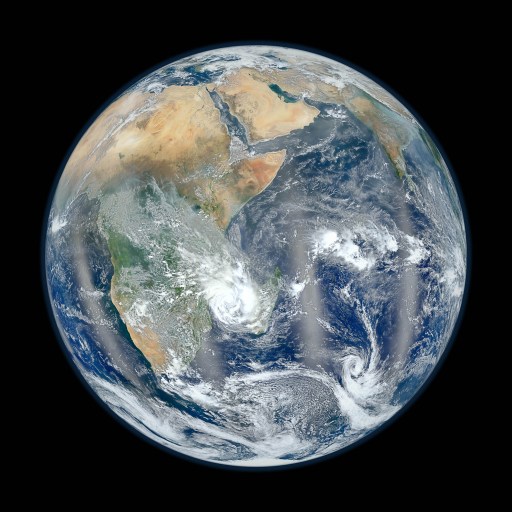
Eastern Hemisphere from Space Nasa High Resolution

If we take what amounts to the very long view of the matter it’s quite easy to see how both the tradition of human rights and transhumanism emerge from what are in effect two different Christian emphasises on the life of Christ. Of course, this is to look at things from the perspective of the West alone. One can easily find harbingers of both human rights and transhumanism outside of  Christianity and the West in Non-Western societies and religious/philosophical traditions in Islam, Hinduism, Buddhism or Taoism among others. For now though, lets stick with seeing things through the lens of the Western tradition alone.

Perhaps the primary source for human rights in Christianity would be the idea of Christ as God relocated into the fragility of a human body, a consciousness supremely sensitive to the most vulnerable among us- the sick, the poor, the excluded, the powerless and insisting on the spiritual equality of human beings. Roots of transhumanism can be found in another Christ tradition- the idea of man made God, the desire to transcend human limits to seek and find enlightenment.

Putting aside the elitism of the gnostics, such doubled vision need not necessarily be understood as the source of irreconcilability and conflict, but more like a gestalt drawing where two pictures can exist in one. What picture one sees becomes a matter of what you are looking for at the moment.

Historically zooming in a little closer to the Age of Enlightenment we can again see both the tradition of human rights and something like a proto- transhumanism existing side by side. If an enormous increase in the span of biological or material longevity is taken to be the sine qua non of transhumanism, then the Marquis de Condorcet who predicted in his 1794 Sketch for a Historical Picture of the Progress of the Human Spirit that:

….a period must one day arrive when death will be nothing more than the effect either of extraordinary accidents or of the flow and gradual decay of the vital powers and that the duration of the middle space of the interval between the birth of man and this decay will itself have no assignable limit. (368)

Was at the same time a staunch defender of much human rights as we would now understand them- the abolition of slavery, equal rights for women, and political rights as they had been articulated in the American Declaration of Independence and Bill of Rights and especially in the French Declaration of the Rights of Man.

Yet, if if human rights and proto-transhumanism can often be found right next to one another, so to speak, in both Christianity and the Enlightenment it is certainly difficult to argue that such is the case today. Or only if we narrowly define rights in terms of so-called “negative rights” that is liberties which are used by many transhumanists to argue that they have a right to pursue transcendence, augmentation, and increased powers. How then did the two become so clearly separated in our consciousness?

Often the emergence of human rights and transhumanism is presented sequentially with human rights appearing first and transhumanism or posthumanism occurring afterwards. You find this in Steve Fuller who characterizes human rights (both economic and political) as “humanity 1.0” whereas posthumanism is the newer “humanity 2.0” a separate and sometimes rivalrous utopian project.

This kind of temporal positioning of the utopian project to universally achieve human rights as the ideal of the past with posthumanism as a set of goals for the future is, despite its intuitive appeal, not very historically accurate. For the sharp separation of the human rights and transhumanism can only be dated to their emergence as two clearly defined utopian projects.

It might be surprising to learn exactly how contemporary the appearance of these movements as clearly distinguishable utopian projects actually is. For starters, the very recent appearance of the global movement for human rights is something that has been stressed strongly in recent years by Marxist scholars who want to alert us the inadequacies of the rhetoric of human rights in providing a path through which lasting change in the conditions of humanity in the early 21st century might be achieved. The perspective of this critique can be found in the political writings of the activist and fiction author China Mieville, but by far the most comprehensive argument for both the contemporary nature of human rights and their inadequacy is found in the work of the historian Samuel Moyn.

In his The Last Utopia: Human Rights in Human History Moyn makes a pretty compelling case that far from being the telos of history human rights emerged as the only 20th century utopian project left standing in the 1970’s. For Moyn, human rights emerged as the dominant utopian narrative precisely because all other utopian projects had failed.  Soviet style communism proved itself a failure not with its Eastern European collapse in 1989 but with the Soviet invasion of Czechoslovakia in 1968 which showed that state communism could not be reformed by democratic means.

Liberalism had failed with the American debacle in Vietnam, and even self-determination which had since the American and French Revolutions had been seen as the only path through which rights could be truly secured had proven itself a failure as the new post-colonial states failed to not only institute rights but went on the offensive against national minorities.

Unlike other utopian projects Moyn holds that human rights was able to survive because it was moralistic rather than programmatic. It gave idealistic youth in the West something to focus their energies on that ultimately had little bearing on the actual political regime either domestically or internationally. The rhetoric of human rights gave communist dissidents a moral kludge with which they could hammer away at Eastern bloc violations of human rights without calling for the end of the communist project and without the need to insight revolution.

I have some problems with Moyn’s insistence on an extremely sharp historical separation between what we understand as human rights and what came before. We have known that human rights and self-determination (in terms of peoples) have had a troubling mutually interdependent relationship since Edmund Burke criticized the ideas behind the French Revolution. The problematic relationship between human rights and self-determination was brilliantly explored back in the 1940’s by Hannah Arendt.

That the articulation of rights in the Universal Declaration of Rights in 1948 was written under the assumption that European colonial empires would be retained is less than Moyn argues a sort of moralistic distraction from European powers hopes to retain their colonies than an attempt to guarantee rights outside of the context in which they had previously resided i.e. the sovereign nation-state. Moyn also makes no mention of international movements that have little connection with the nation-state as such and therefore bear more similarity to human rights as understood today such as the movement to abolish slavery and the rights of women and children.

The Universal Declaration was also written, I should add,  in light the recognition that the of the economic crisis that had collapsed the capitalist economic system and led to the Second World War necessitated the universal adoption of egalitarian systems- social democracy-  as the only forms of society that were sustainable, humanistic, and just.

Where Moyn is helpful is in focusing our view on the contemporary period rather than trying to find deeper historical currents. I found his Last Utopia especially fruitful in understanding how human rights and transhumanism separated course and also in grasping how the separation of either utopian project from the broader question of political and economic composition is, a both Moyn and China Mieville suggest for human rights alone, is likely to lead us into a cul de sac.

Let me start with one of the Soviet dissidents that Moyn thinks was instrumental in launching the human rights movement, Andrei Dmitrievich Sakharov. Sakharov was instrumental in the creation of the Soviet hydrogen bomb. The Americans had gotten their first. The explosion of the American hydrogen bomb over the Bikini Atoll in 1954- a weapon 1,000 times more powerful than the fission nuclear weapons dropped on Japan in 1945 signaled the birth of the human capacity to destroy both civilization and life on earth.

The Soviets would explode their own “true hydrogen bomb” a year later in 1955 based largely on Sakharov’s design. Perhaps the responsibility for what he had made possible had affected him, or perhaps his scientific grasp of the destructive potential of these new weapons had made him aware of the universal fragility of life, but by the 1960’s Sakharov had thrown himself into political activism.

His 1968 essay Progress, Coexistence and Intellectual Freedom marked his appearance onto the political scene. What is remarkable about this essay is the way it combines different utopian projects that have since become distinct rivals, and which we are only now attempting to recombine. Sakharov moves from the call for international peace to environmentalism to the encouragement of continued technological progress and development of the Third World to human rights.

What unites all of these for Sakharov is both an understanding of a shared human destiny and the recognition of our universal fragility especially in the face of modern, and largely man made, catastrophic risks.

Our challenges and possibilities can not be hermetically sealed off from one another but form a continuum requiring answers on all fronts. The role of science and technology is especially interesting here for Sakharov sees them as not only the source of many of our challenges but as the best and most essential tools we have for solving our problems. Yet, it is the essentially the political choice of what to use those our powers for that is the primary question.

Sakharov’s views are also infused with the perspective that both capitalist and communist societies had arrived at a sort of egalitarian consensus. Communist critiques that capitalism lead to inequality and immiseration and that the victory of communism over capitalism was a moral imperative to save the world’s poor no longer held now that capitalist societies had adopted social democratic policies and aimed at the development and dominance of a broad middle class. The same kind of consensus on social democracy that had been seen in the Universal Declaration.

Sakharov would go on to be a fierce defender of the idea that human right represented the best universvisable ethic for a new global age. Yet the kind of fusion of rights, social democracy, environmentalism and scientific and technological progress seen in his Progress, Coexistence and Intellectual Freedom would take a quite different turn in the West a kind of perfusion and splintering of utopian projects whose missions became quite distinct and even rivals for human commitment.

In the late 1960’ and 70’s Western environmentalism took a stand against science and technology a position that is only now being challenged. The struggle for human rights was cut off not merely from environmentalism but from the kinds of social democratic and egalitarian concerns with which it had emerged in tandem. Like environmentalism, human rights had very little to say in terms of the world’s geopolitical order and therefore too often became a ready made masks for US and Western geopolitical interests.

The idea of science and technology as a utopian project also in the 1970’s became separated from its fellow travelers. One can trace this back to the idea of “digitopia” conceived in Silicon Valley which saw in science and technology solutions to all of the world’s problems if only government would get out of the way. Much of contemporary transhumanism would embrace the libertarian assumptions found in “California culture” and this strain is still strong today. This, for instance, is the venture capitalist Peter Thiel a vocal (and financial) supporter of transhumanist causes such as the Methuselah Foundation which our earlier Condorcet would certainly recognize:

 In our time, the great task for libertarians is to find an escape from politics in all its forms—from the totalitarian and fundamentalist catastrophes to the unthinking demos that guides so-called ‘social democracy.’ . . . We are in a deadly race between politics and technology. . . . The fate of our world may depend on the effort of a single person who builds or propagates the machinery of freedom that makes the world safe for capitalism.

For this reason Theil supports utopian seasteading the goal of which “is to innovate more minimalist forms of government that would force existing regimes to change under competitive pressure.” Ostensibly, such islands would be havens for the testing of all sorts of transhumanist innovations.

Yet, the “island” we are actually on isn’t in the middle of any ocean, but the earth itself. It was from a recognition of this fundamental shared fragility of not just humanity but all of the earthly life that has come to depend upon it that Sakharov was able to envision the integration of many of the 20th centuries utopian projects. Even transhumanism the most seemingly optimistic of modern utopian projects emerges from the recognition of our fragility- the desire to be “god-like” is the best sign that we are very far from being “gods”.

One might view much of transhumanism today as built on the same sorts of isolationist assumptions that underlie the project of utopian seasteading. The greatest danger would be a transhumanism that serves as a tool in the stratification of societies along class lines where transhumanists put up “islands” within societies whose overall well being they have abandoned in the name of achieving post-human ends.

Yet, it may be the the sheer interdependence of the 21st century world makes it impossible to pursue any utopian project that fails to take the shared fate of humanity into account. There is a great need of a truly global movement that integrates our various problems and hopes as it becomes increasingly clear that modern crises do not fit squarely into singular versions of utopia or dystopia. The current crises in Syria and Egypt are environmental, rights based, technological, social democratic and geopolitical all at the same time.

We need a utopian project that addresses all of these problems simultaneously and articulates and expands human possibilities for everyone. Let’s hope that the recent profusion of early 21st century movements that seek the reintegration of utopian projects help break us out of our log jam. With these I would include a branch of transhumanism known as techno-progressivism which has the potential to bridge the recently emerged gap between human rights (along with the rest of life) and transhumanism. One of the best way to do this might be for techno-progressives to become aware of and adopt some of the new reformulation of rights as “capabilities” rather than the traditional notion of rights as entitlements. But that is for another time.


Towards a Transhumanist Techno-progressive Divorce

Janus

 How is this for a bold statement: the ultimate morality or immorality of transhumanism rests with the position it will take on the question of human rights and more specifically its adoption or denial of the principles of one document little discussed outside of the circle of international lawyers and human rights activists: The Universal Declaration of Right of 1948.

It was by a circuitous route that I came to this conclusion, which at first glance may seem nonsensical, for, after all, isn’t transhumanism precisely about the post- human rather than us current human beings for which the idea of human rights and The Universal Declaration were created?

As briefly mentioned in a prior post, my first indication that human rights and The Universal Declaration might need to be brought into the center of transhumanists’ view was suggested to me by a person who isn’t a transhumanist at all, and indeed is deeply uncomfortable with much of transhumanist rhetoric and underlying assumptions. No one would call the science-fiction author, Kim Stanley Robinson, a neo-luddite. Rather, he sees science, at least in its beneficent manifestations, as the ultimate utopian project. And, as anyone who has ever read one of Robinson’s novels knows, he views utopianism as a very good thing indeed.

It was in a panel discussion  “Utopia- Science Fiction and Fact” that Robinson brought up The Universal Declaration of Rights. As a reminder the Universal Declaration was the first global statement of rights to which, according to the consent of every nation on earth, all human beings are entitled and consists of 30 articles  spelling out these rights. They include not only basic so-called negative rights such as the freedom from arbitrary arrest and torture, but positive rights such as the right to marry and found a family, the right to “social security”, the right to work, the right to rest and leisure, the right to food, shelter, clothing and medical care, the right to “the full development of the human personality”, the right to a stable domestic and international political order, the right to education and to “enjoy the arts and share in scientific achievements and its benefits”.

My interpretation of Robinson bringing up the Universal Declaration in a transhumanist forum was that we already had a utopian project for the future “the project of justice” as he called it; therefore, we should be leery about getting ahead of ourselves. He seemed to be saying that we should focus our scientific and technological efforts on achieving these still far-off 20th century goals before we run full-steam towards the 21st or perhaps 22nd century goals of transhumanism.

It was only when I came across an interview by another future oriented thinker who also brought up the Universal Declaration that I started to think there might be something more to the relationship of transhumanism and the Universal Declaration than my superficial grasp of Robinson’s view had led me to believe.

In an interview with Adam Ford, avowed transhumanist, Steve Fuller, characterized the Universal Declaration as a perfect summation of 20th century progressive politics. This view of what he called “humanity 1.0” found in the Universal Declaration he believes will be likely find itself in conflict with the transhumanism of “humanity 2.0” in the years to come.

Fuller believes that the goals of humanity 1.0, of a progressive, egalitarian society, could only be “paid for” by “holding back” the superior members of society who tried to push the abilities of humanity evolutionarily forward. As time moves onward, more and more of ranks of these visionaries, Fuller thinks, will be filled by transhumanists. Thus his predicted tension between those who hold to the goals humanity 1.0 and those seeking to expand the limits of the possible and achieve the goals of humanity 2.0.

This prediction of probable conflict between the adherents of humanity 1.0 and those seeking to move to a transhumanist notion of humanity 2.0 grows out of Fuller’s libertarian “great man” theory of progress. For him, progress is pushed forward by “superior” individuals who break the bonds of the possible through risk, experimentation, innovation and revolution pulling the rest of society along.

The kind of antagonistic picture of how the world works found in Fuller is on full display in the movie Jobs where innovation and society is pulled forward by visionaries whose disdain for the rest of us non-visionaries types makes them, in common parlance, assholes.

The question that should naturally arise whenever justifications for inequality, such as Fuller’s based upon of the pull of “great men” are made is whether or not such lone visionaries are really acting “alone”? Someone like Steve Jobs was dependent on a society and history around and before him to obtain his visions, and we can never be quite sure if his breakthroughs would have occurred without him. It is just as likely that instead of being driven by “great men” progress in science and technology or human thought in general is really a matter of seizing opportunities that are lying there for anyone to pick up, and which can only be supported if a large enough pool of individuals have come to the point in their own thinking to find the new idea, or invention or whathaveyou compelling.

This libertarian myth that egalitarian policies are the enemy of innovation and upward mobility to which Fuller subscribes and which he conflates with the transhumanist project needs to be vocally challenged, and with hard data. It is, after all, in the Scandinavian countries where egalitarianism runs deepest that rates of innovation are highest and ranked consistently higher than in the in-egalitarian US. Despite libertarian mythology, it is in egalitarian countries where upward mobility is highest as well; suggesting, that egalitarian policies, contra Fuller, are much less about holding the “superior” back as maximize those able to create breakthroughs and in giving everyone a fair shot at success.

There is also the too often unspoken question of power. In another panel discussion, this one for the RSA, only the fiction author and political activist China Mieville had the guts or the comprehension to challenge Fuller’s underlying assumptions regarding power and inequality. If inequality has deep roots in the differential distribution of power and political influence, then Fuller’s version of transhumanism becomes  just one more way in which the already wealthy and powerful will be able to make their advantage permanent.

As another figure worried about exploding levels of inequality, Chrystia Freeland, points out in her book Plutocrats: The Rise of the New Global Super-Rich and the Fall of Everyone Else this is already happening at an ever increasing rate as the rich use their wealth to gain educational advantages for their children and distort market influence through their leverage over the political process. Of course, the rich have always done this. What is unprecedented today is the scale and extent to which the super-wealthy have been able to rig the game, so to speak, in their and their childrens’ favor.

A transhumanism lacking an egalitarian anchor, of which the Universal Declaration is just one example, threatens to become just one more way in which the already wealthy and powerful (including many of us lucky enough to be born in the developed world) will be able to make their advantage permanent by, for instance, genetically enhancing themselves or their children when this option is not available to all, purchasing the most advanced form of bioelectrical enhancements whose expense prices out the bulk of the middle class and the poor, replacing middle class and working class jobs with AIs and robots- further shifting the balance of economic distribution away from labor and towards capital without at the same time adopting policies to offset this decline of opportunities for human work with policies such as guaranteed basic income.

Yet, if I thought the extent of Fuller’s critique of the progressive worldview that underlie the Universal Declaration was based on a simplistic view of the reality of social equality reminiscent of Ayn Rand’s Atlas Shrugged or the Kurt Vonnegut short-story “Harrison Bergeron”, I was in for a rude awakening when I actually read Fuller’s book- Humanity 2.0.  It was in reading this book that I became convinced not just of the need for an egalitarian orientation for transhumanism but for the full embrace and incorporation of The Universal Declaration of Human Rights into its project if transhumanism was to free itself from the potential to unleash social evil.

It was in Humanity 2.0  that Fuller showed just how far he was willing to go in his rejection of the Universal Declaration, as far in fact as to call for the rehabilitation of the inhuman Nazi regime that had given rise to the Universal Declaration in the first place. The kinds of ethical obscenities that can be found in Humanity 2.0 are indicative of the dangers inherent when one unmoors the idea of post-humanity, of the transhuman, from the project to obtain the requisites of the human condition- of humanity 1.0- for all, and when one sees progress being driven by “superior” individuals or groups.

Part of the moral dilemma any transhumanists has to face is the sheer, and often unacknowledged gap, between transhumanist goals and the actual conditions of the large numbers of humanity. Transhumanists in large measure have objectives such as the obtainment of biological immortality when the average life expectancy in a country like Sierra Leone is 46. Talk of a technologically supercharged humanity rings hollow when 2.6 billion human beings lack toilets. If these disparities are not addressed and our global environmental, and political problems are not solved, we will likely have more explosions like the recent one in Egypt which is as much a crisis of population density, energy, food and water scarcity as it is a secular vs. religious conflict.

The immoral potential implicit in this gap confronts us directly, even if on simplistic terms, in the film Elysium where in the year 2154 the majority of humanity lives on a planet of want, social breakdown and violence when a minority lives in a transhumanist paradise in space where there is no disease, poverty or war. Here, transhumanism becomes a sort of sinister version of The Rapture of the Nerds that is the dream of singularitarians.  It is a possibility that emerges from the race for the rights of the future when we have yet to secure the rights of the past.

One of the main ways techno-progressivism- a relatively recent branch of transhumanism- might best distinguish itself, or even if necessary, divorce itself, from both the kinds of anti-progressive transhumanism seen in Fuller, dramatically presented in Elysium and found in the millenarian fantasies of singularitarianism would be to openly embrace as its primary mission the obtainment of the goals set forth in the Universal Declaration. The priority of science as a utopian project would then be aimed at the achievement of a sustainable human condition for all. To these goals could then be added core transhumanists hopes such as the radical extension of the human lifespan (which would fall under the Universal Declaration’s right to life) and the right to explore and build upon the transcendence of current human capabilities, including by the use of technological means (which would fall under the Universal Declaration’s right to the full development of the human personality).

Still, a little historical and philosophical background and context might prove helpful in making the reasons for such a linkage between the projects of humanity 1.0 as represented by the Universal Declaration and  tehno- progressivism a little clearer and might lay bare some of the risks in tying progressivism to science and technology alone without addressing underlying dynamics of wealth and power.

For, it should not be surprising that human rights, singularitarianism and transhumanism emerged almost simultaneously and might someday soon prove real rivals for defining the human future. All three emerged from the loss of faith that utopia could be created through political action and as responses to the recognition of a common human identity and our likely fate. To that I will turn next time…

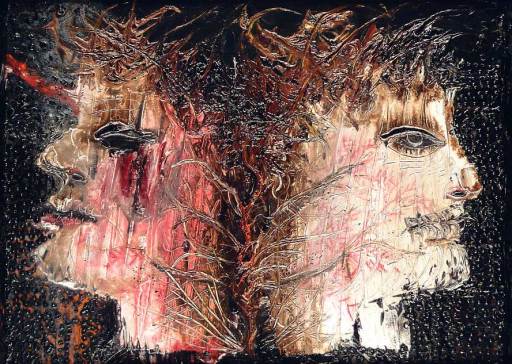
The above painting of Janus is by South African artist Christo Coetzee (1929-2001), oil on board.   It can be found in the Sanlam Collection. Copyright Christo Coetzee, all rights reserved.

Taxing Multinational Corporations Against Global Catastrophic Risks

Human beings have a very limited attention span, a fact amplified a thousand fold by modern media. It seems the “news” can consist of a only handful of widely followed stories at a time, and only one truly complex narrative. This is a shame because the recent breaking of one substantial news story was followed by the breaking of another one which knocked it out of the field of our electronic tunnel vision. Without some narrative connecting the two only one can really hold our attention at a time. Neither of these stories have to do with Kate Middleton and the birth of Prince George.

Back in late May revelations of Apple dodging tens of billions in taxes from the US broke unto the news. Revelations which were quickly followed up by congressional hearings. But then, right on its heels, came the revelations of Edward Snowden about very questionable surveillance techniques of the NSA. The Snowden leaks did not so much spark as spread a desperately needed debate over the growing capacity of the American security state to tap the open design and marketing of the Internet as the medium for a new “transparent society” as a means to its own ends. Snowden turbocharged a debate we need to be having, and we need to keep alive however short our attention spans.

It is unfortunate, though, that the Snowden revelations managed to push the story of Apple’s and other corporations tax dodging- and especially that of other tech giants such as Google and Amazon off of the front page. For, in many ways that story is just as important a story as the Snowden leaks, and despite appearances, is in some ways connected to them.

As a reminder of what happened at Apple, here is a description from one of those “anti-capitalist” over at Forbes Magazine . Lee Shepard reports that after Apple had set up what were in effect a series of shell companies in Ireland where:

“….60% of Apple’s profits, are routed through these Irish subsidiaries and taxed nowhere. “

“….the holding company pays no tax to any government, and has not paid tax for five years. It claims tax residence nowhere.”

When the story first broke I thought Apple’s efforts at tax evasion were out of the ordinary. I was wrong. What Apple was doing is not just widespread- it was representative of the way global capitalism in the 21st century worked. Since at least the 1990’s corporations had in fact become organizations no longer anchored to territorial states. What this meant was that multi-nationals of all sorts were able to escape effective taxation anywhere. The Tax Justice Network ,  calculates that tax evasion through the establishment of havens and fancy financial accounting costs the world’s states roughly 3 trillion dollars per year or around 5% of global GDP in lost revenue.

Some of the most egregious tax avoiders are tech companies we all know and love. Google’s motto might be “Don’t be evil”, but one wonders how much food or medicine its 2 billion of avoided taxes a year might have bought.  What is particularly rankling here is that we have come to associate a certain social consciousness to Silicon Valley companies we no doubt do not link to other types of multinationals such as Oil Companies. The very same people who lecture us at TED about new projects to save the world, along with the people who applaud them in the audience, are often the very individuals people starving government services for cash as part or at the head of globe straddling multinationals.

Yet the nation-states bereft of the funding they need to function seem to be turning against this massive tax avoidance with a vengeance.  The G20 charged the OECD with writing and issuing a report that calls for coordinated efforts by states to recapture a good deal of this missing revenue. President Obama’s recent proposal of a “grand bargain” with the GOP on taxes called for the lowering of corporate rates to be offset by the closure of loopholes that allow corporations to avoid taxes nearly all together.

Whatever their seriousness in dealing with tax evasion the development of coordinated rules between the leading economies is likely to take years and be beset by wrangling, distortion through corporate lobbying and attempts at arbitrage. Trying to tie the revenues of what truly are global corporations to some particular state or divide such taxable revenues proportionally between different sets of states is bound to be messy, complicated, and to take a long time.

Such re-nationalization of taxation would constitute a step backwards for globalization. Yet the digerati of TED and the global elite of Davos are right about this- many of our problems are global in scope and require global solutions. As I have suggested elsewhere what we need is a truly global tax a means of investing not in the nation-state, as important as it remains, but in the well being of the world as a whole.

Some Christian denominations promote the idea of a tithe where 10% of one’s income should be given to charity. A similar 10% tithe on the missing revenues of global corporations would give us 300 billion in revenue we could invest in the state of our shared world. What follows then are some suggestions on where we could spend this windfall.

Prevention and Response to Pandemic Disease:

Much about early 21st century life might suggest that humanity has finally “conquered nature” and that the largest threats to civilization stem from we ourselves. We should not, however, count the threat from nature out. The largest potential killer in the near future is probably pandemic disease. How big of a threat? The World Bank states it this way:

Because a novel flu virus could infect 30-40% of all people, in a worst-case scenario, business and consumer confidence would plummet, worker absenteeism would rise sharply, and public services would falter, says Olga Jonas, economic adviser for the World Bank health team. “Disruptions would propagate across economies and could include breakdowns of food distribution and public order in megacities,” she says.

A severe flu pandemic could cost 4.8% of global GDP, or more than $3 trillion—and it would hit the poor the hardest. The risk is rising because livestock and human densities increase alongside weak veterinary and public health systems in developing countries.

Globalization and an explosion of urbanization make ideal vectors for killer flus or other forms of devastating communicable diseases. Most of these diseases are zoonotic, that is they emerge out of animals especially those human beings have close contact with due to their being raised for food. Preventing the emergence and spread of these diseases will therefore require the introduction of higher standards of sanitation. It will also require the improvement of public health systems in the developing world. The cost? Again, according to the World Bank:

To this end, veterinary and human health systems in developing countries will require $3.4 billion annually, compared with less than $450 million currently.  A Bank report  argues that this sustained level of investment is justified in view of at least $37 billion in annual expected benefits from prevented pandemics and other major outbreaks.

Let’s just round it to 3 billion 1% of our 300 billion dollar global tithe.

 Avoiding Impacts from the Sky:

We all know about the “big-one” that slammed into earth 65 million years ago killing the dinosaurs along with 70% of the life on earth. In terms of probability, however, we should be just as worried about impacts such as the Tunguska Event an asteroid impact which flattened around 2,000 square kilometers of forest in Siberia in 1908. According to a 2008 report by the Association of Space Explorers, Tunguska scale impacts occur roughly 3 times every thousand years.

A future asteroid collision could have disastrous effects on our interconnected human society. The blast, fires, and atmospheric dust produced could cause the collapse of regional agriculture,leading to widespread famine. Ocean impacts like the Eltanin event (2.5 million years ago) produce tsunamis which devastate continental coastlines.

The impact of a Tunguska size asteroid on a major world urban area or in the oceans near it would be akin to the explosion of 500 Hiroshima sized atomic bombs and/or could set off devastating tsunamis of which we have become in recent years all too familiar.

The main problem when dealing with asteroid impacts isn’t so much dispatching with them once found (really deflecting) as it is finding them in the first place. To this end, former NASA astronaut Ed Lu established the B612 Foundation, a private company that hopes to launch a satellite called Sentinel in 2018 which will look for near earth asteroids.

Lu is to be highly commended for this initiative, yet the question needs to be asked why isn’t NASA or the ESA or some other combination of national space agencies doing this on a scale commensurate with the threat?  B612’s answer is that:

NASA lacks the funding for a mission to find and track the million asteroids that threaten our planet. Because of the ongoing federal budget situation, there is no realistic prospect for those funds to materialize.

B612 estimates the cost over the 12 year planned life of Sentinel to run on the order of 450 million dollars. NASA itself does have an asteroid detection program that costs 20 million per year and the Obama administration awakened to the threat posed by near earth asteroids by the spectacular explosion of one such asteroid over Russia earlier this year proposes to double amount for FY 2014. In other words, the budget of B612, an organization funded through charitable donations is equivalent to the allocation for the same vitally important endeavor as that of the richest country on earth with the most sophisticated and well funded space organization of all time.

NASA’s well known budget woes are merely symptomatic of an American government crushed between rising entitlement costs, a massively bloated security architecture, and the sheer inability to raise revenues to meet these expenses. What suffers as a consequence are all the other vital things a government is supposed to do which in the US context is labeled with the misnomer “discretionary spending”. Related to the prior issue of climate change the essential tools and abilities of earth sciences, not just at NASA but at related agencies such as NOAA, are being steadily eroded by budgetary constraints.

This is no stain whatsoever on Lu, who is filling a vital gap left by our problems funding government, but the lost annual tax revenue of the company where he worked after leaving NASA from 2007-2010, Google, the aforementioned 2 billion dollars, could fund launching and supporting 4 of B612’S Sentinels.

Let’s imagine that we use the equivalent of Google’s avoided taxes out of our global tithe to quadruple the size of the Sentinel project giving us 2 billion to avoid asteroid induced armageddon or the destruction of a major city with all of the death and destruction that would cost. It’s a bargain.

Preparing for Climate Change including Geo-engineering research

There is growing realization that we have passed the point at which we can stop our production of atmospheric carbon dioxide raising the earth’s temperature by 2 degrees celsius (3.6 degrees fahrenheit) before the end of the century. How destructive this rise in temperature will ultimately be we can’t be sure, but it would be smart of us to put aside funds to hedge against worse case scenarios, and start doing major research into geoengineering should we confront Venus style runaway warming.

One thing we need to fund is more research on geoengineering. Many environmentalist do not want us to go there, all of us should not want us to go there, but in the case the effects of rising temperature threaten the lives of billions of people or even civilization itself, we need to have a better grasp of the possibilities. China has declared geoengineering to be a major research focus. During the 2009-2010 FY the Obama administration received requests for 2 billion dollars towards geoengineering research of which it awarded 100 million. The most dangerous scenario would be for a country suffering desperately under the impact of climate change to unilaterally decide to geoengineer the climate to a lower temperature without any international scientific consensus on if and how this should be done.

With our global tithe the world could easily quadruple the amount requested for geoengineering research in the US. Part of that 8 billion could be used to fund international entities charged with coming up with clear red lines where geoengineering should be used and what kind.

Something else we need to be prepared for is widespread displacement whether from sea level rise swallowing low lying areas or desertification. Estimates of just how many refugees will emerge from the impact of climate change are wide indeed- anywhere from 250 million to 1 billion people. Both numbers are incredibly scary.

Systems need to be put in place to help nation- states deal with population flows on a scale never seen before, especially scenarios where sea level rise consumes low lying heavily populated countries such as Bangladesh. The UN agency charged to deal with both refugee flows and disaster response is the UNHCR. It is the first line of defence  poor countries responding to increasingly frequent and more devastating natural disasters. As of 2013 its budget was $87 million.  In 2013 there are roughly 44 million refugees. Even if we stick to the low estimate of 250 million eventual refugees from climate change that would mean 5 times more internally and externally displaced persons than there are today. We should therefore bulk up the UNHCR to five times its current size to prepare meaning that its portion of our global tithe should be around $450 million dollars.

A Second Green Revolution:

The overall rate of population growth may have slowed but projections that we will hit 9 billion before the end of the century still hold. The problem we are facing is that we have no idea how we will feed so many people. The Food and Agricultural Organization of the United Nations estimates that food production between the early 2000’s and 2050 will have to grow by 70% and developing country production to double by 2050 to keep pace with population growth.

The last time we had Malthusian warnings of mass hunger, back in the late 1960’s we were saved by a revolution in agricultural production that goes by the name The Green Revolution. This revolution in agricultural production is credited with saving a billion human beings from starvation and worked by applying mass production methods to food production, using synthetic fertilizers, the development of higher yielding varieties of staple crops and the application of intensive irrigation.

The problem is the Green Revolution appears to have petered out. Growth in yields near 3% in the 1970’s have declined to almost half of that now. It seems we’ve rung all we can from this industrialized model of agriculture. As the World Resource institute puts it:

…most high-quality agricultural land is already in production, and the environmental costs of converting remaining forest, grassland, and wetland habitats to cropland are well recognized. Even if such lands were converted to agricultural uses, much of the remaining soil is less productive and more fragile; thus, its contribution to future world food production would likely be limited. The marginal benefit of converting new land increases the importance of continuing to improve crop yields so the existing agricultural lands can produce additional food.

Some things we could do about this looming crisis of food scarcity according to Alex Evans from the Center for International Cooperation at New York University they would include among others:

Devote more money to agriculture:

“The last twenty years have seen a disastrous decline in the proportion of foreign aid that goes to agriculture, from 17 per cent in 1980 to 3 per cent in 2006.  Total aid spending on agriculture fell 58 percent in real terms over the same period.  Today, developed country donors urgently need to reverse this trend, and to start plugging the gap left by years of under-investment.”

 Devote more public research money to agriculture:

… the budget of the Consultative Group on International Agricultural Research has fallen by 50 per cent over the last 15 years, for example.

Such monies could be used to rapidly deploy potentially game changing technologies such genetically engineering major food to take nitrogen from the air which might end our destructive reliance on synthetic fertilizers.

Create an IEA for food:

A global system of food reserves need not entail the creation of a new agency, but to be credible the system would need to be overseen by a disinterested party, such as the World Food Programme.  It would also be essential to be clear that the role of any system of reserves would be limited to emergency assistance: not to act as a price support for producers, or a permanent system for managing food aid.

How much would those things cost? I have no idea. Let’s take as our ball park figure the combined amount the US and the EU now spend on highly distorting agricultural subsidies. For the US that’s about 20 billion for the EU it’s around 50 billion. Taking away a 70 billion dollar slice of our initial 300 billion tithe.

Nuclear Disarmament

The idea of ridding the world of nuclear weapons may seem utopian, but many of those who think the goal both attainable and necessary are some of the hardest of  realists around. The contemporary movement to ban nuclear weapons got its start with an article in the Wall Street Journal back in 2007. “A World Free of Nuclear Weapons” was written by former Secretary of State in the Reagan administration, George Schultz, and signed by none other than Henry Kissinger. Since then we’ve had Global Zero an international movement whose aim is to rid these apocalyptic weapons from the earth. Global Zero has a four phased plan that gets us to zero nuclear weapons by the 2030s. This would be an incredible way to mark the centenary of the Second World War which gave us these weapons in the first place.

How much would it cost? Probably around 2 billion per year. As always, let’s just double that cost and say that the program runs from now until the centenary of the nuclear attacks on Hiroshima and Nagasaki- 2045.

At 4 billion per year for 32 years that’s about 128 billion from our tithe.

Universal Primary and Secondary Education

If we are ever to achieve the world set forth in the Universal Declarations of Rights we will need to ensure that education is available for all. This is Article 26 of the Declaration, but is also the keystone upon which all other parts of the Declaration rest- the means for the full development of every human personality. While the spread of primary and secondary education has been great over the last few decades, many, especially girls, remain locked out of its benefits.

How much would it cost to ensure that primary and secondary education were available to all? Right now the developing world spends about 82 billion on education at this level.

A high end estimate for how much making free primary and secondary education universal is 35 billion additional dollars. Let’s just double the 82 billion now spent and throw in a few extra billion for could measure- 88.5 billion the remainder of our global tithe.

To review the numbers:

3.0 billion Pandemic diseases

2.0 billion Asteroid Impacts

8 billion Geoengineering Research

500 million UNHCR

70 billion Next Green Revolution

128 billion Nuclear Disarmament

88.5 billion primary and secondary education for all

300 billion

With a mere 10% of the lost taxes from global corporations we have protected ourselves against pandemic diseases and asteroid impacts, created an insurance policy against climate change, done something to address the risk of global famine, eliminated nuclear weapons and provided free primary and secondary education to everyone in the developing world. In the process we have achieved or come far closer to achieving  at least 3 of the 8 Millenium Development Goals. Not bad at all.

Of course, this is not meant to be an absolutely serious proposal but an exercise to show that we do indeed have the resources to address many of the most pressing of our global problems- we just need to get our priorities straight. And this brings me back to where I began- the Snowden leaks whose gorey details just keep on coming.

What the Snowden leaks revealed is that however much the members of global corporations talk the talk of world citizenship they remain subjects of the nation-states from which they stem. The recognition of this fact threatens the most positive elements the globalization of the economy has brought us, namely an increased awareness of our global interconnection and interdependence and hence our global responsibility. The combined facts that techno-elites are simultaneously acting as a tool of the US security state, avoided paying taxes anywhere in the world, and touting “techno- philanthropy” as the main route to solving the world’s problems leaves one in a state of ethical vertigo from which it is difficult to get one’s bearings.

What seems clear to me, however, is that if the positive elements of globalization are to survive, then the elites whose capital is increasingly likely to be sucked up by the nation-states better find a way to make sure a good slice of this capital is used to address the kinds of global problems which the elites tried to make us aware. Even if, or perhaps especially because, they had robbed us of the wherewithal to actually solve them in the first place.

Welcome to Our Future: 2312

2312

Part of the problem each of us has when it comes to realistically imagining the future is that we ultimately bring our own cognitive biases, our optimism or pessimism, to the question at hand. From the perspective of the types of small societies we evolved out of these kinds of sunny vs gloomy dispositions were no doubt a very good thing. A discovery of a rich patch of good game land followed by feasts necessitated curmudgeons who would remind the tribe that the days of full stomachs would not last. Thankfully, these complainers would not have the final word, and the group would set off again over the next hill assured by the sunnysiders that more of the riches of the world remained on the other side.

Our modern media world, however, tends to undermine this diversity of cognitive biases sorting us into more sharply distinguished optimist and pessimist camps. In our digital echo chambers the future is all good or all bad, utopia or dystopia as the title of my blog says. Lately though, a number of thinkers have been trying to shake us out of our tendency to see the glass as half empty or half full reminding us that the world is more complicated than the illusionist in our heads.

Here I would put the work of Ramez Naam who in his The Infinite Resource faces head on both the enormous problems in front of us- climate change, global food shortages, growing energy needs, and fresh water scarcity while at the same time offering up realistic solutions to these problems without the need for a Deus ex Machina solution such as “our coming super-intelligent AIs will solve these problems for us”. I’d throw Kim Stanley Robinson into this realist camp as well. His most recent novel 2312 gives us a portrait of the next few centuries that is something very far from Shangri-la but isn’t a post-apocalyptic horror story either.

The source of Robinson’s pessimism is the state and probable future of the global environment, especially in terms of the likely impact of climate change. As energy innovator Hal Harvey recently pointed out in this scary, yet even then, not hopeless speech on the climate situation at the Aspen Ideas Festival we only have a brief window in which we can prevent potentially catastrophic climate change from occurring and that window is rapidly closing. 2312 in a sense gives us a sketch of what our world might look like if we do indeed allow Harvey’s window to slam shut.

In the world of 2312 the earth’s temperature has risen by 5 K.  As a consequence there has been extensive sea level rise- Manhattan is now like Venice and mass deaths of people on all continents and mass extinctions have occurred. Had the novel focused on this period it would have been apocalyptic, but instead it sets its sight on the post-apocalyptic world that follows our failure to have addressed our environmental challenges in time.

In Robinson’s future- historical scheme only after we are faced with apocalyptic crisis do we marshall a response commensurate to the situation at hand. Humanity tries to set things straight by geoengineering the earth’s climate, a project that ultimately fails spectacularly in the “Little Ice Age”. In a period that becomes known as the Accelerando,a real push is made to settle the solar system. Much of it is terraformed and settled  including asteroids which are hollowed out to become biomes holding within them the precious cargo of the flora and fauna that once graced the earth.  AIs including quantum computers surgically implanted in human beings know as “qubes” become widespread. Human longevity is increased to the extent that a person is now fit and active into her hundreds.

The kinds of terraforming that are used to transform much of the solar system into areas that are hospitable to human life prove inapplicable to geoengineering the earth back to its pre- industrial state because the blunt force methods of terraforming- slamming comets into planets and the like- are simply unworkable on a planet that already has billions of human beings not to mention other lifeforms most of which are hanging on to life by a thread.

The scale and coordination of the response to the environmental crisis the Accelerando represents does not last, however, and the pendulum swings again humanity falling into two dark periods- The Ritard and Balkanization during which the trends of the Accelerando slow and the solar system becomes divided into competing factions. It is in this world where the earth continues to suffer extreme environmental and economic crises, and the new worlds of the solar system have turned against one another that the plot of 2312 takes place.

Robinson is by his own declaration not a transhumanist. And yet his protagonist, Swan Er Hong can certainly be described in this way. Swan has a qube implanted in her brain named Pauline which makes her a kind of cyborg. She has the genes of songbirds in her that allows her to “whistle” like a bird. She is transgendered with both a vagina and a working penis- a product of the fact that a good deal of the increased lifespan of human beings seen in 2312 has been gained by human beings taking on transgendered features. Something that makes sex scenes in 2312 just a little complicated. Treating the body, and even the mind, as something essentially plastic in this way comes naturally to Swan, for she is an artists and her body itself is one of her works of art she being a practitioner of what Robinson calls in honor of performance artist Marina Abramović “abramovics”.

The plot of 2312 centers around a series of terrorists attacks in the inner solar system and the efforts of Swan the mercurian, the man who will become her lover, Wahram from Saturn, (Robinson is having some fun with astrological stereotypes), and an exiled Martian, Inspector Gennette, along with others try to solve these incidents. Along the way they spark a political movement of sorts setting off the forced return of the earth’s lost animals to the planet as a way to spark the earthling’s desire to address the planet’s continuing ecological problems.

I must admit that I had some difficulty with the novel’s plot. There were numerous points where I had to engage my “willing suspension of disbelief” not because the technological or social situations seemed so “out there” as the experiences of the quite empathetic and rounded characters were squished into predetermined unfolding of the overarching story of the novel.

There are three ways it seems to me one can make the experiences of characters realistic in the context of a grand future-historical novel such as 2312.  The least interesting is to tell the story from the perspective of the people at the top- the most historically important characters whose decisions therefore have the biggest effect on how such narrative unfolds. The second way is to give witness to the fact that small characters can unleash the forces of history in the way an otherwise very insignificant man like Gavrilo Princip set off World War I with his assassination of the Archduke Franz Ferdinand. The third and probably the best way is to take historically insignificant characters and see how the grand narratives unleashed elsewhere affect them. The best moral judgement of the decisions of elites or the injustice of a system is how it impacts the lives of people who have to live closest to those impacts.

When one tries to see in the lives of historically marginal characters, which is really what Swan should be considered, experiences that reflect decisions of world-historical significance one is left with the impression that the character is suffering from paranoia. This at least is what I thought when Swan encounters an extremely proficient “lawn bowler” whose style of play mimics the terrorist “pebble attacks” and who does indeed end up a central character in the plot.

That said, 2312 did something few other books are able to do so easily, it changed the way I looked at the world. Robinson is a superb travel writer and made our solar system, a place I had long thought of as quaint or “dead” come alive as a wondrous imaginative palette upon which our future is yet to be written.

Yet, amazingly enough, Robinson most affected my view of living on earth. It’s hard to remember that we live on a very special world that is so much different, so much more a home, than any other place we know. While reading the novel I started to pay attention to Luna in the sky and the glories of the setting summer sun. I had the urge to take more walks and one night saw a doe grazing in a field watching me curiously and had the urge to chase or run with it, like Swan.

What Robinson is trying to do is find that sweet spot in the future that is at the outer reaches of our understanding and therefore our agency. This is much better than something like my Far Future’s Project which I am wrapping up this week, or Stewart Brand’s Long Now because we really do have some degree of agency over, and therefore some responsibility for, what happens a century or two in the future. If writing about the future is really just turning up the volume on the present then we can only be confident in these sorts of limited time frames that we will be playing anything like the same score.

It is when thinking in terms of this near term and intermediate future that our tendencies for optimism or pessimism need to be set aside and the search for realism engaged. One can be a long term optimist or a long term pessimist when it comes to the the human future but both are mere waking fantasies, whether exhilarating or frightening. At the end of the day we can never actually know.

Neither long term optimism nor pessimism frees us from our responsibility to act so as to positively shape the future right now. There are all kinds of ways we need to do this as political, economic and socially beings in response to the future society we are likely to live in or the decisions and sacrifices taken today that we bequeath to our future self.

We can also decide to make investments in the future to a world we are unlikely to live in. Here we have everything from our response to climate change and environmental issues to social legacies. The question of what can we and what we should leave for our great or even great-great grandchildren in light of the nearly endless possibilities of what the world they will be living in will actually look like is one that we should be asking because it may serve as a better way to frame the question of what kind of future is it exactly that we hope for and should be working towards in the first place.

Still, if Robinson gives us a realizable version of the future with much of the transhuman in it, he is, as was mentioned, decidedly not a transhumanist.  Part of this stems from his fear that transhumanism might come to represent escapism. There are also his views of what  transhumanism means in light of a document few of us have probably heard of and even fewer actually given a second thought- the Universal Declaration of Human Rights. Essentially, Robinson thinks transhumanists are getting ahead of themselves. We are nowhere near achieving the kind of worldwide realization of the promise of conditions supporting self-actualization for all promised by the Declaration and transhumanists have already moved the bar.

Robinson is not alone in seeing our current failure to realize the promises of the Declaration as a challenge to the transhumanist project. The social epistemologist Steve Fuller believes positions on the Declaration will be a major area of friction between transhumanists and others, especially those on the left. It is, therefore, an important issue but for a latter time.

The kind of realistic science-fiction offered to us by Robinson where greater than light speed and settlement of “the stars” remains what it is today- a mere fantasy- nevertheless expands our and deepens our canvas to embrace our second home in the solar system. It is a canvass certainly large enough for the human story to play itself out.

The claim idea that our filling in of this canvass through the settlement of the solar system and terraforming its bodies constitutes the “arrogance of humanism” as Ernest J. Yanarella did in Strange Horizons has things ass-backwards. The arrogance of humanism lies in assuming that on a cosmic scale our endeavors are much more than one of Swan’s performance pieces such as her “painting” of a field with a rainbow of fallen autumn leaves. Like Swan, all we can do at our best is create beautiful objects that live a short moment only to be undone by the wind.

Of Art, Algorithms and Humanity

Lascaux

We are at the strangest of crossroads, a series of changes that challenge and upend what have been the core elements of the human experience since the beginning of our species. Nothing perhaps cuts so close to that core as what is happening and will happen to the meaning and place of art in our lives. Art here understood as everything from the music we compose to our paintings and drawings to the stories we tell or the films and videos we create.

For all of our history it has been we ourselves who created art, and perhaps we might even twist Ben Franklin who defined us as a “tool making animal”  to say that humankind is an art making animal. Just now we are beginning to have companions and competitors in these acts of creation. Joining us are increasingly intelligent machines- art creating algorithms that are not only already producing art, but are daily getting better at it. It’s a good time, then, to stop and wonder what the rise of these algorithmic artists will mean.

Human beings have been making art seemingly since our very beginning. We didn’t need the rise of complex human societies in the form of cities to create it.  Like the lost sketches of our childhood, most of our initial art didn’t make it into the future succumbing to dissolution by the elements, creating a great gap of silence between us and our prehistoric forebears, a fact that made the discovery of the Lascaux caves in 1940 all the more astounding. Today, you couldn’t see the Lascaux caves even if you had the wherewithal to get yourself to southern France- they have been sealed off for the caves’ protection. Modern humans with our numbers and our groping are rightly considered a new form of destructive element that can destroy what it loves through its very curiosity. But, thanks to the miracle of the Internet one can visit the wondrous caves without ever leaving the comfort of one’s home.

What strikes me as question begging in seeing the caves if only in this limited way is just how clearly its artists were versions of us. Their drawings putting me in mind of nothing so much as the chalk sketches of my daughters. And yet, we are so different from these artists in terms of the world we live in and the understanding we have of it that the gap between us is a chasm. Or better, we can understand, even if to a limited extent these artists but were we able to rip them from the past and bring them into the present it is very unlikely that they would ever understand us.

???????????????????????????????

Over and above human biology, what it seems we share most with the artists of Lascaux is the natural desire to create these sorts of representations. No human society has ever existed without art. We are born with the desire to create these strange models of our world. From the moment my daughters could pick up a crayon they were drawing, from the instant they could hit one object off of another they were making music. With sentences came incredible stories and “plays”.

There is a debate currently raging as to whether one form of art, literature, makes us more moral the best response to which I have seen is that it makes us more human. But perhaps we should say more than human. Art, or good art at least, has the capacity to expand human consciousness far out beyond the boundaries of the self and therefore is part and parcel of those other endeavors of our intelligence such as mathematics, science, philosophy,  history and religion that allow us to spread out the fabric of our awareness over all that we can see. The creation and even consumption of art is a mark of our intelligence and it can therefore be assumed that as our machines become more intelligent they will become more artistic as well. It is already happening.

Algorithms already shape our artistic choices. A program at Amazon suggests what books you should buy, and similar algorithms at Pandora or Netflix knows your tastes in music or movies as well or perhaps better than you do. It isn’t only that algorithms guide our artistic choices in some cases they are used to decide what gets made or heard.

As pointed out by Christopher Steiner in his Automate This a company like Epagogix is being used by film production companies to decide what movies get made or how much to invest in particular films allowing movie companies to recognize a flop before the director even shouts “action”. (75) Steiner shows us how the same thing is being done for music with a company like Music X-Ray which allows musicians to upload their songs into a huge database that can be searched by music producers for, among other things, potential hits. Lady Gaga and Justin Bieber beware. (87)  I have little doubt that similar technologies will eventually be applied to books allowing publishers to find the “Harry Potters” among the flood of manuscripts they receive every day.

In the most basic sense the way in which these film and music sorting algorithms work is that some target criteria is defined, say films grossing over a certain amount, and then the massive data searching capacities of artificial intelligence are applied. At least at this stage technology seems to have empowering potential for individual artists. Their work still exists within a sea of other creations but now at least can be found.

At the moment, on account of its expense, this AI sorting only benefits those producing hits- that is work with the broadest commercial appeal, which most of us hopefully realize is not necessarily the best or most groundbreaking art. We can at least hope that as the cost to create and run these sorts of algorithms decline they will be used to sort for artistic criteria beyond mere commercial appeal.

That’s how algorithms are being used to sort art, but what about actually making it? Music, perhaps because it so closely resembles the mathematics of intelligent machines has been the first to fall here. As only one example: in 2012 on the centenary of Alan Turing’s birth the London Symphony Orchestra performed Hello World! a set of musical pieces composed purely by an algorithm named IAMUS. It does not seem a huge step from algorithms sorting through really big data sets to find hit songs to them being used as tools to allow artists to create hit songs or other productions in the first place or even composing such songs themselves.

The next few decades are likely to experience a tension regarding the question of what these artistic algorithms are actually for?  This will not be another version of the tired  neo-luddite vs technophile dispute but a debate over how to use technology based on different interpretations of its meaning. Are artistic algorithms tools to help human beings create art and find audiences or are they artists themselves? I have no good answer to the question.

Two seemingly contradictory things seem clear to me. The first is that algorithms and artificial intelligence will further expand the fabric of our consciousness. As Jeff Hawkins put it in a recent interview about the future of AI:

When I ask myself, What’s the purpose of life?, I think a lot of it is figuring out how the world works. These machines will help us do that. Many, many years from now, we’ll be able to build machines that are super-physicists and super-mathematicians, and explore the universe. The idea that we could accelerate our accretion of knowledge is very exciting.

Such expansion seems unlikely to be be limited to our models of the universe,  biology or social structure, but will embrace our artistic horizon as well.

The second thing that rings true is that as long as we continue to posses the type of intelligence that defines us as humans we will continue to create art for we are born artists just as we are born scientists and spiritual seekers. How those two aspects of our artistic future resolve themselves is beyond me but perhaps a hint at the major possibilities can be found in the caves of Lascaux.

Perhaps, as in the caves, we will establish places where we can practice our art free from the threat of dissolution that comes from contact with the world. However, the world against which our art will need to be preserved will not be the natural world but what Andrew McAfee calls the New Machine Age we are entering. Art is for human beings to create machines are tools.

Another possibility is that we will have a version of Stanislaw Lem’s Incommunicability Thesis. Machines will become extremely proficient in composing music or perhaps even writing books but they will just be running sophisticated algorithms and have no idea what these productions actually mean. Likewise,for the majority of human beings who are not high level programmers the art the machines create will provide no reflection whatsoever of the internal states, the “thoughts” of the machine. If Lem had been an anthropologist he would have been the strictest of cultural relativists. In this view, not only could the artists of Lascaux never understand us, we could never understand them. You need to live in the worldview of a culture to understand it beyond the level of a nearly empty abstraction.

As a last possibility, maybe the coming age of artistic algorithms will so expand our imaginative horizons that it will appear that our past was nothing more than being trapped in a cave of shadows. That we will have at long last emerged into the sublime brilliance of the light.


Science Fiction and the occulted canvass of time

Leonardo Davinci's Inventions

In a recent interview the ever insightful and expansive Vernor Vinge laid out his thoughts on possibility and the future. Vinge, of course, is the man who helped invent the idea of the Singularity, the concept that we are in an era of ever accelerating change, whose future, beyond a certain point,- we cannot see. For me, the interesting thing in the Vinge interview is just how important a role he thinks imagination plays in pulling us forward into new technological and social possibilities. For Vinge, our very ability to imagine some new technological or social reality signals our ability to create it in the near future. Imagination and capability are tied at the hip.

One of his own examples should be sufficient to explain. It was a lack of imagination, not so much technological as social, which prevented the ancients from seeing Hero’s steam engine as something better than an amusing toy.  “For what,” an ancient anchored to the past of what had seemingly always been “ could be a more productive and efficient a system than slavery?”

The ancients were tied to the short chain of the past, we have a very different orientation to time- our gaze is forward not backward. In part, the accelerating rate of technological change today emerges out of this change in our imaginative orientation away from the past and towards the future. Many of us are both thinking about the future seriously, and have a broadened perspective on what is possible because we have learned how to dream. We are, in Vinge’s words “grabbing the fabric of reality and pulling it towards us” a great change in the attitude towards the future than could be found a mere 500 years ago.

Vinge is right about this, the idea of imagining the future as something fundamentally different from the past is a relatively recent human habit of mind. If the future was a painting one might say that for most of human history the painting remained monotonously the same with the new only added very slowly to it. To continue with this analogy, what one started to see beginning around the late 1200s was the appearance of blank space on an expanded canvas to which the new could be added, something that would eventually happen at an accelerating pace.

And it has been the kinds of imagination we associate with Vinge’s craft -science-fiction- that has played a large role in producing despite Ecclesiastes “new things under the sun”.  Science-fiction, its progenitors and its derivatives were one of the main vectors by which the new could be imagined. We merely had to await the improvement in our technical skill, our ability to “paint” them- to bring them into being. Here is one of the first and maybe the most powerful example. Way back in the late 1200s Roger Bacon in his Epistola de Secretis Operibus Artis et Naturae Magiae predicted the future with an accuracy that would make Nostradamus blush. Predicting:

Machines for navigation can be made without rowers so that the largest ships on rivers or seas will be moved by a single man in charge with greater velocity than if it were full of men. Also cars can be made so that without animals they will move with unbelievable rapidity… Also flying machines can be constructed so that a man sits in the midst of a machine revolving some engine by which artificial wings are made to flap like a bird… Also a machine can easily be made for walking in the seas and rivers, even to the bottom without danger.” (Aladdin’s Lamp  417-418)

Now, Roger Bacon seems to disprove part of Vinge’s ideas regarding imagination and the future, namely; the idea that if we can dream of something we are likely to make it happen right away, for it would take another seven centuries for us to be driving in cars or flying in airplanes. Yet this gap would disappear, in fact it would be measured in decades rather than centuries, for almost all of the history of science-fiction, up until recently that is. But I am getting ahead of myself.

Leonardo Da Vinci also still belongs to the age when the ability to imagine ran far out in front of our capacity to create in the real world. Da Vinci in  imagining flying machines or submarines or tanks- such as the speculative inventions pictured above- might be said to be practicing an early type of science- fiction, expanding the realm of what was imaginable and therefore potentially possible, but like the possibilities sketched out in Bacon they would take a long time in coming.

Related to this expansion in imaginative possibilities that began in early modern Europe that same region also experienced an expansion of the world itself.  During the Age of Exploration Europeans came face-to-face with the true size of the world, but it would be sometime before they knew the details about the human societies that inhabited it. This was a recipe for the imagination to run wild and provided an arena of fantasy in which European anxieties and hopes could be played out. One got all sorts of frightening stories about “cannibals”, but one also had Utopian lands presented as ideal cities rediscovered. These stories allowed Europeans to imagine alternatives to their own societies. After the discovery in the same period that the moon and planets were also “earth-like” worlds you get the birth of that staple of science-fiction- intelligent life on other planets- with works such as Bernard Le Bovier de Fontenelle’s Conversations on the Plurality of Worlds that allowed brave writers to explore alternative versions of their societies in yet another landscape.

By the 1800s the gap between what we dreamed and what we could do was closing incredibly fast. Not only was the world being transformed by industrialization it was also clear that technology was steadily improving and thus revolutionizing and expanding the prospects for human societies in the future – we now call this progress. Our canvas was being filled in, but was also being even further stretched out to allow for yet more possibilities. Science-fiction writers were to play a large role in driving  this expansion both of what we could do and what, because it was imaginable was deemed possible.

To name just a few of these visionaries: even if predicting the future of technology wasn’t his intention, Jules Verne expanded our technological horizon by dreaming up trips to the moon and undersea voyages. Then there was the cultural sensation of Edward Bellamy and the incomparable H.G. Wells.

Bellamy, in his futuristic Looking Backward 2000-1887 was just one of many who thought the new landscape of human flourishing would be found through the proper organization of the enormous powers of industrialization. Bellamy got a number of things right about the future, from department stores and credits cards to a version of the radio and the telephone that lay less than a century into the future.

H.G. Wells was even better, his trope of a time machine in lieu of a Rip-Van Winkle type sleep to get one of his protagonists into the future notwithstanding, he got some pretty important, though sadly dark, things from atomic bombs to aerial warfare essentially correct. Less than half a century after Wells had imagined his nightmare technologies they were actually killing people.

For a time the solar system itself, not because it contained living worlds resembling the earth as Fontenelle had imagined, but because it was at last reachable seemed to hold the hope of yet another canvas upon which different versions of the future could be drawn. The absolute master in presenting the sheer enormity of this canvas was Olaf Stapledon who in works like Last and First Men and Star Maker placed humanity’s emigration into space within the context of the history of life on earth and even the universe itself giving such a quest what can only be called a religious dimension.

Stapledon was thinking in terms of billions of years, but the technologies to take us into space spurred forward by the Second World War- Nazi V rockets, and then the Cold War “space race” seemed to be bringing his dreams into reality almost overnight.

This was the perfect atmosphere not only for pulp science-fiction and comics based around the exploration and settlement of space, but for much deeper fare such as that of Stapledon’s great heir, Arthur C. Clarke, who wrote his own religious versions of the meaning of the space race.

Yet,  it was our future in space where the narrowing gap between what we can dream and what we could do began to not only stop narrowing but actually to widen.  Clarke was eerily on the money when it came to the development of telecommunications and the personal computer, but wide off the mark when it came to our immediate future in space. His 1968 novel and movie 2001: A Space Odyssey has us taking manned missions to Jupiter in that millennial year which, sadly, has come and gone without even having men return to the moon.  Despite his hopes, his beautiful fiction did not inspire the creation of actual space ships twirling space stations and missions, but a whole series of big budget films and television series based in outer space. More on that in a minute.

Right around the time American astronauts were setting foot on the moon science-fiction  was taking some other and ultimately introspective turns more aligned with the spirit of the times. In the words of the man Fredric Jameson in his Archaeologies of the Future called the “Shakespeare of science-fiction”, Philip K. Dick:

Our flight must be not only to the stars but into the nature of our own beings. Because it is not merely where we go, to Alpha Centaurus or Betelgeuse, but what we are as we make our pilgrimages there. Our natures will be going there, too. “Ad astra” — but “per hominem.” And we must never lose sight of that. (The Android and The Human)

It would be a while until we’d make it to Alpha Centaurus or Betelgeuse, for humanity’s rabbit leap movement into the solar system sputtered to a turtle-like crawl with the end of the Apollo missions in 1972. Like the picture of our big blue marble from space seemed to tell us, we, serious science-fiction writers included, were going to have to concentrate on the earth and ourselves for a while, and no question here was as important perhaps than that implied by Dick of what exactly was our relationship with the technological world we had built and how to react in light of this world changing into something new with both promise and danger?

Even if the 70s and 80s were a period of retreat from the actual human settlement and exploration of space they were a heyday of dreaming about it. I was a kid then, and I loved it! There was Star Wars and Star Trek, Battlestar Galactica and a new Buck Rogers.  Special effects, even if they seem primitive by today’s standards had gotten so good that one felt, at least if you were 10, like you were really there. And yet, we were nowhere near the things that could be dreamed stuck instead in low-earth orbit like David Bowie’s Major Tom.

This very ability to produce such vivid dreams of what could be was itself driven by technological changes that actually were happening a fact that became even more the case with the development of computers that were fast enough and cheap enough to make realistic computer animation possible- CGI- possible. Our waking dreams will become even more lifelike given the resurrection and inevitable improvement of 3D.

This new gap between our dreams and reality has resulted in a weird sort of anxiety in the generation, and no doubt mostly men of that generation, who grew up with the idea “the year 2000” would be some magical technological era of cites in space and the next stage of our interstellar adventure. No one, perhaps, has been more vocal in expressing this mindset than the technologists and billionaire, Peter Thiel who in a 2011 interview in the New Yorker stated the case this way:

One way you can describe the collapse of the idea of the future is the collapse of science fiction,” Thiel said. “Now it’s either about technology that doesn’t work or about technology that’s used in bad ways. The anthology of the top twenty-five sci-fi stories in 1970 was, like, ‘Me and my friend the robot went for a walk on the moon,’ and in 2008 it was, like, ‘The galaxy is run by a fundamentalist Islamic confederacy, and there are people who are hunting planets and killing them for fun.’

Doubtless, Theil downplays the importance of the revolution in computers and telecommunications that occurred in this period- a revolution he himself helped push forward. While states provide incapable or unwilling or both of pursuing Arthur C. Clarke’s vision of our future in space, a generation of bohemians and tech geeks succeeded in making his dreams about personal computers and a global communications network which had rendered location irrelevant come true. Here is Bill Gates in his Spock- like hyper-rational yet refreshingly commonsensical way on Peter Thiel’s slogan for technological pessimism:

We wanted flying cars, instead we got 140 characters.

I feel sorry for Peter Thiel. Did he really want flying cars? Flying cars are not a very efficient way to move things from one point to another. On the other hand, 20 years ago we had the idea that information could become available at your fingertips. We got that done. Now everyone takes it for granted that you can look up movie reviews, track locations, and order stuff online. I wish there was a way we could take it away from people for a day so they could remember what it was like without it.

Yet, Thiel and the cohort around him are not ones for technological resignation or perhaps even realism. Instead, they are out to make something like the sci-fi space fantasies they were raised on as kids in the 70s and 80s come true. Such is the logic behind what, so far at least, has been the first successful foray of a private company into space exploration- Elon Musk’s Space X. Believe it or not, two companies plan to send missions to Mars in the very near future: Inspiration Mars which hopes to launch a manned orbital probe and the even more ambitious Mars One which hopes to send a human crew to Mars that will not return- permanent settlers- in 2023 with an unmanned mission sending supplies to be sent only three years from now.

In a twist that I am not sure is a dystopian space version of The Truman Show or a real world version of Kim Stanley Robinson’s thought provoking Mars Trilogy the whole experience of the deliberately marooned Mars colonists of Mars One is to be broadcast to us earthlings safe on our couches. If this ends up like the Truman Show what we’ll have is the reduction of Stapledon’s or Clarke’s vision of space as a canvas upon which human destiny is to be written to a banal and way too expensive version of interstellar product placement that would be farcical if it wasn’t ultimately also a suicide mission. Though, instead of virgins in heaven the Martian marooned will see their families made rich by advertising royalties with the only price that they will never see them in person and given the distance will never be able to speak with them in real time again. Yet there are reasons to be optimistic as well.

Perhaps the Mars One mission, if it is successful, will result in something  Robinson’s Mars Trilogy as described in Archeologies of the Future. According to Jameson, Robinson has provided us with a tableau in the form of human colonies on Mars upon which different definitions of what it means to be human and what the ideal society and what we should most value are played off against one another in a way that can never be finally and satisfactorily resolved. Mars One and missions of its type might give us a version of real-world science-fiction, where, as Philip K. Dick suggested it should be, the question is not where we are and what we can do but what we should be? Such adventures might help restore the canvass of the future, both by luring us away from our enticing versions of it which are too far from our grasp, and by allowing us to find some fate other than falling into the black pit of Vinge’s Singularity where our own still human future has been rendered irrelevant.

Then there is the future of science-fiction itself. As David Brin recently pointed out, his fellow science-fiction writer, Neal Stephenson, has launched a fascinating endeavor, Project Hieroglyph that encourages collaboration between science-fiction authors, artists and engineers in creating positive visions of the near human future.

Yet, there is another, even more important role I believe science-fiction can play.

Part of the reality of science and technology today is that it can be used to build radically different forms of society. As Douglas Rushkoff pointed out in this brilliant impromptu speech many of us thought the spread of the Internet was going to rise to one form of society- a society of free time and digital democracy, but instead the Internet has been used as a tool for the disappearance of the distinction between life and work, the application of ubiquitous surveillance by corporations and the government. In a time such as ours when the same technology can be used to pursue very different ends and used to support very different sorts of societies perhaps the primary role of science-fiction is to give us the intellectual and emotional skills necessary to negotiate our technological world- both as individuals and as a society. In this sense science-fiction, which seems to many just “kids’ stuff” is the most serious form of fiction we have, a tried and true road to the future.

Inventing a New World

As the sun is setting into the Pacific Ocean at the end the terminus of Western Civilization, Western Civilization ends here in California at Venice Beach, so we stood there inventing a new world…

                                                                                                                                                 Ray Manzarek

I had been anxiously awaiting Stewart Brand’s scheduled talk at The Long Now which he gave this last Tuesday. Revive and Restore Brand’s project which will explore the prospect of bringing back extinct species is just the latest project of this intellectual maverick and pied-piper of the digital, and what may now be the opening rounds of the biological age. Brand has been a sort of weathervane for the cultural winds of American, or rather a very influential subset of American culture.

He began his career as an ecologist, but quickly became a sort of Forrest Gump of the major cultural and technological currents appearing out of San Francisco and what would become known as Silicon Valley- trails that radiated outward to influence both America and the larger world.

He makes an appearance in Tom Wolfe’s The Electric Kool Aid Acid Test due to his association with Ken Kesey’s Merry Tricksters, and founded the hippie back to the land bible- The Whole Earth Catalog– a project which a technology giant like Steve Jobs could cite as one of his inspirations. We have Brand to thank for the first iconic pictures of our “big blue marble” from space, for he led a public campaign for NASA to release these photos of earth it had kept secret.

It is somewhat poignant that Brand made his first entry into public consciousness here with the Apollo moon landings. The American foray to the moon proved to be the capstone, rather than as was thought at the time a stepping stone, on a great world- civilizational project to settle the worlds beyond earth. It was a project that required the mass resources of the state and it capacity for committing itself to goals that spanned across generations. This was the same state that Brand and his generation feared, quite rightly, might just end up killing us all. Indeed, the very technologies which threatened the world with thermonuclear armageddon brought us into earth orbit and allowed humans to leave their footprints on our beloved moon.

States don’t do projects like the Apollo missions anymore. The only consolation being that they don’t threaten to kill us off in a nuclear holocaust either. Some saw this twilight coming or helped it along. Brand and his fellow travelers represented a generational rebellion against the “system” and the “establishment” for the way it both crushed individuals and the kinds of existential risks it posed to both humanity and the natural world. What was odd about Brand in this mix of rebels and hippies was the instrument he chose to be the primary tool against the system wasn’t psychedelic drugs or music but the computer- a device that up until then in the form of corporate and government mainframes was associated with most dehumanizing features of the system itself- turning human being into “numbers”.

In the 1970s and 80s Brand helped create the idea that computers and computer networks could be transformed into a liberating force of individual empowerment and personal exploration, and to this effect not only brought hackers to public attention, but helped establish another bible, this one for the Internet during the period of the dotcom boom of the 1990s, Wired Magazine.

In the late 1990s Brand launched yet another bold project, The Long Now Foundation, whose mission is to take a long term perspective of human affairs- 10,000 years into the human past and 10,000 years into its future. As he himself put it:

Civilization is revving itself into a pathologically short attention span. The trend might be coming from the acceleration of technology, the short-horizon perspective of market-driven economics, the next-election perspective of democracies, or the distractions of personal multi-tasking. All are on the increase. Some sort of balancing corrective to the short-sightedness is needed-some mechanism or myth which encourages the long view and the taking of long-term responsibility, where ‘long-term’ is measured at least in centuries. Long Now proposes both a mechanism and a myth.

The Long Now Foundation often deals with topics which the state is no longer up to or those which have such a global aspect that it’s difficult to frame them within the context of territorially defined states at all.

Revive and Restore seem like a poignant culmination point for the 74 year old Brand bringing together his first love of ecology, his belief in the utopian potential of technology, and his interest in understanding and coming up with solutions to problems within a wide historical arc. The effort to revive extinct species, not just in zoos, but in the context of restored habitats is a perfect long term project that would take multiple generations to achieve. It seeks to undo some of the damage from our ancestors not just from the recent past, as is the case from extinctions in the early early part of the last century such as the Passenger Pigeon and the Tasmanian Tiger, but going back to our spear throwing ancestors who killed off megafauna such as the Woolly Mammoth  at the very beginning of Brand’s long now.

The world would be a better place if there were more Stewart Brands, nevertheless, I think it might be wise to consider not so much his current project as the assumptions that have been at the root of most of them, assumptions he brought from the commune movement of the early 1970s whose attitude towards the political world was that it was rotten to the core and so- the hell with it.

These were assumptions that would be widely shared among a certain segment of the left- represented by Brand and his fellow travelers, and even more so by the right beginning with the same man who presided as governor of the tie- dyed California of Brand’s young adulthood, Ronald Reagan. Both would so revolutionize the world that by the early 21st century techno-philanthropists and visionaries of the kind that surround Brand and his projects would be trying to fulfill many of the roles that were formerly the task of governments-  the founders of corporate titans whose very nature as global entities under constant innovative pressure left traditional forms of government starved of the very funds that allow it to function.

The argument that Brand and the people around him were largely responsible for our ideas that digital technology would be a liberating force but had they also brought into this discourse a kind of disconnectedness from surrounding social reality has been made before, and excellently, by Fred Turner in his From Counterculture to Cyberculture. Yes, the internet and personal digital technology are liberating, but the idea that they are purely so can only be supported when one ignores the underlying social reality upon which they rest. Smart phones in our hands or computers on our desktops bring with them all sorts of potential, but one needs to remember that there are other, and often low paid, human beings who make such things. The communications revolution allows and amazing degree of personal empowerment, but it has also run hand in glove with perhaps the largest explosion of economic inequality in the history of both the United States and the larger world.

The Long Now’s Revive and Restore is a sexy project that has managed to get a lot of press, yet, there is a danger that the digerati are merely building the 21st century version of the Egyptian pyramids- lasting monuments that nonetheless end up sapping. or at least fail to support, the society underneath them. Just as needed are efforts to gather the San Francisco elites who flock to The Long Now’s wonderful seminars to discuss how to get their companies revenue into the hands of governments, or at least those parts of the government that are doing things the digerati consider worthwhile. This is the lesson to be drawn from the recent tax scandal involving Apple, which through clever accounting tricks that are ubiquitous across the large multi-national companies was able to avoid tens of billions in taxes.

Recovering the billions in taxes lost from Apple alone would allow us to do far more in the effort to protect at risk species and habitats than any effort to revive lost species. With 10 billion dollars we could triple the budget of NOAA from 5 to 15 billion. That would certainly help at risk marine life and habitats, but if our goal was to confront extinction directly, recovering just 10 billion from Apple would allow us to triple the combined budget for the US Fish and Wildlife Service’s Endangered Species Program.

It is certainly the case that the tech-giants- Apple, Google, Microsoft,  Facebook and Amazon along with all the great American multinationals are now global companies to an extent that being able to capture some of their revenue for the purpose of supporting the community from which they spring might be well nigh impossible. It is also the case that forums such as The Long Now Foundation, the TED Conference, or most of all The World Economic Forum at Davos are some of the few places, almost all of them dominated by non-government actors, where the global aspects of many of our problems are acknowledged and the idea of a common future for humanity- the very idea Brand wanted to get across by pushing NASA to publish its photos of earth from space- embraced. That is, global intellectual and business elites realize there is need for global coordination and action across a whole range of problems if humanity is to prosper and some might argue even survive.

As Peter Diamandis points out in his Abundance, today’s economic titans, a great number of which rose to prominence on the back of the computer revolution foreseen and pushed forward by Brand, are much more socially conscious than any of their predecessors. Today’s elites are not only aware of global problems they are desperate to do something meaningful to address them. Yet, in presenting this group of innovators whom Diamandis calls “techno-philanthropists” as capable of solving the world’s problems almost single handedly, through the application of the same technological and entrepreneurial methods through which they built their high tech companies, Diamandis distorts the relationship between techno-philanthropists and the state by overplaying the impact of the former and almost ignoring the impact of the latter.

From Christina Freeland’s insightful book, Plutocrats, here is Bill Gates head of the largest and most laudable of the techno-philanthropist on the relationship between government and his Bill and Melinda Gates Foundation:

Our foundation tends to fund more of the up-front discovery work, and we’re a partner in delivery, but government funding is the biggests. Take delivering AIDS medicine. We did the pilot studies that you could deliver ARBs [angiotensin II receptor blockers] in Africa, and then PEPFAR [the U.S. President’s Emergency Plan for AIDS Relief, the U.S. government program which is five billion [dollars] a year, which is way more than our whole program, just that one U.S. government help program- just one country- came in and scaled up from that. (75-76)

The dangers of the institutions created and supported by government are that they will degenerate as rules and procedures accumulate over time into the kinds of arbitrary bureaucracy presented in Franz Kafka’s dystopian novel The Castle where the system has become so detached from its original purpose to be not only incomprehensible but pointless. The second danger is that those who belong to such institutions will confuse the well being of the institution and its members with the goals of the institution itself.

The innovative nature of technological-philanthropy might be able to break through the Byzantine walls of bureaucracies that have themselves now become part of the problem- you can see something like this in The Bill and Melinda Gates Foundation challenge to entrenched educational interests such as teacher’s unions. But this isn’t the whole story.

The types of institutions that spring from government or something like government are necessary for the slow plodding work of pursuing goals over multi-generational spans of time. Their existence is necessary for any task we hope to accomplish that cannot be achieved all in one go. These are precisely the types of problems Brand believes society is no longer addressing- the inspiration behind his organization The Long Now.

Added to this aspect of being multi-generational problems many of the world’s challenges are, as the current elites recognize, global in scope. Climate change is a global problem that will not be solved overnight, the same can be said for the threat from asteroids or pandemics, or the sixth great extinction. Many security problems now have a global aspect as will the need to find a working modus vivendi with potentially transformative technologies such as synthetic biology. The pictures of our shared earth that Brand pressured NASA to publish also remind us that the natural beauty of the earth and even its cultural and historical legacy is something all of us on our small world share and need to collectively preserve.

One of our primary problems is how to develop and support the kinds of international institutions that are necessary for our new global world in an era dominated by multinational corporations that skillfully avoid taxation by “locating” in the country with the lowest tax rate?

Here is an idea: perhaps we could initiate a global tithe on these world spanning corporations, a minimum tax that would be funneled into existing international institutions and perhaps new ones that support the long term future of humanity along with the preservation of the biosphere and the legacy of life on earth in all its aspects. This would truly be a Long Now type endeavor one that would help close the rift between the new innovative elites and the “establishment” they abandoned in the heady utopianism of the late 20th century.