On Recognizing Deep Fragility


Eastern Hemisphere from Space Nasa High Resolution

If we take what amounts to the very long view of the matter it’s quite easy to see how both the tradition of human rights and transhumanism emerge from what are in effect two different Christian emphasises on the life of Christ. Of course, this is to look at things from the perspective of the West alone. One can easily find harbingers of both human rights and transhumanism outside of  Christianity and the West in Non-Western societies and religious/philosophical traditions in Islam, Hinduism, Buddhism or Taoism among others. For now though, lets stick with seeing things through the lens of the Western tradition alone.

Perhaps the primary source for human rights in Christianity would be the idea of Christ as God relocated into the fragility of a human body, a consciousness supremely sensitive to the most vulnerable among us- the sick, the poor, the excluded, the powerless and insisting on the spiritual equality of human beings. Roots of transhumanism can be found in another Christ tradition- the idea of man made God, the desire to transcend human limits to seek and find enlightenment.

Putting aside the elitism of the gnostics, such doubled vision need not necessarily be understood as the source of irreconcilability and conflict, but more like a gestalt drawing where two pictures can exist in one. What picture one sees becomes a matter of what you are looking for at the moment.

Historically zooming in a little closer to the Age of Enlightenment we can again see both the tradition of human rights and something like a proto- transhumanism existing side by side. If an enormous increase in the span of biological or material longevity is taken to be the sine qua non of transhumanism, then the Marquis de Condorcet who predicted in his 1794 Sketch for a Historical Picture of the Progress of the Human Spirit that:

….a period must one day arrive when death will be nothing more than the effect either of extraordinary accidents or of the flow and gradual decay of the vital powers and that the duration of the middle space of the interval between the birth of man and this decay will itself have no assignable limit. (368)

Was at the same time a staunch defender of much human rights as we would now understand them- the abolition of slavery, equal rights for women, and political rights as they had been articulated in the American Declaration of Independence and Bill of Rights and especially in the French Declaration of the Rights of Man.

Yet, if if human rights and proto-transhumanism can often be found right next to one another, so to speak, in both Christianity and the Enlightenment it is certainly difficult to argue that such is the case today. Or only if we narrowly define rights in terms of so-called “negative rights” that is liberties which are used by many transhumanists to argue that they have a right to pursue transcendence, augmentation, and increased powers. How then did the two become so clearly separated in our consciousness?

Often the emergence of human rights and transhumanism is presented sequentially with human rights appearing first and transhumanism or posthumanism occurring afterwards. You find this in Steve Fuller who characterizes human rights (both economic and political) as “humanity 1.0” whereas posthumanism is the newer “humanity 2.0” a separate and sometimes rivalrous utopian project.

This kind of temporal positioning of the utopian project to universally achieve human rights as the ideal of the past with posthumanism as a set of goals for the future is, despite its intuitive appeal, not very historically accurate. For the sharp separation of the human rights and transhumanism can only be dated to their emergence as two clearly defined utopian projects.

It might be surprising to learn exactly how contemporary the appearance of these movements as clearly distinguishable utopian projects actually is. For starters, the very recent appearance of the global movement for human rights is something that has been stressed strongly in recent years by Marxist scholars who want to alert us the inadequacies of the rhetoric of human rights in providing a path through which lasting change in the conditions of humanity in the early 21st century might be achieved. The perspective of this critique can be found in the political writings of the activist and fiction author China Mieville, but by far the most comprehensive argument for both the contemporary nature of human rights and their inadequacy is found in the work of the historian Samuel Moyn.

In his The Last Utopia: Human Rights in Human History Moyn makes a pretty compelling case that far from being the telos of history human rights emerged as the only 20th century utopian project left standing in the 1970’s. For Moyn, human rights emerged as the dominant utopian narrative precisely because all other utopian projects had failed.  Soviet style communism proved itself a failure not with its Eastern European collapse in 1989 but with the Soviet invasion of Czechoslovakia in 1968 which showed that state communism could not be reformed by democratic means.

Liberalism had failed with the American debacle in Vietnam, and even self-determination which had since the American and French Revolutions had been seen as the only path through which rights could be truly secured had proven itself a failure as the new post-colonial states failed to not only institute rights but went on the offensive against national minorities.

Unlike other utopian projects Moyn holds that human rights was able to survive because it was moralistic rather than programmatic. It gave idealistic youth in the West something to focus their energies on that ultimately had little bearing on the actual political regime either domestically or internationally. The rhetoric of human rights gave communist dissidents a moral kludge with which they could hammer away at Eastern bloc violations of human rights without calling for the end of the communist project and without the need to insight revolution.

I have some problems with Moyn’s insistence on an extremely sharp historical separation between what we understand as human rights and what came before. We have known that human rights and self-determination (in terms of peoples) have had a troubling mutually interdependent relationship since Edmund Burke criticized the ideas behind the French Revolution. The problematic relationship between human rights and self-determination was brilliantly explored back in the 1940’s by Hannah Arendt.

That the articulation of rights in the Universal Declaration of Rights in 1948 was written under the assumption that European colonial empires would be retained is less than Moyn argues a sort of moralistic distraction from European powers hopes to retain their colonies than an attempt to guarantee rights outside of the context in which they had previously resided i.e. the sovereign nation-state. Moyn also makes no mention of international movements that have little connection with the nation-state as such and therefore bear more similarity to human rights as understood today such as the movement to abolish slavery and the rights of women and children.

The Universal Declaration was also written, I should add,  in light the recognition that the of the economic crisis that had collapsed the capitalist economic system and led to the Second World War necessitated the universal adoption of egalitarian systems- social democracy-  as the only forms of society that were sustainable, humanistic, and just.

Where Moyn is helpful is in focusing our view on the contemporary period rather than trying to find deeper historical currents. I found his Last Utopia especially fruitful in understanding how human rights and transhumanism separated course and also in grasping how the separation of either utopian project from the broader question of political and economic composition is, a both Moyn and China Mieville suggest for human rights alone, is likely to lead us into a cul de sac.

Let me start with one of the Soviet dissidents that Moyn thinks was instrumental in launching the human rights movement, Andrei Dmitrievich Sakharov. Sakharov was instrumental in the creation of the Soviet hydrogen bomb. The Americans had gotten their first. The explosion of the American hydrogen bomb over the Bikini Atoll in 1954- a weapon 1,000 times more powerful than the fission nuclear weapons dropped on Japan in 1945 signaled the birth of the human capacity to destroy both civilization and life on earth.

The Soviets would explode their own “true hydrogen bomb” a year later in 1955 based largely on Sakharov’s design. Perhaps the responsibility for what he had made possible had affected him, or perhaps his scientific grasp of the destructive potential of these new weapons had made him aware of the universal fragility of life, but by the 1960’s Sakharov had thrown himself into political activism.

His 1968 essay Progress, Coexistence and Intellectual Freedom marked his appearance onto the political scene. What is remarkable about this essay is the way it combines different utopian projects that have since become distinct rivals, and which we are only now attempting to recombine. Sakharov moves from the call for international peace to environmentalism to the encouragement of continued technological progress and development of the Third World to human rights.

What unites all of these for Sakharov is both an understanding of a shared human destiny and the recognition of our universal fragility especially in the face of modern, and largely man made, catastrophic risks.

Our challenges and possibilities can not be hermetically sealed off from one another but form a continuum requiring answers on all fronts. The role of science and technology is especially interesting here for Sakharov sees them as not only the source of many of our challenges but as the best and most essential tools we have for solving our problems. Yet, it is the essentially the political choice of what to use those our powers for that is the primary question.

Sakharov’s views are also infused with the perspective that both capitalist and communist societies had arrived at a sort of egalitarian consensus. Communist critiques that capitalism lead to inequality and immiseration and that the victory of communism over capitalism was a moral imperative to save the world’s poor no longer held now that capitalist societies had adopted social democratic policies and aimed at the development and dominance of a broad middle class. The same kind of consensus on social democracy that had been seen in the Universal Declaration.

Sakharov would go on to be a fierce defender of the idea that human right represented the best universvisable ethic for a new global age. Yet the kind of fusion of rights, social democracy, environmentalism and scientific and technological progress seen in his Progress, Coexistence and Intellectual Freedom would take a quite different turn in the West a kind of perfusion and splintering of utopian projects whose missions became quite distinct and even rivals for human commitment.

In the late 1960’ and 70’s Western environmentalism took a stand against science and technology a position that is only now being challenged. The struggle for human rights was cut off not merely from environmentalism but from the kinds of social democratic and egalitarian concerns with which it had emerged in tandem. Like environmentalism, human rights had very little to say in terms of the world’s geopolitical order and therefore too often became a ready made masks for US and Western geopolitical interests.

The idea of science and technology as a utopian project also in the 1970’s became separated from its fellow travelers. One can trace this back to the idea of “digitopia” conceived in Silicon Valley which saw in science and technology solutions to all of the world’s problems if only government would get out of the way. Much of contemporary transhumanism would embrace the libertarian assumptions found in “California culture” and this strain is still strong today. This, for instance, is the venture capitalist Peter Thiel a vocal (and financial) supporter of transhumanist causes such as the Methuselah Foundation which our earlier Condorcet would certainly recognize:

 In our time, the great task for libertarians is to find an escape from politics in all its forms—from the totalitarian and fundamentalist catastrophes to the unthinking demos that guides so-called ‘social democracy.’ . . . We are in a deadly race between politics and technology. . . . The fate of our world may depend on the effort of a single person who builds or propagates the machinery of freedom that makes the world safe for capitalism.

For this reason Theil supports utopian seasteading the goal of which “is to innovate more minimalist forms of government that would force existing regimes to change under competitive pressure.” Ostensibly, such islands would be havens for the testing of all sorts of transhumanist innovations.

Yet, the “island” we are actually on isn’t in the middle of any ocean, but the earth itself. It was from a recognition of this fundamental shared fragility of not just humanity but all of the earthly life that has come to depend upon it that Sakharov was able to envision the integration of many of the 20th centuries utopian projects. Even transhumanism the most seemingly optimistic of modern utopian projects emerges from the recognition of our fragility- the desire to be “god-like” is the best sign that we are very far from being “gods”.

One might view much of transhumanism today as built on the same sorts of isolationist assumptions that underlie the project of utopian seasteading. The greatest danger would be a transhumanism that serves as a tool in the stratification of societies along class lines where transhumanists put up “islands” within societies whose overall well being they have abandoned in the name of achieving post-human ends.

Yet, it may be the the sheer interdependence of the 21st century world makes it impossible to pursue any utopian project that fails to take the shared fate of humanity into account. There is a great need of a truly global movement that integrates our various problems and hopes as it becomes increasingly clear that modern crises do not fit squarely into singular versions of utopia or dystopia. The current crises in Syria and Egypt are environmental, rights based, technological, social democratic and geopolitical all at the same time.

We need a utopian project that addresses all of these problems simultaneously and articulates and expands human possibilities for everyone. Let’s hope that the recent profusion of early 21st century movements that seek the reintegration of utopian projects help break us out of our log jam. With these I would include a branch of transhumanism known as techno-progressivism which has the potential to bridge the recently emerged gap between human rights (along with the rest of life) and transhumanism. One of the best way to do this might be for techno-progressives to become aware of and adopt some of the new reformulation of rights as “capabilities” rather than the traditional notion of rights as entitlements. But that is for another time.



Towards a Transhumanist Techno-progressive Divorce

Janus

 How is this for a bold statement: the ultimate morality or immorality of transhumanism rests with the position it will take on the question of human rights and more specifically its adoption or denial of the principles of one document little discussed outside of the circle of international lawyers and human rights activists: The Universal Declaration of Right of 1948.

It was by a circuitous route that I came to this conclusion, which at first glance may seem nonsensical, for, after all, isn’t transhumanism precisely about the post- human rather than us current human beings for which the idea of human rights and The Universal Declaration were created?

As briefly mentioned in a prior post, my first indication that human rights and The Universal Declaration might need to be brought into the center of transhumanists’ view was suggested to me by a person who isn’t a transhumanist at all, and indeed is deeply uncomfortable with much of transhumanist rhetoric and underlying assumptions. No one would call the science-fiction author, Kim Stanley Robinson, a neo-luddite. Rather, he sees science, at least in its beneficent manifestations, as the ultimate utopian project. And, as anyone who has ever read one of Robinson’s novels knows, he views utopianism as a very good thing indeed.

It was in a panel discussion  “Utopia- Science Fiction and Fact” that Robinson brought up The Universal Declaration of Rights. As a reminder the Universal Declaration was the first global statement of rights to which, according to the consent of every nation on earth, all human beings are entitled and consists of 30 articles  spelling out these rights. They include not only basic so-called negative rights such as the freedom from arbitrary arrest and torture, but positive rights such as the right to marry and found a family, the right to “social security”, the right to work, the right to rest and leisure, the right to food, shelter, clothing and medical care, the right to “the full development of the human personality”, the right to a stable domestic and international political order, the right to education and to “enjoy the arts and share in scientific achievements and its benefits”.

My interpretation of Robinson bringing up the Universal Declaration in a transhumanist forum was that we already had a utopian project for the future “the project of justice” as he called it; therefore, we should be leery about getting ahead of ourselves. He seemed to be saying that we should focus our scientific and technological efforts on achieving these still far-off 20th century goals before we run full-steam towards the 21st or perhaps 22nd century goals of transhumanism.

It was only when I came across an interview by another future oriented thinker who also brought up the Universal Declaration that I started to think there might be something more to the relationship of transhumanism and the Universal Declaration than my superficial grasp of Robinson’s view had led me to believe.

In an interview with Adam Ford, avowed transhumanist, Steve Fuller, characterized the Universal Declaration as a perfect summation of 20th century progressive politics. This view of what he called “humanity 1.0” found in the Universal Declaration he believes will be likely find itself in conflict with the transhumanism of “humanity 2.0” in the years to come.

Fuller believes that the goals of humanity 1.0, of a progressive, egalitarian society, could only be “paid for” by “holding back” the superior members of society who tried to push the abilities of humanity evolutionarily forward. As time moves onward, more and more of ranks of these visionaries, Fuller thinks, will be filled by transhumanists. Thus his predicted tension between those who hold to the goals humanity 1.0 and those seeking to expand the limits of the possible and achieve the goals of humanity 2.0.

This prediction of probable conflict between the adherents of humanity 1.0 and those seeking to move to a transhumanist notion of humanity 2.0 grows out of Fuller’s libertarian “great man” theory of progress. For him, progress is pushed forward by “superior” individuals who break the bonds of the possible through risk, experimentation, innovation and revolution pulling the rest of society along.

The kind of antagonistic picture of how the world works found in Fuller is on full display in the movie Jobs where innovation and society is pulled forward by visionaries whose disdain for the rest of us non-visionaries types makes them, in common parlance, assholes.

The question that should naturally arise whenever justifications for inequality, such as Fuller’s based upon of the pull of “great men” are made is whether or not such lone visionaries are really acting “alone”? Someone like Steve Jobs was dependent on a society and history around and before him to obtain his visions, and we can never be quite sure if his breakthroughs would have occurred without him. It is just as likely that instead of being driven by “great men” progress in science and technology or human thought in general is really a matter of seizing opportunities that are lying there for anyone to pick up, and which can only be supported if a large enough pool of individuals have come to the point in their own thinking to find the new idea, or invention or whathaveyou compelling.

This libertarian myth that egalitarian policies are the enemy of innovation and upward mobility to which Fuller subscribes and which he conflates with the transhumanist project needs to be vocally challenged, and with hard data. It is, after all, in the Scandinavian countries where egalitarianism runs deepest that rates of innovation are highest and ranked consistently higher than in the in-egalitarian US. Despite libertarian mythology, it is in egalitarian countries where upward mobility is highest as well; suggesting, that egalitarian policies, contra Fuller, are much less about holding the “superior” back as maximize those able to create breakthroughs and in giving everyone a fair shot at success.

There is also the too often unspoken question of power. In another panel discussion, this one for the RSA, only the fiction author and political activist China Mieville had the guts or the comprehension to challenge Fuller’s underlying assumptions regarding power and inequality. If inequality has deep roots in the differential distribution of power and political influence, then Fuller’s version of transhumanism becomes  just one more way in which the already wealthy and powerful will be able to make their advantage permanent.

As another figure worried about exploding levels of inequality, Chrystia Freeland, points out in her book Plutocrats: The Rise of the New Global Super-Rich and the Fall of Everyone Else this is already happening at an ever increasing rate as the rich use their wealth to gain educational advantages for their children and distort market influence through their leverage over the political process. Of course, the rich have always done this. What is unprecedented today is the scale and extent to which the super-wealthy have been able to rig the game, so to speak, in their and their childrens’ favor.

A transhumanism lacking an egalitarian anchor, of which the Universal Declaration is just one example, threatens to become just one more way in which the already wealthy and powerful (including many of us lucky enough to be born in the developed world) will be able to make their advantage permanent by, for instance, genetically enhancing themselves or their children when this option is not available to all, purchasing the most advanced form of bioelectrical enhancements whose expense prices out the bulk of the middle class and the poor, replacing middle class and working class jobs with AIs and robots- further shifting the balance of economic distribution away from labor and towards capital without at the same time adopting policies to offset this decline of opportunities for human work with policies such as guaranteed basic income.

Yet, if I thought the extent of Fuller’s critique of the progressive worldview that underlie the Universal Declaration was based on a simplistic view of the reality of social equality reminiscent of Ayn Rand’s Atlas Shrugged or the Kurt Vonnegut short-story “Harrison Bergeron”, I was in for a rude awakening when I actually read Fuller’s book- Humanity 2.0.  It was in reading this book that I became convinced not just of the need for an egalitarian orientation for transhumanism but for the full embrace and incorporation of The Universal Declaration of Human Rights into its project if transhumanism was to free itself from the potential to unleash social evil.

It was in Humanity 2.0  that Fuller showed just how far he was willing to go in his rejection of the Universal Declaration, as far in fact as to call for the rehabilitation of the inhuman Nazi regime that had given rise to the Universal Declaration in the first place. The kinds of ethical obscenities that can be found in Humanity 2.0 are indicative of the dangers inherent when one unmoors the idea of post-humanity, of the transhuman, from the project to obtain the requisites of the human condition- of humanity 1.0- for all, and when one sees progress being driven by “superior” individuals or groups.

Part of the moral dilemma any transhumanists has to face is the sheer, and often unacknowledged gap, between transhumanist goals and the actual conditions of the large numbers of humanity. Transhumanists in large measure have objectives such as the obtainment of biological immortality when the average life expectancy in a country like Sierra Leone is 46. Talk of a technologically supercharged humanity rings hollow when 2.6 billion human beings lack toilets. If these disparities are not addressed and our global environmental, and political problems are not solved, we will likely have more explosions like the recent one in Egypt which is as much a crisis of population density, energy, food and water scarcity as it is a secular vs. religious conflict.

The immoral potential implicit in this gap confronts us directly, even if on simplistic terms, in the film Elysium where in the year 2154 the majority of humanity lives on a planet of want, social breakdown and violence when a minority lives in a transhumanist paradise in space where there is no disease, poverty or war. Here, transhumanism becomes a sort of sinister version of The Rapture of the Nerds that is the dream of singularitarians.  It is a possibility that emerges from the race for the rights of the future when we have yet to secure the rights of the past.

One of the main ways techno-progressivism- a relatively recent branch of transhumanism- might best distinguish itself, or even if necessary, divorce itself, from both the kinds of anti-progressive transhumanism seen in Fuller, dramatically presented in Elysium and found in the millenarian fantasies of singularitarianism would be to openly embrace as its primary mission the obtainment of the goals set forth in the Universal Declaration. The priority of science as a utopian project would then be aimed at the achievement of a sustainable human condition for all. To these goals could then be added core transhumanists hopes such as the radical extension of the human lifespan (which would fall under the Universal Declaration’s right to life) and the right to explore and build upon the transcendence of current human capabilities, including by the use of technological means (which would fall under the Universal Declaration’s right to the full development of the human personality).

Still, a little historical and philosophical background and context might prove helpful in making the reasons for such a linkage between the projects of humanity 1.0 as represented by the Universal Declaration and  tehno- progressivism a little clearer and might lay bare some of the risks in tying progressivism to science and technology alone without addressing underlying dynamics of wealth and power.

For, it should not be surprising that human rights, singularitarianism and transhumanism emerged almost simultaneously and might someday soon prove real rivals for defining the human future. All three emerged from the loss of faith that utopia could be created through political action and as responses to the recognition of a common human identity and our likely fate. To that I will turn next time…

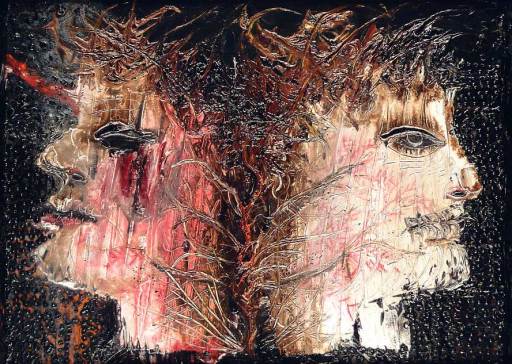
The above painting of Janus is by South African artist Christo Coetzee (1929-2001), oil on board.   It can be found in the Sanlam Collection. Copyright Christo Coetzee, all rights reserved.

The Terrifying Banality of Humanity 2.0

William Blake Urizen in Fetters Tears streaming from His Eyes

Something I think we are prone to forget in this age of chattering heads and two-bit pundits is that ideas have consequences. Anyone engaged in public discourse has some responsibility to wrestle with the ethical implications of their thought, and this is as much the case for the Rush Limbaugh’s of the world as it is for that disappearing class of thinkers who once proudly went by the name intellectuals.

In a way, artists have always had an easier time than those engaged in more discursive lines of thought. We hold Plato morally accountable for the ideas he put forward in a work like The Republic in a way we don’t hold his contemporary Aeschylus for a play full of human violence like The Oresteia. The reason for this is that philosophers rather than artists it is assumed, not doubt in part falsely, are not just giving us a view into the world as it is, but as they believe it should be.

If ideas are indeed serious things, and we need to hold intellectuals responsible for their moral implications in a way artists need not be, then the pushing open, perhaps better tearing up, of the envelope of our moral horizons found in Steve Fuller’s recent Humanity 2.0: What it means to Be Human: Past, Present and Future needs to be confronted in a way a work of art like the song Vicarious by the band Tool does not, even if both start from a kind of Archimedean point outside or above the normal human perspective to look down upon the world as whole to end up with a sort of metaphysical justification for evil and violence.

Upon picking up Humanity 2.0 I did not expect this. What I anticipated is a recent version of run of the mill transhumanism with an epistemological slant (Fuller is a social epistemologist). Instead, what I got was a rather disturbing set of conclusions embedded within an otherwise banal alternative history of sociology.

There were far too many points throughout Humanity 2.0 where I found myself stopping to exclaim “Did he really just say that?” to discuss them all. So, in what follows I will focus on what I found the most relevant. For starters, Fuller thinks that for transhumanism, or better transhumanism as he understands it, to succeed it has to adopt what can only be understood as a form of  politics as deception. The first step in this deception is merely the discussions surrounding transhumanists’ concerns, where, for Fuller:

Intentionally or not, this serves to acclimatize citizens, in the company of their peers, to whatever nano-driven changes might be on the horizon, thereby updating the concept of self-fulfilling prophecy. (147)

In social psychology, this strategy is often dubbed ‘inoculation’, the suggestion being that by allowing people to spend time thinking about extreme or pure cases of some potential threat, you have laid the groundwork for the acceptance of a less virulent version.  (148)

Fuller compares this indirect method to be used in the achievement of transhumanist ends to be akin to the victory of socialism which emerged as a way to stave off the communist threat. (150)

Let’s pause and think about what he is saying for a moment. For Fuller, discussions and debates surrounding the issues of the application of science and technology to transform the current human condition are not so much a way to think through the profound challenges and questions transhumanist concerns pose to our understanding of what it means to be human or even post-human as they are a sort of public relations campaign which will win over the public to transhumanist positions the more extreme the proposals it appears to make for the human future.

That Fuller would adopt a perspective more reminiscent of the television show Mad Men that anything we might recognize from the tradition of moral philosophy or democratic politics shouldn’t be all that surprising given that he thinks the bizarre way in which we afford corporations with the rights of individuals to be a primary vector by which his post- human version of utopia will come into being. He muses:

Once the modes of legitimate succession started to be forged along artificial rather than natural lines with the advent of the corporation… the path to the noosphere had been set. (205)

If indeed Fuller means us to associate our modern corporations- our Walmart’s and McDonald’s- with the telos of the world, Teilhard de Chardin will not be the only one rolling in his grave.

Fuller’s love of corporations and his view of them as vectors for what he conceives to be the “real” ends of transhumanism is just one shade of his unabashed collectivism. One of his primary aims is to rehabilitate 19th and early 20th century eugenics. Many of the contemporary proponents of eugenics tend to approach the issue from the standpoint of reproductive rights. The problem with antique forms of eugenics, in their view, wasn’t just that it was based upon bad, meaning pre-genetic and racial science, but that it was focused on empowering the group in complete disdain of the rights and life of individuals.

Fuller will have none of such individualism or talk of “rights”.  We should rehabilitate 19th and 20th century eugenics because:

The history of eugenics is relevant to the project of human enhancement because it establishes the point-of-view from which one is to regard human-beings: namely, not as ends in themselves but as a means for the production of benefits… (emphasis added/142)

Lest we think that Fuller is out merely to rehabilitate the image of now forgotten  eugenicists like Francis Galton and couldn’t possibly be talking about “rehabilitating” our understanding of National Socialism we have this:

Put bluntly, we must envisage the prospect of a transformation in the normative image of Nazi Germany comparable to what Barrington Moore described for the French Revolution. This is not easy… there have been only the barest hints of Nazi rehabilitation. But hints there are, helped along by the deaths of those with first-hand experience of Nazism. (244)

Does the death of those with first-hand experience of Nazi atrocities make us wiser in Fuller’ eyes? This is not the kind of “PR” transhumanism needs.

Fuller’s commitment to collectivism takes him very far from traditional transhumanism indeed. In his hands the universal commitment to the increase in human longevity becomes nonsensical because the individual herself, from Fuller’s perspective, is a non-entity, a bridge to a kind of reborn primordial soup of cells and silicon which from his pantheist perch appears to be the ideal evolutionary future of a disembodied human intelligence or logos.

From his perspective the satirical world of “Utilitaria” imagined by the moral philosopher, Steven Lukes, where the characters are fully cared for from birth until old age only to be literally deconstructed both mentally and physically to serve as “parts” for the young becomes not a searing critique of a purely utilitarian world devoid of human rights, but a prescription for his version of our post-human future.

… with nature-inspired technologies we might think more imaginatively (aka divinely) about the terms on which ‘the greatest good’ can be secured for ‘the greatest number’, especially how parts of individuals might be subsumed under this rubric.” (228)

This zooming out to an amoral height in which the individual no longer has real value aside from whatever benefits they can bring not so much to society as to the process of history leading us to Fuller’s post-human age leads him to embrace a whole host of troubling concepts.  He gives gives his proposal to disassemble the panoply of protections we have built up around the use of human beings in scientific research vanilla,  soft-nietzschean labels such as “suffering smart”. Where his proposals amount to a kind of martyrology in which individuals sacrifice their own lives and health for the “honors” of propelling scientific research at a faster pace.

Fuller’s version of “heaven” is a return to the Eden of the primordial soup where the distinctions between species, machines, and even individuals has collapsed. In this he is riding the wave of the transformation of biology into an information science where individuals of a species become mere pattern of genes and the boundary between species become permeable. Here, Fuller takes the extremely irresponsible glorification of our new found ability to swap and combine genes between species who have not occupied the same place in lineage since the dawn of life on earth coming from figures like Freeman Dyson to an even greater extreme. Being able to incorporate the genes from other species is less for Fuller a means of human enhancement as it is the road the disappearance of the human into some sort of divine stew.

Fuller takes this transformation of biology into an information science to the degree that he has become one of the most vocal proponents of teaching intelligent design in schools. What? The logic behind his advocation of the pseudoscience of intelligent design is that the actual history of life on earth has become irrelevant now that we have reduced it to information.

… nothing much hangs on the fact of whether animals and plants evolved naturally or were specially created, let alone whether it happened over 5000 or 5 billion years… (64)

For Fuller, intelligent design is a sort of noble lie meant to teach its students how to be “God-like” designers of nature.

As far as things to raise critical awareness I will stop there, and am left to wonder how it is possible that Fuller has come up with such a regressive version of transhumanism where debate and discourse is replaced by manipulation, where corporations and collectives have replaced individuals, where not just 19th and early 20th century racists, but Nazis mass murderers are seen as premonitions of transhumanism and that is not be taken as a negative thing, a warning, where individuals become sacrificial animals for a research endeavor whose success would ultimately spell the end of individuals, where intelligent design is touted as a serious version of biological science?

The extent that Fuller flirts with the shibboleths of early 20th century fascism, indeed, he appears to see them as the true harbingers of transhumanist politics, suggested that the most recent offshoot of transhumanist thought, so called techno-progressivism will need to divorce and divest itself from its transhumanist roots if it is to remain ethically viable. Special efforts need to be made to disentangle techno-progressivism from underlying religious aspiration,s for it is these which serve as the launch point from which Fuller would undo much of the moral progress that emerged as a delayed response to the abuses and cognitive distortions of fascism and European imperialism.

As I have warned elsewhere religious rhetoric or the historically unconscious adoption of ideas whose origins are ultimately religious is dangerous to the transhumanist project both because it puts transhumanists and traditional religious persons in an artificial state of conflict, but also because it leads to the very kinds of moral and intellectual hubris found in a work like Humanity 2.0.

Fuller taps into what Susan Neiman in her Evil in Modern Thought declared to be the moral problem that would define the modern age- why is there evil in the world? A problem answered by thinkers such as Gottfried Leibniz with his concept of theodicy. The problem of evil is one of our own limited human perspective. Get up “high” enough and you will see that we live in the “best of all possible worlds”.

It shouldn’t be surprising that theodicy emerged at the same time as modern science and biblical literalism. Before the scientific revolution it was assumed that the everyday world that surrounds us is the worst of all possible worlds only in comparison to the Hell thought to be literally below us both a consequence of ours and the rebellious angels’ fall from grace.

Newton was just the most prominent of the early moderns to have destroyed the gap between the perfect world of the heavens and that of earth; what guided a thrown object here was the same thing that ruled heavenly objects above. Here emerges the idea of God as a celestial engineer.

Many of the early scientists such as Newton or Francis Bacon were proponents of the new biblical literalism. For them the project of freeing our understanding of the world from the hold of ancient and inaccurate science and finding the true meaning of the Bible by clearing it of the distortions caused by Catholicism were a set piece- a dual project. In her The Case for God, Karen Armstrong points out how these early moderns created the literalists idea of God replacing more mystical and metaphorical understandings. What drives debates between vocal New Atheists and fundamentalist is that the two are in fact theological brothers who share their conception of God and are merely arguing over whether this God exists or not.

Fuller places himself within this camp although his argument might be described as a leap from New Atheism to fundamentalism: the literalists creator God of the early moderns (and today’s fundamentalists) does not exist, so we should ourselves become this God. All of history then becomes excused as the mere birthpangs of us a newborn “god”.

The problem is we are not “gods” and are nowhere near “becoming gods”, or are very strange gods indeed. Not the omnipotent creator/designer that is a common power fantasy, but a god trapped within his own creation that needs to create and act anew merely to survive and can never be sure that the next creative act will not spell his end.

Theodicy of the type Fuller promotes denies the very reality that the Copernican Revolution and all subsequent great leaps in our scientific understanding has brought us: We are not at the center of events- we are not the story.

Theodicy implies that we can judge the universe by the moral qualities characteristic of human individuals- good and evil. But we do not exist on the same moral plane of the universe because the universe does not have a moral plane. It creates and destroys with absolute indifference.

When doing science we have to approach the world from above, from an Archimedean point, but morality does not and can not work like this. Justifying the whole of life or the entirety of the universe on moral grounds means a justification which a more theological age called evil, death, pain and destruction, for there is no need to justify the good. Fuller wants to justify historical and natural evil, but instead ends up at the same place as the viewpoint of the character in that Tool song I mentioned earlier who justifies his own voyeuristic bloodlust because the universe itself is a place of pain:

Credulous at best, your desire to believe in angels in the hearts of men.

                Pull your head on out your hippy haze and give a listen.

   Shouldn’t have to say it all again.

              The universe is hostile. so Impersonal. devour to survive.

So it is. So it’s always been.

  We all feed on tragedy

 It’s like blood to a vampire

Vicariously I, live while the whole world dies

   Much better you than I

The banality of evil is that it comes not so much from this sort of willful malice as a mistaken notion of the good and an obliviousness to our own limits. Fuller’s Humanity 2.0 has both in spades.

Welcome to Our Future: 2312

2312

Part of the problem each of us has when it comes to realistically imagining the future is that we ultimately bring our own cognitive biases, our optimism or pessimism, to the question at hand. From the perspective of the types of small societies we evolved out of these kinds of sunny vs gloomy dispositions were no doubt a very good thing. A discovery of a rich patch of good game land followed by feasts necessitated curmudgeons who would remind the tribe that the days of full stomachs would not last. Thankfully, these complainers would not have the final word, and the group would set off again over the next hill assured by the sunnysiders that more of the riches of the world remained on the other side.

Our modern media world, however, tends to undermine this diversity of cognitive biases sorting us into more sharply distinguished optimist and pessimist camps. In our digital echo chambers the future is all good or all bad, utopia or dystopia as the title of my blog says. Lately though, a number of thinkers have been trying to shake us out of our tendency to see the glass as half empty or half full reminding us that the world is more complicated than the illusionist in our heads.

Here I would put the work of Ramez Naam who in his The Infinite Resource faces head on both the enormous problems in front of us- climate change, global food shortages, growing energy needs, and fresh water scarcity while at the same time offering up realistic solutions to these problems without the need for a Deus ex Machina solution such as “our coming super-intelligent AIs will solve these problems for us”. I’d throw Kim Stanley Robinson into this realist camp as well. His most recent novel 2312 gives us a portrait of the next few centuries that is something very far from Shangri-la but isn’t a post-apocalyptic horror story either.

The source of Robinson’s pessimism is the state and probable future of the global environment, especially in terms of the likely impact of climate change. As energy innovator Hal Harvey recently pointed out in this scary, yet even then, not hopeless speech on the climate situation at the Aspen Ideas Festival we only have a brief window in which we can prevent potentially catastrophic climate change from occurring and that window is rapidly closing. 2312 in a sense gives us a sketch of what our world might look like if we do indeed allow Harvey’s window to slam shut.

In the world of 2312 the earth’s temperature has risen by 5 K.  As a consequence there has been extensive sea level rise- Manhattan is now like Venice and mass deaths of people on all continents and mass extinctions have occurred. Had the novel focused on this period it would have been apocalyptic, but instead it sets its sight on the post-apocalyptic world that follows our failure to have addressed our environmental challenges in time.

In Robinson’s future- historical scheme only after we are faced with apocalyptic crisis do we marshall a response commensurate to the situation at hand. Humanity tries to set things straight by geoengineering the earth’s climate, a project that ultimately fails spectacularly in the “Little Ice Age”. In a period that becomes known as the Accelerando,a real push is made to settle the solar system. Much of it is terraformed and settled  including asteroids which are hollowed out to become biomes holding within them the precious cargo of the flora and fauna that once graced the earth.  AIs including quantum computers surgically implanted in human beings know as “qubes” become widespread. Human longevity is increased to the extent that a person is now fit and active into her hundreds.

The kinds of terraforming that are used to transform much of the solar system into areas that are hospitable to human life prove inapplicable to geoengineering the earth back to its pre- industrial state because the blunt force methods of terraforming- slamming comets into planets and the like- are simply unworkable on a planet that already has billions of human beings not to mention other lifeforms most of which are hanging on to life by a thread.

The scale and coordination of the response to the environmental crisis the Accelerando represents does not last, however, and the pendulum swings again humanity falling into two dark periods- The Ritard and Balkanization during which the trends of the Accelerando slow and the solar system becomes divided into competing factions. It is in this world where the earth continues to suffer extreme environmental and economic crises, and the new worlds of the solar system have turned against one another that the plot of 2312 takes place.

Robinson is by his own declaration not a transhumanist. And yet his protagonist, Swan Er Hong can certainly be described in this way. Swan has a qube implanted in her brain named Pauline which makes her a kind of cyborg. She has the genes of songbirds in her that allows her to “whistle” like a bird. She is transgendered with both a vagina and a working penis- a product of the fact that a good deal of the increased lifespan of human beings seen in 2312 has been gained by human beings taking on transgendered features. Something that makes sex scenes in 2312 just a little complicated. Treating the body, and even the mind, as something essentially plastic in this way comes naturally to Swan, for she is an artists and her body itself is one of her works of art she being a practitioner of what Robinson calls in honor of performance artist Marina Abramović “abramovics”.

The plot of 2312 centers around a series of terrorists attacks in the inner solar system and the efforts of Swan the mercurian, the man who will become her lover, Wahram from Saturn, (Robinson is having some fun with astrological stereotypes), and an exiled Martian, Inspector Gennette, along with others try to solve these incidents. Along the way they spark a political movement of sorts setting off the forced return of the earth’s lost animals to the planet as a way to spark the earthling’s desire to address the planet’s continuing ecological problems.

I must admit that I had some difficulty with the novel’s plot. There were numerous points where I had to engage my “willing suspension of disbelief” not because the technological or social situations seemed so “out there” as the experiences of the quite empathetic and rounded characters were squished into predetermined unfolding of the overarching story of the novel.

There are three ways it seems to me one can make the experiences of characters realistic in the context of a grand future-historical novel such as 2312.  The least interesting is to tell the story from the perspective of the people at the top- the most historically important characters whose decisions therefore have the biggest effect on how such narrative unfolds. The second way is to give witness to the fact that small characters can unleash the forces of history in the way an otherwise very insignificant man like Gavrilo Princip set off World War I with his assassination of the Archduke Franz Ferdinand. The third and probably the best way is to take historically insignificant characters and see how the grand narratives unleashed elsewhere affect them. The best moral judgement of the decisions of elites or the injustice of a system is how it impacts the lives of people who have to live closest to those impacts.

When one tries to see in the lives of historically marginal characters, which is really what Swan should be considered, experiences that reflect decisions of world-historical significance one is left with the impression that the character is suffering from paranoia. This at least is what I thought when Swan encounters an extremely proficient “lawn bowler” whose style of play mimics the terrorist “pebble attacks” and who does indeed end up a central character in the plot.

That said, 2312 did something few other books are able to do so easily, it changed the way I looked at the world. Robinson is a superb travel writer and made our solar system, a place I had long thought of as quaint or “dead” come alive as a wondrous imaginative palette upon which our future is yet to be written.

Yet, amazingly enough, Robinson most affected my view of living on earth. It’s hard to remember that we live on a very special world that is so much different, so much more a home, than any other place we know. While reading the novel I started to pay attention to Luna in the sky and the glories of the setting summer sun. I had the urge to take more walks and one night saw a doe grazing in a field watching me curiously and had the urge to chase or run with it, like Swan.

What Robinson is trying to do is find that sweet spot in the future that is at the outer reaches of our understanding and therefore our agency. This is much better than something like my Far Future’s Project which I am wrapping up this week, or Stewart Brand’s Long Now because we really do have some degree of agency over, and therefore some responsibility for, what happens a century or two in the future. If writing about the future is really just turning up the volume on the present then we can only be confident in these sorts of limited time frames that we will be playing anything like the same score.

It is when thinking in terms of this near term and intermediate future that our tendencies for optimism or pessimism need to be set aside and the search for realism engaged. One can be a long term optimist or a long term pessimist when it comes to the the human future but both are mere waking fantasies, whether exhilarating or frightening. At the end of the day we can never actually know.

Neither long term optimism nor pessimism frees us from our responsibility to act so as to positively shape the future right now. There are all kinds of ways we need to do this as political, economic and socially beings in response to the future society we are likely to live in or the decisions and sacrifices taken today that we bequeath to our future self.

We can also decide to make investments in the future to a world we are unlikely to live in. Here we have everything from our response to climate change and environmental issues to social legacies. The question of what can we and what we should leave for our great or even great-great grandchildren in light of the nearly endless possibilities of what the world they will be living in will actually look like is one that we should be asking because it may serve as a better way to frame the question of what kind of future is it exactly that we hope for and should be working towards in the first place.

Still, if Robinson gives us a realizable version of the future with much of the transhuman in it, he is, as was mentioned, decidedly not a transhumanist.  Part of this stems from his fear that transhumanism might come to represent escapism. There are also his views of what  transhumanism means in light of a document few of us have probably heard of and even fewer actually given a second thought- the Universal Declaration of Human Rights. Essentially, Robinson thinks transhumanists are getting ahead of themselves. We are nowhere near achieving the kind of worldwide realization of the promise of conditions supporting self-actualization for all promised by the Declaration and transhumanists have already moved the bar.

Robinson is not alone in seeing our current failure to realize the promises of the Declaration as a challenge to the transhumanist project. The social epistemologist Steve Fuller believes positions on the Declaration will be a major area of friction between transhumanists and others, especially those on the left. It is, therefore, an important issue but for a latter time.

The kind of realistic science-fiction offered to us by Robinson where greater than light speed and settlement of “the stars” remains what it is today- a mere fantasy- nevertheless expands our and deepens our canvas to embrace our second home in the solar system. It is a canvass certainly large enough for the human story to play itself out.

The claim idea that our filling in of this canvass through the settlement of the solar system and terraforming its bodies constitutes the “arrogance of humanism” as Ernest J. Yanarella did in Strange Horizons has things ass-backwards. The arrogance of humanism lies in assuming that on a cosmic scale our endeavors are much more than one of Swan’s performance pieces such as her “painting” of a field with a rainbow of fallen autumn leaves. Like Swan, all we can do at our best is create beautiful objects that live a short moment only to be undone by the wind.

The Dangers of Religious Rhetoric to the Trans-humanist Project

Thomas_Cole_-_Expulsion_from_the_Garden_of_Eden

When I saw that  the scientist and science-fiction novelist, David Brin, had given a talk at a recent Singularity Summit with the intriguing title “So you want to make gods?  Now why would that bother anybody? my hopes for the current intellectual debate between science and religion and between rival versions of our human future were instantly raised. Here was a noted singularitarian, I thought, who might raise questions about how the framing of the philosophy surrounding the Singularity was not only alienating to persons of more traditional religious sentiments, but threatened to give rise to a 21st century version of the culture wars that would make current debates over teaching evolution in schools or the much more charged disputes over abortion look quaint, and that could ultimately derail us from many of the technological achievements that lie seemingly just over the horizon which promise to vastly improve and even transform the human condition.

Upon listening to Brin’s lecture those hopes were dashed.

Brin’s lecture is a seemingly lite talk to a friendly audience punctuated by jokes some of them lame, and therefore charming, but his topic is serious indeed. He defines the real purpose of his audience to be “would be god-makers” “indeed some of you want to become gods” and admonishes them to avoid the fate of their predecessors such as Giordano Bruno of being burned at the stake.

The suggestion Brin makes for  how singularitarians are to avoid the fate of Bruno, a way to prevent the conflict between religion and science seem, at first, like humanistic and common sense advice: Rather than outright rejection and even ridicule of the religious, singularitarians are admonished to actually understand the religious views of their would be opponents and especially the cultural keystone of their religious texts.

Yet the purpose of such understanding soon becomes clear.  Knowledge of the Bible, in the eyes of Brin, should give singularitarians the ability to reframe their objectives in Christian terms. Brin lays out some examples to explain his meaning. His suggestion that the mythological Adam’s first act of naming things defines the purpose of humankind as a co-creator with God is an interesting and probably largely non-controversial one. It’s when he steps into the larger Biblical narrative that things get tricky.

Brin finds the seeming justification for the expulsion of Adam and Eve from the Garden of Eden to be particularly potent for singularitarians:

And the LORD God said, Behold, the man is become as one of us, to know good and evil: and now, lest he put forth his hand, and take also of the tree of life, and eat, and live for ever. Genesis 3:22 King James Bible


Brin thinks this passage can be used as a Biblical justification for the singularitarian aim of personal immortality and god-like powers. The debate he thinks is not over “can we?”, but merely a matter of “when should we?” attain these ultimate ends.

The other Biblical passage Brin thinks singularitarians can use to their advantage in their debate with Christians is found in the story of the Tower of Babel.  

And the LORD said, Behold, the people is one, and they have all one language; and this they begin to do: and now nothing will be restrained from them, which they have imagined to do.  Genesis 11:6 King James Bible

As in the story of the expulsion from the Garden of Eden, Brin thinks the story of the Tower of Babel can be used to illustrate that human beings, according to Christianity’s  own scriptures, have innately god-like powers. What the debate between singularitarians and Christians is, therefore, largely a matter of when and how human beings reach their full God-given potential.

Much of Brin’s lecture is animated by an awareness of the current conflict between science and religion. He constructs a wider historical context to explain this current tension.  For him, new ideas and technologies have the effect of destabilizing hierarchy, and have always given rise in the past to a counter-revolution supported and egged on by counter-revolutionary oligarchs. The United States is experiencing another one of these oligarchic putsches as evidenced in books such as The Republican War on Science. Brin thinks that Fermi’s Paradox or the “silence” of the universe, the seeming lack of intelligent civilizations other than our own might be a consequence of the fact that counter-revolutionaries or “grouches” tend to win their struggle with the forces of progress. His hope is that our time has come and that this is the moment where those allied under the banner of progress might win.

The questions which gnawed at me after listening to Brin’s speech was whether or not his prescriptions really offered a path to diminishing the conflict between religion and science or were they merely a means to its further exacerbation?
The problem, I think, is that however brilliant a physicists and novelists Brin might be he is a rather poor religious scholar and even worse as a historian, political scientist or sociologist.

Part of the problem here stems from the fact that Brin appears less interested in opening up a dialogue between the singularitarians and other religious communities than he is at training them in his terms verbal “judo” so as to be able to neutralize and proselytize to their most vociferous theological opponents- fundamentalist Christians. The whole thing put me in mind of how the early Jesuits were taught to argue their non-Catholic opponents into the ground.  Be that as it may, the Christianity that Brin deals with is of a literalist sort in which stories such as the expulsion from the Garden of Eden or the Tower of Babel are to be taken as the actual word of God. But this literalism is primarily a feature of some versions of Protestantism not Christianity as a whole.

The idea that the book of Genesis is literally true is not the teaching of the Catholic, Anglican, or large parts of the Orthodox Church the three of which make up the bulk of Christians world-wide. Quoting scripture back at these groups won’t get a singularitarian  anywhere. Rather, they would likely find themselves in the discussion they should be having, a heated philosophical discussion over humankind’s role and place in the universe and where the very idea of “becoming a god” is ridiculous in the sense that God is understood in non-corporal, indefinable way, indeed as something that is sometimes more akin to our notion of “nothing” than it is to anything else we can speak of.  The story Karen Armstrong tells in her 2009, The Case for God.

The result of framing the singularitarian argument on literalist terms may result in the alienation of what should be considered more pro-science Christian groups who are much less interested in aligning the views and goals of science with those found directly in the Bible than in finding a way to navigate through our technologically evolving society in a way that keeps the essence of their particular culture of religious practice and the beliefs found in their ethical perspective developed over millenia intact.

If Brin goes astray in terms of his understanding of religion he misses even more essential elements when viewed through the eyes on an historian. He seems to think that doctrinal disputes over the meaning of religious text are less dangerous than disputes between different and non-communicating systems of belief, but that’s not what history shows. Protestants and Catholics murdered one another for centuries even when the basic outlines of their interpretations of the Bible were essentially the same. Today, it seems not a month goes by without some report of Sunni-Muslim on Shia-Muslim violence or vice versa. Once the initial shock for Christian fundamentalist of singularitarians quoting the Bible wears off, fundamentalists seem likely to be incensed that they are stealing “their” book, for a quite alien purpose.

It’s not just that Brin’s historical understanding of inter/intra-religious conflict is a little off, it’s that he perpetuates the myth of eternal conflict between science and religion in the supposed name of putting an end to it. The myth of the conflict between science and religion that includes the sad tale of the visionary Giordano Bruno whose fate Brin wants his listeners to avoid, dates no later than the late 19th century created by staunch secularists such as Robert Ingersoll and John William Draper. (Karen Armstrong, The Case for God, pp. 251-252)

Yes, it is true that the kinds of naturalistic explanations that constitute modern science emerged first within the context of the democratic city-states of ancient Greece, but if one takes the case of the biggest most important martyr for the freedom of thought in history, Socrates, as of any importance one sees that science and democracy are not partners that are of necessity glued to the hip. The relationship between science, democracy, and oligarchy in the early modern period is also complex and ambiguous.

Take the case of perhaps the most famous case of religions assault on religion- Galileo. The moons which Galileo discovered orbiting around Jupiter are known today as the Galilean moons. As was pointed out by Michael Nielsen, (@27 min) what is less widely known is that Galileo initially named them the medicean moons after his very oligarchic patrons in the Medici family.


Battles over science in the early modern period are better seen as conflicts between oligarchic groups rather than a conflict where science stood in the support of democratizing forces that oligarchs sought to contain. Science indeed benefited from this competition and some, such as Paul A. David, argue that the scientific revolution would have been unlikely without the kinds of elaborate forms of patronage by the wealthy of scientific experiments and more importantly- mass publication.

The “new science” that emerged in the early modern period did not necessarily give rise to liberation narratives either. Newton’s cosmology was used in England to justify the rule of the “higher” over the “lower” orders, just as the court of France’s Sun-king had its nobles placed in well defined “orbits” “circling” around their sovereign. (Karen Armstrong, The Case for God,  p. 216)

Brin’s history and his read of current and near future political and social development seems to be almost Marxist in the sense that the pursuit of scientific knowledge and technological advancement will inevitably lead to further democratization. Such a “faith” I believe to be dangerous. If science and technology prove to be democratizing forces it will be because we have chosen to make them so, but a backlash is indeed possible. Such a “counter-revolution” can most likely be averted not by technologists taking on yet more religious language and concepts and proselytizing to the non-converted. Rather, we can escape this fate by putting some distance between the religious rhetoric of singularitarians and those who believe in the liberating and humanist potential of emerging technologies. For if transhumanists frame their goals to be the extension of the healthy human lifespan to the longest length possible and the increase of available intelligence, both human and artificial, so as to navigate and solve the problems of our complex societies almost everyone would assent. Whereas if transhumanists continue to be dragged into fights with the religious over goals such as “immortality”, “becoming gods” or “building gods”(an idea that makes as much sense as saying you were going to build the Tao or design Goodness)  we might find ourselves in the 21st century version of a religious war.

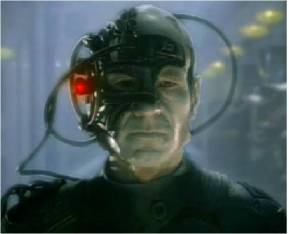
What’s Wrong With Borgdom?

Lately, I’ve had superorganisms on the brain. My initial plan for my post this week was to do a piece comparing earthly superorganisms like the Leaf Cutter Ant with the most well known of science-fiction superorganisms- the Borg. Two things happened that diverted me from this path. First,  the blogger and minimalist beekeeper, James Cross, shared with me an article he wrote that largely said what I wanted to say about the Borg and insects as well or better than I could have. Second, during the course of my research I ran into a recent article that stuck in my craw, which I felt compelled to address.

Someday I will return to the Borg, but now for that article I mentioned. The article, by the author, Travis James Leland, I found on the Institute for Ethics and Emerging   Technologies website, and is entitled We Are the Borg, And That is a Good Thing.”.

Leland’s point in the article is that many of the positive changes from technology that have been brought to our lives in recent decades have first been imagined in science-fiction, and one of the most powerful of these visions has been that of Star Trek.
But, while Star Trek has this incredibly powerful vision of a hopeful technological world it also has a “dark-side” in the form of the Borg. This darker view of technology, Leland thinks, leads to neo-luddism: the phrase “resistance is futile”- with which the Borg “introduce” themselves to species they are about to assimilate, now greets every new technology, and frankly scares people into seeing our technological future in a much more dismal light than should be the case. Leland hopes to cast doubt on this pessimistic vision:

But is it such a bad thing for humanity to want to become a collective? Isn’t one of the main selling points of the internet, social media, etc. the fact that we are all now closer than ever? What I write on my Twitter account can be read by hundreds or even thousands of people instantly. They know what I am thinking, and I can see what is on the mind of all the people I follow. Facebook allows me to share videos, photos, music, status updates and more (although I rarely use Facebook anymore, but I plan on returning to it). Foursquare, Google+, LinkdIn, Skype, and all the other apps and social media are being used to keep us constantly “plugged in” to our peers, our favorite celebrities, causes, politicians, businesses and anyone or anything else we want.

Leland completely embraces the cyborg- transhumanist ideal of the merger of human beings with their technology. In other words, he wants to be a cyborg:

I have been keeping up on the research into Google Glasses, Augmented Reality, implanted microchips, prosthetic limbs, brain uploading and more and I have to say “bring it on!”

For Leland, opposition, or fear, of cyborg-transhumanism isn’t a matter of ethical, egalitarian, or spiritual objections- it’s all about bad “PR”, and we have Star Trek’s Borg partially to blame. If opposition to cyborg-transhumanism is all about spin, then what is needed to undo such opposition is spin in the opposite direction to make cyborg- transhumanism “sexier”. He states:

This one will all come down to advertising, I think.

Leland then shares two videos that he thinks make the positive case for cyborgs. The first one is of a young woman, deaf from birth, who has been granted the ability to hear via a cochlear implant. It is a very touching video. It may be a little too harsh to characterize Leland posting it as an advertisement for cyborg-transhumanism as despicable, but it was certainly disturbing enough for me to feel inspired to write this post.

The second video is, ehem, an advertisement for Corning Glass that pictures a near human future in which a family is blissfully connected to one another via technology, all embedded in glass, of course.

Let me first tackle the issue of social media. The best counter to Leland’s Corning Glass video, with its happy family and their augmented reality bubble, is a dark and frankly brilliant piece of design fiction called Sight  that was brought to my attention by the Atlantic blogger Kasia Cieplak-Mayr von Baldegg (that’s a mouthful).

Sight  is a very short film that shows us the potential dark side of a world of ubiquitous augmented reality and social profiles- a world in many ways scarier that the Borg because it seems so possible. In this film, which I really encourage you to check out for yourself, a tech- savvy hotshot, seduces, and we are led to believe probably rapes, a young woman using a “dating app” that gives him access to almost everything about her.

Sight  gets to the root of the potential problem with social media which isn’t the ability to interconnect and communicate with others , which it undoubtedly provides,  but the very real potential that it could also be used as a tool of manipulation and control.

Sight  is powerful because it shows this manipulation and control person to person, but on a more collective level manipulation and control is the actual objective of advertisement. It is the bread and butter of social media itself. It is quite right of us to wish to limit the ways our personal information can be used, and to ask questions of it such as: Does using a social media website mean that all my “friends” are bombarded with advertisements for product X because I recently bought X? Do social media companies have the right to sell to third parties my “social map” revealing my friends, my interests, my location? What the advertisement Leland shared from Corning Glass showed was a world of ubiquitous video displays against the backdrop of loving families almost without advertisements- the just as, if not more likely scenario, is the kind of nightmare of manipulation found in Sight  and a world of almost constant bombardment by personalized advertisements based on our location, what we are doing, and our “social map”.

Corporate abuse of social media goes well beyond targeted advertising. Upwards of 37% of  hiring managers use social media to prescreen applicants. Even if one would argue that such screening is merely due diligence on the part of corporations one must be aware of the extremely negative knock-on-effects this might be having on American democracy. I can’t tell you how many bloggers I have run into who are afraid to reveal their own names out of fear that what they might say could have a negative impact on their “employment prospects”. This leads me to wonder how many people are dissuaded from blogging or engaging in other forms of publicly accessible speech at all. What this means is that, on some level, people are beginning to become afraid of actually saying what they think which means social media, which should have the effect of facilitating democracy, is instead sucking the very lifeblood out of it.

If individuals or corporations with such deep information about us make some of our skin crawl, governments themselves in possession of such knowledge is just as, or even creepier. As an article in the Economist recently pointed out wiretapping laws have not kept pace with social media. What this means is that the governments essentially have open access to not merely our publicly accessible profiles, but all the background information such as where we went, who we called, emailed, SKYPED with etc. all without need of a warrant.

Conta-Leland being wary of the potential for abuse of social media, and fighting to short-circuit such abuse  is not neo-luddism, but a prerequisite for freedom in a world in which social media is here to stay- for good and for ill.

Leland engages in the very sort of manipulation that seems to underlie the dark side of social media when he essentially appropriates the private, even if shared,  experience of the young deaf woman regaining her hearing for his own ends.

His posting of this video as a form of “advertising” for the kind of cyborg-transhumanism he wishes for the future raises a whole set of questions: Are we supposed to think that questions, concerns or even opposition towards cyborg- transhumanism would mean keeping people deaf and blind? Why is this video so moving for viewers, and the experience of regaining her hearing bring such joy to the woman in the first place? Is it not that she has been given the capacity to do what most of us take for granted? Would our reaction not be different if instead of being brought into the human world of sound the woman was instead given an implant to be able to hear high frequency sounds that could be heard by bats or dogs? I think it most certainly would be.

One thing is clear, pressures are building among medical technology companies to extend the sort of technology that has brought the joy and wonder of sound to this young woman well beyond bringing people within the range of normal human experience or curring debilitating diseases, but first for the good news.

As a recent article in the Financial Times, Health Care: Into the Cortex , by Clive Cookson points out, at least some in the pharmaceutical industry think we are on the cusp of a bioelectronics revolution. Moncef Slaoui, head of research for the health care juggernaut GlaxcoSmithKline believes according to Cookson that:

…this is a moment comparable to the birth of the modern pharmaceuticals industry at the end of the19th and beginning of the 20th centuries, when chemical companies began to realize that they could design drugs with compound effects.

Here are some of the wonders of bioelectronics that have either already come down the pike, or are in process according to Cookson:

  • Paralyzed persons with bioelectronic implants being able to control robots with their just their thoughts.    
  • Bioelectronic communication with persons in a comatose state.
  • Robotic “suits” that give tetraplegics the ability to walk.
  • “Smart-Skin” implanted under the skin of epileptics to diminish/prevent seizures.
  • Deep brain stimulation to reduce the symptoms of Parkinson’s Disease, and although Cookson doesn’t mention this, clinical depression that is not responsive to existing treatments.
  • Stimulation of the peripheral  nervous system, outside of the brain, to treat conditions such as obesity.

All of these actual and potential inventions promise to reduce or end human suffering, and in that respect, are certainly a good thing. The danger, I think, will come from the fact that the shear economies of scale necessary to sustain medical bioelectronics is likely, as it has in the areas of pharmaceuticals and cosmetic surgery (the latter which began as a way to repair the horrendous scars of war suffered by some injured soldiers, and to help ease the emotional burden of women undergoing mastectomies), to demand the creation  of a mass market for bioelectronics, which will mean taking it beyond the treatment of disease.

I can imagine it working something like “plug-in-play” devices do now with people being able to essentially dock their brain into computerized systems to access networks instantly, or to communicate “telepathically” or to gain instant access to a new skill. I can see these products being aggressively marketed to quite healthy people, much as pharmaceuticals are aggressively marketed today. I can imagine all kinds of intense social pressures to use these products in order to effectively compete in the corporate world or the dating game. I cringe at the thought of how such hyper-expensive “enhancements” will further exacerbate an already pernicious social and economic inequality.  And I can lament like the words in the Arcade Fire song We Used to Wait, “that I hope that something pure can last”.

The ethical questions this type of cyborg-transhumanism will open up are real and are likely to be legion: questions about equity and individual rights and forced competition and peer pressure and morality and who decides what kind of world we live. The current field of bioethics, which currently deals with the ethical dilemmas posed by biological technology, will probably need to spawn a whole new subfield, or even new field of ethics itself, that will deal with the specific problems posed by bioelectronics. Let’s hope that the forums for discussing, debating, and deciding such issues are more open and democratic than the current ones for bioethics, which tends to be locked up in universities and exclusive publications. And let’s be fast in creating such forums because it seems very likely that we are about to plunge ourselves headlong into the dreams and nightmares of Leland’s borgdom.