Arrested Development

When I was a kid, the original Star Wars trilogy seemed to correspond to my own moral development, at least up until The Return of the Jedi. Star Wars, the first of the three was a classic good vs. evil morality /adventure tale- perfect for my own understanding of the world at the time. The world was simple, clear cut. There were good guys and bad guys, and the best one could hope for was to end up one of the key players on the side of the good guys. The sheer nobodyness of the main characters- Luke was just some kid living on a desert planet, Han and Chewy like futuristic truck drivers, the lowly droids a couple of clowns, contrasted with the sheer scale of what they were up against was democratizing- you couldn’t just be one of the good guys- you could be ONE of the good guys.

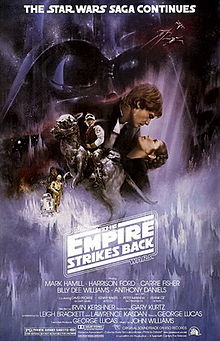
The Empire Strikes Back, for my money by far the best of the 3, was released in 1980.  The movie itself introduced elements of mysticism and mythology in its plot line, and also an element of moral ambiguity. Vader, we find out, is Luke’s father- the lines between good guy and bad guy had been slightly smudged.

But if things in the movies were getting morally complicated, things in the real world took on a surreal good vs. evil dichotomy.  It is impossible for me to explain to someone who was not of a certain age during this period of time- and was a boy- how the flare up of the Cold War that took place during this time colored the imagination.  This was the period of Regan’s Evil Empire Speech, and his SDI, aptly panned the Star Wars initiative.

Hollywood and the culture were amplifying the political reality to infuse the world, at least for a particular breed of media-tuned young boys, with an air of looming showdown and apocalypse.  Adults, should have known better, but as a kid I was too busy preparing myself for a hero’s role in a real life version of Red Dawn , amassing troops on my Risk board, listening to jets fly overhead at night thinking “this is it!” and begging my parents to see the horror show of The Day Afterwhich had they let me might have scared me straight.

By the time we get to the Return of the Jedi, the ambiguity is gone. The bad guy is converted, the good guys win, the Evil Empire is defeated. The progress towards adulthood, with the exception of sexy Leia, has stopped. Adults it seems never grow beyond the realm of fairy-tales. Even if, in the real world, such fairy-tales never make sense.

Whether Regan’s aggressive policy towards the Soviet Union precipitated the collapse of  the Eastern Bloc is an interesting historical question, and one in which I have an open mind. The fact of the matter remains that the outcome was not the matter of some “force” of good working for the survival of the human race and freedom, but a piece of extremely good luck. Barring any such force, he might just as likely have gotten us all blown up.

Perhaps the only time this good vs. evil rhetoric made sense was when the Allies battled against the Nazis. But even then, the Allies managed to cross over to the “dark side”, or at the very least, gave the conflict a shade of grey, when they began deliberately killing civilians from the air, and brought Stalin, Hitler’s doppelganger, into the lighter side of the force.

As an adult, the dangers of this arrested development and simplified moral imagination were brought home to me with the disaster of the Second Iraq war.  Adults holding to a vision of  the universe as a drama of good against evil not only made stupid policy mistakes, but also fell into the most grotesquely immoral behavior on a individual level.

Unfortunately, the 9-11 wars, from where I sit, have not proven to be a painful initiation to adulthood, but another version of the Return of the Jedi.  Both the right, and the left,  continue to paint one another as not just misguided, but demonic as the country drifts towards oblivion.

All this got me wondering where this whole good vs. evil fairy tale that is so dangerous, and politically crippling given our destructive capacities, and need for cooperation on enormously complex problems, actually originated.

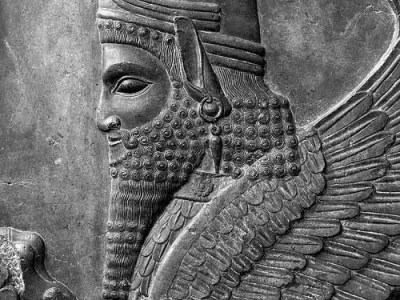
Some might blame the heritage of a particular aspect of the Abrahamic religions, Christianity, Judaism, and Islam.  For my part, I go a little further back, and blame a bewildered searching prophet who lived on the steppes of Central Asia around 1200 B.C.E.  I blame Zarathustra….

The Taiping Heavenly Kingdom

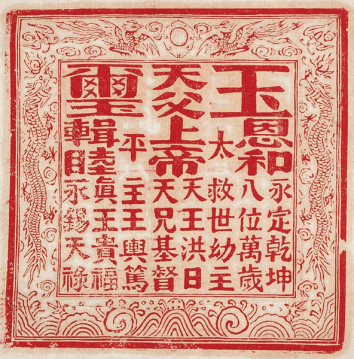
If as mentioned previously the First Opium War opened China to British drug pushers, it also opened up China to the cultural influence of the West, and one of these influences stemmed from the flood of Christian missionaries who thereafter inundated the country.Obviously there was a lot lost in translation between these Christian missionaries and the Chinese, for after Hong Xiuquan, a member of the Hakka ethnic group in southern China, encountered Christianity he became convinced that he was the brother of Jesus who had been sent to China to rid the country of “devils”.

The devils Hong Xiuquan was talking about included the Confucian meritocracy, themselves the heirs of a practical variant of utopianism.  This resentment towards Confucians was not surprising given that he had failed the civil service exams, based on the Confucian classics numerous time, and thus found himself  barred from a government post that would have granted him a stable income and place in society.

This is one of the stupendous what-ifs of history, like Hitler not getting into art school in Vienna, and going on to almost destroy Europe.  Would the Taiping Rebellion have never happened, would 20-30 million people not be killed if one man was better at taking standardized tests? Can the gods be so cruel in their irony?

As it was,  Hong Xiuquan set to preaching and soon had himself a sect.  In part, the attraction of the sect was a reflection of the dystopian environment around him. Bandits robbed seemingly at will, the Hakka people fought incessantly over sparsequality farmland,  natural disasters rocked the country . The civil and population pressures gave rise to a pernicious practice of female infanticide that overtime caused the natural ratio of males to females to become all out of whack.  Young hot-bloods had too much testosterone in their veins and too little food in their stomachs, and were thus a volatile mix in which  Hong Xiuquan served as a match.  Much of the popularity of the Taiping movement, like the modern day Taliban, stemmed from their ability to bring a semblance of order and security to this otherwise chaotic and dangerous world .

Yet the the Taiping Heavenly Kingdom, established in modern day Nanjing, was something much different than the Taliban.  It was a strange hybrid form of utopia, a kind of marriage between what we in the West would understand as Puritanism, abolitionism, feminism, Spartan or  pseudo-totalitarian military organization, and perhaps even a version of Malthusian environmentalism.

The Taiping replaced the Confucian classic that had served as the gateway to government office with the Bible, vice laws were passed  and came down hard on opium users, gamblers, consumers of alcohol, and prostitutes.  The sexes were strictly separated, and, in one of those classic examples of utopian overreach, sex, even by married couples, was discouraged.

At the same time, the Taiping launched a program of radical egalitarianism that gave the rebellion characteristics somewhere between the French Revolution and the American Civil War.  In a stroke, they abolished private property, banned the barbaric practice of foot- binding women, and declared the sexes equal, permitting women to take exams and serve in government.   They also, before the Emancipation Proclamation was even conceived, abolished slavery (of the Chinese variety).

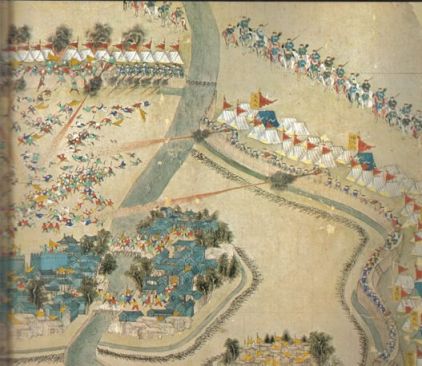
It was their tight military structure and totalitarian organization of society that made the Taiping so hard to defeat.  They proved as effective at mobilizing society as the civic-republicanism of the French people mobilized against Europe only a few decades before. The degenerating Qing Dynasty that ostensibly ruled China had a much harder time putting down the Taiping separatist than the Union armies had bringing down the Confederacy almost simultaneously.  And unlike with the American war, the British took sides in the conflict and supported the Qing, which may have been a decisive element in their eventual victory.

Many of the policies of the Taping Heavenly Kingdom might be understood as utilitarian responses to a Malthusian environment.  Their prohibitions on sex were efforts to drive the population down,  and sexual equality offered an answer to the distortions of female infanticide.  Women in the kingdom were just as valued as men.

This weird mash-up of different, and contradictory, forms of utopia to Western eyes seems not to make sense.  Yet, when seen from the perspective of what was happening elsewhere in the first half of the 19th century, the strangeness of the Taiping Heavenly Kingdom becomes less bewildering.

The Taiping Rebellion occurs in the historical space between the French  Revolution and American Civil War and contains aspects of both.  Perhaps revolutionary concepts blew like pollen across the Central Asia and the Pacific and cross-fertilized with native Chinese elements to create the strange hybrid of the Taiping Heavenly kingdom.

What the French Revolution, American Civil War and Taiping Rebellion all shared is that they were attempts to create what we now understand to be a modern, sovereign state.   What the founding fathers of modern China, Sun Yat Sen and Mao saw in the Taiping utopia was a hopeful harbinger of this new form of the state in China, and therefore, despite their differences in vision from it, admired the rebellion as a failed attempt at necessary transformation.

The current plutocrats ruling China, however, see in the Taiping a dangerous historical precedent that must be guarded against at all costs. What was once the source of partially irrational utopian hopes of the Chinese leadership has become the source of equally irrational dystopian fears. Anyone wondering today about China’s often cruel and  seemingly paranoid treatment of Christians, Tibetans, or fringe religious sects such as the Falun Gong needs to keep the historical experience of the Taiping Rebellion in mind in order to understand the root of Chinese fears.

What relevance does any of this have today? Some have suggested that we keep the experience of the Taiping Rebellion at the forefront of our minds when we think any future large scale disruptions to Chinese society.   One might wonder out-loud how China is going to deal with its massive demographic, environmental and political challenges. One might also wonder how China, now the “workshop of the world”, like the British who cleaned their clock in the Opium Wars, might deal with another tectonic shift coming from automation and localized production that challenges that status.

Given how purely speculative all this is, what interests me most is what kinds of strange cross-fertilizations, like that between the Taiping Rebellion and intellectual flora that originated in the West,  are going on today, and, more important may occur in the near future.

As I wrote in a recent post, it might be a good idea for people in the West to start looking for novel ideas about politics, culture, technology, art to start emerging from the more dynamic developing world, and that would include China, even though it is rapidly aging and therefore probably missing something of the natural utopianism and innovation of youth.

When the history of the Occupy Wall Street Movement is written one of its most interesting aspects might be that it was inspired by a similar movement in the developing world- the Arab Spring.  (Though it might be more accurately called a Mediterranean Spring and have its origin in Greece).   One can only imagine, should China ever bloom into its own spring, what strange and interesting ways of thinking and being in the world might emerge there.  What bloomed in China might eventually make its way to our shores to combine with Western traditions giving rise to something we have not seen before, perhaps for ill, but let us hope, for good.

Taiping Rebellion, Tectonic Shifts

Around the same time as the American Civil War a civil war that became known as the Taiping Rebellion was raging in China. The American Civil War was a brutal conflict that left 625,000 Americans dead. The Taiping Rebellion resulted in the deaths of somewhere between 20-30 million people, making it one of the bloodiest conflicts in human history.

The origins of the Taiping Rebellion lay some years prior in the First Opium Wars fought between the British and the Qing Empire of China from 1839-1842.  In the Opium Wars the grand old British Empire played the role of the modern day Columbian drug cartel,
or Mexican drug lords, with the major difference being that the British, being militarily superior to the Chinese, were able to force China to accept the British importation of an addictive poison rather than just sneak it across the border.

As a consequence of the devastating impact of the opium trade on the people of China, the Chinese Emperor sent the Confucian scholar Lin Zexu to the port of Canton in order to put a stop to the importation of the drug by British merchants. Lin wrote an impassioned letter to Queen Victoria appealing to her sense of humanity with the hope of stopping the trade.

We find that your country is distant from us about sixty or seventy thousand miles, that your foreign ships come hither striving the one with the other for our trade, and for the simple reason of their strong desire to reap a profit. Now, out of the wealth of our Inner Land, if we take a part to bestow upon foreigners from afar, it follows, that the immense wealth which the said foreigners amass, ought properly speaking to be portion of our own native Chinese people. By what principle of reason then, should these foreigners send in return a poisonous drug, which involves in destruction those very natives of China? Without meaning to say that the foreigners harbor such destructive intentions in their hearts, we yet positively assert that from their inordinate thirst after gain, they are perfectly careless about the injuries they inflict upon us! And such being the case, we should like to ask what has become of that conscience which heaven has implanted in the breasts of all men?

The result of Lin’s efforts was a war by the British against the Chinese Empire, that the Chinese were destined to lose.

The fact that tiny Great Britain, with a little over 27 million people in 1850, could so easily have brought a continental empire of 450 million to heel would have been considered ludicrous only 50 years before.  It was certainly the case that European powers had had an easy time knocking off the great empires of the Americas- the Aztec and the Inca- two centuries earlier, but these were civilizations lacking steel, wheels, horses, or gunpowder weapons, technologies the Europeans had largely imported from fellow Old World civilizations- especially the Chinese. As Jared Diamond has pointed out, the Europeans were also in possession of devastating weapons of mass destruction in the form of diseases to which Native Americans had no immunity, and which killed more than any of the cruelties of conquest.

China, though, should have been different. China was the oldest living civilization, the great technological, political and cultural innovator. It was, after all, the more advanced society Europeans were trying to get to in search of trade, technology, and a hoped for ally against the Muslims when Columbus “goofed up” and ran into the New World.

The reason China wasn’t different is that the world had begun one of those great periods of tectonic shift in nature and history. This time, the shift was the development of a whole new type of civilization, an industrial civilization which, for a time, turned the Western civilization in which it first took root into the ruler of the world. For the mechanized British army and navy the “white man’s burden” that came with technological advantage meant cornering the Chinese drug market, and crippling the world’s most revered civilization.

The response of some of the Chinese to all this was the establishment of a pseudo-Christian utopia called the Taiping Heavenly Kingdom. The war between the Qing Chinese and this strange utopian-cult would constitute the bloodiest conflict of the 19th century rivaling the wars unleashed by the ravenous Napoleon…

Tenochtitlan, Dürer, Civilization

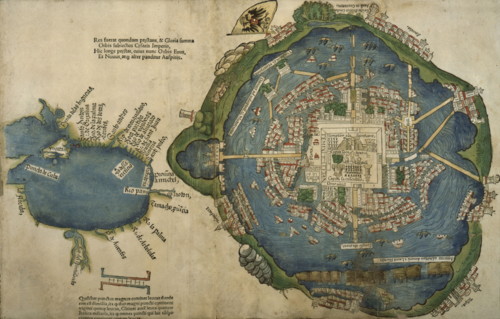
In the year 1521 the armies of Hernando Cortez captured the Aztec capital of Tenochtitlan near where Mexico City now stands.  In conquering the city Cortez had brought to the Spanish empire one of the great cities in the world. The population of Tenochtitlan numbered somewhere between 200,000- 250,000. To modern ears, accustomed to cities of enormous scale, these numbers appear tiny. And yet, it should be remembered that the world population in 1500 was only 500 million compared to the 7 billion alive today. The largest city in the world in 1500 was Beijing, China with 625,000 people. At the time, Tenochtitlan was in the middle range of the world’s ten largest urban centers tied with cities both still existent, and whose fame has been long forgotten, cities such as Hangzhou in China, Tabriz in Iran, and glorious Istanbul. Only one Western city could be numbered among the largest cities in the world in 1500, Paris with a population of 185,000.

The great artist from Nuremberg, Albrecht Dürer, who lived during this time of Western discovery and initial conquest of the New World, had the opportunity to set his eyes on some of the stolen treasures of Aztec civilization. Certainly, they must have come as a shock. The genius Dürer found something both familiar and utterly alien. The universal character of art he could comprehend, while at the same time the mythological language and culture that gave context to the art was incomprehensible within the  not only the Christian world-view, but from the view point of any of the cultures, ancient or modern, he might have known. Only the works of Ancient Egypt might have appeared so wondrously baffling.  In 1520 Dürer wrote of seeing the Aztec treasures:

All the days of my life, I have seen nothing that rejoiced my heart so much as these treasures, for I saw among them wondrous works of art, and I marveled at the subtle Ingenia of men in foreign lands. Indeed I cannot express all that I thought there.

It is not definitively known whether the account of Cortez’s conquest of the Aztecs, especially its beautiful illustrations of Tenochtitlan, such as the one above, influenced Dürer’s short work on fortified cities published in 1527, (illustration below) but the more than superficial similarities, timing, and his interest in the Aztec’s all suggest this may be the case. If Tenochtitlan did indeed influence Dürer’s idea of fortified cities it would be somewhat ironic, for he was expressing not just his own utopian ideal, but offering what he thought was a practical remedy for Turks on the march against Hungary. In basing his fortifications on Tenochtitlan, Dürer was using a city that had fallen to a handful of Spaniards and their allies almost overnight.

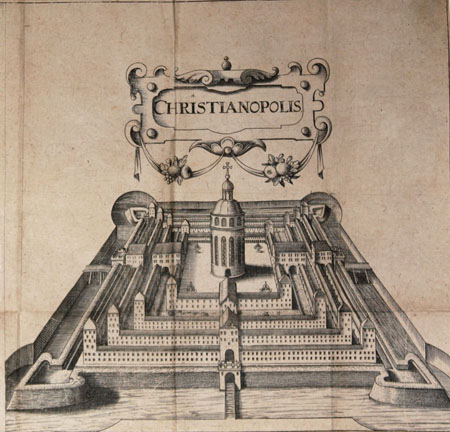
Dürer’s fortress cities remained a mere flight of imagination for all but one instance: the Black Forest town of Freudenstadt designed by the architect Heinrich Schickhardt, which was explicitly based on the designs of Dürer.  Freudenstadt folds us firmly back into the utopian tradition, for the town was an immediate influence on J.V. Andreae’s Christianopolis , another idealized city and utopia (pictured below) that remained a mere thing of the mind.

All of this brings us back to Tenochtitlan. For the Spanish conquest of the city signaled the beginning of the rise of the West. The momentum of urbanization shifted there, especially with the beginning of industrialization around 1800. All of the world’s largest cities, save one, were located in the West by 1900: London, New York, Paris, Berlin, Chicago, St. Petersburg, and Philadelphia. The one exception was Tokyo, a consequence of the fact that Japan alone among non-Western societies had fully embraced industrialization.

As has always been the case, with cities came all the momentum in art, architecture, literature, science, technology. This was the Venetian sunset of our civilization. In the 21st century the momentum of civilization has again shifted back to the non-Western world. Like Paris at the beginning of the modern era, New York stands alone as a representative of the West among the world’s ten most populous cities. Mexico City, the heir of Tenochtitlan, is back where it once was among the world’s largest cities.  With this shift, the creative energies of humanity are likely to move away from the West and towards the great cities of the wider world. A person in Europe or America can only patiently wait for the art of “foreign lands” to blow their mind like the Aztec’s blew the mind of Dürer, or for the ideal city to be re-imagined somewhere outside of our civilization, and perhaps, this time, even formed.

The Universe as Crytogram

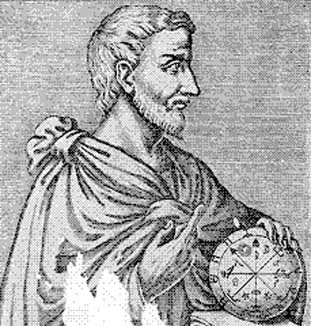
No one has perhaps had such a large impact on the utopian imagination as the mystical philosopher, Pythagoras. This obscure figure, who, lived in the early 6th century, and the brotherhood he founded, were a major source of inspiration for Plato and the utopian visions he crafted. The Pythagorean idea of basing society on the principle of friendship was the basis of Thomas Moore’s modern re-creation of imagined ideal societies, an idea which Moore picked up through a work – The Adages- by his great friend, the satirist, and humanist Erasmus. The figure of Pythagoras was a source of the early modern revival of mysticism such as that of the Kabala, and influential secret societies such as the Freemasons, and Rosicrucians.

Likewise, the name of Pythagoras was called upon like a lost god by the revolutionaries in France and beyond during the early stages of the democratic movement that rippled out from America starting in the late 1700s.

Above all, Pythagoras was the lode star for a revolution in human existence that would supersede in its impact all of the thoughts of philosophy and the entirety of the political revolutions that have marked the modern age. Pythagoras was a major figure in the scientific utopias, notably Francis Bacon’s New Atlantis that helped spark a revolution in knowledge.  Pythagoras was a kind of background figure for many of the giants of that revolution.

We live in a technological society based on the idea of progress. It is a self-evident truth for us that we known more than our ancestors. This, however, is a novel idea.  Many of the initiators of the scientific revolution of the 17th century did not believe they were discovering anything new. Rather, they thought their project was to discover ancient wisdom- sapientia antique.

The men who made the scientific revolution could not sever their connection from ancient knowledge having only recently emerged out of a dark age in which the few works of the past that had survived seemed a like a thin tether to precarious civilization.  Of those works that did survive none were as comprehensive as those of the encyclopedic Aristotle.

This philosopher ruled over the late Medieval and early Modern Western mind.  This became problematic as the empiricism of the early moderns started to poke holes in the Aristotelian edifice. Aristotle said there was nothing special about mathematics and that it offered no true window into nature, he said the sun, planets, and stars revolved around the earth, that the heavens were pure and unchanging, that objects fell or rose according to their nature.

The early moderns thought the new math borrowed from the Arabs might be an effective tool of explanation, they discovered that the heavens were not as Aristotle described, that objects in motion did not act as he predicted.

What gave them confidence and drove their anti-Aristotelian crusade was their belief that another ancient philosopher had contradicted the great Aristotle. Pythagoras, and his largely lost philosophy, became the wedge between the ancient and the new by which the modern world was born.

What the early moderns found in the fragments of the Pythagoreans that survived the end of antiquity were like clues to a wholly different view of the world. In the works of the followers of Pythagoras could be found the incredible idea that numbers represent the fundamental order of the world, that the solar system was not centered around the earth, but a “central fire”- a half-way house to a heliocentric view of the solar system.  In the works of the Pythagoreans could be found the idea of the continuity of animal and even plant life with humanity.

The society founded by Pythagoras was fond of secrecy, and it was this occult idea of knowledge that drove early moderns such as Kepler and Newton to try to rediscover the hidden key to the universe which they sincerely believed Pythagoras and his followers had known. Nature for Pythagoras was a type of cryptogram which could be decoded once the proper corresponding numerical relationship was found. For science, even up until our own day, nature retains this cryptographic quality. Think of the search for DNA, the Human Genome, and the quest for a unified theory of physics that is the purpose of massive experimental apparatus such as CERN.

Pythagoras’ seemingly inconsequential epiphany that the world is number, arrived at when he noticed that the by the plucking of strings varied proportionally with the length of the string, has ultimately proven more revolutionary than the most profound utopian or religious texts. The models by which we now understand the world are built out of numbers. Our world is run and managed by machines whose thinking is composed of advanced forms of calculation. Indeed even the self seems to be merging, perhaps disappearing, into mathematics with movements such as The Quantified Self. We are all, for better, and for worse, Pythagoreans now.

City of the Sun

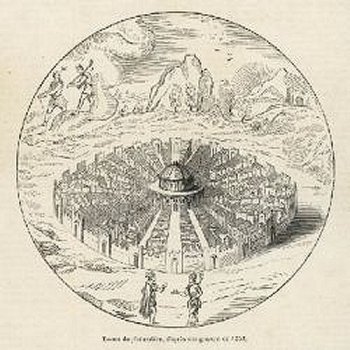
The City of the Sun is a utopia written by the Dominican Friar Tommaso Campanella.  Perhaps the most interesting feature of Campanella’s imaginary city is what might be called its architecture of knowledge. The city is made up of a number of walls upon each of which are inscribed all the knowledge of a particular set of sciences. On the outer wall are inscribed all the truths of mathematics, on the second metallurgy, geography, meteorology, the third botany, the next biology of fish, insects, reptiles, the one that follows the biology of large animals, then the mechanical arts, and finally history, war, philosophy, religion and law.

That Campanella’s divisions of knowledge are a little confusing makes perfect sense given that our current fields of inquiry had yet to really crystallize.  Yet, what should be clear is that he has imagined what is in effect an archive of all human knowledge from the least to the most complex. The architecture of his city itself is a storehouse of human knowledge and physically embeds all that we know. This is a little like the current Rosetta Disk project of the Long Now Foundation which attempts to create a store house of knowledge about human languages on a micro-disc.

Contrast Campanella’s City of the Sun with IBM’s current Smarter Cities project and one gets a feel for the revolution in our understanding of knowledge from Campanella’s time to our own. For him the new science, just being born when he imagined his ideal city, would soon discover all that was knowable. All of human knowledge could be inscribed on the walls of a small city. For us, knowledge is dynamic, expansive. The space granted by Campanella would unlikely be enough for even the most obscure specialty. IBM’s Smarter Cities imagines the knowledge center of a city not as a sort of library or museum, but as akin to the body’s central nervous or immune systems, capable of getting feedback from itself and responding to real time information regarding things like traffic, crime, social services, fire/disaster response, medical care, and education.

One might wonder what might happen to the “feedback” system of democracy if cities were ever effectively run by computers, but that is another question, for another time.

Apocalyptic Logic

The mounting tensions with Iran over its nuclear program are already bad enough if one had only real-world security issues and the eternal competitions between nations in mind.  The Iranians have very real reasons for wanting the bomb, top among them the fact that it seems to offer the only effective protection against America’s otherwise unstoppable power. This is the lesson they no doubt have learned from the contrasting cases of North Korea and Iraq/Libya where a lesser power has been able to deter American arms through the possession of nuclear weapons, whereas, the regimes of Iraq and Libya, having abandoned their nuclear programs were overthrown by the US and its allies.

The strategic reasons for the Israelis not wanting Iran to have the bomb are equally obvious. A nuclear armed Iran would indeed be the biggest strategic threat Israel has faced, and therefore, they reasonably will do everything possible to prevent Iran from developing atomic weapons. The Arab regimes similarly fear a nuclear armed Iran, and the US which ostensibly is committed to the defense of these regimes and Israel, fears the instability a nuclear Iran would bring to an already unstable region.

All sides in this dispute are therefore acting within the reasoned limits of national interest, though deeply conflicted interest they are, and it is already difficult to imagine the situation not being “resolved” by war, which, sadly, is far too often the final form of “negotiations” between states.

But to all this is also added a religious element, on both sides, that feeds belligerence and a distortion in the ability of  states to make rational decisions as to the question of whether or not to go to war.

An influential minority in the Iranian government, appear to be applying an apocalyptic logic to current events, and see in the threat of  war which would devastate the country,  instead the promise of the return of the promised 12th Imam, the Mahdi, of  the Shia branch of Islam, who will return after a period of tribulation to rule- alongside Jesus- and fill the world with justice.

Although Judaism , too, has a version of the end times, it is probably not the main root of the apocalyptic logic also driving Israeli policy. For what lies behind Jewish end of the world anxieties is the very real historical experience of near extinction in the Holocaust.  This fear of being totally destroyed as a people, this idea that any threat faced with courage and unyielding strength, is akin to a victory against evil itself, makes the Jewish polity find the normal condition of strategic competition between states unacceptable, and blinds it to the possibility of finding a permanent modus vivendi with countries in the region that are destined to not merely to be the equals of Israel, but the true, natural great powers of the Middle East.

On the American side, although only really so far as the Republicans are concerned, the influence of Christian fundamentalist, has turned Israel into a kind of sainted kingdom whose interests are of equal weight, indeed over-ride, the national interest of the United States.  For Christian fundamentalist, the existence of Israel is the key component in their own ideas regarding the end of days.  Israel will be the scene of world war and the emergence of world government under the Anti-Christ until the triumphant return of Christ. Judaism itself will, thereafter, be no more, with all of the “good” Jews converted to Christianity.

Some Christian fundamentalist (even a guy who has worked for the CIA)  see the Shia Madhi as a “mini” Anti-Christ who will bring the conditions for his more powerful successor to come. The countdown has begun.

All of this is, of course, crazy. And that’s the point. The strategic questions facing Iran, Israel and the United States are almost too complex and difficult to begin with, and added to all of it is the crazed logic of apocalypse.

Between conspiracy and protest

The US government launched a major crackdown on the group Anonymous today, arresting five of the group’s leaders. The charges could result in some of the leaders of the group serving up to 105 years in prison.

This is how the Washington Post characterized the arrests:

“This is the most important roll-up of hackers ever,” said Richard Stiennon, a cybersecurity analyst who has closely followed Anonymous.

Stiennon said that the arrests had instilled “distrust into Anonymous” and, as a consequence, the FBI may have “broken the back of the collective.”

Members of the group, and its sympathizers, were quick to point out that Anonymous was as much an idea as an organization, and that you can not destroy an idea, and well it may be. And yet, the successful prosecution of the men arrested today would certainly be a huge deterrent to the kind hackivism practiced by Anonymous and similar groups, which got me wondering if there would be any truly effective means of political protest left should the back of the group really be broken as Stiennon seems to hope.

For me, the question is whether or not the kinds of things credited to Anonymous count as political protest or something else?

Back in the late 1990’s I was doing research for a book that came to naught (though I did end up turning it into a short piece of historical fiction that I will post with this should I ever find it). I was researching a labor strike on the Pennsylvania canal in the early 1800s and reading  a lot of newspaper articles about the event from the time period. Thing is, they always referred to what we would call a strike as a “conspiracy”. Why was that?

It seems there had been an infamous legal case in Pennsylvania back in 1806 called Commonwealth vs Pullis that had ruled that a strike by a group of Philadelphia journeymen cordwainers amounted to a conspiracy against the owners of the factories in which they worked, and that society would collapse should the principle the strikers used to justify their actions ever be taken as universal. The ruling effectively made both unions and strikes illegal throughout the early years of the 19th century.

The prosecution’s case was that:

We charge a combination, by means of rewards and punishments, threats, insults, starvings and beatings, to compel the employers to accede to terms, they the journeymen present and dictate. If the journeymen cordwainers may do this, so may the employers; the journeymen carpenters, the brick-layers, butchers, farmers, and the whole community will be formed into hostile confederacies, the prelude and certain forerunner of bloodshed and civil war.

It now rests with the jury, under the direction of the court to say, whether we shall in future be governed by secret clubs, instead of the constitution and laws of the state; a verdict of not guilty, will sanction combinations of the most dangerous kind; a contrary verdict will give the victory to the known and established laws of the commonwealth.

No doubt, the US government’s case against Anonymous will argue similarly: that the actions of the group in no way represent legitimate political protests, and to argue otherwise would amount to inviting “cyber-chaos”.

Surely, if one looks over many of the actions credited to Anonymous many of them are juvenile, and perhaps even criminal. Yet, in an age in which elites hide behind security fortresses to shield themselves from public protests, and an amazing protest movement such as OWS can emerge overnight, only to disappear just as quickly, hacktivism, of the sort practiced by Anonymous is one of the few means of democratic protest that actually bite, which is the reason why the reactions by authorities has been so strong against groups like Wikileaks and Anonymous.

One wonders what leverage citizens will have should governments be able to treat all such actions, regardless of their political aspect, as conspiracies and sentence hacktivist to a century in prison.

Utopia Secular and Religious

Utopia scholars such as Ronald Schaer have argued that the concept of utopia, properly understood, is a secular one that originated in the early sixteenth century with Thomas Moore. Yet, as Schaer himself points out, the most powerful of 20th century utopian movements can not really be understood with out reference to the eschatological visions of the Judeo-Christian, and one should add Islamic, traditions

Indeed the worldly paradise predicted at the end of days ,and hoped for by elements these religions to a greater or lesser extent, is, even if we proceed with intellectual caution, more intimately connected with the political consequences of the idea of utopia than Schaer would have us believe. In many ways the most powerful of the secular utopian movements have borrowed so much from their religiously conceived predecessors as to be almost indistinguishable.

One might wonder where human agency has gone in religious utopianism, for underneath the secular version of utopia lies the humanist assumption that we can build the future. Yet, the most powerful secular utopian movements also seem to lack this quality of human agency, with some other entity serving the role once ascribed to God. For communists, utopia was to emerge through the deterministic forces of history, for Nazis through the war of nature, for the current Transhumanist/Sigularian movement the promises of religion- immortality, collective consciousness, omniscience are to emerge through the deterministic evolution of technology.

The difference between utopianism which wears the guise of religion in comparison to plain vanilla religion is that religious-utopianism promises the eminent arrival of a new and perfect world within the life-time of believers.  Religious utopianism points to a future state not a lost paradise at the beginning of human history. Lastly, whereas religion guides individual moral behavior, often for the purpose of obtaining happiness after death, the goals of religious utopianism are collective in character and serve as a guide to political action now.

The reason we should be paying close attention to utopia as religiously conceived is that, today, secular utopias are far less potent than religious ones, and failing to take heed of religious utopias blinds us to their very real capacity to effect the world in the here-and-now, rather than merely affect the state of human spiritually, or subsist as some ethereal hope for some promised land, far-off, at the “end of history”.

Utopian thinking continues to have a great hold on the human psyche, and utopian movements are one of the major forces guiding political action today. We should, therefore, try our best to understand them. In the immediate future, such an understanding would provide some insight when comes to the looming showdown with Iran- the subject of my next post.