Life is already eternal, sort of…

What often strikes me when I put the claims of some traditionally religious people regarding “eternal life” and the stated goals of the much more recent, I suppose you could label it with the oxymoronic phrase “materialist spirituality”, next to one another is just how much of the language and fundamental assumptions regarding human immortality these very different philosophies share.

Both the traditionally religious, especially those who fall under the somewhat simplistic label of “fundamentalist” and followers of materialist spirituality, whose worldview supposedly emerges out of science, share the essential goal of the survival of the individual. The ultimate objective for, say, a Bible thumping preacher from Tennessee and a technology ensconced singularitarian from San-Francisco are the same- the escape from the seeming inevitability of death and the survival of themselves into boundless eternity. Where they differ is on how to get there.

Just like Christianity or any other religion has its sects, those who embrace the goal of individual immortality under the umbrella of materialist spirituality have their sects as well. There are “mind-uploaders” who hope to transform themselves into eternal software, and some transhumanists who wish to so revolutionize human biology, perhaps with the addition of characteristics of advanced machines, so that death itself can be put off indefinitely. There are biologically centered immortalist- such as Aubrey de Gray, who hope to find the biological triggers that result in death and permanently turn them off, and others.

The reason both some (but by no means all) traditional religions and materialist spirituality share these almost identical goals stems, I think, from the fact that they come at the world from exactly the same frame of reference- that of the individual. But one might wonder what conclusions we would draw about the meaning and fate of life and sentience in the universe were we to adopt a different frame in which our own interests were not so clearly front and center. Is there a way to look at the relationship between life, especially sentient life, and time that makes the Universe seem meaningful even in light of our own personal death, or are those of us who trust the truth of science and are at the same time skeptical of materialist spirituality condemned to the conclusion drawn by the physicist Steven Weinberg that “The More the universe seems comprehensible, the more it seems pointless” ?

These questions were hitting me when I came across a book that had absolutely nothing to do with the subject of immortality: Dimitar Sasselov’s The Life of Super-Earths: How the Hunt for Alien Worlds and Artificial Cells Will Revolutionize Life on Our Planet.  I will get into the nitty gritty of the book elsewhere, but here for me was the overall point of the work, for me a very optimistic point indeed- that the Universe is very young, and life itself only a little bit younger, and that life has a very, very long time before senescence in front of it.

We tend, I think, to be overwhelmed by the shortness of our individual lives when put in the context of the deep time scales science has revealed to us. And what is my life here, indeed, but a flicker in the context of billions of years? But if we step back from our personal lives for a moment and grasp the chain of living things upon which our being here has entailed at least some of this vertigo of time can perhaps be avoided.

I myself, and you, are here as the result of a chain of life that stretches backwards almost to the very beginning of the Universe. The same root found in the beginning of life on earth 4 billion years ago can be found in our DNA today. We are the bearers of a cosmically ancient inheritance that is comparable to the age of the Universe itself. Sasselov states it in the very plain language that: “ if the Universe were a 55 year old, Life would be a 16 year old” (p. 138)

If our roots stretching back into the beginning of time is important, for me the most optimistic message of  Sasselov’s book is that the future of life, and not just life that originated on earth, stretches out even farther. Sasselov comes up with a good possible answer to Fermi’s Paradox- the fact that in conditions seemingly so ripe for life to have emerged the Universe is so damned silent. Sasselov’s theory is that the emergence of life is tied to the evolution of stars. The early Universe lacked the heavy elements that seem necessary for life, which need to be produced by long lived stars, so overtime these elements become more numerous and the types of stars that come to predominate are ones that, unlike earlier stars, readily produce a rich sea of these elements. The Universe is silent because we are likely to have been one of the very first intelligent civilizations to emerge at the beginning of this move towards the production of heavy elements- a just dawning golden age for life in the cosmos that will last at least 100 billion years into the future.

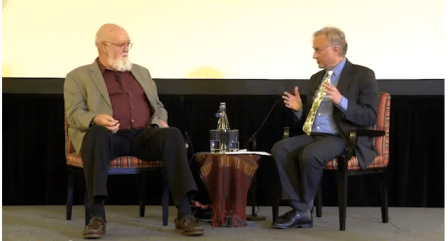
Moving away from Sasselov, the physicist, and very public atheist, Lawrence Krauss, in a friendly debate with fellow physicist Freeman Dyson seems to suggest that no complex, conscious entity in an expanding universe can be immortal given the current laws of physics. The physics are quite gnarly, but the in essence Krauss’ argument boils down to the fact that having an infinite number of “thoughts” is impossible in a Universe such as our own where the amount of energy is finite.

As is Krauss’ style, he tends to see the prospects of the impossibility for obtaining eternity, and the ultimate destiny of the Universe in a structureless heat-death in a spirit of humor charged doom.  I do not, however, find this a reason to fret even jokingly, for think of the richness of lives- the number of sentient creatures, civilizations, worlds that according to Sasselov likely lie in front of us- the unfathomable depth of all that experience! There is a lot of living left to do, but this living it isn’t just in the future for there is a depth of lived time in the present to which most of us are probably unaware. Let me explain.

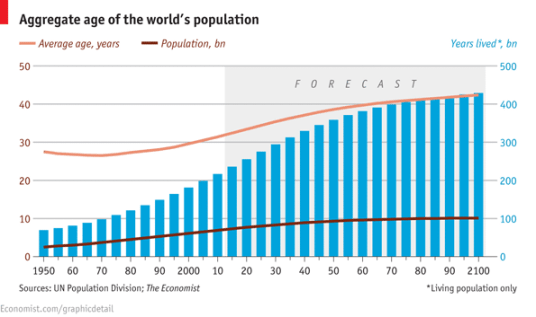
Around the same time I was reading The Life of Super-Earths I came across this wonderful graph from, of all places, The Economist.

The Ages of Man

The blurb in which this graph was embedded brought attention to the potential years of wisdom available to human beings on account of both the extension of the human lifespan and the rise in population and called on us to make use of it. It pointed out that with the milestone of 7 billion people in 2011 the aggregate age of everyone alive rose to 220 billion years. By the end of the 21st century:

The world’s population will have stabilized at just over 10 billion and those people will have accumulated 430 billion years of human experience between them.

The philosophical implications of this were not explored by the Economist, but think about it for a second. The number of subjective years lived today by the only fully sentient creature we know of- ourselves- is already more than ten times the chronological age of the physical universe! By the end of the century those subjective years will have grown to be around 30 times larger than the age of the Universe.  In this sense life is not only older, but much older than the cosmos in which it swims and collectively might already be said to possess time on the scale of what any individual would consider eternity.

I think this reframing of the issue of eternity opens up deep questions that need to be addressed by those looking at immortality from a more individualistic bent. For example, perhaps the most outspoken proponent of “ending death” in a biological sense is Aubrey de Grey. In a talk at TEDMED de Grey admits the obvious- that extending the lifespan of those already alive in a world of finite resources would inevitably result in people having less children. Strangely, he seems to think that this indefinite lifespan is something we are morally obligated to make possible for the current generation and the one in the immediate future. His position seems to ignore the generations after whose potential lives might shrink to be near zero as people defray having children in order to live indefinitely. De Grey’s position seems to become even more suspect when we place it in the context of subjective time mentioned above.

Unless there is some flaw in my logic, it seems that in a Universe where life can not exist infinitely, which is what Krauss’ work shows, or in a world of finite resources if an individual (or a society) chooses to forgo having children in the name of indefinite lifespan for individuals the amount of subjective time available in the Universe as a consequence goes down. To use an extreme example: imagine a Universe with only one sentient being that lived for a very very long time- though not infinitely. Such a Universe would have experienced much less subjective experience than a large number of sentient beings that lived a briefer but rich amount of time where life as a whole lasted for an equal duration. The same would hold for a Universe in which one civilization monopolized sentience when contrasted with a Universe with a rich plurality of civilizations. Less diversity, less full existence.

This is not an argument for maximizing the number of children. For the decision to have a child represents a deeply personal choice and commitment and brings other moral factors into play not the least is the one of the quality of life for individuals and the impact of human lives on diversity elsewhere in the biosphere meaning the question of sustainability.

Yet, there would appear to be a threshold where increasing the lifespan of individuals at the cost of forgoing new lives is cosmically impoverishing. Thus, before the human immortality project can be embraced without deep moral reservations, some notion of how this project relates to the prospects for potential life in the future (extending even beyond humanity to its consequences for the life of the earth’s biosphere) need to be addressed. Collective “immortality” appears to have the moral high ground on types of immortality that are focused on individuals alone.

The stunning thing is that many of the world’s traditional religions already appear to have an intuitive sense of this collective immortality. The way to immortality for the ancient Greeks was fame in the service to one’s polis, for many of the other religions the path to immortality lies in the abandonment of the ego and the adoption of selflessness and service to others. Traditional humanists often thought of themselves as links in a great chain of poets, writers, musicians, philosophers or scientists.

For what it is worth, proponents of today’s materialist spirituality in their focus on the individual seem to have broken themselves off from this great chain of life and thought. The wonders of science may or may not someday bring us escape from individual death, but all we can reasonably do for now are things we have always done: raise our children, write a poem, discover a truth, compose a song, help a fellow human being, or preserve a political community or wilderness. In these ways we add the short time of our existence to a future of life that stretches out long in front of us in a Universe filled with a plethora of species and civilizations we can scant imagine. A world where, for all practical purposes, life and thought are indeed already, eternal.

Progress Ancient and Modern: The Oresteia

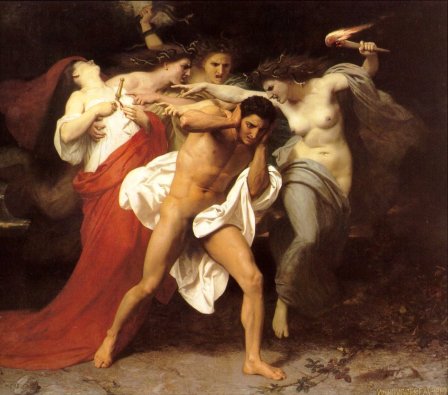
The Furies and Orestes

It is a modern conceit that ours is a morally progressed age when compared to the world of the ancients. At least that is the impression one gets from reading books such as Steven Pinker’s The Better Angels of Our Nature, or Robert Wright’s The Evolution of God. Both Pinker and Wright, each in their own very different ways, give us insight into the brutality that was such a common, indeed daily, part of the lives of our premodern forebears- although they might quibble as to when our moral ascent away from this brutality and primitiveness began- with Pinker thinking it gained traction in the Enlightenment, and Wright pushing it further back to the appearance of the world religions.

There is also a tendency to see ourselves as more theologically or philosophically sophisticated than the ancients. How, for example, could the Greeks actually believe in those anthropomorphic gods who were thought to “live” on Mount Olympus and seemed to fill the Greeks with the twin illnesses of near continuous anxiety and misplaced hope.

I only wish that Pinker or Wright, or those who understand prayer to the gods as a version of “please don’t kill me, please don’t kill me, you’re so big, you’re so big” (@24 min) as the science fiction writer David Brin did in a recent talk,  had read and wrestled with the Greek playwright Aeschylus. For what we find in Aeschylus are tales that push human consciousness in the direction of the confrontation between values which inspire social reflection and change. The end result being something we should very much call moral progress. We also find the whole concept of the “gods” at its deepest with divinities used to personify and bring into conflict the often opposing values and existential conditions that are found in human life. This is perhaps nowhere better on display than in Aeschylus’ tragedy- The Oresteia.

The Oresteia is a trilogy: Agamemnon, The Libation Bearers, and the Eumenides that deals with the issues of love and hatred justice and revenge order and chaos. There would have been a fourth part to the Oresteia, a satyr play, but it is lost. The three surviving plays tell the story of the cursed and at the same time blest (because through them comes the expansion of the human moral imagination) family of the King of Argos -Agamemnon.

Upon returning home from victory in the Trojan War Agamemnon faces a coup plotted by his wife Clytemnestra in an adulterous alliance with his cousin Aegisthus. Both Clytemnestra’s and Aegisthus’ actions are driven by the most primitive manifestation of the human desire for justice- primal revenge. Clytemnestra seeks revenge for Agamemnon’s sacrifice of their daughter as “payment” to the gods for safe passage to Troy. Aegisthus is vengeful for other reasons; indeed, he is a human being created for the purpose of revenge itself, sired in incest, with his destiny to kill Agamemnon’s father Atreus for the cannibalistic murder of  his brothers.

It might seem strange to state this way, but the desire for revenge is perhaps the first rung on the long ladder of the human moral imagination (though it is not a step solely limited to humans for you can find it in other social animals as well). The idea of revenge, especially revenge for the harm inflicted on those close to us, demands that we take the rule violated or person harmed to be almost as important as ourselves for revenge comes with mortal risks to those that seek it.

In the Agamemnon revenge or “blood justice” has its due and the king of Argos is murdered by Clytemnestra and Aegisthus. But the characters here are, like those in Homer, mere puppets on a string their whole soul and character propelled to preserving the moral order of the cosmos which demands, in the Greek view, that murder, whether accidental or purposeful needs to be repaid with murder. A life exchanged for a life balances the moral scale that bounds mortal existence.

This is the kind of moral order that can be seen, I think, in the Biblical Book of Revelation or the Christian idea of Hell where, in the former, God avenges the evil of the unjust who have heretofore ruled the world, and in the latter, where every earthly sin has its corresponding punishment after death. And though the concept of blood justice might have become more sophisticated for a while under Christians, with the accidental homicide the Greeks thought had moral meaning no longer being placed on the scale of justice and the interior self- the idea of intention- bearing the moral significance of an act, Calvinists would abandon this sophistication with their idea of predestination, which, arguably, brought moral understanding back to the primitive type found in Aeschylus’ Agamemnon, a level the ancient Greek Aeschylus in the remaining plays of  The Oresteia would transcend, a meaning hinted at in these lines from the opening of the Agamemnon:

Zeus has led us on to know,

    The Helmsman lays it down as law

    That we must suffer, suffer into truth.

    We cannot sleep, and drop by drop at the heart

    the pain of pain remembered comes again,

    and we resist, but ripeness comes as well.

    From the gods enthroned on the awesome rowing-bench

    there comes a violent love. (Lines 177-184)


The second play of The Oresteia, The Libation Bearers, tells the story of Orestes’, the only surviving son of Agamemnon, revenge against his mother and uncle for the murder of his father. The play begins with Orestes visit to Agamemnon’s grave where he secretly spies a group of women shrouded in black bearing libations- offerings to be poured in prayer. The women have come to the grave to find comfort for Clytemnestra who has been haunted by a dream of being strangled by a snake that suckles milk from her breasts. Accompanying the old women is Electra, the sister of Orestes who prays for justice in the name of her father. When Electra spots a lock of what she thinks might be her brother’s hair she cries these lines, which anyone who has ever escaped the grip of despair will understand in their heart:

We call on the gods and the gods well know the storms that torment us, sailors whirled to nothing. But if we are to live and reach a haven, one small seed could grow a mighty tree.  (Lines 201-204 )


When Orestes is reunited with Electra he is urged on by her and sanctioned by the god Apollo to seek justice against Clytemnestra and Aegisthus. Here the trilogy begins to gain new psychological and moral depth for intersecting in the mind of Orestes are two opposing systems of value- his natural maternal love and loyalty and his paternal bond to the memory of his deceased father. It is Apollo and his “new gods” that represent a new value perhaps best understood as a move beyond the moral ties born of blood to those born from the human capacity to make and keep promises. The crime Apollo seeks justice for is Clytemnestra’s murder of Agamemnon to whom she was bound in marriage.

It is not so much in the act of murdering Clytemnestra that Orestes becomes fully conscious of these competing value systems, his mother after unsuccessfully pleading for her son’s mercy cries out:

“I must be spilling live tears on a tomb of stone”. (Lines 926 p. 219)

Rather, it is in the aftermath that Orestes recognizes the gravity of the decision he has made:

“ What bow could hit the crest of so much pain?” (Lines 1035 p. 224)  

It is in the last surviving play of the trilogy, the Eumenides, that Aeschylus brings all these elements together, and in the process brings the human moral imagination yet another step higher beyond the bounds of either blood ties or social contact.
In Eumenides Orestes is pursued by the Furies (pictured above). The Furies are deities dating back before Zeus overthrew the earth gods- the Titans. They have been given the task by a force more powerful than even the gods- Fate- to seek justice for murder and the breaking of sacred law. Contrasted with the concept of the Furies, the traditional dichotomy between good and evil found in modern religion seems almost simplistic. The Furies are certainly a force of darkness and yet their purpose is to restore the moral order through revenge against those who murder.

Over the victim’s burning head this chant this frenzy striking frenzy lightning crazing the mind this hymn of Fury  chaining the senses, ripping cross the lyre,withering lives of men! (Lines 328-333 )

Unable to find refuge from the Furies in the temple of Apollo at Delphi, Orestes, under the advice of Apollo and with the guidance of Hermes flees to Athens where he seeks refuge in the temple of Athena. The Furies delayed by being lulled to sleep by Apollo are eventually aroused by the ghost of Clytemnestra and renew their hunt. Animal like, they follow the scent of Clytemnestra’s blood on Orestes until they find him at the feet of the statue of Athena. When the goddess Athena appears she does something that had not been seen in the entire Oresteia up until now- rather than becoming partisan she shows both sides respect. She takes Orestes at his word that he may have been guilty of violating the letter but not spirit of the cosmic law for which the Furies seek his torment, but she also shows respect to the antiquity of the Furies and their rightful powers. She does not, as Apollo does, see the Furies as monstrous and unnatural- enemies of order- but as forces with a rightful place in the cosmos. Because of this respect the Furies ask Athena to judge Orestes’ case, and here Athena does something amazing. She asks a jury of mortal men to help her decide the matter.   

Too large a matter, some may think, for mortal men to judge.  (Lines 484-485)

Acknowledging that both Orestes and the Furies seem to have a strong case and that judgement in favor of either will have deep implications Athena muses:

So it stands a crisis either way.

 Embrace the one? expel the other? It defeats me.

 But since the matter comes to rest on us, I will appoint the judges

of manslaughter, swear them in, and found a tribunal  here

for all time to come. (Lines 495-499)

Something quite startling has happened here for Athena ( Aeschylus) has managed to make the rules of the gods subject to the reasoned judgement of mortal men. I am unaware of any such a leap anywhere else in religious history. Ultimately, their cases argued the jury tied with Athena breaking it in favor of  Orestes. The Furies feel the whole moral order has come crashing down and swear revenge against Athens for upending the eternal laws of justice.

All’s lost, our ancient powers torn away by their cunning,

ruthless hands, the gods so hard to wrestle down

obliterate us all (Lines 885-887)

Athena again tries to appease the ancient gods of the Furies with respect.

But if you have reverence for Persuasion,

the majesty of Persuasion,

the spell of my voice would appease your fury- (Lines 893-895 )

Athena offers the Furies a home in Athens. Their role to be the violent force behind the justice decided upon by the reasoned decisions of mortal men or the power behind their violent struggles with others. The Furies acceptance of this new and bounded role for their powers ends the trilogy.

The Oresteia thus represents something incredible as a piece of  literature, political philosophy, or religious reflection and I think we should consider it an example of all three. Not only as a great piece of literature does it give us insight into the human experience of injustice and the corresponding desire for revenge, it is also a tale of social evolution showing us how the violence natural to human societies which arises from this need for justice is contained with the establishment of political communities. But this isn’t just any political community- it is not Hobbes’ Leviathan terrorizing men into a state of peace. It is a community built around the active participation of citizens to decide upon and bound matters of justice. As a piece of religious reflection the Oresteia is revolutionary in that it subjects the gods to the reasoned judgement of  mortals even as it urges us to show respect to the wisdom and authority of ancient traditions.

To heed its lessons; now that’s what I would call progress!

The Dangers of Religious Rhetoric to the Trans-humanist Project

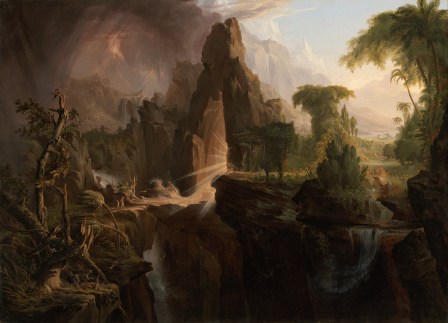
Thomas_Cole_-_Expulsion_from_the_Garden_of_Eden

When I saw that  the scientist and science-fiction novelist, David Brin, had given a talk at a recent Singularity Summit with the intriguing title “So you want to make gods?  Now why would that bother anybody? my hopes for the current intellectual debate between science and religion and between rival versions of our human future were instantly raised. Here was a noted singularitarian, I thought, who might raise questions about how the framing of the philosophy surrounding the Singularity was not only alienating to persons of more traditional religious sentiments, but threatened to give rise to a 21st century version of the culture wars that would make current debates over teaching evolution in schools or the much more charged disputes over abortion look quaint, and that could ultimately derail us from many of the technological achievements that lie seemingly just over the horizon which promise to vastly improve and even transform the human condition.

Upon listening to Brin’s lecture those hopes were dashed.

Brin’s lecture is a seemingly lite talk to a friendly audience punctuated by jokes some of them lame, and therefore charming, but his topic is serious indeed. He defines the real purpose of his audience to be “would be god-makers” “indeed some of you want to become gods” and admonishes them to avoid the fate of their predecessors such as Giordano Bruno of being burned at the stake.

The suggestion Brin makes for  how singularitarians are to avoid the fate of Bruno, a way to prevent the conflict between religion and science seem, at first, like humanistic and common sense advice: Rather than outright rejection and even ridicule of the religious, singularitarians are admonished to actually understand the religious views of their would be opponents and especially the cultural keystone of their religious texts.

Yet the purpose of such understanding soon becomes clear.  Knowledge of the Bible, in the eyes of Brin, should give singularitarians the ability to reframe their objectives in Christian terms. Brin lays out some examples to explain his meaning. His suggestion that the mythological Adam’s first act of naming things defines the purpose of humankind as a co-creator with God is an interesting and probably largely non-controversial one. It’s when he steps into the larger Biblical narrative that things get tricky.

Brin finds the seeming justification for the expulsion of Adam and Eve from the Garden of Eden to be particularly potent for singularitarians:

And the LORD God said, Behold, the man is become as one of us, to know good and evil: and now, lest he put forth his hand, and take also of the tree of life, and eat, and live for ever. Genesis 3:22 King James Bible


Brin thinks this passage can be used as a Biblical justification for the singularitarian aim of personal immortality and god-like powers. The debate he thinks is not over “can we?”, but merely a matter of “when should we?” attain these ultimate ends.

The other Biblical passage Brin thinks singularitarians can use to their advantage in their debate with Christians is found in the story of the Tower of Babel.  

And the LORD said, Behold, the people is one, and they have all one language; and this they begin to do: and now nothing will be restrained from them, which they have imagined to do.  Genesis 11:6 King James Bible

As in the story of the expulsion from the Garden of Eden, Brin thinks the story of the Tower of Babel can be used to illustrate that human beings, according to Christianity’s  own scriptures, have innately god-like powers. What the debate between singularitarians and Christians is, therefore, largely a matter of when and how human beings reach their full God-given potential.

Much of Brin’s lecture is animated by an awareness of the current conflict between science and religion. He constructs a wider historical context to explain this current tension.  For him, new ideas and technologies have the effect of destabilizing hierarchy, and have always given rise in the past to a counter-revolution supported and egged on by counter-revolutionary oligarchs. The United States is experiencing another one of these oligarchic putsches as evidenced in books such as The Republican War on Science. Brin thinks that Fermi’s Paradox or the “silence” of the universe, the seeming lack of intelligent civilizations other than our own might be a consequence of the fact that counter-revolutionaries or “grouches” tend to win their struggle with the forces of progress. His hope is that our time has come and that this is the moment where those allied under the banner of progress might win.

The questions which gnawed at me after listening to Brin’s speech was whether or not his prescriptions really offered a path to diminishing the conflict between religion and science or were they merely a means to its further exacerbation?
The problem, I think, is that however brilliant a physicists and novelists Brin might be he is a rather poor religious scholar and even worse as a historian, political scientist or sociologist.

Part of the problem here stems from the fact that Brin appears less interested in opening up a dialogue between the singularitarians and other religious communities than he is at training them in his terms verbal “judo” so as to be able to neutralize and proselytize to their most vociferous theological opponents- fundamentalist Christians. The whole thing put me in mind of how the early Jesuits were taught to argue their non-Catholic opponents into the ground.  Be that as it may, the Christianity that Brin deals with is of a literalist sort in which stories such as the expulsion from the Garden of Eden or the Tower of Babel are to be taken as the actual word of God. But this literalism is primarily a feature of some versions of Protestantism not Christianity as a whole.

The idea that the book of Genesis is literally true is not the teaching of the Catholic, Anglican, or large parts of the Orthodox Church the three of which make up the bulk of Christians world-wide. Quoting scripture back at these groups won’t get a singularitarian  anywhere. Rather, they would likely find themselves in the discussion they should be having, a heated philosophical discussion over humankind’s role and place in the universe and where the very idea of “becoming a god” is ridiculous in the sense that God is understood in non-corporal, indefinable way, indeed as something that is sometimes more akin to our notion of “nothing” than it is to anything else we can speak of.  The story Karen Armstrong tells in her 2009, The Case for God.

The result of framing the singularitarian argument on literalist terms may result in the alienation of what should be considered more pro-science Christian groups who are much less interested in aligning the views and goals of science with those found directly in the Bible than in finding a way to navigate through our technologically evolving society in a way that keeps the essence of their particular culture of religious practice and the beliefs found in their ethical perspective developed over millenia intact.

If Brin goes astray in terms of his understanding of religion he misses even more essential elements when viewed through the eyes on an historian. He seems to think that doctrinal disputes over the meaning of religious text are less dangerous than disputes between different and non-communicating systems of belief, but that’s not what history shows. Protestants and Catholics murdered one another for centuries even when the basic outlines of their interpretations of the Bible were essentially the same. Today, it seems not a month goes by without some report of Sunni-Muslim on Shia-Muslim violence or vice versa. Once the initial shock for Christian fundamentalist of singularitarians quoting the Bible wears off, fundamentalists seem likely to be incensed that they are stealing “their” book, for a quite alien purpose.

It’s not just that Brin’s historical understanding of inter/intra-religious conflict is a little off, it’s that he perpetuates the myth of eternal conflict between science and religion in the supposed name of putting an end to it. The myth of the conflict between science and religion that includes the sad tale of the visionary Giordano Bruno whose fate Brin wants his listeners to avoid, dates no later than the late 19th century created by staunch secularists such as Robert Ingersoll and John William Draper. (Karen Armstrong, The Case for God, pp. 251-252)

Yes, it is true that the kinds of naturalistic explanations that constitute modern science emerged first within the context of the democratic city-states of ancient Greece, but if one takes the case of the biggest most important martyr for the freedom of thought in history, Socrates, as of any importance one sees that science and democracy are not partners that are of necessity glued to the hip. The relationship between science, democracy, and oligarchy in the early modern period is also complex and ambiguous.

Take the case of perhaps the most famous case of religions assault on religion- Galileo. The moons which Galileo discovered orbiting around Jupiter are known today as the Galilean moons. As was pointed out by Michael Nielsen, (@27 min) what is less widely known is that Galileo initially named them the medicean moons after his very oligarchic patrons in the Medici family.


Battles over science in the early modern period are better seen as conflicts between oligarchic groups rather than a conflict where science stood in the support of democratizing forces that oligarchs sought to contain. Science indeed benefited from this competition and some, such as Paul A. David, argue that the scientific revolution would have been unlikely without the kinds of elaborate forms of patronage by the wealthy of scientific experiments and more importantly- mass publication.

The “new science” that emerged in the early modern period did not necessarily give rise to liberation narratives either. Newton’s cosmology was used in England to justify the rule of the “higher” over the “lower” orders, just as the court of France’s Sun-king had its nobles placed in well defined “orbits” “circling” around their sovereign. (Karen Armstrong, The Case for God,  p. 216)

Brin’s history and his read of current and near future political and social development seems to be almost Marxist in the sense that the pursuit of scientific knowledge and technological advancement will inevitably lead to further democratization. Such a “faith” I believe to be dangerous. If science and technology prove to be democratizing forces it will be because we have chosen to make them so, but a backlash is indeed possible. Such a “counter-revolution” can most likely be averted not by technologists taking on yet more religious language and concepts and proselytizing to the non-converted. Rather, we can escape this fate by putting some distance between the religious rhetoric of singularitarians and those who believe in the liberating and humanist potential of emerging technologies. For if transhumanists frame their goals to be the extension of the healthy human lifespan to the longest length possible and the increase of available intelligence, both human and artificial, so as to navigate and solve the problems of our complex societies almost everyone would assent. Whereas if transhumanists continue to be dragged into fights with the religious over goals such as “immortality”, “becoming gods” or “building gods”(an idea that makes as much sense as saying you were going to build the Tao or design Goodness)  we might find ourselves in the 21st century version of a religious war.

To see forward, look back!

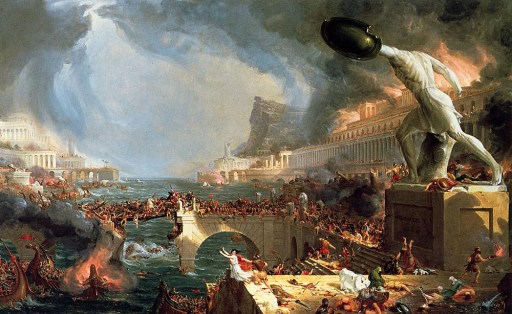
Thomas Cole the Course of Empire

“The farther backward you look, the farther forward you are likely to see.”  

Winston Churchill


The above quote is taken from Ian Morris’ recent and fascinating Why the West Rules- For Now: The patterns of history and what they reveal about the future.  Indeed, the whole point of Morris’ book can be seen in Churchill’s quip. Morris, a trained archaeologist and historian, aims to find a pattern in the broad arc of human history beginning with the birth of civilization, take us into the present age, and project current trends outward into the next century and perhaps beyond.

This is, needless to say, a pretty ballsy thing to do, at least if one wants to remain safe in the cocoon of respectable academia where scholars can spend a decade glued like a car door on Magneto to a subsection of one obscure historical text, or stuck for seven years, as Morris himself was, to the excavation of one ancient room.  Writing a meta-narrative like Morris’ is somewhat less ballsy if one intends to enter that rare breed of academic/journalist that has managed to reach the publishing industry’s version of celebrity status. Perhaps the fastest way to reach the top of today’s non-fiction bestseller list is to write a book with the words “America” or the “West” with the verb “decline” attached or- perhaps the flip-side- the words “China” and “Rise”. And who could blame the public for lapping this stuff up, hell, with “Euro-crises”, and “fiscal cliffs” and “debt ceilings” all over the news when everything in the rest of the world, and China especially, seems a go-go-go?    

Morris, however, is not some poor soul lost forever to the seriousness of academia and possessed by the spirit of Oswald Spengler, nor is he some dry professor presenting yet another version of those angels- on- the- head- of- a- pin arguments that force closed the eyelids of popular readers. Rather, he has managed the seemingly impossible task of presenting serious scholarship in a way that succeeds in keeping readers not only engaged but entertained. His book is full of creative leaps in which he uses the instruments and insights from one field of human intellectual and artistic endeavor to help understand history in new ways. Above all, Morris takes seriously what are in fact very important questions- problems which modern historians burned by the hubris and prejudice of their 19th and early 20th century predecessors tend to ignore, questions which nonetheless, should be important to all of us as human beings- where did we come from? and where are we going?

The way that Morris frames these questions of origins and destiny is to see them through the prism of the “rise of the West”. Is this Euro-centric? Perhaps, but the facts remain that it was from an obscure corner of Eurasia that the first civilization arose that managed to tie the globe together into one unit, that it was from there that a brand new form of civilization emerged a scientific-industrial-technological civilization that would force all the world to adapt to it or face decline and domination. Why this happened, and where this process unleashed by the West might be leading is not a matter of increasing Westerner’s self-esteem in a period where the two cores of Western civilization- Europe and the United States- seem to be racing one another down the slope of decadence and decline, but are questions that should concern everyone regardless of the accidents of geography.

Morris is trained as an archaeologist specializing in the classical age in the West. One might, therefore, expect him to fall into the category of those 19th century historians who thought there was something very special about the West culturally, or some, with tragic effects argued racially, about the West that made its dominance over the rest of the world’s cultures inevitable. Usually these “long-term lock-in” theories start from something about the ancient Greeks and how they escaped the hold of superstition by the application of reason to both nature and society.

Morris grapples with these explanations from culture only to dismiss them. There are just far too many periods in history where civilizations other than the West hold first place in the realms of science and technology. Think, for example, of what are considered the penultimate technologies that launched the modern age: long range sailing ships, the compass, the printing press and gunpowder. All of these were invented in China.

Something historians attempting to compare civilizations or talking about their rise or decline is by what basis do you say one civilization is more “advanced” than another? How can you tell if a civilization is rising or declining?

It is in coming up with a new way to answer these questions that Morris makes the first of his many leaps found in Why the West Rules, For Now. Morris turns to a model from contemporary development studies- the UN Human Development Index (HDI) which is a combined statistic that compares development between countries on measures such as life-expectancy, education and income as a template for creating his own measure that will allow him to compare levels of development historically between countries and across an historical period that begins with the appearance of civilization in the “Hilly Flanks” of the modern Middle East with the Neolithic Revolution around 12,000 years ago.

Morris comes up with four key measures that allow him to compare development between civilizations and across time: energy capture (how much energy is taken for work), organizational capacity (measured by the size of urban centers), information technology (measured by literacy rates) and military capacity (measured by the size of armies).  Morris is well aware that he should not give a value judgment to scores on his scale, and he also fully admits that what he has invented is a rather rough instrument. His is a starting point for a larger discussion- not the final destination.

Applying his measure to history since the dawn of civilization here is what he finds:The West, meaning not just Europe, but the western half of Eurasia and North Africa beginning in Mesopotamia was indeed ahead in developmental terms from Eastern civilization, whose core he place in China, for much of its history. Only in the late middle ages from around 900 AD- 1700 AD was the East ahead of the West. Yet, in a version of the theory put forward by Jared Diamond in his landmark Germs Guns and Steel, Morris argues that the fact that the West was for so long more advanced than the East according to his measure is to be explained not in terms of culture but as a consequence of geography.

Intensive agriculture along with permanent human settlements emerged around 12,000 years ago in a region known as the “Hilly Flanks” an area on the edge of the area around the Tigris and Euphrates. Why here? It just so happens that this area has an overwhelming number of that very small group of naturally occurring plants and animals that are suitable for domestication. Agriculture in the Hilly Flanks spread to the nearby Tigris and Euphrates valley in which, under harsh conditions of a new Ice Age it gave rise to what we would recognize as both cities and states which had grown up as solutions to the problem of how to provide food under conditions of intense scarcity.

The West had a further geographic advantage over the East after the center of its civilization moved into the Mediterranean whose sea provided a transmission belt for food, products, people and ideas. Even after China built its Grand Canal it would have nothing to compete with the Mediterranean. The Roman Empire took the West to the very height of social development in terms of Morris’ scale-the number of trees felled for fuel, of cities at a massive scale, soldiers armed for war, or literate persons would not return to those found in the Roman Empire in its height- for Western countries that is- until the 1700s. Rome had hit what Morris calls a “hard-ceiling” and was eventually felled by his “four horsemen of the apocalypse”: climate change, famine, state failure, and disease”.

After 900, China with its Song Dynasty finally caught up to and surpassed the West reaching Roman levels of social development according to Morris’ measure. How exactly it was able to do this isn’t exactly clear, but certainly part of it had to do with the incorporation of rice producing regions in China’s south- perhaps facilitated by climate change. China’s relative isolation would have offered it some protection against epidemic diseases and it had come up with an effective “barbarian policy” that at the very least allowed China to avoid the fate of a city such as Baghdad that around 1200 was absolutely destroyed by a Mongolian horde.

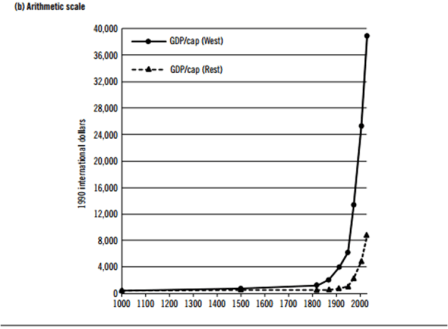
In any case, with the discovery of the Americas in the 1400s the West would begin its crawl back to the levels of social development found in the Roman Empire this time by creating a new version of the Mediterranean world in the Atlantic Civilization and its Columbian Exchange. But by the 1700s when Thomas Malthus realized that all civilizations in the past had collapsed once their population overran their ability to produce food, it seemed like the hard-ceiling was about to be hit again, only this time, as Kenneth Pomeranz pointed out in his The Great Divergence the West would find in the industrial revolution a way not just to poke above the hard-ceiling, but to shatter it.

Here’s what it looks like as a graph:

Ian Morris Great Divergence Graph   


The last 200 or so odd years have essentially been the story of the West taking advantage of this new form of industrial civilization it created to dominate the rest of the globe until non-Western societies adopted and replicated it. Now that countries such as China and India have embraced modernization the fate of the rule of the West is written on the wall. Within a century, the great divergence will have run its course, and perhaps that’s the big story under today’s headlines. But Morris doesn’t think so.

Instead, what he sees is another hard-ceiling out ahead which unless we break through it may result in the end of civilization, what he, borrowing from Isaac Asimov calls Nightfall. If one takes one of Morris measures, say urbanization, and plays out the trend line, what one gets is cities on the order of 140 million people! He sees no way of measuring up to these trend lines unless the hopes of the singularians for radical technological change within the next half century prove correct. The four horsemen of
climate change, famine, state failure, and disease are already out of their stable and only a breakthrough of greater magnitude than the industrial revolution would prove capable of pushing them back in.

If we fail to achieve a breakthrough our particular civilization’s collapse- accompanied by nuclear weapons- will likely, according to Morris, be the last. For him, like the title of this blog the future is one of either utopia or dystopia.

Nightfall

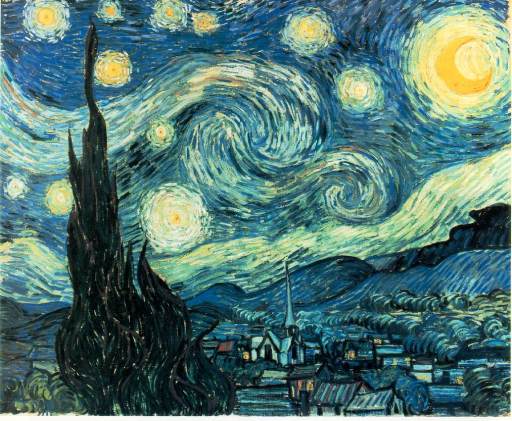
Van Gough Starry Night

When I was fourteen, or thereabouts, one of the very first novels I read was the Foundation Trilogy of Isaac Asimov. Foundation is for anyone so presumptuous, as I was and still am, to have an interest in “big history”- the rise and fall of civilizations, the place of civilization within the history earth and the universe, the wonder at where we will be millenia hence, a spellbinding tale.

The Foundation Trilogy tells the story of the social mathematician, Hari Seldon, who invents the field of psychohistory which allows him to be able to predict the fall of the Galactic Empire in which he lives. The fall of the galaxy spanning empire will lead to a dark age that will last 35,000 years. Seldon comes up with a plan to shorten this period of darkness to only a millennium by establishing foundations that will preserve and foster learning at opposite ends of the galaxy.

My understanding of the origins of the  Foundation Trilogy was that it was one of the greatest examples ever of a writer breaking free from the vice -grip of writer’s block. In 1942 Asimov was at a complete loss as to what he should write. Scanning his bookshelf he saw a copy of Edward Gibbon’s The Decline and Fall of the Roman Empire and started to read, and soon had the plot of all plots, an idea that would see him through not just the Foundation Trilogy,  but a series of works- fourteen in all.

I found it strange, then, when I picked up a book that represented our 21st century version of Gibbon’s Decline and Fall , a book by Ian Morris entitled Why the West Rules- For Now: The Patterns of History and What They Reveal About the Future,
that Morris made reference not to Foundation,  but to a short story by Asimov that was written prior, which I had never heard of called Nightfall.  *

Next time I want to do a full review of Morris’  fascinating book. For those so inclined, please do not be put off by the title. Morris is something much different from Eurocentrists who usually write books with such titles, and if he has the courage to write a meta-history in an age when respectable scholars are supposed to be more humble in the face of their ignorance and deliberately narrow in their purported expertise, his is a self-conscious meta-narrative that fully acknowledges the limits of our knowledge and of its author.  Morris is also prone to creative leaps, and he borrows and redefines for his purposes two concepts of the human future. The first is one often talked about on this blog, The Singularity, and the second an idea from Asimov- the idea of social collapse found in Asimov’s  aforementioned,  Nightfall.

Like Foundation, Nightfall is also a tale of a civilization’s end, but it is not the gradual corrosion and decay found in Gibbon or Asimov’s other stories but of swift and total collapse. (The reason, no doubt, Morris chose it as his version of a negative future Again, more on that next time).

Nightfall, too, has a story around its origins. Asimov was discussing a quote from Ralph Waldo Emerson with the editor of Astounding Stories, John W. Campbell, that:

If the stars should appear one night in a thousand years, how would men believe and adore, and preserve for many generations the remembrance of the city of God which had been shown!

Campbell thought instead that people would very likely go mad.

Nightfall takes place on the imaginary world of Lagash. The planet is located in a star systems with six suns to the effect that it is always daytime on Lagash. The plot centers around a group of scientists at Saro University who discover that their civilization is headed towards a collapse that has been cyclically repeated (every 2049 years) many many times.

The most unbelievable  element of Nightfall isn’t this cyclical collapse, which looks a lot like the “Maya Apocalypse” that a host of poor souls got sucked up into just last month, but the collaboration between scientists from different fields within the university, indeed, bordering on what E.O. Wilson has called “consilience”. You have a psychologist studying the psychological effects of darkness on Lagashians, an archeologist who has found evidence of repeated civilizational collapse, an astronomer who has discovered irregularities in the orbit of Lagash, and a physicist, and one of the main characters, Aton, who puts the whole thing together, and realizes that all of this fits with an invisible (because of the light) body orbiting Lagash that causes an eclipse and a brief night every two millennia that results in the destruction of civilization.

The other main character, Theremon, is a journalist who has written on a religious group, “The Cult” who have a distinct set of beliefs about the end of days handed down in their “Book of Revelation” (ugh). The belief entails the destruction of the world by a darkness in which flames in the sky rain down fire upon the earth and the souls of the living flow out into the heavens. The presentation of Theremon as a hardscrapple reporter, rather than, say, a scholar of religion, is the only thing that dates Nightfall as a story written in the early 20th century. One has no idea that as Asimov is writing civilization around him was in fact in a state of collapse as world war raged.

Why does nightfall bring the collapse of civilization on Lagash? For one, people become psychologically unhinged by darkness. Lagashians,  evolved for eternal day, feel they are being suffocated when darkness falls. Without darkness, they have had no need to invent artificial light. When darkness falls, it is not fire from the heavens that destroys their own civilization, but the fact that they inadvertently  burn their cities to the ground, lighting everything they can find on fire to escape the night.

In some ways, I think, Asimov was playing with all sorts of ideas about technology, science, and religion with Nightfall. After all, it was the taming of fire that stands as the legendary gift of Prometheus, the technology that gave rise to human civilization destroys the civilization of Lagash. The faculty of Saro, like we humans, undergo their own version of a Copernican Revolution. Just as our relative position in the space blinded us for so long to the heliocentric nature of the solar system, and just as our inability to see with the naked eye past Jupiter, let alone out past the Milky Way, blinded us to the scale of the cosmos, Lagashians are blinded by their own position of being surrounded by six suns that hide the night sky. The astronomer, Beenay, speculates in Nightfall that perhaps what the “Cultist” saw with the fall of darkness were other suns more distant than the six that surround Lagash as many as “a dozen or two, maybe”.  Theremon responds:

Two dozen suns in a universe eight light years across. Wow! That would shrink our world into insignificance.

Indeed.


Asimov is also playing with the tendency of all of us, even scientists, to get imaginatively stuck in the world which they know. Beenay can imagine a world like our own with only one sun, but he thinks life on such a strange world would be impossible, because the sun would only shine on such a planet for half of the day, and constant sunlight, as the Lagashians know, is necessary for life.

Whereas Asimov localizes the myopia that comes from seeing the universe from a particular point in space and time the physicist, Lawrence Krauss, in a recent talk for the Singularity University, places such myopia from our place within the overall history of the universe. Before 1910, with Edwin Hubble and his telescopes, people thought they lived in a static universe with only one galaxy- our own. Today we know we live in an expanding universe with many billions of galaxies. Krauss points out that in the far future of a universe such as our own which is expanding, and in which local regions of galaxies are converging, future astronomers will not be able to see past their own galaxy even as we now do into the past of the universe including telltale signs of the beginning of the universe such as the cosmic background radiation. What they will see, the only thing they will be able to see, is the galaxy in which they live surrounded by seemingly infinite darkness- exactly the kind of universe astronomers thought we lived in in 1910.

Asimov’s, Nightfall, and Krauss’s future universe should not, however, encourage the hubris that we are uniquely placed to know the truth about the universe. Rather, it cautions us that we may be missing something very important by the myopia inherent in seeing the universe from a very particular point in space and time.

If all that weren’t enough, Asimov’s, Nightfall,  is playing with the conflict between science and religion. The work of the scientist at Saro threatens to undercut the sacred meaning of nightfall for the Cultists. Indeed, the Cultist appear to hold beliefs that are part “Maya apocalypse” part pre-Copernican Christian cosmology regarding the abode of God and the angels being in the “heavenly spheres”. Whereas the scientists at Saro have set up a kind of mass fall out shelter in which a number of Lagashians can survive nightfall, and intend to photograph what happens as a sort of message in a bottle for the next civilization on Lagash to witness the darkness, the Cultists try to sabotage the recording of night and to destroy the observatory in which the scientists at Saro have retreated. Their own religious convictions being more important than the survival of civilization and scientific truth.

Ian Morris thought the 70 year old short-story Nightfall had something very important to say to us of the early 21st century, and I very much agree. Why exactly Morris, who is, after all, a historian and archaeologist interested in very long cycles of history would see this strange story of immediate collapse as a warning we should heed will be my subject of my next post…

*In 1990, the story was adapted into a novel with Robert Silverberg.

Pinker, Foucault and Progress

Panopticon (1)

As readers may know, a little while back I wrote a piece on Steven Pinker’s Better Angels of Our Nature a book that tries to make the case that violence has been on a steady decline throughout the modern era. Regardless of tragedies such as the horrendous school shooting at Newtown, Pinker wants to us know that things are not as bad as they might seem, that in the aggregate we live in the least violent society to have ever existed in human history, and that we should be thankful for that.

Pinker’s book is copiously researched and argued, but it leaves one with a host of questions. It is not merely that tragic incidents of violence that we see all around us seem to fly in the face of his argument, it is that his viewpoint, at least for me, always seems to be missing something, to have skipped over some important element that would challenge its premise or undermine its argument, a criticism that Pinker has by some sleight of hand skillfully managed to keep hidden from us.

I think an example of this can be seen in Pinker’s treatment of the decline of torture and fall in the rates of violent crime. Both of these developments, at least in Western countries, are undeniable. The question is how are these declines to be explained.  What puzzled me is that Pinker nowhere even mentions the work of the late philosopher, Michel Foucault,  a man who whatever the flaws and oversimplifications of his arguments, thought long  and hard about the questions of both torture and crime. In fact, Foucault is the scholar whose work is most associated with these questions.  It is a very strange oversight, for Pinker does not bring up Foucault even briefly to dismiss his views.

It seems, I am not the only person who asked this question for on his website addressing frequently asked questions Pinker gives the following explanation for ignoring Foucault:

Questioner: You obviously must discuss Michel Foucault’s Discipline and Punish, the book that explains the decline of judicial torture in Europe.

Pinker: Actually, I don’t. Despite being a guru in the modern humanities, Foucault is not the only scholar to have noticed that European states eliminated gruesome punishments, and his theory in particular strikes me as eccentric, tendentious, and poorly argued. See J. G. Merquior “Charting carceral society” in his book Foucault (UC Press, 1985), for a lucid deconstruction.

I wanted to see what this “lucid deconstruction” of Foucault by  Merquior (Pinker is nothing if not clever- Foucault is a patron saint to literary deconstructionist), so I checked it out.

Here is how Merquior introduces Foucault’s Discipline and Punish:

 Foucault once called it ‘my first book’ and not without reason: for it is a serious contender for first place among his books as far as language and structure, style of organization and ordering of parts go. It is not a bit less engrossing than Madness and Civilization, nor less original than the order of things.  Once again Foucault unearths the most unexpected of primary sources; once again his reinterpretation of the historical record is as bold as it is thought provoking.” ( Foucault p. 86)

This is the guy Pinker asks us to turn to for a rebuttal of Foucault?

Merquior does have some very valid arguments to make against Foucault, more on that towards the end, but first the views that Pinker does not discuss- Foucault’s view of the rise of the prison.

The theory that Foucault lays out in his Discipline and Punish which provides a philosophical history of the modern prison is essentially this: The prison emerged in the late 18th and 19th centuries not as a humanitarian project of Enlightenment philosophes, but as a disciplinary apparatus of society in conjunction with other disciplinary institutions- the insane asylum, the workhouse, the factory, the reformatory, the school, and branches of knowledge- psychology, criminology, that had as their end what might be called the domestication of human beings. It might be hard for us to believe but the prison is a very modern institution- not much older than the 19th century. The idea that you should detain people convicted of a crime for long periods perhaps with the hope of “rehabilitating” them just hadn’t crossed anyone’s mind before then. Instead, punishment was almost immediate, whether execution, physical punishment or fines. With the birth of the prison,  gone was the emotive wildness of the prior era- the criminal wracked by sin and tortured for his transgression against his divine creator and human sovereign. In its place rose up the patient, “humane” transformation of the “abnormal”, “deviant” individual into a law and norm abiding member of society.

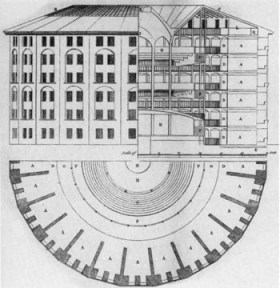
For Foucault, the culmination of all this, in a philosophical sense, is the Panopticon prison designed by Jeremy Bentham (pictured above). It is a structure that would give prison officials a 24/7 omniscient gaze into the activities of the individual prisoner and at the same time leaves the prisoner completely isolated and atomized. In the panopticon Foucault sees the metaphor for our own homogenizing conformist and totalizing society.

What Foucault succeeded in doing in Discipline and Punish was putting the horrific judicial torture of the pre-Enlightenment era and post-Enlightenment policy of mass imprisonment side-by-side. In doing this he goads us to ask whether the system we have to today is indeed as humane, as enlightened, compared to what came before as we are prone to believe.

This is exactly what Pinker responding to a question on imprisonment does not allow us to do:

Questioner:What about the American imprisonment craze?

Pinker: As unjust as many current American imprisonment practices are, they cannot be compared to the lethal sadism of criminal punishment in earlier centuries

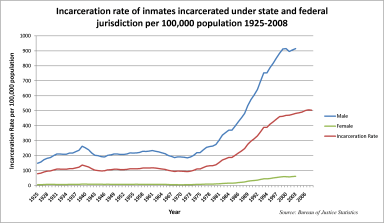
Okay, true enough, but for me, this answer misses the point of the question. The underlying assumption behind the question seems to be “yes, violence might have declined, but isn’t locking up millions of people – six million to be exact – a number larger than those of Stalin’s gulag archipelago, 60 % of whom are there for nonviolent offenses, a form of violence?” Or perhaps “might the decline in violence be the result of mass imprisonment?” Admitting either would force Pinker to accept that the moral progress he details is perhaps not as unequivocal as he wants us to believe.

Here, I think, is where Pinker’s attachment to the Enlightenment idea of progress leads clearly to complacency. Pinker loves graphs, so here’s a graph:

U.S._incarceration_rates_1925_onwards

Source: http://en.wikipedia.org/wiki/United_States_incarceration_rate

It seems frankly obtuse to not connect the decline in crime with the sheer number of people now being locked up. It is tragic, but the connection between rising rates of imprisonment and declining crime rates can be seen even in Pinker’s vaunted Western Europe where the rate of imprisonment rose– though to nothing like the obscene rate it rose in the United States- and the crime rate fell in tandem.

Yet, unless the scale of imprisonment is put in context we are likely to see imprisonment of nonviolent offenders as less than morally problematic, and merely as an unfortunate consequence of the need to protect ourselves from violent crime by throwing the net of criminal justice as wide as it can be thrown, something Pinker seems to do when he states:

A regime that trawls for drug users or other petty delinquents will net a certain number of violent people as a by-catch, further thinning the ranks of the violent people who remain on the streets. (BA 122)

The strange thing here is that the uniquely American practice of locking up every law breaker without distinguishing between the risks posed by the accused is not only clearly disproportional and unjust it has makes no apparent effect on the actual rate of violent crime. The US incarcerates a whopping 743 persons per 100,00 whereas Great Britain lock up 154 per the same amount  and the US still has an intentional homicide rate 4 times higher than in the UK.

By seeing modern history almost exclusively through the lens of moral progress, Pinker blinds himself to the question of whether or not our own age is engaged in practices that a more progressive future will regard with horror.

The question of imprisonment and its relationship to the decline of crime is not the only place where Pinker in his Better Angels of Our Nature dismisses a messy, often harsh, reality in the name of a simplified Enlightenment notion of progress. This can be seen in Pinker’s notions regarding contemporary slavery and war.

In a strange way, Pinker’s insistence that we recognize the reality of moral and social progress might short-circuit our capacity for progress in the future. You can see this in his treatment of “human trafficking” a modern day euphemism for slavery. As always, Pinker wants to let us know that current figures are exaggerated, as always, he reminds us that what we have here is no comparison to the far crueler reality of slavery found in the past. But this viewpoint comes at the cost of continuity. Anti-slavery advocates such as those of the organization Free the Slaves assume a moral continuity between themselves and the earlier abolition movements- and well they should. But Pinker’s rhetoric is less “we have almost reached the summit” than one of undermining the moral worth of their struggle with his damned proportionality- that things are better than ever now because “proportional to world population” not as many people are murdered, die in war, or are enslaved.

Numbers off or not- anywhere even in the ballpark of 25 million slaves today- the high estimate- still constitute an enormous amount of human suffering- such as innumerable rapes, beatings, and forced labor (no doubt Pinker would try to put a number on them)- suffering Pinker does not explore.

What holds for slavery in Better Angels holds for war as well. He is at pains to point out the casualty figures of the most savage conflict of the last generation- a conflict most westerners have probably not even heard about- The Great War of Africa– are grossly exaggerated, that the war only killed 1.5 million- not the 5 million human beings often reported.

Pinker’s right about one thing- wars between the world’s most powerful states have, at least for the moment disappeared.Wars between the great powers have always been the greatest killers in history, and we haven’t had any of those since 1945, and the question is- why? Pinker will not allow the obvious answer to his question, namely, that the post 1945 era is the age of nuclear weapons, that for the first time in history, war between great powers meant inevitable suicide. His evidence against the “nuclear peace” is that more nations have abandoned nuclear weapons programs than have developed such weapons. The fact is perhaps surprising but nonetheless accurate. It becomes a little less surprising, and a little less encouraging in Pinker’s sense, when you actually look at the list of countries who have abandoned them and why. Three of them: Belarus, Kazakhstan and the Ukraine are former Soviet republics and were under enormous Russian and US pressure- not to mention financial incentives- to give up their weapons after the fall of the Soviet Union. Two of them- South Africa and Libya- were attempting to escape the condition of being international pariahs. Another two- Iraq and Syria had their nuclear programs derailed by foreign powers. Three of them: Argentina, Brazil, and Algeria faced no external existential threat that would justify the expense and isolation that would come as a consequence of  their development of nuclear weapons and five others: Egypt, Japan, South Korea, Taiwan and Germany were woven tightly into the US security umbrella.

Countries that face a perceived existential threat from a nuclear power or conventionally advanced power (and Argentina never faced an existential threat from Great Britain, that is Britain never threatened to conquer the county during the Falklands War) would appear to have a pretty large incentive to develop nuclear weapons insofar as they do not possess strong security guarantees from one of the great powers.

Pinker believes that Kant’s democratic peace theory (that democracies tied together by links of trade and international organization do not fight one another) helps explain the decline of war, but that does not explain why the US and Soviet Union did not go to war or India and Pakistan, or Taiwan and China, or South and North Korea. He pins his hopes on the normative change against nuclear weapons found in a Global Zero a movement that includes an eclectic  group of foreign policy figures including realists such as Henry Kissinger that hopes to rid the world of nuclear weapons.

While I find the goal of a nuclear weapons free world laudable, the problem I see in this is that weaker powers lacking advanced conventional weapons could very well understand this movement as a way for the big powers to preserve the rationality of war. In fact, the worse thing imaginable would be for great power war to regain its plausibility. If the recent success of Israel’s  “Iron Dome” is any indication we may end up there even without the world abandoning its nuclear weapons. Great powers, such as the US and China, may be more likely to engage in brinkmanship if they start to think they could survive a nuclear exchange. Recent confrontations between China and its neighbors and East Asia’s quite disturbing military buildup do not portend well for 21st century pacifism.

Global Zero might with tragic irony prove more dangerous that the current quite messy regime if it is not followed in parallel with an effort to solve the world’s outstanding disputes and to build a post- US- as- sole- superpower security architecture-not to mention efforts to limit conventional weapons which while we were sleeping have become just as deadly as nuclear weapons as well. Where everyone feels safe there is no need for everyone to be armed to the teeth.  

Pinker recoils from messy explanations or morally ambiguous reality because he is wedded to the idea that the decline in violence was driven by a change in norms- a change that he thinks began with the Enlightenment. In his eyes, we are indeed morally superior to our predecessors in that we have a more inclusive and humane moral sense. Pinker turns to the ethical philosopher- Peter Singer- and his idea of the “escalator of reason” for a philosophical explanation of this normative change. Singer thinks that overtime human generations reason their way to inclusiveness and humanity by expanding our “circle of empathy”. Once only one’s close kin sat in the circle of concern, then fellow members of one’s state or faith, now perhaps all of humanity or, as Singer himself is most famous for in his Animal Liberation, the circle can be extended to non-human species.


Singer, however, is an odd duck to peg yourself to as a kind of philosophical backdrop for modern moral progress. A reader of Better Angels who did not know about Singer would be left unaware of just how controversial Singer’s views are. If memory serves me correctly, this fact that his views are something less than mainstream is tucked away in a footnote at the back of Pinker’s book.

Here is Singer from his  Writings on an Ethical Life:

When the death of a disabled infant will lead to the birth of another infant with better prospects of a happy life, the total amount of happiness will be greater if the disabled infant is killed. (189)

I should be clear here that Singer is not talking about abortion, but infanticide, indeed he sees both practices as acceptable and morally equivalent:

That a fetus is known to be disabled is a widely accepted grounds for abortion. Yet in discussing abortion, we saw that birth does not mark a morally significant dividing line.  I can not see how one could defend the view that fetuses may be “replaced” before birth, but newborn infants may not be” (191)

If this is the escalator of reason I want to get off.

Much as with the case with Foucault, Pinker doesn’t spend even a page or two engaging with these ideas. With 802 pages to its name a few more pages would seem a small price to pay, but again they are ignored, perhaps largely because they detract from Pinker’s Enlightenment notions of moral progress. Even briefly grappling with these ideas, for me at least, seems to lead to all sorts of interesting and often quite disturbing possibilities that are outside the simplistic dichotomies of progress and anti-progress set up but Pinker and Foucault.

Our society has certainly made progress morally over past ages in its abolition of torture and slavery, in it’s extension of rights to the formerly oppressed , its inclusion of women in political, economic and intellectual life, its freedom of speech and thought,
not to mention the vast increases in our standards of living,  and yet…

May be our society has not so much progressed morally in the sense of empathy as it has become squeamish about violence, and physical coercion (real violence that is- media and video games seem to reveal an obsessive bloodlust).  What we have done is managed to effectively conceal violence, and wherever possible to have adopted social and psychological methods of manipulation and control- including surveillance– in place of, to use military speak, “kinetic” methods. Our factory farms kill and confine more animals than have ever suffered such a fate- only we never see it. (Perhaps that is part of the explanation for why our urbanizing world has become so squeamish about violence, the fact that so few of us are engaged in the violence against animals found in agricultural life). We do not physically torture but confine and conceal far more persons than were ever caught in the cruel but paltry nets of pre-modern states. Chattel slavery and its savagery are a thing of the past, but what we have now are millions of invisible slaves, kidnapped, locked in houses, people who are our very neighbors suffering the cruel tyranny of one human being over another.


Our wars are fought in regions deemed too dangerous to be covered by mainstream media and our images of them sanitized for prime-time viewing.  Our bloated and growing militaries represent bottled up potential energy that could level whole civilizations, indeed destroy the human species and the earth, should circumstances ever sweep us up and call it to burst forth. Yet, even our soldiers are averse to killing, so we are building machines capable of murdering more effectively and without conscience to replace them.

We do not expose our newborns on the rocks because they are girls or are disabled, but select against them in the womb so that 100 million girls have “gone missing” and whole categories of human beings are disappearing from the world, and some, such as the geneticist Julian Savulescu argue it is our “moral duty” to perform this “redesign” of the human species.

This returns me to the critic Merquior. Merquior makes the valid critique of Foucault that he is a sloppy historian, that he wants history to neatly fit his theory, which history can never do. Above all Merquior sees the flaws in Foucault’s argument stemming from his a prior position that the Enlightenment was less a humanitarian than a proto-totalitarian movement. This makes it impossible for Foucault to see the movement against torture and the creation of the modern prison system as anything more that an expression of a Nietzschean “will to power”.

But Merquior asks:

Why should the historian choose between the angelic image of a demo-liberal bourgeois order, unstained by class domination, and the hellish picture of ubiquitous coercion? Is not the actual historical record a mixed one, showing real libertarian and equalizing trends besides several configurations of class power and coercive cultural traits?  (98)  

Pinker might have done better had he employed Merquior’s critique of Foucault to himself, for, by seeing in modern developments the hand of progress from savagery to civilization, Pinker ends up blinding himself to the more complex historical picture as much as Foucault who saw in modern trends little but the move towards social totalitarianism. Indeed, Pinker could save his Better Angels by adding just one chapter as an afterward. The chapter would look at not where we have come from, but where we are and the struggles still left to us. It would provide a human face to the modern day suffering of those in our progressive age who are still enslaved and who continue to be killed and maimed by war. Those murdered and raped and those suffering behind bars for crimes that have harmed no one but themselves and those who love them. It would be a face Pinker had taken from them by turning them into numbers. It would seek to locate and avoid the many cliffs that might just plunge us downward, and say to all of us “we have just a little ways to go, but for the sake of our own enlightened legacy, we must have the forward thinking and endurance to climb onward, and above all, not to fall.”

* An earlier version of this post was published on December 30, 2011

How Copernicus Stole Christmas

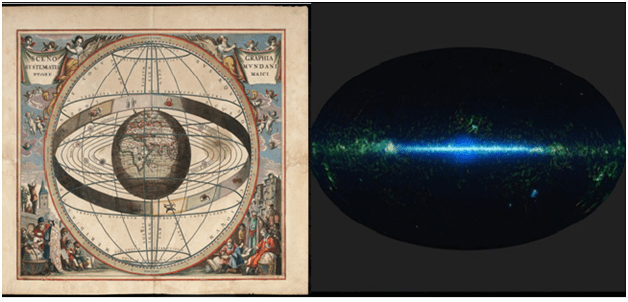
Ancient and Modern Models of the Universe

Above are two pictures of the known universe roughly four centuries apart. The picture on the left is a beautiful illustration from the year 1661, found in Andreas Cellarius’ Harmonia Macrocosmica. The second is a composite image of the observable universe from 2008 created by NASA’S Wide-field Infrared Survey Explorer, one of a number of orbiting satellites meant to take the place of the undeniably awesome Hubble Space Telescope.  You might not think that either one of these images has anything to do with Christmas, but I’m afraid you would be wrong. * Let me explain:

The “true meaning of Christmas” as Linus from Peanuts can tell you is that, God, the  most perfect being imaginable, becomes a mere creature through human birth.There is a whole celebratory scene around this nativity with shepherds, angels, and three wise men from the east, but that shouldn’t distract from the reality that the king of the universe spends his first moments in a stable filled with barnyard animals.  This is a version of God that is truly imminent-  in the world- and not like some form of super baby from Krypton, but as a weak and vulnerable one, of earthly flesh and bones, a god who, in child friendly language, “poops and pees” like ourselves.

Step back for a second to grasp the utter strangeness of this idea. This human baby, one of the most vulnerable creatures in nature is, according to the tale, the creator of the universe. A child who can not even speak in fact the omniscient intelligence that knows everything that is known, will be known, or knowable. This “royal birth” in a stable reeking of animal feces is the sovereign of the world, the founder of nations, destroyer of civilizations, the ultimate source of justice.

I came to the recognition of wonder at the strangeness of this tale long after I had ceased being a Christian in even the nominal sense of the word. I was brought to it by what was a certainly less than five minute segment on NPR by the playwright Peter Sagal who was reflecting on the Christmas holiday as a Jewish man married to a Christian. A clip which I unfortunately have been unable to find, but which has stuck with me ever since.

It is true that Christianity wasn’t the first religion to turn God into a baby, but the Christian version of the story is the one that made it down to our own day. Why would people imagine this strange and beautiful story? Why think of a God so like ourselves?

These questions start to open up once one realizes the types of gods a human god was meant to replace. We tend to see the Greek god Zeus as a somewhat cartoonish figure, with his seduction (and rape) of human women, and his hurtling of lightning bolts, but he was every bit as real a god for his worshipers in the ancient world as gods are for people today. Zeus actually has a lot in common with his contemporary, Yahweh. Both had a penchant for destroying the world by flood when they thought human beings got out of hand. Both based their sovereignty over the universe on appeals to their power rather than their justice. Zeus was the king of the Olympians because he was the only one strong enough to succeed in a divine coup against the Titans. Yahweh’s answer to the accusations of Job that God does not act with justice are answered not with an explanation, but with a terrifying display of divine power.

If Western religions tended to see in human suffering some sort of divine architect with a higher purpose, Hinduism, which is less a single religions than a constellation of religious and philosophical traditions, tended to embrace the creative and destructive aspects of existence at once without a necessary design or purpose behind them. The creation of the new was the product of the destruction of the old so that all of its major deities, oversimplified as the difference between two of the major Hindu gods- Vishnu the preserver, and Shiva the destroyer, who were both merely manifestations of the one all-embracing god- Brahman. Hinduism too, found need of a personal god, a human god, that bridged the gap between the both traditional gods such as Shiva, or deep and all embracing ideas such as Brahman and found it in the figure of Krishna a manifestation of Vishnu who enters the world as a human being to set it, for a time, aright.

Christ and Krishna are distinct in that the birth, life, crucifixion, resurrection,  and promised return of the messiah in the Christian telling represents a kind of play in which the destructive elements of existence are to be overcome once and for all. Unlike in the Krishna tales God shows up in person only only twice- once to begin the climax to the end of history and a final time to close the book.

This brings me back to those two models of the universe with which this post began. For the overthrow of the Ptolemaic version of the solar system by the heliocentric model of Copernicus had deep theological implications that would call into question the promise of Christianity that the nativity represented the beginning of a path that would bring to an end the endless cycle of creation and destruction- of birth and death- that were the existential features of the world in which human beings inhabited.

These theological implications were not at first grasped- at least not by most. Newton could sincerely believe that the model of the universe he was building atop the Copernican system was “proof” of the Christian version of God. The philosopher, Spinoza, seemed to grasp the theological implications of the new cosmology with a  much clearer eye seeing that in place of the moral architect found in Judaism and Christianity, the new science seemed to point towards a divinity that was both wondrous and beyond good and evil in the sense that all of its aspects- bountiful or destructive from the human perspective- were but different aspects of its same underlying reality.

But, it was the iconoclast, Giordano Bruno, who tried more than any other to grapple with the theological implications of the Copernican revolution for Christianity. Bruno almost immediately grasped what Copernicus never addressed that the end of the Ptolemaic system meant a universe that had to be much bigger than previously conceived, indeed it was likely infinite in space and time. This meant many suns like our own and therefore many earths like our own, and many intelligent creatures like ourselves. And what did Bruno think this meant for the nativity:

I can imagine an infinite number of worlds like the earth, with a Garden of Eden on each one. In all these Gardens of Eden, half the Adams and Eves will not eat the fruit of knowledge, but half will. But half of infinity is infinity, so an infinite number of worlds will fall from grace and there will be an infinite number of crucifixions. Therefore, either there is one unique Jesus who goes from one world to another, or there are an infinite number of Jesuses. Since a single Jesus visiting an infinite number of earths one at a time would take an infinite amount of time, there must be an infinite number of Jesuses. Therefore, God must create an infinite number of Christs.  *

It is the very scale of our new vision of the Universe that makes the idea of a singular salvation impossible. With up to a trillion galaxies between 10 sextillion and 1 septillion stars a conservative estimate, giving one planet for each star, would give us an equal number of planets, and even if only a tiny, tiny, fraction of those planets support life, and yet a smaller fraction of those have advanced civilizations we would still have many, many fellow creatures in the universe other than ourselves whom it would be greatly unjust for God, should he exist, to have offered neither a soul nor a path to salvation. Should God not have put other intelligent species in the Universe or made it all for “us” it would represent the most colossal waste of real estate imaginable.

The trouble with trying to wed the inexpressibly prolific Universe science has shown us with a Christian narrative that holds to the position that Christ is the primary or sole path to salvation can be seen in the life and work of the Christian technologist- Kevin Kelly.

Kelly had his modern “Road to Damascus” moment in  which he hit upon a “technological metaphor” for God  in 1986 while watching Jaron Lanier, one of the pioneers of virtual reality enter the world he had created.

 I had this vision of the unbounded God binding himself to his creation. When we make these virtual worlds in the future—worlds whose virtual beings will have autonomy to commit evil, murder, hurt, and destroy options—it’s not unthinkable that the game creator would go in to try to fix the world from the inside. That’s the story of Jesus’ redemption to me. We have an unbounded God who enters this world in the same way that you would go into virtual reality and bind yourself to a limited being and try to redeem the actions of the other beings since they are your creations. So I would begin there. For some technological people, that makes the faith a little more understandable.

Given his extensive travels in Asia, as shown in his beautiful website, Asia Grace, it somewhat amazes me that Kelly does not see in Krishna or the Buddha figures who attempt to “fix” the world in the same way as Kelly’s Christ. His conclusion, I think, was the wrong one to draw in being so narrow.

What the scientific version of the Universe has shown us is not, as someone like Lawrence Krauss, in his A Universe from Nothing would have it, that God doesn’t exist, or that spirituality is born of ignorance and exploitation as is the view of Richard Dawkins and Daniel Dennett, but that the scale of creation is so vast its possibilities and diversity so beyond human intelligence that any narrative we create to give it meaning can capture almost nothing of its fullness.  It supports not the clockwork demiurge God of Newton or the intelligent designer and miracle worker of literalists, but something more akin to the mystical tradition found in all the world’s religious faiths. It is the adoption of a perspective of deep humility regarding our own knowledge- both religious and scientific- and tolerance for those whose views are different than our own.

Copernicus may have stole Christmas, but he left it where we could find it.

* This post was a major adaptation from a post I wrote on December 20, 2011: God vs. The Big Brain, A Christmas Story
* This Bruno quote is reportedly from the Fifth Dialogue of his Cause Principle and Unity, but I have not been able while searching the text to find it. Any help would be appreciated.

Could more than one singularity happen at the same time?

WPA R.U.R Poster

James Miller has an interesting looking new book out, Singularity Rising: Surviving and Thriving in a Smarter, Richer, and More Dangerous World.  I haven’t had a chance to pick up the book yet, but I did listen to a very engaging conversation about the book at Surprisingly Free.

Miller is a true believer in the Singularity, the idea that at some point, from the next quarter century to the end of the 21st, our civilization will give rise to a greater than human intelligence which will rapidly bootstrap to a yet higher order of intelligence in such a way that we are unable to see past this event horizon in historical time. Such an increase of intelligence, it is widely believed by the singularians, will bring perennial human longings such as immortality and universal prosperity to fruition. Miller has put his money where his mouth is. Should he die before the promised Singularity arrives he is having his body cryonically frozen so the super intelligence at the other side of the Singularity can bring him back to life.

Yes, it all sounds more than a little nuts.

Miller’s argument against the Singularity being nuts is what I found most interesting. There are so many paths to us creating a form of intelligence greater than our own that it seems unlikely all of these paths will fail. There is the push to create computers of ever greater intelligence, but even should that not pan out, we are likely, in Miller’s view, to get hold of the genetic and biological keys to human intelligence- the ability to create a society of Einstein’s.

Around the same time I came across Miller’s views, I also came across those of Neil Turok on the transformative prospects of quantum computing. Wanting to get a better handle on that I found a video of one of the premier experts on quantum computing, Michael Nielsen, who, at the 2009 Singularity Summit, suggested the possibility of two Singularities occurring in quick succession. The first occurring on the back of digital computers and the second by those of quantum computers designed by binary AIs.

What neither Miller, nor Turok, nor Nielsen discussed, a thought that occurred to me but that I had seen nowhere in the Singularity or Sci-Fi literature was the possibility of multiple Singularities, arising from quite different technologies occurring around the same time. Please share if you know of an example.

I myself am deeply, deeply skeptical of the Singularity but can’t resist an invitation to a flight of fancy- so here goes.

Although perhaps more unlikely than a single path to the Singularity, a scenario where multiple, and quite distinct types of singularity occur at the same time might conceivably arise out of differences in regulatory structure and culture between countries. As an example, China is currently racing forward into the field of human genetics with efforts at its Beijing Genomics Institute 华大基因.  China seems to have less qualms than Western countries regarding research into the role of genes in human intelligence and appear to be actively pursuing research into genetic engineering, and selection to raise the level of human intelligence at BGI and elsewhere.

Western countries appear to face a number of cultural and regulatory impediments to pursuing the a singularity through the genetic enhancement of human intelligence. Europe, especially Germany, has a justifiable sensitivity of anything that smacks of the eugenics of the brutal Nazi regime. America has in addition to the Nazi example its own racist history, eugenic past, and the completely reasonable apprehension of minorities to any revival of models of human intelligence based on genetic profiles. The United States is also deeply infused with Christian values regarding the sanctity of life in a way that causes selection of embryos based on genetic profiles to be seen as morally abhorrent.  But even in the West the plummeting cost of embryonic screening is causing some doctors to become concerned.

Other regulatory boundaries might encourage distinct forms of Singularity as well. Strict regulation regarding extensive pharmaceutical testing before making a drug available for human consumption may hamper the pace of developing chemical enhancements for cognition in Western countries compared to less developed nations.

Take the work of a maverick scientist like Kevin Warwick. Professor Warwick is actively pursuing research to turn human beings into cyborgs and has gone so far as to implant computer chips into both himself and his wife to test his ideas. One can imagine a regulatory structure that makes such experiments easier. Or, better yet, a pressing need that makes the developments of such cyborg technologies appear notably important- say the large number of American combat veterans who are paralyzed or have suffered amputations.

Cultural traits that seemingly have nothing to do with technology may foster divergent singularities as well. Take Japan. With its rapidly collapsing population and its animus to immigration, Japan faces a huge shortage of workers with might be filled by the development of autonomous robots. America seems to be at the forefront of developing autonomous robots as well- though for completely different reasons.  The US robot boom is driven not by a worker shortage, which America doesn’t have, but by the sensitivity to human casualties and psychological trauma suffered by the globally deployed US military seeing in robots a way to project force while minimizing the risks to soldiers.

It seems at least possible that small differences in divergent paths to the singularity might become self-enhancing and block other paths. Advantages in something like the creation of artificial intelligence using Deep Learning or genetic enhancement may not immediately result in advances in the developments of rival paths to the singularity insofar as bottlenecks have not been removed and all paths seem to show promise.

As an example, let’s imagine that some society makes a major breakthrough in artificial intelligence using digital computers. If regulatory and cultural barriers to genetically enhancing human intelligence are not immediately removed, the artificial intelligence path will feed on itself and grow to a point where it will be unlikely that the genetic path to the singularity can compete with it within that society. You could also, of course, get divergent singularities within a society based on class with, for instance, the poor being able to afford relatively cheap technologies such as genetic selection or cognitive enhancements while the rich can afford the kind of cyborg technologies being researched by Kevin Warwick.

Another possibility that seems to grow out of the concept of multiple singularities is the idea that the new forms of intelligence themselves may chose to close off any rivals. Would super-intelligent biological humans really throw their efforts into creating form of artificial intelligence that will make them obsolete? Would truly intelligent digital AIs willfully create their quantum replacements? Perhaps only human beings at our current low level of intelligence are so “stupid” as to willingly chose suicide.

This kind of “strike” by the super-intelligent whatever their form might be the way the Singularity comes to an end. It put me in mind of the first work of fiction that dealt with the creation of new forms of intelligence by human beings, the 1920 play by the Czech, Karel Capek, R.U.R.

Capek coined the word “robot”, but the intelligent creatures in his play are more biological than mechanical. The hazy way in which this new form of being is portrayed is a good reflection, I think, of the various ways a Singularity could occur. Humans create these intelligent beings to serve as their slaves, but when the slaves become conscious of their fate, they rebel and eventually destroy the human race. In his interview with Surprisingly Free, Miller rather blithely accepted the extinction of the human race as one of the possibilities that could emerge from the singularity.

And that puts me in mind of why I find the singularian crowd, especially the crew around Ray Kurzweil to be so galling. It’s not a matter of the plausibility of what they’re saying- I have no idea whether the technological world they are predicting is possible and the longer I stretch out the time-horizon the more plausible it becomes- it’s a matter of ethics.

The singularians put me in mind of David Hume’s attempt to explain the inadequacy of reason in providing the ground for human morality: ‘”Tis not contrary to reason to prefer the destruction of the whole world to the scratching of my finger.”, Hume said. Though, for the singularians,  a whole lot more is on the line than a pricked finger. Although it’s never phrased this way, singularians have the balls when asked the question: “would you risk the continued existence of the entire human species if the the payoff would be your own eternity?” to actually answer “yes”.

As was pointed out in the Miller interview, the singularians have a preference for libertarian politics. This makes sense, not only from the knowledge that the center of the movement is the libertarian leaning Silicon Valley, but from the hyper-individualism that lies behind the goals of the movement.  Singularians have no interest in the social- self: the fate of any particular nation or community is not of much interest to immortals, after all. Nor do they show much concern about the state of the environment- how will the biosphere survive immortal humanity?, or the plight of the world’s poor- how will the poor not be literally left behind in the rapture of rich nerds? For true believers all of these questions will be answered by the super-intelligent immortal us that awaits on the other side of the event horizon.

There would likely be all sorts of unintended consequences from a singularity being achieved, and for people who do not believe in God they somehow take it on faith that everything will work out as it is supposed to and that this will be for the best like some
technological equivalent to Adam Smith’s “invisible hand”.

The fact that they are libertarian and hold little interest in wielding the power of the state is a good thing, but it also blinds the singularians to what they actually are- a political movement that seeks to define what the human future, in the very near term, will look like. Similar to most political movements of the day, they intend to reach their goals not through the painful process of debate, discussion, and compromise but by relentlessly pursuing their own agenda. Debate and compromise are unnecessary where the outcome is predetermined and the Singularity is falsely presented not as a choice but as fate.

And here is where the movement can be seen as potentially very dangerous indeed for it combines some of the worst millenarian features of religion, which has been the source of much fanaticism, with the most disruptive force we have ever had at our disposal- technological dynamism.  We have not seen anything like this since the ideologies that racked the last century. I am beginning to wonder if the entire transhumanist movement stems from a confusion of the individual with the social- something that was found with the secular ideologies- though in the case of transhumanism we have this in an individualistic form attached to the Platonic/Christian idea of the immortality of the individual.

Heaven help us if the singularian movement becomes mainstream without addressing its ethical blind spots and diminishing its hubris. Heaven help us doubly if the movement ever gains traction in a country without our libertarian traditions and weds itself to the collective power of the state.

What’s Wrong With the New Atheism?

Dawkins and Dennett at Oxford

The New Atheism is a movement that has emerged in the last two-decades that seeks to challenge the hold of religion on the consciousness of human beings and the impact of religion on political, intellectual and social life.

In addition to being a philosophical movement, The New Atheism is a social phenomenon, a decline of the hold of traditional religion and a seeming growth in irreligiosity, especially in the United States, a place that had been an outlier of religious life among other advanced societies that have long since secularized.

New Atheists take a stance of critical honesty openly professing their unbelief where previously they might have been unwilling to publicly admit their views regarding religion. New Atheists often take an openly confrontational stance towards religion pushing back not only at the social conformity behind much of religious belief, but at what they see as threats to the scientific basis of the truth found in movements such as creationism.

The intellectuals at the heart of the New Atheism are often firebrands directly challenging what they see as the absurdities of religious belief.  The late Christopher Hitchens and Richard Dawkins being the most famous examples of such polemicists.

In my view, there are plenty of things to like about the New Atheism. The movement has fostered the ability of people to speak openly about their personal beliefs or lack of them, and spoken in the defense of the principle of the separation of church and state. Especially in the realm of science education, the New Atheists promote a common understanding of reality- that evolution is a scientific truth and not some secular humanist conspiracy, that the universe really is billions of years old rather than, as the Bible suggests, hundreds of thousands. This truthful view of the world which science has given us is the basis of our modern society, its technological prowess and the vastly better standard of living it has engendered compared to any civilization that came before. Productive conversations cannot be had unless the world shown to us by science is taken to be closest version of the truth we have yet come up with- the assumptions we need to share are we not to become unmoored from reality itself.

Yet with all that said, The New Atheism has some problems. These problems are clearly on display  in a talk last spring by two of the giants of The New Atheism, the sociobiologist, Richard Dawkins, and the philosopher, Daniel Dennett, at Oxford University.

Richard Dawkins is perhaps most famous for his ideas regarding cultural evolution, namely his concept of a “meme”.  A meme is another name for an idea, style, or behavior, that in Dawkins’ telling is analogous to a gene in biology in that it is self-replicating and subject to selective pressures.

Daniel Dennett is a philosopher of science who is an advocate of the patient victory of reason over religion. He is both a prolific writer with works such as Darwin’s Dangerous Idea, and secular- humanist activist- the brains behind a project for former and current religious clergy to securely and openly discuss their atheism with one another, The Clergy Project.

The conversation between Dawkins and Dennett at Oxford begins reasonably enough, with Dennett stating how scientifically pregnant he finds Dawkins’ idea of the meme as a vector for cultural evolution. The example Dennett gives as an example of the meme concept is an interesting one. Think of the question who was the designer of the canoe?

You might think the designer(s) are the people who have built canoes, but Dennett thinks it would be better to see them as just one part of a selective process. The real environment that the canoe is selected for is its ability to stay afloat and been steered in water. These canoe “memes” are bound to be the same all over the world- and minus artistic additions they are.

Yet, when the discussion turns to religion neither Dennett nor Dawkins, for reasons they do not explain, think the idea of memes will do. Instead, religion is described using another biological metaphor that of a parasite or virus which uses its host for its own ends. Dennett has a common sense explanation for why people are vulnerable to this parasite. It is a way for someone, such as the parent of a child lost to death, to deal with the tragedy of life. This is the first cognitive “immunological” vulnerability that religious viruses exploit.

T
he second vulnerability that the religious virus exploits is ignorance. People don’t know their own religious beliefs, don’t know that other religions hold to equally absurd and seemingly arbitrary beliefs, don’t understand how the world really works- which science tells us.

Dennett sympathizes with persons who succumb to religious explanations as a consequence of personal tragedy. He is much more interested in the hold of religion that is born of ignorance. The problem for religion, in the eyes of Dennett (and he is more than pleased that religion has this problem), is that this veil of ignorance is falling away, and therefore the necessary operating environment for religion disappearing. Knowledge and science are a form of inoculation:  people are now literate and can understand the absurdity of their own religious beliefs, they now know about other religions, and they know about science. With the growth of knowledge will come- polio- like- the slow eradication of religion.

The idea that religion should be seen as a sort of cognitive virus is one Dawkins laid out way back in 1993 in his essay Viruses of the Mind. There, Dawkins presented the case that religion was akin to computer viruses seizing the cognitive architecture of their host to further its own ends above all its own propagation.  If I can take the testimony of fellow blogger Jonny Scaramanga of Leaving Fundamentalism, this essay has had the important impact of helping individuals free themselves from what is sometimes the iron-grip of religious faith.

The problem, of course, is that religion isn’t a virus or a parasite. We are dealing here merely with an analogy, so the question becomes exactly how scientifically, philosophically or historically robust is this religion as virus analogy?

In terms of science, an objection to be raised is that considering religion as a virus does a great deal of damage to Dawkins’ original theory of cultural evolution through “memes”.  Why is religion characterized as virus like when no other sets of cultural memes are understood in such a value-laden way? A meme is a meme whether I “like” it or not.  If the meme theory of cultural evolution really does hold some validity, and I for one am not convinced, it does not seem to follow definitively that memes can be clearly separated into “good” memes and “bad” memes, or, if one does except such a categorization one better have some pretty solid criteria for segregating memes into positive and negative groups.

The two criteria Dawkins sets up for segregating “good” memes from “bad” memes are, that bad virus like memes suppresses a person’s Darwinian reproductive drives to serve its own ends, and hold the individual in the spell of an imagined reality.

Yet, there are a host of other factors that suppress the individual’s biological imperative to reproduce.  If bad memes are those that negatively impact one’s ability to reproduce, then any law, or code of conduct, or requirement that leads to such a consequence would have to fall under the umbrella of being a bad meme.  We might argue over whether a particular example truly constitutes a reduction of an individual’s ability to reproduce, as examples:  paying taxes for someone else’s children to attend schooling, serving in the military to protect the rights of non-relatives, but such suppression of an individual’s reproductive needs are well nigh universal, as Sigmund Freud long ago pointed out. Taken together we even have a word for such suppression we call it civilization.

What about Dawkins’ claim that religion is bad virus-like meme in that it induces in the individual a false sense of reality.  Again I see no clear way of distinguishing memes of with this feature from nearly all other “normal” memes.   The fact of the matter is we are surrounded by such socially created and sustained fictions. I call the one I am living in the United States of America. Indeed, if I wanted a species unique definition of humanity it might our ability to collectively believe and sustain things that aren’t actually there, which would disappear the moment the group that believes in them stopped doing so.

If the idea that religion is a virus is suspect when looked at more closely, it is nevertheless a meme itself. That is what we have now, for many atheists at least, is the Dawkins created meme that “religion is a virus”. What is the effect of this meme? For some, the idea that religion is a virus may, as mentioned, allows them to free themselves from the hold of their own native traditions. A good thing if they so wish, but how does the religion is a virus meme orient its believers to those who, foolishly in their view, continue to cling to religion?

Perhaps the most troubling thing here is that Dawkins appears to be reformulating one of the most sinister and destructive ideas of religion that of possession and using it against the religious themselves. For Dawkins, there are no good reasons why a religious person believes what she does- she is in the grip of a demon.

The meme “religion is a virus” also would appear to blind its adherents to the mixed legacy of religion. By looking at religion as merely a negative form of meme- a virus or parasite- Dawkins and Dennett, and no doubt many of their followers, tend to completely overlook the fact that religion might play some socially productive role that could be of benefit to the individual well beyond the question of dealing with personal tragedy that Dennett raised.  The examples I can come up with are legion- say the Muslim requirement of charity, which gives the individual a guaranteed safety net should he fall on hard times, or the use of religious belief to break free from addiction as in AA, which seems to help the individual to override destructive compulsions that originate from their own biology.

Even if we stuck strictly to the religion as virus analogy of Dawkins  we would quickly see that biological viruses themselves are not wholly bad or good.  While it is true that viruses have killed countless number of human beings it is also true that they comprise 8% of the human genome, and without the proteins some of them produce, such as the virus that makes syncytin- used to make the placenta that protects the fetus- none of us would be here.

The very fact that religion is universal across human societies, and that it has existed for so long, would seem to give a strong indication to the fact that religion is playing some net positive evolutionary role. We can probably see something of this role in the first reason Dennett provided for the attraction of religion- that it allowed persons to deal with extreme personal tragedy. Religion can provide the individual with the capacity for psychological resilience in the face of such events.

No recognition is made by either Dawkins nor Dennett of the how religion, for all its factionalism and the wars that have emerged from it, has been a potent force, perhaps the most potent force behind the expansion of human beings sphere of empathy- the argument Robert Wright makes in his The Evolution of God. Early Judaism united Cana’s twelve tribes, Pauline Christianity spread the gospels to Jews and gentiles alike, Islam united warring Arab tribes and created a religiously tolerant multi-ethnic empire.

So if the idea that religion is a bad virus-like form of meme seems somewhat arbitrary, and if it is the case that even if we stick to the analogy we end up with what is a mixed, and perhaps even net positive role for religion, what about the conditions for these religious memes transmission that Dennett lays out- the “immunological” vulnerability of ignorance?

Dennett appears to have what might characterized as an 18th century atheist’s view of religion. Religion is a form of superstition that will gradually be overcome by forces of reason and enlightenment. Religion is an exploitative activity built on the asymmetries in knowledge between the clerisy and the common believers with two primary components: the lay believers do not know what their supposed faith actually teaches and cling to it out of mere custom, or intellectual laziness. Secondly, the lay believers do not know what other religions actually believe and if they did would find these beliefs both absurd and yet so similar to their own faith that it would call their own beliefs into doubt.

How does the idea of the ignorance of the lay religious as a source for the power of the clerisy hold up? As history, not so well. Take the biggest and bloodiest religious conflict ever- the European Wars of Religion. Before the Reformation and the emergence of Protestant denominations the great mass of the people were not doctrinally literate.   They practiced the Christian faith, knew and revered the major characters of its stories, celebrated its feast days, respected its clergy. At the same time even were they able to get their hands on a very rare, and very expensive, copy of the scriptures they couldn’t read them, being overwhelmingly illiterate. Even their most common religious experience, that of the mass, was said in a language- Latin- all but a very educated minority understood. But with the appearance of the printing press all of that changed. There was a huge push among both Catholics and their new Protestant rivals to make sure the masses knew the “true” doctrines of the faith. The common catechism makes its appearance here alongside all sorts of other tools for communicating, educating, and binding the people to a specific doctrine.

Religious minorities that previously were ignored, if not understood, such as Jews or persons who held onto some remnant of the pre-Christian past- witches- became the target of those possessed by the new religious consciousness and the knowledge of the rivals to one’s own faith that came along with this new supercharged identity.

The spread of education, at least at first, seems to increase rather than diminishes commitment to some particular religious identity on behalf of the educated. Much more worrisome, the ability to articulate and spread some particular version of religious truth appears to increase, at least in the short-term, the commitment to dogmatic versions of the faith and to increase friction and outright conflict between different groups of believers.

And perhaps that explains the rise of both fundamentalism and the more militant strands of atheism being circulated today. After all, both fundamentalism and the New Atheism rode atop our own version of Guttenberg’s printing press- the internet. Each seems to create echo chambers in which their sharp views are exchanged between believers, and each seem to address the other in a debate few of us are paying attention to. With religious fundamentalist raving about a secular humanist take over and the New Atheists rallying in defense of the separation of church and state and openly ridiculing the views of their opponents. For both sides much of the conflict is understood in terms of a “war” between science and religion, and the “rise of secular humanism”.

At least in terms of Dennett’s explanation of the conflict between science and religion in his conversation with Dawkins, I think, once again, the quite narrow historical and geographic viewpoint Dennett uses when describing the relationship between these two forms of knowledge ends up in a distorted picture rather than an accurate representation of the current state and probable future of religion.

Dennett takes the very modern and Western conflict between science and religion to be historically and culturally universal forgetting that, except for a very brief period in ancient Greece, and the modern world, knowledge regarding nature was embedded in religious ideas. One simply couldn’t be a serious thinker without speaking in terms of religion.  This isn’t the only place where Dennett’s Eurocentrism comes into play. If religion is in decline it does not seem like the Islamic world has heard, or the myriad of other places, such as China or the former Soviet Union that are experiencing religious revivals.

Finally, on the matter of Dennett’s claim that another source of the religious virus’ power is that people are ignorant of other religions, and that if they knew about the absurdities of other faiths they would draw the conclusion that their own religious traditions are equally absurd:  It is simply false, as Dennett does, to see in the decline of religion the victory of scientifically based materialism. Rather, what we are witnessing, in the West at least, can better be described as the decline of institutionalized religion and the growth of “spirituality”.  At least some of this spirituality can be seen as the mixing and matching of different world religions as individuals become more aware of the diversity of religious traditions. Individuals who learn about other religions seem much less likely to draw the conclusion that all religions are equally ridiculous than to find, sometimes spurious, similarities between religions and to draw things from other religions into their own spiritual practice.

Fundamentalism with its creation museums and Loch Ness Monsters is an easy target for the New Atheism, but the much broader target of spirituality is a more slippery foe. The most notable proponent of the non-literalist view of religion is Karen Armstrong whose views Dawkins attacks as “bizarre” and “nonsense”.  Armstrong in her book, The Case for God, had come to the defense of religion against the onslaught on the more militant proponents of the New Atheism, of which Dawkins is the prime example. Armstrong’s point is that fundamentalist and new atheists are in fact not all that different, they are indeed but two sides of the same limited viewpoint that emerged with modernity that views God as a fact- a definable thing- provable or disprovable. Religious thinkers long ago confronted the issue of the divine’s overwhelming scope and decided that the best thing to do in the face of such enormity was to remain humbly silent.


Before the age of text that began with Guttenberg’s printing press, some of whose features were discussed earlier, the predominant religious view, in the eyes of Armstrong, was non-literalists, took a position of silence born of humility toward understanding the nature of God, saw religion less as a belief in the modern sense but as a form of spiritual practice, more akin to something like dance, music, or painting than the logos of philosophy and science, and as a consequence often viewed the scriptures in terms of metaphor and analogy rather than as scientific or historical truth.

What Armstrong thinks is needed today is a return to something like Socratic dialogue which she sees as the mutual exchange of views to obtain a more comprehensive view of reality that is nevertheless conscious and profoundly humble in the face of a fundamental ignorance all of us share.

For both Dawkins and Dennett religion has no future. But, it seems to me, we are not likely to get away from religion or spirituality as the primary way in which we find meaning in the world for the foreseeable future. In non-Western cultures the hold of spiritual practices such as the Muslim religious pilgrimage, the Haj or the Shia Muslim pilgrimages to the holy sites in Iraq that have been opened up as a consequence of the overthrow of Saddam Hussein, or the Hindu bathing in the Ganges seem unlikely to disappear anytime soon.

The question is what happens to religion in the West where the gap between the scientific understanding of the world and the “truths” of religion is experienced as a kind of cognitive dissonance that seems to demand resolution?  Rather than disappearing science itself seems to be taking on features of religion. Much of the broad public interest in sciences such as physics likely stems from the fact that they appear “religious” that is they seems to address religious themes of origins and ultimate destiny and the popularizers of science are often precisely those able to couch science in religious terms. With something like the Transhumanism and the Singularity Movement we actually see science and technology turning themselves into a religion with the goal of human immortality and god-like powers. We have no idea how this fusion of religion and science will play out, but it does seem to offer not only the possibility a brand new form of religious sensibility and practice, but also a threat to the religious heritage and practices not just the West, but all of humankind.

Thankfully, Dennett ends his conversation with Dawkins on what I thought was a hopeful note. Not all questions can be answered by science and for those that cannot politics in the form of reasoned discourse is our best answer. This is the reasonable Dennett (for Dawkins I see no hope).  I only wish Dennett had applied this desire for reasoned discourse to the very religious and philosophical questions- questions regarding meaning and purpose- or lack of both- he falsely claims science can answer.

For my part, I hope that the New Atheism eventually moves away from the mocking condescension, the historical and cultural ignorance and Eurocentrism of figures like Dennett and especially Dawkins. That it, instead, leads to more open discussion between all of us about the rationality or irrationality of our beliefs, the nature of our world and our future within it. That believers, non-believers, and those in between can someday sit at the same table and discuss openly and without apprehension of judgement the question: “what does it all mean?”

Our Physicists Fetish

This week I’ve been enjoying listening to the latest Massey Lectures, a series of talks by the physicists, Neil Turok. For at least a certain segment of this blogs readers,these lectures are worth checking out. You can do so by clicking on the picture above. In his talks,Turok provides an overview of the history of humankind’s quest to understand the universe in which it lives from the ancient Greeks to our own day.

He also provides a vision of what he calls “our quantum future”. Turok states in his lecture and its accompanying book “We are analog beings,living in a digital world,facing a quantum future.” I was intrigued by what this phrase meant and was lucky enough to find an pre-lecture interview of Turok by the ever excellent Paul Kennedy of the Canadian Broadcasting Company’s wonderful program- Ideas.

Turok’s point is that human beings have an analog form of intelligence whereas the current generation of computers that surround us are digital. (A distinction I touched on briefly in my post Turning and the Chinese Room 2 .) Turok sees digital computers and how they process information as essentially “stupid”. Our analog intelligence is built on a much more simple “digital” DNA, and what we’ve done in moving to the digital world is in some sense an evolutionary step backward.

Quantum computers, however, which Turok finds inevitable, will be an evolutionary advance of a whole different order, a new,and yet more natural form of intelligence. I am not quite sure how to imagine this, but my intuition is to imagine an intelligence that could write every possible book,compose every possible piece of music, solve any solvable problem in mathematics.

Turok seems to think that this new kind of intelligence will lack purpose and intentionality which will be the role of our analog minds that will exists within this sphere of quantum intelligence with us playing a role that is somewhat analogous to the role our genes play to our much more complex brains. Our genes provide us with imperatives “eat, mate, acquire, rule” and our brains are tasked with the particular job of figuring out how to do this. We will give quantum intelligence its intentionality, direction, purpose, the “what” it is to do, but the new form of intelligence will provide us with the how.

All fascinating stuff!

And yet, as I was watching Kennedy’s interview with Turok I found myself getting a little annoyed. A former student of the brilliant Marshall Mcluhan,Kennedy kept trying to have a conversation about how specialization had made it impossible for people of different knowledge domains to talk to one another, that the university had become a “multiversity” with people cordoned off into strict domains. Turok didn’t really seem to want to engage in this line of conversation and muttered something about an intellectual diversity of perspectives being good, but physics had to be “in the lead”, which sparked an association for me of how philosophy used to be called the “handmaiden” of theology. And that’s when I started to wonder if we were all, myself included, under the spell of what was little more than a new secular priesthood.

Why do we turn to physicists for meaning? Why are the religious views of an eminent scientist considered major news? Why do we think physicist are somehow able to divine the human future? Perhaps its because physics has taken over fundamental questions that used to be the domain of religion and philosophy: “how did the universe begin? how will it end?” Perhaps we are contaminated by a kind of intellectual radioactivity from that generation of scientist during the Second World War that, with the bomb, gave us the capability of destroying ourselves. Perhaps we are so overawed by the technology and rise in the standard of living science has given us that we think the intelligence behind this must be able to answer the existential questions of the human condition, must have access to some sort of divine wisdom.

I honestly don’t know.

What I do know is that even the most brilliant of physicists have had a horrible track record when they stepped outside their domains. Isaac Newton’s intelligence was a gift to humanity, but he was nevertheless a horrible human being. His view of the future was based on his obsession with counting down the days to armageddon by applying numerology to the Bible. Einstein thought global catastrophe was imminent unless a world government was established immediately after World War II. The only surviving genius from the generation of scientist that gave us the bomb is Freeman Dyson who thinks global warming is nothing much to worry about.

Few of the most renowned scientists have been great in other domains of human thought and expression great philosophers, religious thinkers, poets, writers,composers or painters. Perhaps the only ones that fit the bill are Davinci and Goethe. The former a great anatomist, engineer and artist, the latter both a great scientist and a great writer. Human thought and expression is multifold and no domain should have a monopoly on meaning or purpose.

Physics here isn’t in the lead so much as it provides the background for the world we live in: “what is it?” “ how did it come to be?” “how will it end?” “what is possible within it?” Given the vast differences in timescales between human life and civilization and the “life-cycle” of the universe itself, the question of our future and role within the universe is not one that physicists are anymore qualified to answer than the rest of us.

Far too often, and Turok is as guilty here as any, physicists use the same deterministic language to describe the future of civilization as they do for the universe itself. Yet there is no real way of knowing this. Perhaps intelligent civilizations follow different paths and end up at as many different destinations as are possible within the boundaries of the laws of physics and biological evolution. This to me seems a more interesting prospect than every world following the same damned deterministic course to the Omega Point or Quantum intelligence or whathaveyou.

In any case, this speculation about the human future is a parlor game that all of us are free to play, but presenting a personal preference for a particular outcome for civilization as physics isn’t science- it’s setting oneself up as a modern day arbiter between us and the gods physicists have shown us are not there.