Looking Backward

Imagine, if you will, the following scenario taking place today: A, to this point failed, novelist writes an updated version of Rip-Van Winkle where his protagonists falls asleep to be awakened a century or so in the future. Through this protagonist the reader is then given a tour through a future in which the social problems of his own day have been completely resolved, the linchpin of their solution being a new and revolutionary economic system.  To add a human element to the story the protagonist finds love in this future-world in the form of the great-great granddaughter of the woman he loved a century in the past, a love that his coma had tragically stopped short.

My guess is that today such a novel would be judged, though not in these words, a mere “ fairy tale of social felicity” (Bellamy)  If it was lucky, it would find itself on the shelf at Barnes and Noble next to works by J.R. Tolkien, or J.K. Rowling. What is most unlikely is that the book would become the third largest best seller in US history, and that it would spawn the formation of “clubs” throughout the country where professionals: doctors, lawyers, professors, and scientists would gather round to discuss whether the book offered a blueprint for solving society’s economic and political ills. It would seem out of the ordinary for such a book today to engender actual debate among political theorists, let alone in the form of other utopian novels that tried to play out rival versions of the future. Nor would it seem likely that real-world revolutionaries would take such a piece of pulp-fiction seriously. I mean Rip-Van Winkle? Come on!

And yet, all these things were precisely what happened to Edward Bellamy’s novel Looking Backward: 2000-1887. The novel tells the story of Julian West who falls into a coma like sleep in 1887 and wakes up in the year 2000. The world in which Julian awakes is one which has solved the endemic problems of capitalism: class war, economic instability, and inequality and constitutes a socialist utopia where the means of production are under the centralized control of the federal government. Something Bellamy, almost a half-century before Hitler would steal the phrase, called “national socialism”.

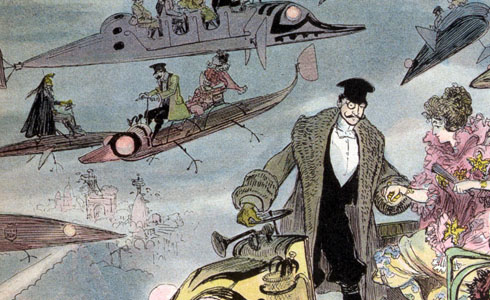
Bellamy got at least the general outlines of some future economic and technological developments right, though his Victorianism gives his vision of the future a decidedly steampunk feel. He imagines goods being bought in centralized warehouses tied together in a complex, super-fast, and efficient nation-spanning logistics system: a system managers at Wal- Mart and Amazon would certainly recognize. Bellamy envisions a kind of telephone/radio that would allow live performances to be piped in from anywhere in the country to anyone’s home. He imagines all purchases being made with something like a credit card. Although, because this income comes from the government, it has a stronger resemblance to the “Access Cards” given to the needy to purchase food, medical care, and other necessities.

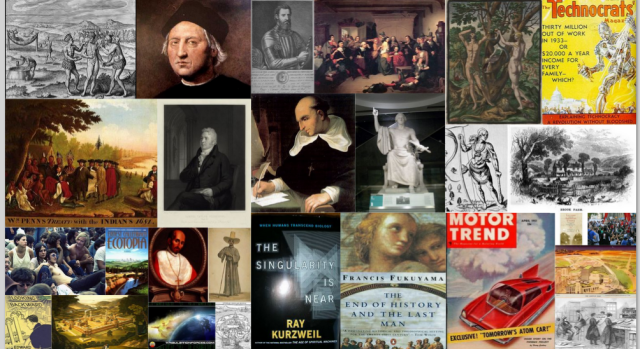
What meaning this Victorian tale could have for today is discussed in an excellent recent essay in Lapham’s Quarterly by, Ben Tarnoff, entitled “Magical Thinking. (The picture above is taken from that article).  Tarnoff thinks we can take away two things by considering Looking Backward. The first is how the novel, and the spirit which it represents, can be contrasted with our own anti-utopian sentiments, the product he thinks, of our encounter with the most horrific versions of “utopianism” in the early 20th century. The second is that Tarnoff sees the novel as emerging out of the problems of capitalism. Problems that Bellamy in his own way was trying to solve, and which we ourselves relate to in a much different way.

Rather than having ever solved those problems Tarnoff believes we have come to accept them:

The twenty-first century bears little resemblance to Bellamy’s future; the closer comparison would be to his present, to the late nineteenth century that the hero of his novel happily escapes. This was a society defined by tremendous income inequality, financial uncertainty, sleazy politics—in other words, much like our own. The contradictions of modern capitalism haven’t resolved themselves, as Bellamy assumed. Rather, they’ve become deeply embedded in American life, and the new economic world created after the Civil War has come to feel so natural, so inescapable, that even many of its staunchest critics have trouble imagining an alternative.

I agree with Tarnoff’s first point, that our ability to imagine alternatives is stunted compared to the very creative era in which Bellamy lived, but I want to qualify Tarnoff’s second point that this lack of imagination can be explained by the fact that we’ve somehow come to live with the kinds of problems Bellamy thought just couldn’t go on without giving rise to the demand for an alternative.

In our own era utopian science-fiction and political philosophy, let alone economic theory have seemingly completely parted company. There are exceptions to this- Ayn Rand has a cult following among libertarians, and Ursula Le Guin has captured the hearts of anarchists, but these are exceptions. (If anyone has other examples please, please share in the comments section).

The very word utopian is a kind of intellectual insult that means you just aren’t serious about what you are saying and need better acquaintance with the limiting reality of facts.

Taroff believes we have come to this stunted imagination because we have come to accept the kinds of economic and political conditions that Bellamy found intolerable, but this position becomes somewhat less clear when we take the longer view.

Bellamy was writing during a period of intense economic dislocation, labor unrest, and stagnating economic growth that began during the 1870’s and is known as the Long Depression. In her book Imperialism (book 2 of the Origins of Totalitarianism) the political theorist, Hannah Arendt, credits this economic crisis with the great wave of largely European imperialism at the end of the 19th century. Imperialism didn’t solve the economic crisis, and what occurred instead is that the crisis was met by a whole series of measures starting in the United States to solve some of the the endemic problems of “late capitalism”, by for instance, preventing the rise of monopolies.

Yet, truly revolutionary forces pushing towards an alternative economic system to capitalism would only come to the fore in the aftermath of the First World War, in the collapsed Russian Empire, forces that would gain traction in Western countries with the collapse of the world economy in the Great Depression. Thereafter, public policy, even in a society convinced of the virtues of free-enterprise, such as the United States, would push in the direction of a “tamed” capitalism and a more equal society in which the abuses, instabilities and inequality of capitalism were contained. Technological and demographic developments would dovetail with these efforts and result in an unprecedented period of widespread prosperity and economic calm, though perhaps also one lacking economic innovation, and certainly one of endemic inflation and general stagnation.

When this age of growth began to peter-out in the 1970s the logic seemed to be that the way back to more innovative and less inflationary growth would be to return to at least some of the conditions of capitalism in the era of Bellamy: a return to less regulated markets, tougher competition between labor- including American workers with lower paid workers abroad- a less generous welfare-state, and an acceptance of inequality as the byproduct of success in economic competition.

It should not come as a surprise at all that the kind of utopianism found in the 1950s and 60s wasn’t really proposing an alternative form of society and economics, but instead was a super-technological, Popular Mechanics, version of the consumer society that had, after all, only just come into being after the horrors of Depression and War. Nor, should it seem shocking that utopianism, again as  a serious alternative version of the current economic and political order, was so silent after the 1970s. The spirit of the times was that it was our utopian aspirations that had gotten us into the mess we were in in the first place.

Christian Caryl, in an excellent article for the magazine Foreign Policy, 1979: The Great Backlash offers the argument that the contemporary era, whatever we might choose to call it, should be dated not from the end of the Cold War or 9/11, but the year 1979. Caryl pools together some of the most seemingly different cast of characters in modern history: Margaret Thatcher, Deng Zhou Ping (the post Mao premier of China), the Ayatollah  Khomeini, and Pope John Paul II. Ronald Reagan would join this crew with his election in 1981.  Caryl contends that all of  these figures, in their very different ways pushed the world in the direction of a common goal:

The counterrevolutionaries of 1979 attacked what had been the era’s most deeply held belief: the faith in a “progressive” vision of an attainable political order that would be perfectly rational, egalitarian, and just. The collapse of the European empires after World War I and the Russian Revolution, the Great Depression, and the triumph of wartime bureaucracy and planning during World War II all gave forward thrust to this vision; postwar decolonization and the rapid spread of Marxist regimes around the world amplified it. By the 1970s, however, disillusionment had begun to set in, with a growing sense in many countries that heartless (and in some cases violent) elites had tried to impose a false, mechanistic vision on their countries, running roughshod over traditional sensibilities, beliefs, and freedoms. As a result of the late 1970s revolt, we live today in a world defined by pragmatic and traditional values rather than utopian ones.

For three decades we have lived in this world where the utopian imagination has been expelled from the intellectual field. For my money, the question is: do we still live in this world?

We might answer this question by looking at the current state of the counter-revolutions of 1979.  The Thatcher-Reagan revolution that pushed the idea of a less regulated market based society seems to have hit a wall with the 2008 financial crisis. Even before then, the idea that unleashing market forces would result in a general prosperity, rather than serve to heighten economic inequality, was already in doubt. A Romney-Ryan victory in the elections might give these ideas a new lease on life, for a time, but their administration is unlikely to solve the problems at the root of the current crisis because their philosophy itself was born out of a distinct set of economic and social problems that either no longer exist or are not the real problem: runaway inflation, the stranglehold of powerful unions, stifling regulation of the financial markets, welfare dependency. (It should be added that a continued Obama-Biden administration has no real solutions to our current problems either.)

It also seems quite clear that the capitalist revolution begun by Deng Zhou Ping in China seems to have played itself out. China is facing daunting demographic, environmental, political and socio-economic challenges that undermine its model of export led growth and one-party dictatorship. China cannot continue its rate of blistering growth because its disastrous one-child-policy has resulted in a society “that may grow old before it becomes rich”, even the slower growth it has been experiencing of late may be too fast for its fragile environment to sustain. The one-party dictatorship rather than representing the rule of wise, red-robed  mandarins is rot-through with corruption and increasingly incapable of rational decisions- China builds bullet trains, but fails to build the practical infrastructure of a city like Beijing, so that the city experiences dangerous floods in which hundreds are killed.

Post-Khomeini Iran is a basket case in terms of its economy. It is unable to engage in needed reforms- as witnessed when it crushed the Green Revolution, and though it might have gained a huge strategic windfall with the American’s foolish overthrow of Iran’s worse enemy- Saddam Hussein’s Iraq- it has seeming squandered these gains. It has squandered the goodwill of the Arab populace in the wider region by supporting its murderous ally in Syria, and by obstinately pursuing the technology for atomic weaponry which alienates Arab governments, has resulted in the US strangling the country economically, and may result in an actual attack by Israeli or US forces- or both, which will further set back this great and historic people.

Lastly, the Catholic Church which saw the charismatic John Paul II succeeded by the papal bureaucrat of Pope Benedict, has seen its moral authority eroded by its secretive response to the tragedy of child sexual abuse by its clergy. The very conservatism that
served the Church so well when it fought against communism threatens now to not so much destroy the Church as radically shrink it. Rather than focus its energies on the real problem of rapidly disappearing numbers of priests, which might be solved by embracing women, and/or allowing priest to marry, it rewrites the liturgy to make it more historically authentic. American Bishops even goes so far as to threaten Church members who do not fully embrace politically all of the Church’s thinking with “soft-excommunication” in the form of being banned from receiving communion.

A good case can be therefore be made that the anti-utopian counter-revolution begun in 1979, is in many respects, a spent force.

There are ways in which the critical observations of late 19th century society offered up by Bellamy in Looking Backward eerily resemble the problems of our own day. The novel begins with the narrator lamenting the sad state of the relations between labor and capital.

Strikes had become so common at that period that people had ceased to inquire into their particular grounds In one department of industry or another they had been nearly incessant ever since the great business crisis of 1873. In fact it had come to be the exceptional thing to see any class of laborers pursue their avocation steadily for more than a few months at a time.

What we did see was that industrially the country was in a very queer way. The relation between the workingman and the employer between labor and capital appeared in some unaccountable manner to have become dislocated. The working classes had quite suddenly and very generally become infected with a profound discontent with their condition and an idea that it could be greatly bettered if they only knew how to go about it On every side with one accord they preferred demands for higher pay shorter hours better dwellings better educational advantages and a share in the refinements and luxuries of life demands which it was impossible to see the way to granting unless the world were to become a great deal richer than it then was.  (LB-19-21)

Bellamy describes the relationship between the minority of the rich and the majority of the poor in the 1880s as that of the rich seated in a coach being pulled by an army of the poor.

The driver was hunger and permitted no lagging though the pace was necessarily very slow. Despite the difficulty of drawing the coach at all along so hard a road the top was covered with passengers who never got down even at the steepest ascents.

Naturally such places were in great demand and the competition for them was keen everyone seeking as the first end in life to secure a seat on the coach for himself and to leave it to his child after him. (LB 11-12)

How did the rich feel about the condition of the poor?

Was not their very luxury intolerable to them by comparison with the of their brothers and sisters in the harness the knowledge that their own weight added their toil? Had they no compassion for beings from whom fortune only them? Oh yes commiseration was expressed by those who rode for those had to pull the coach especially when vehicle came to a bad place in the road it was constantly doing or to a steep hill.

It was agreed that it was a great pity that the coach should be so hard to pull and there was a sense of general relief when the specially bad piece of road was gotten over This relief was not indeed wholly on account of the team for there was always some danger at these bad places of a general overturn in which all would lose their seats.

It must in truth be admitted that the main effect of the spectacle of the misery of the toilers at the rope was to enhance the passengers sense of the value of their seats upon the coach and to cause them to hold on to them more desperately than before. If the passengers could only have felt assured that neither they nor their friends would ever fall from the top it is probable that beyond contributing to the funds for liniments and bandages they would have troubled themselves extremely little about those who dragged the coach. (LB 13-15).   

The financial panic of 1873 and the economic depression that followed, the conditions which inspired Bellamy to write Looking Backward,  have been replaced in our imagination by the Great Depression of the 1930s. Aside from economic historians, few people probably even known that there was a collapse of financial markets in the 1870s ,or that it was followed by a period of very slow growth that saw acute struggles between capital and labor for society’s diminishing returns. This lack of historical knowledge is sad because it blinds us to the historical scenario that is perhaps the best analogy to our own. Whereas the Great Depression saw a financial crisis followed by severe unemployment, the Long Depression began with a financial crisis in 1873 and was followed by a generation of mass underemployment and deflation. This point that 1873 and its aftermath are the better analogy to our own day has been made by many economists-including Paul Krugman.  

The times, therefore, might be ripe for an upsurge in utopian imagination, a utopianism conscious of its own colossal failures and the crimes committed in its name.

Looking Backward: 2100-2012, anyone?

Defining Home 2

Something that has struck me over the course of the global economic crisis is the overlap between groups on the “far- left” best personified internationally by the Occupy Movement, and, at least in the United States, the “far-right” whose libertarian aspirations has been best encapsulated by Republican presidential candidate Ron Paul.

In my view of things, both the Occupy Movement and Ron Paul libertarians share a great many things in common. Both represent a systematic critique of the current economic and political order along with a strong desire to change that order. This sharing of basic assumptions by those on opposite ends of the political spectrum is not entirely new. In the early part of the 20th century the Communists and Nazis both offered systematic critiques of the then current order. What gives me hope today is that both the Occupy Movement and libertarians, unlike the Communist and Nazis, set themselves firmly against the coercive apparatus of the state both in its international and domestic manifestations.

The Occupy Movement is an anti-war movement (and war is now the constant condition in which our society exists)  in that it seeks to shed light upon and undermine the current practice of real politik and the injustice of American empire. The libertarians want, quite literally, to bring all of the boys home, that is to unwind the American empire and its globe straddling military apparatus that has been in existence since the Second World War.  Members of both movements hold deep respect for the dissident Julian Assange, and are deeply troubled by the increase of the state’s powers of covert surveillance and control.

Both movements seek an end to the collusion of finance and governments and the cronyism found in the relationship between the state and corporations. They both hold that the state should have little, if anything to do with the choices of individuals, and oppose use of the coercive powers of the state i.e. imprisonment to punish people for those choices, such as drug use.

The members of both movements, also, tend to be young, no doubt a reflection of the fact that this crisis has been particularly hard on the youngest members of society many of whose aspirations for the future have been clouded or destroyed by the crisis.  However, in this sad fact also lies my hope. For, if these young people, unlike the generation of the 1960s that abandoned their critique of the system for what was largely a return to the status quo, can hold firm to their principles then they might eventually bring to the system deep and truly systematic change.

In that vein, I hope the conversation below between two young and articulate voices from both sides of the political spectrum represents, in its very small way, the beginning of a philosophical discussion that rises above the sophistry of the current regime.

The discussion was sparked by a prior post Defining Home after which I tried to bring these two deep thinking bloggers into discussion (the dialogue below in its original form can be found in the comments section there).  On the surface the two could not be more different. Giulio Amerigo Caperchi is an Italian-American living in Italy who writes the excellent blog Geaneology of Consent  which looks at current events from the perspective of the political theory and represents an excellent window into the types of ideas that underlie the Occupy Movement. Henry Moore is a fervent Ron Paul supporter hailing from Yellowstone country, and a thoughtful voice for the sentiments of libertarians who writes for the blog http://keimh3regpeh2umeg.wordpress.com/.

The discussion below lays out the differing views of the two sides on the nature of and our relationship to the free market. This is the chasm that currently separates the Occupy Movement from libertarians, and, in my understanding only when this chasm is bridged will we really have a real possibility of any systematic reform of the crumbling world of the early 21st century.

_______________________________________________________

Giulio:

One of the key assumptions running through classical liberalism and neo-liberal theory (from Adam Smith, through Hayek, up to Milton Friedman) is that the market is the only place where true, spontaneous and un-biased information may be witnessed and analysed. The market, for these economists, is a site where individuals freely interact (“trade, truck and barter” as Adam Smith said) unhindered and on a completely voluntary basis. As such it is the only place where “real” human behaviour is expressed: “reality” thus occurs in the marketplace. The market is conceived as a neutral ground devoid of ideology and political influence.

This is a tremendous assumption with far-reaching consequences. And, more importantly, it is a key ideological manoeuvre. What neo-liberals like to claim is that seeing that they derive their social policies from feedback accruing from the “neutral” free market, they are ideologically un-biased. They contrast themselves to “big-government central planning” and socialism which apply one-size-fits-all social policy to intrinsically diverse populations. The crucial point is, however, that basing social policy on the utopian idea of perfectly working, self-regulating and unbiased free markets is itself a sublimely ideological assumption. The neo-liberal free-market is a utopia as much as the communist classless society is. In this respect forcing societies to conform to the rules of the free-market is itself a one-size-fits-all policy.(Joseph Stiglitz is probably the most important economist which shows that markets are VERY imperfect and VERY biased).

This is not to say that one should be completely relativist and refuse the idea that there is nowhere that one may garner social feedback with which to inform policy. But the deconstruction of what experts and technicians call “reality”, “truth”, and “natural law” is always necessary to reveal the ideological bias ALWAYS present in any idea, concept or science.

I therefore totally agree (Rick) with your powerfully stated conclusions, namely, that there is the need for constant discussion and deliberation on these “assumptions” which inform our private and public lives. The democratization of these assumptions is critically needed to reveal their ideological underpinnings and their nature as instruments (sometimes) of domination. That is why epistemological sovereignty (mostly at the local level of course) is a key instrument of resistance and a safeguard against the excesses of what experts (be they in Washington, in a university or on Wall Street) call “truth”.

Henry:

Giulio,

To me “neoliberal” is a loaded word. One that I am not ashamed to cast about myself, particularly for “Supply Siders” and other assorted Friedmanites. I do not put myself in that camp, though as an Austrian School lay-enthusiast, I see some common ground, though not as much as I would otherwise like.

I don’t know much about what neo-liberals think in terms of whether “the market is the only place where true spontaneous and un-biased information may be witnessed and analyzed.” I guess it really comes down to how you define “market”. Markets in the purely economic sense? Or markets in the more abstract sense?

If the former, and if your claim is correct, I would say that neo-liberals are quite narrow minded. If the latter, I would tend to agree with the neo-liberals. If this more abstract, conceptual marketplace, essentially an (I am loathe to use the word) aggregation of human action is indeed the only place to witness spontaneous and unbiased information, it is precisely because of how broad an idea it is. This is where the Austrian School often faces the most criticism: the theory that all human action can be deduced using the same (or superficially dissimilar) axioms as purely economic action.

So basically, ALL human action, spontaneous or otherwise is seen as part and parcel of the marketplace (which could, in effect really be an infinite amount of smaller marketplaces). Given this axiom, it is impossible for human action to exist outside of the marketplace, by definition. Based on this, the market would be the only place to witness spontaneous information.

And then there is the question of bias. Bias exists in the market. Whether this is desirable or not depends entirely on the human actors themselves. This includes those acting spontaneously and those acting more deliberately. Those acting deliberately (such as the state, regulators, corporations) are able to cause undesirable bias by distorting the market. They cannot do this without committing, perpetuating, or taking advantage of some form of coercion, explicit or implicit. At which point the FREE part of the Free Market goes out the window.

Under ideal circumstances, which may not even be attainable on a large scale, biases that occur are simply a reflection of the decisions of market actors. I fail to see the problem. If there is good, good. If there is bad, the fault is in the actors, not the system. I don’t think most libertarians believe in the perfectibility of the human condition, which to me is the defining characteristic of a utopian ideology. And certainly most would not suggest that the Free Market alone could accomplish this. Most hold that the Free Market, whether it might be considered to have inherent flaws or not, at least is the best allocator of resources and cause of economic growth. But the main reason some prefer the Free Market has little to do with how effective it is in these areas, but instead the fact that it is the most consistent with what are seen as natural rights. Some, myself included, would still advocate the Free Market even if it was not the “best” system for allocating resources and spurring growth. It is not the practical implications that are our chief concern. It is the ethical ones.

I agree that Markets are not, as you say, “perfectly working, self-regulating and unbiased”. I do hold, however that Markets are the best of all possibilities, but this is not perfection. That markets self-regulate to a point, which happens to be the same point at which the word FREE goes out the window. That bias is not undesirable, per se.

I am sure that you and I agree more than we would disagree on many an issue, this one included. It is not my intent to argue, though I am happy to engage in discussion. I am only here to express another point of view for the benefit of this blog’s readers and to, in someone else’s words, engage in a civil exchange of ideas between bloggers.


Giulio:

Hi Henry,

Thank you for your wonderful and very articulate response. You are indeed right, we do agree on many respects.

Essentially, what I am arguing for, and the chief reason I criticize utopian strands of free-market ideology, is for the separation of the the political sphere from the economic, and the refusal of subsuming politics and the public sphere to economic imperatives.

I do not agree with the fundamental neoliberal axiom that all human action may be explained in terms of rational individuals freely pursuing their interests. Coming from a more communitarian perspective (think Michael Sandel for example), there are certain types of behaviour that cannot be rationalized through market motivations. Patriotism and sacrifice, for example, elude the idea of rational interest-motivated behaviour. The virtues informing classical citizenship, also, are not informed by market behaviour but by respect and allegiance to the public sphere and to the common good of the “demos”.

More importantly, something like the social contract and the erection of democratic a order are not a spontaneous acts arising from the state of nature (as some neo-liberals and libertarians have it -think Nozick), but a conscious political effort of collective human agency.

On the question of bias, we thoroughly agree: very few believe in the infallibility of human behaviour and that there won’t always be bias/asymmetries/coercion in our societies. I also agree that it is not inherently the fault of the free market. However, I do think that a society informed by the rationale of laissez faire is more inclined to exacerbate such power imbalances that we naturally find in the human condition.

Finally, I am not arguing against the free market per se. But I am arguing that in CERTAIN domains the free market is NOT best suited to allocate resources or inform behaviour. For example (and here comes my European bias) healthcare, basic public transportation, the military, certain infrastructure, water provision, education, and the right to food are services and issues so essential to the unity and stability of the modern nation state that they cannot be exposed to the imbalances/biases/asymmetries inherent in the free market. In addition, I do not think that the free market is always most consistent with regimes ensuring natural rights. The ethical implications of natural rights, for me, do not arise spontaneously from a system of free-markets but from a united and concerted discussion within democracies on which ethical paradigm(s) best applies to particular contexts.


In conclusion, I agree with your final remarks saying that markets are not perfect but that they are better than many other catastrophic politico-economic systems witnessed throughout history. But we cannot remain blind to the economic and financial catastrophe caused by unbridled and corrupt free markets (with governments thoroughly compliant of course) unfolding before our very eyes. Yes to free markets – but constant vigilance of its inherent excesses (as in all things).

I therefore think that we must have a public discussion on WHERE markets are best suited to allocate resources and promote growth/innovation/creativity, and where they are not. While I am not a fan of government regulation (and this is my libertarian side coming out), prudential limits and legislative boundaries are essential to our stability as a nation and as a united people. Therefore, as Rick says in his post, we should have a public discussion on whether the neoliberal axiom we have discussed earlier should in fact inform societal and governmental behaviour.

Many thanks for taking the time to answer my points and engage in this fruitful discussion. Indeed this is what democratic deliberation is all about. I really do think we don’t disagree that much and that we both favour a democracy and an economic order where liberty is indeed maximised.


Rick:

Henry,

What I am curious about is this: I know from reading your blog that you are strongly anti-interventionist in terms of the government trying to manage the economy, and hold that many of the large-scale economic crises we have experienced were brought about by government interference in the market.

But do you think this always the case? Are markets, in your view, not so much perfect as impervious to catastrophic failure insofar as they are not subject to government distortions? Has the government no or only a minimum role in cushioning the public from such crises in your understanding?

Some further questions: Do you not hold the view that what are termed neo-liberal policies have the consequence of exacerbating sharp economic inequality? If you do believe neo-liberal policies can result in rising inequality why is this inequality not a danger to the survival of the market based society you wish to promote? At some point, it seems to me, some level of equality is necessary for the survival of the market itself. Isn’t it in a sense true that this is what natural property rights are meant to protect? Wouldn’t the right to hold property contradict itself in a society where only a tiny minority actually held property?


Henry:

Rick,

Please understand that I approach Free Markets from a Libertarian position, rather than an Egalitarian one. That is, from a love of liberty (which is simply the result of others’ duty to not aggress), regardless of its consequences, rather than a love of equality (which has many forms, some of which seem not to be compatible with others, and some which may be incompatible with liberty). Having said that, libertarianism and egalitarianism are not mutually exclusive. In fact, there is a “leftist” school of thought that emphasizes both. The left-libertarians, particularly Market Anarchists argue, pragmatically, that markets are best because they lead to equality and social justice, that monopolies rarely come into existence, and that when they do, it really is because they are the best and most efficient at what they do, rather than because their cronies did them a favor. To them, it is regulations that truly cause monopolies, rather than protect against them.

More right-leaning anarchists and libertarians (such as myself) would tend to agree, but with the caveat that even if markets did lead to inequality they are still better because they do not violate the non-aggression axiom. However, my heart does bleed more than others I could name.

Wikipedia says, “Neoliberalism is an ideology based on the advocacy of economic liberalizations, free trade, and open markets. Neoliberalism supports privatization of state-owned enterprises, deregulation of markets, and promotion of the private sector’s role in society. In the 1980s, much of neoliberal theory was incorporated into mainstream economics.”

Looking at the first sentence, it would seem that the libertarian groups I mentioned above all fit neatly into this camp. But neoliberalism, especially as it has been incorporated into mainstream economics does not seem to have much common ground, apart from a few general principles, with the more fringe (anarchists, deontological minarchists) elements of Free Market advocates.

First, Neoliberalism tends to accept things the way they are, even while advocating for a change of hands, from the public sector to the private sector. If there is already a monopoly, regardless of how it got there, so long as it is not a public entity (on paper), all is well. That is their take on economic liberalization. Rather than lead to inequality, this enshrines inequality that already exists.

Second, free trade to a Neoliberal, is not free at all, it is managed, often heavily-managed trade and consistent with the ideas of a state-corporate partnership that resembles a “benign” fascism, i.e., crony capitalism, and entangling alliances. That is not to say that one form of managed trade isn’t better than another form, but to call either free trade is a mockery.


Third, the concept of an open market is not the same as that of a free market. A free market is an open market that is always subject to market forces, and in that sense they are the same.

But an open market could in theory be a part of any economic system so long as none (perhaps meeting certain requirements like competency, liquidity, and/or competitiveness, perhaps not) are denied the right to enter that market as a merchant. Also, the otherwise laudable idea that all markets should be open markets leads to the more contemptible idea that “closed” markets should be forced open. This can amount to forced trade, or at the very least trade that favors one party over the other. Another variant of legal plunder.

Fourth, privatization of state-owned enterprises, may be all well and good for things such as railroads and communications and resources, but in the case of an entity that should not exist in the first place (Federal Reserve System, Federal National Mortgage Association, Federal Home Loan Mortgage Association, to name a few), privatization is just another road of economic fascism.

And finally, deregulation can mean any number of things. It can mean deregulation of certain entities or industries and not others, which is picking winners and losers. It can also mean the removal of regulations that were in place to paper over the problems caused by other regulations, or to remove the original regulations and leave the ones that only came about as a result of the original ones, when this may be a considerably worse thing to do than to just leave them all or remove them all. This sort of occurrence is fodder for the mainstream media which can then claim that deregulation is causing economic mischief and miscalculation.

So Neoliberalism, as practiced, does seem to promote inequality. Not a gradual inequality emanating from true competition and market forces, but an already present inequality solidified and then worsened in the process of so called “liberalization.”

Inequality such as this is indeed a danger. Partly because the sheer scope of it may squeeze out competition, thus harming potential competitors and consumers, and partly because it was brought about through coercion.

Some level of equality (though I am not sure how one would measure it) may be necessary to the progression of a market based system. If different players do not at least have similar chances, the one with the best chances will necessarily end up on the top. By the same token, if their chances are roughly equal, they can compete and keep the others from crowding them out. Even so, it is very hard to maintain front runner status, even with a huge head start (in terms of resources or capital), without being artificially propped up. There will always be those smaller (unequal) entities that are just able to do things more efficiently, provided the larger entity does not have some regulatory body fixing prices in its favor, which is just one example of being artificially propped up.

Can markets have serious downturns or crashes without large scale government intervention? The answer is yes. But something (the market, to me, is not a “something”, but rather the absence of “something”, it is negative, not positive) still must be the cause. Put in place of government intervention either wide-scale fraud or groupthink. I see no reason why these wouldn’t cause problems. But there are several differences between these things and government intervention.

Whereas the failures of government intervention can be used to excuse even more of it, when fraud or groupthink occur, because they are not thought to have the same irreproachable nature as the state, they are more readily dealt with. A downturn caused by government just leads to more such intervention and more problems. Look at the dot-com boom and bust. The government’s and the Fed’s policies resulting from it led to our current housing boom-bust, and those same policies in reaction to that are now leading to a sovereign debt boom and soon to be bust. But con artists and highly speculative fads, because they do not have power over whole jurisdictions simply cannot create as big of problems. And because they are not quite so sacrosanct as the state, they will be discovered, understood, and dealt with, and will have no chance of using their own blunders to save or perpetuate themselves.

In the case of fraud, there should be laws protecting against it, but they should be defensive in nature rather than aggressive. They should not forbid every single action that could, in theory become fraudulent, as they would tend to weed out perfectly safe and moral economic actions. And in the case of irrational or risky manias, no law can protect against these. There are too many variables. Should the Dutch government have banned tulips or the cultivation of tulips or any activity related to tulips even if it had known tulipomania would lead to a bust? But even in that example, the monetary environment was distorted by debasement of the currency. Crooks and speculators (who, unlike the former, serve a valuable purpose in the market) will always exist and always be problematic, but when they are enabled with regulations protecting them from bankruptcy and granting them monopolistic privilege; or with an elastic currency encouraging their risk-taking and misallocation of resources, then doesn’t the blame fall on the enablers as well?

That the government should cushion the blows of its own making is just another way it can get its foot in the door and create more distortions. I do not think the government should have the role in bailing out industries, especially when the time is coming when the government will be the one that is in need of a handout. I am a little less inclined to criticize welfare programs for their economic effects (which, as with a bailout or stimulus, are negative), as much as for their lack of necessity. I don’t see why charity and initiative (as opposed to just one, which may be insufficient) can’t more than replace welfare programs, especially in relatively normal economic times. During a crisis, drastic measures may be more necessary, but only because of how dependent some have become during more stable conditions.

I apologize for being so long- winded in answering your questions. When I really thought about them, they were much harder to answer than I thought they would be. To be honest, I wish I could say even more, but for both our sake I will leave things as they are. I also apologize for not answering things in the order you asked them and for stringing out some of my sentences.

Rick:

Giulio,

What I am curious about is this:

I know from reading your blog that you are especially interested in finding alternatives to the current economic and social order which you find to be dominated by corporate interests which use the tools of the state for their own ends and suppress what might be called “forms of living” that emerge spontaneously and organically from the people. I am thinking here of things like peasant movements and organic farming. Knowledge, in your view, is often an instrument of power.

My questions are, though you reject the idea Henry promotes that property rights are the basis of natural rights: Is there any natural limit to the power of the state acting as an instrument of the people to demand use or regulation of the property held by individuals? If yes, what limits do you think these might be? If no, is how is this not a kind of tyranny of the public, and why will it not give rise to the same sorts of injustices and epistemological imperialism you see now originating from the free market only now from a different set of players- bureaucrats, democratic factions, ethnic groups etc?


Giulio:

I thoroughly believe that there is absolutely no natural limit to what the state’s power can be used for. Be it guided by private, ethnic, religious or public interests, the modern state remains fundamentally a coercive apparatus with absolute sovereignty over its territory and citizens (in its classical Weberian definition). If an egalitarian-minded political movement claiming to represent “the people” were to take power tomorrow morning, there would be no internal or “natural” principle limiting its power: it would most probably coercively redistribute the hard-earned property of the well-off and may very well impose its own epistemological imperialism. History is rife with such occurrences.

My central point, however, is that principles of limitation of public and private power do in fact exist. The Declaration of the Rights of Man, the Declaration of Independence, the US Constitution, along with most of modern legal orders clearly limit the power first and foremost of the state (these were, after all, documents enshrining principles defending the private citizen from arbitrary power of centralized monarchies). In addition, most of the greatest minds of the enlightenment (both liberal and egalitarian) such as Montesquieu, Locke, Rousseau, along with practically all of the American Founding Fathers saw the separation of government’s powers as central to the architecture of any democratic nation.

So the first effective limits to state power come into existence with the birth of the modern democracy. We may safely state that the aforementioned “fathers” of liberal democracies were primarily concerned with the state NOT falling into corrupt hands (be them egalitarian or private-minded). Madison’s famous essays in the Federalist Papers are a prime example of this.

The limitations to state power are therefore, in my personal opinion, not “natural” limits based on axioms of non-aggression or conceptualizations of personal and property rights as libertarians have it. Rather, they are principles born out of historical struggle and resistance against various forms of oppression (in the enlightenment it was against absolutism and aristocracy). These principles may be “self-evident” and “universal”, but they do not exist in a void: if government were to retreat to nothingness tomorrow morning we would not in fact be left with our inviolable personal liberty. Liberty, as French philosopher Foucault once said, is relational: it exists solely in virtue of its mutual recognition.

This act of recognition is thoroughly a positive act, as it is born out of political struggle and out of democratic deliberation. Indeed, the recognition of rights to one another is the basis of a democratic society, of the social contract and is the very “stuff” of democracy. Thus, any limitation to the power of the state, for me, is not based on “negative” rights but on positive democratic deliberation over what those limitations should be. Which brings me to why I do not agree with libertarian tenets. Even though I agree with libertarians in asserting that government is essentially a coercive apparatus, I don’t believe that its simple retreat will leave us with more liberty. It is not a zero sum game of: more government = less liberty; or, less government = more liberty.

In this conceptualization, when government retreats out of the individual’s life we are left with the free market. But the free market is not a “negative” domain devoid of interests, morals and values; rather, it comes laden with specifically free-market ethics and morals (or lack thereof). For example, in the domain of free markets liberty is not primarily understood as the relationship between free and equal citizens in the public sphere, but is rather defined by, and exercised through, the exchanges between rationally motivated individuals pursuing their self interest. This is a momentous change in the very conceptualization of the citizen and her/his relationship within society.

In conclusion, I therefore argue for increased democratization of the spaces in which individuals interact: be it government or free market. The principles limiting the domains and extents of the public and the private are never given but always negotiated, fought over and forged through political contention. Let us use our democratic instruments to participate in the definition of our public and private life and not retreat to what some consider a “natural” form of human existence. What some deem “natural” (as some proponents of free markets do) is, in my personal opinion, an ideological paradigm no different from the ones we are familiar with today. For me, it is better to define our nature collectively through democratic means in positive political acts rather than allowing “natural” forces -such as inequality- strip us of our personal liberty and collective self-determination.


I thank you again Rick for allowing me to be part of this enlightened discussion, and please excuse me again for this late response. And Hank, thank you for clearly stating and elegantly expounding many of the key points of libertarianism, as well as helping me understand some of its areas which I had previously not been acquainted with. Although I do not agree with all libertarian tenets, I do remain fascinated by it and will now study it in a different light.

Henry:

You guys have been great and this has been a very informative discussion.

_____________________________________________________________

It is my belief that these are precisely the kinds of conversations we should be having, and I would like to make it a permanent feature of this blog to do so. If readers are interested in these types of conversations both through text, and perhaps actual discussions via SKYPE or some other medium, shoot me email: rsearle.searle@gmail.com. I hope to make this feature available on Utopia or Dystopia starting sometime this fall.


Rick Searle

Republic of Insects


There is a scene in Plato’s socratic dialogue, Phaedo, in which Socrates and a handful of his followers are discussing reincarnation. Phaedo, by way of explanation, is a moving dialogue which discusses the topic of immortality. Part of what makes it so moving is that it occurs on the eve of Socrates’ execution by the Athenian democracy for practicing a form of philosophy that many Athenians felt was a threat to their very existence: questioning its gods, its morality, its way of life.

In the scene discussing reincarnation, Socrates is trying to argue that where the soul of an individual finds itself in the next life is directly tied to its virtue, or lack of virtue, practiced in its’ prior life. Classic karma: human beings who practice virtue, but not philosophy, during their lives will have the happiest of lives to follow of all but the philosophers. He defines the happiest life this way:

Socrates: “I suppose the happiest people, and those that reach the best destination, are the ones who have cultivated the goodness of an ordinary citizen, so-called ‘temperance’ and ‘justice’, which is acquired by habit and practice without the aid of philosophy and reason”.

Cebes: “How are they the happiest?”

Socrates: “Because they will probably pass into some kind of social and disciplined creature like bees, wasps, and ants; or even back into the human race again, becoming decent citizens.” (141) [emphasis added].

The fact that Socrates thinks the better part of humanity, again excluding the philosophers, who he thinks will get off the wheel of birth-death-rebirth permanently, will find themselves in the bodies of bees, wasps, or ants and not what we would more likely consider a more noble animal- say lions, or wolves, or some such thing, probably strikes most of us as odd. Maybe Socrates is having a little fun at Cebes expense, we might ask?  After all, why in the world would any good person, even if they weren’t a philosopher, want to live the life of an ant?

One person who might understand what Socrates (or Plato speaking for Socrates) was getting at, who might even want to, if only for a brief period of time, actually live the life of an ant (who in fact did, imaginatively, in a section of his novel, Anthill) is the famed biologist, E.O. Wilson, who has made the study of ants and other social insects his life passion.  But Wilson is not merely “the king of the ants” .

Wilson is a public intellectual of the first order bringing the findings of the biological sciences to a general readership since the late 1960s. A scientist with a deep respect for the arts, he has tried to bridge the gap between science and the humanities (Consilience), and science and religion (The Creation).

He has also not been without controversy, being the founder of the field of sociobiology that attempts to explain human behavior from the standpoint of genetics and evolution (Sociobiology & On Human Nature).  The effort to explain human behavior in terms of biology, which Wilson helped start back in the 1970s, quite rightly, engendered a period of spirited opposition given the horrors that had emerged from the Nazi embrace of biological and evolutionary theories regarding the nature and future of humanity only a generation before. In our own day, these debates appear to be largely forgotten, and sociobiology has proven able to hold its own against less biologically inclined schools of social thought. Wilson’s latest book, The Social Conquest of Earth, however, might have the unintended result of reigniting these controversies, and leads one to doubt if the dangers implicit in socio-biological thinking are not as potent as ever.

At 83, Wilson’s, Social Conquest, may be his last major work. Its ambition certainly makes it seem that way, for in his book, he not only offers a major (and controversial) revision of the theory of evolution, he sets out to explain humanity itself- its culture, religion, art, and good and evil duality- all within the context of his new evolutionary theory.

What he did not intend was to give us insight into the meaning of Utopia, especially the earliest and most powerful Utopia ever conceived- Plato’s Republic. With Utopia being one of the subjects with which this blog is mostly concerned, I will ultimately focus on that, but let me begin by explaining what Wilson was definitely trying to say with his Social Conquest.

This, with some simplifications, is the way Wilson tells his story: Socio-biologists have, since the beginning, attempted to explain animal, and much more so, human behavior, in reference to evolution. They were able to make great strides, but one problem kept popping up, the problem of “goodness”, or better, they had no ironclad way to explain why goodness, or to use the fancier phrase- altruism- was so prevalent in the natural world. To state the matter crudely:  If everything in nature was supposed to be about passing on genes, then why, do people help others when there is no clear reproductive benefit in doing so? Why do firemen rush into burning buildings to save children who are not their own?

Many socio-biologists thought they had the solution when they came up with an idea called “kin-selection”. The idea is that people help others because they share identical genes, or that such aid somehow contributes to passing on their genes. The firefighter seems to risk his own reproductive future, but is actually trying to save it because the children in the burning building are really his nieces and nephews. If they are not, in fact, his nieces and nephews perhaps he is “confused”: his idea that he should save them a kind of hold over from the period in history when human societies were so small that any children he knew would have likely been close relatives.

The problem for socio-biologists is that, although the theory seemed to hold up pretty well for almost all animal behavior, (cute pictures of mother dogs raising tiger cubs aside) there were a lot more anomalies to the theory of kin-selection than just the case of brave firefighters when it came to human beings. To give just a short list of examples: how does one explain any war above the tribal level,  or celibate classes such as priests, or homosexuality? Shouldn’t there be pretty strong evolutionary pressure for individuals to distinguish between who is a relative and who is not, and only sacrifice their own reproductive future for the former? Socio-biologists kept tying themselves in knots trying to explain why human beings just didn’t seem to act like the theory of kin-selection said they should act. Wilson, thinks he has figured out how to untie these knots, and he has done it, no surprises, by looking at bugs.

Things is, in addition to human beings, who socio-biologists had a devil of a time fitting into their model of kin-selection, there is a very small group of insects who similarly resisted explanation under that same model. These insects who resisted explanation under the theory of kin-selection are the so-called eusocial insects. In terms of insect species they are a mere handful among millions and are largely composed of the: ants, termites, bees, and wasps (which, with the exception of termites, are exactly the “social and disciplined” insects Plato seems to hold as analogous to humans in his Phaedo.) Though only a small number in terms of species, their biomass is rivaled only by us human beings.

What makes eusocial insects so unique is not only that these insects live in colonies, but that the vast majority of their colonies’ populations foregoes any sort of reproduction at all. Instead, individuals devote themselves to the survival and “prosperity” of the colony as a whole: something that not only throws those the kin-selection crowd for a loop, but appears impossible under the theory of evolution as currently understood.

Wilson thinks he has found the solution to this conundrum, and in the process to have uncovered the root of human nature as well. His solution is something called group-selection. The long and short of it is that eusocial groups are under evolutionary pressure to develop altruism internally and competition externally. Species that have obtained a high level of internal altruism are poised for a remarkable level of complexity, and scale. (If you doubt it just take a look at the Leaf Cutter Ant). More of their collection of genes survive, and therefore, while any particular “individual” is likely to take a reproductive hit by belonging to such a group, in the aggregate more genes survive.  Eusociality is, therefore, an extremely effective evolutionary strategy. The reason it is so rare is that it takes a very peculiar evolutionary path to reach it because it flies against the grain of the standard evolutionary imperative for the individual to reproduce at all costs. Wilson claims that we humans too are one of those rare species that exhibit this quality of eusociality.

In his Social Conquest, Wilson lays two parallel journeys followed through what he describes as an “evolutionary maze” to reach the improbable state of eusociality by both the social insects and ourselves. I will not go into the details, but needless to say, Wilson sees the same forces of group selection he identifies in the eusocial insects to be going on in us. Human groups do better against other human groups if their members are less selfish towards one another and willing to sacrifice even to the point of surrendering the opportunity to reproduce- for instance someone willing to risk their life, before having children, in war.

But, if Wilson proposes that we are restrained, even to the point of sainthood to those of our “tribe”,  he holds it is a moral free-for-all outside because we are evolutionarily wired to be aggressive against outsiders, for here our evolutionary, individualistic imperatives take precedence. Wilson sees these contrary pulls as the origin of the angel/demon duality that appears a defining feature of the human condition.

Wilson writes in The Social Conquest :

The dilemma of good and evil was created by multilevel selection, in which individual selection and group selection act together on the same individual but largely in opposition to each other. …

Group selection shapes instincts that tend to make individuals altruistic towards one another (but not towards members of other groups). Individual selection is responsible for much of what we call sin, while group selection is responsible for the greater part of virtue. Together they have created the conflict between the poorer and better angels of our nature. (241)

Here I think we can see some of Wilson’s Baptist upbringing shinning through. I have multiple objections to this reading of human morality, not the least of which is that most sins are committed against people we know. Bad husbands beat their wives, not the women in a neighboring village etc. Nor, is there mention at all in Wilson’s book that his theory is opposed by the majority of socio-biologists and is thus scientifically controversial.  But I will set these moral and scientific objections aside for I think Wilson has provided us with a very important window into the idea of Utopia, so let me continue with that.

There is no mention of Plato in The Social Conquest, nor does the word Utopia occur even once, though, both, certainly should. Plato, as I will try to show anticipates Wilson’s Eusocial theory by 2,500 or so years, and in turn has placed the conflict between “group and individual selection” at the heart of the Utopian tradition from its very inception.

To provoke flashbacks of your Philosophy 101 course in college; Plato’s Republic lays out the structure of what Plato believed to be the perfect state. Now, in what follows, I do not want to suggest that the Republic is merely some piece of ancient entomology projected onto human society- I am well aware that the Republic is much, much more than that. I am merely pointing out that Plato wants to resolve something like the eusociality/individual Selection conflict that Wilson draws our attention to. More than that, Plato wants to solve it once and for all and make the new society unchangeable, like a bug frozen in amber.  To identify and solve this problem Plato had many models available, and as the Phaedo quote above makes clear, one of these models Plato had on hand was an entomological one, and he even used it directly in the Republic as I will show in a minute.

The Republic imagines a three tiered society composed of philosopher-rulers, the Guardians, the military, Auxiliaries, and under them a much larger producer class which will contain artisans, farmers and the like. While it is unclear what exact arrangement obtains for the producing class, Plato achieves almost perfect eusociality for his Guardians/Auxiliaries (who because Guardians emerge from the Auxiliaries the two can be treated as one in most respects).

Individual selection, that is the tendency for individuals to chose in favor of the reproduction of themselves and their own genes, is completely stripped from the Guardians/Auxiliary class through the control of breeding- that is, the mates of  Guardians/Auxiliaries are chosen based on social rules and regulations for breeding the healthiest offspring- not based on the individual’s choice of or ability to win a mate. The genetic origin of children are hidden from the Guardians/Auxiliaries, so that they will not show particular favor to their own offspring, and private property among the Guardians/Auxiliaries is eliminated, again, so this class is discouraged from following individualistic ends.

This extremely cohesive eusocial class of Guardians/Auxiliaries sits on top of a much larger producer class, much like the queen sits atop an insect colony. It is clear that the survival/propagation of the Guardians is the main purpose of Plato’s social arrangement,
just as the insect queen is protected and provided for by warrior and worker insects.

Plato severely limits the size of ideal state, which leads one to wonder what will happen if the producer class grows too large as long as we assume that their breeding too is not regulated by the Guardians? The idea of the danger of “drones” is found throughout the Republic– indeed Plato characterizes the disintegration of the non-ideal state as a growth in the population of human drones. (Drones are insect members of a hive that contribute nothing to the hives’ overall well- being, indeed can attack and destroy the hive from which they get their sustenance.)  We can get an idea for what Plato’s Guardians/Auxiliaries will do with human drones who get too numerous, fail to produce, or engage in criminal behavior/rebellion in his advice to the statesman:

…. and the State-physician, or legislator, must get rid of them, just as the bee-master keeps the drones out of the hive (Republic, 507).

In my reading of it when the producers get too numerous, or when some producers refuse to work or rebel they will be expelled from the Republic, and one can expect that if for some reason they can’t be expelled they would likely face an even worse fate.

The eusociality which Plato discovered, perhaps in part by looking at the social organization of insects, has been a hallmark of many Utopias ever since. But one is left to wonder whether Plato, and now Wilson, have really articulated something true about the human societies or merely found an example, in the world of insects, of the kinds of perfectly hierarchical and harmonious societies they wish human beings lived in, and in the process imagined us as more like insects than is actually the case.

One should never forget that democracy effectively murdered Plato’s friend and mentor, and thus became the target of revenge for an unparalleled genius able to articulate compelling visions of its opposite. Wilson, for all his genteel reasonableness in a world of fanatical hotheads appears to be no fan of democracy. Writing to second the views of the mathematical theorist Herbert A. Simon, Wilson states in The Social Conquest:

…hierarchies work better than unorganized assemblages and that they are easier for their rulers to understand and manage.  Put another way, you cannot expect success if assembly-line workers vote at executive conferences or enlisted men plan military campaigns” (99)

Such a statement might not amount to any kind of anti-democratic claim against Wilson, after all, even the most participatory form of democracy ever known, Plato’s Athens, thought experts should direct certain areas of human life, though they judged areas where true expertise existed, and thus should be deferred to, to be quite limited. But, given that the word “democracy” appears not even once in The Social Conquest, given that Wilson only mentions ancient Athens in the context of their brutal massacre of the Milesians, we might reasonably start to have our doubts.

Accusations that Wilson was misapplying what he had learned from his thoughtful gaze into the alien world of insects onto the much more complex society of human beings, and by such  simplifications was implicitly providing a naturalistic justification for the most insidious, if not necessarily most brutal, forms of hierarchical control and oppression, are nothing new and have been around since the 1970s.

Sadly, what may very well be Wilson’s last great work has done nothing to dispel such suspicions.

* Explanation for the picture above: According to Greek Mythology the Myrmidons (or “ant-people”, also “ants-nest”. ), according to one legend, were a people created when Zeus took the form of an ant and seduced the Princess Phthia. The Myrmidons were a fierce warrior-people, and their name later came to mean “a loyal follower, especially one who executes orders without question, protest, or pity – unquestioning followers.”

The illustration above is a science-fiction style rendering of a Myrmidon by the artist Russell M. Hossain.


Pagels’ Revelation 2, On Violence and Utopia

To return to the questions in the prior post:  Who was this John of Patmos, as he identifies himself, author of Revelation, and why did he write this strange book? As all reputable Biblical scholarship makes clear, he was not the disciple of Jesus named John, and/or the author one of the four key texts in the New Testament, the Gospel of John.

John of Patmos was Jewish believer in the message of Christ, that is, not quite yet a Christian (more on that in a bit).  Given the time in which he was living, and the beliefs he had adopted, his idea that the end of the world was at hand was no mere fantasy of the delusional, but reflected real, and current events. He seems to have written, first and foremost, for the reasons he said he had- to warn “all who could hear” about what he believed was the coming end of the world.

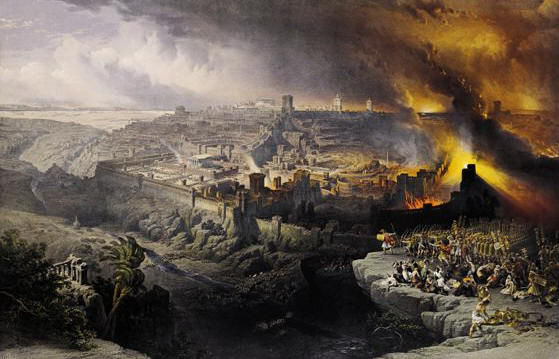
He was writing around 90 AD, and may very well have been a refugee from the incredibly violent Roman siege, starvation, and destruction of Jerusalem in 70 AD. Jesus had predicted the destruction of the famed Jewish temple in that holiest of cities- “that not one stone would remain”, and in essence it had happened. (Pagels believes this prophecy reported in the Gospels to be legit, and not, as some think a later embellishment R10).

The war in the homeland of the Jews, then called Judea, had broken out four years earlier as a rebellion of intensely religious Jews, known as the Zealots, who sought to throw out the Romans and establish a kingdom of the godly on earth. It was perhaps the world’s first truly civilizational religious war:  in part sparked by what many Jews considered to be Roman sacrilege of Jewish religious norms, whose rebels aimed at creating a religiously based political community to be ruled by their hoped for coming messiah. It was a revolt that was ultimately crushed by the Romans who in doing so took direct aim at the Jewish religion: desecrating its holy sites and burning its most sacred temple to the ground.

John may have seen this destruction himself, and even if he did not, he certainly had met the scores of refugees from the Roman war on the holy land. He would have heard, first hand, the stories of the destruction and sacrilege, the rape of Jewish women, the tale of the Jews under siege at the fortress of Masada who chose mass suicide rather than the murder or enslavement by the Roman army that surrounded them.  But this religious war would have only been part of John’s understanding of Rome’s violence against “God’s people”, he would also be confronted by the specter of Rome’s own cult of power, and its corresponding religious persecution.

In modern times, at least in Western countries, we tend to try to preserve a line, sharp or blurred ,depending on our particular national culture, between politics and religion. Political figures or movements that cross this line are usually criticized for using religion for political ends. In the Roman world, on the other hand, it was not merely that religion was co-opted by political forces- it was that religion possessed no real independent existence apart from the state.

As Pagel’s points out, the Imperial Cult of Rome, in which conquered peoples accepted and worshiped both Roman gods and the emperor, were a means by which conquered peoples showed their loyalty to the conqueror. To not give worship to Rome rulers and its gods constituted an act of political defiance. Any wonder then that Jews, and later Christians, aroused the suspicion of Rome, which sometimes resulted in the empire’s extremely cruel persecutions of these dissident groups even outside the religious wars between Romans and Jews. Such persecutions could include everything from crucifiction to being tortured and eaten alive by wild animals for public entertainment.

If the political world offered John plenty of endtime material, the natural world delivered as well. The massive eruption of Mount Vesuvius in 79 C.E. had not only turned people quite literally to stone, it had opened a vast crater that seemingly opened into the burning mouth of hell, and caused molten lava to rein from the heavens.

But if it is clear that we should not look at Revelation as a book that aimed its’ prophecy at some far-off human future, but instead was a dystopian perspective on the Roman Empire in  the present of its author, how should we make sense of John’s seeming obsession with the Jews, which is another underlying theme in the book? That is, how are we to understand that Revelation is told from the perspective of the Jewish fight for liberation and justice against the Romans when it author, John, seemingly has such horrible things to say about the Jews as well.

It was once typical to read John’s ravings about the Jews as an early example of Christian anti- semitism. A pathology, which as we all know, was to play such a disastrous role in later Western history. That’s how I always read Revelation, but Pagel offers an alternative explanation, one that seemed to make apparently nonsensical ravings such as ones against “those that say they are Jews and are not” scattered throughout Revelation actually make sense.

Pagel sees John as on the losing side of an argument about what Christianity was to become. Was it to present itself the fulfillment of the Jewish faith, concentrate on the conversion of fellow Jews, and retain Jewish law for converts such as dietary laws and the practice of circumcision? Or was it to open itself fully to non-Jews- the Gentiles- concentrate on their conversion rather than the conversion of fellow Jews, and largely abandon Jewish law for religious practices that would be more attractive to non-Jews?

Pagel sees John of Patmos as taking the position that Christianity should remain as close as possible to the Judaism it claimed to fulfill, whereas the apostle Paul, whose side ultimately won this debate, wanted, in a sense, to walk away from traditional Judaism and spread a new faith among the Gentiles.

So John in his Revelation is aiming at two primary targets: the Roman Empire, and those in his new religious movement centered on the figure of Jesus Christ (the Paul faction) who wanted to redefine the faith to embrace the Gentiles and abandon almost all of traditional Judaism.John’s seemingly anti-semitic statements can now be seen not as attacking the Jews but those early Christians who were abandoning much of Judaism and setting their sights on converting the pagans.

With this in mind we can start to answer the question of what all his crazy symbolism might mean. The Beast in all likelihood is the Roman Empire, with the “Whore of Babylon” being the great city of Rome itself, both after all,  sit upon seven hills. The Beast’s “seven heads” are likely the last seven emperors of Rome up until the madman emperor,  Nero.

The infamous Nero, who had murdered his own mother and was rumored to have deliberately set afire the city of Rome, could easily play the part of the last head (emperor) of the seven headed Beast (Rome). Nero had died of a self-inflicted wound to the head- just like the wound suffered by John’s Beast, but was rumoured to be still alive and plotting his return. A rumor John may have known and believed.

The so-called “mark of the beast” which people need to be able to “buy or sell” is probably a cryptic reference to Roman coins which often had images of the Roman emperor, Roman gods, or both, and which many observant Jews of the time faced a moral dilemma in using. (Though Jesus with his “Render what is Caesar’s unto Caesar and what is God’s unto God”, apparently, did not.)

The “false prophet” figure of the antichrist, though John doesn’t call him that, is likely a reference to one of the figures on the Paul side of the where-do-we-go-from-here? debate among early Christians. He might also be the author of a lost alternative end-of-time narrative to John’s own. Pagels shows us just how common these narratives were at the time, an obvious reflection of the enormous pressures society was undergoing at that time.

The figure of Jezebel is also likely one of these figures of early Christianity, and Pagels here too brings prominent Christian preachers who were women lost to time, or erased from official history back into view. Talk of  Jezebel’s “fornication” by John Pagels sees not so much as a puritanical slur as a reference of this prophetesses’ tendency to aim her preaching at “unclean” pagans.

This still leaves us with plenty of questions in terms of John’s symbolism, but a more practical question is how John’s Revelation came to be in the Bible at all if it was indeed a rival to the ultimately winning (Paul) side of the debate among early Christians regarding the future of the faith?

In fact, Pagels points out that including Revelation in the officially sanctioned books that make up the New Testament was highly contested and controversial. At the end of the day, Revelation had a number of opposing strengths that would lead to its eventual inclusion in the Bible.

For one, it offered hope, and ultimate justice and in doing so became popular with Christians who were even more brutally persecuted by the Romans during the 2nd century than they had been when John penned Revelation. The Romans considered the Christians “atheist” in that they didn’t believe in the gods, and though neither would admit it, Christianity and atheism have been the flip-side of one another ever since.

What was worse for the Romans is that this atheism was rapidly spreading and in sections of the population: slaves, women, the poor where such beliefs might foment revolution. The fact that many Christians would not disavow their beliefs, would suffer horrible tortures and death rather than pay homage to the emperor and the Roman gods, or would refuse to curse the name of this agitator- Jesus- whom the Romans had proved to be a charlatan when they crucified him over a century before, made Christians appear like dangerous fanatics in the eyes of Roman magistrates, a cancer on the Empire that needed to be stopped before it became impossible to do so.

Under conditions like this, for Christians, John’s Revelation didn’t read like prophecy- it read like the news. But then everything changed.

In 313 the Roman Emperor Constantine legalized Christianity. By the end of his reign Christianity would be the official religion of the empire that had tried to destroy it. Christian churches, not pagan temples, would be paid for with the taxes of Rome. Pagans, rather than Christians would find themselves under state persecution.  A betting man would have wagered that The Book of Revelation which had preached against the Roman Empire had had its day. Yet here, another strength of Revelation makes its appearance- that is the ambiguity of its symbolism. John never says “I am talking about the Roman Empire”, “the Whore of Babylon is Rome” etc. You can project onto Revelation any enemy you wish, which also means you can deny that its characters represent some particular power or person as well.

The person almost singularly responsible for getting the Book of Revelation included in the Bible was Athanasius, Bishop of Alexandria.  Athanasius was an impassioned proponent of a hierarchical and universal (catholic) church. His election to the position of Bishop in Alexandria in the early 300s was contested and the issue ultimately decided in his favor by Constantine with whom he had close connections. Many in the Egyptian church fought this decision and Athanasius fought a 40yr struggle to bring them to heel.

In this fight Athanasius found in Revelation a potent weapon. John’s warnings against “false prophets” would be used in Athanasius’ hands to mean any group of “heretics” that did not submit to the will of the Church which was now firmly aligned with the Roman Empire. This Athanasius was a major figure among the group of Church and Imperial officials that would create the Nicene Creed, the declaration of belief that Catholics recite at the beginning of religious services to this day. He was also a key player in the decision of what books were to make up the official Christian Bible, and he would argue for, and win the inclusion of Revelation.

This still leaves us with the last question, namely, what does The Book of Revelation mean for us? Here I will step away from Pagel and speak for myself. What it certainly is not is some sort of actual prophecy to be applied to our own time. Yet, given the ambiguity symbolism in the story, and its proven ability to be projected upon just about any political or religious environment, Revelation is likely to be used, or rather misused, in this way until human beings stop imagining the end of the world. A scenario that will probably only come about when there are no longer human beings around to worry about such things. That is, the end of Revelation, or some variant of it, will only come about once the world, at least for us human beings, really has ended.

As I have pointed out in the past, other myths that explained the world in terms of a battle of good against evil, that would end with the victory of the good and represent the end of history predate The Book of Revelation, but it is primarily this book that still holds us in its spell.

John’s strange images of violence, destruction, and evil incarnate take us into the world of our worst fears, but his story ends with the birth of a new world, and the end not merely of this particular experience of suffering in this specific time, but the end of all suffering, and, at least for the just, for all of time to come. In his vision not just human beings stop hurting and killing one another, but animals stop doing so to one another as well. The bloodshed of John’s end-times is a type of catharsis that purges, once and for all, the elemental relationship between violence and the living world. Revelation, as Pagels points out, is a vision of both our worst fears and most fervent hopes.

It is probably this idea of ending violence through violence that has proven to be the most deadly legacy of Revelation. You can see it in the revolutionary reigns of terror in both the French and Russian Revolutions where killing was justified on the basis that violence was being made a thing of the past- a new state to be reached, it was claimed, once the current violence was over. You find this same dangerous nonsense in “wars to end all wars” or “the war on terrorism”, which given that terrorism is a tactic amounts to “the war on war”.  The idea that violence waged against violence will be one that the side of “good violence” is destined to win is a dangerous illusion that has resulted in the most dangerous of gambles with the very survival of humanity.

Violence is good for only two things that I can think of: self-defense, and to stop other violence as it is occurring or right before it is about to occur. Violence can not end violence, and it effect is often exactly the opposite, it can only stop the violence of another group in its tracks. Violence is, thus, a purely negative force, and despite what you might have learned in your political science classes it is never the basis of anything. Even the cruelest of states use violence not as a basis of their power but as a means of making sure no one but those willing to collaborate with them is actually able to organize. As the Romans knew well there is no basis for empire without a sea of willing collaborators.

But if we can step back from this dangerous illusion in Revelation that violence can end violence we can see what I believe to be the true and lasting value of that bizarre book.  In a way that would have never occurred to the Romans who held violence to be an elemental, inescapable, and even praiseworthy feature of the world [these Romans who,  after all, built their famous Coliseum as a house-of-horrors to entertain vast crowds with animals killing animals, animals killing humans, and humans killing humans] that there was something wrong with this state of affairs, that a more perfect world would be one in which violence, even the natural violence of animals, never occurred.

But John, in his confrontation with the Roman Empire could see this, and was thus able to take a moral and imaginative leap into a world that was not, into a utopia, where violence was gone from the world. This is the same type of leap that was taken from a very different perspective by the Indian religion of Jainism that till this day practices nonviolence against all living things. Both Revelation and Jainism accuse the violent character of the natural and human worlds of being immoral on account of such violence, and imagine in its place something new.

A world purged of violence is without doubt utopian in the sense that it will never be realized, but the fact that so many of us have come to believe that violence is fundamentally wrong, that we have purged or tried to purge it from all the places where Roman civilization found it to be natural: from the family, from the economy, from criminal justice, from even our relationship with animals can give us hope that the arc of history moving away from violence, an arc that John of Patmos helped identify, is more than just the delusion of a madman but a destination we, with effort, can continuously move towards, if never reach.

Turing and the Chinese Room 2

I propose to consider the question, “Can machines think?”

Thus began Alan Turing’s 1950 essay Computing Machinery and Intelligence without doubt the most import single piece written on the subject of what became known as “artificial intelligence”.

Straight away Turing insists that we won’t be able to answer this question by merely reflecting upon it. If we went about it this way we’d get all caught up in arguments over what exactly “thinking” means. Instead he proposes a test.

Turing imagines an imitation game composed of 3 players: (A) a man, (B) a woman, and (C) an interrogator with the role of the latter being to ask questions of the 2 players and determine which one is a man. Turing then transforms this game by exchanging the man with a machine, and replacing the woman with the man. The interrogator is then asked to figure out which is the real man:

We now ask the question, “What will happen when a machine takes the part of A in this game?” Will the interrogator decide wrongly as often when the game is played like this as he does when the game is played between a man and a woman? These questions replace our original, “Can machines think?”

The machine in question Turing now narrowly defines as a digital computer, which consists of 3 parts (i) Store, that is the memory, (ii) Executive Unit, that is the part of the machine that performs the operations, (iii) The Control, the part of the machine that makes sure the Executive Unit performs operations based upon instructions that make up part of the Store. Digital computers are also “discrete state” machines, that is they are characterized by clear on-off states.

This is all a little technical so maybe a non-computer example will help. We can perhaps best understand digital technology by comparing it to its old rival analog. Think about a selection of music stored on your iPod versus, say, your collection of vintage ‘70s
8 tracks.  Your iPod has music stored in a discrete state- represented by 1s and 0s. It has an Executive Unit that allows you to translate these 1s and 0s into sound, and a Control that keeps the whole thing running smoothly and allows you, for example, to jump between tracks. Your 8 tracks, on the other hand, store music as “impressions” on a magnetic tape, not as discrete state representations, the “head”, in contact with the tape  reverses this process and transforms the impressions back into sound, you move between the tracks by causing the head to actually physically move.

Perhaps Turing’s choice of digital over analog computers can be said to amount to a bet about how the future of computer technology would play out. By compressing information into 1s and 0s – as representation- you could achieve seemingly limitless Storage/Control capacity. Imagine if all the songs on your iPod needed to be stored on 8 tracks! If you wanted to build an intelligent machine using analog you might as well just duplicate the very biological/analog intelligence you were trying to mimic. Digital technology represented, for Turing, a viable alternative path to intelligence other than the biological one we had always known.

Back to his article. He rephrases the initial question:

Let us fix our attention on one particular digital computer C. Is it true that by modifying this computer to have an adequate storage, suitably increasing its speed of action, and providing it with an appropriate programme, C can be made to play satisfactorily the part of A in the imitation game, the part of B being taken by a man?

If we were able to answer this question in the affirmative, Turing insisted, then such a machine could be said to possess human level intelligence.

Turing then runs through and dismisses what he considers the most likely objections to the idea of whether or not a machine that could think could be built:

The Theological Objection– computers wouldn’t have a soul. Turing’ reply: Wouldn’t God grant a soul to any other being that possessed human level intelligence? What was the difference between bringing such an intelligent vessel for a soul into the world by procreation and by construction?

Heads in the Sand Objection– The idea that computers could be as smart as human is too horrible to be true.  Turing’s reply: Ideas aren’t true or false based on our wishing them so.

The Mathematical Objection- Machines can’t understand logically consistent sentences such as “this sentence is false”.  Turing’s reply: Okay, but, at the end of the day humans probably can’t either.

The Argument from Consciousness- Turing quotes a professor Lister: “”Not until a machine can write a sonnet or compose a concerto because of thoughts and emotions felt, and not by the chance fall of symbols, could we agree that machine equals brain-that is, not only write it but know that it had written it.” Turing’s reply:  If this is to be the case, why don’t we apply the same prejudice to people. How do I really know that another human being thinks except through his actions and words?

The Argument from Disability- Whatever a machine does it will never be able to do X.  Turing’s reply: These arguments are essentially making unprovable claims based on induction- that I’ve never seen a machine do X therefore no machine will ever do X.
Many of them are also alternative arguments from consciousness:

The claim that a machine cannot be the subject of its own thought can of course only be answered if it can be shown that the machine has some thought with some subject matter. Nevertheless, “the subject matter of a machine’s operations” does seem to mean something, at least to the people who deal with it. If, for instance, the machine was trying to find a solution of the equation x2 – 40x – 11 = 0 one would be tempted to describe this equation as part of the machine’s subject matter at that moment. In this sort of sense a machine undoubtedly can be its own subject matter.

Lady Lovelace’s Objection- Lady Lovelace, friend of Charles Babbage whose plans for his Analytical Engine in the early 1800s were probably the first fully conceived modern computer, and Lovelace perhaps the author of the first computer program had this to say:

The Analytical Engine has no pretensions to originate anything. It can do whatever we know how to order it to perform”

 Turing’s response: this is yet another argument from consciousness. The computers he works with surprise him all the time with results he did not expect.

Argument from the Continuity of the Nervous System: The nervous system is fundamentally different from a discrete state machine therefore the output of the two will always be fundamentally different. Turing’s response: The human brain is analogous to a  “differential analyzer” (our old analog computer discussed above), and solutions of the two types of computers are indistinguishable. Hence a digital computer is able to do at least some things the analog computer of the human brain does.

Argument from the Informality of Behavior: Human beings, unlike machines, are free to break rules and are thus unpredictable in a way machines are not. Turing’s response: We cannot really make the claim that we are not determined just because we are able to violate human conventions. The output of computers can be as unpredictable as human behavior and this emerges despite the fact that they are clearly designed to follow laws i.e. are programmed.

Argument from ESP: Given a situation in which the man playing against the machine possesses some yet understood telepathic power he could always influence the interrogator against the machine and in his favor. Turing’s response: This would mean the game was rigged until we found out how to build a computer that could somehow balance out clairvoyance. For now, put the interrogator in a “telepathy proof room”.

So that, in a nutshell, is the argument behind the Turing test. By far, the most well known challenge to this test was made by the philosopher, John Searle, (relation to the author has been lost in the mist of time). Searle has so influenced the debate around the Turing test that it might be said that much of the philosophy of mind that has dealt with the question of artificial intelligence has been a series of arguments about why Searle is wrong.

Like Turing, Searle in his 1980 essay, Minds Brains and Programs, will introduce us to a thought experiment:

Suppose that I’m locked in a room and given a large batch of Chinese writing. Suppose furthermore (as is indeed the case) that I know no Chinese, either written or spoken, and that I’m not even confident that I could recognize Chinese writing as Chinese writing distinct from, say, Japanese writing or meaningless squiggles. To me, Chinese writing is just so many meaningless squiggles.

Now suppose further that after this first batch of Chinese writing I am given a second batch of Chinese script together with a set of rules for correlating the second batch with the first batch. The rules are in English, and I understand these rules as well as any other native speaker of English. They enable me to correlate one set of formal symbols with another set of formal symbols, and all that ‘formal’ means here is that I can identify the symbols entirely by their shapes. Now suppose also that I am given a third batch of Chinese symbols together with some instructions, again in English, that enable me to correlate elements of this third batch with the first two batches, and these rules instruct me how to give back certain Chinese symbols with certain sorts of shapes in response to certain sorts of shapes given me in the third batch.

With some additions, this is the essence of Searle’s thought experiment, and what he wants us to ask: does the person in this room moving around a bunch of symbols according to a set of predefined rules actually understand Chinese? And our common sense answer is- “of course not!”

Searle’s argument is actually even more clever than it seems because it could having been taken right from one of Turing’s own computer projects. Turing had written a computer program that could have allowed a computer to play chess. I say could have allowed because there wasn’t actually a computer at the time sophisticated enough to run his program. What Turing did then was to use the program as a set of rules he used to play a human being in chess. He found that by following the rules he was unable to beat his friend in chess. He was, however, able to beat his friend’s wife! (No sexism intended).

Now had Turing given these rules to someone who knew nothing about chess at all they would have been able to play a reasonable game. That is, they would have played a reasonable game without having any knowledge or understanding of what it was they were actually doing.

Searle’s goal is to bring into doubt what he calls “strong AI” the idea that the formal manipulation of symbols- syntax- can give rise to the true understanding of meaning- semantics. He identifies part of our problem in our tendency to anthropomorphize our machines:

The reason we make these attributions is quite interesting, and it has to do with the fact that in artifacts we extend our own intentionality; our tools are extensions of our purposes, and so we find it natural to make metaphorical attributions of intentionality to them; but I take it no philosophical ice is cut by such examples. The sense in which an automatic door “understands instructions” from its photoelectric cell is not at all the sense in which I understand English.

Even with this cleverness, Searle’s argument has been shown to have all sorts of inconsistencies. Among the best refutations I’ve read is one of the early ones- Margaret A. Boden’s 1987 essay Escaping the Chinese Room.  In gross simplification Boden’s argument is this: Look, normal human consciousness is made up of a patchwork of “stupid” subsystems that don’t understand or possess what Searle claims is the foundation stone of true thinking- intentionality- “subjective states that relate me to the rest of the world”- in anything like his sense at all. In fact, most of what the mind does is made up of these “stupid” processes. Boden wants to remind us that we really have no idea how these seemingly dumb processes somehow add up to what we experience as human level intelligence.

Still, what Searle has done has made us aware of the huge difference between formal symbol manipulation and what we would call thinking.  He made us aware of the algorithms (a process or set of rules to be followed in calculations or other problem-solving operations) that would become a simultaneous curse and backdrop of our own day. A day when our world has become mediated by algorithms in its economics, its warfare, in our choice of movies and books and music, in our memory and cognition (Google)  in love (dating sites) and now it seems in its art (see the excellent presentation by Kevin Slavin How Algorithms Shape Our World). Algorithms that Searle ultimately understood to be lifeless.

In the words of the philosopher Andrew Gibson on Iamus’ Hello World!:

I don’t really care that this piece of art is by a machine, but the process behind it is what is problematic. Algorithmization is arguably part of this ultra-modern abstractionism, abstracting even the artist.

The question I think that should be asked here is how exactly Iamus, the algorithm that composed, Hello World! worked? The composition Hello World! was created using a very particular form of algorithm known as a genetic algorithm, or, in other words Iamus is a genetic algorithm. In very over-simplified terms a genetic algorithm works like evolution. There is (a) a “population” of randomly created individuals (in Iamus’ case it would be sounds from a collection of instruments). Those individuals are the selected against (b) an environment for the condition of best fit (I do not know in Iamus’ case if this best fit was the judgement of classically trained humans, some selection of previous human created compositions, or something else), the individual that survive (are chosen to best meet the environment) are then combined to form new individuals (compositions in Iamus’ case) (c) an element of random features is introduced to individuals along the way to see if they help individuals better meet the fit. The survivor that best meets the fit is your end result.

Searle would obviously claim that Iamus was just another species of symbol manipulation and therefore did not really represent something new under the sun, and in a broad sense I fully agree. Nevertheless, I am not so sure this is the end of the story because to follow Searle’s understanding of artificial intelligence seems to close as many doors as it opens in essence locking Turing’s machine, forever, into his Chinese room. Searle writes:

I will argue that in the literal sense the programmed computer understands what the car and the adding machine understand, namely, exactly nothing. The computer understanding is not just (like my understanding of German) partial or incomplete; it is zero.

For me, the line he draws between intelligent behavior or properties emerging from machines and those emerging from biological life is far too sharp and based on rather philosophically slippery concepts such as understanding, intentionality, causal dependence.

Whatever else intentionality is, it is a biological phenomenon, and it is as likely to be as causally dependent on the specific biochemistry of its origins as lactation, photosynthesis, or any other biological phenomena.

Taking Turing’s test and Searle’s Chinese Room together leaves us, I think, lost in a sort of intellectual trap. On the one side we having Turing arguing that human thinking and digital computation are essentially equivalent. All experience points to the fact that this is false. On the other side we have Searle arguing that digital computation and the types of thinking done by biological creatures are essentially nothing alike. An assertion that is not obviously true. The problem here is that we lose what are really the two most fundamental questions and that is how are computation and thought alike, and how are they different?

Instead what we have is something like Iamus “introduced” to the world, along with its creation as if it were a type of person, by the Turing faction when in fact it has almost none of these qualities that we consider to be constitutive of personhood.  A type of showmanship that put me in mind of the wanderings of the Mechanical Turk.  The 18th century mechanical illusion that for a time fooled  the courts of Europe into thinking a machine could defeat human beings at chess. (There was, of course, a short person inside.)

To this, the Searle faction responds with horror and utter disbelief aiming to disprove that such a “soulless” thing as a computer could ever, in the words of Turing’s Lister: “write a sonnet or compose a concerto”, that was not a product of nothing other than” the chance fall of symbols”.  The problem with this is that our modern day Mechanical Turks are no longer mere illusions- there is no longer a person hiding inside- and our machines really do defeat grand masters in chess, and win trivia games, and write news articles, and now compose classical music. Who knows where this will stop, if it indeed if it will stop, and how many what have long been considered the most  human defining activities qualities will be successfully replicated, and even surpassed, by such machines.

We need to break through this dichotomy and start asking ourselves some very serious questions. For only by doing so are we likely to arrive at an understanding both of where we are as a technology dependent species and where what we are doing is taking us. Only then will we have the means to make intentional choices about where we want to go.

I will leave off here with something shared with me by Andrew Gibson. It is a piece by his friend Amanda Feery composed in memory of Turing’s centenary entitled “Turing’s Epitath”.

And I will leave you with questions:

How is this similar to Iamus’ Hello World!?  And how is it different?

Turing and the Chinese Room 1

Two-Thousand-and-twelve marks the centenary of Alan Turing’s birth. Turing, of course, was a British mathematical genius who was preeminent among the “code -breakers”, those who during the Second World War helped to break the Nazi Enigma codes and were thus instrumental in helping the Allies win the war. Turing was one of the pioneers of modern computers. He was the first to imagine the idea of what became known as a Universal Turing Machine, (the title of the drawing above) the idea that any computer was in effect equal to any other and could, therefore, given sufficient time, solve any problem whose solution was computable.

In the last years of his life Turing worked on applying mathematical concepts to biology. Presaging the work of, Benoît Mandelbro, he was particularly struck by how the repetition of simple patterns could give rise to complex forms. Turing was in effect using  computation as a metaphor to understand nature, something that can be seen today in the work of people such as Steven Wolfram in his New Kind of Science, and in fields such as chaos and complexity theory. It also lies at the root of the synthetic biology being pioneered, as we speak, by Craig Venter.

Turning is best remembered, however, for a thought experiment he proposed in a 1950 paper Computing Machinery and Intelligence, that became known as the “Turing test”, a test that has remained the pole star for the field of artificial intelligence up until our own day, along with the tragic circumstances the surrounded the last years of his life.

In my next post, I will provide a more in-depth explanation of the Turing test. For now, it is sufficient to know that the test proposes to identify whether a computer possesses human level intelligence by seeing if a computer can fool a person into thinking the computer is human. If the computer can do so, then it can be said, under Turing’s definition, to possess human level intelligence.

Turing was a man who was comfortable with his own uniqueness,  and that uniqueness included the fact that he was homosexual at a time when homosexuality was considered both a disease and a crime. In 1952, Turning, one of the greatest minds ever produced by Britain, a hero of World War Two, and a member of the Order of the British Empire was convicted in a much publicized trial for having engaged in homosexual relationship. It was the same law under which Oscar Wilde had been prosecuted almost sixty years before.

Throughout his trial, Turing maintained that he had done nothing wrong in having such a relationship, but upon conviction faced a series of nothing- but- bad options, the least bad of which he decided was hormone “therapy” as a means of controlling his “deviant” urges, a therapy he chose to voluntarily undergo given the alternatives which included imprisonment.

The idea of hormone therapy represented a very functionalist view of the mind. Hormones had been discovered to regulate human sexual behavior, so the idea was that if you could successfully manipulate hormone levels you could produce the desired behavior. Perhaps part of the reason Turing chose this treatment is that it had something of the input-output qualities of the computers that he had made the core of his life-work. In any case, the therapy ended after the period of a year- the time period he was sentenced to undergo the treatment. Being shot through with estrogen did not have the effect of mentally and emotionally castrating Turing, but it did have nasty side effects such as making him grow breasts and “feminizing” his behavior.

Turing’s death, all evidence appears to indicate, came at his own hand,  ingesting an apple laced with poison in seeming imitation of the movie Snow White. Why did Turing commit suicide, if in fact he did so? It was not, it seems, an effect of his hormone therapy, which had ended quite some time before. He did not appear especially despondent to his family or friends in the period immediately before his death.

One plausible explanation is that, given the rising tensions of the Cold War, and the obvious value Turing had as an espionage target, Turing realized that on account of his very public outing, he had lost his private life. Who could be trusted now except his very oldest and deepest friends? What intimacy could he have when everyone he met might be a Soviet spy meant to seduce what they considered a vulnerable target, or an agent of the British or American states sent there to entrap him?  From here on out his private life was likely to be closely scrutinized: by the press, by the academy, by Western and Soviet security agencies. He had to wonder if he would face new trials, new tortuous “treatments”, to make him “normal” perhaps even imprisonment.

What a loss of honor for a man who had done so much to help the British win the war the reason, perhaps, that Turing’s death occurred on  or very near the ten year anniversary of the D-Day landing he had helped to make possible. What outlets could there be for a man of his genius when all of the “big science” was taking place under the umbrella of the machinery of war, where so much of science was regarded as state secrets and guarded like locked treasures and any deviation from the norm was considered a vulnerability that needed to be expunged? Perhaps his brilliant mind had shielded him from the reality of what had happened and his new situation after his trial, but only for so long, and that once he realized what his life had become the facts became too much to bear.

We will likely never truly know.

The centenary of Turing’s birth has been rightly celebrated with a bewildering array of tributes, and remembrances. Perhaps, the most interesting of these tributes, so far, has been the unveiling of a symphony composed entirely by a computer, and performed by the London Symphony Orchestra on July, 2, 2012..  This was a piece (really a series of several pieces) “composed” by a computer algorithm- Iamus, and entitled:  “Hello World!”

Please take a listen to this piece by clicking on the link below, and share with me your thoughts. Your ideas will help guide my own thoughts on this perplexing event, but my suspicion right now is that “Hello World!” represents something quite different than what either its sympathizers or distractors suggest, and gives us a window into the meaning and significance of the artificial intelligences we are bringing into what was once our world alone.

Hello World!”   

The First Prophet and His Legacy

Out of all the post I’ve made on this blog, so far, one in particular solicited the sharpest criticism. It probably had something to do with the title. Naming the post Blame Zarathustra and then connecting the ancient sage to the invention of what I characterized as an extremely dangerous strand of dualistic thinking that normally goes by the name of a later prophet and his religion- Mani and Manichaeism- brought forth much justified criticism from still practicing Zoroastrians and scholars of his ancient faith.

I decided I should do a little homework before holding to such sweeping assertions. I was, in other words, in search of the real Zarathustra, and that search led me to a book of exactly that title: the wonderful In Search of Zarathustra by Paul Kriwaczek.

Kriwaczek’s aim is to uncover both the truth and the legacy of the figure of Zarathustra (or Zoroaster), a man he characterizes as the first prophet. His quest takes him throughout Asia and Europe through both the past and the present.  For Kriwaczek the new vision that Zarathustra, brought to the world was that:

Unlike other prophets of antiquity, Zarathustra had taught that history was neither cyclic nor eternal. The struggle described between good and evil would one day be brought to as head in a great battle, and after many troubles and torments, the forces of good would be victorious.

Evil would be vanquished; history- the world as we know it-would come to an end. (148)

Zarathustra thus brought two ideas into history that were to be of enormous consequence. The first was the view of history as a battle between the forces of good and evil. The second was the promise that the ugly reality of not just human history but the natural world would come to a beneficent and final end. This latter idea has proven perhaps the most potent for it broke with the much older traditions of a cyclical and therefore irredeemable history. Cyclical views of history and nature were those such as the Hindu idea of Yugas or epochs- a golden age, Satya-Yuga, inevitably giving way to successively worse ages until the total decay of the Kali-Yuga ended and the cycle began all over again. Other cyclical theories of history, such as that of the Greek poet, Hesiod, were almost identical to the Yugas.

Kriwaczek thinks these two ideas: the war between good and evil, and the idea that history is linear and leading to a positive end state, influenced the almost as ancient Hebrew idea of God as an actor in human history. Kriwaczek holds that the ideas of the Hebrews regarding “the end of the world” that were developed independently and can be found in the books of Isaiah, Ezekiel, among others,  were far more this-worldly in nature than the vision of Zarathustra. The early prophets foretold the coming of a messiah and the reordering of the political world in which the Jews would play the role in world affairs we ascribe to conquering and imperial peoples such as the Romans. What the early Hebrew messianic visions did not hold was the idea that history itself, and the relationship of humankind with the world would be revolutionized, which was the view of
the Zoroastrians. ( 149-150)

Kriwaczek sees the Book of Daniel, with its intense imagery and prophesy of a world transformed, which was compiled from earlier stories during the Maccabean revolt of the Jews against the Greeks, as a bridge linking the Hebrew messianic and the apocalyptic  legacy of Zarathustra. The Maccabean revolt resulted not in Jewish independence, let alone,Palestine becoming the center of a new and divinely sanctioned world power, but to the intervention of the Roman general Pompey and the Jews absorption  by the growing Roman Empire. Under these conditions, Judaism abandoned its worldly millennialism for a concept of an end of the world that would transform the very nature of the human relationship with God, nature, and each other- ideas much closer to Zoroastrianism. (160)

These ideas regarding the imminent end of the current world and the birth of a new one were especially popular among so called “God-fearers”, gentiles who had adopted elements of the Jewish faith. (166) The Roman Empire provided a vast network for the interchange of ideas, people, and products. In these conditions Judaisms became a proselytizing faith actively seeking converts in all corners of the Empire. Before the destruction of the Temple in 70 C.E. this “open” Judaism was perhaps the most numerous and widespread faith in the Roman world. Perhaps, one of the major reasons Rome crushed the revolt in Palestine with such violence as depicted in The Jewish War of Josephus.

One uses the singular term Judaism for the faith during this period, but in fact Judaism was a spectacularly diverse religion during the late periods B.C.E and early periods of the Common Era giving rise not just to the schools of the Pharisees and Sadducees depicted in the New Testament, but to apocalyptic sects such as the Essenes and, of course, Christianity.

If Kriwaczek gives us a good grounding in Zoroastrianism and Judaism we need other scholars to move further afield.  The religious scholar, Elaine Pagels, in her Book Of Revelation explores how a  group of Christians best represented by John of Patmos, author of the Book of Revelation, built upon earlier beliefs to create their own version of a world that was soon to undergo a second creation, after an epic confrontation between the forces of good and evil.

John of Patmos lived in truly apocalyptic times, especially for early Christians. Not only was there the evil decadence of figures such as the emperor Nero, there was the brutal persecution of Christians, the before mentioned invasion of Judea and burning of the Temple in Jerusalem by Roman legions, and the eruption of Mount Vesuvius, which must have truly made it seem that the world itself was coming to an end.

John of Patmos must have been tapping into a deep need for apocalyptic narratives for Christianity’s great rival during its first centuries was an even more dualistic faith in the form of  Manichaeism founded  by the prophet Mani (216-276 C.E.).  Manichaeism was a form of gnosticism, a broad array of beliefs on the nature of humankind and the world to the divine that if it had one broadly shared feature it was the idea that the material world was corrupt and the individual, therefore, was called to free his spirit from its spell. Manichaeism  imagined a world torn between a world of light and a world of darkness. It was an amazingly flexible faith able to spread from societies as diverse as the Roman Empire, Safavid Iran, India and even China.

After Mani, the best known Manichean was a man who converted from that faith to Christianity- Saint Augustine. Augustine probably did more than any other person to move the Church away from its apocalyptic and utopian strain. His great work The City of God reimagined the Christian community as mystical city, not the seed for some type earthly paradise.

Of course, dualistic ideas regarding the battle between good and evil, and the understanding of history as the unfolding and eventual conclusion of this epic struggle didn’t disappear within Christianity because of Augustine. The philosopher John Gray in his excellent book, Black Mass, traces these beliefs from the figure of the mystic, Joachim of Fiore (1135-12o2 C.E.), through the Reformation and English Civil War, right up until the secular utopias of the 20th century with their own dualistic, apocalyptic narratives- Communism and Nazism.

Part of the inadequacy of Gray’s otherwise compelling book is that he seems to think no good has ever come out of this strain of thinking. I believed this fervently myself until I began to look more deeply into the matter, and came across a figure such as Bartolomé de las Casas (1484-1566). This Catholic friar who lived in the Americas was perhaps the first hero of the movement for human rights, bravely defending the rights of Native Americans against Spanish atrocities. He was also a man whose world view was steeped in dualistic and apocalyptic thought believing the end of the world which would start with the conquest of Europe by Muslim armies to be imminent, and the New World to represent a last refuge for Christian civilization.

How could both of these views be compatible, I thought? And then I remembered my readers’ criticism of my initial post about Zarathustra. “I just didn’t get it”, they seemed to be saying. Zarathustra was talking about something more internal- in the mind and heart- than external, located in the political realm. It seems to me now that what Zarathustra invented, contrary to the parody of him by the genius Friedrich Nietzsche who saw the first prophet as the source of the tortured conscience of humanity, the very possibility of moral progress. As individuals, and as societies, we are called by this ancient sage to choose between good and evil, and in choosing the good, day by day, we can move the world toward ever brighter light.

Ameritopia Revisited

Ameritopia is a recent book by the conservative political writer and radio commentator Mark Levin. Though the book made the New York Times bestseller list, it has largely been ignored by mainstream media. This is a shame, not because Levin provides us with anything radically new on the subject of utopia, but because his view is poised to become the prism through which a large number of Americans define the very idea of utopia, and therefore what this idea means to America’s past, present and future. A more balanced reading of America’s utopian history might permit Americans, whatever their political stripe, to take something positive from our utopian heritage.

Levin structures his book by taking four authors as exemplary of the utopian mind-set: Plato, Thomas More, Hobbes and Karl Marx and contrasting them to what he believes to be thinkers in the anti-utopian camp: Montesquieu, John Locke, James Madison and Alexis de Tocqueville. Plato, More, Hobbes and Marx respectively represent rule by an intellectual elite (guardians), the suppression of human ambition and inequality, total control by the state, and the abolition of property. Their counterpoise respectively represent the separation of powers as a means to prevent tyranny, natural right and God given rights as the basis of a necessarily limited government power, the idea of American government as a limited form of government, the dangers of pursuing economic equality as opposed to the necessary equality of political and legal rights.

Levin uses selected writings of Montesquieu, Locke, Madison and De Tocqueville to define what he understands to be the American philosophical and political tradition a tradition that views utopianism such that:

Looked at another way, the utopian models of Plato’s republic, More’s Utopia, Hobbes Leviathan, and Marx’s Communist Manifesto could not be more repugnant to America’s philosophical and political foundation. Each of these utopias, in their own way, are models for totalitarian regimes that rule over men as subjects. 122

Right around the same time I was slogging my way through Ameritopia the Canadian novelist, Margaret Atwood, had a piece in the New York Times with the fanciful title: Hello, Martians. Let Moby-Dick Explain.  In the article Atwood is having an imaginary discussion with a group of Martians who are asking her to explain the United States.  Even though she is Canadian she gives it a shot with the following:

“America has always been different from Europe,” I said, “having begun as a utopian religious community. Some have seen it as a dream world where you can be what you choose, others as a mirage that lures, exploits and disappoints. Some see it as a land of spiritual potential, others as a place of crass and vulgar materialism. Some see it as a mecca for creative entrepreneurs, others as a corporate oligarchy where the big eat the small and inventions helpful to the world are stifled. Some see it as the home of freedom of expression, others as a land of timorous conformity and mob-opinion rule.”

Thing is, while Levin sees America as the heroic anti-utopia that through its political traditions and institutions has resisted utopian fantasies that have reigned elsewhere, Atwood sees America as the land of utopia defined by that dream more than any other society. Both can’t be right, or can they?

Soon after I finished Ameritopia and read Atwood’s article I began to compile a list of American utopias or strands of utopian thought in America. The list soon became so long and tedious that I was afraid I’d lull my poor readers to sleep if I actually wrote the whole thing out. There had to be a better way to get all this information across, so I decided to make a slideshow.

Immediately below is what I take to be a general history of utopia in America.  Anyone interested in specifics can consult the slideshow. It should be noted from the outset that I probably missed more than I included and may have made some errors on multiple points. Any suggestions for corrections would be of help.

The idea of America has been intertwined with the idea of utopia from the day Europeans discovered the New World. The discovery of the Americas became tied to anticipation and anxiety about the end of the world and the beginning of the reign of Christ on earth, it inspired a new golden age of utopian literature beginning with Thomas Moore, it became one of the main vectors through which the myth of the noble savage became popular in Europe. Many of the initial European settlements in the Americas either were themselves utopian experiments or gave rise to such experiments. America was seen as the place where utopian aspirations such as the end of poverty could in fact be realized, and the American republic was built from utopian themes such as equality.

Throughout the early 19th century the United States was the primary location for utopian communities seeking to overcome the problems associated with industrial civilization. By the end of that century large numbers of Americans had placed their utopian hopes with technology and government control over the economy, a position that was not fundamentally shaken until the late 1960s when utopian aspirations in the United States flowered and took on a more communitarian, spiritual, liberation, and environment centric form.

The end of the Cold War saw a further upsurge in utopian thought this time seen as an end to history and a further acceleration of wealth. Both aspirations were done in by political events such as 9-11, and the crash of stock market bubbles in 2000 and 2008.
Even in such technologically advanced times apocalyptic utopianism remained a major strain of American thought, a new breed of secular utopians and technophiles had also emerged that held their own idea of an approaching technological apocalypse. Lastly,
the era since the economic collapse has seen the rise of political movements which exhibit a combination of ideas from America’s utopian past. The story of utopia in America is not over…

Click on image above to watch the slideshow.

Given all this it is fair to ask how Levin could have gotten things so horribly wrong.

Sometimes we are wrong about something precisely because we are right about something closely related to it. And Levin is write about this: that the founders well aware that they were engaged in a kind of bold continental sized experiment wanted to make sure that experiments of such a scale would be incredibly difficult to initiate in the future. They were especially leery of national experiments that might originate from the two major strands of utopian thinking in the past- economic and religious.

Here is the primary architect of the American system of government, James Madison, in Federalist Number 10:

The influence of factious leaders may kindle a flame within their particular States, but will be unable to spread a general conflagration through the other States. A religious sect may degenerate into a political faction in a part of the Confederacy; but the variety of sects dispersed over the entire face of it must secure the national councils against any danger from that source. A rage for paper money, for an abolition of debts, for an equal division of property, or for any other improper or wicked project, will be less apt to pervade the whole body of the Union than a particular member of it; in the same proportion as such a malady is more likely to taint a particular county or district, than an entire State.

No matter how critical we are of the gridlock of today which prohibits necessary systematic change it was probably one of the factors that helped prevent the radicalization of American society during the tumultuous first half of the 20th century- a period that saw much of the rest of the world succumb to fascist and communist dictatorships. For all its flaws, the system probably still keeps us safe from the extremes on either side of the political spectrum, and we should therefore be aware of what we are doing when we try to change it.

Be that as it may, Levin gets this right and as a consequence misses the actual legacy of utopian thought in America. When large scale social and political experiments go wrong they can hurt a lot of people, the Soviet Union was one such experiment as is the European Union whose ultimate fate is today in doubt. The United States itself almost failed in its Civil War, which was the point made by Lincoln in his Gettysburg Address: “Now we are engaged in a great civil war, testing whether that nation or any nation so conceived and so dedicated can long endure”.

Small scale utopias or even imagined utopias are much less dangerous. When they fail, as almost all do, they burn a lot less people. At the same time they serve as laboratories in which new ways of being in the world can be tested. The aspirations inspired by purely imagined utopias often spur real reform in society in which the real tries to meet the standard of the dreamed.

In many ways the utopian tradition helped give rise to the society we have today. Certainly not utopia, but much more humane and just than the America these utopias were responding to in the 18th and 19th centuries. That is Ameritopia.

Would Kierkegaard Tweet?

Recently I had one of those incidents of intellectual synchronicity that happen to me from time to time. I had grudgingly, after years of resistance, set up a Twitter account (I still won’t do Facebook). For whatever reason Twitter reminded me of a book I had read eons ago by the Danish philosopher Søren Kierkegaard called The Present Age.  I decided to dig the book out from the catacombs of my dusty attic to find out what my memory was hinting at.  More on that synchronicity I mentioned later.

The Present Age is Kierkegaard’s 1846 attempt to think through the spiritual and existential consequences of the new condition of a cheap and ubiquitous press.  The industrial revolution wasn’t only about the accelerated production of goods, but also enabled the mass production of information.  The art of printing was ripe for a revolution having remained essentially unchanged since Guttenberg in the 1400s.

In 1814 the Times of London acquired a printing press with a speed of 1,100 impressions per minute. The widespread adoption of this technology gave rise to extremely cheap publications, the so-called, “penny press”, that were affordable for almost anyone who could read.  The revolution in printing lit a fire under the mass literacy that had started with Guttenberg extending the printed word downward to embrace even the poorest segments of society and was facilitated by the spread of public education throughout the West.

This revolution had given rise to “the public” the idea of a near universal audience of readers. While some authors, such as Charles Dickens, used this 19th century printing revolution to aim at universal appeal Søren Kierkegaard really wasn’t after a best seller status giving his works such catchy titles as Fear and Trembling.

What Kierkegaard is for can be neatly summed up in one quote from The Present Age:

If you are capable of being a man, then danger and the harsh judgment of reality will help you to become one. (37)

Kierkegaard wanted individuals to make choices. Such choices came with very real and often severe ethical consequences that the individual was responsible for, and that could not be dismissed. The ethical life meant a life of commitments which were by their very nature hard for the individual to fulfill.

One of the main problems Kierkegaard saw with the new public that had been generated by the cheap press was that it turned everyone into a mere spectator.

The public is a concept that could not have occurred in antiquity because the people en masse, in corpore, took part in any situation which arose, and were responsible for the actions of the individual, and moreover, the individual was personally present and had to submit at once to the applause or disapproval for his decision. Only when the sense of association in society is no longer strong enough to give life to concrete realities is the Press able to create that abstraction ‘the public’, consisting of unreal individuals who never are and can never be united in an actual situation or organization- and yet are held together as a whole”  (60).

The issue for Kierkegaard here is that, since the rise of the press, the world had become enveloped in this kind of sphere of knowledge which had become disconnected from our life as ethical and political beings. A reader had the illusion of being a participant in, say, some distant revolution, famine, or disaster, but it was just that, an illusion. Given how much this world commanded our ethical and political attention, when in reality we could do nothing about it, Kierkegaard thought people were likely to become ethically paralyzed in terms of those issues where we really could, and should, take individual responsibility.

And now back to that synchronicity I had mentioned. Right around the same time I had dug up my dusty copy of The Present Age I was walking through the local library and happened to pass a 2011 book by Evgeny Morozov called The Net Delusion. On a whim I brought the book home and when I cracked it open to my surprise saw that he had a chapter dedicated to the Danish philosopher- Why Kierkegaard Hates Slacktivism.  Morozov’s point was that the internet gives us this illusion of participation and action that requires very little on our part. We sign this or that petition or make this or that donation and walk away thinking that we have really done something. Real change, on the other hand, probably requires much more Kierkegaard-like levels of commitment. These are the types of commitments that demand things like the loss of our career, our personal life, and in the case of challenging dictatorships, perhaps the loss life itself.  The ease of “doing something” offered by the internet, Morozov thought might have a real corrosive effect on these kinds of necessary sacrifices.

It is here that synchronicity plot thickens, for both Kierkegaard and Morozov, despite their brilliance, miss almost identical political events that are right in front of them.  As  Walter Kaufmann in the introduction of my old copy of The Present Age points out Kierkegaard totally misses the coming Revolutions of 1848 that were to occur two years after his book came out.

The Revolutions of 1848 were a series of revolts that ricocheted across the world challenging almost every European aristocracy with the demand for greater democratic and social rights. Rather than having acted as a force suppressing the desire for change, the new press allowed revolution to go viral with one revolt sparking another and then another all responding to local conditions, but also a reflecting a common demand for freedom and social security. Individuals acting in such revolutions were certainly taking on very real existential risks as states cracked down violently on the revolts.

Similarly, Morozov’s Net Delusion, published just before the beginning of the 2011 Arab Spring, missed a global revolution that, whatever the impact of new technologies such as Twitter, were certainly facilitated rather than negatively impacted by such technologies.  The Arab revolutions which spread like wild-fire inspired similar protests in the West such as the Occupy Wall Street Movement that seemed to require more than just pressing the “like button” on Facebook for the committed individuals that were engaged in the various occupations.

When it came to the Revolutions of 1848, Kierkegaard was probably proven to be right in the end as the revolutions failed to be sustained in the face of conservative opposition paving the way for even more revolutionary upheaval in Europe in the next century.  Only time will tell if a similar fate awaits the revolutions of 2011 with conservative forces regrouping in autocratic societies to stem any real change, and Western youth becoming exhausted by the deep ethical commitments required to achieve anything more than superficial change.

  • Søren Kierkegaard, The Present Age , Translated by Alexander Dru, Introduction Walter Kaufmann, Harper Torchbooks, 1962
  • Evgeny Morozov, The Net Delusion, Public Affairs, 2011

The Sixth Age

An almost universal myth found in agricultural civilizations is that of a lost paradise or golden age placed in the beginning of human history, or if still supposed to be in existence, beyond the sprawl of civilization, a prehistoric utopia frozen in amber.

The paradise myth we are most familiar with, of course, is that of the Biblical Garden of Eden and the story of the Fall. Yet, there were other myths similar in content that exist elsewhere. In the West, the biggest rival to the story of Adam and Eve and their paradise was that of the Greek poet Hesiod (sometime between 750-650 B.C.E) and his Ages of Man, a concept found in his Works and Days.  It was a myth once as well known as that of the Garden of Eden, but isn’t much talked about now. That’s a shame, because it has some very important things to tell us. So let me try…

The first of Hesiod’s ages, the Golden Age was a period when:

First of all the deathless gods who dwell on Olympus made a golden men who lived in the time of Cronos when he was reigning in heaven. And they lived like gods without sorrow of heart, remote and free from toil and grief: miserable age rested not on them; but with legs and arms never failing they made merry with feasting beyond the reach of all evils. When they died, it was as though they were overcome with sleep, and they had all good things; for the fruitful earth unforced bare them fruit abundantly and without stint. They dwelt in ease and peace upon their lands with many good things, rich in flocks and loved by the blessed gods.

It was all downhill from there.

How exactly this golden age ends isn’t precisely clear, but, Zeus, the new head of the universe after his Titan predecessor, Cronos, is deposed ends up destroying the human race of the Golden Age. The people of the Silver Age that follows are neither as long lived or as content as their golden ancestors. For the first time human beings are forced to seek shelter from the elements and build houses. They are also forced to work for a living and start fighting among themselves. Understandably, the people of the Silver Age are also less than deferential to the gods, and Zeus ends up destroying them too.

The Bronze Age that followed ends up being even more violent than the Silver. Human beings were in a constant state of war and strife. Like turtles or hermit crabs they take shelter from one another in hard houses, made of bronze, of course. Even the none- too- compassionate Zeus was appalled by their barbarity. Yahweh like, he destroyed them in a flood.

There is a pause in the seemingly endless degeneration of humanity with the Heroic Age that follows the Bronze. People here are pious and brave if still violent, and this is the period that we see the world’s heroes, such as Achilles take the stage. But, make no mistake this is only a pause.

The age which follows, the age in which Hesiod finds himself, is the Iron Age. It is the worst yet of the lot for men here are destined to labor to preserve their existence, and continue their strife, with even parents and children coming to blows. If the people of the Golden Age lived long lives, and died peacefully by the end of the Iron Age people will be born with grey hair and die soon after.

Hesiod seems to hold out hope that something better will follow.  At least that is how I understand him when he says:

Thereafter, would that I had not been born in the fifth generation, but either had died before or been born afterward.

But Hesiod gives us no insight into what the sixth age of man will be like.

For me, one of the things I find fascinating is just how many features Hesiod’s Works and Days and the opening chapters of the Book of Genesis share.  Both see the movement from paradise into the world as a metamorphosis from a life of ease to a life of labor. Both seem to take a certain negative stance towards knowledge. Genesis against the knowledge of good and evil, and Hesiod against technology. If one thought Yahweh was cruel for cursing humankind to live “by the sweat of his brow” he has nothing on Zeus, who along with his court of Olympian gods:

…keep hidden from men the means of life. Else you would easily do work enough in a day to supply you for a full year even without working.

What a strange idea- that what has made the mysteries of nature so difficult to discover and control is that they have been hidden by the gods. Here, I think, a seed had been sown in the Western mind. The return to paradise would entail the discovery of the “means of life” that had been hidden by the gods. It was a seed that when full grown would give us science and the power over nature, but I will leave that subject for the future.

Instrumental in this “knowledge war” between Zeus and humanity are the characters of Prometheus and Pandora. Again, like Genesis, Works and Days is really not one story but two.

The myth of Prometheus is found in Hesiod’s Works and Days along with his Theogony. The essence of the story is this: Prometheus, the only one of the Titans that had taken Zeus’s side in coup d’état against Cronos had a special place in his heart for human beings having, according to some legends, created them. Not only had Prometheus created humans, who the Greeks with their sharp wisdom called mortals, he was also the one who, when all the useful gifts of nature had seemingly been handed out to the other animals before humans had got to the front of the line, decided to give mortals an upright posture, just like the gods, and that most special gift of all- fire.

Prometheus was up to something.

Having a special place in his heart for the mortals, and a special disdain for Zeus and his cronies who had destroyed his fellow Titans, Prometheus tricked Zeus into accepting worthless bones wrapped in fat rather than the prime parts of an animal for sacrifice, which human would thereafter keep for themselves.  Incensed by this trick Zeus took not only fire from the mortals, but hid from them the ways of nature casting them into a world of unending scarcity.

Prometheus is punished by being chained for eternity to a rock. His liver pecked out daily by an eagle only to regenerate during the nights on account of his nature as an immortal like the medical fantasies of nanotechnologist.

The other famous character in Hesiod’s story is Pandora.  In yet another way that Hesiod’s Works and Days and Theogony resemble the first chapters of Genesis, Hesiod manages to blame women for all of humankind’s problems. It appears that women didn’t exist before the gods got it into their heads to payback the mortals for Prometheus’ trick with the sacrificial meat. The gods create the beautiful figure of the first woman Pandora, who with her famous box, would bring upon humanity all of its ills with the gift of hope remaining when Pandora shut the lid.

Hesiod’s understanding of the arc of history no doubt strikes modern ears as strange. We are apt to see history as progressive rather than regressive. Longevity increases rather than decreases, material goods and ease increase not decrease, the present is better than the past and the future will be better still. The Golden Age is in front of us rather than, in Hesiod’s scheme, in our distant past.

In recent years the case for general progress has been made by a whole slew of thinkers who, if they take the current crisis into account at all, see it as a mere bump on the road to an inexorably improving  human condition. Steven Pinker, for example, in his
Better Angels of Our Nature argues that, despite the news, violence and discrimination have been in steep decline since the Enlightenment. Not only are a lesser number of human beings injured or killed by one another, relative to the population, but the last few centuries have seen the end of slavery, the emancipation of women, the disappearance of state sponsored racism, the recognition of the rights of homosexuals, and the acknowledgement of the rights of animals.

Another recent book, this one by Stephen Moore and called It’s Getting Better All the Time makes a similar case that the world since the beginning of the 20th century has witnessed unprecedented progress. The book has an interesting back story in that Moore crafted the book from the notes of the late Julian Simon who is famous for his bet with the modern day Malthusian Paul Erlich. Erlich’s dystopian work The Population Bomb   predicted a Malthusian crisis for the end of the 20th century as the explosive  growth of the human population, he thought, would lead to an era of starvation, scarcity and environmental catastrophe. Simon and Erlich wagered on the price of five commodities, Simon predicting that their price would fall, Erlich that they would rise.
Erlich lost the bet, but the argument continues, and Malthusians continue to make quite reasonable arguments that we are headed off the end of a cliff. It’s just taking longer than expected to fall.

It is easy to see this argument tracing its way back to Hesiod. Those who side with technology are in the camp of Prometheus, and those who see our golden age in the primitive, unspoiled past, like Hesiod take the side of Zeus.

Whether the Sixth Age will represent a permanent end to Zeus’ curse or yet another movement away from paradise- only the future will tell.