The Far Futures Project

Zodiac Man 1413

When I was a kid there was a series on Nostradamus narrated by an Orson Welles surrounded in cigar smoke and false gravitas. I had not seen The Man Who Saw Tomorrow for over 30 years, though thanks to the miracle of Youtube I was able to find it here.  Amazingly enough, I still remember Part 9 of the series in which the blue- turbaned, Islamic, 3rd antichrist allied with the Soviet Union plunges the world into thermonuclear war. I also remember the ending- scenes of budding flowers and sunshine signaling the rebirth of nature and humanity, a period of peace and prosperity to last 1,000 years. I think what must have made an impression on my young mind was the time frame of Nostradamus’ supposed predictions- with the Third World War to start sometime between the years 1994-1999, a time frame that was just close enough to scare the bejesus out of an already anxiety prone 9 year old. Thankfully, I was able to escape the latent fear induced by this not so well produced premonition when the USSR went belly up in 1991. Predicting the future is a tough job.

And what does it mean to predict the future anyway? Any idea that the future is somehow foreseeable seems to rely on some concept of determinism, but it’s not quite clear that all aspects of existence experienced by human beings are equally deterministic. Astrology seems to be a good example of how this works. Some of the things we experience do indeed seem to be determined, or better, their course stays essentially the same over vast stretches of time. It makes sense, even though it doesn’t work, to repackage and apply this determinism at the human level giving us a false but confidence building sense of control. The crazy thing, at least in terms of the future of society as opposed to the future of individuals,  is that human beings seem prone to making predictions with bad outcomes, just consult the prophet of your choice. So, one wonders why something that is supposed to relieve anxiety- knowing what will happen- ends up doing the exact opposite and instead fills us with nostrodemian dred?

Maybe its all about the scale of the market. Palm readers who inform too many of their customers that their lives are about to go into the toilet probably go out of business pretty fast. When you’re dealing with mass markets though- fear sells. Better to write a book on the looming terrorist threat than one on just how peaceful modern societies are. You get more eyeballs when your piece has the word armageddon in the title than if it contains the word utopia.

Then there is the question of time horizon. As Stewart Brand suggested to the religious scholar Elaine Pagels the attraction of the ambiguity of a “prophetic” text like the Book of Revelation is that one can insert one’s own mortal timeline into it. Ray Kurzweil isn’t the first to predict the end of normal human affairs perilously close to the limit of his own likely lifespan.

Perhaps almost all predictions regarding the future are merely reflections of our own current anxieties, but this is not to say that our relationship to the future is merely all in our heads. Human beings and our societies exist along a continuum of time and this not only ties us to the what-is-not of the past but the what-is-not of the future as well. What we do today, if it proves relevant, will shape the future as much as the decisions made by those who preceded us shapes us today. To deny this is to deny something as real as the very present in front of us.

Yet, this future horizon is not merely something that applies to human civilization but to the earth and universe as a whole. Unless there is some cosmic mystery currently hidden from us, the earth will exists for something approaching 5 billion years before being consumed by the sun, and our universe, however dispersed because of expansion, will continue to have organized structures such as stars and galaxies- likely prerequisites for life- for far far longer than it has been in existence (13.5 billion years) into the realm of the unimaginable range of 100 trillion years.

There exists, then, a very likely future if not for our mortal selves or even humanity, for the cosmos and most likely life and intelligent life. We have something to predict about however silly such predictions will appear in retrospect. This gives us, I think, a great opportunity for a sort of “game”, an attempt to stretch our imaginations outward not so much in the hope that we can see like Welles’ Nostradamus the future that lies before for us so much as to see how broadly we can paint the canvas of what- might- be.

In this spirit, I invite you to participate in what I am calling The Far Futures Project.Those who wish can come up with their own predictions for the near and far future. Send them to farfuturesproject@gmail.com and I will post them on my blog Utopia or Dystopia. My only requirements are that you follow the template in terms of years found in my predictions below:  500, 10,000, 1 million, 1 billion, though I understand they will appear arbitrary to many. My second requirement is that you follow normal editorial standards with the awareness that these posts are geared towards general audience. Also, please provide some identifying information that will allow readers to connect with your ideas- especially links to your own work. My hope is to run the project for about a month, so here’s your chance.

You can see the first response to the call of  the project in this entry by my friend and fellow blogger James Cross here. 

As for me, here I go…

Rick Searle’s Far Future

500 years

The often painful transition that can be traced to changes in human society initiated by the industrial revolution in the 1800s has finally begun to reach equilibrium. Historians in the 2500s tend to see developments since the start of the industrial revolution as a set piece where humanity had to adjust itself to a new technological order, a new relationship with nature, new forms of inter-relations between and among peoples, and above all a need for humanity to decide both what it was and what it should be.

The technological question that the industrial revolution posed which took nearly 7 centuries to resolve was what would be the relationship between human beings and the rapidly evolving kingdom of machines?

Well before the 26th century there emerged a kind of modus-vivendi between human beings and machines, especially machines of the intelligent type. The employment crisis of the early to mid-21st century revolved around the widespread application of machine intelligence to all fields of economic, cultural, and political life, although no one yet could claim such machines possessed features of human intelligence such as consciousness.  True Artificial General Intelligence or AGI remained a ways off, and never really replicated human intelligence, but would prove to be something quite different.

The consequence of the exponentially increasing processing power of computers was the ability to automate almost any formerly human process from the most intellectually challenging – classical composition or scientific discovery to the most simple production procedure. The capacity of machines to do almost any conceivable type of work road atop the ability to tap into human networks and feedback systems resulting in a kind of symbiosis between human intelligence and machines that whatever its human component left far too many people without gainful employment and would prove unsustainable not only economically but emotionally.

Numerous solutions to this dilemma were tried until a genuine modus vivendi was achieved. One attempted solution was to hive off human life from machines by providing people with a guaranteed income and allowing them to opt out of economic, intellectual and cultural pursuits- a solution that at the end of the day proved unsatisfying for far too many to be sustainable.

Another attempted solution was to tie human intelligence even closer to the new forms of machine intelligence by fusing the human mind with that of machines. This solution proved not so much unsustainable as unreachable in the form it had been articulated. Part of the problem stemmed from the fact that those parts of the human brain that were responsible for emotions, which human beings shared with other mammals, moved at such a glacial pace that they proved incompatible with the lightening fast cognition of machines. To propel emotional cognition faster seemed to inevitably result in various unwanted conditions from emotional deadening, to hyper-anxiety, to an accelerated sense of subjective time that canceled out the very longevity human beings had succeeded in creating.

The long lived humans of the 22th century embraced a slower and more reflective notion of time than their 21st century forebears and sought to limit machine intelligence from impinging on activities which embedded human life across the arch of time from the creation of art to the raising of children, the latter which came back into vogue after the prolonged “baby bust”.

Under what became the new post-capitalist order that took hold almost everywhere humans and machines were each given their unique domains based upon the question of scale and speed. Intelligent machines were extremely effective at running large scale entities- cities, armies, markets, coordinating reactions to pandemics and disasters for which the human mind was ill designed. There were also areas where the wetware of the brain proved far too slow- including moving human beings across space in the various incarnations of the 20th century automobile and airplane, fighting under conditions of modern, war or performing emergency surgery.

Machines were also able to fill dangerous (and degrading) economic niches human beings were ill suited to perform. This issue of scale and niche would prove the key to the future evolution of machines, an embedded tendency that someone in the far future when machines became the dominant “lifeform” in the universe would likely be unable to trace to its mundane economic and psychological origins.

A second question that had been raised by the industrial revolution was what the relationship between the natural world and humanity should be, a question that was intimately related to the issue of human population? Since the industrial revolution various societies had gone through a series of stages in terms of their relationship to the natural world a period of brute force rapaciousness unconcerned with environmental impacts followed by growing awareness and idealization of the natural world followed in the end by an increase in biological knowledge that allowed human beings to reverse, minimize, and isolate their impact on the biosphere.

Especially starting in the 22nd century, vast projects were launched that aimed to restore the natural world not merely to its conditions before the industrial revolution, but to those before human beings emerged from Africa over 10,000 years before. The rain forests of the world were restored.  The auroch was genetically recreated and re-established in much of Eurasia along with more common species such as wolves and boar. The ancient chestnut forests and species that relied on them such as the passenger pigeon have been restored in North America, and the estuaries are alive with fish in a way they have not been since at least the 19th century. All the major African species, especially the great apes, have been restored to pre-modern numbers and prehistoric hominids resurrected and established in their ancient homeland of the African savannah. Long extinct species likely killed off by the hunting prowess of early humans- the Woolly Mammoth, Saber Tooth Tiger, Ground Sloth, and Giant Beaver brought back into existence and reestablished in the tundra of Siberia, Canada, and an iceless Greenland.

A solid majority of human beings- nearly 70%- now live in high density cities a move that has not merely aided in decreasing human population because of city-dweller’s smaller family sizes, but shifted the human impact on the environment from diffuse to compact allowing nature to reclaim enormous tracts of non-urbanized space. Especially important in this decreased spatial impact is the movement of farming into the cities. Vast aeroponic vertical farms in urban centers now produce the majority of the world’s food. Much of the Great Plains in North America has reverted to grassland and wildflowers. The return of the Buffalo has even resulted in a small number of Native American Blackfoot to return to their long lost traditional lifestyle- though they have kept the post-columbus horse.

For the first time in history there is effective global management of the earth’s biosphere. The global environment is constantly monitored not only from satellites but from a whole host of animal embedded sensors and cameras that provide real-time 24/7 monitoring of the earth’s environment. Invasive species and destructive diseases are caught, isolated and removed at lightening fast speeds.

Sophisticated AI directed modeling allows for extremely detailed predictions as to environmental impact permitting the tailoring of industrial and agricultural projects to promote healthy ecosystems, and directs the movement and actions within the human geography to best meet the needs of wildlife and the larger ecosystem.

This earth-scale environmental management is just one sign of the vastly increased capacity for global governance that was developed from the late 21st century forward. It origins lie in crises of both an environmental and geopolitical nature which that century was thankfully able to overcome.

Various times from the 19th through the 21st century the world was torn between different imperial orders. The 19th century imperial order of the Europeans was replaced by the 20-21st century American (and for a shorter spell, Soviet) imperial regime. From the early 21st century not just East Asia but the world had to adjust to the appearance of China in the global arena.

The world was on the verge of thermonuclear war not one but 3 times: The Cuban Missile Crisis (1963)  the Russo-Japanese-Sino War fought over Chinese incursions into booming Siberia and the northern Pacific (2054) the Sino–Indian War, between China and India over China’s attempt to divert water from the Himalayas (2085). There was also a deep conflict between an alliance of “hot” countries and “cold” countries, that is between countries where the effects of climate change were sharp and devastating and those that had largely benefited from the change.

The Russo-Sino-Japanese war and the Sino-Indian war were both products not merely of the international order adjusting to the power of China but were responses to the reality of climate change. This eventually led to an alliance between China and many of the other hot countries that launched a policy to geo-engineer the world’s climate starting in 2095. In spite of worldwide protests and threats of war by the US and Russia, the hot countries began spewing tons of sunlight blocking sulfates into the atmosphere for a time turning the sky of the earth a gaudy orange. This did however have the intended effect, cooling the earth by almost 2 degrees and bringing rain and temperature distributions back to early 21st century norms. Disaster was averted but only at an incredible costs to humanity’s sense of itself and its relationship to the earth. The act did, however, start humanity on the right course.

Not even the massive migration flows of refugees fleeing from climate change got the world attention as much as the earth’s blue skies turning orange. The world came perilously close to war when an alliance of arctic countries- Russia, the US and Canada began shooting the tethered sulphur spewing Verne like Chinese dirigibles out of the sky. The Reykjavik Treaty which ended this conflict sparked a new era not only in the way human beings related to the earth’s environment but in the international relations between states. This new era of international cooperation was supported by a convergence in the systems of government found in most of the world’s countries and all of its major powers. The old argument between democracy and autocracy was no more.

Since the American (1776) and French (1789) revolutions people had been arguing over whether democracy was the best form of government. What occurred by the late 21st century was a convergence in both democratic and authoritarian regimes towards a form of government sometimes called responsive democracy that was neither representative nor direct but continuously scanned the public for feedback and direction as to government policy in the same way companies used social media to establish consumer preferences. Critics of responsive democracy claimed that it was easily manipulated by vested interests who were able shape citizen preferences, and that it robbed the public of its democratic responsibility to deliberate and decide. Yet, the model seemed unstoppable and by giving people a real voice in the face of the dominant oligarchies did seem to quell social pressures in countries as vastly different as the US and China.

In the centuries between 1800 – 2500 the major religious, philosophical, and cultural disputes would center around the question of what humanity was and what it should become. The dispute could be traced to Charles Darwin’s publication of The Origins of Species in 1857. What did it mean for the present and future of humanity to say that it had evolved from “lesser” species?

The 19th and early 20th centuries had seen the application of the darker aspects of the idea of human evolution with both racially justified imperialism and the Nazis. From the 21st through the 23rd century conflicts raged between the traditionally religious, environmentalists, and various shades of transhumanism, disputes that included not merely ideological struggles but  inquisitions on all sides. Eventually, however, a widespread consensus began to take hold, a set of philosophical assumptions that lie underneath post-21st century understandings of the relationship between human beings and machines, the environment, and both domestic and international politics.

Humanity in a general sense was to be preserved on earth. Whatever their profound changes in health and longevity human beings  in this era were essentially the same as human beings 10,000 years before. Earthbound machines were preserved as servants, while those of above human intelligence sequestered in a slim number of domains. Genetic transformation of human beings outside the realm of increasing health, strength, longevity or biological intelligence was discouraged, and biological cures promoted over bio-mechanical ones.

Those who wanted bold experiments such as creating a race of chimeras with mixed human and mechanical features, to merging into collective intelligences, could still have them, they just had to be pursued, given their perceived dangers to the survival of humanity, outside of the earth. Mars became the key destination in this regard, a kind of laboratory for all things post-human, but there would also be great floating cities in the solar system and even the first colonies sent out to closest living planets beyond the solar system…

10,000 years

Human civilization has reached the 10% milestone. 20,000 years living settled life in cities. During this period human beings have been the dominant form of intelligence and, on earth at least, have succeeded in suppressing the new evolutionary kingdom  of the machines. This age is now coming to a close and traditional humans, still safe and thriving largely on earth, have receded far  into the background of the evolutionary story now playing out in the Milky Way.

Despite their diminished status in the grand scheme of things, life for earthbound human beings has never been better. The average human being can be expected to live over 1,000 years. With so much investment in what in formerly human terms was the long term prosperity of society human beings have never been so inclined not to wage war against one another or let their society go to rot. The commitments of individuals to society, to an art, to persons, are long indeed, although few human relationships can be sustained over such time periods and as a consequence there are well developed rituals for “letting go” of marriage partners of friends and for a surprisingly large number even life itself. By far the greatest human works of art are created in this period as are the deepest works of philosophy. This is the true age of the “long form” single songs that run for months, novels comprised of hundreds of individual books, memoirs of love and loss felt over centuries.

Outside of the earth, humans and many more post-humans have terra-formed Mars and perhaps a billion now call that planet home. Over the millennia an innumerable number of sister earths have been discovered within a thousand light years of the solar system, though no other technological civilization has been discovered so far. Post-humans settlers have long reached the nearest living planets.

The descendants and creations of humanity that have continued to evolve and differentiate into a bewildering variety of forms across the width of a 5,000 light year span surrounding the earth. A large number of these creatures  are the descendants of the silicon based forms humanity had invented far back in the 20th century- although silicon is no longer the dominant substrate and instead can be found a huge multiplicity of underlying elements.

1 million years

Humanity is now nearing the 2 million year mark, the average lifespan for a species.It has long since retired from the heart of things and watches with a mixture of awe and fear the goings on of the “gods” in the heavens.

Machines in space have begun an enormous surge of evolution akin to the Cambrian Explosion in the earth’s ancient history.  From the big-picture view it can be seen that the kingdom of machines has been a way for life to overcome its limitations and expand into a much greater range of cosmic real estate. Carbon based life had evolved and could only thrive in a very narrow niche of the universe- stellar bodies that were not so large that the effects of gravity overwhelmed those of chemical reactions and not so small  where the chemical reactions on which life was built did not occur with regularity.

Anywhere there is usable energy machines can be found, and in a diversity that matches that found in carbon based life- from the geothermal vents of a body like IO, where organisms are metallic-slugs able to withstand intense heat and pressure to the clouds of the gaseous giants where colonies of microscopic smart dust live off the planetary winds.

To study these forms in 21st century terms would require someone who combined the skills of an archaeologist an engineer and a biologist. Each machine form having a genealogy that tied it to some idiosyncrasy of human need and design in the distant past as well as evolving to meet the specific requirements of its own unique environment. Inside some of these machines can also be found still living biological cores- the machine itself being merely a means of survival and replication. One can only speculate as to the internal life of such beings whether the environment in which they currently live is the fabric of their consciousness or whether they live in a dream world of their past animal existence unaware as to their own current strangely transformed state.

If machine evolution allowed life to expand into vastness of space where gravitational dominance and chemical equilibrium formerly prevented it from taking root, there was also an expansion of life into brand new scales. The largest living organism ever found on earth, The Great Coral Reef, was a little over 1,200 miles (2000 km).  In terms of social animals a Roman Empire like ant colony grew to be nearly 4,000 (6000 km) on the European Mediterranean and Atlantic coasts.  Human civilization grew from the African Savannah  to the earth, to the solar system, and near galactic living planets.  Still nothing would match the superorganisms that would emerge from machines which would eventually grow to reach not merely a planetary, stellar, or solar system, but galactic and multi-galactic scales.

There were also scales below that of molecular that life, especially complex life, was unable to tap. Only the simplest of living organisms could exist on such small scales. Machine life, however, was able to move a million scales down to the range of atoms themselves becoming not merely the “living atomic scale matter” of some larger forms which thus even more strongly resembled organic life, but became a whole habitable zone unto itself, the home of the mechanical versions of bacteria the truly dominant form of both the organic and the mechanical world.

All this is very dangerous for organic life ,which not only continues to exist but thrives in the “cracks”- areas that are free from the terrestrially unbound silicon descendants. An enormous explosion of life, including intelligent life, is taking root in these cracks.  Some of these are descendants of earth based life, but most have arisen completely independently. Whole civilizations rise and fall unaware of the story that plays out above them in the realm of the stars. And still, this remains merely the beginning of the beginning…

1 billion years

Humanity has long ceased to exist though the ultimate cause of their demise is unknown. The most likely scenario being that its defenses were worn down by the forays of some superorganism though there are rumors that the machine defenses humanity had built were themselves the culprit. Life, in one form or another, however, continues to move on. In fact, we have entered the golden age of life in both carbon based and silicon forms. The increasing amount of complex elements, especially of carbon from stars means that life is taking root on more and more planets, the story of evolution playing out across a diverse landscape of enormous scope. In this “lower world”, the world under the stars, stems a vast cacophony of forms- the splendor of life filling all the spaces of its possibility.  Among these are a plethora of intelligent species and civilizations a great number which live out histories of creation and destruction with far too many destroying themselves upon reaching nuclear maturity.

Still, a good number, perhaps a slim majority, survive. From these civilizations come not merely art, music, stories, ideas, but also biographies- beings who have not merely lived but  represent as it were a path of life, a story, embedded in the very fabric of reality. Silicon descendants, not just from the earth, but many places besides are likewise entering a new and golden phase.

Organic life is somewhat protected from the intrusions, exploitation or destruction at the hands of silicon based forms by the vastness of space and from the sheer diversity of environments where silicon forms are able to find usable energy. There is also, however, a new tendency for silicon protect the carbon based life from which it ultimately emerged.

It is unknown how this happened but it is thought that some especially prudent civilization programmed its machines with the purpose of protecting its organic progenitor. Somehow this purposing went rogue and there are quite a number of silicon forms that offer spheres of protection to not just the organic life forms from which they emerged but for all organic life they come across.

There appears to have been an unforeseen evolutionary advantage to this strategy.  With the evolutionary experiments that emerges out of carbon based life being seen like the ancient invention of sex- a way to gain new “genes” and through diversity increase resilience. Some very patient and hands- off silicon based forms use carbon-based worlds as running simulations from which they can glean ways to increase their own internal complexity. Though, a good number have taken to actually “cultivating” intelligence on worlds- driving evolution in the direction of creating an intelligent species with technological potential from which they can glean even more diversity.

For those still living on planets the night sky has become even more brilliant than in the age of lifeless stars. A show of lights in unspeakably brilliant patterns the glow of enormous silicon descendants “talking” to one another across the vast stretches of space. Now is the age in which the “music of the spheres” has become real for not only is there light the cities in the skies sing to one another as well in music we can not even dream.

Reflections on Abundance

Great Chain of Being and the Feudal Orders


It is hard to avoid getting swept up in the utopian optimism of Peter Diamandis.  The world he presents in his Abundance: The Future is Better Than you Think is certainly the kind of future I would hope for all of us: the earth’s environment saved and its energy costless, public health diseases, global hunger and thirst eradicated, quality education and health care ubiquitous (not to mention cheap) and, above, all extreme poverty at long last conquered.

 The way Diamandis gets us from here to there is almost all a matter of increasing efficiency through technological innovation. The efficiency of solar cells is rising exponentially along with a whole suite of clean energy options from fuel producing organisms created through synthetic biology to Fourth Generation nuclear power plants that not only manage to not produce any radioactive byproduct, they are safe from Three Mile Island style disasters, consume old nuclear waste and are so small they actually don’t need anyone to run them.

 Then there is the future of toilets. Hypothetical sewage systems that in addition to not using any of our precious water, can use human waste as a home brewed power source, and produce a natural form of agricultural fertilizer to boot. Access to a clean toilet is actually a very big deal. 2.5 billion people on earth do not have access to a clean toilet with the effect that 1,800 children die needlessly from waste borne illness each day.

Amazingly enough more people have access to cellphones than clean toilets as the use of the former has exploded over the preceding decade, and with this factoid appeared my first doubts regarding Diamandis’ assumptions, but for now let’s stick to the optimism of solutions.

 Far too many people go hungry in the world today, 925 million or one out of every 7 of us, according to Diamandis (102), but that might be about to get a whole lot worse. That’s because the world’s population is rapidly headed towards 9 billion while our ability to increase agricultural yields in the way we did with the Green Revolution has stalled. Thankfully, Diamandis sees technological solutions on the horizon- genetically modified crops, including one of the best ideas I have heard in years that of “golden rice”, that is rice fortified with the essential and often missing vitamin in the diet of the poor- Vitamin A.  There are also vertical farms where crops are grown using aeroponics, giving a whole new meaning to “locally grown” along with bringing agriculture into the “internet of things” equipping plants and animals with sensors that give constant feedback and allow the meticulous allocation of water, nutrients, light, temperature and pesticides. There is also the long promised “meat in a vat” promising a final rapprochement between carnivores and herbivores everywhere. World running out of fresh water? No problem, technologies are in the works that can cheaply realize the perennial human dream of turning the salted oceans into a drinkable Niagara.

 Then there is the education of tomorrow: if much of essential learning in the world today is either absent, as in large parts of the developing world, or composed of factory age style education that lumps children into groups and stamps them out like Model T’s, technology promises to solve that too. Salman Khan, whose Academy I love, has brought learning to anyone with an internet connection. Massive Open Online Courses -MOOCS- have done Khan one better and are now bringing the classrooms of elite universities to the masses. Advances in artificial intelligence promise a future where every child (and perhaps adult) has their own customized tutor and moves through the world of knowledge not based on some cookie cutter idea of what an educated person looks like, but based on their own interests, abilities and learning styles.

 The doctorless masses, especially those in the developing world, are about to get their own personal assistants as well- automated nurses and doctors brought to them through the miracle of their cell phone and other wireless technology.

 All these developments Diamandis hopes will raise the world’s bottom billion up through Maslow’s Pyramid to the point where the bear struggle to survive no longer prevents individuals from pursuing self-actualization. A billion new entrants to the global economy will make a damned good consumer market to boot.

 Every bone in my body hopes Diamadis’ predictions bear fruit and believes we should push forward at every level, both public and private, technological innovations to address many of the world’s problems. There are, however, a number of big- questions Diamandis does not address- issues like inequality and technological unemployment, and the tensions between globalization and democracy- that should give us pause when it comes to the essentials of Diamadis’ argument which in a nutshell boils down to this: that most of the world’s deepest problems are to be solved by the application of technology to increase efficiency, and that a good deal of these solutions will be spurred on by a class that combines aspects of business, science and technology. and philanthropy, the so called techno-philanthropists of which Diamandis counts himself.

 Inequality gets barely a mention in Abundance and when it does it is brought up in the carbon cutout form of “the rich get richer while the poor get poorer” only to be dispatched with with a wave of Diamandis’ hand. Sometimes the things unmentioned in a good book on closer inspection turn out to be somehow deeply interwoven with the author’s underlying assumptions. The primary target of Abundance is not how to get the sputtering US economy back into motion it is how technology might be used to get the horribly poor 2.5 billion people who struggle on a little more than a dollar a day out of such extreme poverty without as a consequence wrecking the planet. Behind these billions of the poor lies a sad statistic that reveals a great deal about the nature of our new global economy that, as David Rothkopf puts it in his Superclass, The Global Power Elite and the World They Are Making:


The reality is that the combined net worth of the world’s richest thousand or so people- the planet’s billionaires- is almost twice that of the poorest 2.5 billion. (xv)

 I do not know what it is like going to sleep knowing that you own more than hundreds of millions of people many of whom live in conditions you would not think fit for your pets, but somewhere it has to pull on the conscience. When you hold Diamandis’ argument in your hand and spin it so that you can see it from the view of the bottom up what you get, I think, is a kind of shaving off of these sharp edges of egregious human inequality in order to justify what amounts to a still pretty extreme view of what “normal” inequality looks like. It’s a hell of alot easier to justify your G550 when millions of children aren’t living in garbage.

 The fact that Diamandis’ argument is at bottom a justification for an only somewhat less extreme form of today’s unprecedented levels of inequality can be seen in one of the primary vectors through which he thinks the “bottom billion” will be raised out of the most dehumanizing poverty not nation states, international institutions, or world government, but those Diamandis calls “techno-philanthropists” that is people with both the technological prowess and the capital to solve the major energy, food, water, education and communication problems that he holds responsible for extreme poverty. His models for this are not only Bill Gates and his Bill and Melinda Gates Foundation, an institution that I do believe when the history books are written will be remembered as one of the most positive and impactful initiatives of the early 21st century, but also the old “robber barons” of the late 19th century of Andrew Carnegie and John D. Rockefeller. For Diamandis the robber barons were economically transformative figures that in addition left a lasting cultural and educational legacy that has benefited us all. Doubtless, but then no mention is made of how the likes of Carnegie achieved this enormous wealth he could use for our benefit by earning ten thousand times the salary of his lowest paid workers. (Superclass 102)

 Diamandis is speaking from the perspective of a global elite, the people who hobnob at Davos, and whip up sleek versions of saving the world at TED, people that quite rightly, and much unlike the provincial bumpkins of American national politics, are conscious of the enormous problems found in the world. Diamandis thinks the solution to these problems is an increase in technological efficiency which only raises questions when one remembers that is this very efficiency which is the source of the global elites enormous wealth in the first place, and is an area where their global interests collides head on with the economic and social reality of the developed world’s democracies from which most of this elite still hails.

 Like Carnegie and Rockefeller and unlike many of the elites of old today’s superclass have their money and the power that comes with it because they have been transformative figures and have largely affected this transformation through quantum leaps in  efficiency- for those old enough- think of how difficult it was to find information before Larry Page and Sergey Brin invented Google, or how easy Jeff Bezos’s Amazon made shopping for books or anything else or how expensive necessities were before Sam Walton built Walmart. Diamandis promises more of these revolutions in efficiency this time targeted directly at the world’s poorest. Yet already there is an elephant in the room.

 The largely unacknowledged problem is that globalization and the revolutions brought about by the continued progress of Moore’s Law have been of enormous benefit to the developing world and a decidedly mixed bag for the developed countries. To quote John Cassidy from the New Yorker from back in 2011: 

To me, what is really, really alarming is this: a typical American male who works full time and still has a job is earning almost exactly the same now as his counterpart was back in 1972, when Richard Nixon was in the White House, O. J. Simpson rushed a thousand yards for the Buffalo Bills, and Don McLean topped the charts with “American Pie”

 Both globalization and Moore’s Law enabled revolutions have, however,  been a miracle for the world’s poor- especially those of the world’s two most populous countries China and India- something the ever entertaining Hans Rosling brings home with gusto here.  The uplifting effects of globalization are now, at long last, even being felt in Africa, and Diamandis is right to point out the profound changes cell phones have brought to that continent.

 How is such a discrepancy between the rich/developed and poor/developing world to be explained? I think at least part of it can be explained this way:  if technological innovation is all about creative destruction then perhaps the developed and developing world do not get the two in equal measure. This is because in the developed world there is an awful lot to destroy. Cell phones in North America, Europe and Japan replaced well established landlines, whereas cell phones in the developing world had very little to replace at all. Automation has been in a generation long race with the poorly paid factory workers of the developing world as to which could produce goods more cheaply, but both left developed world manufacturing workers in the dust. Diamandis’ prescriptions fails to acknowledge this disconnect of globalization and technological innovation in terms of their varied impact on developed and developing economies to merely embrace the trend.

 It is one thing to replace nurses with cell phone apps where few nurses are to be found-the situation in the developing world- and quite another in an economy such as that of the US where not only do millions make their living doing such tasks but where we have spent a decade or more pushing people towards this career on account of a looming shortage of health care workers. Replacing non-existent teachers with AI tutors is all well and good where there are very few teachers to begin with, but what do you do when you have millions of people who have committed themselves to this noble profession who have been replaced by self-directed videos or a teaching bot?

 We have seen the idea that globalization and technology has the effect of pushing down wages for the majority while creating at the same time a spiked world of the super-wealthy before. This was essentially the future as written by Karl Marx- a still relevant  thinker who gets no mention from Diamandis. Marx might have been widely off in terms of his historical timeline, but correctly identified the deep trend of capitalism to push in this direction. If we are at the beginning stages of developing something like Marx’s bi-polar class system we might ask what took these predictions so long in coming about? Marx missed a lot of things- from the strength of unions to the willingness of the state to act against the interest of economic actors, which were important in delaying his predictions but tangential here.

 Someone might have been able to prove to Marx, writing in the 1800s, that his ideas were going to take a long time to be anywhere close to reality with the simple exercise of asking him how long he thought it would take until the majority of available occupations would be replaced by mechanized labor or labor so simplified that it could be done by a human being with even the most rudimentary education. How long would it take before there was an automated doctor, automated lawyer, automated journalist like Marx himself. How long would it be until shopkeepers and bureaucrats could be replaced by machines? For it was fields such as these that exploded in growth after the decline of the craft guilds and the mechanization of agriculture, both brought about by machines and the new ideas regarding the division of labor in which workers were turned into cogs of production. Marx might have then seen that the near future in front of him would be less likely to be the age of revolution than a golden age of the middle class as societies were able to tap millions of workers who had been let loose by the end of the craft guilds and above all the mechanization of the farms and put then to work at non-automated tasks. Today’s situation might prove different because the kinds of innovations we are pushing towards, for the developed economies, might end up leaving far too many people without a job. Unless that is we can come up with a whole host of occupations that will remain off limits to AI for quite some time.

 I have no real solution to this dilemma other than to caution skepticism towards the all too common view that technology is somehow a panacea to all, rather than just some, of our problems and that innovation is merely a matter of gain without real and profound costs. Above all, I would warn against attempts to read our present condition as somehow indicative of the “destiny” of life, our world, or the universe itself or at least not in ways where such views can be used as justifications for what in the end remain political decisions.

 Towards the beginning of Abundance Diamandis presents a picture of the evolution of life moving through stages of specialization and cooperation from the singular prokaryotes to the cooperative eukaryotes with their internal specialization to multicellular organisms. Diamandis leaning on Robert Wright takes this story of specialization and cooperation up another level to us and our global civilization built on yet greater specialization and complexity. In a separate article that in some sense is merely an extension of the argument proposed by Diamandis Wright discusses the rise of the internet and the way it has allowed human beings to weave themselves together, asking:

Could it be that, in some sense, the point of evolution — both the biological evolution that created an intelligent species and the technological evolution that a sufficiently intelligent species is bound to unleash — has been to create these social brains, and maybe even to weave them into a giant, loosely organized planetary brain? Kind of in the way that the point of the maturation of an organism is to create an adult organism?”

 On the one hand this view rings true to me, but then I start to think about the life and nature of our 21st century elites who have thrown off their ties to the local and the national to live their lives enmeshed in global networks of the rich and powerful. Innovators who have built, own, and control the very networks through which a world that is for the first time in history truly one has come about. People who whatever their virtues reap enormous benefits from the wealth they possess and the power they exercise, who  already act in some sense like Wright’s “planetary brain”. It’s then that I remember how invisibly political such ideas are and wonder- was there ever an age where the elites of the day did not see their own reign written into the very fabric of the universe itself?

Visions of Immortality and the Death of the Eternal City

Vangough Flowers in a blue  vase

It was a time when the greatest power the world had yet known suffered an attack on its primary city which seemed to signal the coming of an age of unstoppable decline.The once seemingly unopposable power no longer possessed control over its borders,it was threatened by upheaval in North Africa,  unable to bring to heel the stubborn Iranians, or stem its relative decline. It was suffering under the impact of climate change, its politics infected with systemic corruption, its economy buckling under the weight of prolonged crisis.

Blame was sought. Conservatives claimed the problem lie with the abandonment of traditional religion, the rise of groups they termed “atheists” especially those who preached the possibility of personal immortality. One of these “atheists” came to the defense of the immortalist movement arguing not so much that the new beliefs were not responsible for the great tribulations in the political world, but that such tribulations themselves were irrelevant. What counted was the prospect of individual immortality and  the cosmic view- the perspective that held only that which moved humanity along to its ultimate destiny in the universe was of true importance. In the end it would be his movement that survived after the greatest of empires collapsed into the dust of scattered ruins….

Readers may be suspicious that I am engaged in a sleight of hand with such an introduction, and I indeed am; however much the description above resembles the United States of the early 21st century, I am in fact describing the Roman Empire of the 400s C.E. The immortalists here are not contemporary transhumanists or singularitarians but early Christians whom many pagans considered not just dangerously innovative, but also, because they did not believe in the pagan gods, were actually labeled atheists- which is where we get the term. The person who came to the defense of the immortalists and who laid out the argument that it was this personal immortality and the cosmic view of history that went with it that counted rather than the human drama of politics history and culture was not Ray Kurzweil or any other figure of the singularitarian or transhumanist movements,  but Augustine who did so in his work The City of God.

Now, a book with such a title not to mention one written in the 400s might not seem like it would be relevant to any secular 21st century person contemplating our changing relationship with death and time, but let me try to show you why such a conclusion would be false. When Augustine wrote The City of God he was essentially arguing for a new version of immortality. For however much we might tend to think the dream of immortality was invented to assuage human fears of personal death the ancient pagans (and the Jews for that matter) had a pretty dark version of it. Or, as Achilles said to Odysseus:

“By god, I’d rather slave on earth for another man—some dirt-poor tenant farmer who scrapes to keep alive—than rule down here over all the breathless dead.”

For the pagans, the only good form of immortality was that brought by fame here on earth. Indeed, in later pagan versions of paradise which more resembled the Christian notion “heaven” was reserved for the big-wigs. The only way to this divinity was to do something godlike on earth in the service of one’s city or the empire. Augustine signaled a change in all that.

Christianity not only upended the pagan idea of immortality granting it to everybody- slaves no less than kings, but, according to Augustine,  rendered the whole public world the pagans had found so important  irrelevant. What counted was the fact of our immortality and the big picture- the fate that God had in store for the universe, the narrative that got us to this end. The greatest of empires could rise and fall what they will, but they were nothing next to the eternity of our soul our God and his creation. Rome had been called the eternal city- but it was more mortal than the soul of its most powerless and insignificant citizen.

Of course, from a secular perspective the immortality that Augustine promised was all in his head. If anything, it served as the foundation not for immortal human beings nor for a narrative of meaning that stretched from the beginning to the the end of time- but for a very long lived institution- the Catholic Church- that has managed to survive for two millennia, much longer indeed than all the empires and states that have come and gone in this period, and who knows, if it gets its act together may even survive for another thousand years.

All of this might seem far removed from contemporary concerns until one realizes the extent to which we ourselves are and will be confronting a revolutionary change in our relationship to both death and time akin to and of a more real and lasting impact than the one Augustine wrestled with. No matter what way one cuts it our relationship to death has changed and is likely to continue to change. The reason for this is that we are now living so long, and suspect we might be able to live much longer. A person in the United States in 1913 could be expected to live just shy of the ripe old age of 53. The same person in 2013 is expected to live within a hair’s breath of 79. In this as in other departments the US has a ways to go. The people of Monaco, the country with the highest life expectancy, live on average a decade longer.

How high can such longevity go? We have no idea. Some, most famously Aubrey de Gray, think there is no theoretical limit to how long a human being can live if we get the science right. We are likely some ways from this, but given the fact that such physical immortality, or something close to it, does not seem to violate any known laws of nature, then if there is not something blocking its appearance, say complexity, or more ominously, expense, we are likely to see something like the defeat of death if not in this century then in some further future that is not some inconceivable distance from us.

This might be a good time,then, to start asking questions about our relationship to death and time, and how both relate to the societies in which we live. Even if immortality remains forever outside our grasp by exploring the topic we might learn something important about death time and ourselves in the process. It was exactly these sorts of issues that Augustine was out to explore.

What Augustine argued in The City of God was that societies, in light of eternal life had nothing like the meaning we were accustomed to giving them. What counted was that one lead a Christian life (although as a believer in predestination Augustine really thought that God would make you do this if he wanted to). The kinds of things that counted in being a good pagan were from Augustine’s standpoint of eternity little but vanity. A wealthy pagan might devote money to his city, pay for a public festival, finance the construction of a theater or forum. Any pagan above the level of a slave would likely spend a good deal of time debating the decisions of his city, take concern in its present state and future prospects. As young men it would be the height of honor for a pagan to risk his life for his city. The pagan would do all these things in the hope that they might be remembered. In this memory and in the lives of his descendants lie the possibility of a  good version of immortality as opposed to the wallowing in the darkness of Hades after death. Augustine countered with a question that was just as much a charge: What is all this harking after being remembered compared to the actual immortality offered by Christ?

There are lengths in the period of longevity far in advance of what human beings now possess where the kinds of tensions between the social and pagan idea of immortality and the individual Christian idea of eternal life that Augustine explored do not yet come into full force. I think Vernor Vinge is onto something (@36 min) when he suggests that extending the human lifespan into the range of multiple centuries would be extremely beneficial for both the individual and society. Longevity on the order of 500 years would likely anchor human beings more firmly in time. In terms of the past such a lifespan would give us a degree of wisdom we sorely lack, allowing us to avoid almost inevitably repeating the mistakes of a prior age once those with personal experience of such mistakes or tragedies are no longer around to offer warnings or even who we could ask- as was the case with our recent financial crisis once most of those who had lived through the Great Depression as adults had passed.

500 years of life would also likely orient us more strongly towards the future. We could not only engage in very long term projects of all sorts that are impossible today given our currently limited number of years, we would actually be invested in making sure our societies weren’t making egregious mistakes- such as changing the climate- whose full effects wouldn’t be felt until centuries in the future. These longer-term horizons, at least when compared to what we have now, would cease being abstractions because it would no longer be our great grandchildren that lived there but us.

The kinds of short-termism that now so distort the politics of the United States might be less likely in a world where longevity was on the order of several centuries. Say what one might about the Founding Fathers, but they certainly took the long-term future of the United States into account and more importantly established the types of lasting institutions that would make that future a good one. Adams and Jefferson created our oldest and perhaps most venerable cultural institution- The Library of Congress. Jefferson founded the University of Virginia. Later American political figures, such as Lincoln, not only did the difficult work of keeping the young nation intact, but developed brillant institutions such as Land-Grant Colleges to allow learning and technological know-how to penetrate the countryside. In addition to all this, the United States invented the idea of national parks, the hope being to preserve for centuries or even millennia the natural legacy of North America.

Where did we get this long term perspective and where did it go? Perhaps it was the afterglow of the Enlightenment’s resurrection of pagan civic virtues. We certainly seem no longer capable of taking such a long view- the light has gone out. Politicians today seem unable to craft policy that will deal with issues beyond the next election cycle let alone respond to issues or foster public investments that will play out or come to fruition in the days of their grandchildren. Individuals seem to have lost some of the ability to think beyond their personal life span, so perhaps, just perhaps, the solution is to increase the lifespan of individuals themselves.

Thinking about time, especially long stretches of time, and how it runs into the annihilation of death, seems to inevitably lead to reflections about human society and the relationship of the young with the old. Freud might have been right when he reduced the human condition to sex and death for something in the desire to leave a future legacy inspired by death does seem to resemble sex- or rather procreation- allowing us to pass along imperfect “copies” of ourselves even if, when it comes to culture, these copies are very much removed from us indeed.

This bridging of the past and the future might even be the ultimate description of what societies and institutions are for. That is, both emerge from our confrontation with time and are attempts to win this conflict by passing information, or better, knowledge, from the past into the future in a similar way to how this is accomplished biologically in the passing on of genes through procreation. The common conception that innovation most likely emerges from youth, if it is true, might be as much a reflection of the fact that the young have quite simply not been here long enough to receive this full transmission and are on that account the most common imperfect “copies” of the ideas of their elders. Again, like sex, the transmission of information from the old to the new generation allows novel combinations and even mutations which if viable are themselves passed along.

It’s at least an interesting question to ask what might happen to societies and institutions that act as our answer to the problem of death if human beings lived for what amounted to forever? The conclusion Augustine ultimately reached is once you eliminate death you eliminate the importance of the social and political worlds. Granting the individual eternity means everything that now grips our attention become little but fleeting Mayflies in the wind. We might actually experience a foretaste of this, some say we are right now, even before extreme periods of longevity are achieved if predictions of an ever accelerating change in our future bear fruit. Combined with vastly increased longevity accelerating change means the individual becomes the only point in history that actually stands still. Whole technological regimes, cultures, even civilizations rise and fall under the impact of technological change while only the individual- in terms of a continuous perspective since birth or construction- remains. This would entail a reversal of all of human history to this point where it has been the institutions that survive for long periods of time while the individuals within them come and go. We therefore can’t be sure what many of the things we take as mere background to our lives today- our country, culture, idea of history, in such circumstances even look like.

What might this new relationship between death and technological and social change  do to the art and the humanities, or “post-humanities”?  The most hopeful prediction regarding this I have heard is again Vinge, though I can not find the clip. Vinge discussed the possibility of extended projects that are largely impossible given today’s average longevity. Artists and writers probably have an intuitive sense for what he means, but here are some examples- though they are mine not his. In a world of vastly increased longevity a painter could do a flower study of every flower on earth or portraits of an entire people. A historian could write a detailed history of a particular city from the palaeolithic through the present in pain staking detail, a novelist could really create a whole alternative imagined world filled with made up versions of memoirs, religious texts, philosophical works and the like. Projects such as these are impossible given our limited time here and on account of the fact that there are many more things to care about in life besides these creations.

Therefore, vastly increased longevity might mean that our greatest period of cultural creation- the world’s greatest paintings, novels, historical works and much else besides will be found in the human future rather than its past. Increased longevity would also hopefully open up scientific and technological projects that were centuries rather than decades in the making such as the recovery of lost species and ecosystems or the move beyond the earth. One is left wondering, however, the extent to which such long term focus will be preserved in light of an accelerating speed of change.

A strange thing is happening in that while the productive lifespan of an individual artist is increasing- so much for The Who’s “hope I die before I get old”–  the amount of time it takes an artist to create any particular work is, through technological advancement, likely decreasing. This should lead to more artistic productivity, but one is left to ponder what any work of art would mean if the dreams of accelerating technological change come true at precisely the same time that human longevity is vastly increased? Here is what I mean: when one tries to imagine a world where human beings live for lengths of time that are orders of magnitude longer than those today and where technological change proves to be in a persistently accelerating state what you get is a world that is so completely transformed within the course of a generation that it bears as much resemblance to the generation before it as we do to the ancient Greeks. What does art mean in such a context where the world it addresses no longer exists not long after it has been made?

This same condition of fleetingness applies to every other aspect of life as well from the societies we live in down to the relationships with those we love.  It was Augustine’s genius to realize that if one looks at life from the perspective of individual eternity it is not the case that everything else becomes immortal as well, but that the mortality of everything we are not becomes highlighted.

This need not spell the end of all those things we currently take as the vastly important long lasting background of our mortal lives, but it will likely change their character. To use a personal story, cultural and political creations and commitments in the future might still be meaningful in the sense that my Nana’s flower garden is meaningful. My Nana just turned 91 and still manages to plant and care for her flowers that bloom in spring only to disappear until brought back by her gentle and wise hands at the season’s return. Perhaps the longer we live the more the world around us will get its meaning not through its durability but as a fleeting beauty brought forth because we cared enough to stop for a moment to orchestrate and hold still, if even for merely a brief instant, time’s relentless flow.


The Lost Art of Architectonic

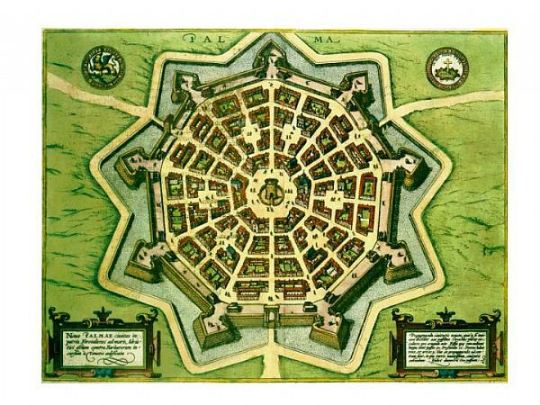
Palmanova

One of the things that most strikes me when thinking on the subject of our contemporary discourse regarding the future is just how seldom those engaged in the discussion aim at giving us a vision of society as a whole. There are books that dig deep but remain narrow  such as Eric Topol’s: The Creative Destruction of Medicine: How the Digital Revolution Will Create Better Health Care, and George Church’s recent Regenesis: How Synthetic Biology Will Reinvent Nature and Ourselves. Many of these books are excellent, but one walks away from reading them with a good idea of where a particular field or part of our lives might be headed rather than society as a whole.

Even when authors try to extend the reach of speculation out more broadly they tend to approach things from certain lens that ends up constraining them. Steven Johnson’s Future Perfect tries to apply the idea of peer-networks to areas as diverse as politics, education, economics and the arts while Peter Diamandis, and Steven Kotler in Abundance appear to project the mindset and passions of Silicon Valley: exponential growth in computers, the D.I.Y movement, billionaire philanthropy, and the spread of the benefits of technology to the world’s poorest, into a future where human potential can finally be met.  However good these broader approaches are they seldom leave you with an idea of how all the necessary parts of the future societies they hint at and depict fit together let alone what it might be like to actually live within them.

What seems to be missing in many works on the future is the sense of a traveler’s perspective on worlds they depict. The interesting thing about being a traveler is that you both experience the society you are traveling in as an individual and are at the same time outside of it, able to take a bird’s eye view that allows you to see connections and get a sense for how the whole things fits together like an artful building designed by an architect.

We used to have a whole genre devoted to this architectonic way of looking at the future, the literature of utopia. Writing utopias may seem very different from envisioning positive versions of the future, but perhaps not as much as we might think. Like futurists, many utopian writers tried to extrapolate from technological trends. Way back in 1833, John Adolphus Etzler, wrote a utopia  The Paradise Within the Reach of All Men, that bears remarkable similarity to the arguments of Diamandis and Kotler though the technology that was thought would finally end human want was nascent industrial era machines, and Etzler embedded his argument in a narrative that gave the reader an idea of what living in such a society should look like. More famous example of such extrapolations are Edward Bellamy’ s Looking Backward, 1887 or the incomparable H.G. Wells’ A Modern Utopia, 1905.

One might object that futurism is a predictive endeavor whereas utopianism tries to prescribe what would be best and therefore what we should do. Again, I am not quite sure this distinction holds, for much of futurists writing is as much arguments about potential and are meant to coax us into some possible future, or as Diamandis and Kotler put it in Abundance: “The best way to predict the future is to create it yourself.” (239). Utopianism is at least transparent in the fact that it is being prescriptive as opposed to futurism which often tries to come across as tomorrow’s news.

I am not quite sure who we could blame for this state of affairs, but surely Friedrich Engels of  the duo Marx and Engels would bear part of the responsibility. Back in 1880 Engels in his essay Socialism: Utopian and Scientific made the case that Marxism as opposed to the utopianism such found in figures such as Robert Owen was “scientific” in that it was based upon an understanding of the future as determined. Marxists in this view weren’t trying to influence the course of history they were just responding to and playing a role in underlying forces that would unfold to an inevitable conclusion anyway.  Whether he wanted to or not, Engels had removed human agency when it came to the issue of deciding what the human future would look like, or rather he drove such agency into the shadows, unacknowledged and occult.

One might ask, what about futurism that is focused not on good scenarios at least from the author’s point of view, but bad outcomes- predictions of disaster and explorations of risk? Even here, I think, futurists are trying to shape the future as much as predict it like a fortune teller. It’s a sadistic prophet indeed who merely tells you your society will be destroyed without giving you someway to avoid that fate. Futurism that focuses on negative futures are largely warnings that we need to take steps to prevent something terrible from happening or at the very least prepare.

We can find utopian literature in this world of negative futures too or at least the doppelganger of utopia- the realm of dystopia. Indeed, dystopian literature has provided us with some of the best early warning systems we have ever had such as Yevgeny Zamyatin’s novel We which warned us about Soviet totalitarianism, Jack London’s The Iron Heel which provided us with a premonition of fascism or Aldous Huxley’s Brave New World which has proved a better reflection of the future with its depiction of the dystopia of consumer society than George Orwell’s 1984.

The one place where compelling architectonic versions of the future continue to be found is in science-fiction. Writers of science-fiction continue to play this social role, and often do so with brilliance as this praise for Kim Stanley Robinson’s recent novel 2312 attests. This teasing out and wrestling with both the positive and negative possible worlds we might arrive at given our current course or with some changes in our trajectory lend evidence to the observation that science-fiction whose surface often seems so silly is in fact the most socially and philosophically serious form of fiction we have.

Yet there are differences between science-fiction and utopian literature not the least of which is utopia’s demand to convey an architectonic vision of possible worlds. The desire in utopias to get every detail right down to how people dress and what they eat make utopian literature some of the worst we have because it takes away from the development of characters. In a utopia the normal way fiction is organized is inverted: the world portrayed is the real character whereas the protagonists and others are the mere backdrops  for this world.

Unlike much of science-fiction, the focus of utopia is more on social organization than science and technology  although even in one of the earliest and the most famous utopia- Plato’s Republic- science and technology play a role, just not in a form we would readily recognize. Plato based his work on some of the most advanced applied-sciences of his day: pedagogy, dialectical philosophy, geometry, musicology, medicine/athletics, and animal husbandry. Yet these sciences and technologies were not the driver of his utopia. They were the building blocks he used to create a certain form of social organization.

In the sense that they were often seen as proposing a blueprint for the human world utopian literature was often serious in a way science-fiction need not be. Etzler did not merely write a utopia he tried to build one in Venezuela based upon his ideas. Edward Bellamy is a mere footnote in American literature compared to the geniuses who shared the stage with him during his era: Herman Melville, Henry James or Mark Twain. Yet, Bellamy’s work was considered serious enough that it inspired clubs to debate his ideas regarding the future of industrialism all throughout the United States and  influenced real revolutionaries such as V.I. Lenin. Would any serious social thinker today dare to write a version of the future in the form of a utopia?

Perhaps what we need today is less a revival of utopia as a literary form- something it was never very good at- than a new way to imagine architectonic possible futures. Given the fact that we are a long way off from the day when a person like H.G. Wells could conjure up a vision of utopia sure in the belief that he had some working knowledge of everything under the sun this new form of utopia would need to be collaborative rather than springing from the mind of just one individual.

I can imagine gathering together a constellation of individuals from across different disciplines in a room: scientists, engineers, artists, fiction writers, philosophers, economists, social scientists etc and asking them to design together the “perfect” city. They would ask and answer questions such how their imagined city provides for its basic needs, how it is layed out, how it fits into the surrounding ecosystem, how its economy works,  how its educational system functions, its penal system. Above all it would attempt to create a society whose pieces fit together in an architectonic whole. Unlike past utopian literature, such exercises wouldn’t present themselves as somehow final and perfected, but merely provide us with glimpse of destinations to which we might go.

How Science and Technology Slammed into a Wall and What We Should Do About It

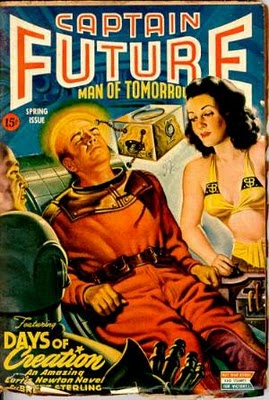
Captin Future 1944

It might be said that some contemporary futurists tend to use technological innovation and scientific discovery in the same way God was said to use the whirlwind against defiant Job, or Donald Rumsfeld treated the poor citizens of Iraq a decade ago. It’s all about the “shock and awe”. One glance at something like KurzweilAI.Net leaves a reader with the impression that brand new discoveries are flying off the shelf by the nanosecond and that of all our deepest sci-fi dreams are about to come true. No similar effort is made, at least that I know of, to show all the scientific and technological paths that have led  into cul-de-sac, or chart all the projects packed up and put away like our childhood chemistry sets to gather dust in the attic of the human might-have- been.  In exact converse to the world of political news, in technological news it’s the jetpacks that do fly we read about not the ones that never get off the ground.

Aside from the technologies themselves future oriented discussion of the potential of technologies or scientific discovery tends to come in two stripes when it comes to political and ethical concerns: we’re either on the verge of paradise or about to make Frankenstein seem like an amiable dinner guest.

There are a number of problems with this approach to science and technology, I can name more, but here are three: 1) it distorts the reality of innovation and discovery 2) it isn’t necessarily true, 3) the political and ethical questions, which are the most essential ones, are too often presented in a simplistic all- good or all-bad manner when any adult knows that most of life is like ice-cream. It tastes great and will make you fat.

Let’s start with distortion: A futurists’ forum like the aforementioned, KurzweilAI.Net,  by presenting every hint of innovation or discovery side-by-side does not allow the reader to discriminate between both the quality and the importance of such discoveries. Most tentative technological breakouts and discoveries are just that- tentative- and ultimately go nowhere. The first question a reader should ask is whether or not some technique process or prediction has been replicated.  The second question is whether or not the technology or discovery being presented is actually all that important. Anyone who’s ever seen an infomercial knows people invent things everyday that are just minor tweaks on what we already have. Ask anyone trapped like Houdini in a university lab-  the majority of scientific discovery is not about revolutionary paradigm shifts ala Thomas Kuhn but merely filling in the details. Most scientists aren’t Einsteins in waiting. They just edit his paperwork.

Then we have the issue of reality: anyone familiar with the literature or websites of contemporary futurists is left with the impression that we live in the most innovative and scientifically productive era in history. Yet, things may not be as rosy as they might appear when we only read the headlines. At least since 2009, there has been a steady chorus of well respected technologists, scientists and academics telling us that innovation is not happening fast enough, that is that our rates of technological advancement are not merely not exceeding those found in the past, they are not even matching them. A common retort to this claim might be to club whoever said it over the head with Moore’s Law; surely,with computer speeds increasing exponentially it must be pulling everything else along. But, to pull a quote from ol’ Gershwin “ it ain’t necessarily so”.

As Paul Allen, co-founder of Microsoft and the financial muscle behind the Allen Institute for Brain Science pointed out in his 2011 article, The singularity isn’t near, the problems of building ever smaller and faster computer chips is actually relatively simple, but many of the other problems we face, such as understanding how the human brain works and applying the lessons of that model- to the human brain or in the creation of AI- suffer what Allen calls the “complexity break”. The problems have become so complex that they are slowing down the pace of innovation itself. Perhaps it’s not so much of a break as we’ve slammed into a wall.

A good real world example of the complexity break in action is what is happening with innovation in the drug industry where new discoveries have stalled. In the words of Mark Herper at Forbes:

But the drug industry has been very much a counter-example to Kurzweil’s proposed law of accelerating returns. The technologies used in the production of drugs, like DNA sequencing and various types of chemistry approaches, do tend to advance at a Moore’s Law-like clip. However, as Bernstein analyst Jack Scannell pointed out in Nature Review’s Drug Discovery, drug discovery itself has followed the opposite track, with costs increasing exponentially. This is like Moore’s law backwards, or, as Scannell put it, Eroom’s Law.”

It is only when we acknowledge that there is a barrier in front of our hopes for innovation and discovery that we can seek to find its source and try to remove it. If you don’t see a wall you run the risk of running into it and certainly won’t be able to do the smart things: swerve, scale, leap or prepare to bust through.

At least part of the problem stems from the fact that though we are collecting a simply enormous amount of scientific data we are having trouble bringing this data together to either solve problems or aid in our actual understanding of what it is we are studying. Trying to solve this aspect of the innovation problem is a goal of the brilliant young technologist,Jeffrey Hammerbach, founder of Cloudera. Hammerbach has embarked on a project with Mt. Sinai Hospital to apply tools for organizing and analyzing the overwhelming amounts of data gather by companies like Google and FaceBook to medical information in the hopes of spurring new understanding and treatments of diseases. The problem Hammerbach is trying to solve as he acknowledged on a recent interview with Charlie Rose is precisely the one identified by Herper in the quote above, that innovation in treating diseases like mental illness is simply not moving fast enough.

Hammerbach, is our Spiderman. Having helped create the analytical tools that underlie FaceBook he began to wonder if it was worth it quipping: “The best minds of my generation are thinking about how to make people click ads”.  The real problem wasn’t the lack of commercial technology it was the barriers to important scientific discoveries that would actually save people’s lives. Hammerbach’s conscientious objection to what technological innovation was being applied for vs what it wasn’t is, I think, a perfect segway (excuse the pun) to my third point the political and ethical dimension, or lack thereof, in much of futurists writing today.

In my view, futurists too seldom acknowledges the political and ethical dimension in which technology will be embedded. Technologies hoped for in futurists communities such as brain-computer interfaces, radical life extension, cognitive enhancements or AI are treated in the spirit of consumer goods. If they exist we will find a way to pay for them. There is, perhaps, the assumption that such technologies will follow the decreasing cost curves found in consumer electronics: cell phones were once toys for the rich and now the poorest people on earth have them.

Yet, it isn’t clear to me that the technologies hoped for will actually follow decreasing curves and may instead resemble health care costs rather than the plethora of cheap goods we’ve scored thanks to Moore’s Law. It’s also not clear to me that should such technologies be invented to be initially be affordable only by the rich that this gap will at all be acceptable by the mass of the middle class and the poor unless it is closed very, very fast. After all, some futurists are suggesting that not just life but some corporal form of immortality will be at stake. There isn’t much reason to riot if your wealthy neighbor toots around in his jetpack while you’re stuck driving a Pinto. But the equation would surely change if what was at stake was a rich guy living to be a thousand while you’re left broke, jetpackless, driving a Pinto and kicking the bucket at 75.

The political question of equity will thus be important as will much deeper ethical questions as to what we should do and how we should do it. The slower pace of innovation and discovery, if it holds, might ironically, for a time at least, be a good thing for society (though not for individuals who were banking on an earlier date for the arrival of technicolored miracles) for it will give us time to sort these political and ethical questions through.

There are 3 solutions I can think of that would improve the way science and technology is consumed and presented by futurists, help us get through the current barriers to invention and discovery and build our capacity to deal with whatever is on the other side. The first problem, that of distortion, might be dealt with by better sorting of scientific news stories so that the reader has some idea both where the finding being presented lies along the path of scientific discovery or technological innovation and how important a discovery is in the overall framework of a field. This would prevent things occurring such as a preliminary findings regarding the creation of an artificial hippocampus in a rat brain being placed next to the discovery of the Higgs Boson, at least without some color coating or other signification that these discoveries are both widely separated along the path of discovery and of grossly different import.

As to the barriers to innovation and discovery itself: more attempts such as those of Hammerbach’s need to be tried. Walls need to be better identified and perhaps whole projects bringing together government and venture capital resources and money used to scale over or even bust through these blocked paths. As Hammerbach’s case seems to illustrate, a lot of technology is fluff, it’s about click-rates, cool gadgets, and keeping up with the joneses. Yet, technology is also vitally important as the road to some of our highest aspirations. Without technological innovation we can not alleviate human suffering, extend the time we have here, or spread the ability to reach self-defined ends to every member of the human family.

Some technological breakthroughs would actually deserve the appellation. Quantum computing, if viable, and if it lives up to the hype, would be like Joshua’s trumpets against the walls of Jericho in terms of the barriers to innovation we face. This is because, theoretically at least, it would answer the biggest problem of the era, the same one identified by Hammerbach, that we are generating an enormous amount of real data but are having a great deal of trouble organizing this information into actionable units we actually understand. In effect, we are creating an exponentially increasing data base that requires exponentially increasing effort to put the pieces of this puzzle together- running to standstill. Quantum computing, again theoretically at least, would solve this problem by making such databases searchable without the need to organize them beforehand. 

Things in terms of innovation are not, of course, all gloom and doom. One fast moving  field that has recently come to public attention is that of molecular and synthetic biology perhaps the only area where knowledge and capacity is not merely equalling but exceeding Moore’s Law.

To conclude, the very fact that innovation might be slower than we hope- though we should make every effort to get it moving- should not be taken as an unmitigated disaster but as an opportunity to figure out what exactly it is we want to do when many of the hoped for wonders of science and technology actually arrive. At the end of his recent TED-Talk on reviving extinct species, a possibility that itself grows out of the biological revolution of which synthetic biology is a part, Stewart Brand, gives us an idea of what this might look like. When asked if it was ethical for scientist to “play God” in doing such a thing he responded that he and his fellow pioneers were trying to answer the question of if we could revive extinct species not if we should. The ability to successfully revive extinct species, if it worked, would take some time to master, and would be a multi-generational project the end of which Brand, given his age, would not see. This would give us plenty of time to decide if de-extinction was a good idea, a decision he certainly hoped we would make. The only way we can justly do this is to set up democratic forums to discuss and debate the question.

The ex-hippie Brand has been around a long time, and great evidence to me that old age plus experience can still result in what we once called wisdom. He has been present long enough to see many of our technological dreams of space colonies and flying cars and artificial intelligence fail to come true despite our childlike enthusiasm. He seems blissfully unswept up in all the contemporary hoopla, and still less his own importance in the grand scheme of things, and has devoted his remaining years to generation long projects such as the Clock of the Long now, or the revival of extinct species that will hopefully survive into the far future after he is gone.

Brand has also been around long enough to see all the Frankenstein’s that have not broken loose, the GMOs and China Syndromes and all those oh so frightening “test tube babies”.  His attitude towards science and technology seems to be that it is neither savior nor Shiva it’s just the cool stuff we can do when we try. Above all, he knows what the role of scientists and technologists are, and what is the role of the rest of us. Both of the former show us what tricks we can play, but it is up to all of us as to how or if we should play them.

The Ubiquitous Conflict between Past and Future

Materia and Dynamism of a Cyclist by Boccioni

Perhaps one of the best ways to get a grip on our thoughts about the future is to look at the future as seen in the eyes of the past. This is not supposed to be a Zen koan to cause the reader’s mind to ground to a screeching halt, but a serious suggestion. Looking at how the past saw the future might reveal some things we might not easily see with our nose so close to the glass of contemporary visions of it. A good place to look, I think, would be the artistic and cultural movement of the early 20th century that went under the name of Futurism.

Futurism, was a European movement found especially in Italy but also elsewhere, that took as its focus radical visions of a technologically transformed human future. Futurists were deeply attracted to the dynamic aspects of technology. They loved speed and skyscrapers and the age of the machine. They also hated the past and embraced violence two seemingly unrelated orientations that I think may in fact fit hand in glove.

The best document to understand Futurism is its first: F.T. Marinetti’s The Futurist Manifesto.  Here is Marinetti on the Futurist’s stance towards the cultural legacy of the past that also gives some indication of the movement’s positive outlook towards violence:

Let the good incendiaries with charred fingers come! Here they are! Heap up the fire to the shelves of the libraries! Divert the canals to flood the cellars of the museums! Let the glorious canvases swim ashore! Take the picks and hammers! Undermine the foundation of venerable towns!


Given what I think is probably the common modern view that technology, at least in its non-military form, is a benign force that makes human lives better, where better also means less violent, and that technology in the early 21st century is used as often to do things such as digitally scan and make globally available an ancient manuscript such as The Dead Sea Scrolls  as to destroy the past, one might ask what gives with Futurism?

Within the context of early 1900s Italy, both Futurisms’ praise of violence and its hatred for the accumulated historical legacy makes some sense. Italy was both a relatively new country having only been established in 1861, and compared to its much more modernized neighbors a backward one. At the same time the sheer weight of the past of pre-unification Italy stretching back to the Etruscans followed by the Romans followed by the age of great Italian city-states such as Florence, not to mention the long history as the seat of the Roman church, was overwhelming.

Italy was a country with too much history, something felt to be holding back its modernization, and the Futurist’s  hatred of history and their embrace of violence were dual symptoms of the desire to clear the deck so that modernity could take hold. What we find with Futurism is an acute awareness that the past may be the enemy of the future and an acknowledgement, indeed a full embrace, of the disruptive nature of technology, that technology upends and destroys old social forms and ways of doing things.

We might think such a conflict between past and future is itself a thing of the past, but I think this would be mistaken. At bottom much of the current debates around the question of what the human (or post-human) future should look like are really debates between those who value the past and wish to preserve it and those who want to escape this past and create the world anew.

Bio-conservatives might be thought of as those who hope to preserve evolved human nature and or the evolved biosphere in intact in the face of potentially transformative technology. Transhumanists might be thought of as holding the middle position in the debate between past and future wanting to preserve in varying degrees some aspects of evolved humanity while embracing some new characteristics that they hope technology will soon make widely available. Singularitarians are found on the far end of the future side of the past vs future spectrum, not merely embracing but pursuing the creation of a brand new evolutionary kingdom in an equally new substrate- silicon.

You also find an awareness of this conflict between past and future in the most seeming disparate of thinkers. On the future as destroyer of the past side of the ledger you have a recent mesmerizing speech at the SXSW Conference by the science-fiction author, Bruce Sterling. Part of the point Sterling seems to be making in this multifaceted talk is that technologists need to acknowledge that technology does not always produce the better, just the different. Technology upends the old and creates a new order and we should both lament the loss of what we have destroyed and embrace our role in having been a party to the destruction of the legacy of the past.

On the past as immovable anchor that prevents us from realizing not just the future but the present side of the ledger we have the architect Rem Koolhaas who designed such modern wonders as the CCTV Headquarters in Beijing. Koolhaas thinks the past is currently winning in the fight against the future. He is troubled by the increase in the area human being have declared “preserved”, that is off-limits to human development. This area is surprisingly huge, Koolhaas, claims it is comparable to the space of the entire country of India.

In a hypothetical plan to deal with the “crisis” of historic preservation in Beijing Koolhaas proposed mapping a grid over the city with areas to be preserved and those where development was unconstrained established at random. Koolhaas thinks that the process should be random to avoid cultural fights over what should be preserved and what should not, which end up reflecting the current realities of power more than any “real” historical significance. A version of “history is written by the victors”. But the very randomness of the process not only leaves me at least with the impression of being both historically illiterate and somewhat crazy, it is based, I think, on a distorted picture of the very facts of preservation themselves.

Koolhaas combines the area preserved for historic reasons with those preserved for natural ones. Thus, his numbers would include the vast amounts of space countries have set and hope to set aside as natural preserves. It’s not quite clear to me that these are areas that most human beings would really want to live in anyway, so it remains uncertain whether the fact that these areas prohibited from being developed indeed somehow hold back development in the aggregate. Koolhaas thinks we need a “theory” of preservation as a guide to what we should preserve and what we should allow to be preserved in the name of something new.  A theory suggests that the conflict between past and future is something that can or should be resolved, yet I do not think resolution is the goal we should seek.  To my lights what is really required is a discussion and a debate that acknowledges what we are in fact really arguing about. What we are arguing about is how much we should preserve the past vs how much we should allow the past to be destroyed in the name of the future.

What seems to me a new development, something that sets us off from the early 20th century Futurism with which this post began, is that technology, rather than by default being the force that destroys the past and gives rise to the future as was seen in Sterling’s speech is becoming neutral in the conflict between past and future. You can see some of this new neutrality not only in efforts to use technology to preserve and spread engagement with the past as was seen in the creation of a digital version of The Dead Sea Scrolls, you can see it in the current project of the eternal outsider, Stewart Brand, which hopes to bring back into existence extinct species such as the Passenger Pigeon through a combination of reverse genetic engineering and breeding.

For de-extinct species to be viable in the wild will probably require the resurrection of ecosystems and co-dependent species that have also been gone for quite some time such as Chestnut forests for the Passenger Pigeon. Thus, what is not in the present and in front of us- the future- in Brand’s vision will be the lost past. We are probably likely to see more of this past/future neutrality of technology going forward and therefore might do well to stop assuming that technological advancement of necessity lead to the victory of the new.

Because we can never fully determine whether we have not at least secondarily been responsible for a species extinction does that mean we should never allow another species to go extinct, if we can prevent it? This would constitute not an old world, but in fact a very new one, a world in which evolution does not occur, at least the type of evolution in large creatures that leads to extinction. When combined with the aim of ending human biological death this world has a strong resemblance to the mythical Garden of Eden, perhaps something that should call the goal itself into question. Are we merely trying to realize these deeply held religious ideas that are so enmeshed  in our thought patterns they have become invisible?

Advances in synthetic biology could lead as Freeman Dyson believes to life itself soon becoming part- software part- art with brand new species invented with the ease and frequency that new software is written or songs composed today. Or, it could lead to projects to reverse the damage humankind has done to the world and return it to the state of the pre-human past such as those of Brand. Perhaps the two can live side by side perhaps not. Yet, what does seem clear is that the choice of one takes time and talent away from the other. Time spent resurrecting the Passenger Pigeon or any other extinct species is time and intellectual capacity spent inventing species never seen.

Once one begins seeing technological advancement as neutral in the contest between the past and future a number of aspirations that seem futuristic because of their technological dependence become perhaps less so.  A world where people live “forever” seems like a very futuristic vision, but if one assumes that this will require less people being born it is perhaps the ultimate victory of the old vs the new. We might tend to think that genetic engineering will be used to “advance” humankind, but might it not be seen as an alternative to more radical versions of the future, cyborg-technologies or AI, that, unlike genetic engineering go beyond merely reaching biological potential that human beings have had since they emerged on the African savanna long ago?

There is no lasting solution to the conflict of past vs future nor is it a condition we should in someway lament. Rather, it is merely a reflection of our nature as creatures in time.If we do not hold onto at least something from our past, and that includes both our individual and collective past, we become creatures or societies without identity. At the same time, if we put all of our efforts into preserving what was and never attempt the new we are in a sense already dead frozen in amber inside a world of what was. The sooner we acknowledge this conflict is at the root of many of our debates the more likely we are to come up with goals to shoot for that neither aim to destroy the deep legacy of the past, both human and biological, nor prevent us from ever crossing into the frontier of the new.

Finding Our Way in the Great God Debate, part 2

Last time, I tried to tackle the raging debate between religious persons and a group of thinkers that at least aspire to speak for science who go under the name of the New Atheists. I tried to show how much of the New Atheist’s critique of religion was based on a narrow definition of what “God” is, that is, a kind of uber-engineer who designed the cosmos we inhabit and set up its laws. Despite my many critiques of the New Atheists, much of which has to do with both their often inflammatory language, and just as often their dismissal and corresponding illiteracy regarding religion, I do think they highlight a very real philosophical and religious problem (at least in the West), namely, that the widely held religious concept of the world has almost completely severed any relationship with science, which offers the truest picture of what the world actually is that we have yet to discover.

In what follows I want to take a look at the opportunities for new kinds of religious thinking this gap between religion and science offers, but most especially for new avenues of secular thought that might manage, unlike the current crop of New Atheists to hold fast to science while not discarding the important types of thinking and approaches to the human condition that have been hard won by religious traditions since the earliest days of humanity.

The understanding of God as a celestial engineer, the conception of God held by figures of the early scientific revolution such as Newton, was, in some ways, doomed from the start predicated not only on a version of God that was so distant from the lives of your average person that it would likely become irrelevant, but predicated as well on the failure of science to explain the natural world from its own methods alone. If science is successful at explaining the world then a “God of the gaps” faces the likely fate that science at some point eventually explains away any conceivable gap in which the need for such a God might be called for.  It is precisely the claim that physics has or is on the verge of closing the gap in scientific knowledge of what Pope Pius XII thought was God’s domain- the Universe before the Big Bang- that is the argument of another atheist who has entered the “God debate”, Lawrence Krauss with his A Universe From Nothing.

In his book Krauss offers a compelling picture of the state of current cosmology, one which I find fascinating and even wonderous. Krauss shows how the Universe may have appeared from quantum fluctuations out of what was quite literally nothing. He reveals how physicists are moving away from the idea of one Universe whose laws seem ideally tuned to give rise to life to a version of a multiverse. A vision in which an untold number of universes other than our own exist in an extended plane or right next to one another on a so call “brane” which will forever remain beyond our reach, and that might all have a unique physical laws and even mathematics.

Krauss shows us not only the past but the even deeper time of the future where our own particular Universe is flat and expanding so rapidly that it will, on the order of a few hundred billion years, be re-organized into islands of galaxies surrounded by the blackness of empty space, and how in the long-long frame of time, trillions of years,  our Universe will become a dead place inhospitable for life- a sea of the same nothing from whence it came.

A Universe from Nothing is a great primer on the current state of physics, but it also has a secondary purpose as an atheist track- with the afterword written by none other than Dawkins himself. Dawkins, I think quite presumptuously, thinks Krauss will have an effect akin to Darwin banishing God from the questions regarding the beginning of the Universe and its order in the same way Darwin had managed to banish God from questions regarding the origin of life and its complexity.

Many people, myself included, have often found the case made by the New Atheists in many ways to be as counter-productive for the future of science as the kind of theologization and politicization of science found in those trying to have Intelligent Design (ID) taught in schools, or deny the weight of scientific evidence in regards to a public issue with a clear consensus of researchers for what amounts to a political position e.g. climate change. This is because their rhetoric forces people to choose between religion and science, a choice that in such a deeply religious country such as the United States would likely be to the detriment of science.  And yet, perhaps in the long-run the New Atheists will have had a positive effect not merely on public discourse, but ironically on religion itself.

New Atheists have encouraged a great “coming out” of both fellow atheists and agnostics in a way that has enabled people in a religious society like the United States to openly express their lack of belief and skepticism in a way that was perhaps never possible before. They have brought into sharp relief the incongruity of scientific truth and religious belief as it is currently held and thus pushed scholars such as Karen Armstrong to look for a conception of God that isn’t, like the modern conception, treated as an increasingly irrelevant hypothesis of held over from a pre-Darwinian view of the world.


Three of the most interesting voices to have emerged from the God Debate each follow seemingly very different tracks that when added together might point the way to the other side. The first is the religious scholar Stephen Prothero. Armstrong’s Case for God helped inspire Prothero, to write his God is Not One (2010.) He was not so much responding to the religious/atheist debate as he was cautioning us against the perennialism at the root of much contemporary thought regarding religion. If the New Atheists went overboard with their claim that religion was either all superstitious nonsense ,or evil, and most likely both, the perennialists, with whom he lumps Armstrong, went far too much to the other side arguing in their need to press for diversity and respect the equally false notion that all religions preached in essence the same thing.


Prothero comes up with a neat formula for what a religion is. “Each religion articulates”:


  • a problem;
  • a solution to this  problem, which also serves as the religious goal;
  • a technique (or techniques) for moving from this problem to this solution; and
  • an exemplar (or exemplars) who chart this path from problem to solution. (p. 14)

For Prothero, what religions share is, as the perennialists claim, the fundamentals of human ethics, but also a view that the human condition is problematic. But the devil, so to speak, is in the details, for the world’s great religions have come up with very different identifications of what exactly this problematic feature is ,and hence very different, and in more ways than we might be willing to admit, incompatible solutions   to the problems they identify.

God is Not One is a great introduction to the world’s major religions, a knowledge I think is sorely lacking especially among those who seem to have the most knee-jerk reactions to any mention of religious ideas. For me, one of the most frustrating things about the New Atheists, especially, is their stunning degree of religious illiteracy. Not only do they paint all of Judaism, Christianity, and Islam with the same broad brush of religious literalism and fundamentalism, and have no grasp of religious history within the West, they also appear completely disinterested in trying to understand non-Western religious traditions an understanding that might give them better insight into the actual nature of the human religious instinct which is less about pre-scientific explanations for natural events than it is about an ethical orientation towards the world. Perhaps no religion as much as Confucianism can teach us something in this regard.  In the words of Prothero:

Unlike Christianity which drives a wedge between the sacred and the secular- the eternal “City of God” and the temporal “City of Man”- Confucianism glories in creatively confusing the two. There is a transcendent dimension in Confucianism. Confucians just locate it in the world rather than above or beyond it.

For all these reasons, Confucianism can be considered as religious humanism. Confucians share with secular humanists a single minded focus on this world of rag and bone.  They, too, are far more interested in how to live than in plumbing the depths of Ultimate Reality. But whereas secular humanists insist on emptying the rest of the world of the sacred, Confucians insists on infusing the world with sacred import- of seeing Heaven in humanity, on investing human beings with incalculable value, on hallowing the everyday. In Confucianism, the secular is sacred. (GN1 108)

Religions, then, are in large part philosophical orientations towards the world. They define the world, or better the inadequacies of the world, in a certain way and prescribe a set of actions in light of those inadequacies. In this way they might be thought of as embodied moral philosophies, and it is my second thinker, the philosopher Alain de Botton who in his Religion for Atheists: A Non-believer’s Guide to the Uses of Religion tries to show just how much even the most secular among us can learn from religion.

What the secular, according to Botton, can learn from religions has little to do with matters of belief which in the light of modern science he too finds untenable. Yet, the secular can learn quite a lot from religion in terms institutions and practices. Religion often fosters a deep sense of community founded around a common view of the world. The religious often see education as less about the imparting of knowledge but the formation of character. Because religion in part arose in response to the human need to live peacefully together in society it tends to track people away from violence and retribution and toward kindness and reconciliation. Much of religion offers us tenderness in times of tragedy, and holds out the promise of moral improvement. It provides the basis for some of our longest lived institutions, embeds art and architecture in a philosophy of life.


Often a religion grants its followers a sense of cosmic perspective that might otherwise be missing from human life, and reminds us of our own smallness in light of all that is, encourages an attitude of humility in the face of the depths of all we do not yet and perhaps never will know. It provides human beings with a sense of the transcendent something emotionally and intellectually beyond our reach which stretches the human heart and mind to the very edge of what it can be and understand.

So if religion, then, is at root a way for people to ethically orient themselves to others and the world even the most avowed atheist who otherwise believes that life can have meaning can learn something from it.  Though one must hope that monstrous absurdities such as the French Revolution’s Cult of the Supreme Being, or the “miraculously” never decomposing body of V.I. Lenin are never repeated.

One problem however remains before we all rush out to the local Church, Temple, or Mosque, or start our own version of the Church of Scientology. It is that religion is untrue, or better, while much of the natural ethics found at the bottom of most religions is something to which we secularists can assent because it was forged for the problems of human living together, and we still live in together in societies, the idea of the natural world and the divinities that supposedly inhabit and guide it are patently false from a scientific point of view. There are two possible solutions I can imagine to this dilemma, both of which play off of the ideas of my third figure, the neuroscientist
and fiction author, David Eagleman.

Like others, what frustrates Eagleman about the current God debate is the absurd position of certainty and narrowness of perspective taken by both the religious and the anti-religious. Fundamentalist Christians insist that a book written before we knew what the Universe was or how life develops or what the brain does somehow tells us all we really need to know, indeed thinks they possess all the questions we should ask. The New Atheists are no better when it comes to such a stance of false certainty and seem to base many of their argument on the belief that we are on the verge of knowing all we can know, and that the Universe(s) is already figured out except for a few loose ends.

In my own example, I think you can see this in Krauss who not only thinks we have now almost fully figured out the origins of the Universe and its fate. He also thinks he has in his hand its meaning, which is that it doesn’t have one, and to drive this home avoids looking at the hundreds of billions of years between now and the Universe’s predicted end.

Take this almost adolescent quote from Dawkins’ afterword to A Universe From Nothing:

Finally, and inevitably, the universe will further flatten into a nothing that mirrors its beginning” what will be left of our current Universe will be “Nothing at all. Not even atoms. Nothing. “ Dawkins then adds with his characteristic flourish“If you think that’s bleak and cheerless, too bad. Reality doesn’t owe us comfort.  (UFN 188).

And here’s Krauss himself:

The structures we can see, like stars and galaxies, were all created in quantum fluctuations from nothing. And the average total Newtonian gravitational energy of each object in our universe is equal to nothing. Enjoy the thought while you can, if this is true, we live in the worst of all possible universes one can live in, at least as far as the future of life is concerned. (UFN 105)


Or perhaps more prosaically the late Hitchens:


For those of us who find it remarkable that we live in a universe of Something, just wait. Nothingness is headed on a collision course right towards us! (UFN 119)


Really? Even if the view of the fate of the Universe is exactly like Krauss thinks it will be, and that’s a Big- Big-  If, what needs to be emphasized here, a point that neither Krauss or Dawkins seem prone to highlight is that this death of the Universe is trillions of years in the future and that there will be plenty of time for living, according to Dimitar Sasselov, hundreds of billions of years, for life to evolve throughout the Universe, and thus for an unimaginable diversity of experiences to be had. Our Universe, at least at the stage we have entered and for many billions of years longer than life on earth has existed, is actually a wonderful place for creatures such as ourselves.  If one adds to that the idea that there may not just be one Universe, but many many universes, with at least some perhaps having the right conditions for life developing and lasting for hundreds of billions of years as well, you get a picture of diversity and profusion that puts even the Hindu Upanishads to shame. That’s not a bleak picture. It one of the most exhilarating pictures I can think of, and perhaps in some sense even a religious one.


And the fact of the matter is we have no idea. We have no idea if the theory put forward by Krauss regarding the future of the Universe is ultimately the right one, we have no idea if life plays a large, small, or no role in the ultimate fate of the Universe, we have no idea if there is any other life in the Universe that resembles ourselves in terms of intelligence, or what scale- planet, galaxy, even larger- a civilization such as our own can achieve if it survives for a sufficiently long time, or how common such civilizations might become in the Universe as the time frame in which the conditions for life to appear and civilizations to appear and develop grows over the next hundred billion years or so. See the glass empty, half empty, or potentially overflowing it’s all just guesswork, even if Krauss’ physics make it an extremely sophisticated and interesting guesswork. To think otherwise is to assume the kind of block-headed certainty Krauss reserves for religious fanatics.  

David Eagleman wants to avoid the false certainty found in many of the religious and the New Atheists by adopting what he calls Possibilism. The major idea behind Possibilism is the same one, although Eagleman himself doesn’t make this connection, that is found in Armstrong’s pre-modern religious thinkers, especially among the so-called mystics, that is the conviction that we are in a position of profound ignorance.

Science has taken us very very far in terms of our knowledge of the world and will no doubt take us much much farther, but we are still probably at a point where we know an unbelievable amount less than will eventually become known, and perhaps there are limits to our ability to know in front of us beyond which will never be able to pass. We just don’t know. In a similar way to how the mystics tried to lead a path to the very limits of human thought beyond which we can not pass, Possibilism encourages us to step to the very edge of our scientific knowledge and imagine what lies beyond our grasp.

I can imagine at least two potential futures for Possibilism either one of which I find very encouraging.  If traditional religion is to regain its attraction for the educated it will probably have to develop and adopt a speculative theology that looks a lot like Eagleman’s Possibilism.  

A speculative theology would no longer seek to find support for its religious convictions in selective discoveries of science, but would  place its core ideas in dialogue with whatever version of the world science comes up with. This need not mean that any religion need abandon its core ethical beliefs or practices both of which were created for human beings at moral scale that reflects the level at which an individual life is lived. The Golden Rule needs no reference to the Universe as a whole nor do the rituals surrounding the life cycle of the individual- birth, marriage, and death at which religion so excels.


What a speculative theology would entail is that religious thinkers would be free to attempt to understand their own tradition in light of modern science and historical studies without any attempt to use either science or history to buttress its own convictions.

Speculative theology would ask how its concepts can continue to be understood in light of the world presented by modern science and would aim at being a dynamic, creative, and continuously changing theology which would better reflect the dynamic nature of modern knowledge, just as theology in the past was tied to a view of knowledge that was static and seemingly eternal. It might more easily be able to tackle contemporary social concerns such as global warming, inequality and technological change by holding the exact same assumptions as to the nature of the physical world as science while being committed to interpreting the findings in light of their own ethical traditions and perspectives.

Something like this speculative philosophy already existed during the Islamic Golden Age a period lasting from the 700s through the 1200s in which Islamic scientists such as Ibn Sina (Avicenna) managed to combine the insights of ancient Greek, Indian, and even Chinese thinking to create whole new field of inquiry and ways of knowing. Tools from algebra to trigonometry to empiricism that would later be built upon by Europeans to launch the scientific revolution. The very existence of this golden age of learning in the Muslim world exposes Sam Harris’ anti-Islamic comment for what it is- ignorant bigotry.

Still, a contemporary speculative theology would have more expansive and self-aware than anything found among religious thinkers before.  It would need to be an open system of knowledge cognizant of its own limitations and would examine and take into itself ideas from other religious traditions, even dead ones such as paganism, that added depth and dimensions to its core ethical stance. It would be a vehicle through which religious persons could enter into dialogue and debate with persons from other perspectives both religious and non-religious who are equally concerned with the human future, humanists and transhumanists, singularitarians, and progressives along with those who with some justification have deep anxieties regarding the future, traditional conservatives, bio-conservatives,  neo-luddites, and persons from every other spiritual tradition in the world.  It would mean an end to that dangerous anxiety held by a great number of the world’s religions that it alone needs to be the only truth in order to thrive.   

Yet, however beneficial such a speculative theology would be I find its development out of any current religion highly unlikely.  If traditional religions do not adopt something like this stance towards knowledge I find it increasingly likely that persons alienated from them as a consequence of the way their beliefs are contradicted by science will invent something similar for themselves. This is because despite the fact that the Universe in the way it is presented by the New Atheists is devoid of meaning this human need for meaning, to discuss it, and argue it, and try to live it, is unlikely to ever stop among human beings. The very quest seems written into our very core. Hopefully, such dialogues will avoid dogma and be self-critical and self-conscious in a way religion or secular ideologies never were before. I see such discussions more akin to works of art than religious-treatises, though I hope they provide the bases for community and ethics in the same way religion has in the past as well.

And we already have nascent forms of such communities- the environmentalist cause is one such community as is the transhumanist movement. So, is something like The Long Now Foundation which seeks to bring attention to the issues of the long term human future and has even adopted the religious practice of pilgrimage to its 10,000 year clock– a journey that is meant to inspire deeper time horizons for our present obsessed culture.

Even should such communities and movements become the primary way a certain cohort of scientifically inclined persons seek to express the human need for meaning, there is every reason for those so inclined to seek out and foster relationships with the more traditionally religious ,who are, and will likely always, comprise the vast majority human beings. Contrary to the predictions of New Atheists such as Daniel Dennett the world is becoming more not less religious, and Christianity is not a dying faith but changing location moving from its locus in Europe and North America to Latin America, Africa, and even Asia. Islam even more so than Christianity is likely to be a potent force in world affairs for some time to come, not to mention Hinduism with India destined to become the world’s most populous country by mid-century. We will need all of their cooperation to address pressing global problems from climate change, to biodiversity, to global pandemics, and inequality. And we should not think them persons who profess such faiths ignorant for holding fast to beliefs that largely bypass the world brought to us by science. Next to science religion is among the most amazing things to emerge from humanity and those who seek meaning from it are entitled to our respect as fellow human beings struggling to figure out not the what? but the why? of human life.

Whether inside or outside of traditional religion the development of scientifically grounded meaning discourses and communities, and the projects that would hopefully grow from them, would signal that wrestling with the “big questions” again offered a path to human transcendence. A path that was at long last no longer in conflict with the amazing Universe that has been shown to us by modern science. Finding such ways of living would mean that we truly have found our way through the great God debate.

Finding Our Way Through The Great God Debate

“The way that can be spoken of. Is not the constant way; The name that can be named. Is not the constant name.”

Lao Tzu: Tao Te Ching

Over the last decade a heated debate broke onto the American scene. The intellectual conflict between the religious and those who came to be called “the New Atheists” did indeed, I think, bring something new into American society that had not existed before- the open conflict between what, at least at the top tier of researchers, is a largely secular scientific establishment, or better those who presumed to speak for them, and the traditionally religious. What emerged on the publishing scene and bestseller lists were not the kinds of “soft-core” atheism espoused by previous science popularizers such as the late and much beloved Carl Sagan, but harsh, in your face atheist suchs as the Sam Harris, Richard Dawkins and another late figure, Christopher Hitchens.

On the one hand there was nothing “new” about the New Atheists. Science in the popular imagination had for sometime been used as a bridge away from religion. I need only look at myself. What really undermined my belief in the Catholicism in which I was raised were books like Carl Sagan’s Dragons of Eden, and Cosmos, or to a lesser extent Stephen Hawkings A Brief History of Time, even a theologically sounding book like Paul Davies God and the New Physics did nothing to shore up my belief in a personal God and the philosophically difficult or troubling ideas such as “virgin birth”, “incarnation”, “transubstantiation” or “papal infallibility” under which I was raised.

What I think makes the New Atheists of the 2000s truly new is that many science popularizers have lost the kind of cool indifference, or even openness to reaching out and explaining science in terms of religious concepts that was found in someone like Carl Sagan. Indeed, their confrontationalist stance is part of their shtick and a sure way to sell books in the same way titles like the Tao of Physics sold like hotcakes in the archaic Age of Disco.

For example, compare the soft, even if New Agey style of Sagan  to the kind of anti-religious screeds given by one of the New Atheist “four horsemen”, Richard Dawkins, in which he asks fellow atheists to “mock” and “ridicule” people’s religious  beliefs. Sagan sees religion as existing along a continuum with science, an attempt to answer life’s great questions. Science may be right, but religion stems from the same deep human instinct to ask questions and understand, whereas Dawkins seems to see only a dangerously pernicious stupidity.

It impossible to tease out who fired the first shot in the new conflict between atheists and the religious, but shots were fired. In 2004, Sam Harris’ The End of Faith hit the bookstores, a book I can still remember paging through at a Barnes N’ Noble when there were such things and thinking how shocking it was in tone. That was followed by Harris’ Letter to a Christian Nation, Richard Dawkins’ The God Delusion along with his documentary about religion with the less than live-and-let-live  title- The Root of All Evil? -followed by Hitchens’ book  God is Not Great, among others.

What had happened between the easy going atheism of the late Carl Sagan and the militant atheism of Harris’ The End of Faith was the tragedy of 9/11 which acted as an accelerant on a trend that had been emerging at the very least since Dawkins’ Virus of the Mind published way back in 1993. People who once made the argument that religion was evil or that signaled out any specific religion as barbaric would have before 9/11 been labeled as intolerant or racists.  Instead, in 2005 they were published in the liberal Huffington Post. Here is Harris:

It is time we admitted that we are not at war with “terrorism”; we are at war with precisely the vision of life that is prescribed to all Muslims in the Koran.

One of the most humanistic figures in recent memory, and whose loss is thus even more to our detriment than the loss of either the poetic Sagan or the gadfly Hitchens tried early on to prevent this conflict from ever breaking out. Stephen Jay Gould as far back as 1997 tried to minimize the friction between science and religion with his idea of Nonoverlapping Magisteria (NOMA). If you read one link I have ever posted please read this humane and conciliatory essay.  The argument Gold makes in his essay is that there is no natural conflict between science and religion. Both religion and science possess their own separate domains: science deals with what is- the nature of the natural world, whereas religion deals with the question of meaning.

Science does not deal with moral questions because the study of nature is unable to yield meaning or morality on a human scale:

As a moral position (and therefore not as a deduction from my knowledge of nature’s factuality), I prefer the “cold bath” theory that nature can be truly “cruel” and “indifferent”—in the utterly inappropriate terms of our ethical discourse—because nature was not constructed as our eventual abode, didn’t know we were coming (we are, after all, interlopers of the latest geological microsecond), and doesn’t give a damn about us (speaking metaphorically). I regard such a position as liberating, not depressing, because we then become free to conduct moral discourse—and nothing could be more important—in our own terms, spared from the delusion that we might read moral truth passively from nature’s factuality.

Gould later turned his NOMA essay into a book- The Rocks of Ages in which he made an extensive argument that the current debate between science and religion is really a false one that emerges largely from great deal of misunderstanding on both sides.

The real crux of any dispute between science and religion, Gould thinks, are issues of what constitutes the intellectual domain of each endeavor. Science answers questions regarding the nature of the world, but should not attempt to provide answers for questions of meaning or ethics. Whereas religion if properly oriented should concern itself with exactly these human level meaning and ethical concerns. The debate between science and religion was not only unnecessary, but the total victory of one domain over the other would, for Gould, result in a diminishment of depth and complexity that emerges as a product of our humanity.

The New Atheists did not heed Gould’s prescient and humanistic advice. Indeed, he was already in conflict with some who would become its most vociferous figures- namely Dawkins and E.O. Wilson- even before the religion vs. science debate broke fully onto the scene. This was a consequence of Gould pushing back against what he saw as a dangerous trend towards reductionism of those applying genetics and evolutionary principles to human nature. The debate between Gould and Dawkins even itself inspired a book, the 2001, Dawkins vs. Gould published a year before Gould’s death from cancer.

Yet, for how much I respect Gould, and am attracted to his idea of NOMA, I do not find his argument to be without deep flaws. One of inadequacies of Gould’s Rocks of Ages is that it makes the case the that the conflict between science and religion is merely a matter of dispute the majority of us, the scientifically inclined along with the traditionally religious, against marginal groups such as creationists, and their equally fanatical atheists antagonists. The problem, however, may be deeper than Gould lets on.

Rocks of Ages begins with the story of the Catholic Church’s teaching on evolution as an example of NOMA in action.  That story begins with Pius XII’s 1950 encyclical, Humani Generis, which declared that the theory of evolution, if  it was eventually proven definitively true by science, would not be in direct contradiction to Church teaching.  This was followed up (almost 50 years later, at the Church’s usual geriatric speed) by Pope John Paul II’s 1996 declaration that the theory of evolution was now firmly established  as a scientific fact, and that Church theology would have to adjust to this truth. Thus, in Gould’s eyes, the Church had respected NOMA by eventually deferring to science on the question of evolution whatever challenges evolution might pose to traditional Catholic theology.

Yet, the same Pope Pius XII who grudgingly accepted that evolution might be true, one year later used the scientific discovery of the Big Bang to argue, not for a literal interpretation of the book of Genesis which hadn’t been held by the Church since Augustine, but for evidence of the more ephemeral concept of a creator that was the underlying “truth” pointed to in Genesis:

Thus, with that concreteness which is characteristic of physical proofs, it [science] has confirmed the contingency of the universe and also the well-founded deduction as to the epoch when the cosmos came forth from the hands of the Creator.

Hence, creation took place in time.

Therefore, there is a Creator. Therefore, God exists!

Pius XII was certainly violating the spirit if not the letter on NOMA here. Preserving the requisite scientific skepticism in regard to evolution until all the facts were in, largely because it posed challenges to Catholic theology, while jumping almost immediately on a scientific discovery that seemed to lend support for some of the core ideas of the Church- a creator God and creation ex nihilo.

This seeming inclination of the religious to ask for science to keep its hands off when it comes to challenging it claims, while embracing science the minute it seems to offer proof of some religious conviction, is precisely the argument Richard Dawkins makes against NOMA, I think rightly, in his The God Delusion, and for how much I otherwise disagree with Dawkins and detest his abusive and condescending style, I think he is right in his claim that NOMA only comes into play for many of the religious when science is being used to challenge their beliefs, and not when science seems to lend plausibility to its stories and metaphysics. Dawkins and his many of his fellow atheists, however, think this is a cultural problem, namely that the culture is being distorted by the “virus” of religion. I disagree. Instead, what we have is a serious theological problem on our hands, and some good questions to ask might be: what exactly is this problem? Was this always the case? And in light of this where might the solution lie?

In 2009, Karen Armstrong, the ex-nun, popular religious scholar, and what is less know one time vocal atheist, threw her hat into the ring in defense of religion. The Case for God which was Armstrong’s rejoinder to the New Atheists is a remarkable book .
At least one explanation of theological problems we have is that a book like the Bible, when taken literally, is clearly absurd in light of modern science. We know that the earth was not created in 6 days, that there was no primordial pair of first parents, that the world was not destroyed by flood, and we have no proof of miracles understood now as the suspension of the laws of nature through which God acts in the world.  

The critique against religion by the New Atheists assumes a literal understanding either of scripture or the divine figures behind its stories. Armstrong’s The Case for God sets out to show that this literalism is a modern invention. Whatever the case with the laity, among Christian religious scholars before the modern era, the Bible was never read as a statement of scientific or historical fact. This, no doubt, is part of the reason its many contradictions and omissions where one story of an event is directly at odds with a different version of the exact same.

The way in which medieval Christian scholars were taught to read the Bible gives us an indication of what this meant. They were taught to read first for the literal meaning and once they understood move to the next level to discover the moral meaning of a text. Only once they had grasped this moral meaning would they attempt to grapple with the true, spiritual meaning of a text. Exegesis thus resembles the movement of the spirit away from the earth and the body above into the transcendent.

The Christian tradition in its pre-modern form, for Armstrong then, was not attempting to provide a proto-scientific version of the world that our own science has shown to be primitive and false, and the divine order which it pointed to was not one of some big bearded guy in clouds, but understood as the source and background of  a mysterious cosmic order which the human mind was incapable of fully understanding.

The New Atheists often conflate religion with bad and primitive science we should have long outgrown: “Why was that man’s barn destroyed by a lightning bolt?” “ As punishment from God. “How can we save our crops from drought?” “Perform a rain dance for the spirits?” It must therefore be incredibly frustrating to the New Atheists for people to cling to such an outdated science. But, according to Armstrong religion has never primarily been about offering up explanations for the natural world.

Armstrong thinks the best way to understand religion is as akin to art or music or poetry and not as proto-science. Religion is about practice not about belief and its truths are only accessible for those engaged in such practices. One learns what being a Christian by imitating Jesus: forgiving those who hurt you, caring for the poor, the sick, the imprisoned, viewing suffering as redemptive or “carrying your cross”. Similar statements can be made for the world’s other religions as well though the kinds of actions one will pursue will be very different. This is, as Stephen Prothero points out in his God is not One, because the world’s diverse faith have defined the problem of the human condition quite differently and therefore have come up with quite distinct solutions. (More on that in part two.)

How then did we become so confused regarding what religion is really about? Armstrong traces how Biblical literalism arose in tandem with the scientific revolution and when you think about it this makes a lot of sense. Descartes, who helped usher in modern mathematics wrote a “proof” for God. The giant of them all, Newton, was a Biblical literalists and thought his theory of gravity proved the existence of the Christian God. Whereas the older theology had adopted a spirit of humility regarding human knowledge, the new science that emerged in the 16th century was bold in its claims that a new way had been discovered which would lead to a full understanding of the world- including the God who it was assumed had created it. It shouldn’t be surprising that Christians, perhaps especially the new Protestants, who sought to return to the true meaning of the faith through a complete knowledge of scripture, would think that God and the Bible could be proved in the same way the new scientific truths were being proved.


God thus became a “fact” like other facts and Westerners began the road to doubt and religious schizophrenia as the world science revealed showed no trace of the Christian God -or any other God(s) – amid the cold, indifferent and self-organizing natural order science revealed. To paraphrase Richard Dawkins’ The Blind Watchmaker if God was a hypothetical builder of clocks there is no need for the hypothesis now that we know how a clock can build itself.

Armstrong,thus, provides us with a good grasp of why Gould’s NOMA might have trouble gaining traction. Our understanding of God or the divine has become horribly mixed up with the history of science itself, with the idea that God would be “proven”
an assumption that helped launch the scientific revolution. Instead, what science has done in relation to this early modern idea of God as celestial mechanic and architect of the natural world, is push this idea of God into an ever shrinking “gap” of knowledge where science (for the moment) lacked a reasonable natural explanation of events. The gap into which the modern concept of God got itself jammed after Darwin’s theory of natural selection proved sufficient to explain the complexity of life eventually became the time before the Big Bang. A hole Pope Pius XII eagerly jumped into given that it seemed to match up so closely with Church theology. Combining his 1950-51 encyclicals he seemed to be saying “We’ll give you the origin of life, but we’ll gladly take the creation of the Universe”!

This was never a good strategy.

Next time I’ll try to show how this religious crisis actually might provide an opportunity for new ways of approaching age old religious questions and open up new avenues of  pursuing transcendence- a possibility that might prove particularly relevant for the community that goes under the label, transhumanist.

God in the Age of Alien Earths

329px-Giordano_Bruno_Campo_dei_Fiori

Four hundred and thirteen years ago to the day, on February, 17 1600, the mystic philosopher, and some would  argue,scientist, Giordano Bruno, was handed over by the Catholic Church to the civil authorities in Rome and burned to death in the Campo de’ Fiori. Burning at the stake was a punishment that aimed at the annihilation of the person. The scattering of a body’s ashes, like Bruno’s ashes were scattered into the Tiber river, was not as many now look on similar rituals, a way of connecting a person forever into the fabric of a place they find for whatever reason sacred, but a way to cast a person out from the human world from which they came. It was the way “soulless” creatures such as animals were treated in death.

The “crimes” for which Bruno was executed revolved around his holding heretical beliefs, that is ideas which were directly in contradiction to the teachings of the Church.The idea common today that Bruno was not so much a condemned religious heretic as the first martyr in the conflict between science and religion gained traction only in the late 19th century, and is if not false, is doubtless overly simplistic.  Only one of the charges against Bruno dealt with a scientific rather than a religious question, or at the very least what should have been considered a scientific hypothesis alone. Bruno was charged with believing the existence of, in the words of the Inquisition, “the plurality of worlds”.

What was meant by the plurality of worlds? Primarily it meant Bruno had argued for the belief in more earths than our own, that there were many worlds with life and sentient creatures not merely similar but perhaps, given his belief in infinities, identical or only slightly different from the those on our own earth. What we see when we witness Bruno trying to apply the new Copernican astronomy along with his own ideas regarding infinity to Christian theology is a Christian narrative stretched to the breaking point. Bruno wrote:

I can imagine an infinite number of worlds like the earth, with a Garden of Eden on each one. In all these Gardens of Eden, half the Adams and Eves will not eat the fruit of knowledge, but half will. But half of infinity is infinity, so an infinite number of worlds will fall from grace and there will be an infinite number of crucifixions. Therefore, either there is one unique Jesus who goes from one world to another, or there are an infinite number of Jesuses. Since a single Jesus visiting an infinite number of earths one at a time would take an infinite amount of time, there must be an infinite number of Jesuses. Therefore, God must create an infinite number of Christs.  *

What drew Bruno to the attention of Inquisitors was, I think, less the fact that he contradicted scriptures than the fact that he drew theological implications from the new view of the Universe provided by Copernicus and in light of his own ideas regarding infinity. This matter of the drawing of theological implications by someone outside of the Church hierarchy was a matter for which the Church had become particularly defensive and aggressive during Bruno’s time given this was the very power that had slipped from its fingers with Martin Luther and lay at the root of much of its then raging conflict with Protestants.

Yet, this drawing of specifically Christian theological implications was something Bruno had to do give the fact that any discussion regarding the question of cosmological meaning by someone living in a Christian society had to be done within Christian terms.  What I mean by the phrase cosmological meaning is what might be called the “big questions”. They include questions that were answered almost solely by religion until the modern era, but are now the prerogative of science, questions such as “what is the nature of the world?” “what is its origin?” “what is its ultimate fate?” ,but also questions that really can’t be answered by science even today, questions such as “what is the role of humanity in the future of the Universe?”, or “what is our place in the cosmic scheme of things?”. At the time Bruno was writing there existed no real philosophical or other discourse which might address these sorts of questions, questions that had been reopened by the new science that wasn’t tightly woven with Christian theology.

The fact that Bruno was more likely a theological rather than a scientific martyr can be seen in the experience of the thinker who spurred much of his brilliant imagination. No one had really cared when Copernicus, 60 years before Bruno, had shown that a heliocentric model of the solar system was the best way to predict the orbits of the planets. Church authorities did care when Galileo in 1610 with his book The Starry Messenger was not only able to show that the Copernican Theory was no mere piece of mathematical fancy-footwork that had little to do with reality, but was an observable fact, and that, as was Bruno had argued, objects in the heavens in some sense were worlds like earth- the moon had mountains, and Jupiter itself was orbited a series of moons, but this too might have been for different reasons than at first seem.

Yet, Galileo probably got himself in hot water with the Church as much for his pugnaciousness as for his science. He did, after all, name the dim-witted character who argues for a geocentric model in his book, Simplistico, a character with whom it doesn’t take much imagination to see the Pope himself. In the end, Galileo fared far better than Bruno, not being burned, but merely confined to the limits of his home.

That the Church didn’t much care about philosophical arguments for life on other worlds so long as no theological implications were drawn, and that its brutal reaction to Bruno was driven in part by its then raging conflict with “heresies” throughout Europe during Bruno’s time seems to be the conclusion one should draw from the reaction, or better lack of reaction, to Bernard Le Bovier de Fontenelle’s Conversations on the Plurality of Worlds, published in 1686 after the religious wars had died down. The reaction to Fontenelle’s work, to which science-fiction writers ever since owe their lineage, was that no one batted an eye .  No Catholic or Protestant theologian took note of the work. Despite its popularity, no one ever attempted to ban it or burn it as had happened with the works of both Bruno and Galileo not to mention the fact that Fontenelle was never accused of heresy, tortured, put on trial or imprisoned in his home or anywhere else.

Fontenelle’s Conversations on the Plurality of Worlds is a dialogue between a philosopher (presumably Fontenelle himself)  and a marquess, a noblewoman of refinement and leisure as such person existed before the French monarchy went to rot, that takes place while the pair take a series of walks in her garden under the beauty of the night sky.   

The first chapter in Conversations has the philosopher establish, despite all appearances, the reality of the Copernican heliocentric model of the solar system whereas the rest is a superb piece of early science fiction in which the philosopher
discusses what life might be like on earth’s moon and her sister planets.

The resolution of telescopes wasn’t all that great in Fontenelle’s day, though it was a heck of alot better than looking at things through the naked eye. It was thus easy to confuse smooth areas on the moon lacking mountains or craters for large bodies of water, which is why we have things like The Sea of Tranquility, features that were themselves mapped and named by the Jesuit scholars Giovanni Battista Riccioli, and Francesco Maria Grimaldi.

What makes Fontenelle’s Conversations, despite its sometimes jarring Eurocentrism, and the droll background of a caricature of  philosopher engaged in a flirtatious dance with a caricature of a noblewoman, is not that he projects the kind of life found on earth outward, but that he argues that we may be blinded to its possibility beyond earth by sticking too close to our own experience, and should therefore try to reason our way from the type of planet we are talking about to the kinds of life that might be found upon it.

Fontenelle’s philosopher in Conversations states that  “the moon is an earth too and a habitable world” (p. 30). He speculates that our belief that it is lifeless no doubt resembles ancient belief that there could be no life at the antipodes of the earth- its poles. Our position is somewhat akin to that of American Indians that had no idea that whole civilizations existed over the oceans, and that someday we will be able to communicate with beings from the moon, whether initiated by us or them.

The revolution in the way we looked into space thanks the telescope, or the way we looked at the geography of the earth on account of Columbus and those that followed him, weren’t the only revolutions that upended the view of the world of early modern Europe. There was also the new world brought to us by the invention of the microscope, and it is here that Fontenelle thinks we can see a glimpse of just how deep the profusion of living forms in the Universe, especially ones that defy our expectations run:

A mulberry leaf is a little world inhabited by multitudes of these invisible worms which to them is a country of vast extent. What mountains what abysses are there in it? (pp. 71-72)

Fontenelle with two centuries to go before evolution would become known, assumes that life will have to be suited for the environment in which it exists. In leaps we with our knowledge likely find ridiculous, but which are close in spirit to the truth of the matter the philosopher speculates on what life might be like in environments very different from the earth: The arid moon bathed in long stretches of light and darkness, the hothouses of Mercury and Venus the frigid enormity of Jupiter and Saturn. (For whatever reason he has no interest in Mars.)

The philosopher is overawed by the diversity of a Universe filled with life, and acknowledges the stars are suns like our own. Around many of these stars will circle planets, although a diversity of types of solar systems will be found. The marquess recoils from the scale of all this life and its ungraspable diversity. Such a richness makes her own life seem far too small. Yet, the philosopher thinks this should not impact our appreciation for the specialness of what is in front of us, an ability which has been implanted in us by nature.

“They cannot spoil fine eyes or a pretty mouth their value is still the same in spite of all the worlds that can possibly exist.” (p. 105)

As to life in the solar system we, three and some centuries after Fontenelle, of course, know better. Our exploration of the moons and planets that along with us circle our sun might be written as a tragic tale of the failure to find any life in our neighborhood other than our own. Fontenelle’s marquess had anticipated a reason for this- the Goldilocks Zone, the fact that the earth appears to orbit the sun at just the right distance from the sun. Like the famous porridge, neither too hot nor too cold.

I am sure said the Marchioness we have one great convenience in the situation of our world it is not so hot as Mercury and Venus nor so cold as Jupiter or Saturn and our country is so temperately placed that we have no excess either of heat or cold I have heard of a philosopher who gave thanks to nature that he was born a man and not a beast a Greek and not a Barbarian and for my part I render thanks that I am seated in the mildest planet of the universe and in one of the most temperate regions of that planet. (p. 99)

Yet, our own day might give new life to the dream of Fontenelle’s philosopher. This at least is the story one finds in another remarkable and much more recent book-  Dimitar Sasselov’ The Life of Super-Earths: How the Hunt for Alien Worlds and Artificial Cells Will Revolutionize Life on Our Planet.  Sasselov book lays out how astronomers have in the last decade identified a huge number of extra-solar planets, and through amazing instruments, especially NASA’s aptly named Kepler Probe , are seeking out such bodies in the Goldilocks Zone around near earth planets.

Many of the extrasolar  planets so far discovered turnout to be something quite different from our earth, especially in terms of scale. They are much bigger than our own “big” blue marble, only a little smaller than Uranus- hence the term “super-earth”.  Sasselov’ tries to show how life on such planets might be even more ideally suited for life than the earth itself which is almost as small as dead planets such as Mars that are not large enough to hold complex atmospheres and engender internal processes such as plate tectonics,and is nowhere near the limit of big living planets that might be water worlds of pure ocean, a limit that is closer to the size of Uranus.  Planets much larger such as Saturn or Jupiter are not good places for life to take hold with too much atmospheric complexity and gravity for fragile life forms. We are Goldilocks here too, but we have baby bear’s bowl.

Life requires the kinds of complex elements that make up our own planet, and it is supposed, any super-earths. It is only recently,  Sasselov argues, that the generation of stars in the Universe has aged enough to produce these necessary elements. Hence the silence of the Universe today likely reflects the fact that we are one of the first to the party. But it will be a long celebration, with more than 10 times the age of the Universe- 150 billion years- of excellent conditions for life to take hold in front of it. Fontenelle would leap for joy at the diversity!

The Kepler Probe is helping us find planets located in the Goldilocks Zone using the same method Galileo used for identifying Jupiter’s moons. It is locating transits- moments when an object passes, in this case, in front of a parent star. It will take other techniques and instruments to gauge whether life is present on such planets when identified, but Sasselov is pretty confident that we are on the verge of finding life outside the solar system. Thus, in his view, we are about to complete the revolution started by Copernicus.

In one of those strange coincidences of intellectual history, Sasselov, is proposing the use of updated ideas and tools to understand life beyond the solar system that can be found in Fontenelle’s Conversations. Sasselov thinks we should be able to use the new synthetic biology, the heir to the philosopher’s microbiology, to create in the lab life forms that might have evolved in any of the distinct worlds we find, which, as Fontenelle claimed in a much more simplified form will be different from life on earth because they have evolved (not his word) to match the conditions found there. Sasselov thinks synthetic biology will allow us to reset the clock back to the very beginning of life and run experiments in how these life forms might have evolved given conditions that are different, in terms of composition, temperature, pressure etc. from those on earth.

Should life be discovered on another planet in our near future, what might the impact be on traditional religion, especially in light of the current conflict between it and science? Or, to phrase the question differently, how might Bruno fare in a world where his alien earths had actually been found?

I, of course, have no way to know. My sincere hope, however, is that such a completion of the Copernican Revolution will have the effect of ending (or at least substantially decreasing) rather than exacerbating the conflict between the two domains. Right now, a good deal of the conflict between science and religion appears to be driven by the desire of religious authorities to use the language of science to make cosmological claims that support their own theological worldview, and the overreaction of the so-called New Atheists to these claims. On the one hand you have the misnomer of “creation science” that seeks to lend the air of scientific support for what are in reality religious convictions. On the other, you have the seemingly open minded view of an institution such as the Catholic Church that looks for a God that somehow resembles the God of their tradition in the “gaps” of knowledge science cannot currently explain. Seeing, for instance, in the Big Bang evidence for a creator God who brought the world into being ex nihilo- out of nothing.  This seemingly modern view inspired an entire book by the vocally atheist physicist, Lawrence Krauss, who in his A Universe From Nothing aims to show that the Universe of contemporary physics leaves no room at all for a creator God in the Christian sense.

I have complained about the militant intolerance of the New Atheist elsewhere, but agree with at least this about their critique: No religion should use the findings of science to back their theological claims, which in the end amount to a claim to exclusive say over the universal human questions of cosmological meaning. For example, followers of theistic religions: Judaism, Islam or Christianity should avoid using scientific phenomena such as the Big Bang to argue for the existence of the creator that underlies their theology because it theologically excludes the many faiths and philosophies that contain no concept of such a creator. Likewise, even if the finding of modern science appear to fit better with the concepts of a particular religion, say Buddhism, this does not mean that Buddhists can turn around and say that the moral, ethical and existential bearings of a theistic religion such as Christianity are somehow false. This is because the cosmological claims of any religion are merely secondary features rather than primary ones. Religions are above all ethical and philosophical orientations towards life on a human scale. If one finds concepts such as charity or sin the best way to establish one’s bearings towards other human beings and the human condition more generally, then the truth of this can be found only in the living out of the concepts not in the scientific reality of cosmological claims which were only secondary to the development of the faith in the first place.

As for these big questions, the ones that transcend our individual lives or even the life of our species, these questions of meaning  ideally should involve a discussion all of us, secular and religious, scientist and non-scientist, can share. In terms of its “why?” and “where?” questions that explore the issue of human purpose. These types of questions are not really resolvable in the sense that that they will never really be answered in the same way scientific questions are answered or religious beliefs and practices constitute a particular set of answers to the question of how a human being should live.

My hope is that the discovery of life elsewhere in the Milky Way, rather than result in continued conflict between religion and science (in which many of the religious play a role similar to “climate deniers” and view such an amazing scientific discovery as a cabal against their deeply held beliefs)  will encourage the religious to back off from using cosmological justifications for their faith. Instead, perhaps they will realize that the world which the modern science has revealed is far more complex and surprising than anything any sacred books contain and that their most fruitful path lie not in trying to square these two worlds and find “proofs” for their faith, but to ensure their faith provides meaning and purpose for the human beings who live within them.

In turn, I hope the New Atheists, no longer vulnerable to the belief that religion is somehow invading its intellectual turf, will stop demonizing and ridiculing religious persons whose goal has always been, even if it has so often failed, or if other non-religious paths to the same exist higher purpose exist, to be better human beings. It would be a world in which Bruno was never again burned at the stake be he scientist- or saint.

*This Bruno quote is reportedly from the Fifth Dialogue of his Cause Principle and Unity, but I have not been able while searching the text to find it. Any help would be appreciated.

Life is already eternal, sort of…

What often strikes me when I put the claims of some traditionally religious people regarding “eternal life” and the stated goals of the much more recent, I suppose you could label it with the oxymoronic phrase “materialist spirituality”, next to one another is just how much of the language and fundamental assumptions regarding human immortality these very different philosophies share.

Both the traditionally religious, especially those who fall under the somewhat simplistic label of “fundamentalist” and followers of materialist spirituality, whose worldview supposedly emerges out of science, share the essential goal of the survival of the individual. The ultimate objective for, say, a Bible thumping preacher from Tennessee and a technology ensconced singularitarian from San-Francisco are the same- the escape from the seeming inevitability of death and the survival of themselves into boundless eternity. Where they differ is on how to get there.

Just like Christianity or any other religion has its sects, those who embrace the goal of individual immortality under the umbrella of materialist spirituality have their sects as well. There are “mind-uploaders” who hope to transform themselves into eternal software, and some transhumanists who wish to so revolutionize human biology, perhaps with the addition of characteristics of advanced machines, so that death itself can be put off indefinitely. There are biologically centered immortalist- such as Aubrey de Gray, who hope to find the biological triggers that result in death and permanently turn them off, and others.

The reason both some (but by no means all) traditional religions and materialist spirituality share these almost identical goals stems, I think, from the fact that they come at the world from exactly the same frame of reference- that of the individual. But one might wonder what conclusions we would draw about the meaning and fate of life and sentience in the universe were we to adopt a different frame in which our own interests were not so clearly front and center. Is there a way to look at the relationship between life, especially sentient life, and time that makes the Universe seem meaningful even in light of our own personal death, or are those of us who trust the truth of science and are at the same time skeptical of materialist spirituality condemned to the conclusion drawn by the physicist Steven Weinberg that “The More the universe seems comprehensible, the more it seems pointless” ?

These questions were hitting me when I came across a book that had absolutely nothing to do with the subject of immortality: Dimitar Sasselov’s The Life of Super-Earths: How the Hunt for Alien Worlds and Artificial Cells Will Revolutionize Life on Our Planet.  I will get into the nitty gritty of the book elsewhere, but here for me was the overall point of the work, for me a very optimistic point indeed- that the Universe is very young, and life itself only a little bit younger, and that life has a very, very long time before senescence in front of it.

We tend, I think, to be overwhelmed by the shortness of our individual lives when put in the context of the deep time scales science has revealed to us. And what is my life here, indeed, but a flicker in the context of billions of years? But if we step back from our personal lives for a moment and grasp the chain of living things upon which our being here has entailed at least some of this vertigo of time can perhaps be avoided.

I myself, and you, are here as the result of a chain of life that stretches backwards almost to the very beginning of the Universe. The same root found in the beginning of life on earth 4 billion years ago can be found in our DNA today. We are the bearers of a cosmically ancient inheritance that is comparable to the age of the Universe itself. Sasselov states it in the very plain language that: “ if the Universe were a 55 year old, Life would be a 16 year old” (p. 138)

If our roots stretching back into the beginning of time is important, for me the most optimistic message of  Sasselov’s book is that the future of life, and not just life that originated on earth, stretches out even farther. Sasselov comes up with a good possible answer to Fermi’s Paradox- the fact that in conditions seemingly so ripe for life to have emerged the Universe is so damned silent. Sasselov’s theory is that the emergence of life is tied to the evolution of stars. The early Universe lacked the heavy elements that seem necessary for life, which need to be produced by long lived stars, so overtime these elements become more numerous and the types of stars that come to predominate are ones that, unlike earlier stars, readily produce a rich sea of these elements. The Universe is silent because we are likely to have been one of the very first intelligent civilizations to emerge at the beginning of this move towards the production of heavy elements- a just dawning golden age for life in the cosmos that will last at least 100 billion years into the future.

Moving away from Sasselov, the physicist, and very public atheist, Lawrence Krauss, in a friendly debate with fellow physicist Freeman Dyson seems to suggest that no complex, conscious entity in an expanding universe can be immortal given the current laws of physics. The physics are quite gnarly, but the in essence Krauss’ argument boils down to the fact that having an infinite number of “thoughts” is impossible in a Universe such as our own where the amount of energy is finite.

As is Krauss’ style, he tends to see the prospects of the impossibility for obtaining eternity, and the ultimate destiny of the Universe in a structureless heat-death in a spirit of humor charged doom.  I do not, however, find this a reason to fret even jokingly, for think of the richness of lives- the number of sentient creatures, civilizations, worlds that according to Sasselov likely lie in front of us- the unfathomable depth of all that experience! There is a lot of living left to do, but this living it isn’t just in the future for there is a depth of lived time in the present to which most of us are probably unaware. Let me explain.

Around the same time I was reading The Life of Super-Earths I came across this wonderful graph from, of all places, The Economist.

The Ages of Man

The blurb in which this graph was embedded brought attention to the potential years of wisdom available to human beings on account of both the extension of the human lifespan and the rise in population and called on us to make use of it. It pointed out that with the milestone of 7 billion people in 2011 the aggregate age of everyone alive rose to 220 billion years. By the end of the 21st century:

The world’s population will have stabilized at just over 10 billion and those people will have accumulated 430 billion years of human experience between them.

The philosophical implications of this were not explored by the Economist, but think about it for a second. The number of subjective years lived today by the only fully sentient creature we know of- ourselves- is already more than ten times the chronological age of the physical universe! By the end of the century those subjective years will have grown to be around 30 times larger than the age of the Universe.  In this sense life is not only older, but much older than the cosmos in which it swims and collectively might already be said to possess time on the scale of what any individual would consider eternity.

I think this reframing of the issue of eternity opens up deep questions that need to be addressed by those looking at immortality from a more individualistic bent. For example, perhaps the most outspoken proponent of “ending death” in a biological sense is Aubrey de Grey. In a talk at TEDMED de Grey admits the obvious- that extending the lifespan of those already alive in a world of finite resources would inevitably result in people having less children. Strangely, he seems to think that this indefinite lifespan is something we are morally obligated to make possible for the current generation and the one in the immediate future. His position seems to ignore the generations after whose potential lives might shrink to be near zero as people defray having children in order to live indefinitely. De Grey’s position seems to become even more suspect when we place it in the context of subjective time mentioned above.

Unless there is some flaw in my logic, it seems that in a Universe where life can not exist infinitely, which is what Krauss’ work shows, or in a world of finite resources if an individual (or a society) chooses to forgo having children in the name of indefinite lifespan for individuals the amount of subjective time available in the Universe as a consequence goes down. To use an extreme example: imagine a Universe with only one sentient being that lived for a very very long time- though not infinitely. Such a Universe would have experienced much less subjective experience than a large number of sentient beings that lived a briefer but rich amount of time where life as a whole lasted for an equal duration. The same would hold for a Universe in which one civilization monopolized sentience when contrasted with a Universe with a rich plurality of civilizations. Less diversity, less full existence.

This is not an argument for maximizing the number of children. For the decision to have a child represents a deeply personal choice and commitment and brings other moral factors into play not the least is the one of the quality of life for individuals and the impact of human lives on diversity elsewhere in the biosphere meaning the question of sustainability.

Yet, there would appear to be a threshold where increasing the lifespan of individuals at the cost of forgoing new lives is cosmically impoverishing. Thus, before the human immortality project can be embraced without deep moral reservations, some notion of how this project relates to the prospects for potential life in the future (extending even beyond humanity to its consequences for the life of the earth’s biosphere) need to be addressed. Collective “immortality” appears to have the moral high ground on types of immortality that are focused on individuals alone.

The stunning thing is that many of the world’s traditional religions already appear to have an intuitive sense of this collective immortality. The way to immortality for the ancient Greeks was fame in the service to one’s polis, for many of the other religions the path to immortality lies in the abandonment of the ego and the adoption of selflessness and service to others. Traditional humanists often thought of themselves as links in a great chain of poets, writers, musicians, philosophers or scientists.

For what it is worth, proponents of today’s materialist spirituality in their focus on the individual seem to have broken themselves off from this great chain of life and thought. The wonders of science may or may not someday bring us escape from individual death, but all we can reasonably do for now are things we have always done: raise our children, write a poem, discover a truth, compose a song, help a fellow human being, or preserve a political community or wilderness. In these ways we add the short time of our existence to a future of life that stretches out long in front of us in a Universe filled with a plethora of species and civilizations we can scant imagine. A world where, for all practical purposes, life and thought are indeed already, eternal.