Pandemonium, Kingdom of the Quants 2

THE QUANTS

Quants is a term for a breed of mathematical wizards who, from the early 1970s forward, essentially built the computerized system of finance we have today. Before the quants, Wall Street types were largely made up of testosterone filled, play- by- the- gut traders- (think Gordon Gekko of the 80s classic- Wall Street- though no doubt with harrier  knuckles than Michael Douglas.) After the quants, Wall Street would be filled with refugees from the world of quantum physics or other math heavy branches of the sciences. Its myriad of financial transactions would be no longer be based on the gut instinct of human traders, but run by advanced algorithms that churned away the world’s daily business within a bewilderingly complex network tied together through satellites and fiber optic cables that literally circled the globe. The world for the first time had truly become “one world” with everything of value in it symbolized in electric strings of ones and zeros.

How did this come to be so?

A book probably destined to become the definitive story of the rise of the quants is the Wall Street Journal’s Scott Patterson’s The Quants: How a new breed of math whizzes conquered Wall Street and nearly destroyed it. Patterson begins his story with Ed Thorp, who started his career not as a Wall Street trader, but as an academic with a penchant for gambling.

The journey to quantdom began with the quest to beat the roulette wheel. Thorp was sure he could figure out a “scientific system” to predict where the ball would fall, and thus conquer chance and make himself a fortune. He found an unlikely ally in the economist, and gagater, Claude Shannon.

In a scene that reminded me of the 60s classic Get Smart, Patterson recounts how Thorp and Shannon invented a roulette computing computer that was placed in Shannon’s shoe. Shannon would relay the predictions to the roulette playing Thorp through a radio device in his ear. The scheme, of course, went nowhere, and could have ended up getting the both of them killed. Thorp, however was not to be deterred, chance could be beaten, even if it wasn’t the chance of the roulette wheel. He turned his attention to BlackJack, where he did, indeed, come up with a winning strategy that he would turn into a best selling book- Beat the Dealer.  With one kind of chance beaten, Thorp set out to conquer another, and he set his eyes on the biggest casino in the world, the one found on Wall Street. Thorp’s core method, as it would be for all quants, would be to use advanced computers, and highly sophisticated mathematics borrowed from the physical sciences, to divine the future of the market, the outcome of the great financial game, and in the process make a killing for himself.

Thorp, who with philosophy major, Jay Regan, started the computer based trading firm Thorp and Regan, was but the first of a flood of people with an advanced mathematical background who would stream into Wall Street, especially after the 1980s, enabled by financial deregulation, the explosion of super-fast and relatively inexpensive computing, and the development of sophisticated mathematical finance.

Thorp’s quant brethren, a good deal of whom also had a taste for gambling included: Ken Griffin (Citadel Investment Group), Cliff Asness (AQR Capital Management), Boaz Weinstein (Deutsche Bank), and Jim Simons, who emerged from the super-secret field of military cryptography to create what is perhaps the most successful quant fund in the world (Renaissance Capital Management).

I should step aside from Patterson’s narrative for a moment and provide a general picture of the historical circumstances that coincided with the rise of the quants. The quants were just one of many groups linked together by newfound faith in “the market” that had emerged from the failure of Keynesian economics. To overly simplify the matter, Keynesianism, which had grown out of the collapse of the global economy in the 1930s, held the position that government managers should interfere with the economy to prevent a rerun of the Great Depression, and perhaps more importantly, believed that such interference with the economy would work. This interference was largely what is called “counter-cyclical”. When recession struck the government would run up huge budget deficits to keep unemployment from going so high that it would derail consumer spending, thus, in theory, avoiding the vicious circle of unemployment-less spending-more unemployment that had characterized the Great Depression.

By the 1970s, Keynesianism was a spent force. Yes, another Great Depression hadn’t occurred, but Western economies became mired in unemployment and seemingly intractable inflation as this great sketch by comedian Father Guido Sarducci illustrates better than any economist could.

The revolution that Ronald Reagan (though Reagan with his oversized budget deficits was perhaps more of a Keynesian than some would admit) and Margaret Thatcher launched in the early 1980s would assert not only that markets were smarter than any government manager, but that giving the freest reign possible to the markets would eventually lead to prosperity for all.

The argument between those who favored some sort of government management of the economy, and the proponents of the wisdom of the markets, was at root an epistemological argument- an argument over how knowledge worked. The Keynesians might have argued that if an economy was to avoid the kinds of crises experienced in the 1930’s you needed able management at the top, an expert who kept the ship on course. The position of the market proponents was that knowledge was best processed from the bottom up, as individuals made decisions based on their interactions with one another. Based on these interactions, the sum of all individual interactions- the market- was an order of magnitude smarter than any individual bureaucrat who by necessity had to understand the economy on an abstract level, and thereby risked losing so much of the economy’s actual detail that they lost touch with reality itself.

To return to Patterson’s narrative, the strange thing about the quants is that they were both true believers in the free market, who simultaneously held that they were so smart that they could “beat the market”-the title of one of Thorp’s books.  This idea that the market could be outsmarted flew in the face of the prevailing theory of how markets worked, the so-called,  Efficient Market Hypothesis. The idea behind the EMH was that markets were always smarter than any individual or subgroup because markets reflected the total of information exchanged between individuals.  If you own what is called an “Index Fund”, through your 401K  at work, or for some other reason, your retirement future is built on the assumption of the EMH. That is, an Index Fund buys an entire market assuming that there is no way for human beings to be able to pick winners and losers- the hope being that winners out number losers over the long haul.

Quants certainly believed in the wisdom of the market. They even had a word for it “Alpha”, the website Seeking Alpha, and the hedge fund magazine Alpha get their name here. What the quants believed was not that the market was wrong, but that it was slow. If, through their sophisticated mathematical models and lightning fast computers, they could get to the “Truth” first- say by buying up a stock that their models told them was about to rise in price- they could make a killing. And many of them did just that.

Here’s Patterson on the quest for Truth of the quants:

The Truth was a universal secret about the way the market worked that could only be discovered through mathematics.  Revealed through studies of obscure patterns in the market, the Truth was the key to unlocking billions in profits. The quants built gigantic machines- turbocharged computers linked to financial markets around the globe- to search for the Truth, and to deploy it in their quest to make untold fortunes. The bigger the machine, the more Truth they knew, the more they could bet. And from that, they reasoned, the richer they would be. (The Quants, p. 8)

The quants, using their sophisticated mathematics were largely responsible for the creation of a whole host of financial exotica, such as Credit Default Swaps, that came to the public’s attention with the financial collapse of 2008. Many of their creations were meant to hedge risks, thereby “guaranteeing” profit, and became a large component of the delusion that human beings had gotten so smart that full-blown financial crises were a thing of the past. Economists called this lack of crises, what proved to be a mere calm before the storm “The Great Moderation”- a delusion that was believed in all the way up to Federal Reserve Chairman, Alan Greenspan himself. Once the valuation models the quants had devised to price their exotic financial instruments was shown to be an illusion, the financial institutions that held them started to unravel.  As the financial system verged on the edge of collapse in 2008, the quants models, which predicted that the market would soon return to equilibrium, stopped working. Panicked investors were not acting as the model of human beings as rational actors would suggest. Quant funds were forced to join in the massive selling, or risk being wiped out entirely, as the value of not just the exotic instruments they invented, but the market itself, evaporated in the biggest decline since the 1930s.

There had been lone prophets who tried to point out the fundamental errors in the models of the quants. One of these prophets was the mathematical genius Benoît Mandelbrot who, way back in the 1960s, observed that many markets rather than reflecting the smooth structure one would expect from a phenomenon of rational actors looking for the best price, was instead filled will all of these crazy spikes as prices alternatively soared then crashed. A more contemporary critic of the quants was the trader and writer, Nassim Taleb, who pointed out that the mathematical models of the quants, which were based on the physical sciences where predictable averages- Gaussian bell curves- were the order of the day (say the average human height- Mediocristan) did not work in the realm of economics because it was prone to extremes (say a sample of average income with Bill Gates in the mix-Extremistan).

The cries of the prophets were for-not until the whole system reached a point of near implosion.  An implosion that was only halted by a massive Keynesian intervention and reinflation in the form of bailouts and stimulus aimed largely at the financial sector, but also elsewhere (GM) by the world’s most powerful governments and their central banks. An action that almost certainly lacked much, if any, democratic legitimacy, and that, while probably having saved us from a full-scale implosion of the global economy, has not allowed us to escape what is proving to be a long“soft-depression”. Indeed, if the current crisis in the EU portends the future, governments may have merely postponed an economic reckoning that will likely now be centered on the bloated finances of the governments of the rich countries rather than the financial markets themselves.

This may seem like a particularly long and drawn out detour from what I had promised in the post preceding this one, that is, to apply what I had learned from David Hawkes’ reading of Paradise Lost to the quants. So, without further ado, let’s see where this takes us:

I should say right off the bat that what I am about to do is apply religious concepts to secular phenomenon. This might strike some as vulgar and a debasement of spiritual concerns. I understand this concern, and think it real myself, but nevertheless find this effort worthwhile. My suspicion is that when we peer underneath things we today believe to be wholly secular, we will find ideas that have their origins in religion. The reason we likely don’t recognize this is that ours is the first truly secular age,  that is, it is the first age whose social conventions are devoid of any explicitly religious context, or, in other words all other ages have approached both the human and the natural world through religious ideas. It is from this realization, not from any sense of my own personal religion or spirituality (I have little of either) that I think approaching the world using religious concepts is sometimes helpful, and this is the case even if the current religions are no more “real” than the religion of the Greek gods.

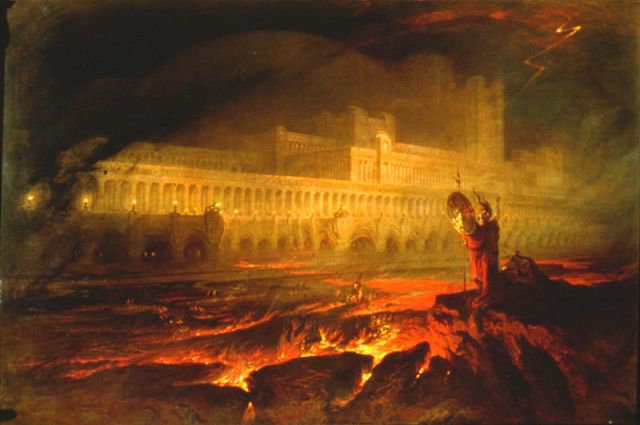
To continue: It would be a mistake, I think, to believe the quants were brought low by the vice of greed alone, and Milton/Hawkes can perhaps help us see why.  The broken relationship (sin) that underlies the whole of Paradise Lost is the sin of idolatry, and for our purposes, one can see this most especially in the construction of the capital of Hell, Pandemonium. The fallen angel Mammon (again meaning money) whose vision becomes the basis for Pandemonium was, while he was still in Heaven, transfixed by its beauteous gold. Mammon confuses this mere symbol of Heaven’s beauty for the beauty of Heaven itself. If its golden visages could be duplicated, in the logic of Mammon, then the fallen could recreate Heaven in what was actually Hell. It is this confusion, of the power brought to us by money, Milton seems to be telling us, with the powers of Heaven and of God, which is the danger point of our relationship with earthly wealth, rather than the animal-like greed for more and more. Mammon’s Pandemonium, is perhaps, like the beautifully decorated Anglican (and before that Catholic) cathedrals that dotted England in Milton’s day, a confusion of style over substance, an affront to the idea of God as the source of charity and love.

Ultimately, this boils down to an argument over what we should attend to during this short life of ours. The quants were, without doubt, brilliant individuals. Yet, they chose to use this brilliance not to seek out cures for disease, or find ways to aid the poor, or even to unveil the beauty of creation through science, but sought the generation of riches for themselves, and wealth for the already well off members of the hedge funds they managed. (Hedge funds, by law are limited to people with a minimum of a million dollars in assets).

The quants might respond that the wealth they were chasing would eventually make its way down to the lower classes like manna from Heaven. It would be a difficult argument for the quants to make in regards to the poor, given how hard the financial crisis, in part caused by the quants, has been on the least well off. It would be just as difficult a case for the quants to make for the middle class whose imaginary wealth- the value of their houses and stocks- disappeared as quickly as the electrons it was made of, once the power of cheap borrowing, of leverage, short- circuited.

It is not merely, however, the fact that the quants could be accused of idolatry in the sense of their worship of wealth, of which many could be accused, but that they were guilty of idolatry in that they both exalted their own idea of “truth” in a way that was almost quasi-religious, and that they practiced what was in a sense a form of divination.

On the first point: the mathematically inclined seem almost cognetally prone to a form of Platonism. That is, they tend to look at numbers not as mundane symbols to be manipulated for our purposes, but as part of some sort of higher reality whose truth stands above all human convention. You get this weird faith in the ability of numbers to capture reality in the most practical of people, “show me the numbers”, means the same thing as show me the truth, a phrase whose underlying assumption is that the truth can best be captured by abstract digits.

For the quants, “Alpha” was not some limited model of the financial world, but the deep, underlying truth of the it. Alpha was not a symbolic representation of the market, but was the market itself. The fact that this idea was neither rational, nor pragmatic, but instead constituted a sort of faith, can be seen in the fact that the quants’ belief in Alpha was not subject to doubt. Critics, such as Benoît Mandelbrot, or Nassim Taleb weren’t really engaged or answered, they were brushed aside because they didn’t conform to this “faith”. In an earlier age, such heretics might have been burned at the stake, but in our humane present, they were subject to the intellectual equivalent- they were ignored. This blind faith was only called into question by the quants when their “god” failed them and their models were shattered by the hammer blows of reality.

On the second point, I don’t think it is surprising that many of the quants started as gamblers, and not just because Wall Street is the greatest casino on earth, which it certainly is. Rather, gambling has a deep relationship with divination, and what the quants were really trying to do was peer into the non-existent future in order, as all divination does, to assert control over the existent present.

It’s a chicken-and-egg- question of whether gambling or divination came first in human history, and for all intents and purposes, it seems the further we go back the more indistinguishable the two probably become. The fact that a person’s future could be predicted using cards- the modern version of this is, of course, the Tarot deck, or dice, makes perfect sense if we put ourselves into an idolatrous frame of mind- which is essentially the frame of mind of almost all pre-scientific forms of thinking. The key mistake of idolatry is to confuse the symbol with the symbolized. This mistake seems to naturally imply that the more “like” the actual thing our symbol for something is, the more it actually is the thing being represented. An individual life is subject to chance, therefore, if we know the outcome of a game of chance we will be able to predict what will happen in an individual life.

The quants did almost precisely this with their models. What they did is construct extremely sophisticated chance games with one caveat: that the outcome of the chance games would trend towards the equilibrium of the Efficient Market Hypothesis. Like a fortune teller they played their Tarot decks, and then confused the outcome of these games with the economy the rest of us make our living in. Perhaps like the gut-level traders they replaced, and like the successful fortune teller, much of their initial luck arose as much from their intuition as their models. Perhaps, too, like the successful fortune teller, many of them were supremely good con-men who were quick to recognize and exploit the vulnerabilities of people who believed in their predictive power.

This world the quants had helped create only became supremely dangerous for the rest of us when the gap between their models and reality became too wide, or worse was ignored. The fall of idols is always difficult to bear, and given the fact that the larger economy had become tied up in the belief in these false models, their being proven false couldn’t help but affect the vast majority of us who had never heard of a quant or a hedge fund or, or algo-trading, or a credit default swap.

The markets were only saved when the public and quasi-public institutions, the world’s most powerful governments and central banks- (the latter, which especially, had up to that point, been the most vociferous proponents of the virtues of the free market) both turned tail and “got Keynesianism” flooding the markets with cheap cash. This magical elixir to cure the burdens of debt, however, was one limited to the richest institutions and elements of society. Financial deregulation and the exotic instruments devised by the quants had turned the creditors into their own debtors, and these debtors would be cured by the magic of cheap money, a concoction brewed by the world’s central banks who had previously treated even the hint of cheap money like poison.

Something seems to be seriously wrong with our financial system, something that reaches back long before the quants, and touches upon the fundamental assumptions behind the seemingly oldest elements of our economic life- money and debt. Which leads me to the last question along this train of thought:

How might something seemingly so essential to our lives as economic creatures, our money and our debt, be viewed through the lens of idolatry?

Until next time…
* Scott Patterson, The Quants: How a new breed of math whizzes conquered Wall Street and nearly destroyed it, Random House, 2010

Pandemonium, Kingdom of the Quants 1

You wouldn’t think an epic poem from the 17th century that dealt with a war in Heaven between the angels of God and Satan, the creation of Hell, and the fall of Adam and Eve, would have all that much to tell you about the 2008 financial crisis, or, on an even deeper level, would reveal the whole of modern economics to be based on a sort of magical illusion, but you would be wrong. John Milton’s great epic, Paradise Lost does both of those things, and perhaps much more besides.

For those of you who haven’t read Paradise Lost in high school or college I will briefly lay out the story below. I have to admit that I came very late to this book, and hadn’t read it in either high school or college. Once I had I was somewhat upset I hadn’t done so earlier- it is truly one of those books that grab you and change the way you look at the world. All I can say is read this book, and don’t think you can “wait for the movie”, it’s been canceled.

The story is one that probably anyone with even a modest Christian background in some sense already “knows” even if they’ve never heard of Milton. It is the tale of Lucifer and his angelic allies’ rebellion against God, the Son of God, and the angels that remain loyal to their Creator. Lucifer’s rebellion is sparked by his claim that angels are “self-begot”, and therefore owe no worship to God and his Son. The rebels are single-handedly casts out of Heaven by the Son of God, and into the depths of Hell, where they become monstrous, shift-shaping demons. Under the encouragement of the demon, Mammon, (literally “money”), they build Hell’s capital of glittering gold, Pandemonium. This city is supposed to replicate the glorious visages of Heaven, but, though more splendid than any earthly city, remains but Heaven’s pale shadow.

Satan plots his revenge against God, and finds his opportunity in the weak link of God’s new creation- Adam and Eve. After a courageous and epic journey through the depths of Hell, Satan makes his way to the earthly Garden of Eden, where in the form of a serpent, he convinces Eve that the Tree of  Knowledge of Good and Evil God had commanded her and Adam not to eat of on pain of death, is instead the means to upgrade to a god herself.

Ye eat thereof, your eyes that seem so clear,
Yet are but dim, shall perfectly be then
Open’d and clear’d, and ye shall be as gods. (286)

Eve takes the bait, and Adam the ever dutiful husband follows her lead. Rather than leading to godhood, eating from the Tree of Knowledge results in the couple’s expulsion from the Garden and the beginning of the sad fate of human beings until the arrival, promised to Adam by the archangel, Michael, of the Messiah.

You might be asking yourself by now what in the world such a religious epic from an era so unlike our own could possibly have to do with such a real world event as the financial crisis of 2008? Surely, the state of contemporary economics is not so bad that it needs to pull from the pages of religious mythology.

Allow me in what follows to engage in a flight of fancy. What I intend to do below is ride out what is a largely unsubstantiated set of assumptions, a claim, as it were, that has only the barest minimum of research behind it. CRITICISM of such a wild set of assumptions is not only to be expected, but HOPED FOR on my part. For the last thing I would want is to turn some random thought that entered my head into some sort of IDOL, that I refuse to allow to be criticized, or much worse, have DISPROVEN.

Here then is my idea: that one of the best ways to understand the financial crisis that broke upon us in 2008 is not through any of the competing economic models out there which have emerged largely ex post facto to explain the crash, but through the lens of an idea that emerged out of religion- the idea of idolatry.

This idea, in large part, was inspired by David Hawkes, the editor of the brilliant 2005 edition of Paradise Lost I have in front of me. It is Hawkes’ point that what Paradise Lost offers us is an extended meditation on idolatry, and that the concept of idolatry can provide us with a useful guidepost, even when severed from its original ground in the Jewish, Christian or Muslim faiths. That Milton’s great work might be read as a prophecy of our own age of secular idolatry.

Hawkes sees behind Milton’s Paradise Lost, though it is embedded in religious language, what was to become philosophy’s famous distinction between the “thing” and the “thing in itself”. The awareness that we can never know the world as it truly is, but only as it is mediated for us by our senses, and perhaps most especially by our ideas, one would today call them models of it.

The only being who can know the thing in itself, in Milton’s reading of it, is their Creator and thus the world of the created, including the angles, are in a state of alienation in reference to the world.  (XXX-XXXI)

Our inability to know the world as it truly is does not, however, stop us from trying. Far too often in our quest we believe we have reached that unreachable destination.

This seemingly innocent confusion of the map for the territory, the symbol for that which is symbolized, is not, in Hawkes’ terms “ethically neutral”. Instead the thing in itself, which only God can see, becomes confused with the image we hold in our hands or place upon an altar. The illusion that we are in possession of the “Truth”, like the voodoo dolls of witches. seems to lead straight to the illusion that we have God-like control over the actual thing we have symbolized. (XXXII)

In the words of Hawkes:

…. for Milton, sin consists in the refusal to recognize, and thus in the attempt to bridge, the world of experience and the world beyond experience. This is the sin of Satan, whose basic mistake is the failure to understand the difference between himself and God is qualitative rather than quantitative. (xxxvi)

The whole of Paradise Lost is a meditation on the dangers of confusing our idols for the thing in itself, our maps for the actual territory. This delusion is seen in Satan’s futile rebellion against an omnipotent God, in the building of Pandemonium, the capital of Hell, in which the demon Mammon thinks the glory of Heaven can be obtained in the gold of the earth. It is seen in the seduction of Eve by the serpent, when she confuses what she sees -the serpents human like power of speech- with the reality of what will be gotten from eating from the Tree of Life.

Hawkes wants us to connect Milton’s meditation on idolatry with the birth of capitalism that was happening right in front of the “eyes” of the blind prophet. Persons were being alienated from their labor as they were forced from their lands and forced to become wage earners, and more importantly for our purposes, money emerged as “an independent, self-generating force- an efficacious sign”. (XV)

Above all, Hawkes wants us to see Paradise Lost not as a mere epic poem that, despite its genius, is too embedded in a  religious language that offers little guidance to the problems of our secular age, but as what Milton intended it to be, a prophecy, that was meant to capture the outlines of the future. We are that future, and if Hawkes is right, Milton might have been able to peer into the way in which the world would unfold not out of any connection with the divine, but because his genius occurred at the very moment the modern world was coming into being, allowing him to grasps its fundamental assumptions.

Hawkes writes of us:

Our own “postmodern condition” is characterized by the virtually complete dominance of representation    over reality, but few twenty-first-century thinkers are capable of constructing an ethical critique of this situation. Paradise Lost offers such a critique, and that is why Milton’s poem is more pertinent today than ever before. (XXXIII)

What Hawkes interpretation of Paradise Lost provided me with was a model to understand the financial crisis. In particular, it gave me a way to understand the role of two forces which played a role in the outbreak of the crisis: the mathematical geniuses of Wall Street known as “quants” who created a whole new system of computer based finance during the 1980s, 1990s, 2000s  that imploded with the 2008 crisis, and the emergence of “fiat currency” in the early 1970s that engendered a credit boom the likes of which was never seen before, and that was ultimately based on the illusion that money could be created out of thin air- like magic.

Next time the Quants….

* John Milton, Paradise Lost, EDITED WITH AN INTRODUCTION BY David Hawkes, Barnes and Noble Classics, 2005 

Pagels’ Revelation 2, On Violence and Utopia

To return to the questions in the prior post:  Who was this John of Patmos, as he identifies himself, author of Revelation, and why did he write this strange book? As all reputable Biblical scholarship makes clear, he was not the disciple of Jesus named John, and/or the author one of the four key texts in the New Testament, the Gospel of John.

John of Patmos was Jewish believer in the message of Christ, that is, not quite yet a Christian (more on that in a bit).  Given the time in which he was living, and the beliefs he had adopted, his idea that the end of the world was at hand was no mere fantasy of the delusional, but reflected real, and current events. He seems to have written, first and foremost, for the reasons he said he had- to warn “all who could hear” about what he believed was the coming end of the world.

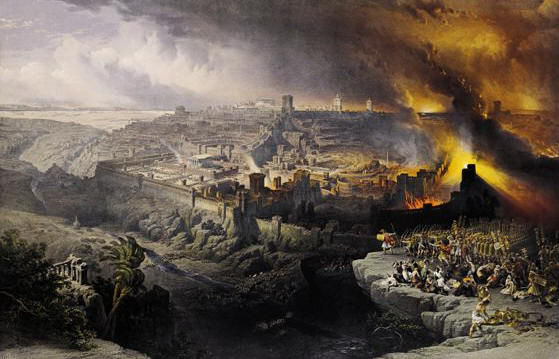
He was writing around 90 AD, and may very well have been a refugee from the incredibly violent Roman siege, starvation, and destruction of Jerusalem in 70 AD. Jesus had predicted the destruction of the famed Jewish temple in that holiest of cities- “that not one stone would remain”, and in essence it had happened. (Pagels believes this prophecy reported in the Gospels to be legit, and not, as some think a later embellishment R10).

The war in the homeland of the Jews, then called Judea, had broken out four years earlier as a rebellion of intensely religious Jews, known as the Zealots, who sought to throw out the Romans and establish a kingdom of the godly on earth. It was perhaps the world’s first truly civilizational religious war:  in part sparked by what many Jews considered to be Roman sacrilege of Jewish religious norms, whose rebels aimed at creating a religiously based political community to be ruled by their hoped for coming messiah. It was a revolt that was ultimately crushed by the Romans who in doing so took direct aim at the Jewish religion: desecrating its holy sites and burning its most sacred temple to the ground.

John may have seen this destruction himself, and even if he did not, he certainly had met the scores of refugees from the Roman war on the holy land. He would have heard, first hand, the stories of the destruction and sacrilege, the rape of Jewish women, the tale of the Jews under siege at the fortress of Masada who chose mass suicide rather than the murder or enslavement by the Roman army that surrounded them.  But this religious war would have only been part of John’s understanding of Rome’s violence against “God’s people”, he would also be confronted by the specter of Rome’s own cult of power, and its corresponding religious persecution.

In modern times, at least in Western countries, we tend to try to preserve a line, sharp or blurred ,depending on our particular national culture, between politics and religion. Political figures or movements that cross this line are usually criticized for using religion for political ends. In the Roman world, on the other hand, it was not merely that religion was co-opted by political forces- it was that religion possessed no real independent existence apart from the state.

As Pagel’s points out, the Imperial Cult of Rome, in which conquered peoples accepted and worshiped both Roman gods and the emperor, were a means by which conquered peoples showed their loyalty to the conqueror. To not give worship to Rome rulers and its gods constituted an act of political defiance. Any wonder then that Jews, and later Christians, aroused the suspicion of Rome, which sometimes resulted in the empire’s extremely cruel persecutions of these dissident groups even outside the religious wars between Romans and Jews. Such persecutions could include everything from crucifiction to being tortured and eaten alive by wild animals for public entertainment.

If the political world offered John plenty of endtime material, the natural world delivered as well. The massive eruption of Mount Vesuvius in 79 C.E. had not only turned people quite literally to stone, it had opened a vast crater that seemingly opened into the burning mouth of hell, and caused molten lava to rein from the heavens.

But if it is clear that we should not look at Revelation as a book that aimed its’ prophecy at some far-off human future, but instead was a dystopian perspective on the Roman Empire in  the present of its author, how should we make sense of John’s seeming obsession with the Jews, which is another underlying theme in the book? That is, how are we to understand that Revelation is told from the perspective of the Jewish fight for liberation and justice against the Romans when it author, John, seemingly has such horrible things to say about the Jews as well.

It was once typical to read John’s ravings about the Jews as an early example of Christian anti- semitism. A pathology, which as we all know, was to play such a disastrous role in later Western history. That’s how I always read Revelation, but Pagel offers an alternative explanation, one that seemed to make apparently nonsensical ravings such as ones against “those that say they are Jews and are not” scattered throughout Revelation actually make sense.

Pagel sees John as on the losing side of an argument about what Christianity was to become. Was it to present itself the fulfillment of the Jewish faith, concentrate on the conversion of fellow Jews, and retain Jewish law for converts such as dietary laws and the practice of circumcision? Or was it to open itself fully to non-Jews- the Gentiles- concentrate on their conversion rather than the conversion of fellow Jews, and largely abandon Jewish law for religious practices that would be more attractive to non-Jews?

Pagel sees John of Patmos as taking the position that Christianity should remain as close as possible to the Judaism it claimed to fulfill, whereas the apostle Paul, whose side ultimately won this debate, wanted, in a sense, to walk away from traditional Judaism and spread a new faith among the Gentiles.

So John in his Revelation is aiming at two primary targets: the Roman Empire, and those in his new religious movement centered on the figure of Jesus Christ (the Paul faction) who wanted to redefine the faith to embrace the Gentiles and abandon almost all of traditional Judaism.John’s seemingly anti-semitic statements can now be seen not as attacking the Jews but those early Christians who were abandoning much of Judaism and setting their sights on converting the pagans.

With this in mind we can start to answer the question of what all his crazy symbolism might mean. The Beast in all likelihood is the Roman Empire, with the “Whore of Babylon” being the great city of Rome itself, both after all,  sit upon seven hills. The Beast’s “seven heads” are likely the last seven emperors of Rome up until the madman emperor,  Nero.

The infamous Nero, who had murdered his own mother and was rumored to have deliberately set afire the city of Rome, could easily play the part of the last head (emperor) of the seven headed Beast (Rome). Nero had died of a self-inflicted wound to the head- just like the wound suffered by John’s Beast, but was rumoured to be still alive and plotting his return. A rumor John may have known and believed.

The so-called “mark of the beast” which people need to be able to “buy or sell” is probably a cryptic reference to Roman coins which often had images of the Roman emperor, Roman gods, or both, and which many observant Jews of the time faced a moral dilemma in using. (Though Jesus with his “Render what is Caesar’s unto Caesar and what is God’s unto God”, apparently, did not.)

The “false prophet” figure of the antichrist, though John doesn’t call him that, is likely a reference to one of the figures on the Paul side of the where-do-we-go-from-here? debate among early Christians. He might also be the author of a lost alternative end-of-time narrative to John’s own. Pagels shows us just how common these narratives were at the time, an obvious reflection of the enormous pressures society was undergoing at that time.

The figure of Jezebel is also likely one of these figures of early Christianity, and Pagels here too brings prominent Christian preachers who were women lost to time, or erased from official history back into view. Talk of  Jezebel’s “fornication” by John Pagels sees not so much as a puritanical slur as a reference of this prophetesses’ tendency to aim her preaching at “unclean” pagans.

This still leaves us with plenty of questions in terms of John’s symbolism, but a more practical question is how John’s Revelation came to be in the Bible at all if it was indeed a rival to the ultimately winning (Paul) side of the debate among early Christians regarding the future of the faith?

In fact, Pagels points out that including Revelation in the officially sanctioned books that make up the New Testament was highly contested and controversial. At the end of the day, Revelation had a number of opposing strengths that would lead to its eventual inclusion in the Bible.

For one, it offered hope, and ultimate justice and in doing so became popular with Christians who were even more brutally persecuted by the Romans during the 2nd century than they had been when John penned Revelation. The Romans considered the Christians “atheist” in that they didn’t believe in the gods, and though neither would admit it, Christianity and atheism have been the flip-side of one another ever since.

What was worse for the Romans is that this atheism was rapidly spreading and in sections of the population: slaves, women, the poor where such beliefs might foment revolution. The fact that many Christians would not disavow their beliefs, would suffer horrible tortures and death rather than pay homage to the emperor and the Roman gods, or would refuse to curse the name of this agitator- Jesus- whom the Romans had proved to be a charlatan when they crucified him over a century before, made Christians appear like dangerous fanatics in the eyes of Roman magistrates, a cancer on the Empire that needed to be stopped before it became impossible to do so.

Under conditions like this, for Christians, John’s Revelation didn’t read like prophecy- it read like the news. But then everything changed.

In 313 the Roman Emperor Constantine legalized Christianity. By the end of his reign Christianity would be the official religion of the empire that had tried to destroy it. Christian churches, not pagan temples, would be paid for with the taxes of Rome. Pagans, rather than Christians would find themselves under state persecution.  A betting man would have wagered that The Book of Revelation which had preached against the Roman Empire had had its day. Yet here, another strength of Revelation makes its appearance- that is the ambiguity of its symbolism. John never says “I am talking about the Roman Empire”, “the Whore of Babylon is Rome” etc. You can project onto Revelation any enemy you wish, which also means you can deny that its characters represent some particular power or person as well.

The person almost singularly responsible for getting the Book of Revelation included in the Bible was Athanasius, Bishop of Alexandria.  Athanasius was an impassioned proponent of a hierarchical and universal (catholic) church. His election to the position of Bishop in Alexandria in the early 300s was contested and the issue ultimately decided in his favor by Constantine with whom he had close connections. Many in the Egyptian church fought this decision and Athanasius fought a 40yr struggle to bring them to heel.

In this fight Athanasius found in Revelation a potent weapon. John’s warnings against “false prophets” would be used in Athanasius’ hands to mean any group of “heretics” that did not submit to the will of the Church which was now firmly aligned with the Roman Empire. This Athanasius was a major figure among the group of Church and Imperial officials that would create the Nicene Creed, the declaration of belief that Catholics recite at the beginning of religious services to this day. He was also a key player in the decision of what books were to make up the official Christian Bible, and he would argue for, and win the inclusion of Revelation.

This still leaves us with the last question, namely, what does The Book of Revelation mean for us? Here I will step away from Pagel and speak for myself. What it certainly is not is some sort of actual prophecy to be applied to our own time. Yet, given the ambiguity symbolism in the story, and its proven ability to be projected upon just about any political or religious environment, Revelation is likely to be used, or rather misused, in this way until human beings stop imagining the end of the world. A scenario that will probably only come about when there are no longer human beings around to worry about such things. That is, the end of Revelation, or some variant of it, will only come about once the world, at least for us human beings, really has ended.

As I have pointed out in the past, other myths that explained the world in terms of a battle of good against evil, that would end with the victory of the good and represent the end of history predate The Book of Revelation, but it is primarily this book that still holds us in its spell.

John’s strange images of violence, destruction, and evil incarnate take us into the world of our worst fears, but his story ends with the birth of a new world, and the end not merely of this particular experience of suffering in this specific time, but the end of all suffering, and, at least for the just, for all of time to come. In his vision not just human beings stop hurting and killing one another, but animals stop doing so to one another as well. The bloodshed of John’s end-times is a type of catharsis that purges, once and for all, the elemental relationship between violence and the living world. Revelation, as Pagels points out, is a vision of both our worst fears and most fervent hopes.

It is probably this idea of ending violence through violence that has proven to be the most deadly legacy of Revelation. You can see it in the revolutionary reigns of terror in both the French and Russian Revolutions where killing was justified on the basis that violence was being made a thing of the past- a new state to be reached, it was claimed, once the current violence was over. You find this same dangerous nonsense in “wars to end all wars” or “the war on terrorism”, which given that terrorism is a tactic amounts to “the war on war”.  The idea that violence waged against violence will be one that the side of “good violence” is destined to win is a dangerous illusion that has resulted in the most dangerous of gambles with the very survival of humanity.

Violence is good for only two things that I can think of: self-defense, and to stop other violence as it is occurring or right before it is about to occur. Violence can not end violence, and it effect is often exactly the opposite, it can only stop the violence of another group in its tracks. Violence is, thus, a purely negative force, and despite what you might have learned in your political science classes it is never the basis of anything. Even the cruelest of states use violence not as a basis of their power but as a means of making sure no one but those willing to collaborate with them is actually able to organize. As the Romans knew well there is no basis for empire without a sea of willing collaborators.

But if we can step back from this dangerous illusion in Revelation that violence can end violence we can see what I believe to be the true and lasting value of that bizarre book.  In a way that would have never occurred to the Romans who held violence to be an elemental, inescapable, and even praiseworthy feature of the world [these Romans who,  after all, built their famous Coliseum as a house-of-horrors to entertain vast crowds with animals killing animals, animals killing humans, and humans killing humans] that there was something wrong with this state of affairs, that a more perfect world would be one in which violence, even the natural violence of animals, never occurred.

But John, in his confrontation with the Roman Empire could see this, and was thus able to take a moral and imaginative leap into a world that was not, into a utopia, where violence was gone from the world. This is the same type of leap that was taken from a very different perspective by the Indian religion of Jainism that till this day practices nonviolence against all living things. Both Revelation and Jainism accuse the violent character of the natural and human worlds of being immoral on account of such violence, and imagine in its place something new.

A world purged of violence is without doubt utopian in the sense that it will never be realized, but the fact that so many of us have come to believe that violence is fundamentally wrong, that we have purged or tried to purge it from all the places where Roman civilization found it to be natural: from the family, from the economy, from criminal justice, from even our relationship with animals can give us hope that the arc of history moving away from violence, an arc that John of Patmos helped identify, is more than just the delusion of a madman but a destination we, with effort, can continuously move towards, if never reach.

Pagles’ Revelation 1


Readers of this blog who take note of how much I talk about the Book of Revelation might be forgiven for thinking I had perhaps lost my grip on reality, that soon I might be found wandering the street with a sign around my neck informing the world that “the end is near!” or might be on the verge of joining the church of Harold Camping with the hope that next time he will get his dates right.

Of course, nothing could be further from the truth. Nevertheless, I perhaps find the Book of Revelation as fascinating as those who believe it to be an outline of the human future composed by the mind of God. For me, Revelation is the first, and without doubt the most powerful dystopia ever written. The vagueness of its symbolism is its strength. For what other narrative is so flexible that its penultimate villain- the Anti-Christ- can be grafted onto historical figures as diverse as the Roman Emperor Nero, Pope Boniface VIII, Napoleon Bonaparte,  Abraham Lincoln, and Barack Obama.

We should not forget either that the Revelation narrative was sometimes used by the “good guys” of history such as Bartolome de Las Casas who fought for the rights of Native Americans against his Spanish countrymen, or could be found in the hearts and minds of the Union armies during the Civil War who sang:

Mine eyes have seen the glory of the coming of the Lord:

He is trampling out the vintage where the grapes of wrath are stored;

He hath loosed the fateful lightning of His terrible swift sword:

His truth is marching on.

He is coming like the glory of the morning on the wave,

He is Wisdom to the mighty, He is Succour to the brave,

So the world shall be His footstool, and the soul of Time His slave,

Our God is marching on.

Glory, glory, hallelujah!

Revelation has proven the most powerful dystopian narrative in history whose value is as varied as the humanity that is its subject inspiring saints, poets, madmen and murderers. Thus, I awaited with some anticipation to get my hands on the religious scholar Elaine Pagels’ recently released Revelations: Visions, Prophecy, and Politics in the Book of Revelation. Pagels is a brilliant historian of religion who writes in a style accessible to the lay reader, and in her work she sets out to tell us the origins of this strangest of books.

For those who have never read the Book of Revelation, or have read it and don’t quite remember what exactly it says,  below are the basics. Please bear with it, for later on, with the help of Pagel we will snap the whole thing into place.

The author of Revelation , John of Patmos, announces at the beginning of his book in a tone that clearly implies the imminent occurrence of what he is about to unveil:

Blessed is he that readeth, and they that hear the words of this prophecy, and keep those things therein: for the time is at hand. [emphasis added]

In powerful words John speaks in the voice of God and indicates that the story he will tell is the end of a drama that began with the creation:

I am Alpha and Omega, the beginning and the ending, saith the Lord, which is, what was, and which is to come, the Almighty.

John then reports how he was given his prophecy, which come to him in visions that he was told by God to convey by letters along with “warnings” to the seven churches of Asia.

In his letter to the church of Ephesus John warns against “them which say they are apostles and are not”.  To the church of Smyrna he warns against “those who say they are Jews and are not”. The church of Pergamos he warns against worshipers of the pagan god Baal. Thyatira he warns against “that woman Jezebel who calleth herself a prophet”. Sardis he cautions to keep on the right path. To Philadelphia John again makes this strange warning against those “which say they are Jews and are not” but are instead of “the synagogue of Satan”. [Quick note: this has often been interpreted as deranged anti-semitism on the part of John, and that is how I have always read it, but Pagel is going to offer a whole new explanation for this nonsense, so again, stay turned].  Lastly, John warns the Laodiceans about their “lukewarm” faith.

Now the story gets interesting. John sees four heavenly beasts with the faces of a lion, calf, man, and an eagle each with six wings and “full of eyes within”  surrounding a throne on a “sea of glass”  praising God. Around the throne also are seated 24 “elders” clothed in dazzling white and also singing praises to God.

On his throne, God holds a book in right hand locked shut with “seven seals”, only a slain lamb, the symbol of Christ, is able to open the book. This is the book on which the end of our world is written. The breaking of the first seal brings forth a white horse representing conquest, the second a red horse-violence-, a black horse-famine-, and a white horse-death. The breaking of the fifth seal reveals those who have died in the name of their faith who cry for the justice and revenge of God upon their tormentors.
The sixth seal triggers an enormous earthquake, the sun goes black, the moon becomes as red as blood, and stars fall from the sky.

For the great day of his wrath has come; and who shall be able to stand?

Angels descend from heaven to mark God’s chosen with a seal that will offer them protection from the horrors to come 144,000 are so marked. The story gets even harder to follow. At the breaking of the seventh seal  angel’s blow trumpets and all hell breaks-loose, so to speak, the angles pour out vials causing all kinds of horrors and monsters to descend upon the earth where a gaping abyss has opened up.

John now shatters all human conventions of past, present, and future. He sees a woman in heaven bathed in sunlight crying in labor giving birth to a child. (Mary, giving birth to Jesus which had happened a little less than a century before John wrote)  Satan, emerging from the abyss, makes chase to kill the child and battles Michael and the Angels of heaven (something that “took place” before the creation of mankind). To his side Satan calls the two figures we all remember from Revelation, the Beast, and another figure who has become known as the Antichrist.

The Beast has “seven heads and ten horns” and is obviously some sort of political power for he is said to have power “over all kindreds and tongues  and nations”. The Beast has been “wounded by a sword but did live”. The second figure, the Antichrist, makes his appearance. He is a sort of miracle worker who convinces the masses to worship the first Beast. The Antichrist decrees that everyone:

….. receive a mark in their right hand or in their forehead:
and that no man might buy or sell, save that he had the mark, or the name of the beast, or the number of his name.

John then let’s us know that if we are wise enough we can actually figure out who this beast is:

for it is the number of a man: and his number is six-hundred threescore and six.

John then sees seven more angels pour yet more cups of horrors on the peoples of the earth. One of these angels takes John to see a woman sitting on a scarlet colored beast- again with seven heads. Upon her head is written:

MYSTERY BABYLON THE GREAT, THE MOTHER OF HARLOTS AND ABOMINATIONS OF THE EARTH

And we are informed that the seven heads of the beast “are seven mountains, on which the woman sitteth”.

John tells us how Babylon will be destroyed and how the merchants that have grown rich from her and those that have felt her pleasures “cinnamon, and, and ointments, and frankincense, and wine, and oil… and the souls of men” [emphasis added] will lament her fall.

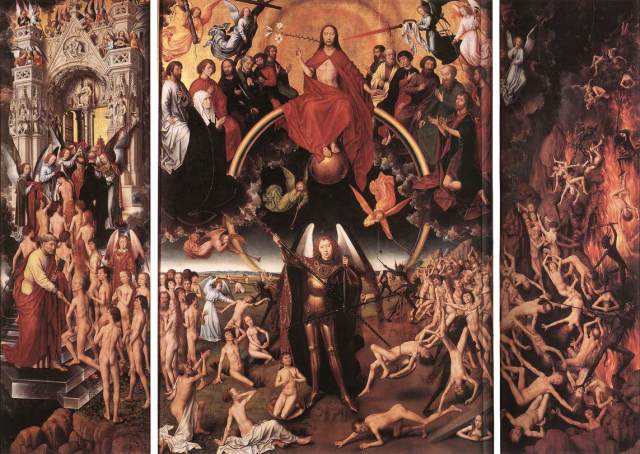
God, on a white horse, and his armies descend from heaven and destroy the Beast, and end up chaining Satan in a bottomless pit for a thousand years. After this period Satan is released who will again deceive the nations of the earth including “Gog and Magog” at the four corners of the earth.  A last great battle for the meaning of the world ensues. The forces of good win. The great generations of the dead of humanity rise from under water and earth: their physical bodies reconstituted. The wicked of the world receive God’s justice, condemned  to a lake of fire.

After this last epic battle between the forces of good and evil, the resurrection of the dead and last judgement, John’s prophecy turns from a horrifying dystopian vision to poetic image of utopia, a reality that promises moral closure, a final end in which the world has made sense: the evil punished, the good rewarded, and all that haunts us has passed away. The world as we have known it with its deceit, desire, pain, and suffering is at last gone replaced with something entirely new and beautiful:

And God will wipe away all the tears from their eyes: and there shall be no more death, neither sorrow, nor crying, neither shall there be any pain: for the former things are passed away.

The holy city of Jerusalem, the seat of this new world, is composed of dazzling jewels on a sea of glass.

And the city had no need of the sun, neither of the moon… for the Lord God giveth them light and they shall reign forever and ever.

That then, is the Book of Revelation, we are left with questions: Who was this John of Patmos? Why did he write this strange book that has haunted us since? What does its crazy symbolism: this Beast, and Antichrist, and Jezebel, and Babylon and all the rest mean? And lastly, the most important questions, what does it say to us? What does it mean, for us?

We will need Pagels’ help to answer these questions, and I will pick it up there next time.

The First Prophet and His Legacy

Out of all the post I’ve made on this blog, so far, one in particular solicited the sharpest criticism. It probably had something to do with the title. Naming the post Blame Zarathustra and then connecting the ancient sage to the invention of what I characterized as an extremely dangerous strand of dualistic thinking that normally goes by the name of a later prophet and his religion- Mani and Manichaeism- brought forth much justified criticism from still practicing Zoroastrians and scholars of his ancient faith.

I decided I should do a little homework before holding to such sweeping assertions. I was, in other words, in search of the real Zarathustra, and that search led me to a book of exactly that title: the wonderful In Search of Zarathustra by Paul Kriwaczek.

Kriwaczek’s aim is to uncover both the truth and the legacy of the figure of Zarathustra (or Zoroaster), a man he characterizes as the first prophet. His quest takes him throughout Asia and Europe through both the past and the present.  For Kriwaczek the new vision that Zarathustra, brought to the world was that:

Unlike other prophets of antiquity, Zarathustra had taught that history was neither cyclic nor eternal. The struggle described between good and evil would one day be brought to as head in a great battle, and after many troubles and torments, the forces of good would be victorious.

Evil would be vanquished; history- the world as we know it-would come to an end. (148)

Zarathustra thus brought two ideas into history that were to be of enormous consequence. The first was the view of history as a battle between the forces of good and evil. The second was the promise that the ugly reality of not just human history but the natural world would come to a beneficent and final end. This latter idea has proven perhaps the most potent for it broke with the much older traditions of a cyclical and therefore irredeemable history. Cyclical views of history and nature were those such as the Hindu idea of Yugas or epochs- a golden age, Satya-Yuga, inevitably giving way to successively worse ages until the total decay of the Kali-Yuga ended and the cycle began all over again. Other cyclical theories of history, such as that of the Greek poet, Hesiod, were almost identical to the Yugas.

Kriwaczek thinks these two ideas: the war between good and evil, and the idea that history is linear and leading to a positive end state, influenced the almost as ancient Hebrew idea of God as an actor in human history. Kriwaczek holds that the ideas of the Hebrews regarding “the end of the world” that were developed independently and can be found in the books of Isaiah, Ezekiel, among others,  were far more this-worldly in nature than the vision of Zarathustra. The early prophets foretold the coming of a messiah and the reordering of the political world in which the Jews would play the role in world affairs we ascribe to conquering and imperial peoples such as the Romans. What the early Hebrew messianic visions did not hold was the idea that history itself, and the relationship of humankind with the world would be revolutionized, which was the view of
the Zoroastrians. ( 149-150)

Kriwaczek sees the Book of Daniel, with its intense imagery and prophesy of a world transformed, which was compiled from earlier stories during the Maccabean revolt of the Jews against the Greeks, as a bridge linking the Hebrew messianic and the apocalyptic  legacy of Zarathustra. The Maccabean revolt resulted not in Jewish independence, let alone,Palestine becoming the center of a new and divinely sanctioned world power, but to the intervention of the Roman general Pompey and the Jews absorption  by the growing Roman Empire. Under these conditions, Judaism abandoned its worldly millennialism for a concept of an end of the world that would transform the very nature of the human relationship with God, nature, and each other- ideas much closer to Zoroastrianism. (160)

These ideas regarding the imminent end of the current world and the birth of a new one were especially popular among so called “God-fearers”, gentiles who had adopted elements of the Jewish faith. (166) The Roman Empire provided a vast network for the interchange of ideas, people, and products. In these conditions Judaisms became a proselytizing faith actively seeking converts in all corners of the Empire. Before the destruction of the Temple in 70 C.E. this “open” Judaism was perhaps the most numerous and widespread faith in the Roman world. Perhaps, one of the major reasons Rome crushed the revolt in Palestine with such violence as depicted in The Jewish War of Josephus.

One uses the singular term Judaism for the faith during this period, but in fact Judaism was a spectacularly diverse religion during the late periods B.C.E and early periods of the Common Era giving rise not just to the schools of the Pharisees and Sadducees depicted in the New Testament, but to apocalyptic sects such as the Essenes and, of course, Christianity.

If Kriwaczek gives us a good grounding in Zoroastrianism and Judaism we need other scholars to move further afield.  The religious scholar, Elaine Pagels, in her Book Of Revelation explores how a  group of Christians best represented by John of Patmos, author of the Book of Revelation, built upon earlier beliefs to create their own version of a world that was soon to undergo a second creation, after an epic confrontation between the forces of good and evil.

John of Patmos lived in truly apocalyptic times, especially for early Christians. Not only was there the evil decadence of figures such as the emperor Nero, there was the brutal persecution of Christians, the before mentioned invasion of Judea and burning of the Temple in Jerusalem by Roman legions, and the eruption of Mount Vesuvius, which must have truly made it seem that the world itself was coming to an end.

John of Patmos must have been tapping into a deep need for apocalyptic narratives for Christianity’s great rival during its first centuries was an even more dualistic faith in the form of  Manichaeism founded  by the prophet Mani (216-276 C.E.).  Manichaeism was a form of gnosticism, a broad array of beliefs on the nature of humankind and the world to the divine that if it had one broadly shared feature it was the idea that the material world was corrupt and the individual, therefore, was called to free his spirit from its spell. Manichaeism  imagined a world torn between a world of light and a world of darkness. It was an amazingly flexible faith able to spread from societies as diverse as the Roman Empire, Safavid Iran, India and even China.

After Mani, the best known Manichean was a man who converted from that faith to Christianity- Saint Augustine. Augustine probably did more than any other person to move the Church away from its apocalyptic and utopian strain. His great work The City of God reimagined the Christian community as mystical city, not the seed for some type earthly paradise.

Of course, dualistic ideas regarding the battle between good and evil, and the understanding of history as the unfolding and eventual conclusion of this epic struggle didn’t disappear within Christianity because of Augustine. The philosopher John Gray in his excellent book, Black Mass, traces these beliefs from the figure of the mystic, Joachim of Fiore (1135-12o2 C.E.), through the Reformation and English Civil War, right up until the secular utopias of the 20th century with their own dualistic, apocalyptic narratives- Communism and Nazism.

Part of the inadequacy of Gray’s otherwise compelling book is that he seems to think no good has ever come out of this strain of thinking. I believed this fervently myself until I began to look more deeply into the matter, and came across a figure such as Bartolomé de las Casas (1484-1566). This Catholic friar who lived in the Americas was perhaps the first hero of the movement for human rights, bravely defending the rights of Native Americans against Spanish atrocities. He was also a man whose world view was steeped in dualistic and apocalyptic thought believing the end of the world which would start with the conquest of Europe by Muslim armies to be imminent, and the New World to represent a last refuge for Christian civilization.

How could both of these views be compatible, I thought? And then I remembered my readers’ criticism of my initial post about Zarathustra. “I just didn’t get it”, they seemed to be saying. Zarathustra was talking about something more internal- in the mind and heart- than external, located in the political realm. It seems to me now that what Zarathustra invented, contrary to the parody of him by the genius Friedrich Nietzsche who saw the first prophet as the source of the tortured conscience of humanity, the very possibility of moral progress. As individuals, and as societies, we are called by this ancient sage to choose between good and evil, and in choosing the good, day by day, we can move the world toward ever brighter light.

Utopia Secular and Religious

Utopia scholars such as Ronald Schaer have argued that the concept of utopia, properly understood, is a secular one that originated in the early sixteenth century with Thomas Moore. Yet, as Schaer himself points out, the most powerful of 20th century utopian movements can not really be understood with out reference to the eschatological visions of the Judeo-Christian, and one should add Islamic, traditions

Indeed the worldly paradise predicted at the end of days ,and hoped for by elements these religions to a greater or lesser extent, is, even if we proceed with intellectual caution, more intimately connected with the political consequences of the idea of utopia than Schaer would have us believe. In many ways the most powerful of the secular utopian movements have borrowed so much from their religiously conceived predecessors as to be almost indistinguishable.

One might wonder where human agency has gone in religious utopianism, for underneath the secular version of utopia lies the humanist assumption that we can build the future. Yet, the most powerful secular utopian movements also seem to lack this quality of human agency, with some other entity serving the role once ascribed to God. For communists, utopia was to emerge through the deterministic forces of history, for Nazis through the war of nature, for the current Transhumanist/Sigularian movement the promises of religion- immortality, collective consciousness, omniscience are to emerge through the deterministic evolution of technology.

The difference between utopianism which wears the guise of religion in comparison to plain vanilla religion is that religious-utopianism promises the eminent arrival of a new and perfect world within the life-time of believers.  Religious utopianism points to a future state not a lost paradise at the beginning of human history. Lastly, whereas religion guides individual moral behavior, often for the purpose of obtaining happiness after death, the goals of religious utopianism are collective in character and serve as a guide to political action now.

The reason we should be paying close attention to utopia as religiously conceived is that, today, secular utopias are far less potent than religious ones, and failing to take heed of religious utopias blinds us to their very real capacity to effect the world in the here-and-now, rather than merely affect the state of human spiritually, or subsist as some ethereal hope for some promised land, far-off, at the “end of history”.

Utopian thinking continues to have a great hold on the human psyche, and utopian movements are one of the major forces guiding political action today. We should, therefore, try our best to understand them. In the immediate future, such an understanding would provide some insight when comes to the looming showdown with Iran- the subject of my next post.