Taiping Rebellion, Tectonic Shifts

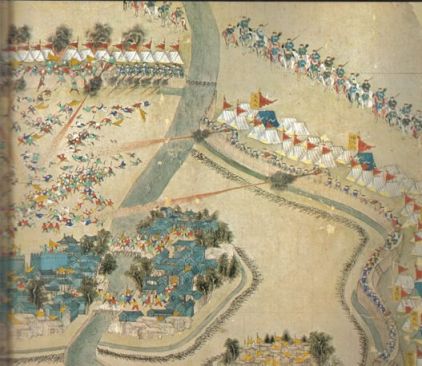
Around the same time as the American Civil War a civil war that became known as the Taiping Rebellion was raging in China. The American Civil War was a brutal conflict that left 625,000 Americans dead. The Taiping Rebellion resulted in the deaths of somewhere between 20-30 million people, making it one of the bloodiest conflicts in human history.

The origins of the Taiping Rebellion lay some years prior in the First Opium Wars fought between the British and the Qing Empire of China from 1839-1842.  In the Opium Wars the grand old British Empire played the role of the modern day Columbian drug cartel,
or Mexican drug lords, with the major difference being that the British, being militarily superior to the Chinese, were able to force China to accept the British importation of an addictive poison rather than just sneak it across the border.

As a consequence of the devastating impact of the opium trade on the people of China, the Chinese Emperor sent the Confucian scholar Lin Zexu to the port of Canton in order to put a stop to the importation of the drug by British merchants. Lin wrote an impassioned letter to Queen Victoria appealing to her sense of humanity with the hope of stopping the trade.

We find that your country is distant from us about sixty or seventy thousand miles, that your foreign ships come hither striving the one with the other for our trade, and for the simple reason of their strong desire to reap a profit. Now, out of the wealth of our Inner Land, if we take a part to bestow upon foreigners from afar, it follows, that the immense wealth which the said foreigners amass, ought properly speaking to be portion of our own native Chinese people. By what principle of reason then, should these foreigners send in return a poisonous drug, which involves in destruction those very natives of China? Without meaning to say that the foreigners harbor such destructive intentions in their hearts, we yet positively assert that from their inordinate thirst after gain, they are perfectly careless about the injuries they inflict upon us! And such being the case, we should like to ask what has become of that conscience which heaven has implanted in the breasts of all men?

The result of Lin’s efforts was a war by the British against the Chinese Empire, that the Chinese were destined to lose.

The fact that tiny Great Britain, with a little over 27 million people in 1850, could so easily have brought a continental empire of 450 million to heel would have been considered ludicrous only 50 years before.  It was certainly the case that European powers had had an easy time knocking off the great empires of the Americas- the Aztec and the Inca- two centuries earlier, but these were civilizations lacking steel, wheels, horses, or gunpowder weapons, technologies the Europeans had largely imported from fellow Old World civilizations- especially the Chinese. As Jared Diamond has pointed out, the Europeans were also in possession of devastating weapons of mass destruction in the form of diseases to which Native Americans had no immunity, and which killed more than any of the cruelties of conquest.

China, though, should have been different. China was the oldest living civilization, the great technological, political and cultural innovator. It was, after all, the more advanced society Europeans were trying to get to in search of trade, technology, and a hoped for ally against the Muslims when Columbus “goofed up” and ran into the New World.

The reason China wasn’t different is that the world had begun one of those great periods of tectonic shift in nature and history. This time, the shift was the development of a whole new type of civilization, an industrial civilization which, for a time, turned the Western civilization in which it first took root into the ruler of the world. For the mechanized British army and navy the “white man’s burden” that came with technological advantage meant cornering the Chinese drug market, and crippling the world’s most revered civilization.

The response of some of the Chinese to all this was the establishment of a pseudo-Christian utopia called the Taiping Heavenly Kingdom. The war between the Qing Chinese and this strange utopian-cult would constitute the bloodiest conflict of the 19th century rivaling the wars unleashed by the ravenous Napoleon…
Tenochtitlan, Dürer, Civilization

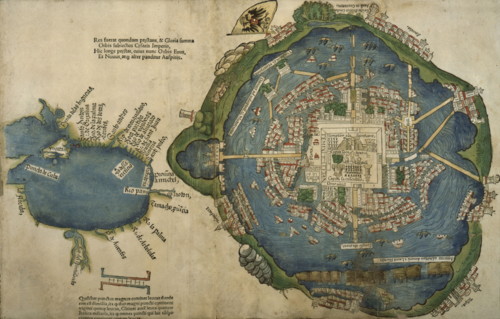
In the year 1521 the armies of Hernando Cortez captured the Aztec capital of Tenochtitlan near where Mexico City now stands.  In conquering the city Cortez had brought to the Spanish empire one of the great cities in the world. The population of Tenochtitlan numbered somewhere between 200,000- 250,000. To modern ears, accustomed to cities of enormous scale, these numbers appear tiny. And yet, it should be remembered that the world population in 1500 was only 500 million compared to the 7 billion alive today. The largest city in the world in 1500 was Beijing, China with 625,000 people. At the time, Tenochtitlan was in the middle range of the world’s ten largest urban centers tied with cities both still existent, and whose fame has been long forgotten, cities such as Hangzhou in China, Tabriz in Iran, and glorious Istanbul. Only one Western city could be numbered among the largest cities in the world in 1500, Paris with a population of 185,000.

The great artist from Nuremberg, Albrecht Dürer, who lived during this time of Western discovery and initial conquest of the New World, had the opportunity to set his eyes on some of the stolen treasures of Aztec civilization. Certainly, they must have come as a shock. The genius Dürer found something both familiar and utterly alien. The universal character of art he could comprehend, while at the same time the mythological language and culture that gave context to the art was incomprehensible within the  not only the Christian world-view, but from the view point of any of the cultures, ancient or modern, he might have known. Only the works of Ancient Egypt might have appeared so wondrously baffling.  In 1520 Dürer wrote of seeing the Aztec treasures:

All the days of my life, I have seen nothing that rejoiced my heart so much as these treasures, for I saw among them wondrous works of art, and I marveled at the subtle Ingenia of men in foreign lands. Indeed I cannot express all that I thought there.

It is not definitively known whether the account of Cortez’s conquest of the Aztecs, especially its beautiful illustrations of Tenochtitlan, such as the one above, influenced Dürer’s short work on fortified cities published in 1527, (illustration below) but the more than superficial similarities, timing, and his interest in the Aztec’s all suggest this may be the case. If Tenochtitlan did indeed influence Dürer’s idea of fortified cities it would be somewhat ironic, for he was expressing not just his own utopian ideal, but offering what he thought was a practical remedy for Turks on the march against Hungary. In basing his fortifications on Tenochtitlan, Dürer was using a city that had fallen to a handful of Spaniards and their allies almost overnight.

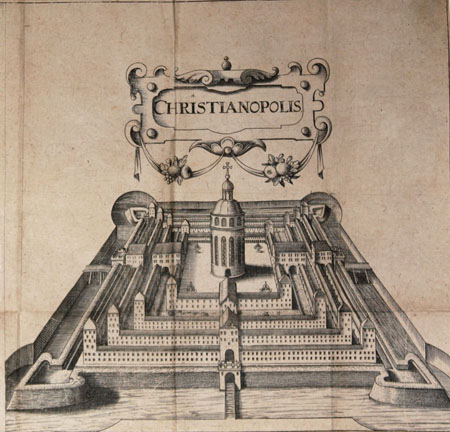
Dürer’s fortress cities remained a mere flight of imagination for all but one instance: the Black Forest town of Freudenstadt designed by the architect Heinrich Schickhardt, which was explicitly based on the designs of Dürer.  Freudenstadt folds us firmly back into the utopian tradition, for the town was an immediate influence on J.V. Andreae’s Christianopolis , another idealized city and utopia (pictured below) that remained a mere thing of the mind.

All of this brings us back to Tenochtitlan. For the Spanish conquest of the city signaled the beginning of the rise of the West. The momentum of urbanization shifted there, especially with the beginning of industrialization around 1800. All of the world’s largest cities, save one, were located in the West by 1900: London, New York, Paris, Berlin, Chicago, St. Petersburg, and Philadelphia. The one exception was Tokyo, a consequence of the fact that Japan alone among non-Western societies had fully embraced industrialization.

As has always been the case, with cities came all the momentum in art, architecture, literature, science, technology. This was the Venetian sunset of our civilization. In the 21st century the momentum of civilization has again shifted back to the non-Western world. Like Paris at the beginning of the modern era, New York stands alone as a representative of the West among the world’s ten most populous cities. Mexico City, the heir of Tenochtitlan, is back where it once was among the world’s largest cities.  With this shift, the creative energies of humanity are likely to move away from the West and towards the great cities of the wider world. A person in Europe or America can only patiently wait for the art of “foreign lands” to blow their mind like the Aztec’s blew the mind of Dürer, or for the ideal city to be re-imagined somewhere outside of our civilization, and perhaps, this time, even formed.

The Universe as Crytogram

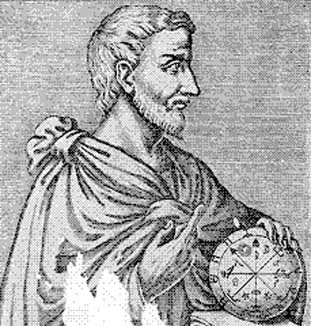
No one has perhaps had such a large impact on the utopian imagination as the mystical philosopher, Pythagoras. This obscure figure, who, lived in the early 6th century, and the brotherhood he founded, were a major source of inspiration for Plato and the utopian visions he crafted. The Pythagorean idea of basing society on the principle of friendship was the basis of Thomas Moore’s modern re-creation of imagined ideal societies, an idea which Moore picked up through a work – The Adages- by his great friend, the satirist, and humanist Erasmus. The figure of Pythagoras was a source of the early modern revival of mysticism such as that of the Kabala, and influential secret societies such as the Freemasons, and Rosicrucians.

Likewise, the name of Pythagoras was called upon like a lost god by the revolutionaries in France and beyond during the early stages of the democratic movement that rippled out from America starting in the late 1700s.

Above all, Pythagoras was the lode star for a revolution in human existence that would supersede in its impact all of the thoughts of philosophy and the entirety of the political revolutions that have marked the modern age. Pythagoras was a major figure in the scientific utopias, notably Francis Bacon’s New Atlantis that helped spark a revolution in knowledge.  Pythagoras was a kind of background figure for many of the giants of that revolution.

We live in a technological society based on the idea of progress. It is a self-evident truth for us that we known more than our ancestors. This, however, is a novel idea.  Many of the initiators of the scientific revolution of the 17th century did not believe they were discovering anything new. Rather, they thought their project was to discover ancient wisdom- sapientia antique.

The men who made the scientific revolution could not sever their connection from ancient knowledge having only recently emerged out of a dark age in which the few works of the past that had survived seemed a like a thin tether to precarious civilization.  Of those works that did survive none were as comprehensive as those of the encyclopedic Aristotle.

This philosopher ruled over the late Medieval and early Modern Western mind.  This became problematic as the empiricism of the early moderns started to poke holes in the Aristotelian edifice. Aristotle said there was nothing special about mathematics and that it offered no true window into nature, he said the sun, planets, and stars revolved around the earth, that the heavens were pure and unchanging, that objects fell or rose according to their nature.

The early moderns thought the new math borrowed from the Arabs might be an effective tool of explanation, they discovered that the heavens were not as Aristotle described, that objects in motion did not act as he predicted.

What gave them confidence and drove their anti-Aristotelian crusade was their belief that another ancient philosopher had contradicted the great Aristotle. Pythagoras, and his largely lost philosophy, became the wedge between the ancient and the new by which the modern world was born.

What the early moderns found in the fragments of the Pythagoreans that survived the end of antiquity were like clues to a wholly different view of the world. In the works of the followers of Pythagoras could be found the incredible idea that numbers represent the fundamental order of the world, that the solar system was not centered around the earth, but a “central fire”- a half-way house to a heliocentric view of the solar system.  In the works of the Pythagoreans could be found the idea of the continuity of animal and even plant life with humanity.

The society founded by Pythagoras was fond of secrecy, and it was this occult idea of knowledge that drove early moderns such as Kepler and Newton to try to rediscover the hidden key to the universe which they sincerely believed Pythagoras and his followers had known. Nature for Pythagoras was a type of cryptogram which could be decoded once the proper corresponding numerical relationship was found. For science, even up until our own day, nature retains this cryptographic quality. Think of the search for DNA, the Human Genome, and the quest for a unified theory of physics that is the purpose of massive experimental apparatus such as CERN.

Pythagoras’ seemingly inconsequential epiphany that the world is number, arrived at when he noticed that the by the plucking of strings varied proportionally with the length of the string, has ultimately proven more revolutionary than the most profound utopian or religious texts. The models by which we now understand the world are built out of numbers. Our world is run and managed by machines whose thinking is composed of advanced forms of calculation. Indeed even the self seems to be merging, perhaps disappearing, into mathematics with movements such as The Quantified Self. We are all, for better, and for worse, Pythagoreans now.

Utopia Secular and Religious

Utopia scholars such as Ronald Schaer have argued that the concept of utopia, properly understood, is a secular one that originated in the early sixteenth century with Thomas Moore. Yet, as Schaer himself points out, the most powerful of 20th century utopian movements can not really be understood with out reference to the eschatological visions of the Judeo-Christian, and one should add Islamic, traditions

Indeed the worldly paradise predicted at the end of days ,and hoped for by elements these religions to a greater or lesser extent, is, even if we proceed with intellectual caution, more intimately connected with the political consequences of the idea of utopia than Schaer would have us believe. In many ways the most powerful of the secular utopian movements have borrowed so much from their religiously conceived predecessors as to be almost indistinguishable.

One might wonder where human agency has gone in religious utopianism, for underneath the secular version of utopia lies the humanist assumption that we can build the future. Yet, the most powerful secular utopian movements also seem to lack this quality of human agency, with some other entity serving the role once ascribed to God. For communists, utopia was to emerge through the deterministic forces of history, for Nazis through the war of nature, for the current Transhumanist/Sigularian movement the promises of religion- immortality, collective consciousness, omniscience are to emerge through the deterministic evolution of technology.

The difference between utopianism which wears the guise of religion in comparison to plain vanilla religion is that religious-utopianism promises the eminent arrival of a new and perfect world within the life-time of believers.  Religious utopianism points to a future state not a lost paradise at the beginning of human history. Lastly, whereas religion guides individual moral behavior, often for the purpose of obtaining happiness after death, the goals of religious utopianism are collective in character and serve as a guide to political action now.

The reason we should be paying close attention to utopia as religiously conceived is that, today, secular utopias are far less potent than religious ones, and failing to take heed of religious utopias blinds us to their very real capacity to effect the world in the here-and-now, rather than merely affect the state of human spiritually, or subsist as some ethereal hope for some promised land, far-off, at the “end of history”.

Utopian thinking continues to have a great hold on the human psyche, and utopian movements are one of the major forces guiding political action today. We should, therefore, try our best to understand them. In the immediate future, such an understanding would provide some insight when comes to the looming showdown with Iran- the subject of my next post.

In the birthplace of democracy

“The mortgage-stones that covered her, by me Removed, — the land that was a slave is free;
that some who had been seized for their debts he had brought back from other countries, where
— so far their lot to roam, They had forgot the language of their home;
and some he had set at liberty, — Who here in shameful servitude were held.”

                                                                                                                      SolonPlutarch’s Lives

When the history of the conflict between the market and democracy is someday written, the events in Greece this Sunday will almost certainly be seen as a major victory for market forces. There, the Greek parliament, under enormous pressure from the financial markets along with Germany and France committed what may amount to political suicide in the upcoming Greek elections. Members of the Greek parliament are willfully taking the country into what is in effect a deflationary induced depression in order to avoid the default and exit of Greece from the Euro-based economies.

Opposition to the draconian cuts necessary to secure funding support by bond holders, European governments and the ECB quite literally set Greece ablaze.

As in the ancient myth, Greek society is caught between Scylla and Charybdis.  Their only choices seem to be that of the chaos that would likely be the result of  a default, and a self-induced economic depression. The latter might prove preferable if it were likely to work in the long-run to restore, and  therefore secure the long term prosperity of Greece.  Such an outcome, is sadly unlikely.

The democratic process is now dictated by the electric speed of the international markets. Greek politicians were in a race against the clock before markets opened on Monday.

 Despite the German’s ridicule of the Greeks’ spendthrift ways, the Greek social system has its origins in the history of the country, which for decades endured brutal right-wing rule opposed only by a defiant left. The social-rights of Greeks were in effect the price to be paid for the left’s acceptance of the fact that Greece was to be a normal rather than a revolutionary country. Dismantling this system is a denial of history, and on par with the most utopian of top-down social transformations. Here the market is at war not just with democracy, but with history itself.

The German view of “lazy” Greeks also fails to take into account the very structural imbalances between Germany as an export economy and almost everybody else in Europe as playing a major contributing  role in the crisis. German exporters are greatly helped by the weakness of a currency they share with backward countries such as Greece. The Greeks get no such benefit, suffering a much stronger currency than would otherwise be the case. The real gain of Greece sharing a currency with mighty Germany has been Greek access to cheap debt. That is over now, and turned out to be not such a good thing, after all.

Rather than being isolated, the Greek crisis is symptomatic of the current state of capitalism, both globally and in Europe. As Robert D. Kaplan pointed out way back in 2009, as Greek riots were already starting to occur before the Arab Spring or Occupy Wall Street movements had even been imagined:

It’s tempting to dismiss this as a purely Greek affair that carries little significance to the outside world. But the global economic crisis will take different forms in different places in the way that it ignites political unrest. Yes, youth alienation in Greece is influenced by a particular local history that I’ve very briefly outlined here. But it is also influenced by sweeping international trends of uneven development, in which the uncontrolled surges and declines of capitalism have left haves and bitter have-nots, who, in Europe, often tend to be young people. And these young people now have the ability to instantaneously organize themselves through text messages and other new media, without waiting passively to be informed by traditional newspapers and television. Technology has empowered the crowd—or the mob if you will.

Likewise, a European Union that could have served to shelter the European social system from the relentless leveling of market forces has shown itself instead to be the most powerful instrument in the hands of such forces able to bring, despite the resistance of history, whole governments, and the societies upon which they rest to heel.

 ,

Psychobot

It is interesting… how weapons reflect the soul of their maker.

                  Don Delillo,  The Underworld

Singularity, or something far short of it, the very real revolution in artificial intelligence and robotics is already encroaching on the existential nature of aspects of the human condition that have existed for as long as our history.  Robotics is indeed changing the nature of work, and is likely to continue to do so throughout this century and beyond. But, as in most technological revolutions, the impact of change is felt first and foremost in the field of war.

In 2012 IEET Fellow Patrick Lin had a fascinating article in the Atlantic about a discussion he had at the CIA revolving around the implications of the robotics revolution. The use of robots in war results in all kinds of questions in the area of Just-War theory that have yet to even begun to be addressed. An assumption throughout Lin’s article is that robots are likely to make war more not less ethical as robots can be programmed to never target civilians, or to never cross the thin line that separates interrogation from torture.

This idea, that the application of robots to war could ultimately take some of the nastier parts of the human condition out of the calculus of warfare is also touched upon from the same perspective in Peter Singer’s Wired for War.  There, Singer brings up the case of Steven Green, a US soldier charged with the premeditated rape and murder of a 14 year old Iraqi girl.  Singer contrast the young soldier “swirling with hormones” to the calm calculations of a robot lacking such sexual and murderous instincts.

The problem with this interpretation of Green is that it relies on an outdated understanding of how the brain works. As I’ll try to show Green is really more like a robot-soldier than most human beings.

Lin and Singer’s idea of the “good robot” as a replacement for the “bad soldier” is based on a understanding of the nature of moral behavior that can be traced, as most things in Western civilization, back to Plato. In Plato’s conception, the godly part of human nature, it’s reason, was seen as a charioteer tasked with guiding chaotic human passions. People did bad things whenever reason lost control. The idea was updated by Freud with his ID (instincts) Ego (self) and Super-Ego (social conscience). The thing is, this version of why human beings act morally or immorally is most certainly wrong.

The neuroscience writer Jonah Lehrer in his How we Decide has a chapter, The Moral Mind, devoted to this very topic.  Odd thing is the normal soldier does not want to kill anybody- even enemy combatants. He cites a study of thousands of American soldiers after WWII done by  U.S. Army Brigadier General S.L.A Marshall.

His shocking conclusion was that less than 20 percent actually shot at the enemy even when under attack. “It is fear of     killing” Marshall wrote “rather than fear of being killed, that is the most common cause of battle failure of the individual”. When soldiers were forced to directly confront the possibility of directly harming another human being- this is a personal moral decision- they were literally incapacitated by their emotions. “At the most vital point of battle”, Marshall wrote, “the soldier becomes a conscientious objector”.

After this study was published, the Army redesigned it’s training to reduce this natural moral impediment to battlefield effectiveness. “What was being taught in this environment is the ability to shoot reflexively and instantly… Soldiers are de-sensitized to the act of killing until it becomes an automatic response. pp. 179-180

Lehrer, of course, has been discredited as a result of plagiarism scandals, so we should accept his ideas with caution, yet, they do suggest what already know that the existential condition of war is that it is difficult for human beings to kill one another, and well it should be. If modern training methods are meant to remove this obstruction in the name of combat effective they also remove the soldier from the actual moral reality of war. This moral reality is the reason why wars should be fought infrequently and only under the most extreme of circumstances. We should only be willing to kill other human beings under the most threatening and limited of conditions.

The designers of  robots warriors are unlikely to program this moral struggle with killing into their machines. Such machines will kill or not kill a fellow sentient beings as they are programmed to do. They were truly be amoral in nature, or to use a loaded and antiquated term, without a soul.

We could certainly program robots with ethical rules of war, as Singer and Lin suggest. These robots would be less likely to kill the innocent in the fear and haste of the fog of war. It is impossible to imagine that robots would commit the horrible crime of rape, which is far too common in war. All these things are good things. The question for the farther future is, how would a machine with a human or supra-human level of intelligence experience war? What would be their moral/existential reality of war compared to how the most highly sentient creatures today, human beings, experience combat.

Singer’s use of Steven Green as a flawed human being whose “hormones” have overwhelmed his reason, as ethically inferior to the cold reason of artificial intelligence which have no such passions to control is telling, and again is based on the flawed Plato/Freud model of the conscience of human beings.  A clear way to see this is by looking inside the mind of the rapist/murderer Green who, before he had committed his crime had been quoted in the Washington Post as saying:

I came over here because I wanted to kill people…

I shot a guy here when we were out at a traffic checkpoint, and it was like nothing. Over here killing people is like squashing an ant. I mean you kill somebody and it’s like ‘All right, let’s go get some pizza’.

In other words, Green is a psychopath.

Again we can turn to Lehrer who in describing the serial killer John Wayne Gacy:

According to the court appointed psychiatrist, Gacy seemed incapable of experiencing regret, sadness, or joy. Instead his inner life consisted entirely of sexual impulses and ruthless rationality. p.169

It is not the presence of out of control emotions that explain the psychopath, but the very absence of emotion. Psychopaths are unmoved by the very sympathy that makes it difficult for normal soldiers to kill. Unlike other human beings they show no emotional response when shown depictions of violence. In fact, they are unmoved by emotions at all.  For them, there are simply “goals” (set by biology or the environment) that they want to achieve. The means to those goals, including murder, are, for them, irrelevant. Lehrer quotes G.K. Chesterson:

The madman is not the man who has lost his reason. The madman is the man who has lost everything except his reason.

Whatever the timeline, we are in the process of creating sentient beings who will kill other sentient beings, human and machine, without anger, guilt, or fear. I see no easy way out of this dilemma, for the very selective pressures of war, appear to be weighted against programming such moral qualities (as opposed to rules for who and when to kill) into our machines.  Rather than ushering in an era of “humane” warfare, on the existential level, that is in the minds of the beings actually doing the fighting, the moral dimension of war will be relentlessly suppressed. We will have created what is in effect, an army of psychopaths.

Of drones and democracy

P.W. Singer has a fascinating article in last Sunday’s edition of the New York Times about the implications of the current robotics revolution in warfare for democracy.

Singer’s reputation of someone who asks the hard questions (and asks them first) about war was gained in his studies of the rise of privatized warfare  and the increasing use of children in warfare.  On both of those issues, Singer was among the first to correctly identify disturbing trends. His perspective shows little ideological bent, merely the search for truth. On these issues he was almost a lone voice crying in the wilderness, as he is in bringing to our knowledge the troubling questions being brought about as the revolution in computer technology and robotics finds itself increasing applied to war. His goal, as always, appears to be to reveal the obvious trends in front of us to which we are blind, and in doing so start a conversation we should already be having.

I think a short review of Singer’s Wired For War  is in order, so that his N.Y. Times article can be seen in its full context.  In that book Singer takes readers on a wild ride through the current robotics revolution in warfare. He sees our era as akin to WWI when new technologies like the tank and airplane were thrown into the field, but no one new yet how to actually use them. (224)

The military now funds over 80% of American spending on artificial intelligence. Much of this funding flows through the Defense Advanced Research Agency (DARPA).  Joel Garreau of the Washington Post SAYS the mission of DARPA “is to accelerate the future into being”. (78)

Not only the US Army, but also the Navy and Airforce (which wants 45% of its bomber fleet to be composed of unmanned vehicles) are rushing to develop unmanned systems. Some of these systems seem straight out of science-fiction, whether swarming insect sized robots or super-sized planes able to stay aloft for months or even years.  (117-118).

Many of the new robots resemble animals, such as a robotic dog .

What does all of this have to do with democracy?

In his article, he makes the point, that increasingly, the US is relying on its advantage in military technology, the most famous of which, are the use of unmanned drones, to wage, what is in effect a constant war, with out the democratic oversight and control that is supposed to be the job of our elected representatives in the Congress. The biggest cost in war, the lives of citizens, no longer at risk, the American government can wage war on terrorist targets throughout the world with seeming impunity.

As a prime example, he cites the recent US military action in Libya.

Starting on April 23, American unmanned systems were deployed over Libya. For the next six months, they carried out at least 146 strikes on their own. They also identified and pinpointed the targets for most of NATO’s manned strike jets. This unmanned operation lasted well past the 60-day deadline of the War Powers Resolution, extending to the very last airstrike that hit Colonel Qaddafi’s convoy on Oct. 20 and led to his death.

Choosing to make the operation unmanned proved critical to initiating it without Congressional authorization and continuing it with minimal public support. On June 21, when NATO’s air war was lagging, an American Navy helicopter was shot down by pro-Qaddafi forces. This previously would have been a disaster, with the risk of an American aircrew being captured or even killed. But the downed helicopter was an unmanned Fire Scout, and the story didn’t even make the newspapers the next day.

Singer’s conclusion:

We must now accept that technologies that remove humans from the battlefield, fromunmanned systems like the Predator to cyberweapons like the Stuxnet computer worm, are becoming the new normal in war.

And like it or not, the new standard we’ve established for them is that presidents need to seek approval only for operations that send people into harm’s way — not for those that involve waging war by other means.

WITHOUT any actual political debate, we have set an enormous precedent, blurring the civilian and military roles in war and circumventing the Constitution’s mandate for authorizing it. Freeing the executive branch to act as it chooses may be appealing to some now, but many future scenarios will be less clear-cut. And each political party will very likely have a different view, depending on who is in the White House.

America’s founding fathers may not have been able to imagine robotic drones, but they did provide an answer. The Constitution did not leave war, no matter how it is waged, to the executive branch alone.

In a democracy, it is an issue for all of us.

The Dispossessed

The State recognizes no coinage but power: and it issues the coins itself. 

(240)

I just finished The Dispossessed, a 1974 novel by Ursula K. Le Guin. This wonderful book tells the story of an “ambiguous” anarchist utopia. Though written during a period much different from our own, The Dispossessed  might have lessons for us today, especially for those in the OWS movement whose political philosophy and hopes represent what might be seen as a triumph of anarchism.

The novel is set on the anarchist colony on the moon of Anarres, founded as a breakaway settlement of a movement called Odonianism- a moral and political philosophy created by Odo a woman who railed against the capitalist system of Urras, the rich and beautiful mother planet.  The two worlds under “The Terms of the Closure of the Settlement of Anarres” have interactions limited to a space freighter that exchanges necessities between them 8 times a year. There is a “wall” between Anarres and Urras, and it is the efforts of the protagonist of The Dispossessed,  a brilliant physicist named Shevek to brake down this wall between worlds that form the essence of the story.

Without doubt, Odonianism has created a moral utopia. The inhabitants of Anarres, constantly subject to a harsh climate and in constant danger of scarcity and famine, are bound together tightly and suffer continuously for one another. The needs of the whole community come before all others, even those of family. As Shevek and his loved partner Takver separate in the name of the needs of the community.  Anarres is an organic community that in the words of Shevek arguing with a Urratzi social Darwinist:

Yes, and the strongest, in the existence of any social species are those who are the most social. In human terms the most ethical. (195)

The people of Anarres have no real government, though it can not really be said that they have politics either. Like Saint-Simon had suggested, without the class war endemic to the state, politics would become the mere “administration of things”.  A series of councils/syndicis make important decisions such as the allocation of work (though an individual is always free to refuse to go where a work syndic requests.  To my ears, these councils sound much like the “working groups” of the OWSM each tasked with a very particular need or goal of the movement. On Anarres they are a place where rotation and openness to debate mask the fact that they can be manipulated for political ends such as the machinations of the scientist Sabul who uses his ability to control the flow of information between Anarres and Urras, and even to control the publication of scientific papers to use the brilliance of Shevek for his own advantage, and take credit for what is mostly Shevek’s work.

It is this ability and desire to control the flow of knowledge and insight (including the insight brought by travelers from other worlds) whether stemming from the flawed human condition of someone like Sabul, or the tyranny of the majority implicit in an egalitarian society, that is the sin of Anarres. For, when combined with an internalized moral code that commands them not to be egoist, the Anarrresti are unable to express their own individual genius. Whether that be in a case like Shevek’s where he is constantly thwarted from constructing a theory that would allow faster- than- light communication, and therefore the enable the strong connection of interstellar peoples to become possible, or the comedy of a non-conformist playwright, such as Tirin, who writes a play about a comic character coming from Urras to Anarres. This suffocation of the spirit of the soul is the primary, and growing, flaw of Odo’s utopia.  As Shevek says:

That the social conscience completely dominates the individual conscience instead of striking a balance with it. We don’t cooperate –we obey. (291)

In an effort to break free from the control of knowledge, Shevek and those around him set up a printing syndicate of their own. This syndicate eventually starts communicating with the outside, with the Urratzi, which ultimately results in the ultimate attempt to breakdown walls- Shevek’s visit to Urras itself.

The capitalist nation of A-Io invites Shevek out of the belief that he is on the verge of discovering a unified theory of time which they will profit from.  Shevek’s journey is a disaster. What he discovers on Urras is a beautiful yet superficial world built on the oppression of the poor by the rich. Not surprising for the time period the novel was written, a Cold War rages between capitalist A-Io and the authoritarian communist nation of Thu. The two-powers fight proxy wars in less developed nations. When the poor rise up to protest the rich in A-Io they are brutally massacred, and Shevek flees to the embassy of the planet Earth. The ambassador of earth shelters Shevek, but expresses her admiration for Urras, with the civilization on earth having almost destroyed itself. Explains the ambassador:

My world, my earth is a ruin.  A planet spoiled by the human species. We multiplied and gobbled and fought until there was nothing left and then we died…

But we destroyed the world first. There are no forest left on my earth. The air is grey, the sky is grey, it is always hot.

She admires Urras for it’s  beauty and material abundance, which has somehow avoided environmental catastrophe. She does not understand the moral criticism of Shevek- a man from a desert world of scarcity, and famine.

Earthlings were ultimately saved by an ancient, sage like people the Hainish. They return Shevek to Anarres, along with a member of the Hainish that wants to see the world anarchist have built. The walls Shevek sought to tear down continue to fall…

What might some of the lessons of this brilliant novel be for our own times? Here are my ideas:

1) For the OWSM itself: that the “administration of things” always has a political aspect. That even groups open to periodic, democratic debate are prone to capture by the politically savvy, and steps make sure they remain democratic need to be constant.

2) One of the flaws of Le Guin’s view of utopia is that it seems to leave no room for democratic politics itself.  Politics, therefore can only be in the form of manipulation (Sabul) or rebellion (Shevek) there is no space, it seems, for consensual decision making as opposed to a mere right to debate and be heard.

3) There is a conflict between the individual (the need for creativity, love of family) and the needs of the community that is existential and cannot be eliminated by any imaginable political system. The key is to strike the right balance between the individual and the community.

4) That the tyranny of the majority is a real danger for any consensus based community and not just a mere bogeyman of conservative forces.

5) The most important thing we can do to preserve the freedom of the individual and health of the community is to keep the lines of communication and connection open. That includes openness to the viewpoints of ideological rivals.

All quotes from: The Dispossessed, An Ambiguous Utopia, Ursula K. Le Guin, Harper and Row, 1974

Machines Rule!

Science Fiction writers, who are perhaps the only group of thinkers taking these questions seriously, usually assume that the era when artificial intelligence rules over human-societies will only arrive after AI achieves human level intelligence or greater. But there is perhaps a way in which AIs already rule, long before they have reached such a level.

JP Morgan recently won the prize for ‘Most Cutting Edge IT Initiative’ at the American Financial Technology Awards 2011. It won this award on the basis of taking end of day risk calculations down from eight hours to 238 seconds. According to its backers, the continued use of super-computers for financial trading will allow the company to:

to minimise its risk and respond more effectively than its competitors to rapidly changing marketing conditions, particularly the financial turmoil in Europe,” said John Barr, research director of financial markets and head of EU research at the 451 Group.

JP Morgan is not alone in its quest to use Teraflop performing computers, fiber-optic networks and black box algorithms to seek to master the financial markets. Kevin Slavin, the founder of the gaming company Area/Code, of all things, gave a beautiful TED Talk in which he discusses the power of algorithms in our world (and not just the financial world).  In that talk, Slavin points out how computer based trading, so called black box or algo trading now comprises 70% of the US stock market- in other words 70% of stock market transaction are now decided by not just mediated through computers.

Black box trading puts a premium on speed, and so Slavin points out how this has led to the strange phenomenon of whole buildings in the heart of Manhattan being hollowed out and filled with computer servers for the advantage of a few nano-seconds. By far the biggest existent absurdity is an an 825 mile trench dug over the last several years to house fiber-optic cables linking Chicago and New York. As Slavin points out, a massive project of terraforming in the name of a slice of time unperceivable by human being, which portends other transformations of even greater scale. His argument is hammered home by recent plans to build a trans-Atlantic fiber optic cable that will cost 400 billion and save traders a whopping 5 milliseconds.

David Brin has a great article on what might be called an ecological understanding of such high speed trading. He compares financial algorithms to parasites.

Want the exact parallel in nature for these systems? It is those gut parasites or e-coli or salmonella, or Typhus, who nibble away the gradient of potential profit that the human trader perceives, between the current asking price and what he or she feels the stock may soon be worth.  These programs can now detect people getting ready to buy a stock they like, and pounce to snap it up first, then offering it to you at just a little higher price. You lose a bit of that gradient, because someone – a program – who did none of your research simply pounced faster than you ever, possibly could.

His solution to this problem is the imposition of a very small Tobin-Tax that would slow trading down to be closer to the level of “human-thought”. So far, so good.

The problem begins when Brin, by suggesting that the kind of super-conscious and dangerous AI, which is the persistent bogey-man of Sci-Fi writers, might emerge from such civilian rather than military sources,  looses sight of the brilliant argument he had been making. For super-computed algorithms need never be as smart as us to “gain control”. They might in fact be given control without ever evolving beyond the level of an extremely efficient and rapidly evolving virus. For, if 70% of the market is now controlled by algorithms, and financial markets are increasingly more powerful than democratic politics, then the machines, in some sense already rule. Something which would indeed have come, as Brin points out, as a “surprise”.

Replace the words markets with algorithms in the comments below by historian of democracy Mark Mazower and you should see what I mean.

MAZOWER: Part of this, I think, is because of the timeframe that we are now becoming accustomed to. If we are in an age in which the markets rule and the markets are not the trading and commodities markets, but they are the financial markets, then the politicians feel that they have to respond to everything in seconds and minutes. And so, part of this is a tussle between how important decisions will be made. Will they be made by the market and on the basis of the ribbons dictated by the market, which is to say extraordinarily short-term and fluctuating?

Or will they remain in the hands of the politicians and those people who elected the politicians?

SIEGEL: You mean that the nature of European democracy is actually at stake in this process of trying to deal with the financial crises?

MAZOWER: European democracy is not under threat. I don’t see alternatives of the kind that existed in the early 20th century to democracy. I discount those. But the extent to which politics remains an area for autonomous decision-making, that is very much up for grabs or will politicians simply be driven by their anxiety about the markets and how the markets will respond to this or that measure? And that is where, it seems to me, that the Franco-German axis has its interest. Because, whether or not you see Sarkozy and Merkel acting in a particularly democratic manner, they are acting as politicians in the name of the state to preserve a political enterprise.

The grand struggle, seems to me, markets versus politics. And then how democratic that politics is, well, that’s the question we have to think about.

The, one might say, almost algorithmic logic of it all appears to be this: Our financial markets are evermore dominated by a myriad of machines without self-consciousness or human-level intelligence. This machine-run market is increasingly at odds with our own democratic self-governance, and has, throughout the financial crisis, been proven to be more powerful than our democratic institutions. In other words, the machines, in a sense, already rule.

What Humanity Wants

Kevin Kelly has written a superb book on technology, and our relationship with it.

What Technology Wants is sharply written in a clear easily approachable language that is the legacy of Kelly’s variegated life story of hippie turned tech guru turned born-again Christian. Kelly is perhaps the only person alive who could have Ray Kurzweil, James Wendell Berry, and Pat Robertson over for dinner and not have the evening end in a fistfight. In other words, Kelly transcends our contemporary limitations, and this shines forth in the smooth reasoning of his book, which appears to convince the reader by allowing whatever positions he has come to the work with to remain compatible with what is in fact Kelly’s assumption shattering argument.

Kelly tells an evolutionary story of technology, the emergence over time of the world of human technical, scientific, and cultural invention. What he calls the Technium. He believes that technology is, as it were, baked into the cake of the universe. There is a revolution against the innate trend of matter towards disorder or entropy. Exotropy, is the development of order out of the energy of chaos. Hydrogen atoms form more complex atoms which in turn form molecules, from this molecular stew emerges life, which evolves along complex paths to give birth to language and technology, which take evolution to yet another level of complexity.

Kelly disagrees with biologist, such as the late Stephen Gould, who argue, that evolution has no inherent direction. He sees evolution as constantly searching a limited possibility space for “tricks” that work. Thus, evolution independently evolved sight numerous times, as it did flight, because they are tricks that work in the environment life finds itself in. Exo-biologists are likely to find life similar to earth elsewhere in a universe where the same laws of physics hold sway.

Kelly extends this evolutionary argument to technology. Technologies represent good tricks and are likely to be discovered independently and repeatedly if lost. Technology represents good tricks in the possibility space that “want” to be discovered independent of their human creators. Kelly’s Technium, has a limited (for the moment) mind of its own separate from humanity thank can be observed in this independence.

The question, of course, is this, on balance a good thing? Kelly thinks yes. The more technology there is, the more capable human beings are of expressing their unique talents- think Jimmy Page without the electric guitar. Nevertheless, Kelly acknowledges our need to keep technology from overwhelming our capacities. His example for how we might do this is, strangely enough, the Amish who are the polar opposite of a Luddite madman like the Uni-Bomber. The Amish have found a way to pace the adoption of technology rather than abandon it whole cloth. As a person who has lived in Amish-country for a number of years, his observation of them as ingenious technological hackers is spot-on, but, given that the majority of us are unlikely to become Amish anytime soon, what is our own escape from being overwhelmed by technology?

For Kelly the answer is individualistic. Each of us needs to choose what technologies fit our needs and what we can ignore. I use a computer but avoid TV, etc. The problem with this individualistic idea of how to free ourselves from the seeming tyranny of technology is that it not really analogous at all for how the Amish deal with the challenges of technology. For them the essential question is “what will this do to the community?”.  Kelly gives us no way of answering this question as a collective- he has no sense of technology as a political question.

The word politics barely appears in Kelly’s book, and there only to make the point that despite what overarching economic system we had chosen in the 20th century- communism or capitalism- our current technological world was inevitable. It just would have occurred earlier or later had we chosen a different system. Kelly’s individualism seems like common sense when dealing with the flood of gadgets that enter our lives every year, but is it really a guide for technologies that promise or threaten the very nature of what it means to be human- AI and genetic engineering- to name just two.

Society, it would seem, has the very real moral obligation to take some degree of control over technology and science as a deterministic process, a foretaste of which we may have seen in the recent efforts to control the release of potentially dangerous biological information related to the study of the Avian flu.

Something I would love to see is the test of some kind of democratic forum when it comes to the ability to creating ethical guidelines for technology. Right now academic panels are largely responsible for such pronouncements. What if we created a “citizens panel” that was structured so as it would require knowledge and not just “gut level” opinions on the part of citizens when it comes to new technologies. How would such a forum stack up to the pronouncements of “experts”. Such participatory forums might give average, concerned citizens a say in the biggest existential questions of our time.

Kelly does not think we are capable of controlling the evolution of technology. This is less an issue of proof than one of faith. For in the end, he sees technology as part of the unfolding of God itself, the playing of an infinite game. It is such faith, despite Kelly’s tone of reasonableness, that should give us pause for it denies us the very freedom which God, (if such a thing exists) or nature has granted us in reference to our creations.