The King of Weird Futures

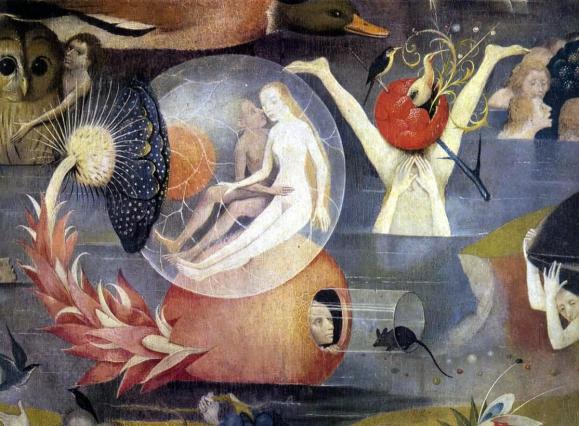
Bosch vanity Garden of earthy delights

Back in the late winter I wrote a review of the biologist Edward O. Wilson’s grandiloquently mistitled tract-  The Meaning of Human Existence. As far as visions of the future go Wilson’s was a real snoozer, although for that very reason it left little to be nervous about. The hope that he articulated in his book being that we somehow manage to keep humanity pretty much the same- genetically at least- “as a sacred trust”,  in perpetuity. It’s a bio-conservatism that, on one level, I certainly understand, but one I also find incredibly unlikely given that the future consists of….well…. an awfully long stretch of time (that is as long as we’re wise enough or just plain lucky ). How in the world can we expect, especially in light of current advances in fields like genetics, neuroscience, artificial intelligence etc, that we can, or even should, keep humanity essentially unchanged not just now, but for 100 years, or 1000s year, 10,000s years, or even longer?

If Wilson is the 21st century’s prince of the dull future the philosopher David Roden should perhaps be crowned the king of weird one(s). Indeed, it may be that the primary point of his recent mind-bending book Posthuman Life:Philosophy at the Edge of the Human, is to make the case for the strange and unexpected. The Speculative Posthumanism (SP) he helps launch with this book a philosophy that grapples with the possibility that the future of our species and its descendents will be far weirder than we have so far allowed ourselves to imagine.

I suppose the best place to begin a proper discussion of  Posthuman Life would be with explaining just exactly what Roden means by Speculative Posthumanism, something that (as John Dahaner has pointed out) Roden manages to uncover like a palimpsest by providing some very useful clarifications for often philosophically confused and conflated areas of speculation regarding humanity’s place in nature and its future.

Essentially Roden sees four domains of thought regarding humanism/posthumanism. There is Humanism of the old fashioned type that even absent some kind of spiritual dimension makes the claim that there is something special, cognitively, morally, etc that marks human beings off from the rest of nature.

Interestingly, Roden sees Transhumanism as merely an updating of this humanism- the expansion of its’ tool kit for perfecting humankind to include not just things like training and education but physical, cognitive, and moral enhancements made available by advances in medicine, genetics, bio-electronics and similar technologies.

Then there is Critical Posthumanism by which Roden means a move in Western philosophy apparent since the later half of the 20th century that seeks to challenge the anthropocentrism at the heart of Western thinking. The shining example of this move was the work of Descartes, which reduced animals to machines while treating the human intellect as mere “spirit” as embodied and tangible as a burnt offering to the gods. Critical Posthumanism, among whom one can count a number of deconstructionists, feminists, multicultural, animal rights, and environmentalists philosophers from the last century, aims to challenge the centrality of the subject and the discourses surrounding the idea of an observer located at some Archimedean point outside of nature and society.

Lastly, there is the philosophy Roden himself hopes to help create- Speculative Posthumanism the goal of which is to expand and explore the potential boundaries of what he calls the posthuman possibility space (PPS). It is a posthumanism that embraces the “weird” in the sense that it hopes, like critical posthumanism, to challenge the hold anthropocentrism has had on the way we think about possible manifestations of phenomenology, moral reasoning, and cognition. Yet unlike Critical Posthumanism, Speculative Posthumanism does not stop at scepticism but seeks to imagine, in so far as it is possible, what non-anthropocentric forms of phenomenology, moral reasoning, and cognition might actually look like. (21)

It is as a work of philosophical clarification that Posthuman Life succeeds best, though a close runner up would be the way Roden manages to explain and synthesize many of the major movements within philosophy in the modern period in a way that clearly connects them to what many see as upcoming challenges to traditional philosophical categories as a consequence of emerging technologies from machines that exhibit more reasoning, or the disappearance of the boundary between the human, the animal, and the machine, or even the erosion of human subjectivity and individuality themselves.

Roden challenges the notion that any potential moral agents of the future that can trace their line of descent back to humanity will be something like Kantian moral agents rather than agents possessing a moral orientation we simply cannot imagine. He also manages to point towards connections of the postmodern thrust of late 21st century philosophy which challenged the role of the self/subject and recent developments in neuroscience, including connections between philosophical phenomenology and the neuroscience of human perception that do something very similar to our conception of the self. Indeed, Posthuman Life eclipses similar efforts at synthesis and Roden excels at bringing to light potentially pregnant connections between thinkers as diverse as Andy Clark and Heidegger, Donna Haraway and Deleuze and Derrida along with non-philosophical figures like the novelist Philip K. Dick.

It is as a very consequence of his success at philosophical clarification that leads Roden across what I, at least, felt was a bridge (philosophically) too far. As posthumanist philosophers are well aware, the very notion of the “human” suffers a continuum problem. Unique to us alone, it is almost impossible to separate humanity from technology broadly defined and this is the case even if we go back to the very beginnings of the species where the technologies in question are the atul or the baby sling. We are in the words of Andy Clark “natural born cyborgs”. In addition to this is the fact that (like anything bound up with historical change) how a human being is defined is a moving target rather than a reflection of any unchanging essence.

How then can one declare any possible human future that emerges out of our continuing “technogenesis” “post” human, rather than just the latest iteration of what in fact is the very old story of the human “artificial ape”? And this status of mere continuation (rather than break with the past) would seem to hold in a philosophical sense even if whatever posthumans emerged bore no genetic and only a techno-historical relationship to biological humans. This somewhat different philosophical problem of clarification again emerges as the consequence of another continuum problem namely the fact that human beings are inseparable from the techno-historical world around them- what Roden brilliantly calls “the Wide Human” (WH).

It is largely out of the effort to find clear boundaries within this confusing continuum that leads Roden to postulate what he calls the “disconnection thesis”. According to this thesis an entity can only properly be said to be posthuman if it is no longer contained within the Wide Human.  A “Wide Human descendent is a posthuman if and only if:”

  1. It has ceased to belong to WH (the Wide Human) as a result of technical alteration.
  2. Or is wide descendent of such a being. (outside WH) . (112)

Yet it isn’t clear, to me at least, why disconnection from the Wide Human is more likely to result in something more different from humanity and our civilization as they currently exist today than anything that could emerge out of, but still remain part of, the Wide Human itself. Roden turns to the idea of “assemblages” developed by Deleuze and Guattari in an attempt to conceptualize how such a disconnection might occur, but his idea is perhaps conceptually clearer if one comes at it from the perspective of the kinds of evolutionary drift that occurs when some set of creatures becomes isolated from another by having become an island.

As Darwin realized while on his journey to the Galapagos isolation can lead quite rapidly to wide differences between the isolated variant and its parent species. The problem when applying such isolation analogies to technological development is that unlike biological evolution (or technological development before the modern era), the evolution of technology is now globally distributed, rapid and continuous.

Something truly disruptive seems much more likely to emerge from within the Wide Human than from some separate entity or enclave- even one located far out in space.  At the very least because the Wide Human possesses the kind of leverage that could turn something disruptive into something transformative to the extent it could be characterized as posthuman.

What I think we should look out for in terms of the kinds of weird divergence from current humanity that Roden is contemplating, and though he claims speculative posthumanism is not normative, is perhaps rooting for, is maybe something more akin to a phase change or the kinds of rapid evolutionary changes seen in events like the cambrian explosion or the opening up of whole new evolutionary theaters such as when life in the sea first moved unto the land than some sort of separation. It would be something like the singularity predicted by Vernor Vinge though might just as likely come from a direction completely unanticipated and cause a transformation that would make the world, from our current perspective, unrecognizable, and indeed, weird.

Still, what real posthuman weirdness would seem to require would be something clearly identified by Roden and not dependent, to my lights, on his disruption thesis being true. The same reality that would make whatever follows humanity truly weird would be that which allowed alien intelligence to be truly weird; namely, that the kinds of cognition, logic, mathematics, science found in our current civilization, or the kinds of biology and social organization we ourselves possess to all be contingent. What that would mean in essence was that there were a multitude of ways intelligence and technological civilizations might manifest themselves of which we were only a single type, and by no means the most interesting one. Life itself might be like that with the earthly variety and its conditions just one example of what is possible, or it might not.

The existence of alien intelligence and technology very different from our own means we are not in the grip of any deterministic developmental process and that alternative developmental paths are available. So far, we have no evidence one way or another, though unlike Kant who used aliens as a trope to defend a certain versions of what intelligence and morality means we might instead imagine both extraterrestrial and earthly alternatives to our own.

While I can certainly imagine what alternative, and from our view, weird forms of cognition might look like- for example the kinds of distributed intelligence found in a cephalopod or eusocial insect colony, it is much more difficult for me to conceive what morality and ethics might look like if divorced from our own peculiar hybrid of social existence and individual consciousness (the very features Wilson, perhaps rightfully, hopes we will preserve). For me at least one side of what Roden calls dark phenomenology is a much deeper shade of black.

What is especially difficult in this regard for me to imagine is how the kinds of openness to alternative developmental paths that Roden, at the very least, wants us to refrain from preemptively aborting is compatible with a host of other projects surrounding our relationship to emerging technology which I find extremely important: projects such as subjecting technology to stricter, democratically established ethical constraints, including engineering moral philosophy into machines themselves as the basis for ethical decision making autonomous from human beings. Nor is it clear what guidance Roden’s speculative posthumanism provides when it comes to the question of how to regulate against existential risks, dangers which our failure to tackle will foreclose not only a human future but very likely possibility of a posthuman future.

Roden seems to think the fact that there is no such thing as a human “essence” we should be free to engender whatever types of posthumans we want. As I see it this kind of ahistoricism is akin to a parent who refuses to use the lessons learned from a difficult youth to inform his own parenting. Despite the pessimism of some, humanity has actually made great moral strides over the arc of its history and should certainly use those lessons to inform whatever posthumans we chose to create.

One would think the types of posthumans whose creation we permit should be constrained by our experience of a world ill designed by the God of Job. How much suffering is truly necessary? Certainly less than sapient creatures currently experience and thus any posthumans should suffer less than ourselves. We must be alert to and take precautions to avoid the danger that posthuman weirdness will emerge from those areas of the Wide Human where the greatest resources are devoted- military or corporate competition- and for that reason- be terrifying.

Yet the fact that Roden has left one with questions should not subtract from what he has accomplished; namely he has provided us with a framework in which much of modern philosophy can be used to inform the unprecedented questions that are facing as a result of emerging technologies. Roden has also managed to put a very important bug in the ear of all those who would move too quick to prohibit technologies that have the potential to prove disruptive, or close the door to the majority of the hopefully very long future in front of us and our descendents- that in too great an effort to preserve the contingent reality of what we currently are we risk preventing the appearance of something infinitely more brilliant in our future.

Is Pope Francis the World’s Most Powerful Transhumanist?

Francis-with-book-

I remember once while on a trip to Arizona asking a long-time resident of Phoenix why anyone would want to live in such a godforsaken place. I wasn’t at all fooled by the green lawns and the swimming pools and knew that we were standing in the middle of a desert over the bones of the Hohokam Indians whose civilization had shriveled up under the brutality of the Sonora sun. The person I was speaking to had a quick retort to my east coast skepticism. Where I lived, he observed, was no more natural than where he did, for the constant need for air conditioning during much of the year in a place like Phoenix was but the flip side of the need for heat in the cold months in the backwoods of my native Pennsylvania. Everywhere humankind lives is in some sense “unnatural”, every place we have successfully settled it was because we had been able to wrestle nature’s arm behind her back and make her cry “uncle”.

Sometime around then, back in 2006, James Lovelock published what was probably the most frightening book I have ever read- The Revenge of Gaia. There he predicted the death of billions of human beings and the retreat of global civilization to the poles as the climate as we had known it throughout the 100,000 or so years of of species history collapsed under the weight of anthropogenic climate change. It was not a work of dystopian fiction.

Lovelock has since backed off from this particular version of apocalyptic nightmare, but not because we have changed our course or discovered some fundamental error in the models that lead to his dark predictions. Instead, it is because he thinks the pace of warming is somewhat slower than predicted due to sulfuric pollution and its reflection of sunlight that act like the sunshields people put on their car windows. Lovelock is also less frightened out of the realization that air conditioning allows large scale societies- he is particularly fond of Singapore, but he also could have cited the Arabian Gulf or American Southwest- to seemingly thrive in conditions much hotter than those which any large human population could have survived in the past. We are not the poor Hohokam.

The problem with this more sanguine view of things is in thinking Singapore like levels of adaptation are either already here or even remotely on the horizon. This is the reality brought home over the last several weeks as the death toll from an historic heat wave sweeping over India and Pakistan has risen into the thousands. Most societies, or at least those with the most people, lack the ability to effectively respond to the current and predicted impacts of climate change, and are unlikely to develop it soon. The societal effects and death toll of a biblical scale deluge are much different if one is in Texas or Bangladesh. Major droughts can cause collapse and civil war in the fragile states of the Middle East that do not happen under similar environmental pressures between Arizona or Nevada- though Paolo Bacigalupi’s recent novel The Water Knife helps us imagine this were so. Nor has something like the drought in California sparked or fed the refugee flows or ethnic religious tensions it has elsewhere and which are but a prelude of what will likely happen should we continue down this path.

It is this fact that the negative impacts of the Anthropocene now fall on the world’s poor, and given the scale of the future impacts of climate change will be devastating for the poor and their societies because they lack the resources to adjust and respond to these changes, that is the moral insight behind Pope Francis’ recent encyclical Laudato Si’, on Care for Our Common Home . It could not have been more timely.

I have to say that much of the document has a beauty that is striking. Parts such as this:

The Psalms frequently exhort us to praise God the Creator, “who spread out the earth on the waters, for his steadfast love endures for ever” (Ps 136:6). They also invite other creatures to join us in this praise: “Praise him, sun and moon, praise him, all you shining stars! Praise him, you highest heavens, and you waters above the heavens! Let them praise the name of the Lord, for he commanded and they were created” (Ps 148:3-5). We do not only exist by God’s mighty power; we also live with him and beside him. This is why we adore him.

Lines like these reminded me of the poetry of Walt Whitman, or perhaps better even that most eloquent atheist Lucretius. And there are points in the letter where the relationship of God to non-human animals is portrayed in almost post-humanist terms, which makes a lot of sense given the pope’s namesake. But the purpose of Laudato Si isn’t to serve as poetry or even as a reminder to Christians that care for the natural world is not only not incompatible with their faith but a logical extension of it. Rather, the purpose of the pope’s letter is to serve as a moral indictment and a call to action. Pope Francis has, rightly and justly, connected our obligations to the global environment with our obligations to the world’s poor.

The problem with religious documents, even beautiful and uplifting documents such as the Laudato Si is that as a type they do not grapple with historical or moral ambiguity. Such documents by their nature try to establish continuity with the past, as in claiming the church contained whatever teaching is being communicated all along. They also by their very nature try to establish firm moral lines not only for the present and future but also in the past rather than grapple with the fact that we are more often confronted with much more ambiguous moral trade-offs -and always have been.

What  Laudato Si lacks is ironically the same acknowledgement that New Atheists so critical of Christianity often lack, namely the recognition that the history of our understanding of nature or the universe through science is part and parcel of the history of Christianity itself. It was Christians, after all, who having won over the Roman elites in the 3rd century AD managed to do what all the natural philosophers since Thales had never managed to, namely, to rid nature of “gods” as an explanation for everyday occurrences thus opening up a space for our understanding of nature as something free of intention. Only such a dis-enchanted nature could be considered predictable and machine-like by thinkers such as Newton, or made a subject for “interrogation” as it was by the philosopher Francis Bacon in the 17th century. And it’s with Bacon that we see how morally complicated the whole conquest of nature narrative Pope Francis grapples with in Laudato Si actually is.

It was Christianity that inspired Bacon’s quest for scientific knowledge – his search for what he believes to be the lost true knowledge of Adam that will give us mastery over nature. The very purpose of this mastery for him was a Christian and charitable one “the relief of man’s estate”. And yet such mastery and relief cannot be won without treating nature as an object to be tamed or forced into the constraints of a machine. The universe as clock.

Tragically, it wouldn’t only be the natural world that the West would subjugate in its quest to escape the pain and privation often inflicted by nature, it would be other human beings as well. The conquest and exploitation of non-Western societies that began, not coincidentally, at the same time as the Scientific Revolution would be justified on the grounds that civilization itself and human progress found such conquest necessary as a means of escaping the trap of nature.

For a long time indeed the argument that the “civilized” had a right to exploit and take from “savages” was a biblical one. When responding to his own rhetorical question of how it could be that English settlers in the New World had the right to seize the lands of the Indians who also were “sons of Adam” the Puritan John Winthrop answered:

That which is common to all is proper to none… Why may not Christians have liberty to dwell among them in their wastelands and woods (leaving such places as they have manured for their corne) as lawfully as Abraham did among the Sodomites? (117)  

The point Winthrop was making was drawn from God’s command of Adam to a life of labor, which was considered the birth of society by John Locke and made the basis of property- that anything not developed and claimed was without value or ownership and there for the taking.

This was not just a matter of Protestant reinterpretations of the Bible. Before Winthrop the Catholic Columbus and Spanish understood their mission and the distinction between them and Native American along millenarian lines. In 1493 Pope Alexander IV gave the New World to Spain and Portugal (as if he owned them). During the opening phase of the modern world Christianity and any globalizing scientific and capitalist project were essentially indistinguishable.

Centuries later when the relationship between Christianity and science was severed by Charles Darwin and the deep time being uncovered by geology in the 19th century neither abandoned the idea of remaking what for the first time in history was truly “one world” in their own image. Yet whereas Christianity pursued its mission among the poor (in which it was soon joined by a global socialist movement) science (for a brief time) became associated with a capitalist globalization through imperialism that was based upon the biological chimera of race- the so-called “white man’s burden”. This new “scientific” racism freed itself from the need to grapple, as even a brutally racist regime like the Confederate States needed to do, with the biblical claim that all of humankind shared in the legacy of Adam and possessed souls worthy of dignity and salvation.  It was a purely imaginary speciation that ended in death camps.

The moral fate of science and society would have been dark indeed had the Nazis racial state managed to win the Second World War, and been allowed to construct a society in which individuals reduced to the status of mere animals without personhood. Society proved only a little less dark when totalitarian systems in the USSR and China seized the reigns of the narrative of socialist liberation and reduced the individual to an equally expendable cog in the machine not of nature but of history. Luckily, communism was like a fever that swept over the world through the 20th century and then, just as quickly as it came, it broke and was gone.

Instead of the nightmare of a global racist regime or its communist twin or something else we find ourselves in a very mixed situation with one state predominant -the United States- yet increasingly unable to impose its will on the wider world. During the period of US hegemony some form of capitalism and the quest for modernity has become the norm. This has not all been bad, for during this period conditions have indeed undeniably improved for vast numbers of humanity. Still the foundation of such a world in the millenarian narrative of the United States, that it was a country with a “divine mission” to bring freedom to the world was just another variant of the Christian, Eurocentric, Nazi, Communist narrative that has defined the West since Joachim de Fiore if not before. And like all those others it has resulted in a great amount of unnecessary pain and will not be sustained indefinitely.

We are entering an unprecedented period where the states with the largest economies (along with comes the prospect of the most powerful militaries) China and at some point India- continue to be the home of 10s of millions of the extremely poor. Because of this they are unlikely to accept and cannot be compelled to accept restraints on their growth whose scale dwarfs that of the already unsustainable environmental course we are already on. These great and ancient civilization/states are joined by states much weaker some of which were merely conjured up by Western imperialist at the height of their power. They are states that are extremely vulnerable to crisis and collapse. Many of these vulnerable states are in Africa (many of those in the Middle East have collapsed) where by the end of this century a much greater portion of humanity will be found and which by then will have long replaced Europe as the seat of the Christianity and the church. We are having a great deal of difficulty figuring out how we are going to extend the benefits of progress to them without wrecking the earth.

Pope Francis wants us to see this dilemma sharply. He is attempting to focus our attention on the moral impact of the environmental, consumer and political choices we have made and will make especially as we approach the end of the year and the climate summit in Paris. Let us pray that we begin to change course, for if he doesn’t, those of us still alive to see it and our children and descendants are doomed.

Though I am no great fan of the idea that this century is somehow the most important one in terms of human survival, we really do appear to be entering a clear danger zone between now and into the early years of the 22nd century. It is by sometime between now and then that human population growth will have hopefully peaked, and alternatives to the carbon economy perfected and fully deployed. Though the effects of climate change will likely last millennia with the halting of new carbon emissions the climate should at least stabilize into a new state. We will either have established effective methods of response and adaptation or be faced with the after effect of natural disasters- immense human suffering, societal collapse, refugee flows and conflicts.  We will also either have figured out a more equitable economic system and created sustainable prosperity for all or tragically have failed to do so.

What the failure to adapt to climate change and limit its impact and/ or the failure to further extend the advances of modernity into the developing world would mean was the failure of the scientific project as the “relief of man’s estate” begun by figures like Francis Bacon. Science after a long period of hope will have resulted in something quite the opposite of paradise.

However, even before these issues are decided there is the danger that we will revive something resembling the artificial religious and racial division of humanity into groups where a minority lays claim to the long legacy of human technological and cultural advancement as purely its own. This, at least, is how I read the argument of the sociologist Steve Fuller who wants us to reframe our current political disputes from left vs right to what he “up- wingers” vs “down wingers” where up wingers are those pursuing human enhancement and evolution through technology (like himself) and down wingers those arguing in some sense against technology and for the preservation of human nature – as he characterizes Pope Francis.

The problem with such a reframing is that it forces us to once again divide the world into the savage and the civilized, the retrograde and the advancing.  At its most ethical this means forgetting about the suffering or fate of those who stand on the “savage” side of this ledger and taking care of oneself and one’s own. At its least ethical it means treating other human beings as sub-human, or perhaps “sub-post human”, and is merely a revival of the Christian justification for crimes against “infidels” or white’s rationale for crimes against everyone else. It is the claim in effect that you are not as full a creature as us, and therefore do not possess equivalent rights.  Ultimately the idea that we can or should split humanity up in such a way is based on a chronological fantasy.

The belief that there is an escape hatch from our shared global fate for any significant segment of humanity during the short time frame of a century is a dangerous illusion. Everywhere else in the solar system including empty space itself is a worse place to live than the earth even when she is in deep crisis. We might re-engineer some human beings to live beyond earth, but for the foreseeable future, it won’t be many. As Ken Stanley Robison never tires of reminding us,the stars are too far away- there won’t be a real life version of Interstellar. The potential escape hatch of uploading or human merger with artificial intelligence is a long, long ways off. Regardless of how much we learn about delaying the aging clock for likely well past this century we will remain biological beings whose fate will depend on the survival of our earthly home which we evolved to live in.

In light of this Fuller is a mental time traveler who has confused a future he has visited in his head with the real world. What this “up-winger” has forgotten and the “down-winger” Pope Francis has not is that without our efforts to preserve our world and make it more just there will either be no place to build our imagined futures upon or there will be no right to claim it represents the latest chapter in the long story of our progress.

In this sense, and even in spite of his suspicion of technology, this popular and influential pope might just prove to be one of the most important figures for the fate of any form of post-humanity. For it is likely that it will only be through our care for humanity as a whole, right now, that whatever comes after us will have the space and security to actually appear in our tomorrow.

The Man Who Invented the Future

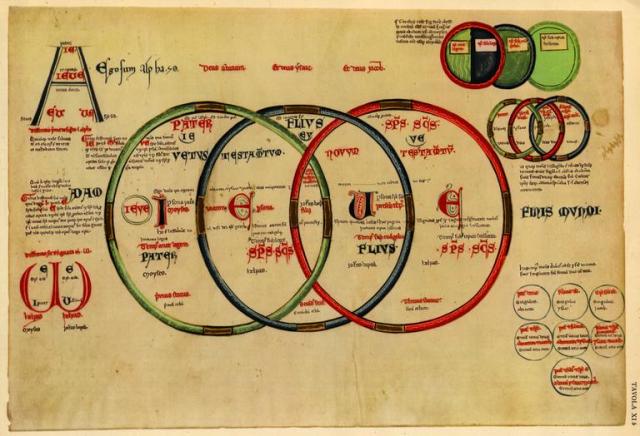
joachim circle trinity

It is strange how some of the most influential individuals in human history can sometimes manage to slip out of public consciousness to the extent that almost no one knows who they are. What if I were to tell you that the ideas of one person who lived almost 900 years ago were central to everything from the Protestant Reformation, to the French Revolution, to Russia and America’s peculiar type of nationalism, to Communism and Nazism, to neo-liberal optimists such as Steven Pinker and now Michael Shermer, to (of most interest to this audience) followers of Ray Kurzweil and his Singularity; would you believe me, or think I was pulling a Dan Brown?

That individual was a 12th century was a monk named Joachim de Fiore, very much for real, and who up until very recently I had never heard of. In some ways this strange monk not only was a necessary figure in formation all of the systems of thought and political movements listed above, he also might seriously be credited with inventing the very idea of the future itself.

Whether you’re a fan of Game of Thrones or not put yourself for a moment in the mind of a European in the Middle Ages. Nothing around you has what we would consider a rational explanation, rather, it can only be understood in reference to the will of an unseen deity or his demonic rival. It is quite a frightening place, and would even be spatially disorienting  for a modern person used to maps and ideas regarding how the different worlds one sees while looking at the ground or up towards the sky, especially at night, fit together. It would have seemed like being stuck at the bottom of a seemingly endless well, unable to reach the “real” world above. A vertical version of Plato’s famous cave.

Starting in the 13th century there were attempts to understand humankind’s position in space more clearly, and some of these attempts were indeed brilliant, even anticipating current idea such as the Big Bang and the multiverse. This was shown recently in a wonderful collaboration between scholars in the humanities, mathematicians and scientists on the work of another largely forgotten medieval figure, Robert Grosseteste.

Even before Grosseteste was helping expand medievals’ understanding of space, Joachim de Fiore had expanded their notion of time. For time in the medieval worldview time was almost as suffocating as the stuck-in-a-well quality of their notion of space.

Medievals largely lacked a notion of what we would understand as an impersonal future that would be different from the past. It wasn’t as if a person living then would lack the understanding that their own personal tomorrow would be different than today- that their children would age and have children of their own and that the old would die- it was that there was little notion that the world itself was changing. It would be a tough sell to get a medieval to pay for a trip into the future, for in their view whether you’d travel 100 or 1000 years forward everything would be almost exactly the same, unless, that is, the world wasn’t there to visit at all.

Being a medieval was a lot like being on death row- you know exactly how your life will end- you just wouldn’t know when exactly you’ll run out of appeals. A medieval Christian had the end of the story in the Book of Revelation with it’s cast of characters such as the Antichrist and scenes such as the battle of armageddon. A Christian was always on the look out for the arrival of all the props for the play that would be the end of the current world, and if they believed in any real difference between the present and the future it was that the world in which these events were to occur would be what we would consider less technologically and socially advanced than the Roman world into which Christ had been born. History for the medievals, far from being the story of human advancement, was instead the tale of societal decay.

Well before actual events on the ground, improvements in human living standards, technological capacity and scientific understanding, undermined this medieval idea of the future as mere decadence before a final ending, Joachim de Fiore would do so philosophically and theologically.

Joachim was born around 1135 into a well of family with his father being a member of the Sicilian court. Joachim too would begin his career as a court official, but it would not last. In his early twenties, while on a diplomatic mission to the Byzantine Emperor, Joachim broke away to visit the Holy Land, and according to legend felt the call of God.He spent the Lenten season in meditation on Mt Tabor where “on the eve of Easter day, he received ‘the fullness of knowledge’”. (3)  

He became a monk and soon a prior and abbot for of Corazzo one assumes on account of his remarkable intelligence, but Joachim would spend his time writing his great trilogy: The Harmony of the New and Old Testaments, Exposition of Apocalypse, and the Psaltery of Ten Strings eventually receiving a dispensation from his work as abbot by  Pope Clement III so he could devote himself fully to his writing.

Eventually a whole monastic order would grow up around Joachim, and though this order would last only a few centuries, and Joachim would die in 1202 before finishing his last book the Tract on the Four Gospels his legacy would almost fully be felt in the way we understand history and the future.

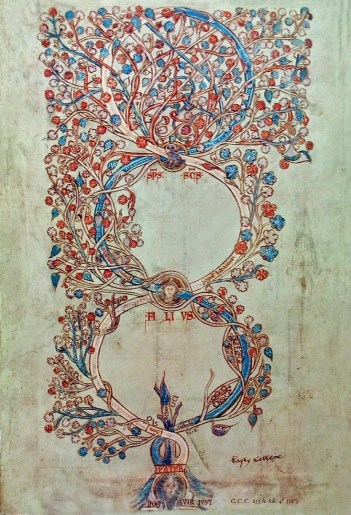
Joachim constructed a theory of history based on the Christian Trinity: the Age of the Father – from Adam to the birth of Christ, the Age of the Son- from Christ until The Age of the Spirit. There had been examples of breaking history into historical ages before, what made Joachim different was his idea that:

“… Scripture taught a record of man’s gradual spiritual developments, leading to a perfected future age which was the fulfillment of prophetic hope.” (13)

“… one to be ushered in with a New Age of guidance by the Holy Spirit acting through a new order of meditative men who truly contemplated God. “ (12)

What is distinct and new about this was that history was spiritualized, it became the story of humankind’s gradual improvement and moving towards a state of perfection that was achievable in the material world (not in some purely spiritual paradise). And we could arrive at this destination if only we could accept the counsel of the virtuous and wise. It was a powerful story that has done us far more harm than good.

Joachim trinitarian tree circles

Joachimite ideas can be found at the root of the millennia fantasies of the European religious wars, and were secularized in the period of the French Revolution by figures like the Marquis de Condorcet and Auguste Comte. The latter even managed to duplicate Joachim’s tri-part model of history only now the ages only now they were The Theological, The Metaphysical, and the Positive Stage which we should read as religious, philosophical and scientific with Joachim’s monks being swapped for scientists.  

Hegel turned this progressive version of history into a whole system of philosophy and the atheist Marx turned Hegel “upside down” and created a system of political economy and revolutionary program. The West would justify its imperial conquest of Africa and subjugation of Asia on the grounds that they were bringing the progressive forces of history to “barbaric” peoples. The great ideological struggle of the early 20th century between Communism, Nazism, and Liberalism pitted versions of historical determinism against one another.

If postmodernism should have meant the end of overarching metanarratives the political movements that have so far most shaped the 21st century seem not to have gotten the memo. The century began with an attack by a quasi- millenarian cult (though they would not recognize Joachim as a forbearer). The 9-11 attacks enabled an averous and ultimately stupid foreign policy on the part of the United States which was only possible because the American people actually believed in their own myth that their system of government represented the end of history and the secret wish of every oppressed people in the world.

Now we have a truly apocalyptic cult in the form of ISIS while Russia descends into its own version of Joachimite fantasy based on Russia’s “historical mission” while truth itself disappears in a postmodern hall of mirrors. Thus it is that Joachim’s ideas regarding the future remain potent. And the characters attracted to his idea of history are, of course, not all bad. I’d include among this benign group both singularitarians and the new neo-liberal optimists. The first because they see human history moving towards an inevitable conclusion and believe that their is an elite that should guide us into paradise – the technologists. Neo-liberal optimists may not be so starry eyed but they do see history as the gradual unfolding of progress and seem doubtful that this trend might reverse.

The problem I have with the singularitarians is their blindness to the sigmoid curve – the graveyard where all exponentials go to die. There is a sort of “evolutionary” determinism to singularitarianism that seems to think not only that there is only one destination to history, but that we already largely know what that destination is. For Joachim such determinism makes sense, his world having been set up and run by an omnipotent God, for what I assume to be mostly secular singularitarians such determinism does not make sense and we are faced with the contingencies of evolution and history.

My beef with the neo-liberal optimists, in addition to the fact that they keep assaulting me with their “never been better” graphs is that I care less that human suffering has decreased than the reasons why, so that such a decrease can be continued or its lower levels preserved. I also care much more where the moral flaws of our society remain acute because only then will I know where to concentrate my political and ethical action. If the world today is indeed better than the world in the past (and it’s not a slam dunk argument even with the power point) let’s remember the struggles that were necessary to achieve that and continue to move ourselves towards Joachim’s paradise while being humble and wise enough to avoid mistaking ourselves with the forces of God or history, a mistake that has been at the root of so much suffering and evil.            

Auguries of Immortality, Malthus and the Verge

Hindu Goddess Tara

Sometimes, if you want to see something in the present clearly it’s best to go back to its origins. This is especially true when dealing with some monumental historical change, a phase transition from one stage to the next. The reason I think this is helpful is that those lucky enough to live at the beginning of such events have no historical or cultural baggage to obscure their forward view. When you live in the middle, or at the end of an era, you find yourself surrounded, sometimes suffocated, by all the good and bad that has come as a result. As a consequence, understanding the true contours of your surroundings or ultimate destination is almost impossible, your nose is stuck to the glass.

Question is, are we ourselves in the beginning of such an era, in the middle, or at an end? How would we even know?

If I were to make the case that we find ourselves in either the middle or the end of an era, I know exactly where I would start. In 1793 the eccentric English writer William Godwin published his Enquiry Concerning Political Justice and its Influence on Morals and Happiness, a book which few people remember. What Godwin is remembered for instead is his famous daughter Mary Shelley, and her even more famous monster, though I should add that if you like thrillers you can thank Godwin for having invented them.

Godwin’s Enquiry, however, was a different kind of book. It grew out of the environment of a time which, in Godwin’s eyes at least, seemed pregnant with once unimaginable hope. The scientific revolution had brought about a fuller understanding of nature and her laws than anything achieved by the ancients, the superstitions of earlier eras were abandoned for a new age of enlightenment, the American Revolution had brought into the world a whole new form of government based on Enlightenment principles, and, as Godwin wrote, a much more important similar revolution had overthrown the monarchy in France.

All this along with the first manifestations of what would become the industrial revolution led Godwin to speculate in the Enquiry that mankind had entered a new era of perpetual progress. Where then could such progress and mastery over nature ultimately lead? Jumping off of a comment by his friend Ben Franklin, Godwin wrote:

 Let us here return to the sublime conjecture of Franklin, that “mind will one day become omnipotent over matter.” If over all other matter, why not over the matter of our own bodies? If over matter at ever so great a distance, why not over matter which, however ignorant we may be of the tie that connects it with the thinking principle, we always carry about with us, and which is in all cases the medium of communication between that principle and the external universe? In a word, why may not man be one day immortal?

Here then we can find evidence for the recent claim of Yuval Harari that “The leading project of the Scientific Revolution is to give humankind eternal life.” (268)  In later editions of the Enquiry, however, Godwin dropped the suggestion of immortality, though it seems he did it not so much because of the criticism that followed from such comments, or the fact that he stopped believing in it, but rather that it seemed too much a termination point for his notion of progress that he now thought really would extend forever into the future for his key point was that the growing understanding by the mind would result in an ever increasing power of the mind over the material world in a process that would literally never end.

Almost at the exact same time as Godwin was writing his Enquiry another figure was making almost the exact same argument including the idea that scientific progress would eventually result in indefinite human lifespans. The Marquis de Condorcet’s Sketch for a Historical Picture of the Progress of the Human Spirit was a book written by a courageous man while on the run from a French Revolutionary government that wanted to cut off his head. Amazingly, even while hunted down during the Terror, Condorcet retained his long term optimism regarding the ultimate fate of humankind.

A young English parson with a knack for the just emerging science of economics, not only wasn’t buying it, he wanted to actually scientifically prove (though I am using the term loosely) exactly why  such optimism should not be believed. This was Thomas Malthus, whose name, quite mistakenly, has spawned its own adjective, Malthusian, which means essentially environmental disaster caused by our own human hands and faults.

As is commonly known, Malthus’ argument was that historically there has been a mismatch between the growth of population and the production of food which sooner or later has led to famine and decline. It was Godwin’s and Condorcet’s claims regarding future human immortality that, in part, was responsible for Malthus stumbling upon his specific argument centered on population. For the obvious rejoinder to those claiming that the human lifespan would increase forever was-  what would we do will all of these people?

Both Godwin and Condorcet thought they had answered this question by claiming that in the future the birth rate would decline to zero. Stunningly, this has actually proven to be correct- that population growth rates have declined in parallel with increases in longevity. Though, rather than declining due to the victory of “reason” and the conquest of the “passions” as both Godwin and Condorcet thought they declined because sex was, for the first time in human history, decoupled from reproduction through the creation of effective forms of birth control.

So far, at least, it seems it has been Godwin and Condorcet that have gotten the better side of the argument. Since the  Enquiry we have experienced nearly 250 years of uninterrupted progress where mind has gained increasing mastery over the material world. And though,we are little closer to the optimists’ dream of “immortality” their prescient guess that longevity would be coupled with a declining birth rate would seem to clear the goal of increased longevity from being self-defeating on Malthusian grounds.

This would not be, of course, the first time Malthus has been shown to be wrong. Yet his ideas, or a caricature of his ideas, have a long history of retaining their hold over our imagination.  Exactly why this is the case is a question  explored in detail by Robert J. Mayhew in his excellent, Malthus: The Life and Legacies of an Untimely Prophet, Malthus’ argument in his famous if rarely actually read An Essay on the Principle of Population has become a sort of secular version of armageddon, his views latched onto by figures both sinister and benign over the two centuries since his essay’s publication.

Malthus’ argument was used against laws to alleviate the burdens of poverty, which it was argued would only increase population growth and an ultimate reckoning (and this view, at least, was close to that of Malthus himself). They were used by anti-immigrant and racist groups in the 19th and early 20th century. Hitler’s expansionist and genocidal policy in eastern Europe was justified on Malthusian grounds.

On a more benign side, Malthusian arguments were used as a spur to the Green Revolution in Agriculture in the 1960’s (though Mayhew thinks the warnings of pending famine were political -arising from the cold war- and overdone.) Malthusianism was found in the 1970’s by Paul Ehrlich to warn of a “population bomb” that never came, during the Oil Crisis slid into the fear over resource constraints, and can now be found in predictions about the coming “resource” and “water” wars. There is also a case where Malthus really may have his revenge, though more on that in a little bit.

And yet, we would be highly remiss were we to not take the question Malthus posed seriously. For what he was really inquiring about is whether or not their might be ultimate limits on the ability of the human mind to shape the world in which it found itself. What Malthus was  looking for was the boundary or verge of our limits as established by the laws of nature as he understood them. Those whose espoused the new human perfectionism, such as Godwin and Condorcet, faced what appeared to Malthus to be an insurmountable barrier to their theories being considered scientific, no matter how much they attached themselves to the language and symbols of the recent success of science. For what they were predicting would happen had no empirical basis- it had never happened before. Given that knowledge did indeed seem to increase through history, if merely as a consequence of having the time to do so, it was still the case that the kind of radical and perpetual progress that Godwin and Condorcet predicted was absent from human history. Malthus set out to provide a scientific argument for why.

In philosophical terms Malthus’ Essay is best read as a theodicy, an attempt like that of Leibniz before him, to argue that even in light of the world’s suffering we live in the “best of all possible world’s”. Like Newton did for falling objects, Malthus sought the laws of nature as designed by his God that explained the development of human society. Technological and social progress had remained static in the past even as human knowledge regarding the world accumulated over generations because the gap between mind and matter was what made us uniquely human. What caused us to most directly experience this gap and caused progress to remain static? Malthus thought he pinned the source of stasis in famine and population decline.

As is the case with any other physical system, for human societies, the question boiled down to how much energy was available to do meaningful work. Given that the vast majority of work during Malthus’ day was done by things that required energy in the form of food whether humans or animals, the limited amount of land that could be efficiently tilled presented an upper bound to the size, complexity, and progress of any human society.

What Malthus missed, of course, was the fact that the relationship between food and work was about to be severed. Or rather, the new machines did consume a form of processed “food” organic material that had been chemically “constructed” and accumulated over the eons, in the form of fossil fuels that offered an easily accessible type of energy that was different in kind from anything that had come before it.

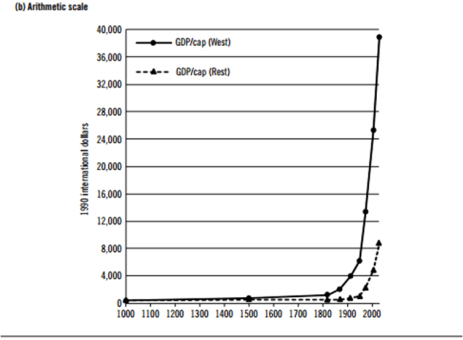
The sheer force of the age of machines Malthus had failed to foresee did indeed break with the flatline of human history he had identified in every prior age. A fact that has never perhaps been more clearly than in Ian Morris’ simple graph below.

Ian Morris Great Divergence Graph

What made this breaking of the pattern between all of past human history and the last few centuries is the thing that could possibly, and tragically, prove Malthus right after all- fossil fuels.  For any society before 1800 the majority of energy other than that derived from food came in the form of wood- whether as timber itself or charcoal. But as Lewis Dartnell pointed out in a recent piece in AEON the world before fossil fuels posed a seemingly unsurmountable (should I say Malthusian?) dilemma; namely:

The central problem is that woodland, even when it is well-managed, competes with other land uses, principally agriculture. The double-whammy of development is that, as a society’s population grows, it requires more farmland to provide enough food and also greater timber production for energy. The two needs compete for largely the same land areas.

Dartnell’s point is that we have been both extremely lucky and unlucky in how accessible and potent fossil fuels have been. On the one hand fossil fuels gave us a rather short path to technological society, on the other, not only will it be difficult to wean ourselves from them, it is hard to imagine how we could reboot as a civilization should we suffer collapse and find ourselves having already used up most of the world’s most easily accessed forms of energy.

It is a useful exercise, then, to continue to take Malthus’ argument seriously, for even if we escape the second Malthusian trap- fossil fuel induced climate change- that allowed us to break free from the trap Malthus’ originally identified- our need to literally grow our energy- there are other predictable traps that likely lie in store.

One of these traps that interests me the most has to do with the “energy problem” that Malthus understood in terms of the production of food. As I’ve written about before, and as brought to my attention by the science writer Lee Billings in his book Five Billion Years of Solitude, there is a good and little discussed case from physics for thinking we might be closer to the end of an era that began with the industrial revolution rather than in the middle or even at the beginning.

This physics of civilizational limits comes from Tom Murphy of the University of California, San Diego who writes the blog Do The Math. Murphy’s argument, as profiled by the BBC, has some of the following points:

  • Assuming rising energy use and economic growth remain coupled, as they have in the past, confronts us with the absurdity of exponentials. At a 2.3 percent growth rate within 2,500 hundred years we would require all the energy from all the stars in the Milky Way galaxy to function.
  • At 3 percent growth, within four hundred years we will have boiled away the earth’s oceans, not because of global warming, but from the excess heat that is the normal product of energy production. (Even clean fusion leaves us burning away the world’s oceans for the same reason)
  • Renewables push out this reckoning, but not indefinitely. At a 3 percent growth rate, even if the solar efficiency was 100% we would need to capture all of the sunlight hitting the earth within three hundred years.

Will such limits prove to be correct and Malthus, in some sense, be shown to have been right all along? Who knows. The only way we’d have strong evidence to the contrary is if we came across evidence of civilizations with a much, much greater energy signature than our own. A recent project out of Penn State to do just that, which looked at 100,000 galaxies, found nothing, though this doesn’t mean the search is over.

Relating back to my last post: the universe may lean towards giving rise to complexity in the way the physicist Jeremy England suggests, but the landscape is littered with great canyons where evolution gets stuck for very long periods of time which explains its blindness as perceived by someone like Henry Gee. The scary thing is getting out of these canyons is a race against time: complex life could have been killed off by some disaster shortly after the Cambrian explosion, we could have remained hunter gatherers and failed to develop agriculture before another ice age did us in, some historical contingency could have prevented industrialization before some global catastrophe we are advanced enough now to respond to wiped us out.

If Tom Murphy is right we are now in a race to secure exponentially growing sources of energy, and it is a race we are destined to lose. The reason we don’t see any advanced civilizations out there is because the kind of growth we’ve extrapolated from the narrow slice of the past few centuries is indeed a finite thing as the amount of energy such growth requires reaches either terrestrial or cosmic limits. We simply won’t be able to gain access to enough energy fast enough to keep technological progress going at its current rate.

Of course, even if we believe that progress has some limit out there, that does not necessarily entail we shouldn’t pursue it, in many of its forms, until we hit the verge itself. Taking arguments that there might be limits to our technological progress is one thing, but to our moral progress, our efforts to address suffering in the world, they are quite another, for there accepting limits would mean accepting some level of suffering or injustice as just the “way things are”.  That we should not accept this Malthus himself nearly concluded:

 Evil exists in the world not to create despair but activity. We are not patiently to submit to it, but to exert ourselves to avoid it. It is not only the interest but the duty of every individual to use his utmost efforts to remove evil from himself and from as large a circle as he can influence, and the more he exercises himself in this duty, the more wisely he directs his efforts, and the more successful these efforts are, the more he will probably improve and exalt his own mind and the more completely does he appear to fulfil the will of his Creator. (124-125)

The problem lies with the justification of the suffering of individual human beings in any particular form as “natural”. The crime at the heart of many versions of Malthusianism is this kind of aggregation of human beings into some kind of destructive force, which leads to the denial of the only scale where someone’s true humanity can be scene- at the level of the individual. Such a moral blindness that sees only the crowd can be found in the work the most famous piece of modern Malthusianism -Paul Ehrlich’s Population Bomb where he discusses his experience of Delhi.

The streets seemed alive with people. People eating, people washing, people sleeping. People visiting, arguing, and screaming. People thrusting their hands through the taxi window, begging. People defecating and urinating. People clinging to the buses. People herding animals. People, people, people, people. As we moved slowly through the mob, hand horn squawking, the  dust, noise, heat, and the cooking fires gave the scene a hellish aspect. Would we ever get to our hotel? All three of us were, frankly, frightened. (p. 1)

Striped of this inability to see the that the value of human beings can only be grasped at the level of the individual and that suffering can only be assessed in a moral sense at this individual level, Malthus can help to remind us that our mind’s themselves emerge out of their confrontation and interaction with a material world where we constantly explore, overcome, and confront again its boundaries. That the world itself was probably “a mighty process for awakening matter into mind” and even the most ardent proponents of human perfectionism, modern day transhumanists or singularitarians, or just plain old humanists would agree with that.

* Image: Tara (Devi): Hindu goddess of the unquenchable hunger that compels all life.

Life: Inevitable or Accident?

The-Tree-Of-Life Gustav Klimt                                                             https://www.artsy.net/artist/gustav-klimt

Here’s the question: does the existence of life in the universe reflect something deep and fundamental or is it merely an accident and epiphenomenon?

There’s an interesting new theory coming out of the field of biophysics that claims the cosmos is indeed built for life, and not just merely in the sense found in the so-called “anthropic principle” which states that just by being here we can assume that all of nature’s fundamental values must be friendly for complex organisms such as ourselves that are able to ask such questions. The new theory makes the claim that not just life, but life of ever growing complexity and intelligence is not just likely, but the inevitable result of the laws of nature.

The proponent of the new theory is a young physicist at MIT named Jeremy England. I can’t claim I quite grasp all the intricate details of England’s theory, though he does an excellent job of explaining it here, but perhaps the best way of capturing it succinctly is by thinking of the laws of physics as a landscape, and a leaning one at that.

The second law of thermodynamics leans in the direction of increased entropy: systems naturally move in the direction of losing rather than gaining order over time, which is why we break eggs to make omelettes and not the other way round. The second law would seem to be a bad thing for living organisms, but oddly enough, ends up being a blessing not just for life, but for any self-organizing system so long as that system has a means of radiating this entropy away from itself.

For England, the second law provides the environment and direction in which life evolves. In those places where energy outputs from outside are available and can be dissipated because they have some boundary, such as a pool of water, self-organizing systems naturally come to be dominated by those forms that are particularly good at absorbing energy from their surrounding environment and dissipating less organized forms of energy in the form of heat (entropy) back into it.

This landscape in which life evolves, England postulates, may tilt as well in the direction of complexity and intelligence due to the fact that in a system that frequently changes in terms of oscillations of energy, those forms able to anticipate the direction of such oscillations gain the possibility of aligning themselves with them and thus become able to accomplish even more work through resonance.

England is in no sense out to replace Darwin’s natural selection as the mechanism through which evolution is best understood, though, should he be proved right, he would end up greatly amending it. If his theory ultimately proves successful, and it is admittedly very early days, England’s theory will have answered one of the fundamental questions that has dogged evolution since its beginnings. For while Darwin’s theory provides us with all the explanation we need for how complex organisms such as ourselves could have emerged out of seemingly random processes- that is through natural selection- it has never quite explained how you go from the inorganic to the organic and get evolution working in the first place. England’s work is blurring the line between the organic and the most complicated self-organizing forms of the inorganic, making the line separating cells from snowflakes and storms a little less distinct.

Whatever its ultimate fate, however, England’s theory faces major hurdles, not least because it seems to have a bias towards increasing complexity, and in its most radical form, points towards the inevitability that life will evolve in the direction of increased intelligence, ideas which many evolutionary thinkers vehemently disavow.

Some evolutionary theorists may see effort such as England’s not as a paradigm shift waiting in the wings, but as an example of a misconception regarding the relationship between increasing complexity and evolution that now appears to have been adopted by actual scientists rather than a merely misguided public. A misconception that, couched in scientific language, will further muddy the minds of the public leaving them with a conception of evolution that belongs much more to the 19th century than to the 21st. It is a misconception whose most vocal living opponent after the death of the irreplaceable Stephen J Gould has been the paleontologist, evolutionary biologist, and senior editor of the journal Nature, Henry Gee, who has set out to disabuse us of it in his book The Accidental Species.

Gee’s goal is to remind us of what he holds to be the fundamental truth behind the theory of evolution- evolution has one singular purpose from which everything else follows in lockstep- reproduction. His objective is to do away, once and for all, with what he feels is a common misconception that evolution is leading towards complexity and progress and that the highest peak of this complexity and progress is us- human beings.

If improved prospects for reproduction can be bought through the increased complexity of an organism then that is what will happen, but it needn’t be the case. Gee points out that many species, notably some worms and many parasites, have achieved improved reproductive prospects by decreasing their complexity.Therefore the idea that complexity (as in an increase in the specialization and number of parts an organism has)  is a merely matter of evolution plus time doesn’t hold up to close scrutiny. Judged through the eyes of evolution, losing features and becoming more simple is not necessarily a vice. All that counts is an organism’s ability to make more copies, or for animals that reproduce through sex, blended copies of itself.

Evolution in this view isn’t beautiful but coldly functional and messy- a matter of mere reproductive success. Gee reminds us of Darwin’s idea of evolution’s product as a “tangled bank”- a weird menagerie of creatures each having their own particular historical evolutionary trajectory. The anal retentive Victorian era philosophers who tried to build upon his ideas couldn’t accept such a mess and:

…missed the essential metaphor of Darwin’s tangled bank, however, and saw natural selection as a sort of motor that would drive transformation from one preordained station on the ladder of life to the next one.” (37)

Gee also sets out to show how deeply limited our abilities are when it comes to understanding the past through the fossil record. Very, very, few of the species that have ever existed left evidence of their lives in the form of fossils, which are formed only under very special conditions, and where the process of fossilization greatly favors the preservation of some species over others. The past is thus incredibly opaque making it impossible to impose an overarching narrative upon it- such as increasing complexity- as we move from the past towards the present.

Gee, though an ardent defender of evolution and opponent of creationist pseudoscience, finds the gaps in the fossil record so pronounced that he thinks we can create almost any story we want from it and end up projecting our contemporary biases onto the speechless stones. This is the case even when the remains we are dealing with are of much more recent origin and especially when their subject is the origin of us.

We’ve tended, for instance, to link tool use and intelligence, even in those cases such as Homo Habilis, when the records and artifacts point to a different story. We’ve tended not to see other human species such as the so-called Hobbit man as ways we might have actually evolved had circumstances not played out in precisely the way they had. We have not, in Gee’s estimation, been working our way towards the inevitable goal of our current intelligence and planetary dominance, but have stumbled into it by accident.

Although Gee is in no sense writing in anticipation of a theory such as England’s his line of thinking does seem to pose obstacles that the latter’s hypothesis will have to address. If it is indeed the case that, as England has stated it, complex life arises inevitably from the physics of the universe, so that in his estimation:

You start with a random clump of atoms, and if you shine light on it for long enough, it should not be so surprising that you get a plant.

Then England will have to address why it took so incredibly long – 4 billion years out of the earth’s 4.5 billion year history for actual plants to make their debut, not to mention similar spans for other complex eukarya such as animals like ourselves.

Whether something like England’s inevitable complexity or Gee’s, not just blind, but drunk and random, evolutionary walk is ultimately the right way to understand evolution has implications far beyond evolutionary theory. Indeed, it might have deep implications for the status and distribution of life in the universe and even inform the way we understand the current development of new forms of artificial intelligence.

What we have discovered over the last decade is that bodies of water appear to be both much more widespread and can be found in environments far beyond those previously considered. Hence NASA’s recent announcement that we are likely to find microbial life in the next 10 – 30 years both in our solar system and beyond. What this means is that England’s heat baths are likely ubiquitous, and if he’s correct, life likely can be found anywhere there is water- meaning nearly everywhere. There may even be complex lifelike forms that did not evolve through what we would consider normal natural selection at all.

If Gee is right the universe might be ripe for life, but the vast, vast majority of that life will be microbial and no amount of time will change that fate on most life inhabited worlds. If England in his minor key is correct the universe should at least be filled with complex multicellular life forms such as ourselves. Yet it is the possibility that England is right in his major key, that consciousness, civilization, and computation might flow naturally from the need of organisms to resonate with their fluctuating environments that, biased as we are, we likely find most exciting. Such a view leaves us with the prospect of many, many more forms of intelligence and technological civilizations like ourselves spread throughout the cosmos.

The fact that the universe so far has proven silent and devoid of any signs of technological civilization might give us pause when it comes to endorsing England’s optimism over Gee’s pessimism, unless, that is, there is some sort of limit or wall when it comes to our own perceived technological trajectory that can address the questions that emerge from the ideas of both. To that story, next time…

Is the Anthropocene a Disaster or an Opportunity?

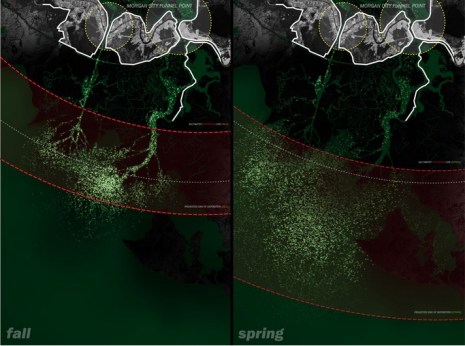
Bradley Cantrell Pod-mod

Bradley Cantrell Pod-Mod

Recently the journal Nature published a paper arguing that the year in which the Anthropocene, the proposed geological era in which the collective actions of the human species started to trump other natural processes in terms of their impact, began in the year 1610 AD. If that year leaves you, like it did me, scratching your head and wondering what your missed while you dozed off in your 10th grade history class, don’t worry, because 1610 is a year in which nothing much happened at all. In fact, that’s why the author’s chose it.

There are a whole host of plausible candidates for the beginning of the Anthropocene, that are much, much more well know than 1610, starting relatively recently with the explosion of the first atomic bomb in 1945 and stretching backwards in time through the beginning of the industrial revolution (1750’s) to the discovery of the Americas and the bridging between the old and new worlds in the form of the Columbian Exchange, (1492), and back even further to some hypothetical year in which humans first began farming, or further still to the extinction of the mega-fauna such as Woolly Mammoths probably at the hands of our very clever, and therefore dangerous, hunter gatherer forebears.

The reason Simon L. Lewis and Mark A. Maslin (the authors of the Nature paper) chose 1610 is that in that year there can be found a huge, discernible drop in the amount of carbon dioxide in the atmosphere. A rapid decline in greenhouses gases which probably plunged the earth into a cold snap- global warming in reverse. The reason this happened goes to the heart of a debate plaguing the environmental community, a debate that someone like myself, merely listening from the sidelines, but concerned about the ultimate result, should have been paying closer attention to.

It seems that while I was focusing on how paleontologists had been undermining the myth of the “peaceful savage”, they had also called into question another widely held idea regarding the past, one that was deeply ingrained in the American environmental movement itself- that the Native Americans did not attempt the intensive engineering of the environment of the sort that Europeans brought with them from the Old World, and therefore, lived in a state of harmony with nature we should pine for or emulate.

As paleontologists and historians have come to understand the past more completely we’ve learned that it just isn’t so. Native Americans, across North America, and not just in well known population centers such as Tenochtitlan in Mexico, the lost civilizations of the Pueblos (Anasazi) in the deserts of the southwest, or Cahokia in the Mississippi Valley, but in the woodlands of the northeast in states such as my beloved Pennsylvania, practiced extensive agriculture and land management in ways that had a profound impact on the environment over the course of centuries.

Their tool in all this was the planful use of fire. As the naturalist and historian Scott Weidensaul tells the story in his excellent account of the conflicts between Native Americans and the Europeans who settled the eastern seaboard, The First Frontier:

Indians had been burning Virginia and much of the rest of North America annually for fifteen thousand years and it was certainly not a desert. But they had clearly altered their world in ways we are only still beginning to appreciate. The grasslands of the Great Plains, the lupine-studded savannas of northwestern Ohio’s “oak openings”, the longleaf pine forests of the southern coastal plain, the pine barrens of the Mid-Atlantic and Long Island- all were ecosystems that depended on fire and were shaped over millennia of use by its frequent and predictable application.  (69)

The reason, I think, most of us have this vision in our heads of North America at the dawn of European settlement as an endless wilderness is not on account of some conspiracy by English and French settlers (though I wouldn’t put it past them), but rather, when the first settlers looked out into a continent sparsely settled by noble “savages” what they were seeing was a mere remnant of the large Indian population that had existed there only a little over a century before. That the native peoples of the North America Europeans struggled so hard to subdue and expel were mere refugees from a fallen civilization. As the historian Charles Mann has put it: when settlers gazed out into a seemingly boundless American wilderness they were not seeing a land untouched by the hands of man, a virgin land given to them by God, but a graveyard.

Given the valiant, ingenious, and indeed, sometime brutal resistance Native Americans gave against European (mostly English) encroachment it seems highly unlikely the the United States and Canada would exist today in anything like their current form had the Indian population not been continually subject to collapse. What so ravaged the Native American population and caused their civilization to go into reverse were the same infectious diseases unwittingly brought by Europeans that were the primary culprit in the destruction of the even larger Indian civilizations in Mexico and South America. It was a form of accidental biological warfare that targeted Native American based upon their genomes, their immunity to diseases having never been shaped by contact with domesticated animals like pigs and cows as had the Europeans who were set on stealing their lands.

Well, it wasn’t always accidental. For though it would be sometime before we understood how infectious diseases worked, Europeans were well aware of their disproportionate impact on the Indians. In 1763 William Trent in charge of Fort Pitt, the seed that would become Pittsburgh, besieged by Indians, engaged in the first documented case of biological warfare. Weidensaul quotes one of Trent’s letters:

Out of regard to the [Indian emissaries] we gave them two blankets and a handkerchief out of the Small Pox Hospital. I hope it will have the desired effect (381)

It’s from this devastating impact of infectious diseases that decimated Native American populations and ended their management of the ecosystem through the systematic use of fire that (the authors of the Nature paper) get their 1610 start date for the beginning of the Anthropocene. With the collapse of Indian fire ecology eastern forests bloomed to such an extent that vast amounts of carbon otherwise left in the atmosphere was sucked up by the trees with the effect that the earth rapidly cooled.

Beyond the desire to uncover the truth and to enter into sympathy with those of the past that lies at the heart of the practice and study of history, this new view of the North American past has implications for the present. For the goal of returning, both the land itself and as individuals, to the purity of the wilderness that has been at the heart of the environmentalist project since its inception in the 19th century now encounters a problem with time. Where in the past does the supposedly pure natural state to which we are supposed to be returning actually exist?

Such an untrammeled state would seem to exist either before Native American’s development of fire ecology, or after their decimation by disease before European settlement west of the Allegheny mountains. This, after all, was the period of America as endless wilderness that has left its mark on our imagination. That is, we should attempt to return as much of North America as is compatible with civilization to the state it was after the collapse of the Native American population, but before the spread of Europeans into the American wilderness. The problem with such a goal is that this natural splendor may have hid the fact that such an ecology was ultimately unsustainable in the wild  state in which European settlers first encountered it.

As Tim Flannery pointed out in his book The Eternal Frontier: An Ecological History of North America and Its Peoples, the fire ecology adopted by Native Americans may have been filling a vital role, doing the job that should have been done by large herbivores, which North America, unlike other similar continents, and likely due to the effectiveness of the first wave of human hunters to enter it as the ultimate “invasive species” from Asia, lacked.  Large herbivores cull the forests and keep them healthy, a role which in their absence can also be filled by fire.

Although projects are currently in the works to try to bring back some of these large foresters such as the woolly mammoth I am doubtful large populations will ever be restored in a world filled even with self-driving cars. Living in Pennsylvania I’ve had the misfortune of running into a mere hundred pound or so white tailed deer (or her running into me). I don’t even want to think about what a mammoth would do to my compact. Besides, woolly mammoths don’t seem to be a creature made for the age we’re headed into, which is one of likely continued, and extreme, warming.

Losing our romanticized picture of nature’s past means we are now also unclear as to its future.  Some are using this new understanding of the ecological history of North America to make an argument against traditional environmentalism arguing in essence that without a clear past to return to the future of the environment is ours to decide.

Perhaps what this New Environmentalism signals is merely the normalization of North American’s relationship with nature, a move away from the idea of nature as a sort of lost Eden and towards something like ideas found elsewhere, which need not be any less reverential or religious. In Japan especially nature is worshiped, but it is in the form of a natural world that has been deeply sculpted by human beings to serve their aesthetic and spiritual needs. This the Anthropocene interpreted as opportunity rather than as unmitigated disaster.

Ultimately, I think it is far too soon to embrace without some small degree of skepticism the project of the New Environmentalism espoused by organizations such as the Breakthrough Institute or the chief scientist and fire- brand of the Nature Conservancy Peter Kareiva, or environmental journalists and scholars espousing those views like Andrew Rifkin, Emma Marris, or even the incomparable Diane Ackerman. For certainly the argument that even if the New Environmentalism contains a degree of truth it is inherently at risk of being captured by actors whose environmental concern is a mere smokescreen for economic interests, and which, at the very least, threatens to undermine the long held support for the setting aside of areas free from human development whose stillness and silence many of us in our drenched in neon and ever beeping world hold dear.

It would be wonderful if objective scientists could adjudicate disputes between traditional environmentalists and New Environmentalists expressing non-orthodox views on everything from hydraulic fracking, to genetic engineering, to invasive species, to geo-engineering. The problem is that the very uncertainty at the heart of these types of issues probably makes definitive objectivity impossible. At the end of the day the way one decides comes down to values.

Yet what the New Environmentalists have done that I find most intriguing is to challenge  the mythology of Edenic nature, and just as in any other undermining of a ruling mythology this has opened the potential to both freedom and risks. On the basis of my own values the way I would use that freedom would not be to hive off humanity from nature, to achieve the “de-ecologization of our material welfare”,  as some New Environmentalists want to do, but for the artifact of human civilization itself to be made more natural.

Up until today humanity has gained its ascendancy over nature by assaulting it with greater and more concentrated physical force. We’ve damned and redrawn the course of rivers, built massive levies against the sea, cleared the land of its natural inhabitants (nonhuman and human) and reshaped it to grow our food.

We’ve reached the point where we’re smarter than this now and understand much better how nature achieve ends close to our own without resorting to excessively destructive and wasteful force. Termites achieve climate control from the geometry of their mounds rather than our energy intensive air conditioning. IBM’s Watson took a small city’s worth of electric power to beat its human opponents on Jeopardy! whose brains consumed no more power than a light bulb.

Although I am no great fan of the term “cyborg-ecology” I am attracted to the idea as it is being developed by figures such as Bradley Cantrell who propose that we use our new capabilities and understanding to create a flexible infrastructure that allows, for instance, a river to be a river rather than a mere “concrete channel” which we’ve found superior to the alternative of a natural river because it is predictable, while providing for our needs. A suffocatingly narrow redefinition of nature that has come at great costs to the other species with which we share with other such habitats, and ultimately causes large scale problems that require yet more brute force engineering for us to control once nature breaks free from our chains.

I can at least imagine an Anthropocene that provides a much richer and biodiverse landscape than our current one, a world where we are much more planful about providing for creatures other than just our fellow humans. It would be a world where we perhaps break from environmentalism’s shibboleths and do things such as prudently and judiciously use genetic engineering to make the natural world more robust, and where scientists who propose that we use the tools our knowledge has given to address plagues not just to ourselves, but to fellow creatures, do not engender scorn, but careful consideration of their proposals.

It would be a much greener world where the cold kingdom of machines hadn’t replaced the living, but was merely a temporary way station towards the rebirth, after our long, and almost terminal assault, on the biological world. If our strategies before have been divided between raping and subduing nature in light of our needs, or conversely, placing nature at such a remove from our civilization that she might be deemed safe from our impact, perhaps, having gained knowledge regarding nature’s secrets, we can now live not so much with her as a part of her, and with her as a part of us.

A Global History of Post-humans

Cave painting hand prints

One thing that can certainly not be said either the anthropologist Ynval Harari’s or his new book Sapiens: A Brief History of Humankind is that they lack ambition. In Sapiens, Harari sets out to tell the story of humanity since our emergence on the plans of Africa until the era in which we are living right now today, a period he thinks is the beginning of the end of our particular breed of primate. His book ends with some speculations on our post-human destiny, whether we achieve biological immortality or manage to biologically and technologically engineer ourselves into an entirely different species. If you want to talk about establishing a historical context for the issues confronted by transhumanism, you can’t get better than that.

In Sapiens, Harari organizes the story of humanity by casting it within the framework of three revolutions: the cognitive, the agricultural and the scientific. The Cognitive Revolution is what supposedly happened somewhere between 70,000- 30,000 thousand years ago when a suddenly very creative and  cooperative homo sapiens came roaring out of Africa using their unprecedented social coordination and technological flexibility to invade every ecological niche on the planet.

Armed with an extremely cooperative form of culture, and the ability to make tools, (especially clothing) to fit environments they had not evolved for, homo sapiens was able to move into more northern latitudes than their much more cold adapted Neanderthal cousins, or to cast out on the seas to settle far off islands and continents such as Australia, Polynesia, and perhaps even the Americas.

The speed with which homo sapiens invaded new territory was devastating for almost all other animals. Harari points out how the majority of large land animals outside of Africa (where animals had enough time to evolve weariness of this strange hairless ape) disappeared not long after human beings arrived there. And the casualties included other human species as well.

One of the best things about Harari is his ability to overthrow previous conceptions- as he does here with the romantic notion held by some environmentalist that “primitive” cultures lived in harmony with nature. Long before even the adoption of agriculture, let alone the industrial revolution, the arrival of homo sapiens proved devastating for every other species, including other hominids.

Yet Harari also defies intellectual stereotypes. He might not think the era in which the only human beings on earth were  “noble savages” was a particularly good one for other species, but he does see it as having been a particularly good one for homo sapiens, at least compared to what came afterward, and up until quite recently.

Humans, in the era before the Agricultural Revolution lived a healthier lifestyle than any since. They had a varied diet, and though they only worked on average six hours a day, and were far more active than any of us in modern societies chained to our cubicles and staring at computer screens.

Harari, also throws doubt on the argument that has been made most recently by Steven Piker, that the era before states was one of constant tribal warfare and violence, suggesting that it’s impossible to get an overall impression for levels of violence based on what end up being a narrow range of human skeletal remains. The most likely scenario, he thinks, is that some human societies before agriculture were violent, and some were not, and that even the issue of which societies were violent varied over time rising and falling in respect to circumstances.

From the beginning of the Cognitive Revolution up until the Agricultural Revolution starting around 10,000 years ago things were good for homo sapiens, but as Harari sees it, things really went downhill for us as individuals, something he sees as different from our status as a species, with the rise of farming.

Harari is adamant that while the Agricultural Revolution may have had the effect of increasing our numbers, and gave us all the wonders of civilization and beauty of high culture, its price, on the bodies and minds of countless individuals, both humans, and other animals was enormous. Peasants were smaller, less healthy,  and died younger than their hunter gatherer ancestors. The high culture of the elites of ancient empires was bought at the price of the systematic oppression of the vast majority of human beings who lived in those societies. And, in the first instance of telling this tale with in the context of a global history of humanity that I can think of, Harari tells the story of not just our oppression of each other, but of our domesticated animals as well.

He shows us how inhumane animal husbandry was long before our era of factory farming, which is even worse, but it was these more “natural”, “organic” farmers who began practices such as penning animals in cages, separating mothers from their young, castrating males, and cutting off the noses or out the eyes of animals such a pigs so they could better serve their “divinely allotted” function of feeding human mouths and stomachs.

Yet this begs the question: if the Agricultural Revolution was so bad for the vast majority of human beings, and animals with the exception of a slim class at the top of the pyramid, why did it not only last, but spread, until only a tiny minority of homo sapiens in remote corners continued to be hunter gatherers while the vast majority, up until quite recently were farmers?

Harari doesn’t know. It was probably a very gradual process, but once human societies had crossed a certain threshold there was no going back- our numbers were simply too large to support a reversion to hunting and gathering, For one of the ironies of the Agricultural Revolution is that while it made human beings unhealthy, it also drove up birthrates. This probably happened through rational choice. A hunter gathering family would likely space their children, whereas a peasant family needed all the hands it could produce, something that merely drove the need for more children, and was only checked by the kinds of famines Malthus had pegged as the defining feature of agricultural societies and that we only escaped recently via the industrial revolution.

Perhaps, as Harrai suggest, “We did not domesticate wheat. It domesticated us.” (81) At the only level evolution cares about- the propagation of our genes- wheat was a benefit to humanity, but at the cost of much human suffering and backbreaking labor in which we rid wheat of its rivals and spread the plant all over the globe. The wheat got a better deal, no matter how much we love our toast.

It was on the basis of wheat, and a handful of other staple crops (rice, maize, potatoes) that states were first formed. Harari emphasizes the state’s role as record keeper, combined with enforcer of rules. The state saw its beginning as a scorekeeper and referee for the new complex and crowded societies that grew up around farming.

All the greatest works of world literature, not to mention everything else we’ve ever read, can be traced back to this role of keeping accounts, of creating long lasting records, that led the nascent states that grew up around agriculture to create writing. Shakespeare’s genius can trace its way back to the 7th century B.C. equivalent to an IRS office. Along with writing the first states also created numbers and mathematics, bureaucrats have been bean counters ever since.

The quirk of human nature that for Harari made both the Cognitive and Agricultural Revolution possible and led to much else besides was our ability to imagine things that do not exist, by which he means almost everything we find ourselves surrounded by, not just religion, but the state and its laws, and everything in between has been akin to a fantasy game. Indeed, Harari left me feeling that the whole of both premodern and modern societies was at root little but a game of pretend played by grown ups, with adulthood perhaps nothing more than agreeing to play along with the same game everyone else is engaged in. He was especially compelling and thought provoking when it came to that ultimate modern fantasy and talisman that all of us, from Richard Dawkins to, Abu Bakr al-Baghdadi believes in; namely money.

For Harari the strange thing is that: “Money is the only trust system created by humans that can bridge almost any cultural gap, and does not discriminate on the basis of religion, gender, race, age or sexual orientation.” In this respect it is “the apogee of human tolerance” (186). Why then have so many of its critics down through the ages denounced money as the wellspring human of evil? He explains the contradiction this way:

For although money builds universal trust between strangers, this trust is invested not in humans, communities or sacred values, but in money itself and the impersonal systems that back it. We do not trust the stranger or the next store neighbor- we trust the coins they hold. If they run out of coins, we run out of trust. (188)

We ourselves don’t live in the age of money, so much as the age of Credit (or capital), and it is this Credit which Harari sees as one of the legs of the three-legged stools which he think defines our own period of history. For him we live in the age of the third revolution in human history, the age of the Scientific Revolution that has followed his other two. It is an age built out of an alliance of the forces of Capital-Science- and Empire.

What has made our the age of Credit and different from the material cultures that have come before where money certainly played a prominent role, is that we have adopted lending as the route to economic expansion. But what separates us from past eras that engaged in lending as well, is that ours is based on a confidence that the future will be not just different but better than the past, a confidence that has, at least so far, panned out over the last two centuries largely through the continuous advances in science and technology.

The feature that really separated the scientific revolution from earlier systems of knowledge, in Harari’s view, grew out of the recognition in the 17th century of just how little we actually knew:

The Scientific Revolution has not been a revolution of knowledge. It has above all been a revolution of ignorance. The great discovery that launched the Scientific Revolution was the discovery that humans do not know the answers to their most important questions. (251)

Nothing perhaps better captures the early modern recognition of this ignorance than their discovery of the New World which began us down our own unique historical path towards Empire. Harari sees both Credit and Science being fed and feeding the intermediary institution of Empire, and indeed, that the history of capitalism along with science and technology cannot be understood without reference to the way the state and imperialism have shaped both.

The imperialism of the state has been necessary to enable the penetration of capitalism and secure its gains, and the powers of advanced nations to impose these relationships has been the result largely of more developed science and technology which the state itself has funded. Science was also sometimes used not merely to understand the geography and culture of subject peoples to exploit them, but in the form of 19th century and early 20th century racism was used as a justification for that racism itself. And the quest for globe spanning Empire that began with the Age of Exploration in the 15th century is still ongoing.

Where does Harari think all this is headed?

 Over millennia, small simple cultures gradually coalesce into bigger and more complex civilizations, so that the world contains fewer and fewer mega-cultures each of which is bigger and more complex. (166)

Since around 200 BC, most humans have lived in empires. It seems likely that in the future, too, most human will live in one. But this time the empire will truly be global. The imperial vision of domination over the entire world could be imminent. (207)

Yet Harari questions not only whether the scientific revolution or the new age of economic prosperity, not to mention the hunt for empire, have actually brought about a similar amount of misery, if not quite suffering, as the Agricultural Revolution that preceded it.

After all, the true quest of modern science is really not power, but immortality. In Harari’s view we are on the verge of fulfilling the goal of the “Gilgamesh Project”.

Our best minds are not wasting their time trying to give meaning to death. Instead, they are busy investigating the physiological, hormonal and genetic systems responsible for disease and old age. They are developing new medicines, revolutionary treatments and artificial organs that will lengthen our lives and might one day vanquish the Grim Reaper himself. (267)

The quest after wealth, too, seems to be reaching a point of diminishing returns. If the objective of material abundance was human happiness, we might ask why so many of us are miserable? The problem, Harari thinks, might come down to biologically determined hedonic set-points that leave a modern office worker surrounded by food and comforts ultimately little happier to his peasant ancestor who toiled for a meager supper from sunset to sunrise. Yet perhaps the solution to this problem is at our fingertips as well:

 There is only one historical development that has real significance. Today when we realize that the keys to happiness are in the hands of our biochemical system, we can stop wasting our time on politics, social reforms, putsches, and ideologies and focus instead on the only thing that truly makes us happy: manipulating our biochemistry.  (389)

Still, even should the Gilgamesh Project succeed, or we prove capable of mastering our biochemistry, Harari sees a way the Sisyphean nature may continue to have the last laugh. He writes:

Suppose that science comes up with cures for all diseases, effective anti-ageing therapies and regenerative treatments that keep people indefinitely young. In all likelihood, the immediate result will be an epidemic of anger and anxiety.

Those unable to afford the new treatments- the vast majority of people- will be besides themselves with rage. Throughout history, the poor and oppressed comforted themselves with the thought that at least death is even handed- that the rich and powerful will also die. The poor will not be comfortable with the thought that they have to die, while the rich will remain young and beautiful.

But the tiny minority able to afford the new treatments will not be euphoric either. They will have much to be anxious about. Although the new therapies could extend life and youth they will not revive corpses. How dreadful to think that I and my loved ones can live forever, but only if we don’t get hit by a truck or blown to smithereens by a terrorist! Potentially a-mortal people are likely to grow adverse to taking even the slightest risk, and the agony of losing a spouse, child or close friend will be unbearable.( 384-385).

Along with this, Harari reminds us that it might not be biology that is most important for our happiness, but our sense of meaning. Given that he thinks all of our sources of meaning are at bottom socially constructed illusions, he concludes that perhaps the only philosophically defensible position might be some form of Buddhism- to stop all of our chasing after desire in the first place.

The real question is whether the future will show if all our grasping has ended up in us reaching our object or has led us further down the path of illusion and pain that we need to outgrow to achieve a different kind of transcendence.


Sex and Love in the Age of Algorithms

Eros and Psyche

How’s this for a 21st century Valentine’s Day tale: a group of religious fundamentalists want to redefine human sexual and gender relationships based on a more than 2,000 year old religious text. Yet instead of doing this by aiming to seize hold of the cultural and political institutions of society, a task they find impossible, they create an algorithm which once people enter their experience is based on religiously derived assumptions users cannot see. People who enter this world have no control over their actions within it, and surrender their autonomy for the promise of finding their “soul mate”.

I’m not writing a science-fiction story- it’s a tale that’s essentially true.

One of the first places, perhaps the only place, where the desire to compress human behavior into algorithmically processable and rationalized “data”, has run into a wall was in the ever so irrational realms of sex and love. Perhaps I should have titled this piece “Cupid’s Revenge”, for the domain of sex and love has proved itself so unruly and non-computable that what is now almost unbelievable has happened- real human beings have been brought back into the process of making actual decisions that affect their lives rather than relying on silicon oracles to tell them what to do.

It’s a story not much known and therefore important to tell. The story begins with the exaggerated claims of what was one of the first and biggest online dating sites- eHarmony. Founded in 2000 by Neil Clark Warren, a clinical psychologist and former marriage counselor, eHarmony promoted itself as more than just a mere dating site claiming that it had the ability to help those using its service find their “soul mate”. As their senior research scientist, Gian C. Gonzaga, would put it:

 It is possible “to empirically derive a matchmaking algorithm that predicts the relationship of a couple before they ever meet.”

At the same time it made such claims, eHarmony was also very controlling in the way its customers were allowed to use its dating site. Members were not allowed to search for potential partners on their own, but directed to “appropriate” matches based on a 200 item questionnaire and directed by the site’s algorithm, which remained opaque to its users. This model of what dating should be was doubtless driven by Warren’s religious background, for in addition to his psychological credentials, Warren was also a Christian theologian.

By 2011 eHarmony garnered the attention of sceptical social psychologists, most notably, Eli J. Finkel, who, along with his co-authors, wrote a critical piece for the American Psychological Association in 2011 on eHarmony and related online dating sites.

What Finkle wanted to know was if claims such as that of eHarmony that it had discovered some ideal way to match individuals to long term partners actually stood up to critical scrutiny. What he and his authors concluded was that while online dating had opened up a new frontier for romantic relationships, it had not solved the problem of how to actually find the love of one’s life. Or as he later put it in a recent article:

As almost a century of research on romantic relationships has taught us, predicting whether two people are romantically compatible requires the sort of information that comes to light only after they have actually met.

Faced with critical scrutiny, eHarmony felt compelled to do something, to my knowledge, none of the programmers of the various algorithms that now mediate much of our relationship with the world have done; namely, to make the assumptions behind their algorithms explicit.

As Gonzaga explained it eHarmony’s matching algorithm was based on six key characteristics of users that included things like “level of agreeableness”  and “optimism”. Yet as another critic of eHarmony Dr. Reis told Gonzaga:

That agreeable person that you happen to be matching up with me would, in fact, get along famously with anyone in this room.

Still, the major problem critics found with eHarmony wasn’t just that it made exaggerated claims for the effectiveness of its romantic algorithms that were at best a version of skimming, it’s that it asserted nearly complete control over the way its users defined what love actually was. As is the case with many algorithms, the one used by eHarmony was a way for its designers and owners to constrain those using it to impose, rightly or wrongly, their own value assumptions about the world.

And like many classic romantic tales, this one ended with the rebellion of messy human emotion over reason and paternalistic control. Social psychologist weren’t the only ones who found eHarmony’s model constraining and weren’t the first to notice its flaws. One of the founders of an alternative dating site, Christian Rudder of OkCupid, has noted that much of what his organization has done was in light of the exaggerated claims for the efficacy of their algorithms and top-down constraints imposed by the creators of eHarmony. But it is another, much maligned dating site, Tinder, that proved to be the real rebel in this story.

Critics of Tinder, where users swipe through profile pictures to find potential dates have labeled the site a “hook-up” site that encourages shallowness. Yet Finkle concludes:

Yes, Tinder is superficial. It doesn’t let people browse profiles to find compatible partners, and it doesn’t claim to possess an algorithm that can find your soulmate. But this approach is at least honest and avoids the errors committed by more traditional approaches to online dating.

And appearance driven sites are unlikely to be the last word in online dating especially for older Romeos and Juliets who would like to go a little deeper than looks. Psychologist, Robert Epstein, working at the MIT Media Lab sees two up and coming trends that will likely further humanize the 21st century dating experience. The first is the rise of non-video game like virtual dating environments. As he describes it:

….so at some point you will be able to have, you know, something like a real date with someone, but do it virtually, which means the safety issue is taken care of and you’ll find out how you interact with someone in some semi-real setting or even a real setting; maybe you can go to some exotic place, maybe you can even go to the Champs-Elyséesin Paris or maybe you can go down to the local fast-food joint with them, but do it virtually and interact with them.

The other, just as important, but less tech-sexy change Epstine sees coming is bringing friends and family back into the dating experience:

Right now, if you sign up with the eHarmony or match.com or any of the other big services, you’re alone—you’re completely alone. It’s like being at a huge bar, but going without your guy friends or your girl friends—you’re really alone. But in the real world, the community is very helpful in trying to determine whether someone is right for you, and some of the new services allow you to go online with friends and family and have, you know, your best friend with you searching for potential partners, checking people out. So, that’s the new community approach to online dating.

As has long been the case, sex and love have been among the first set of explorers moving out into a previously unexplored realm of human possibility. Yet sex and love are also because of this the proverbial canary in the coal mine informing us of potential dangers. The experience of online dating suggest that we need to be sceptical of the exaggerated claims of the various algorithms that now mediate much of lives and be privy to their underlying assumptions. To be successful algorithms need to bring our humanity back into the loop rather than regulate it away as something messy, imperfect, irrational and unsystematic.

There is another lesson here as well, for the more something becomes disconnected from our human capacity to extend trust through person-to-person contact and through taping into the wisdom of our own collective networks of trust the more dependent we become on overseers who in exchange for protecting us from deception demand the kinds of intimate knowledge from us only friends and lovers deserve.


Edward O. Wilson’s Dull Paradise

Garden of Eden

In all sincerity I have to admit that there is much I admire about the biologist Edward O. Wilson. I can only pray that not only should I live into my 80’s, but still possess the intellectual stamina to write what are at least thought provoking books when I get there. I also wish I still have the balls to write a book with the title of Wilson’s latest- The Meaning of Human Existence, for publishing with an appellation like that would mean I wasn’t afraid I would disappoint my readers, and Wilson did indeed leave me wondering if the whole thing was worth the effort.

Nevertheless,  I think Wilson opened up an important alternative future that is seldom discussed here- namely what if we aimed not at a supposedly brighter, so-called post-human future but to keep things the same? Well, there would be some changes, no extremes of human poverty, along with the restoration of much of the natural environment to its pre-industrial revolution health. Still, we ourselves would aim to stay largely the same human beings who emerged some 100,000 years ago- flaws and all.

Wilson calls this admittedly conservative vision paradise, and I’ve seen his eyes light up like a child contemplating Christmas when using the word in interviews. Another point that might be of interest to this audience is who he largely blames for keeping us from entering this Shangri-la; archaic religions and their “creation stories.”

I have to admit that I find the idea of trying to preserve humanity as it is a valid alternative future. After all, “evolve or die” isn’t really the way nature works. Typically the “goal” of evolution is to find a “design” that works and then stick with it for as long as possible. Since we now dominate the entire planet and our numbers out-rival by a long way any other large animal it seems hard to assert that we need a major, and likely risky, upgrade. Here’s Wilson making the case:

While I am at it, I hereby cast a vote for existential conservatism, the preservation of biological human nature as a sacred trust. We are doing very well in terms of science and technology. Let’s agree to keep that up, and move both along even faster. But let’s also promote the humanities, that which makes us human, and not use science to mess around with the wellspring of this, the absolute and unique potential of the human future. (60)

It’s an idea that rings true to my inner Edmund Burke, and sounds simple, doesn’t it? And on reflection it would be, if human beings were bison, blue whales, or gray wolves. Indeed, I think Wilson has drawn this idea of human preservation from his lifetime of very laudable work on biodiversity. Yet had he reflected upon why efforts at preservation fail when they do he would have realized that the problem isn’t the wildlife itself, but the human beings who don’t share the same value system going in the opposite direction. That is, humans, though we are certainly animals, aren’t wildlife, in the sense that we take destiny into our own hands, even if doing so is sometimes for the worse. Wilson seems to think that it’s quite a short step from asserting it as a goal to gaining universal assent to the “preservation of biological human nature as a sacred trust”, the problem is there is no widespread agreement over what human nature even is, and then, even if you had such agreement, how in the world do you go about enforcing it for the minority who refuse to adhere to it? How far should we be willing to go to prevent persons from willingly crossing some line that defines what a human being is? And where exactly is that line in the first place? Wilson thinks we’re near the end of the argument when we only just took our seat at the debate.

Strange thing is the very people who would likely naturally lean towards the kind of biological conservatism that Wilson hopes “we” will ultimately choose are the sorts of traditionally religious persons he thinks are at the root of most of our conflicts. Here again is Wilson:

Religious warriors are not an anomaly. It is a mistake to classify believers of a particular religious and dogmatic religion-like ideologies into two groups, moderates versus extremists. The true cause of hatred and religious violence is faith versus faith, an outward expression of the ancient instinct of tribalism. Faith is the one thing that makes otherwise good people do bad things. (154)

For Wilson, a religious groups “defines itself foremost by its creation story, the supernatural narrative that explains how human beings came into existence.” (151)  The trouble with this is that it’s not even superficially true. Three of the world’s religions that have been busy killing one another over the last millennium – Judaism, Christianity and Islam all have the same creation story. Wilson knows a hell of a lot more about ants and evolution then he does about religion or even world history. And while religion is certainly the root of some of our tribalism, which I agree is the deep and perennial human problem, it’s far from the only source, and very few of our tribal conflicts have anything to do with the fight between human beings over our origins in the deep past. How about class conflict? Or racial conflict? Or nationalist conflicts when the two sides profess the not only the exact same religion but the exact same sect- such as the current fight between the two Christian Orthodox nations of Russia and Ukraine? If China and Japan someday go to war it will not be a horrifying replay of the Scopes Monkey Trial.

For a book called The Meaning of Human Existence Wilson’s ideas have very little explanatory power when it comes to anything other than our biological origins, and some quite questionable ideas regarding the origins of our capacity for violence. That is, the book lacks depth, and because of this I found it, well… dull.

Nowhere was I more hopeful that Wilson would have something interesting and different to say than when it came to the question of extraterrestrial life. Here we have one of the world’s greatest living biologists, a man who had spent a lifetime studying ants as an alternative route to the kinds of eusociality possessed only by humans, the naked mole rat, and a handful of insects. Here was a scientists who was clearly passionate about preserving the amazing diversity of life on our small planet.

Yet Wilson’s E.T.s are land dwellers, relatively large, biologically audiovisual, “their head is distinct, big, and located up front” (115) they have moderate teeth and jaws, they have a high social intelligence, and “a small number of free locomotory appendages, levered for maximum strength with stiff internal or external skeletons composed of hinged segments (as by human elbows and knees), and with at least one pair of which are terminated by digits with pulpy tips used for sensitive touch and grasping. “ (116)

In other words they are little green men.

What I had hoped was the Wilson would have used his deep knowledge of biology to imagine alternative paths to technological civilization. Couldn’t he have imagined a hive-like species that evolves in tandem with its own technological advancement? Or maybe some larger form of insect like animal which doesn’t just have an instinctive repertoire of things that it builds, but constantly improves upon its own designs, and explores the space of possible technologies? Or aquatic species that develop something like civilization through the use of sea-herding and ocean farming? How about species that communicate not audio-visually but through electrical impulses the way our computers do?

After all, nature on earth is pretty weird. There’s not just us, but termites that build air conditioned skyscrapers (at least from their view), whales which have culturally specific songs, and strange little things that eat and excrete electrons. One might guess that life elsewhere will be even weirder. Perhaps my problem with The Meaning of Human Existence is that it just wasn’t weird enough not just to capture the worlds of tomorrow and elsewhere- but the one we’re living in right now.


There are two paths to superlongevity: only one of them is good

Memento Mori Ivories

Looked at in the longer historical perspective we have already achieved something our ancestors would consider superlongevity. In the UK life expectancy at birth averaged around 37 in 1700. It is roughly 81 today. The extent to which this is a reflection of decreased child mortality versus an increase in the survival rate of the elderly I’ll get to a little later, but for now, just try to get your head around the fact that we have managed to nearly double the life expectancy of human beings in a little over two centuries.

By itself the gains we have made in longevity are pretty incredible, but we have also managed to redefine what it means to be old. A person in 1830 was old at forty not just because of averages, but by the conditions of his body. A revealing game to play is to find pictures of adults from the 19th century and try to guess their ages. My bet is that you, like myself, will consistently estimate the people in these photos to be older than they actually were when the picture was taken. This isn’t a reflection of their lack of Botox and Photoshop, so much as the fact that they were missing the miracle of modern dentistry, were felled, or at least weathered, by diseases which we now consider mere nuisances. If I were my current age in 1830 I would be missing most of my teeth and the pneumonia I caught a few years back would have surely killed me, having been a major cause of death in the age of Darwin and Dickens.

Sixty or even seventy year olds today are probably in the state of health that a forty year old was in the 19th century. In other words we’ve increased the healthspan, not just the lifespan. Sixty really is the new forty, though what is important is how you define “new”. Yet get passed eighty in the early 21st century and you’re almost right back in the world where our ancestors lived. Experiencing the debilitations of old age that is the fate of those of us lucky enough to survive through the pleasures of youth and middle age. The disability of the old is part of the tragic aspect of life, and as always when it comes to giving poetic shape to our comic/ tragic existence, the Greeks got to the essence of old age with their myth of Tithonus.

Tithonus was a youth who had the ill fortune of inspiring the love of the goddess of spring Eos. (Love affairs between gods and mortals never end well). Eos asked Zeus to grant the youth immortality, which he did, but, of course, not in the way Eos intended. Tithonus would never die, but he also would continue to age becoming not merely old and decrepit, but eventually shrivel away to a grasshopper hugging a room’s corner. It is best not to ask the gods for anything.

Despite our successes, those of us lucky enough to live into our 7th and 8th decades still end up like poor old Tithonus. The deep lesson of the ancient myth still holds- longevity is not worth as much as we might hope if not also combined with the health of youth, and despite all of our advances, we are essentially still in Tithonus’ world.

Yet perhaps not for long. At least if one believes the story told by Jonathan Weiner in his excellent book Long for this World.  I learned much about our quest for long life and eternal youth from Long for this World, both its religious and cultural history, and the trajectory and state of its science. I never knew that Jewish folklore had a magical city called Luz where the death unleashed in Eden was prevented from entering, and that existed until  all its inhabitants became so bored that they walked out from its walls and we struck down by the Angel of Death waiting eagerly outside.

I did not know that Descartes, who had helped unleash the scientific revolution, thought that gains in knowledge were growing so fast that he would live to be 1,000. (He died in 1650 at 54). I did not realize that two other key figures of the scientific revolution Roger and Francis Bacon (no relation) thought that science would restore us to the knowledge before the fall (prelapsarian) which would allow us to live forever, or the depth to which very different Chinese traditions had no guilt at all about human immorality and pursued the goal with all sorts of elixirs and practices, none of which, of course, worked. I was especially taken with the story of how Pennsylvania’s most famous son- Benjamin Franklin- wanted to be “pickled” and awoken a century later.

Reviewing the past, when even ancient Egyptian hieroglyphs offer up recipes for “guaranteed to work” wrinkle creams, shows us just how deeply human the longing for agelessness is. It wasn’t invented by Madison Avenue or Dr Oz if even the attempts to find a fountain of youth by the ancients seem no less silly than many of our own. The question, I suppose, is the one that most risks the accusation that one is a fool: “Is this time truly different?” Are we, out of all the generations that have come before us believing the discovery of the route to human “immortality” (and every generation since the rise of modern science has had those who thought so) actually the ones who will achieve this dream?

Long for this World is at its heart a serious attempt to grapple with this question and tries to give us a clear picture of longevity science built around the theoretical biologist, Aubrey de Grey, who will either go down in history as a courageous prophet of a new era of superlongevity, or as just another figure in our long history of thinking biological immortality is at our fingertips when all we are seeing is a mirage.

One thing we have on our ancestors who chased this dream is that we know much, much, more about the biology of aging. Darwinian evolution allowed us to be able to conceive non- poetic theories on the origins of death. In the 1880’s the German biologist, August Weismann in his essay “Upon the Eternal Duration of Life”, provided a kind of survival of the fittest argument for death and aging. Even an ageless creature, Weismann argued, would overtime have to absorb multiple shocks eventually end up disabled. The the longer something lives the more crippled and worn out it becomes. Thus, it is in the interest of the species that death exists to clear the world of these disabled- very damned German- the whole thing.

Just after World War II the biologist Peter Medawar challenged the view of  Weismann. For Medawar if you look at any species selective pressures are really only operating when the organism is young. Those who can survive long enough to breed are the only ones that really count when it comes to natural selection. Like versions of James Dean or Marilyn Monroe, nature is just fine if we exit the world in the bloom of youth- as long, that is, as we have passed our genes.

In other words, healthful longevity has not really been something that natural selection has been selecting most organisms for, and because of this it hasn’t been selecting against bad things that can happen to old organisms either, as we’re finding when, by saving people from heart attacks in their 50’s, we destin them to die of diseases that were rare or unknown in the past like Alzheimers. In a sense we’re the victim of natural selection not caring about the health of those past reproductive age or their longevity.

Well, this is only partly true. Organisms that live in conditions where survival in youth is more secure end up with stretched longevity for their size. Some bats can live decades when similar sized mice have a lifespan of only a couple of years. Tortoises can live for well over a century while alligators of the same weight live from 30-50 years.

Stretching healthful longevity is also something that occurs when you starve an animal. We’ve know for decades that lifespan (in other animals at least) can be increased through caloric restriction. Although the mechanism is unclear, the Darwinian logic is not. Under conditions of starvation it’s a bad idea to breed and the body seems to respond by slowing development waiting for the return of food and a good time to mate.

Thus, there is no such thing as a death clock, lifespan is malleable and can be changed if we just learn how to work the dials. We should have known this from our historical experience over the last two-hundred years in which we doubled the human lifespan, but now we know that nature itself does it all the time and not by, like we do , by addressing the symptoms of aging but by resetting the clock of life itself.

We might ourselves find it easy to reset our aging clock if there weren’t multiple factors that play a role in its ticking. Aubrey de Grey has identified seven- the most important of which (excluding cancerous mutations) are probably the accumulation of “junk” within cells and the development of harmful “cross links” between cells. Strange thing about these is that they are not something that suddenly appears when we are actually “old” but are there all along, only reaching levels when they become noticeable and start to cause problems after many decades. We start dying the day we are born.

As we learn in Long for This World, there is hope that someday we may be able to effectively intervene against all these causes of aging. Every year the science needed to do so advances. Yet as Aubrey de Grey has indicated, the greatest threat to this quest for biological immortality is something we are all too familiar with – cancer.

The possibility of developing cancer emerges from the very way our cells work. Over a lifetime our trillions of cells replicate themselves an even more mind bogglingly high number of times. It is almost impossible that every copying error will be caught before it takes on a life of its own and becomes a cancerous growth. Increasing lifespan only increases the amount of time such copying errors can occur.

It’s in Aubrey de Grey’s solution to this last and most serious of super-longevity’s medical hurdles that Weiner’s faith in the sense of that project breaks down, as does mine. De Grey’s cure for cancer goes by the name of WILT- whole body interdiction of the lengthening of telomeres. A great deal of the cancers that afflict human beings achieve their deadly replication without limit by taking control of the telomerase gene. De Grey’s solution is to strip every human gene of its telomeres, something that, even if successful in preventing cancerous growths, would also leave us without red and white blood cells. In order to allow us to live without these cells, de Grey proposes regular infusions of stem cells. What this leave us with would be a life of constant chemotherapy and invasive medical interventions just to keep us alive. In other words, a life when even healthy people relate to their bodies and are kept alive by medical interventions that are now only experienced by the terminally ill.

I think what shocks Weiner about this last step in SENS is the that it underscores just how radical the medical requirements of engineering superlongevity might become. It’s one thing to talk about strengthening the cell’s junk collector the lysosome by adding an enzyme or through some genetic tweak, it’s another to talk about removing the very cells and structures which define human biology, cells and platelets, which have always been essential for human life and health.

Yet, WILT struck me with somewhat different issues and questions. Here’s how I have come to understand it. For simplicities sake, we might be said to have two models of healthcare, both of which have contributed to the gains we have seen in human health and longevity since 1800. As is often noted, a good deal of this gain in longevity was a consequence of improving childhood mortality. Having less and less people die at the age of five drastically improves the average lifespan. We made these gains largely through public health: things like drastically improved sanitation, potable water, vaccinations, and, in the 20th century antibiotics.

This set of improvements in human health were cheap, “easy”, and either comprised of general environmental conditions, or administered at most annually- like the flu shoot. These features allowed this first model of healthcare to be distributed broadly across the population leading to increased longevity by saving the lives primarily of the young. In part these improvements, and above all the development of antibiotics, also allowed longevity increases from at older end of the scale, which although less pronounced than improvements in child mortality, are, nonetheless very real. This is my second model of healthcare and includes things everything from open heart surgery, to chemo and radiation treatments for cancer, to lifelong prescription drugs to treat chronic conditions.

As opposed to the first model, the second one is expensive, relatively difficult, and varies greatly among different segments of the population. My Amoxicillin and Larry Page’s Amoxicillin are the same, but the medical care we would receive to treat something like cancer would be radically different.

We actually are making greater strides in the battle against cancer than at any time since Nixon declared war on the scourge way back in the 1970’s. A new round of immunosuppressive drugs that are proving so successful against a host of different cancers that John LaMattina, former head of research and development for Pfizer has stated that “We are heading towards a world where cancer will become a chronic disease in much the same way as we have seen with diabetes and HIV.”

The problem is the cost which can range up to 150,000 per year. The costs of the new drugs are so expensive that the NHS has reduced the amount they are willing to spend on them by 30 percent. Here we are running up against the limits to second model of healthcare, a limit that at some point will force societies to choose between providing life preserving care for all, or only to those rich enough to afford it.

If the superlongevity project is going to be a progressive project it seems essential to me that it look like the first model of healthcare rather than the second. Otherwise it will either leave us with divergences in longevity within and between societies that make us long nostalgically for the “narrowness” of current gap between today’s poorest and richest societies, or it will bankrupt countries that seek to extend increased longevity to everyone.

This would require a u-turn from the trajectory of healthcare today which is dominated and distorted by the lucrative world of the second model. As an example of this distortion: the physicists, Paul Davies, is working on a new approach to cancer that involves attempting to attack the disease with viruses. If successful this would be a good example of model one. Using viruses (in a way the reverse of immunosuppressives) to treat cancer would likely be much cheaper than current approaches to cancer involving radiation, chemotherapy, and surgery due to the fact that viruses can self-replicate after being engineered rather than needing to be expensively and painstakingly constructed in drug labs. The problem is that it’s extremely difficult for Davies to get funding for such research precisely because there isn’t that much money to be made in it.

In an interview about his research, Davies compared his plight to how drug companies treat aspirin. There’s good evidence to show that plain old aspirin might be an effective preventative against cancer. Sadly, it’s almost impossible to find funding for large scale studies of aspirin’s efficacy in preventing cancer because you can buy a bottle of the stuff for a little over a buck, and what multi-billion dollar pharmaceutical company could justify profit margins as low as that?

The distortions of the second model are even more in evidence when it comes to antibiotics. Here is one of the few places where the second model of healthcare is dependent upon the first. As this chilling article by Maryn Mckenna drives home we are in danger of letting the second model lead to the nightmare of a sudden sharp reversal of the health and longevity gains of the last century.

We are only now waking up to the full danger implicit in antibiotic resistance. We’ve so over prescribed these miracle treatments both to ourselves and our poor farms animals who we treat as mere machines and “grow” in hellish sanitary conditions that bacteria have evolved to no longer be treatable with the suite of antibiotics we have, which are now a generation old, or older. If you don’t think this is a big deal, think about what it means to live in a world where a toothache can kill you and surgeries and chemotherapy can no longer be performed. A long winter of antibiotic resistance would just mean that many of our dreams of superlongevity this century would be moot. It would mean many of us might die quite young from common illnesses, or from surgical and treatment procedures that have combined given us the longevity we have now.

Again, the reason we don’t have alternatives to legacy antibiotics is that pharmaceutical companies don’t see any profit in these as opposed to, say Viagra. But the other part of the reason for their failure, is just as interesting. It’s that we have overtreated ourselves because we find the discomfort of being even mildly sick for a few days unbearable. It’s also because we want nature, in this case our farm animals, to function like machines. Mechanical functioning means regularity, predictability, standardization and efficiency and we’ve had to so distort the living conditions, food, and even genetics of the animals we raise that they would not survive without our constant medical interventions, including antibiotics.

There is a great deal of financial incentive to build solutions to human medical problems around interminable treatments rather than once and done cures or something that is done only periodically. Constant consumption and obsolescence guarantees revenue streams.  Not too long ago, Danny Hillis, who I otherwise have the deepest respect for, gave an interview on, among other things, proteomics, which, for my purposes here, essentially means the minute analysis of bodily processes with the purpose of intervening the moment things begin to go wrong- to catch diseases before they cause us to exhibit symptoms. An audience member asked a thought provoking question, which when followed up by the interviewer Alexis Madrigal, seemed to leave the otherwise loquacious Hillis, stumped. How do you draw the line between illness without symptoms and what the body just naturally does? The danger is you might end up turning everyone, including the healthy, into “patients” and “profit centers”.

We already have a world where seemingly healthy people needed to constantly monitor and medicate themselves just to keep themselves alive, where the body seems to be in a state of almost constant, secret revolt. This is the world as diabetics often experience it, and it’s not a pretty one.  What I wonder is if, in a world in which everyone sees themselves as permanently sick- as in the process of dying- and in need of medical intervention to counter this sickness if we will still remember the joy of considering ourselves healthy? This is medicine becoming subsumed under our current model of consumption.   

Everyone, it seems, has woken up to the fact that consumer electronics has the perfect consumption sustaining model. If things quickly grow “old” to the point where they no longer work with everything else you own, or become so rare that one is unable to find replacement parts, then one if forced to upgrade if merely to insure that your stuff still works. Like the automotive industry, healthcare now seems to be embracing technological obsolescence as a road to greater profitability. Insurance companies seem poised to use devices like the Apple watch to sort and monitor customers, but that is likely only the beginning.

Let me give you my nightmare scenario for a world of superlongevity. It’s a world largely bereft of children where our relationship to our bodies has become something like the one we have with our smart phones, where we are constantly faced with the obsolescence of the hardware and the chemicals, nano-machines and genetically engineered organisms under our own skins and in near continuous need of upgrades to keep us alive. It is a world where those too poor to be in the throes of this cycle of upgrades followed by obsolescence followed by further upgrades are considered a burden and disposable in  the same way August Weismann viewed the disabled in his day.  It’s a world where the rich have brought capitalism into the body itself, an individual life preserved because it serves as a perpetual “profit center”.

The other path would be for superlongevity to be pursued along my first model of healthcare focusing its efforts on understanding the genetic underpinnings of aging through looking at miracles such as the bowhead whale which can live for two centuries and gets cancer no more often than we do even though it has trillions more cells than us. It would focus on interventions that were cheap, one time or periodic, and could be spread quickly through populations. This would be a progressive superlongevity.  If successful, rather than bolster, it would bankrupt much of the system built around the second model of healthcare for it would represent a true cure rather than a treatment of many of the diseases that ail us.

Yet even superlongevity pursued to reflect the demands for justice seems to confront a moral dilemma that seems to be at the heart of any superlongevity project. The morally problematic features of superlongevity pursued along the second model of healthcare is that it risks giving long life only to the few. Troublingly, even superlongevity pursued along the first model of healthcare ends up in a similar place, robbing from future generations of both human beings and other lifeforms the possibility of existing, for it is very difficult to see how if a near future generation gains the ability to live indefinitely how this new state could exist side-by-side with the birth of new people or how such a world of many “immortals” of the types of highly consuming creatures we are is compatible with the survival of the diversity of the natural world.

I see no real solution to this dilemma, though perhaps as elsewhere, the limits of nature will provide one for us, that we will discover some bound to the length of human life which is compatible with new people being given the opportunity to be born and experience the sheer joy and wonder of being alive, a bound that would also allow other the other creatures with whom we share our planet to continue to experience these joys and wonders as well. Thankfully, there is probably some distance between current human lifespans and such a bound, and thus, the most important thing we can do for now, is try to ensure that research into superlongevity has the question of sustainable equity serve as its ethical lodestar.

 Image: Memento Mori, South Netherlands, c. 1500-1525, the Thomson collection