What Humanity Wants

Kevin Kelly has written a superb book on technology, and our relationship with it.

What Technology Wants is sharply written in a clear easily approachable language that is the legacy of Kelly’s variegated life story of hippie turned tech guru turned born-again Christian. Kelly is perhaps the only person alive who could have Ray Kurzweil, James Wendell Berry, and Pat Robertson over for dinner and not have the evening end in a fistfight. In other words, Kelly transcends our contemporary limitations, and this shines forth in the smooth reasoning of his book, which appears to convince the reader by allowing whatever positions he has come to the work with to remain compatible with what is in fact Kelly’s assumption shattering argument.

Kelly tells an evolutionary story of technology, the emergence over time of the world of human technical, scientific, and cultural invention. What he calls the Technium. He believes that technology is, as it were, baked into the cake of the universe. There is a revolution against the innate trend of matter towards disorder or entropy. Exotropy, is the development of order out of the energy of chaos. Hydrogen atoms form more complex atoms which in turn form molecules, from this molecular stew emerges life, which evolves along complex paths to give birth to language and technology, which take evolution to yet another level of complexity.

Kelly disagrees with biologist, such as the late Stephen Gould, who argue, that evolution has no inherent direction. He sees evolution as constantly searching a limited possibility space for “tricks” that work. Thus, evolution independently evolved sight numerous times, as it did flight, because they are tricks that work in the environment life finds itself in. Exo-biologists are likely to find life similar to earth elsewhere in a universe where the same laws of physics hold sway.

Kelly extends this evolutionary argument to technology. Technologies represent good tricks and are likely to be discovered independently and repeatedly if lost. Technology represents good tricks in the possibility space that “want” to be discovered independent of their human creators. Kelly’s Technium, has a limited (for the moment) mind of its own separate from humanity thank can be observed in this independence.

The question, of course, is this, on balance a good thing? Kelly thinks yes. The more technology there is, the more capable human beings are of expressing their unique talents- think Jimmy Page without the electric guitar. Nevertheless, Kelly acknowledges our need to keep technology from overwhelming our capacities. His example for how we might do this is, strangely enough, the Amish who are the polar opposite of a Luddite madman like the Uni-Bomber. The Amish have found a way to pace the adoption of technology rather than abandon it whole cloth. As a person who has lived in Amish-country for a number of years, his observation of them as ingenious technological hackers is spot-on, but, given that the majority of us are unlikely to become Amish anytime soon, what is our own escape from being overwhelmed by technology?

For Kelly the answer is individualistic. Each of us needs to choose what technologies fit our needs and what we can ignore. I use a computer but avoid TV, etc. The problem with this individualistic idea of how to free ourselves from the seeming tyranny of technology is that it not really analogous at all for how the Amish deal with the challenges of technology. For them the essential question is “what will this do to the community?”.  Kelly gives us no way of answering this question as a collective- he has no sense of technology as a political question.

The word politics barely appears in Kelly’s book, and there only to make the point that despite what overarching economic system we had chosen in the 20th century- communism or capitalism- our current technological world was inevitable. It just would have occurred earlier or later had we chosen a different system. Kelly’s individualism seems like common sense when dealing with the flood of gadgets that enter our lives every year, but is it really a guide for technologies that promise or threaten the very nature of what it means to be human- AI and genetic engineering- to name just two.

Society, it would seem, has the very real moral obligation to take some degree of control over technology and science as a deterministic process, a foretaste of which we may have seen in the recent efforts to control the release of potentially dangerous biological information related to the study of the Avian flu.

Something I would love to see is the test of some kind of democratic forum when it comes to the ability to creating ethical guidelines for technology. Right now academic panels are largely responsible for such pronouncements. What if we created a “citizens panel” that was structured so as it would require knowledge and not just “gut level” opinions on the part of citizens when it comes to new technologies. How would such a forum stack up to the pronouncements of “experts”. Such participatory forums might give average, concerned citizens a say in the biggest existential questions of our time.

Kelly does not think we are capable of controlling the evolution of technology. This is less an issue of proof than one of faith. For in the end, he sees technology as part of the unfolding of God itself, the playing of an infinite game. It is such faith, despite Kelly’s tone of reasonableness, that should give us pause for it denies us the very freedom which God, (if such a thing exists) or nature has granted us in reference to our creations.
God vs the Big Brain: A Christmas Story

It’s Christmas time again. Along with the excitement of getting and decorating the tree, and anticipating the girls opening their presents, there is a kind of longing for a long-lost faith. Of all the aspects of Christianity that are hardest to let go of, Christmas is by far the hardest. It’s not just the secular aspects of the holiday, but the fact that during Christmas one confronts the beautiful meaning of the story of Christ. I know that Easter is supposed to be the penultimate Christian holiday, and therefore should be the holiday most pregnant with significance, but I am not all that interested in immortality. I am, however, interested in the meaning of life, the wonder of love and the relationship of a silent and distant God (if there is one) to humanity.

The beauty of the Christmas story is that God, the most perfect being imaginable, becomes a mere human being. He makes his appearance in a stable usually reserved for farm animals. This human being then spends his time, not with the big-wigs of human society, but with the rabble and the outcasts. In fact, his non-conformist ways eventually get him killed. The very torture and indignity of his murder forever flips the table of oppressed and oppressor. It is the oppressed who now share in the dignity of God.

What could be more beautiful than that?

What the Christmas story did was to re-imagine the 1st century nationalist sky God of the Jewish people, and the Unmoved Mover of the philosophers as, well, a person. A person who not only related to the high and mighty but focused his attention on you and me.

Today many are again re-imagining God as a process. This is something that must be implicit in the scientific world-view for it occurred to me years before I had ever heard of Pierre Teilhard de Chardin, back when I was a young teenager and had first encountered science and begun to let go of my faith. For many process theologians, God is a form of intelligence that creates itself through evolution. Life, humanity, technology are evolutionary stages in the unfolding of God.  The problem I see with this is that it’s almost impossible under this theology to think of God in a supernatural way. God is a simply the biggest brain or the sum of all brains.

The Christmas story is unlikely to survive the victory of this idea of God. As we continue to create ever more intelligent forms of artificial intelligence, as we become capable of genetically engineering new forms of intelligent life, should we ever discover intelligent life elsewhere in the universe, the idea of a unique, appearance of God in history becomes frankly untenable.

A unique thinker who is both a Christian and a technologist would disagree. Kevin Kelly had his modern “Road to Damascus” moment in  which he hit upon a “technological metaphor” for God came in 1986 while  watching Jaron Lanier, one of the pioneers of virtual reality enter the world he had created.

I had this vision of the unbounded God binding himself to his creation. When we make these virtual worlds in the future—worlds whose virtual beings will have autonomy to commit evil, murder, hurt, and destroy options—it’s not unthinkable that the game creator would go in to try to fix the world from the inside. That’s the story of Jesus’ redemption to me. We have an unbounded God who enters this world in the same way that you would go into virtual reality and bind yourself to a limited being and try to redeem the actions of the other beings since they are your creations. So I would begin there. For some technological people, that makes the faith a little more understandable.

The problem for the Incarnation this technological metaphor poses is that it’s unclear why God should have done this only once. Kelly sees God as wanting as many forms of intelligence as possible, so the universe should be teeming with other technological civilizations. He could say with the mystic Giordano Bruno:

I can imagine an infinite number of worlds like the Earth, with a Garden of Eden on each one. In all these Gardens of Eden, half the Adams and Eves will not eat the fruit of knowledge, and half will. But half of infinity is infinity, so an infinite number of worlds will fall from grace and there will be an infinite number of crucifixions.

On the Cause, Principle, and Unity’, 5th dialogue

But of course, the same rationale applies on earth. Why should God have appeared only once in human history to Western civilization? After all, the origin of the word avatar is from Hinduism meaning a human incarnation of a God. If God really does need as many versions of intelligence as possible to express his infinite creativity, perhaps we should look at Christmas as a sort of universal birthday- all of our birthday’s in a sense a form of the Nativity. This might be a good way of looking at things, but Kelly and his fellow God as big brain theologians, by postulating that human being are the precursors to much higher forms of intelligence- indeed that the world itself- in Kelly’s term the Technium- is an emergent form of super-intelligence- inadvertently push human beings down the scale of being. Claiming God incarnates himself in such lower order beings as us when there are likely and will be advanced forms of intelligence of which we cannot even imagine is a little like the idea that God would incarnate himself in an ant to get an idea of what an ant’s life is like, and perhaps he does. However, what is clear is that by re-imagining God as a form of corporal intelligence, only vastly, vastly higher than our own, seems to inevitably lead to a sort of pantheism. The uniqueness of the Incarnation is lost and with it the spiritual meaning of Christmas.

All of which does not mean that I won’t love seeing my daughters open up their presents and help me bake Christmas bread once the day comes.

Capitalism vs. the Climate: a rejoinder

Naomi Klein has an interesting and much discussed recent article in The Nation. To grossly oversimplify, her argument goes as follows. Segments of the right are vehemently opposed to any acknowledgement, let alone measures to address the climate crisis, because the way in which climate change would need to be dealt with given its scale would mean the overthrow of the capitalist based order, and the imposition of a truly revolutionary progressive agenda.

So let’s summarize. Responding to climate change requires that we break every rule in the free-market playbook and that we do so with great urgency. We will need to rebuild the public sphere, reverse privatizations, relocalize large parts of economies, scale back overconsumption, bring back long-term planning, heavily regulate and tax corporations, maybe even nationalize some of them, cut military spending and recognize our debts to the global South. Of course, none of this has a hope in hell of happening unless it is accompanied by a massive, broad-based effort to radically reduce the influence that corporations have over the political process. That means, at a minimum, publicly funded elections and stripping corporations of their status as “people” under the law. In short, climate change supercharges the pre-existing case for virtually every progressive demand on the books, binding them into a coherent agenda based on a clear scientific imperative.

Everything in the above agenda I fully support, but then Klein makes what I feel is a grave error that could doom any effort to transform society in a way that would address the scale of our environmental predicament. She, is, in effect as blinded by ideology as the right wing she wishes to dethrone.

This can be see is the way that she throws overboard a whole group of scientists and thinkers who are asking themselves one fundamental question: how can we halt or contain climate change and allow technological civilization to survive?

Far from learning from past mistakes, a powerful faction in the environmental movement is pushing to go even further down the same disastrous road, arguing that the way to win on climate is to make the cause more palatable to conservative values. This can be heard from the studiously centrist Breakthrough Institute, which is calling for the movement to embrace industrial agriculture and nuclear power instead of organic farming and decentralized renewables. It can also be heard from several of the researchers studying the rise in climate denial. Some, like Yale’s Kahan, point out that while those who poll as highly “hierarchical” and “individualist” bridle at any mention of regulation, they tend to like big, centralized technologies that confirm their belief that humans can dominate nature. So, he and others argue, environmentalists should start emphasizing responses such as nuclear power and geoengineering (deliberately intervening in the climate system to counteract global warming), as well as playing up concerns about national security.

She has articulated the essence of our dilemma, but fails to see it as a dilemma, that we are trapped between the devil and the deep blue sea. By characterizing the crisis of Anthropcene as a issue of progressives vs capitalist, Klein misses the ugly truth of the matter. We may have little choice but to “double down” on the very need for technology that got us into this crisis. Like her, I pray that we can create some alternative decentralized and sustainable economic and political system, and think the search for such a path should begin immediately. Like her, I admire the poet-farmer Wendell Barry, unlike Klein and Barry, I realize we do not have 50 years to figure out whether sustainable poly-culture can supplant our massive reliance on mono-culture. 9 billion mouths to feed, the product of technological civilization’s success, is doubtless going to require a huge amount of genetic engineering in the name of increased yields (and hopefully lowered environmental impact). This is the case whether or not I like or embrace that fact. In the same vein coming up with some ideas as to how a massive geo-engineering is a necessary form of insurance give our desperate situation.

Nuclear energy, is much less a PR device to win over “hierarchical” and “individualist” opponents to the policies necessary to stem global warming, than the only solution we have at our fingertips that would allow us to contain on the our impact on the planet without abandoning the majority of human beings that would be imperiled were our technological civilization to be abruptly unplugged. This is the conclusion not of technological junkies, but of deep environmentalist such as the revered James Lovelock.

Klein thinks the right will be unmoved by the kind of environmental genocide unleashed by allowing climate change to run its course.

As the world warms, the reigning ideology that tells us it’s everyone for themselves, that victims deserve their fate, that we can master nature, will take us to a very cold place indeed. And it will only get colder, as theories of racial superiority, barely under the surface in parts of the denial movement, make a raging comeback. These theories are not optional: they are necessary to justify the hardening of hearts to the largely blameless victims of climate change in the global South, and in predominately African-American cities like New Orleans.

Oddly enough, this critique exactly mirrors what some on the right (with a good deal of justification) see as the callousness of radical environmentalism which recognizes the potential human cost of jettisoning technological civilization in the midst of 9 billion people alive on earth. To quote perhaps the most famous radical environmentalist- Ted Kaczynski- better know as the “Unibomber”.

For those who realize the need to do away with the techno-industrial system, if you work for its collapse, in effect you are killing a lot of people. If it collapses, there is going to be mass starvation, there aren’t going to be any more spare parts or fuel for farm equipment, there won’t be any more pesticide or fertilizer on which modern agriculture is dependent. So there isn’t going to be enough food to go around, so then what happens. This is something, that as far as I’ve read, I haven’t seen any radicals facing up to.

Far from abandoning the world’s poor to the ravages of climate on the basis of an atavistic racism, the spread of Christianity, perhaps detrimental in any other ways, may make such coldness less not more likely from the right than from the left. This, after all, is what happened in the best (perhaps only) example of a localized, Third World climate crisis that we know- in Darfur- where developed world Christians were the loudest voice is bringing an end to the slaughter.  The world is a complicated place, and any ideology- left or right- blinds us to the opportunities and dangers in its complexity.

Given the scale of the change in human living that will be required to mitigate the impact of not just global warming, but the Anthopocence more generally, Klein misses the fact that the most necessary allies for such a change, are exactly the ones that the left will find so difficult to deal with (and for many good reasons) that is the religious. After all, from both a humanist and a religious perspective what is required is nothing less than a spiritual revolution in how humanity relates to nature, even if we have to take the fight politically for those who can not, or refuse to see, the dangers we face.

Another chance for European democracy?

Heather Horn had an interesting blog post   in The Atlantic Online that was at last asking some fundamental questions, or at least gave some insight into the fundamental questions being asked by European intellectuals, at a time when the whole EU project has been thrown into doubt. Indeed, it is in the realm of possibility, not dystopian fiction, that if the Europeans don’t create a clear path forward that is trusted by the markets- the whole thing could go bust.

It’s that “trusted by the markets” part that puts into relief the whole democratic nature of Europe’s future. Horn writes:

“In the democracy-versus-capitalism debate, what seems to worry European spectators is the way in which the markets, as expressed through bond prices and ratings agencies, have overtaken the political process. Some European see the exit Greek prime minister George Papandreou — welcome though it was after his surprise call for a referendum on a bailout package for his country — as deeply troubling, particularly when put together with similar political exits of the past year.”

It is the markets, or rather, the pace and scale of market gyrations, that have brought governments to their knees in a way simultaneous riots by the alienated have not. The markets appear to be demanding that the currency union become a real federation. What is the response of European intellectuals to this? Why, to call for a federal Europe, for only an entity of such a scale could push back on the forces of the market.  Again Horn:

“When famed sociologist Jürgen Habermas was asked if the European leaders feared democracy, he responded, “They are afraid of not obtaining a majority or of losing power.’ He added that, due to the debt crisis, “fears about the future of Europe have become the number one theme of discussion. Perhaps the time of the European public sphere has finally come. The political leadership must show itself capable of an open mind about the reorganization of Europe — and have the courage to swim, as needed, against the current, rather than follow polls in search of a majority.'”

The problem with this, of course, is that the push to further integrate Europe appears to have little democratic legitimacy. While it makes sense to no longer allow European policy to be held hostage by national referendum, it is also pretty clear that nothing like a truly European political community (except among elites) exists.

Political communities exist where there has been a common history, shared myths, and tragically, almost always, the unifying experience of war. Europe is indeed a civilization, but it is not a political community in the sense that the United States is a political community. Here in the US we share the historic bonds of our Constitution, the founding act of our revolution, and unifying experience of our Civil War. Europe had three real chances since the late 18th century to move from a civilization to a political community. The first was under Napoleon, which would have been tragic. The second was under Hitler, which would have had tragic, and horrifying consequences for the world. The third, and only truly democratic, opportunity for political unity stemmed from the European resistance movements that fought against the Nazis.

Contrast the views of someone clinging to national sovereignty quoted by Horn:

“This isn’t a lone opinion, either. An op-ed in the German Süddeutsche Zeitung made a similar point back in October. ‘Critics hold that democracy is not suitable to bring Europe through the crisis,’ wrote Heribert Prantl, but, he contended, ‘what’s necessary is a debt cut, not a democracy cut … Germany cannot let its parliamentary democracy be castrated because of Greece.'”

With the views of a member of the Dutch Underground at the close of the Second World War quoted by Hannah Arendt in her Approaches to the German Problem:

We are experiencing at present… a crisis of state sovereignty. One of the central problems of the coming peace will be: how can we, while preserving cultural autonomy, achieve the formation of larger units in the political and economic field.?… A good peace is now inconceivable unless the States surrender parts of their sovereignty to a higher European authority: we leave open the question whether a European Council,or Federation, a United States of Europe or whatever type of unit will be formed”. ( 113)

The problem is that this historic opportunity to create a united, democratic Europe was missed at the end of the War. The project of European unity was not a political project, but a technocratic one. Given political time (a generation) Europeans might yet create it, but if it is the markets that dictate for Europe to decide its future now, European democracy will define itself in resistance to rather than the creation of a united Europe.

Rick Searle

December, 6, 2011

I-ROBOT, meet I-Need-a-Job

For anyone looking for a story about how technology is impacting the unemployment picture, there is perhaps no better place to start than Martin Ford’s Lights at the End of the TunnelWhat Ford hopes is to start a conversation. That conversation is about the rising intelligence of machines, and what that means to the future of work, and the survival of a market based society. Ford’s predictions of a world that our children or grandchildren will be living in: the world before 2089; sounds like science fiction, but his view of the increasing speed and complexity of our machines is conservative. He is no Ray Kurzweil, though he takes the Singularity movement as something much more seriously than many of its detractors might.The world of 2089 is one in which almost all work done by humans can be better performed by machines.  Highly paid knowledge workers might feel safe from all this robot stuff. After all,who can imagine C3PO standing in front of a court room arguing a case? But, as Ford points out, the job of the vast majority of knowledge workers, including lawyers, deals with sifting through information, summarizing that information, and moving it around. This is a task that advanced algorithms can do splendidly, with out the need for coffee breaks at Starbucks, or better, without the need for health care or a 401k matching plan. Certain types of medical professionals, such as radiologist, who make 100k a year, seemed destined to go the way of the the Steel mill worker- replaced by a combination of outsourcing and automation.It is the relationship between outsourcing and automation that is one of the most interesting contentions of Ford’s book. He sees outsourcing as more of a prelude to automation than an end in itself. Companies first outsource something to minimize human labor costs- say that of the poor souls in India who are forced to help Americans with their tech and credit card problems. Eventually though, machines always catch up, and can therefore provide a much more efficient job, 24/7 without ever asking for a sick day off. “Buy America” types might be happy about this because it suggests many of those manufacturing jobs we’ve offloaded to China will at some point be coming home. The rub is they won’t be bringing the jobs back with them.

The jobs that will be last to disappear will be those low skill jobs that have proven extremely hard to automate. There is an old AI adage that something that took life 5 billion years to master- say picking up after toddlers- is hard, whereas something life has been doing for only a few thousand- say mathematics- is easy. Ford’s question is how can a market society based on consumption survive in a world where work has dwindled to almost nothing, along with the incomes attached to it? His answer is- it can’t.

It is Ford’s solutions I have some problems with: a massive guaranteed income system that is meant to preserve consumption. How do we pay for it? We tax the profits of producer companies that would have, without automation, had to provide income to workers. Given that the system is straining, or soon will be, under the current income system we have for the retired, this solution seems more fanciful that a world where almost all work is done by machines.

The question I have is why do we have to preserve the current system under the assumptions of near total automation? Is there no better system that would reflect better the new situation? There isn’t a market economy on Star Trek- well not counting the Ferengi. In any case, Ford has certainly got a discussion started with this excellent and smart book.


Eulogy for the European Union

Pericles, the last of the European Commissioners, appeared before the crowd in Athens. The mass was silent as he took the stage in the cool, dark December evening with yellow lights from the crowd flickering like fire-flies. He was there to announce the dissolution of the European Union.

“What sadder, and yet more relevant place, to announce the end of our grand European project than here at the very birth place of our civilization? From Hellas, and especially from Athens, came the seeds greatest and most unique contributions of our civilization to the inheritance of the world; our philosophy; our science; our democracy and love of freedom.

Our civilization was united only once under the stern, lawful dominion of Rome. A rule that appeared eternal, but like all that is human, or the work of human beings, did not last forever. What Rome left us was a dream of unity, a dream that was adopted even by the Germanic tribes that shattered the empire, and began the story of new European peoples.

The Roman dream was also kept alive by the Catholic Church which preserved for all Europe the grandeur and tradition of Rome, while, as it always is with irony and cunning of history, lit the kindling in the hearts of men, which burned with the desire of egalitarianism and individualism, and burst forth in the fires of the Protestant Reformation. The end of the Wars of Religion meant that Europe would never be united under a single spiritual banner.

Even in the midst of the howling winds of chaos the light of reason lit first by the Ancient Greeks was kept alive and grew bursting forth with modern science, exploration and discovery; enlightenment; capitalism and industrialization: European legacies that have so changed the world that it will never be the same again.  Under the powers brought by its knowledge Europe very nearly conquered the whole of the earth and brought at last Nature herself under man’s dominion. The reign of the West was littered with  contradictions: that of prosperity and enslavement; health and barbarity; power and impotence. But even though it ruled a world Europe still remained divided within.

The new Cesar, Napoleon, emerged and with his armies almost united Europe. Here too, the contradictions of history brought themselves to the fore. Here a republican army led by an autocratic dictator brought free government to Europe through the force of arms. Yet, rather than create a united, free Europe, the French lit the fires of nationalism that would seemingly divide the continent forever.

The First World War was yet a second attempt at uniting Europe this time under the banner of the ascendant Germanic peoples. The Great War was an unparalleled disaster for Europe and cast it from the pedestal of world power it had occupied since the beginning of the modern age.

The new chaos which descended upon Europe brought forth demons from the abyss- Nazi and Soviet totalitarianism- that sought to solve the contradiction of the need for European unity and the diversity of its peoples by destroying all of its differences.

It was only here, during the Second World War, that a truly democratic movement for the foundation of a united Europe, based on the diversity of its peoples, truly existed in the form of the European resistance movements to Nazi rule. There, in the words of Hannah Arendt”:

“As Jews we want to fight for the freedom of the Jewish people, because ‘If I am not for me- who is for me?’ As Europeans we want to fight for the freedom of Europe, because ‘If I am only for me who am I?’ (Hillel) [first century A.D. Jewish sage]. (Jewish Writings 141-142).

 “If any monument to the war dead of the European Union had been built it should have been dedicated to these martyrs for a free and united Europe.

The hope that such a world would emerge out of the ashes of the War was smothered by the big powers at the War’s end who wished for no new political structures in Europe, and instead saw Europe split in two by an iron wall.

It was in the wake of War that it was decided that the fate of Europe was best left to its elites. This too was part of the European tradition. Plato, who walked here, had his Guardians, the Church bound Europe with its in a trans-European clerical elite, the brotherhoods of the scientific revolution and the Enlightenment were pan-European in nature.

For the modern denizens of unification from above by the steady hand of the more Enlightened, globalization seemed to show the way. What was needed was a single market rather than a single demos, what was required was a shared currency, not a shared parliament.  Some, and I count myself among the naive here, thought the European Union, offered a hint at the solution to the contradiction of modern politics- how to have a democratic form of society in a globalized world. In the end the Union seemed to offer little but the oppression of the small by the big powers, and the subservience of both to the all powerful global markets.

And thus it was, after the default of Greece and its exit from the Union was followed by similar events in Italy, Ireland and eventually Spain, that our project came to a tragic end. Unable to make our new empire as free and our loyalty to it as strong as that in and for our traditional nations, we returned to more narrow visions as the source of our aspirations, with the idea of Europe extinguished until futures far distant.”

Here Pericles ended his speech to crowd who remained silent.

Rick Searle

November, 21, 2011

It’s the concentration, stupid!

Harper’s Magazine has an interesting interview with the Marxist political theorist Slavoj Ziizek.  There Ziizek makes what I think are some critical mistakes regarding the OWS movement. Ziizek labels criticism focusing on concentration and cooruption in the financial system as what he calls the “fascist trap”. In effect drawing strong lessons from the Anti-Semitism of Great Depression era fascism to conclude that curent critiques of the financialization of the economy could likely veer off in the same dangerous direction.
Now, any Anti-Semitic rhetoric coming out of the OWSM, or any where else, should be condemned in the strongest terms, as should the overly simplistic demonization of capitalist generally. But that doesn’t imply that we should not be able to speak about the issue of financial and economic concentration, and its overall impact on both politics and the economy. Someone suggesting that perhaps the system would be more robust if the big banks were forced to be smaller, as the conservative Niall Ferguson has done, or that the revolving doorbetween Washington, Wall Street, and Academeia should be at least partially closed should not be bundled up with blind belivers in conspiracy theories or truly fascist maniacs. It is by openly talking about these issues, rather than avoiding them, that Anti-Semitism or any other idiotic simplificaction of the complex world in which we live can be cut off at the root.
Perhaps, as the libertarian economist Tyler Cowen points out in today’s NWT the real distinction that should be made is that between real capitalist, such as Apple, with crony capitalist such as agribusiness,with the real reform of the system being to unlock the grip of the former. Zizek does not want the OWS movement to draw a clear line between Wall Street and Main Street, but from my vantage point at least, the 99%ers, with their critique of capitalism generally, the way they have adopted communist artistic motifs, and their lumping together of the guy who owns the local car wash with multi-billion dollar companies, threatens to drive the so called petit-bourgeois, into the hands of it not reactionaries then at the very least of those uninterested in any systematic reforms. Zizek’s obstiancy in holding on the the communist label, to me at least, seems to show a lack of seriousness about getting the middle class behind any legitimate agenda of financial and economic reform. (Zizek is spot-on with one point, though. What we need is a good understanding of why communism, and I might add all other utopian movements, have ended as either monstrosity or farce.)
But, for now, what if concentration (bigness) and not capitalism itself is the real problem?
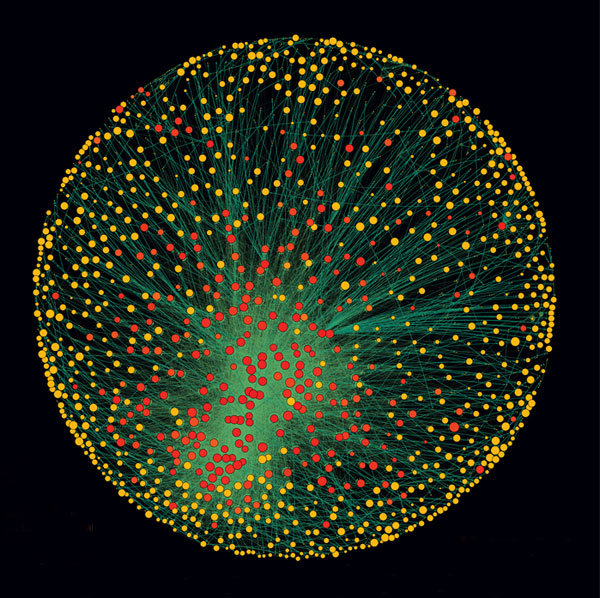
The picture above was produced by James Glattfelder et al  and shows the 1318 companies that dominate the global economy.  Studies by other complex systems theorists have also shown the vulnerabilities of complex systems with a high degree of concentration for systemic crises and collapse. The problem of concentration is what we really should be talking about, but what does Zizek suggest the OWSM and other critics of the current system do?
Zizek hopes the OWSM will focus on a clear goal such as universal health care. With that example he shows himself to be an old school statist, with the ultimate task of the OWSM to focus itself on asserting control over the state for the purpose of social justice. Social justice is a great end in itself,  but I think he misses what are the most amazing aspects of this movement which are 1) Its embodiment of participatory democracy, 2) The idea that networked groups can provide not just governance but social goods themselves, 3) Their international aspect, 4) Their critique of the current global economy as a system. What the OWSM shares with many “main-steam” Americans is not a desire for a more active state, but an innate suspicion of the state, and the perception that the system is not only rigged, but doesn’t really work- at least not for the majority. The reason the majority feel the system is broken is because of real-world concerns over unemployment and stagnant or falling living standards.
The question is whether or not falling living standards can be explained in terms of wealth concentration. That will be the subject of my next post…
Rick Searle
November, 13, 2011