City of the Sun

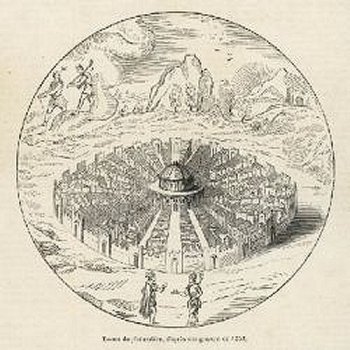
The City of the Sun is a utopia written by the Dominican Friar Tommaso Campanella.  Perhaps the most interesting feature of Campanella’s imaginary city is what might be called its architecture of knowledge. The city is made up of a number of walls upon each of which are inscribed all the knowledge of a particular set of sciences. On the outer wall are inscribed all the truths of mathematics, on the second metallurgy, geography, meteorology, the third botany, the next biology of fish, insects, reptiles, the one that follows the biology of large animals, then the mechanical arts, and finally history, war, philosophy, religion and law.

That Campanella’s divisions of knowledge are a little confusing makes perfect sense given that our current fields of inquiry had yet to really crystallize.  Yet, what should be clear is that he has imagined what is in effect an archive of all human knowledge from the least to the most complex. The architecture of his city itself is a storehouse of human knowledge and physically embeds all that we know. This is a little like the current Rosetta Disk project of the Long Now Foundation which attempts to create a store house of knowledge about human languages on a micro-disc.

Contrast Campanella’s City of the Sun with IBM’s current Smarter Cities project and one gets a feel for the revolution in our understanding of knowledge from Campanella’s time to our own. For him the new science, just being born when he imagined his ideal city, would soon discover all that was knowable. All of human knowledge could be inscribed on the walls of a small city. For us, knowledge is dynamic, expansive. The space granted by Campanella would unlikely be enough for even the most obscure specialty. IBM’s Smarter Cities imagines the knowledge center of a city not as a sort of library or museum, but as akin to the body’s central nervous or immune systems, capable of getting feedback from itself and responding to real time information regarding things like traffic, crime, social services, fire/disaster response, medical care, and education.

One might wonder what might happen to the “feedback” system of democracy if cities were ever effectively run by computers, but that is another question, for another time.

Apocalyptic Logic

The mounting tensions with Iran over its nuclear program are already bad enough if one had only real-world security issues and the eternal competitions between nations in mind.  The Iranians have very real reasons for wanting the bomb, top among them the fact that it seems to offer the only effective protection against America’s otherwise unstoppable power. This is the lesson they no doubt have learned from the contrasting cases of North Korea and Iraq/Libya where a lesser power has been able to deter American arms through the possession of nuclear weapons, whereas, the regimes of Iraq and Libya, having abandoned their nuclear programs were overthrown by the US and its allies.

The strategic reasons for the Israelis not wanting Iran to have the bomb are equally obvious. A nuclear armed Iran would indeed be the biggest strategic threat Israel has faced, and therefore, they reasonably will do everything possible to prevent Iran from developing atomic weapons. The Arab regimes similarly fear a nuclear armed Iran, and the US which ostensibly is committed to the defense of these regimes and Israel, fears the instability a nuclear Iran would bring to an already unstable region.

All sides in this dispute are therefore acting within the reasoned limits of national interest, though deeply conflicted interest they are, and it is already difficult to imagine the situation not being “resolved” by war, which, sadly, is far too often the final form of “negotiations” between states.

But to all this is also added a religious element, on both sides, that feeds belligerence and a distortion in the ability of  states to make rational decisions as to the question of whether or not to go to war.

An influential minority in the Iranian government, appear to be applying an apocalyptic logic to current events, and see in the threat of  war which would devastate the country,  instead the promise of the return of the promised 12th Imam, the Mahdi, of  the Shia branch of Islam, who will return after a period of tribulation to rule- alongside Jesus- and fill the world with justice.

Although Judaism , too, has a version of the end times, it is probably not the main root of the apocalyptic logic also driving Israeli policy. For what lies behind Jewish end of the world anxieties is the very real historical experience of near extinction in the Holocaust.  This fear of being totally destroyed as a people, this idea that any threat faced with courage and unyielding strength, is akin to a victory against evil itself, makes the Jewish polity find the normal condition of strategic competition between states unacceptable, and blinds it to the possibility of finding a permanent modus vivendi with countries in the region that are destined to not merely to be the equals of Israel, but the true, natural great powers of the Middle East.

On the American side, although only really so far as the Republicans are concerned, the influence of Christian fundamentalist, has turned Israel into a kind of sainted kingdom whose interests are of equal weight, indeed over-ride, the national interest of the United States.  For Christian fundamentalist, the existence of Israel is the key component in their own ideas regarding the end of days.  Israel will be the scene of world war and the emergence of world government under the Anti-Christ until the triumphant return of Christ. Judaism itself will, thereafter, be no more, with all of the “good” Jews converted to Christianity.

Some Christian fundamentalist (even a guy who has worked for the CIA)  see the Shia Madhi as a “mini” Anti-Christ who will bring the conditions for his more powerful successor to come. The countdown has begun.

All of this is, of course, crazy. And that’s the point. The strategic questions facing Iran, Israel and the United States are almost too complex and difficult to begin with, and added to all of it is the crazed logic of apocalypse.

Between conspiracy and protest

The US government launched a major crackdown on the group Anonymous today, arresting five of the group’s leaders. The charges could result in some of the leaders of the group serving up to 105 years in prison.

This is how the Washington Post characterized the arrests:

“This is the most important roll-up of hackers ever,” said Richard Stiennon, a cybersecurity analyst who has closely followed Anonymous.

Stiennon said that the arrests had instilled “distrust into Anonymous” and, as a consequence, the FBI may have “broken the back of the collective.”

Members of the group, and its sympathizers, were quick to point out that Anonymous was as much an idea as an organization, and that you can not destroy an idea, and well it may be. And yet, the successful prosecution of the men arrested today would certainly be a huge deterrent to the kind hackivism practiced by Anonymous and similar groups, which got me wondering if there would be any truly effective means of political protest left should the back of the group really be broken as Stiennon seems to hope.

For me, the question is whether or not the kinds of things credited to Anonymous count as political protest or something else?

Back in the late 1990’s I was doing research for a book that came to naught (though I did end up turning it into a short piece of historical fiction that I will post with this should I ever find it). I was researching a labor strike on the Pennsylvania canal in the early 1800s and reading  a lot of newspaper articles about the event from the time period. Thing is, they always referred to what we would call a strike as a “conspiracy”. Why was that?

It seems there had been an infamous legal case in Pennsylvania back in 1806 called Commonwealth vs Pullis that had ruled that a strike by a group of Philadelphia journeymen cordwainers amounted to a conspiracy against the owners of the factories in which they worked, and that society would collapse should the principle the strikers used to justify their actions ever be taken as universal. The ruling effectively made both unions and strikes illegal throughout the early years of the 19th century.

The prosecution’s case was that:

We charge a combination, by means of rewards and punishments, threats, insults, starvings and beatings, to compel the employers to accede to terms, they the journeymen present and dictate. If the journeymen cordwainers may do this, so may the employers; the journeymen carpenters, the brick-layers, butchers, farmers, and the whole community will be formed into hostile confederacies, the prelude and certain forerunner of bloodshed and civil war.

It now rests with the jury, under the direction of the court to say, whether we shall in future be governed by secret clubs, instead of the constitution and laws of the state; a verdict of not guilty, will sanction combinations of the most dangerous kind; a contrary verdict will give the victory to the known and established laws of the commonwealth.

No doubt, the US government’s case against Anonymous will argue similarly: that the actions of the group in no way represent legitimate political protests, and to argue otherwise would amount to inviting “cyber-chaos”.

Surely, if one looks over many of the actions credited to Anonymous many of them are juvenile, and perhaps even criminal. Yet, in an age in which elites hide behind security fortresses to shield themselves from public protests, and an amazing protest movement such as OWS can emerge overnight, only to disappear just as quickly, hacktivism, of the sort practiced by Anonymous is one of the few means of democratic protest that actually bite, which is the reason why the reactions by authorities has been so strong against groups like Wikileaks and Anonymous.

One wonders what leverage citizens will have should governments be able to treat all such actions, regardless of their political aspect, as conspiracies and sentence hacktivist to a century in prison.

Utopia Secular and Religious

Utopia scholars such as Ronald Schaer have argued that the concept of utopia, properly understood, is a secular one that originated in the early sixteenth century with Thomas Moore. Yet, as Schaer himself points out, the most powerful of 20th century utopian movements can not really be understood with out reference to the eschatological visions of the Judeo-Christian, and one should add Islamic, traditions

Indeed the worldly paradise predicted at the end of days ,and hoped for by elements these religions to a greater or lesser extent, is, even if we proceed with intellectual caution, more intimately connected with the political consequences of the idea of utopia than Schaer would have us believe. In many ways the most powerful of the secular utopian movements have borrowed so much from their religiously conceived predecessors as to be almost indistinguishable.

One might wonder where human agency has gone in religious utopianism, for underneath the secular version of utopia lies the humanist assumption that we can build the future. Yet, the most powerful secular utopian movements also seem to lack this quality of human agency, with some other entity serving the role once ascribed to God. For communists, utopia was to emerge through the deterministic forces of history, for Nazis through the war of nature, for the current Transhumanist/Sigularian movement the promises of religion- immortality, collective consciousness, omniscience are to emerge through the deterministic evolution of technology.

The difference between utopianism which wears the guise of religion in comparison to plain vanilla religion is that religious-utopianism promises the eminent arrival of a new and perfect world within the life-time of believers.  Religious utopianism points to a future state not a lost paradise at the beginning of human history. Lastly, whereas religion guides individual moral behavior, often for the purpose of obtaining happiness after death, the goals of religious utopianism are collective in character and serve as a guide to political action now.

The reason we should be paying close attention to utopia as religiously conceived is that, today, secular utopias are far less potent than religious ones, and failing to take heed of religious utopias blinds us to their very real capacity to effect the world in the here-and-now, rather than merely affect the state of human spiritually, or subsist as some ethereal hope for some promised land, far-off, at the “end of history”.

Utopian thinking continues to have a great hold on the human psyche, and utopian movements are one of the major forces guiding political action today. We should, therefore, try our best to understand them. In the immediate future, such an understanding would provide some insight when comes to the looming showdown with Iran- the subject of my next post.

In the birthplace of democracy

“The mortgage-stones that covered her, by me Removed, — the land that was a slave is free;
that some who had been seized for their debts he had brought back from other countries, where
— so far their lot to roam, They had forgot the language of their home;
and some he had set at liberty, — Who here in shameful servitude were held.”

                                                                                                                      SolonPlutarch’s Lives

When the history of the conflict between the market and democracy is someday written, the events in Greece this Sunday will almost certainly be seen as a major victory for market forces. There, the Greek parliament, under enormous pressure from the financial markets along with Germany and France committed what may amount to political suicide in the upcoming Greek elections. Members of the Greek parliament are willfully taking the country into what is in effect a deflationary induced depression in order to avoid the default and exit of Greece from the Euro-based economies.

Opposition to the draconian cuts necessary to secure funding support by bond holders, European governments and the ECB quite literally set Greece ablaze.

As in the ancient myth, Greek society is caught between Scylla and Charybdis.  Their only choices seem to be that of the chaos that would likely be the result of  a default, and a self-induced economic depression. The latter might prove preferable if it were likely to work in the long-run to restore, and  therefore secure the long term prosperity of Greece.  Such an outcome, is sadly unlikely.

The democratic process is now dictated by the electric speed of the international markets. Greek politicians were in a race against the clock before markets opened on Monday.

 Despite the German’s ridicule of the Greeks’ spendthrift ways, the Greek social system has its origins in the history of the country, which for decades endured brutal right-wing rule opposed only by a defiant left. The social-rights of Greeks were in effect the price to be paid for the left’s acceptance of the fact that Greece was to be a normal rather than a revolutionary country. Dismantling this system is a denial of history, and on par with the most utopian of top-down social transformations. Here the market is at war not just with democracy, but with history itself.

The German view of “lazy” Greeks also fails to take into account the very structural imbalances between Germany as an export economy and almost everybody else in Europe as playing a major contributing  role in the crisis. German exporters are greatly helped by the weakness of a currency they share with backward countries such as Greece. The Greeks get no such benefit, suffering a much stronger currency than would otherwise be the case. The real gain of Greece sharing a currency with mighty Germany has been Greek access to cheap debt. That is over now, and turned out to be not such a good thing, after all.

Rather than being isolated, the Greek crisis is symptomatic of the current state of capitalism, both globally and in Europe. As Robert D. Kaplan pointed out way back in 2009, as Greek riots were already starting to occur before the Arab Spring or Occupy Wall Street movements had even been imagined:

It’s tempting to dismiss this as a purely Greek affair that carries little significance to the outside world. But the global economic crisis will take different forms in different places in the way that it ignites political unrest. Yes, youth alienation in Greece is influenced by a particular local history that I’ve very briefly outlined here. But it is also influenced by sweeping international trends of uneven development, in which the uncontrolled surges and declines of capitalism have left haves and bitter have-nots, who, in Europe, often tend to be young people. And these young people now have the ability to instantaneously organize themselves through text messages and other new media, without waiting passively to be informed by traditional newspapers and television. Technology has empowered the crowd—or the mob if you will.

Likewise, a European Union that could have served to shelter the European social system from the relentless leveling of market forces has shown itself instead to be the most powerful instrument in the hands of such forces able to bring, despite the resistance of history, whole governments, and the societies upon which they rest to heel.

 ,

Psychobot

It is interesting… how weapons reflect the soul of their maker.

                  Don Delillo,  The Underworld

Singularity, or something far short of it, the very real revolution in artificial intelligence and robotics is already encroaching on the existential nature of aspects of the human condition that have existed for as long as our history.  Robotics is indeed changing the nature of work, and is likely to continue to do so throughout this century and beyond. But, as in most technological revolutions, the impact of change is felt first and foremost in the field of war.

In 2012 IEET Fellow Patrick Lin had a fascinating article in the Atlantic about a discussion he had at the CIA revolving around the implications of the robotics revolution. The use of robots in war results in all kinds of questions in the area of Just-War theory that have yet to even begun to be addressed. An assumption throughout Lin’s article is that robots are likely to make war more not less ethical as robots can be programmed to never target civilians, or to never cross the thin line that separates interrogation from torture.

This idea, that the application of robots to war could ultimately take some of the nastier parts of the human condition out of the calculus of warfare is also touched upon from the same perspective in Peter Singer’s Wired for War.  There, Singer brings up the case of Steven Green, a US soldier charged with the premeditated rape and murder of a 14 year old Iraqi girl.  Singer contrast the young soldier “swirling with hormones” to the calm calculations of a robot lacking such sexual and murderous instincts.

The problem with this interpretation of Green is that it relies on an outdated understanding of how the brain works. As I’ll try to show Green is really more like a robot-soldier than most human beings.

Lin and Singer’s idea of the “good robot” as a replacement for the “bad soldier” is based on a understanding of the nature of moral behavior that can be traced, as most things in Western civilization, back to Plato. In Plato’s conception, the godly part of human nature, it’s reason, was seen as a charioteer tasked with guiding chaotic human passions. People did bad things whenever reason lost control. The idea was updated by Freud with his ID (instincts) Ego (self) and Super-Ego (social conscience). The thing is, this version of why human beings act morally or immorally is most certainly wrong.

The neuroscience writer Jonah Lehrer in his How we Decide has a chapter, The Moral Mind, devoted to this very topic.  Odd thing is the normal soldier does not want to kill anybody- even enemy combatants. He cites a study of thousands of American soldiers after WWII done by  U.S. Army Brigadier General S.L.A Marshall.

His shocking conclusion was that less than 20 percent actually shot at the enemy even when under attack. “It is fear of     killing” Marshall wrote “rather than fear of being killed, that is the most common cause of battle failure of the individual”. When soldiers were forced to directly confront the possibility of directly harming another human being- this is a personal moral decision- they were literally incapacitated by their emotions. “At the most vital point of battle”, Marshall wrote, “the soldier becomes a conscientious objector”.

After this study was published, the Army redesigned it’s training to reduce this natural moral impediment to battlefield effectiveness. “What was being taught in this environment is the ability to shoot reflexively and instantly… Soldiers are de-sensitized to the act of killing until it becomes an automatic response. pp. 179-180

Lehrer, of course, has been discredited as a result of plagiarism scandals, so we should accept his ideas with caution, yet, they do suggest what already know that the existential condition of war is that it is difficult for human beings to kill one another, and well it should be. If modern training methods are meant to remove this obstruction in the name of combat effective they also remove the soldier from the actual moral reality of war. This moral reality is the reason why wars should be fought infrequently and only under the most extreme of circumstances. We should only be willing to kill other human beings under the most threatening and limited of conditions.

The designers of  robots warriors are unlikely to program this moral struggle with killing into their machines. Such machines will kill or not kill a fellow sentient beings as they are programmed to do. They were truly be amoral in nature, or to use a loaded and antiquated term, without a soul.

We could certainly program robots with ethical rules of war, as Singer and Lin suggest. These robots would be less likely to kill the innocent in the fear and haste of the fog of war. It is impossible to imagine that robots would commit the horrible crime of rape, which is far too common in war. All these things are good things. The question for the farther future is, how would a machine with a human or supra-human level of intelligence experience war? What would be their moral/existential reality of war compared to how the most highly sentient creatures today, human beings, experience combat.

Singer’s use of Steven Green as a flawed human being whose “hormones” have overwhelmed his reason, as ethically inferior to the cold reason of artificial intelligence which have no such passions to control is telling, and again is based on the flawed Plato/Freud model of the conscience of human beings.  A clear way to see this is by looking inside the mind of the rapist/murderer Green who, before he had committed his crime had been quoted in the Washington Post as saying:

I came over here because I wanted to kill people…

I shot a guy here when we were out at a traffic checkpoint, and it was like nothing. Over here killing people is like squashing an ant. I mean you kill somebody and it’s like ‘All right, let’s go get some pizza’.

In other words, Green is a psychopath.

Again we can turn to Lehrer who in describing the serial killer John Wayne Gacy:

According to the court appointed psychiatrist, Gacy seemed incapable of experiencing regret, sadness, or joy. Instead his inner life consisted entirely of sexual impulses and ruthless rationality. p.169

It is not the presence of out of control emotions that explain the psychopath, but the very absence of emotion. Psychopaths are unmoved by the very sympathy that makes it difficult for normal soldiers to kill. Unlike other human beings they show no emotional response when shown depictions of violence. In fact, they are unmoved by emotions at all.  For them, there are simply “goals” (set by biology or the environment) that they want to achieve. The means to those goals, including murder, are, for them, irrelevant. Lehrer quotes G.K. Chesterson:

The madman is not the man who has lost his reason. The madman is the man who has lost everything except his reason.

Whatever the timeline, we are in the process of creating sentient beings who will kill other sentient beings, human and machine, without anger, guilt, or fear. I see no easy way out of this dilemma, for the very selective pressures of war, appear to be weighted against programming such moral qualities (as opposed to rules for who and when to kill) into our machines.  Rather than ushering in an era of “humane” warfare, on the existential level, that is in the minds of the beings actually doing the fighting, the moral dimension of war will be relentlessly suppressed. We will have created what is in effect, an army of psychopaths.
Of drones and democracy

P.W. Singer has a fascinating article in last Sunday’s edition of the New York Times about the implications of the current robotics revolution in warfare for democracy.

Singer’s reputation of someone who asks the hard questions (and asks them first) about war was gained in his studies of the rise of privatized warfare  and the increasing use of children in warfare.  On both of those issues, Singer was among the first to correctly identify disturbing trends. His perspective shows little ideological bent, merely the search for truth. On these issues he was almost a lone voice crying in the wilderness, as he is in bringing to our knowledge the troubling questions being brought about as the revolution in computer technology and robotics finds itself increasing applied to war. His goal, as always, appears to be to reveal the obvious trends in front of us to which we are blind, and in doing so start a conversation we should already be having.

I think a short review of Singer’s Wired For War  is in order, so that his N.Y. Times article can be seen in its full context.  In that book Singer takes readers on a wild ride through the current robotics revolution in warfare. He sees our era as akin to WWI when new technologies like the tank and airplane were thrown into the field, but no one new yet how to actually use them. (224)

The military now funds over 80% of American spending on artificial intelligence. Much of this funding flows through the Defense Advanced Research Agency (DARPA).  Joel Garreau of the Washington Post SAYS the mission of DARPA “is to accelerate the future into being”. (78)

Not only the US Army, but also the Navy and Airforce (which wants 45% of its bomber fleet to be composed of unmanned vehicles) are rushing to develop unmanned systems. Some of these systems seem straight out of science-fiction, whether swarming insect sized robots or super-sized planes able to stay aloft for months or even years.  (117-118).

Many of the new robots resemble animals, such as a robotic dog .

What does all of this have to do with democracy?

In his article, he makes the point, that increasingly, the US is relying on its advantage in military technology, the most famous of which, are the use of unmanned drones, to wage, what is in effect a constant war, with out the democratic oversight and control that is supposed to be the job of our elected representatives in the Congress. The biggest cost in war, the lives of citizens, no longer at risk, the American government can wage war on terrorist targets throughout the world with seeming impunity.

As a prime example, he cites the recent US military action in Libya.

Starting on April 23, American unmanned systems were deployed over Libya. For the next six months, they carried out at least 146 strikes on their own. They also identified and pinpointed the targets for most of NATO’s manned strike jets. This unmanned operation lasted well past the 60-day deadline of the War Powers Resolution, extending to the very last airstrike that hit Colonel Qaddafi’s convoy on Oct. 20 and led to his death.

Choosing to make the operation unmanned proved critical to initiating it without Congressional authorization and continuing it with minimal public support. On June 21, when NATO’s air war was lagging, an American Navy helicopter was shot down by pro-Qaddafi forces. This previously would have been a disaster, with the risk of an American aircrew being captured or even killed. But the downed helicopter was an unmanned Fire Scout, and the story didn’t even make the newspapers the next day.

Singer’s conclusion:

We must now accept that technologies that remove humans from the battlefield, fromunmanned systems like the Predator to cyberweapons like the Stuxnet computer worm, are becoming the new normal in war.

And like it or not, the new standard we’ve established for them is that presidents need to seek approval only for operations that send people into harm’s way — not for those that involve waging war by other means.

WITHOUT any actual political debate, we have set an enormous precedent, blurring the civilian and military roles in war and circumventing the Constitution’s mandate for authorizing it. Freeing the executive branch to act as it chooses may be appealing to some now, but many future scenarios will be less clear-cut. And each political party will very likely have a different view, depending on who is in the White House.

America’s founding fathers may not have been able to imagine robotic drones, but they did provide an answer. The Constitution did not leave war, no matter how it is waged, to the executive branch alone.

In a democracy, it is an issue for all of us.

The Dispossessed

The State recognizes no coinage but power: and it issues the coins itself. 

(240)

I just finished The Dispossessed, a 1974 novel by Ursula K. Le Guin. This wonderful book tells the story of an “ambiguous” anarchist utopia. Though written during a period much different from our own, The Dispossessed  might have lessons for us today, especially for those in the OWS movement whose political philosophy and hopes represent what might be seen as a triumph of anarchism.

The novel is set on the anarchist colony on the moon of Anarres, founded as a breakaway settlement of a movement called Odonianism- a moral and political philosophy created by Odo a woman who railed against the capitalist system of Urras, the rich and beautiful mother planet.  The two worlds under “The Terms of the Closure of the Settlement of Anarres” have interactions limited to a space freighter that exchanges necessities between them 8 times a year. There is a “wall” between Anarres and Urras, and it is the efforts of the protagonist of The Dispossessed,  a brilliant physicist named Shevek to brake down this wall between worlds that form the essence of the story.

Without doubt, Odonianism has created a moral utopia. The inhabitants of Anarres, constantly subject to a harsh climate and in constant danger of scarcity and famine, are bound together tightly and suffer continuously for one another. The needs of the whole community come before all others, even those of family. As Shevek and his loved partner Takver separate in the name of the needs of the community.  Anarres is an organic community that in the words of Shevek arguing with a Urratzi social Darwinist:

Yes, and the strongest, in the existence of any social species are those who are the most social. In human terms the most ethical. (195)

The people of Anarres have no real government, though it can not really be said that they have politics either. Like Saint-Simon had suggested, without the class war endemic to the state, politics would become the mere “administration of things”.  A series of councils/syndicis make important decisions such as the allocation of work (though an individual is always free to refuse to go where a work syndic requests.  To my ears, these councils sound much like the “working groups” of the OWSM each tasked with a very particular need or goal of the movement. On Anarres they are a place where rotation and openness to debate mask the fact that they can be manipulated for political ends such as the machinations of the scientist Sabul who uses his ability to control the flow of information between Anarres and Urras, and even to control the publication of scientific papers to use the brilliance of Shevek for his own advantage, and take credit for what is mostly Shevek’s work.

It is this ability and desire to control the flow of knowledge and insight (including the insight brought by travelers from other worlds) whether stemming from the flawed human condition of someone like Sabul, or the tyranny of the majority implicit in an egalitarian society, that is the sin of Anarres. For, when combined with an internalized moral code that commands them not to be egoist, the Anarrresti are unable to express their own individual genius. Whether that be in a case like Shevek’s where he is constantly thwarted from constructing a theory that would allow faster- than- light communication, and therefore the enable the strong connection of interstellar peoples to become possible, or the comedy of a non-conformist playwright, such as Tirin, who writes a play about a comic character coming from Urras to Anarres. This suffocation of the spirit of the soul is the primary, and growing, flaw of Odo’s utopia.  As Shevek says:

That the social conscience completely dominates the individual conscience instead of striking a balance with it. We don’t cooperate –we obey. (291)

In an effort to break free from the control of knowledge, Shevek and those around him set up a printing syndicate of their own. This syndicate eventually starts communicating with the outside, with the Urratzi, which ultimately results in the ultimate attempt to breakdown walls- Shevek’s visit to Urras itself.

The capitalist nation of A-Io invites Shevek out of the belief that he is on the verge of discovering a unified theory of time which they will profit from.  Shevek’s journey is a disaster. What he discovers on Urras is a beautiful yet superficial world built on the oppression of the poor by the rich. Not surprising for the time period the novel was written, a Cold War rages between capitalist A-Io and the authoritarian communist nation of Thu. The two-powers fight proxy wars in less developed nations. When the poor rise up to protest the rich in A-Io they are brutally massacred, and Shevek flees to the embassy of the planet Earth. The ambassador of earth shelters Shevek, but expresses her admiration for Urras, with the civilization on earth having almost destroyed itself. Explains the ambassador:

My world, my earth is a ruin.  A planet spoiled by the human species. We multiplied and gobbled and fought until there was nothing left and then we died…

But we destroyed the world first. There are no forest left on my earth. The air is grey, the sky is grey, it is always hot.

She admires Urras for it’s  beauty and material abundance, which has somehow avoided environmental catastrophe. She does not understand the moral criticism of Shevek- a man from a desert world of scarcity, and famine.

Earthlings were ultimately saved by an ancient, sage like people the Hainish. They return Shevek to Anarres, along with a member of the Hainish that wants to see the world anarchist have built. The walls Shevek sought to tear down continue to fall…

What might some of the lessons of this brilliant novel be for our own times? Here are my ideas:

1) For the OWSM itself: that the “administration of things” always has a political aspect. That even groups open to periodic, democratic debate are prone to capture by the politically savvy, and steps make sure they remain democratic need to be constant.

2) One of the flaws of Le Guin’s view of utopia is that it seems to leave no room for democratic politics itself.  Politics, therefore can only be in the form of manipulation (Sabul) or rebellion (Shevek) there is no space, it seems, for consensual decision making as opposed to a mere right to debate and be heard.

3) There is a conflict between the individual (the need for creativity, love of family) and the needs of the community that is existential and cannot be eliminated by any imaginable political system. The key is to strike the right balance between the individual and the community.

4) That the tyranny of the majority is a real danger for any consensus based community and not just a mere bogeyman of conservative forces.

5) The most important thing we can do to preserve the freedom of the individual and health of the community is to keep the lines of communication and connection open. That includes openness to the viewpoints of ideological rivals.

All quotes from: The Dispossessed, An Ambiguous Utopia, Ursula K. Le Guin, Harper and Row, 1974

The Future of Freedom and Tyranny

Cory Doctorow delivered a fascinating talk  at the Chaos Communication Congress . Doctorow is an incredibly engaging speaker, and I suggest you really take sometime to sit down and watch it. My take away on it is this:  In this talk he makes the claim that the current copyright wars are but the opening chapter of a “century- long struggle” regarding the freedom of information, of which SOPA, and PIPA are mere opening skirmishes, that is to be fought out by forces against some element of that freedom trying to do away with general purpose computation machines. What does he mean? As I take it corporate and political interest have what will only be an increasing desire to diminish the “hackability” of the information exchanging devices and software we use. So that a computer company might, for instance, want to create the ability to monitor and erase pirated software on my computer. A government might want to be able to monitor people engaged in criminal activity, a power which, when taken to an extreme, might see a tyranny only allowing software or hardware to be sold with extensive surveillance capabilities in its borders. This is, of course, what is known as “spy-ware” and Doctorow sees corporate and government efforts to control information to increasingly be in the form of “spy-ware”.

Doctorow briefly touches on the extension of this conflict between the freedom and control  to new forms of hacking such as 3D printing or DIY biology. As he admits general purpose computation may result in things that “freak even me out”, but he nevertheless appears to think we should always lean more in the direction of freedom than control.

There are is a question I wish I would have been able to ask  Doctorow directly, so asking it here will have to suffice.  My question relates to what might be called the inevitability of efforts to control information, and the ultimate source of such legislation.

One of his listeners pointed out how regulation of the internet might ultimately resemble the laws of the sea with pockets of control and pockets of freedom. Doctorow responded that the analogy was inaccurate. The internet was an interdependent network in a way that the oceans, where something happening in the middle of the Pacific might have no effect elsewhere, is not.

My question is this: if some attempt (a very likely to fail attempt) at governance of the open information system we now possess is inevitable, wouldn’t it be a good idea to try and see if the very liberating and democratic potential of that system was used to provide that governance rather than fight for a kind of perfect freedom of information and hackability?

As Paddy Ashdown recently pointed out one of the features that make our era unique is the dis-junction between the power of the nation-state and the international nature of our problems, that we have yet to evolve institutions, not of world government, but international governance. Attempts , even failed attempts, at such governance their certainly will be as institutions emerge to fill this power vacuum. As Doctorow points out, this is now beginning to be done by secretive, non-democratically accountable institutions such as The Trans-Pacific Strategic Partnership   and ACTA.

A clear example might help better explain my question. I wish Doctorow would have mentioned his thoughts the recent request by the National Science Advisory Board for Bio-security that scientist not publish recent work on the evolveability of the bird flu to a form that would be pandemic in humans for fear that it might be used by terrorists. No doubt, this is but the first of many cases, and not just involving security, but primarily posing deep ethical questions, such as the crazy planet of the apes scenario that a group of British scientist recently warned about. Certainly, in addition to questions of security and crime, there will be the desire and efforts to control the hackability of life, even our own personal selves, on ethical grounds.

What I really want to know, is if knowledge, and even more importantly technological and genetic practice,  is bound to be regulated, then can we construct democratic mechanisms to do it which avoids the problems of the tyranny of the majority, is not motivated by a hysterical fear of technology, and bridges the gap between expert knowledge and common understanding?  That is the question of the century.

Machines Rule!

Science Fiction writers, who are perhaps the only group of thinkers taking these questions seriously, usually assume that the era when artificial intelligence rules over human-societies will only arrive after AI achieves human level intelligence or greater. But there is perhaps a way in which AIs already rule, long before they have reached such a level.

JP Morgan recently won the prize for ‘Most Cutting Edge IT Initiative’ at the American Financial Technology Awards 2011. It won this award on the basis of taking end of day risk calculations down from eight hours to 238 seconds. According to its backers, the continued use of super-computers for financial trading will allow the company to:

to minimise its risk and respond more effectively than its competitors to rapidly changing marketing conditions, particularly the financial turmoil in Europe,” said John Barr, research director of financial markets and head of EU research at the 451 Group.

JP Morgan is not alone in its quest to use Teraflop performing computers, fiber-optic networks and black box algorithms to seek to master the financial markets. Kevin Slavin, the founder of the gaming company Area/Code, of all things, gave a beautiful TED Talk in which he discusses the power of algorithms in our world (and not just the financial world).  In that talk, Slavin points out how computer based trading, so called black box or algo trading now comprises 70% of the US stock market- in other words 70% of stock market transaction are now decided by not just mediated through computers.

Black box trading puts a premium on speed, and so Slavin points out how this has led to the strange phenomenon of whole buildings in the heart of Manhattan being hollowed out and filled with computer servers for the advantage of a few nano-seconds. By far the biggest existent absurdity is an an 825 mile trench dug over the last several years to house fiber-optic cables linking Chicago and New York. As Slavin points out, a massive project of terraforming in the name of a slice of time unperceivable by human being, which portends other transformations of even greater scale. His argument is hammered home by recent plans to build a trans-Atlantic fiber optic cable that will cost 400 billion and save traders a whopping 5 milliseconds.

David Brin has a great article on what might be called an ecological understanding of such high speed trading. He compares financial algorithms to parasites.

Want the exact parallel in nature for these systems? It is those gut parasites or e-coli or salmonella, or Typhus, who nibble away the gradient of potential profit that the human trader perceives, between the current asking price and what he or she feels the stock may soon be worth.  These programs can now detect people getting ready to buy a stock they like, and pounce to snap it up first, then offering it to you at just a little higher price. You lose a bit of that gradient, because someone – a program – who did none of your research simply pounced faster than you ever, possibly could.

His solution to this problem is the imposition of a very small Tobin-Tax that would slow trading down to be closer to the level of “human-thought”. So far, so good.

The problem begins when Brin, by suggesting that the kind of super-conscious and dangerous AI, which is the persistent bogey-man of Sci-Fi writers, might emerge from such civilian rather than military sources,  looses sight of the brilliant argument he had been making. For super-computed algorithms need never be as smart as us to “gain control”. They might in fact be given control without ever evolving beyond the level of an extremely efficient and rapidly evolving virus. For, if 70% of the market is now controlled by algorithms, and financial markets are increasingly more powerful than democratic politics, then the machines, in some sense already rule. Something which would indeed have come, as Brin points out, as a “surprise”.

Replace the words markets with algorithms in the comments below by historian of democracy Mark Mazower and you should see what I mean.

MAZOWER: Part of this, I think, is because of the timeframe that we are now becoming accustomed to. If we are in an age in which the markets rule and the markets are not the trading and commodities markets, but they are the financial markets, then the politicians feel that they have to respond to everything in seconds and minutes. And so, part of this is a tussle between how important decisions will be made. Will they be made by the market and on the basis of the ribbons dictated by the market, which is to say extraordinarily short-term and fluctuating?

Or will they remain in the hands of the politicians and those people who elected the politicians?

SIEGEL: You mean that the nature of European democracy is actually at stake in this process of trying to deal with the financial crises?

MAZOWER: European democracy is not under threat. I don’t see alternatives of the kind that existed in the early 20th century to democracy. I discount those. But the extent to which politics remains an area for autonomous decision-making, that is very much up for grabs or will politicians simply be driven by their anxiety about the markets and how the markets will respond to this or that measure? And that is where, it seems to me, that the Franco-German axis has its interest. Because, whether or not you see Sarkozy and Merkel acting in a particularly democratic manner, they are acting as politicians in the name of the state to preserve a political enterprise.

The grand struggle, seems to me, markets versus politics. And then how democratic that politics is, well, that’s the question we have to think about.

The, one might say, almost algorithmic logic of it all appears to be this: Our financial markets are evermore dominated by a myriad of machines without self-consciousness or human-level intelligence. This machine-run market is increasingly at odds with our own democratic self-governance, and has, throughout the financial crisis, been proven to be more powerful than our democratic institutions. In other words, the machines, in a sense, already rule.